CAD Services Sydney | In-House & Secondment Engineering Support

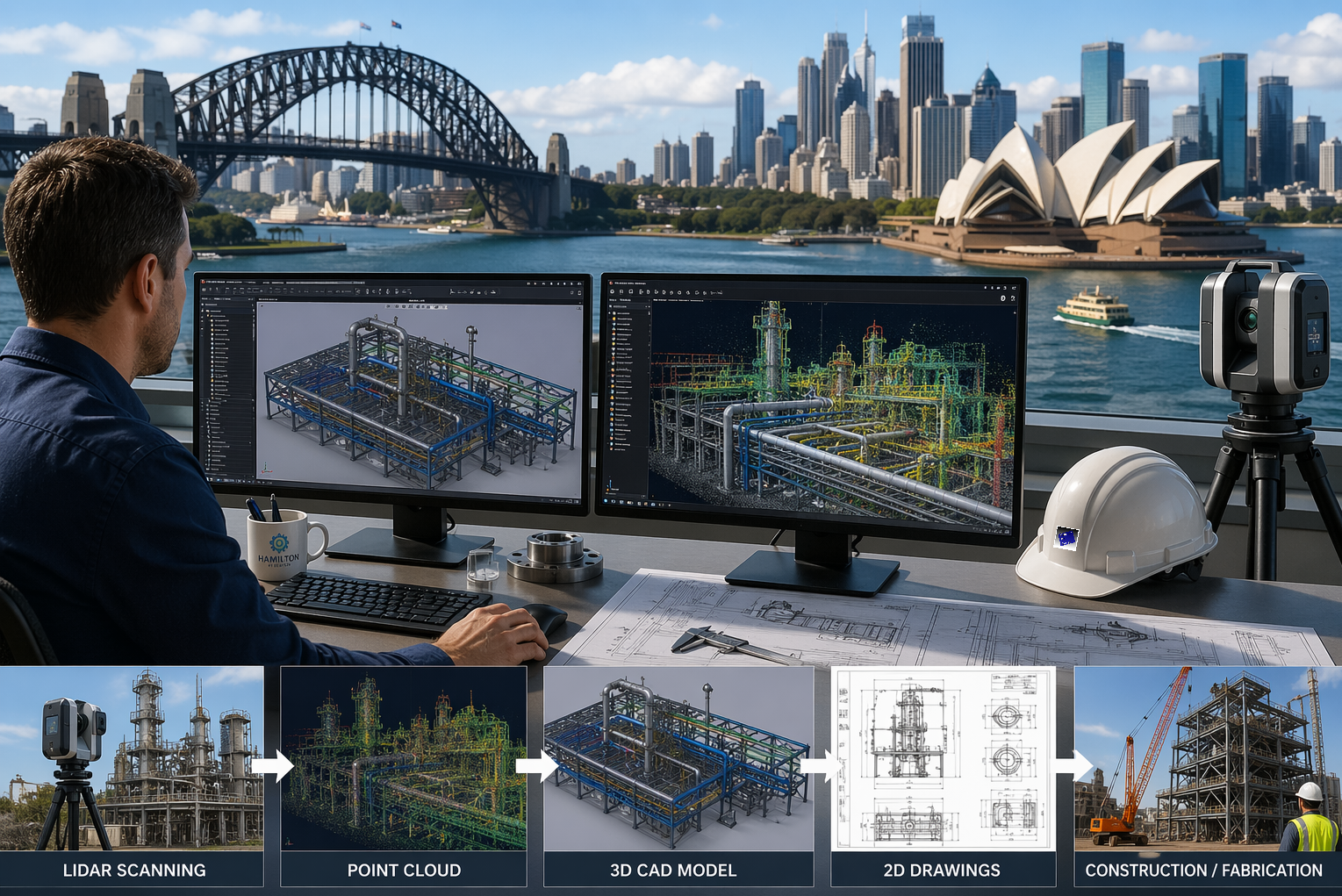
Engineer developing 3D CAD model from LiDAR point cloud data with Sydney Harbour in background

Professional CAD Services in Sydney

When it comes to CAD services in Sydney, the difference is not just capability โ€” itโ€™s how that capability is delivered.

At Hamilton By Design, we provide both:

  • In-house CAD services (fully managed delivery)
  • Secondment CAD services (embedded within your team)

This gives you the flexibility to choose the right approach for your project โ€” whether you need a complete outsourced solution or direct support within your team.

3D LiDAR scanning and 3D modelling service button โ€” laser scanner capturing a point cloud for engineering and CAD modelling
Mechanical engineering services

In-House CAD Services (Fully Managed Delivery)

Our in-house CAD services are designed to deliver complete, end-to-end outcomes.

We manage:

  • Scope definition
  • CAD modelling and drafting
  • Engineering review and quality control
  • Final deliverables ready for fabrication or construction

This approach is ideal for:

  • Defined project scopes
  • Drawing packages
  • Scan-to-CAD modelling
  • Brownfield upgrades with clear deliverables

Secondment CAD Services (Embedded Support)

For projects requiring closer collaboration, we offer Secondment Services:
https://www.hamiltonbydesign.com.au/home/secondment-services/

This allows our engineers and designers to:

  • Work directly within your systems and processes
  • Integrate with your project teams
  • Support shutdowns and peak workloads
  • Provide continuity across design and execution

Secondment is ideal for:

  • Long-term projects
  • Multi-vendor environments
  • Ongoing plant upgrades
  • Internal resource gaps

3D CAD Modelling Australia service banner for Hamilton By Design

Engineering-Led CAD โ€” Not Just Drafting

Whether delivered in-house or through secondment, our CAD services are always engineering-led.

We focus on:

  • Constructability
  • Real-world constraints
  • Alignment with Australian standards
  • Practical, buildable outcomes

Our CAD Services in Sydney

2D Drafting & Drawing Development

  • General Arrangement (GA) drawings
  • Layout drawings for engineering proposals
  • Sections, elevations, and details
  • Drawing revisions and updates

3D CAD Modelling

  • SolidWorks mechanical modelling
  • Plant and equipment modelling
  • Structural and pipework modelling
  • Simplified coordination models

Point Cloud to CAD (Scan-to-Model)

  • Conversion of LiDAR scans (.E57, .RCP, .LAS)
  • Accurate as-built modelling
  • Critical for brownfield and retrofit projects

Built for Brownfield Projects

Sydney projects are typically brownfield, not greenfield.

We specialise in:

  • Retrofit design
  • Existing plant modifications
  • Clearance verification
  • Working with incomplete or outdated drawings

Delivery can be:

  • Fully managed in-house, or
  • Supported through secondment

LiDAR Scanning Integration

Our CAD services integrate with engineering-grade LiDAR scanning, ensuring designs are based on real-world data rather than assumptions.

This results in:

  • Accurate as-built models
  • Reduced rework
  • Improved design confidence

Drawing Control & Engineering Governance

We also support:

  • Revision control (IFR / IFA / IFC)
  • Drawing registers and version tracking
  • Cloud-based access via 3DEXPERIENCE
  • 24/7 access to current drawings

This can be delivered as a managed service or integrated through secondment.


From Scan to Fabrication

Our workflow:

Scan โ†’ Model โ†’ Detail โ†’ Review โ†’ Build

Delivered either:

  • In-house by our team, or
  • Embedded within your team via secondment

Get Started with CAD Services in Sydney

Whether you need:

  • A complete CAD package
  • Additional resources embedded in your team
  • Or a hybrid approach

Hamilton By Design delivers flexible, engineering-driven CAD services in Sydney.

Learn more about our Secondment Services:

Our clients

Talk to Us – Contact Us
Name
Would you like us to arrange a phone consultation for you?
Address
3D Scanning Sydney banner promoting engineering-grade 3D laser scanning, LiDAR scanning, and reality capture services by Hamilton By Design.
Mechanical Engineering Sydney banner with white text on a blue background representing Hamilton By Design's mechanical engineering services in Sydney.
Mechanical Drafting and 3D Modelling Sydney banner highlighting Hamilton By Design's CAD drafting, 3D modelling, and engineering design services in Sydney.


Mechanical Engineering | Structural Engineering


Hamilton By Design provides engineering-led 3D scanning, LiDAR scanning, mechanical engineering and digital engineering services throughout Sydney and Greater Sydney.

Explore our related Sydney services:


  • 3D Scanning Sydney โ€“ Engineering-grade terrestrial laser scanning, as-built surveys and point cloud capture for industrial, infrastructure and commercial projects.
  • Reality Capture Sydney โ€“ High-accuracy reality capture, digital twins, asset documentation and engineering-grade site verification.
  • Scan to CAD Sydney โ€“ Convert point cloud data into AutoCAD, SolidWorks, Inventor and other engineering-ready CAD deliverables.
  • Point Cloud Modelling Sydney โ€“ Engineering-grade point cloud processing, clash detection, as-built verification and 3D modelling.
  • Mechanical Engineering Sydney โ€“ Mechanical design, plant upgrades, materials handling systems, conveyors, chutes, platforms and engineering support.
  • Structural Drafting Sydney โ€“ Structural steel drafting, fabrication drawings, GA drawings, workshop detailing and as-built documentation.

Hamilton By Design supports projects throughout Sydney CBD, Parramatta, Liverpool, Penrith, Blacktown, Chatswood, Alexandria, Mascot, Newcastle and the Central Coast.


Blue banner graphic displaying the text "Point Cloud to CAD - Australia" in large white lettering, representing point cloud processing, scan-to-CAD conversion and digital engineering services across Australia.
Blue banner graphic displaying the text "Scan to CAD Sydney" in large white lettering, representing engineering-led point cloud to CAD conversion, LiDAR scanning and digital engineering services in Sydney.
Blue banner graphic displaying the text "Reality Capture Sydney - CBD" in large white lettering, representing engineering-led reality capture, LiDAR scanning and digital engineering services within Sydney CBD commercial buildings and infrastructure.

Brownfield Costโ€“Benefit: Engineering Design vs Continuous Navisworks Model Maintenance

Executive Summary

In brownfield projects, the highest return comes from applying engineering design effort at the point of change, supported by accurate point cloud data, rather than continuously updating a federated model.

The practical reality is:

Invest in engineering decisions, not in maintaining a model that becomes outdated faster than the plant changes.


3D LiDAR scanning and 3D modelling service button โ€” laser scanner capturing a point cloud for engineering and CAD modelling
Mechanical engineering services

Two Approaches

1. Model Maintenanceโ€“Centric (Navisworks)

Using Autodesk Navisworks Manage as an ongoing platform:

  • Maintain a full federated model
  • Update after every site change
  • Re-run coordination and clash detection
  • Manage model alignment across disciplines

2. Engineering-Driven (Point Cloud + Targeted CAD)

Using:

  • FARO SCENE
  • SOLIDWORKS eDrawings
  • Capture and retain point cloud data as the primary asset
  • Model only what is being modified
  • Use CAD and drawings for fabrication and communication

Cost Drivers

Navisworks Model Maintenance

  • Initial model creation and federation
  • Continuous updates after modifications
  • Data conversion and reprocessing
  • Coordination meetings and clash resolution
  • Ongoing QA and model validation

Additional hidden costs include:

  • Model drift corrections
  • Rework due to mismatch with site conditions
  • Reliance on a limited number of trained users

Engineering-Driven Workflow

  • Targeted scanning where required
  • Point cloud processing and validation
  • Engineering design effort for modifications
  • Drawing and component model production

Additional benefits include:

  • Reusable scan data
  • No requirement to maintain a full plant model
  • Faster response to site-driven changes

3D CAD Modelling Australia service banner for Hamilton By Design

Benefit Comparison

Navisworks model maintenance offers strong upfront coordination, particularly in greenfield projects, but suffers from degradation over time and high ongoing cost.

Engineering-driven workflows using point cloud data provide higher long-term accuracy, faster turnaround for small changes, and better alignment with real site conditions.


Line-of-Sight Reality

Point cloud data is inherently line-of-sight dependent. This means:

  • Only visible surfaces are captured
  • Occlusions result in gaps in the dataset

This limitation exists regardless of software platform.

Importing a point cloud into Navisworks does not improve data completeness or accuracy โ€” it simply presents the same data in a different environment.


Practical Example

For a minor electrical upgrade:

Navisworks Approach

  • Update the federated model
  • Re-run coordination
  • Issue revised model
  • Proceed with installation

This introduces significant overhead for a simple task.


Engineering Approach

  • Review point cloud or site conditions
  • Confirm clearances
  • Design locally
  • Install
  • Update drawings if required

This approach is faster, lower cost, and aligned with how work is actually executed.


Where Navisworks Adds Value

Navisworks remains effective when:

  • Multiple disciplines are designing simultaneously
  • Large-scale coordination is required
  • Clash detection is critical

This typically applies to:

  • Greenfield projects
  • Major brownfield upgrades

It should be treated as a project-phase coordination tool, not a long-term data management system.


  • Use point cloud data as the primary reference
  • Maintain raw and registered datasets (e.g. E57)
  • Model only critical interfaces and new work
  • Use drawings for formal deliverables
  • Apply Navisworks selectively where coordination is required

Final Position

In brownfield environments, value is created through engineering design and decision-making, not through continuous model maintenance.


One-Line Summary

Design what youโ€™re changing. Scan what youโ€™re keeping. Donโ€™t model what you wonโ€™t maintain.

Our clients

Talk to Us – Contact Us
Name
Would you like us to arrange a phone consultation for you?
Address
CHPP Engineering title graphic featuring bold white text reading "CHPP Engineering" centred on a blue rounded rectangle background.
Pipework Drafting title graphic featuring bold white text reading "Pipework Drafting" centred on a blue rounded rectangle background.
3D LiDAR Scanning for Engineering Projects title graphic featuring bold white text on a blue rounded rectangle background.

Wearable 3D Scanners vs Engineering-Grade LiDAR

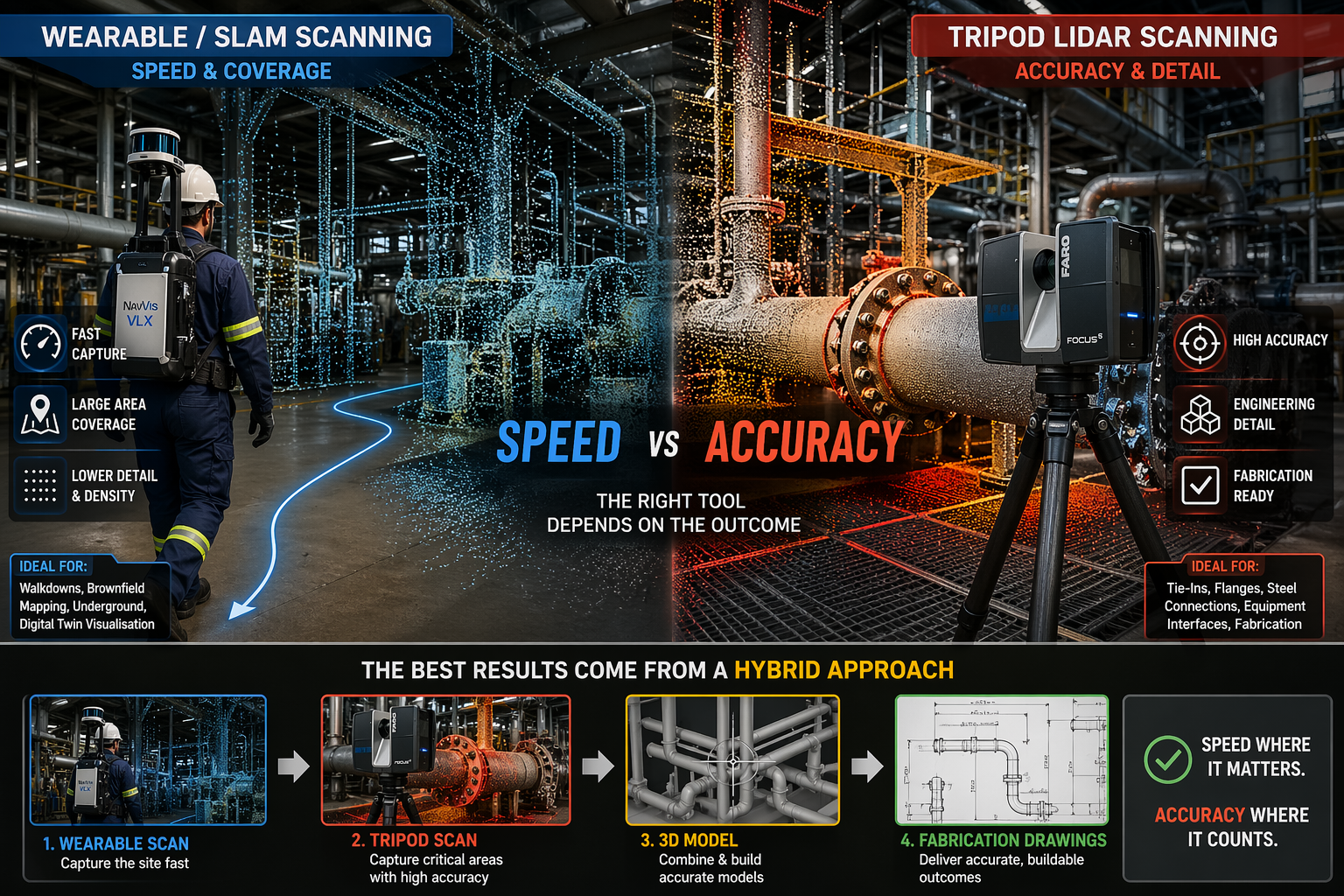
Wearable SLAM lidar scanner compared with tripod laser scanner in an industrial plant showing speed versus accuracy in point cloud data

Wearable 3D Scanners vs LiDAR | Engineering Accuracy Explained

Why Speed Doesnโ€™t Always Mean Accuracy in Industrial Scanning

Blue 3D LiDAR scanner icon on a tripod with scanning waves

Wearable 3D scanning systems โ€” often referred to as backpack or body-mounted LiDAR scanners โ€” are becoming increasingly common across mining, construction, and industrial environments.

These systems allow an operator to walk through a site and capture data in real time, significantly reducing time spent in the field.

However, while speed has improved, an important question remains:

Are wearable scanners suitable for engineering and fabrication work?

At Hamilton By Design, we take an engineering-led approach to scanning. The answer is not as simple as many vendors suggest.


3D LiDAR scanning and 3D modelling service button โ€” laser scanner capturing a point cloud for engineering and CAD modelling
Mechanical engineering services

What Are Wearable 3D Scanners?

Wearable scanners, also known as SLAM LiDAR systems, are designed to be worn while walking through a site.

They typically use a combination of:

  • LiDAR sensors
  • Cameras
  • Inertial Measurement Units (IMU)
  • SLAM (Simultaneous Localisation and Mapping) algorithms

This allows the system to generate a continuous 3D point cloud without the need for tripod setups or survey targets.

In simple terms, the operator becomes the scanner.


The Key Advantage: Speed

The main advantage of wearable systems is speed.

They allow for:

  • Rapid site capture
  • Minimal setup time
  • Scanning of complex or confined environments
  • Efficient coverage of large areas

For walkdowns, site familiarisation, and early-stage layouts, wearable scanning is highly effective.


The Trade-Off: Accuracy and Detail

While wearable systems offer speed, they come with trade-offs.

Wearable SLAM scanners typically produce:

  • Lower point density
  • Reduced edge definition
  • Positional drift over longer distances

In contrast, traditional terrestrial LiDAR scanners provide:

  • High-density point clouds
  • Sharp and well-defined geometry
  • Millimetre-level accuracy
  • Repeatable and verifiable results

Why This Matters for Engineering

In industrial environments, scan data is not just for visualisation. It is used for:

  • Design modelling
  • Clash detection
  • Fabrication drawings
  • Installation planning

If the data lacks accuracy, it can lead to:

  • Misaligned pipework
  • Incorrect steel fabrication
  • Costly rework during shutdowns

A model that looks correct is not the same as a model that is correct.


Where Wearable Scanning Works Best

Wearable systems are well suited to:

  • Large-scale site capture
  • Underground environments
  • Brownfield walkdowns
  • Asset mapping
  • Digital twin visualisation

They provide excellent coverage and speed, but are not always suitable for detailed engineering work.


Where Engineering-Grade LiDAR Is Essential

Tripod-based LiDAR scanning is critical for:

  • Tie-in points
  • Flanges and pipe interfaces
  • Structural steel connections
  • Equipment interfaces
  • Fabrication-ready modelling

These are areas where millimetre-level accuracy is required.


The Reality: A Hybrid Approach

The most effective approach is not choosing one system over the other, but combining both.

A typical workflow includes:

  • Wearable scanning to capture the full site quickly
  • Tripod LiDAR scanning to capture critical areas with high accuracy

This provides both speed and precision.


Engineering-Led Scanning vs Fast Scanning

There is a common misconception that faster scanning leads to better outcomes.

In reality:

  • Fast data is only useful if it is accurate
  • Point clouds must support engineering decisions
  • Accuracy must align with project risk

At Hamilton By Design, the focus is on delivering:

  • Engineering-grade outputs
  • Scan-to-model workflows
  • Fabrication-ready data

Our clients

3D CAD Modelling Australia service banner for Hamilton By Design

Talk to us – Contact Us

Name
Would you like us to arrange a phone consultation for you?
Address

Inspired By Jim


3D CAD Modelling Australia service banner for Hamilton By Design
Australian Drafting logo featuring bold white text reading "Australian Drafting" centred on a blue rounded rectangle background.
Engineering Governance title graphic featuring bold white text reading "Engineering Governance" centred on a blue rounded rectangle background.
Mechanical, Structural & Pipework Drafting service banner by Hamilton By Design featuring white text on a blue background.
Mechanical engineering services
Blue rounded button with the text โ€œSolidWorks Designโ€ in white.
Finite Element Analysis (FEA) engineering simulation button
3D LiDAR Scanning Darwin for engineering surveys, laser scanning, reality capture and point cloud modelling services
3D LiDAR Scanning Australia engineering services for laser scanning, reality capture, scan-to-CAD, Scan-to-BIM and as-built documentation across Australia
3D LiDAR scanning services on the Central Coast providing engineering-grade laser scanning, point cloud capture, scan-to-CAD modelling and industrial reality capture for infrastructure and industrial projects.
3D LiDAR Scanning Perth for engineering surveys, laser scanning, reality capture and point cloud modelling services
3D LiDAR Scanning Sydney for engineering surveys, laser scanning, reality capture and point cloud modelling services
3D LiDAR Scanning Brisbane for engineering surveys, laser scanning, reality capture and point cloud modelling services
3D LiDAR Scanning Canberra for engineering surveys, laser scanning, reality capture and point cloud modelling services
3D LiDAR Scanning Newcastle for engineering surveys, laser scanning, reality capture and point cloud modelling services
3D LiDAR Scanning Adelaide for engineering surveys, laser scanning, reality capture and point cloud modelling services

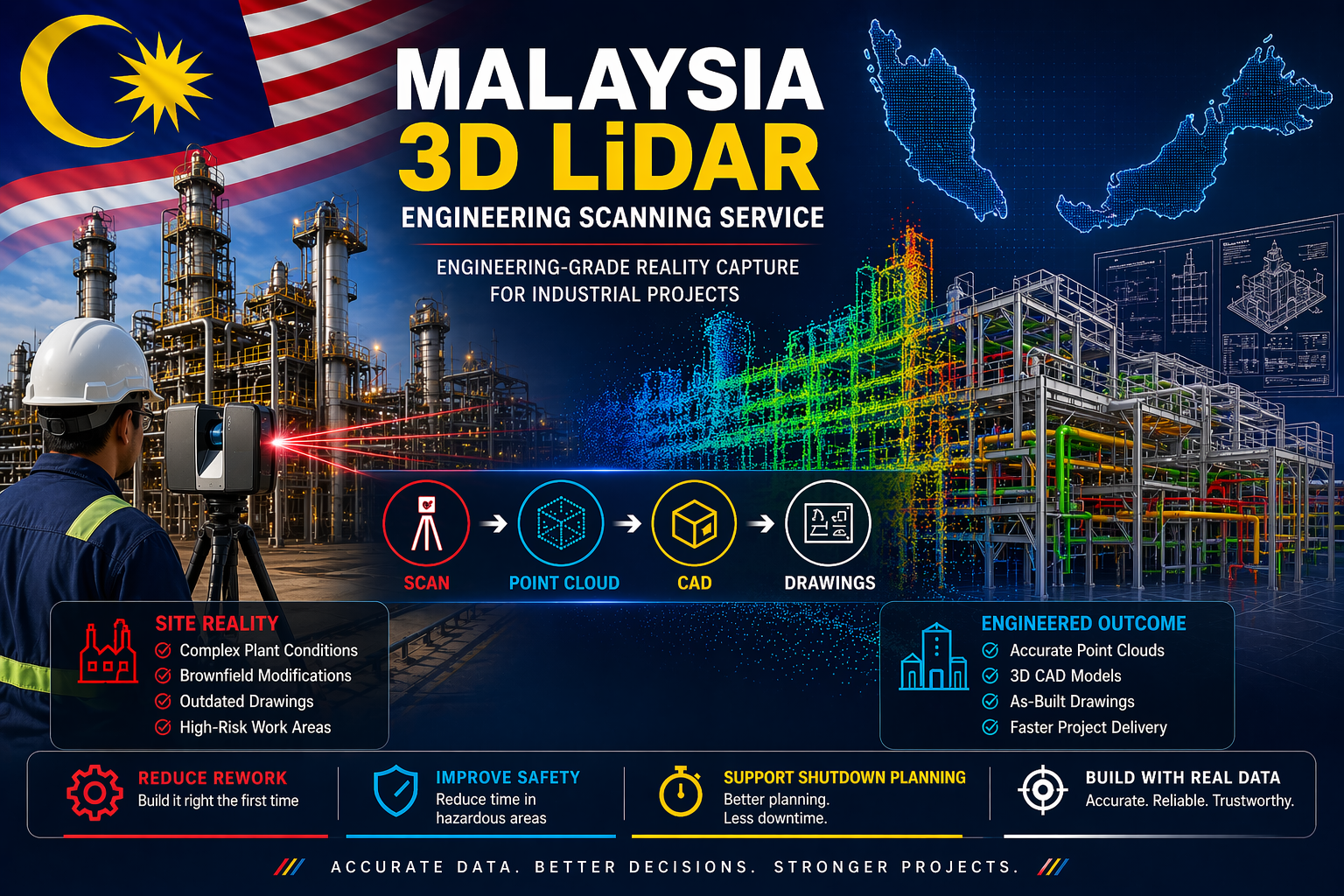
Malaysia 3D LiDAR Engineering Scanning Service

3D LiDAR scanning of a Malaysian industrial plant showing point cloud data converted into CAD models and engineering drawings

Malaysia is a major hub for industrial activity across oil and gas, manufacturing, palm oil processing, and infrastructure. These facilities are often complex environments where accuracy is critical to project success.

Hamilton By Design provides Malaysia 3D LiDAR engineering scanning services, delivering accurate site data that supports safer, faster, and more reliable engineering outcomes.

Traditional measurement methods rely on outdated drawings, manual measurements, and assumptions. Over time, industrial plants change, and what exists on paper often does not reflect what has actually been built.

This creates risk across design, fabrication, and installation.

3D LiDAR scanning removes this uncertainty. Using high-speed laser measurement, millions of data points are captured to create a point cloud. This point cloud represents the exact geometry of the site as it exists in reality.

The data can then be converted into 3D CAD models and engineering drawings, providing a reliable foundation for project delivery.

3D LiDAR scanning and 3D modelling service button โ€” laser scanner capturing a point cloud for engineering and CAD modelling
Mechanical engineering services

The benefits are immediate.

Engineering accuracy improves because designs are based on real-world conditions. Clash detection can be completed before fabrication begins, reducing rework and avoiding costly delays.

Project timelines are reduced. Engineering teams can work remotely using accurate data, limiting the need for repeated site visits.

Safety is improved by reducing the time spent in hazardous environments. This is especially important during shutdowns and brownfield upgrades.

Shutdown planning becomes more effective. Components can be prefabricated, installation can be planned in detail, and downtime can be minimised.

Most importantly, 3D LiDAR scanning provides true as-built documentation. Every visible element of the plant is captured, allowing accurate layouts, sections, and models to be generated without returning to site.

The real value comes from the workflow.

Scan the site.
Process the point cloud.
Build the CAD model.
Produce engineering drawings.

This process transforms raw data into practical, engineering-ready deliverables that can be used across the full lifecycle of a project.

These services are widely used across oil and gas facilities, palm oil processing plants, manufacturing operations, mining infrastructure, and power generation sites throughout Malaysia.

Typical applications include plant upgrades, structural modifications, equipment installations, and shutdown planning.

In todayโ€™s environment, projects are expected to be delivered faster, safer, and with greater accuracy. 3D LiDAR scanning supports these outcomes by ensuring decisions are based on real data rather than assumptions.

If you are planning an upgrade, shutdown, or new installation within an industrial facility in Malaysia, accurate information is critical.

To learn more about how Hamilton By Design can support your project, visit:

Talk to Us – Contact Us
Name
Would you like us to arrange a phone consultation for you?
Address
3D CAD Modelling Australia service banner for Hamilton By Design

Our clients

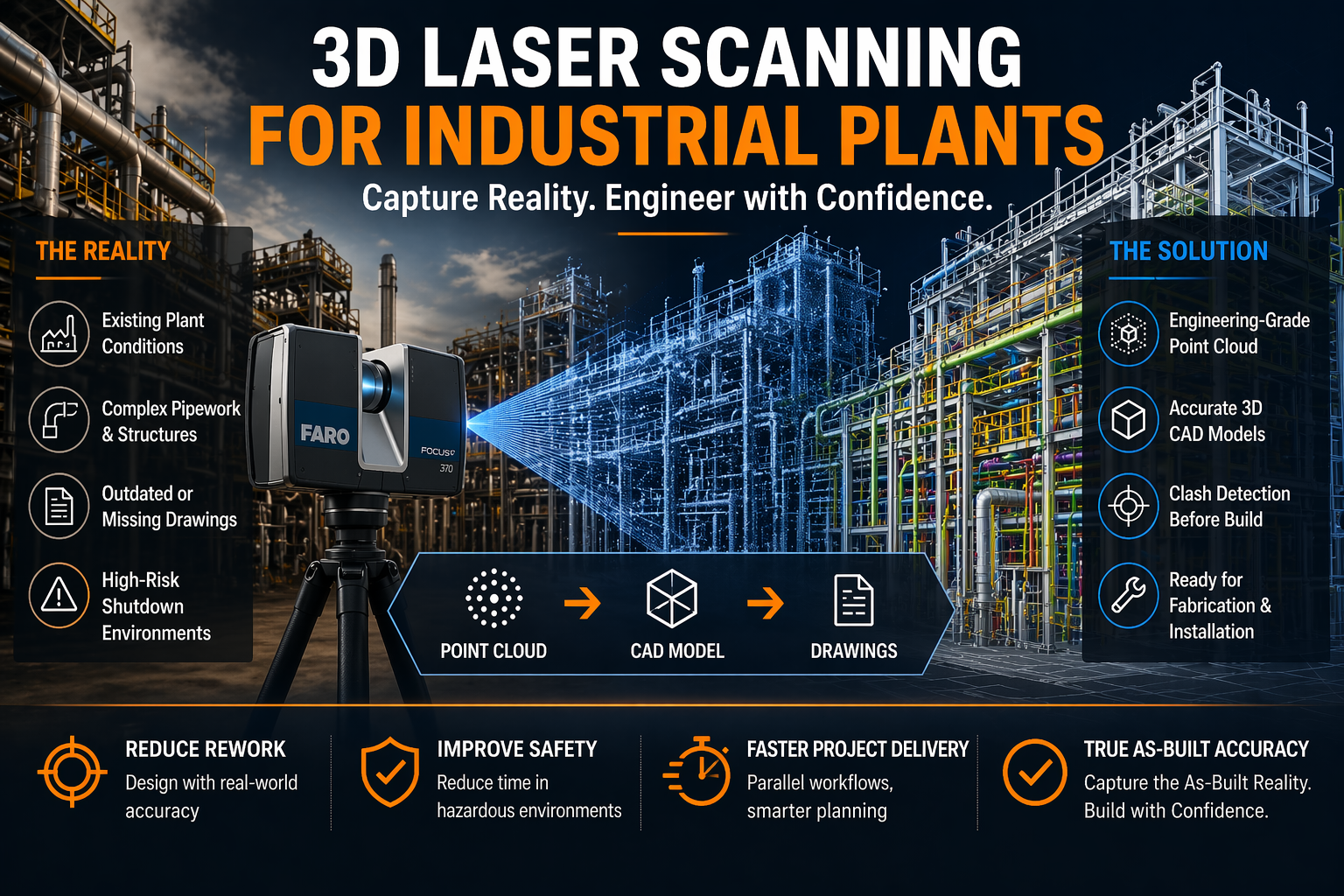
3D Laser Scanning for Industrial Plants

3D laser scanning for industrial plants

3D Laser Scanning for Industrial Plants | Hamilton By Design

Precision Capture. Smarter Engineering. Reduced Risk.

Blue 3D LiDAR scanner icon on a tripod with scanning waves

Industrial plants are complex, high-risk environments where accuracy is everything. Whether you’re working in mining, processing, manufacturing, or energy, one incorrect dimension can lead to costly rework, shutdown delays, or safety issues.

At Hamilton By Design, we specialise in 3D laser scanning for industrial plantsโ€”capturing real-world conditions with engineering-grade accuracy and turning them into usable models, drawings, and digital assets.


3D LiDAR scanning and 3D modelling service button โ€” laser scanner capturing a point cloud for engineering and CAD modelling
Mechanical engineering services

What is 3D Laser Scanning for Industrial Plants?

3D laser scanning (LiDAR) uses high-speed laser measurement technology to capture millions of points in spaceโ€”creating a point cloud that represents the exact geometry of your plant.

Unlike traditional measuring methods:

  • No manual tape measurements
  • No guesswork or assumptions
  • No reliance on outdated drawings

Instead, you get a true digital representation of reality.


Why Industrial Plants Need 3D Laser Scanning

1. Brownfield Accuracy

Most industrial facilities have evolved over time. Drawings rarely reflect whatโ€™s actually been built.

3D scanning provides:

  • Accurate as-built conditions
  • Clash detection before fabrication
  • Confidence in design decisions

2. Shutdown Planning & Risk Reduction

Shutdowns are expensive. Every hour matters.

With a full point cloud:

  • Work can be planned offsite
  • Fabrication can occur before shutdown
  • Installation becomes faster and safer

3. Complex Geometry Capture

Industrial plants include:

  • Dense pipework
  • Structural steel
  • Conveyor systems
  • Mechanical equipment

3D scanning captures all of itโ€”simultaneouslyโ€”with millimetre-level detail.


4. Engineering-Ready Deliverables

At Hamilton By Design, we donโ€™t just scanโ€”we engineer.

Typical outputs include:

  • Registered point clouds (.E57, .RCP)
  • 3D CAD models (STEP, Parasolid)
  • 2D drawings (AutoCAD layouts, sections, elevations)
  • Simplified models for coordination and fabrication

Point Cloud vs STL โ€“ Why It Matters

Many scanning providers deliver mesh files (STL), which are often:

  • Heavy and difficult to edit
  • Not dimensionally reliable
  • Not suitable for engineering workflows

We focus on point cloud to CAD workflows, ensuring:

  • Traceability back to real-world data
  • Editable, parametric models
  • Engineering-grade outputsโ€”not just visuals

Our Technology & Workflow

We utilise high-precision scanning systems such as the FARO Focus S70 to capture industrial environments efficiently and accurately.

Our workflow:

  1. Site scanning (minimal disruption)
  2. Point cloud registration & validation
  3. Engineering model development
  4. Drawing production & issue

We also support integration into platforms like SolidWorks and Autodesk ReCap Pro for seamless design workflows.


Real Benefits for Industrial Clients

  • Reduced rework โ€“ design with confidence
  • Faster project delivery โ€“ parallel workflows
  • Improved safety โ€“ less time in hazardous areas
  • Better communication โ€“ visual clarity across teams
  • Digital asset creation โ€“ foundation for digital twins

Applications Across Industry

Our 3D laser scanning services are used across:

  • Mining and mineral processing plants
  • Power stations and utilities
  • Manufacturing facilities
  • Oil & gas infrastructure
  • Water treatment plants

From conveyors and chutes to pump stations and structural steel upgradesโ€”we connect design to reality.


Why Hamilton By Design?

Weโ€™re not just scanning techniciansโ€”weโ€™re engineers.

That means:

  • We understand fabrication tolerances
  • We design for real-world installation
  • We deliver outputs that your team can actually use

Our focus is simple:
Accurate data โ†’ Better decisions โ†’ Successful projects


Hamilton By Design logo displayed on a blue tilted rectangle with a grey gradient background
3D CAD Modelling Australia service banner for Hamilton By Design

Get Started

If youโ€™re planning an upgrade, shutdown, or new installation within an existing plant, 3D laser scanning is no longer optionalโ€”itโ€™s essential.

Hamilton By Design provides reliable, engineering-grade 3D laser scanning for industrial plants across Australia.

Our clients

Contact us today to discuss your project and see how we can support your next job with precision and clarity.

Name
Would you like us to arrange a phone consultation for you?
Address
CHPP Engineering title graphic featuring bold white text reading "CHPP Engineering" centred on a blue rounded rectangle background.
Pipework Drafting title graphic featuring bold white text reading "Pipework Drafting" centred on a blue rounded rectangle background.
3D LiDAR Scanning for Engineering Projects title graphic featuring bold white text on a blue rounded rectangle background.

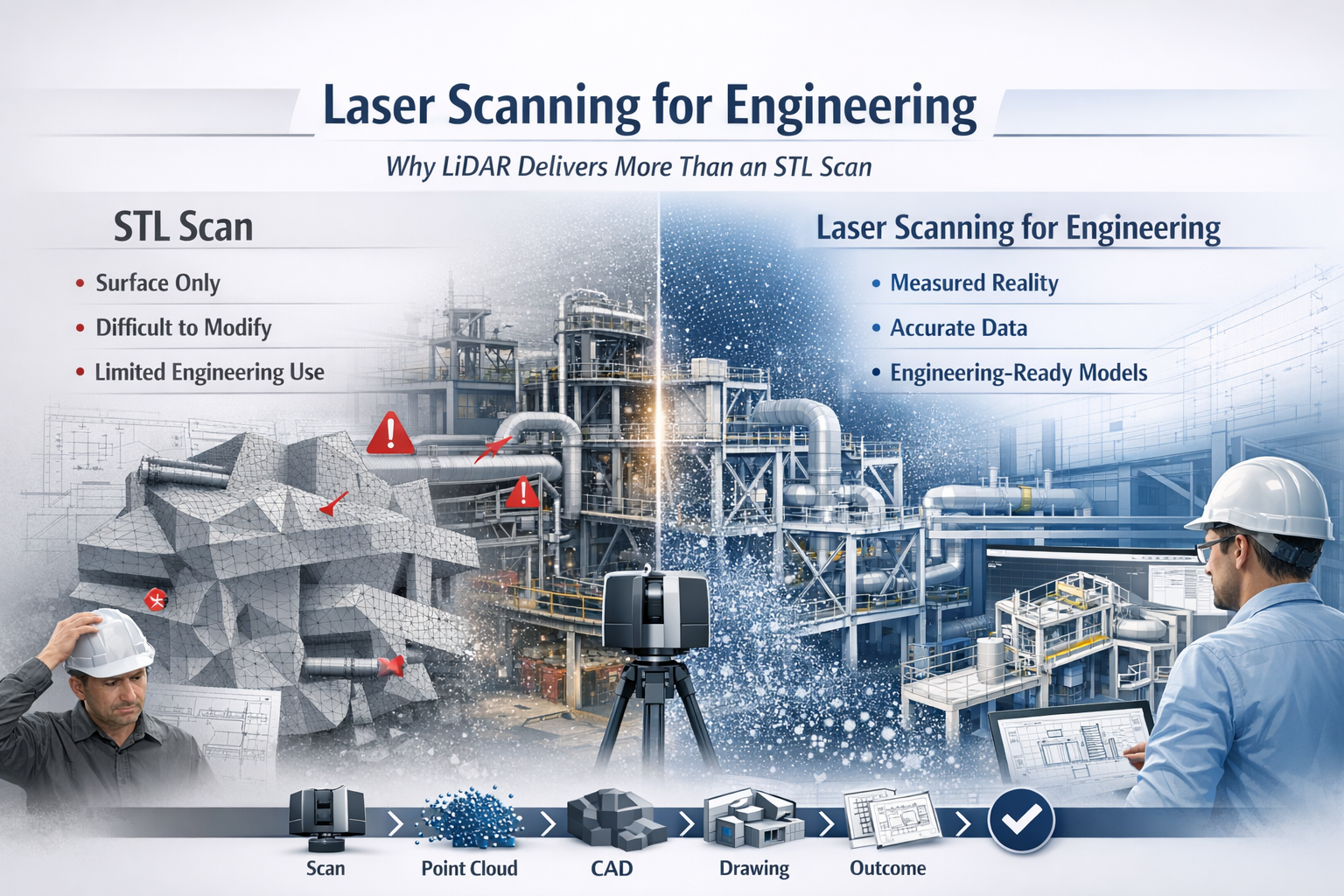
Laser Scanning for Engineering

Laser scanning for engineering infographic comparing LiDAR point cloud data with STL mesh scanning, showing improved CAD modelling and engineering workflows.

Why LiDAR Delivers Real Engineering Outcomes

In modern engineering, accuracy is everything. Whether you are working in mining, manufacturing, infrastructure, or plant design, the difference between success and costly rework often comes down to how well you understand what has actually been built.

This is where laser scanning for engineering has become a critical tool.

While many providers offer โ€œ3D scanning,โ€ not all data is created equal. There is a significant difference between engineering-grade LiDAR point cloud data and basic STL mesh outputs. Understanding that difference can determine whether your project moves forward efficientlyโ€”or gets stuck in rework, assumptions, and redesign.


3D LiDAR scanning and 3D modelling service button โ€” laser scanner capturing a point cloud for engineering and CAD modelling
Mechanical engineering services

What is Laser Scanning for Engineering?

Laser scanning for engineering uses LiDAR (Light Detection and Ranging) technology to capture millions of precise measurements of a physical environment. The result is a high-density point cloudโ€”a true digital representation of reality.

Unlike traditional measurement methods, LiDAR captures:

  • Complex geometry
  • Structural relationships
  • Equipment positioning
  • Real-world deviations from design

This data becomes the foundation for:

  • CAD modelling (SolidWorks, AutoCAD, Revit)
  • Engineering drawings
  • Clash detection
  • Retrofit and upgrade design

In short, it bridges the gap between design intent and as-built reality.


The Problem with STL-Based Scanning

Many scanning providers deliver outputs as STL, OBJ, or mesh files. While these formats are useful for visualisation or 3D printing, they fall short in engineering applications.

Key limitations of STL scans:

  • No intelligence โ€“ Meshes are just surfaces, not structured geometry
  • Difficult to modify โ€“ Not suitable for parametric design workflows
  • Poor for engineering drawings โ€“ Cannot easily generate sections, tolerances, or fabrication details
  • Heavy and inefficient โ€“ Large file sizes with limited usability
  • No clear chain of accuracy โ€“ Hard to verify measurement reliability

In practical terms, an STL file often becomes a dead-end deliverableโ€”you can look at it, but you canโ€™t engineer from it effectively.


Why LiDAR Point Clouds Are Built for Engineering

LiDAR-based laser scanning for engineering produces structured, measurable, and verifiable data that integrates directly into engineering workflows.

Key advantages:

1. True-to-Reality Accuracy

Point clouds capture millions of measured points, providing a high-confidence representation of the real world.

2. Direct CAD Integration

Data can be converted into:

  • Parametric 3D models
  • Fabrication-ready drawings
  • Plant layouts and assemblies

3. Supports Engineering Decisions

Engineers can:

  • Measure directly from the dataset
  • Validate clearances and tolerances
  • Design with confidence

4. Enables Retrofit and Brownfield Design

In existing plants, nothing is ever exactly โ€œas drawn.โ€ LiDAR ensures your design fits what is actually there, not what was intended years ago.

5. Reduces Risk and Rework

Accurate input data leads to:

  • Fewer site revisits
  • Reduced fabrication errors
  • Lower project costs

6. Maintains Chain of Custody

Engineering-grade scanning supports data governance, traceability, and verificationโ€”critical in legal, compliance, and high-risk environments.


Engineering vs Visualisation: A Critical Distinction

A key misunderstanding in the industry is assuming all 3D scanning is equal.

  • STL / Mesh Scanning โ†’ Visualisation Output
  • LiDAR Point Cloud โ†’ Engineering Input

If your goal is:

  • 3D printing โ†’ STL may be enough
  • Engineering design, fabrication, or upgrades โ†’ LiDAR is essential

Real-World Application: Engineering in Practice

Across mining, manufacturing, and infrastructure, laser scanning for engineering is used to:

  • Capture conveyor systems before modification
  • Model structural steel for upgrades
  • Verify equipment installation
  • Design pipework and mechanical systems
  • Plan shutdown works with precision

Instead of guessing dimensions or relying on outdated drawings, engineers work from measured reality.


The Workflow That Delivers Results

A proper engineering workflow looks like this:

Scan โ†’ Register โ†’ Model โ†’ Detail โ†’ Deliver

Not:

Scan โ†’ Export STL โ†’ End

That difference defines whether you receive a usable engineering deliverable or just a digital artifact.


3D CAD Modelling Australia service banner for Hamilton By Design

Laser scanning for engineering is not just about capturing dataโ€”itโ€™s about enabling better engineering outcomes.

LiDAR-based point cloud data provides:

  • Accuracy
  • Usability
  • Engineering value

In contrast, STL-based scanning often limits what you can achieve.

If your project requires real design, real drawings, and real decisions, then the choice is clear:

Use laser scanning for engineeringโ€”not just scanning for appearance.

Our clients

Contact Us

Name
Would you like us to arrange a phone consultation for you?
Address
3D CAD Modelling Australia service banner for Hamilton By Design
Australian Drafting logo featuring bold white text reading "Australian Drafting" centred on a blue rounded rectangle background.
Engineering Governance title graphic featuring bold white text reading "Engineering Governance" centred on a blue rounded rectangle background.
Mechanical, Structural & Pipework Drafting service banner by Hamilton By Design featuring white text on a blue background.
Mechanical engineering services
Blue rounded button with the text โ€œSolidWorks Designโ€ in white.
Finite Element Analysis (FEA) engineering simulation button
3D LiDAR Scanning Darwin for engineering surveys, laser scanning, reality capture and point cloud modelling services
3D LiDAR Scanning Australia engineering services for laser scanning, reality capture, scan-to-CAD, Scan-to-BIM and as-built documentation across Australia
3D LiDAR scanning services on the Central Coast providing engineering-grade laser scanning, point cloud capture, scan-to-CAD modelling and industrial reality capture for infrastructure and industrial projects.
3D LiDAR Scanning Perth for engineering surveys, laser scanning, reality capture and point cloud modelling services
3D LiDAR Scanning Sydney for engineering surveys, laser scanning, reality capture and point cloud modelling services
3D LiDAR Scanning Brisbane for engineering surveys, laser scanning, reality capture and point cloud modelling services
3D LiDAR Scanning Canberra for engineering surveys, laser scanning, reality capture and point cloud modelling services
3D LiDAR Scanning Newcastle for engineering surveys, laser scanning, reality capture and point cloud modelling services
3D LiDAR Scanning Adelaide for engineering surveys, laser scanning, reality capture and point cloud modelling services