Mechanical Engineering | 3D Scanning | 3D Modelling
Category: 3D Scanning & Digital Engineering
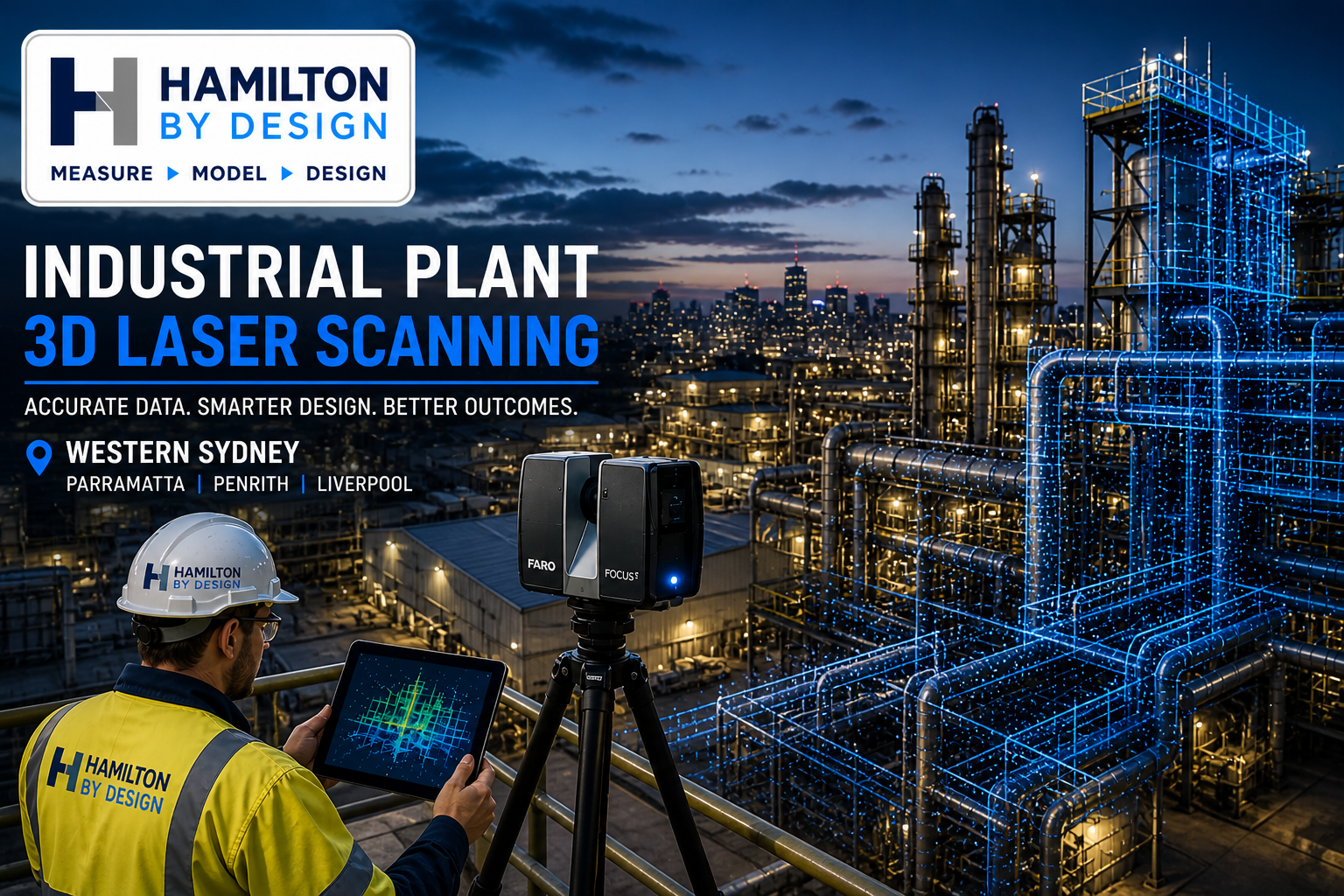
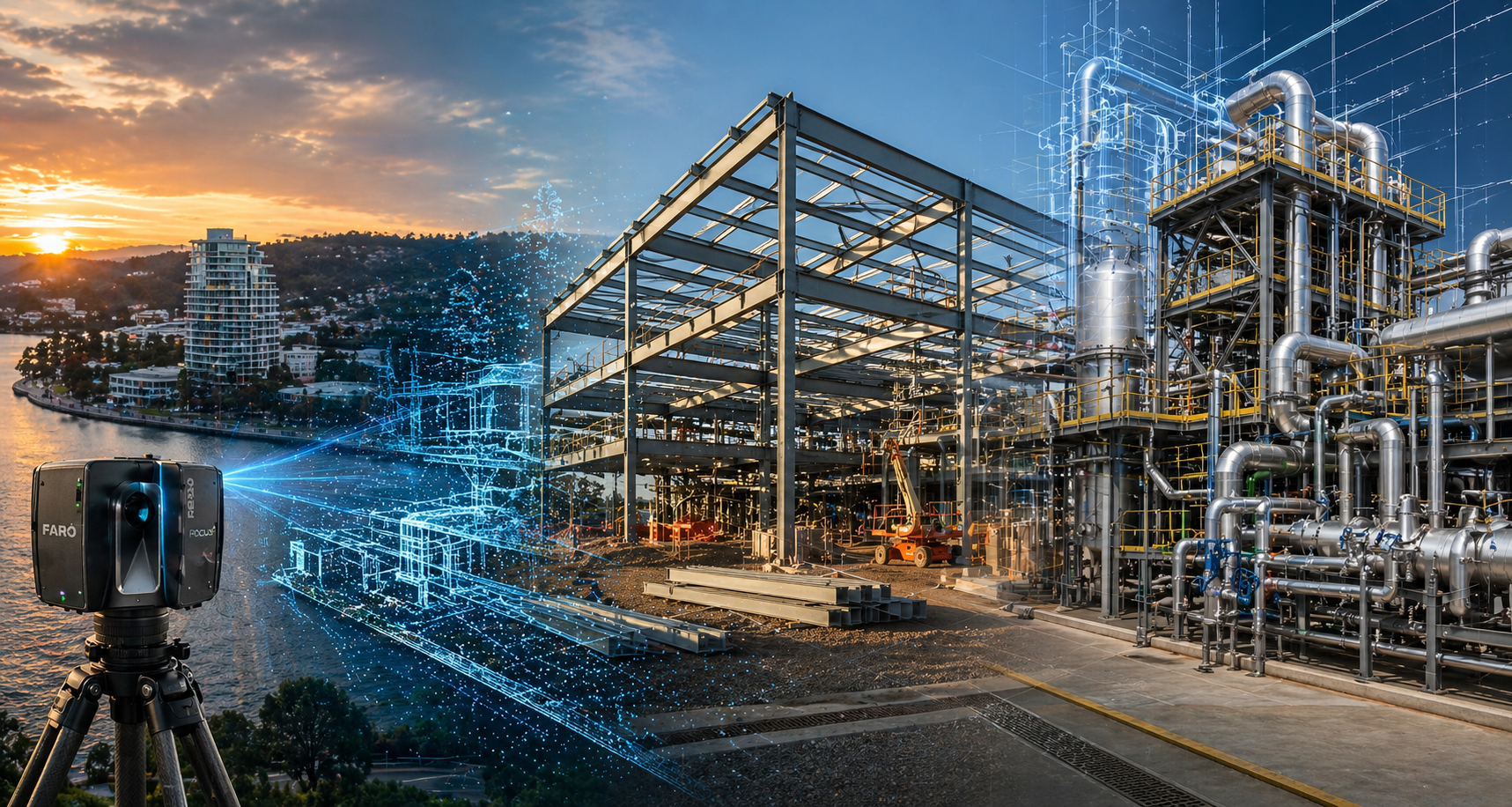
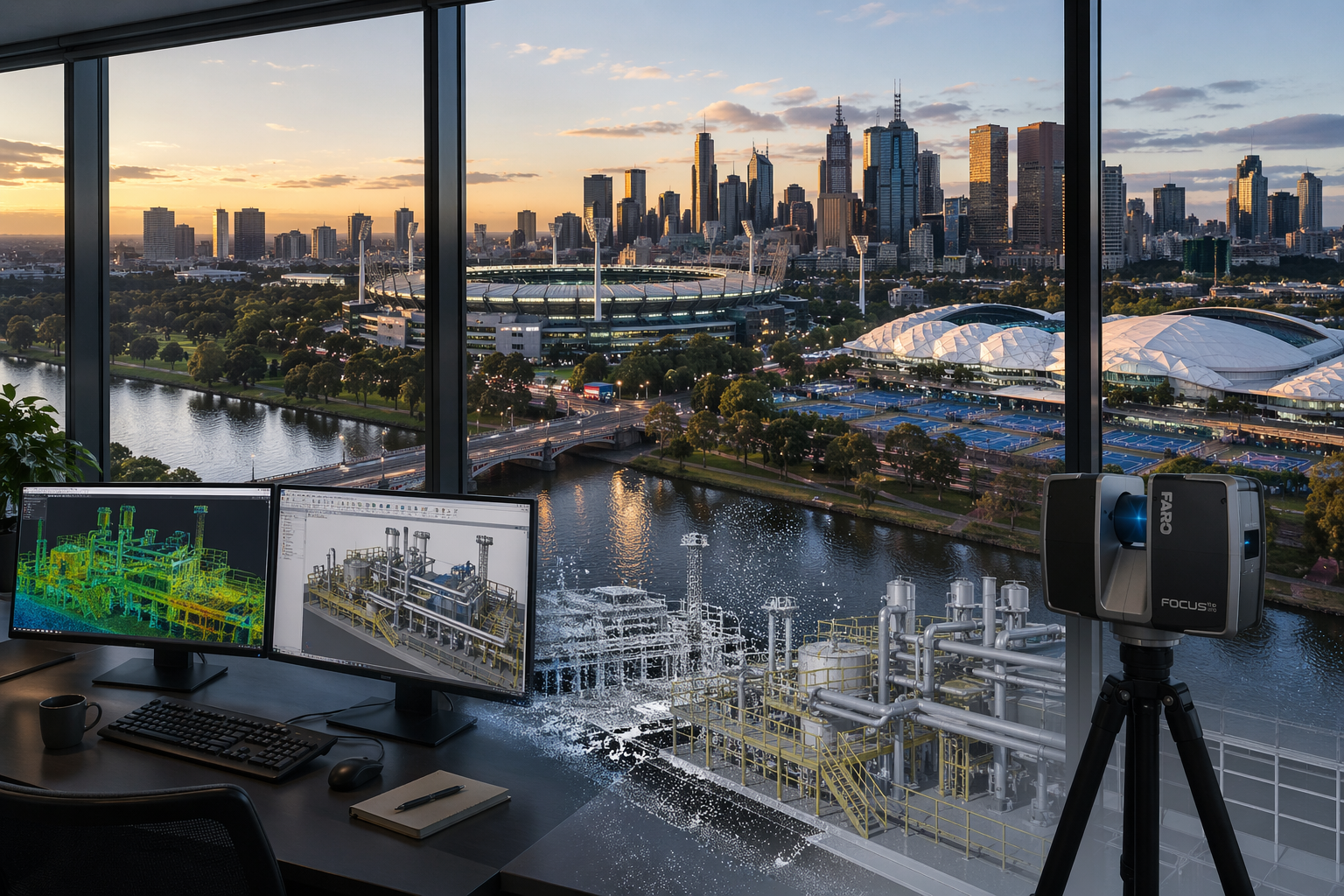
3D Laser Scanning & Reality Capture covers the practical use of engineering-grade 3D laser scanning, LiDAR, and reality capture technologies to accurately document existing assets and site conditions.
This category focuses on how scan data is planned, captured, verified, and converted into usable engineering outputs, including as-built drawings, 3D CAD models, and scan-to-CAD workflows. Content explores real-world applications across power generation, manufacturing, mining, and building & construction, particularly in brownfield and live-site environments where accuracy and control are critical.
Articles in this category examine the difference between visual capture and engineering-grade scanning, the importance of datums, tolerances, and registration, and how reality capture supports Australian Standards–aligned design and documentation.
Engineering-Grade Reality Capture | Point Cloud to CAD | Mechanical Design
At Hamilton By Design, 3D laser scanning is not just about capturing data — it is about delivering engineering outcomes.
We specialise in 3D laser scanning for industrial plants, point cloud to CAD modelling, scan-to-BIM services, and mechanical engineering design across Sydney and Australia. Our approach combines LiDAR scanning with real engineering experience to ensure every model is accurate, usable, and fit for purpose.
Unlike generic scanning providers, we focus on delivering engineering-ready outputs that support design, fabrication, and long-term asset management.
Local 3D Scanning Services
We provide mobile, onsite 3D scanning services across:
Parramatta Penrith Liverpool Greater Sydney
If you are searching for a “3D scanning company near me” or “3D laser scanning Parramatta”, our team delivers fast, reliable, engineering-grade results.
Where 3D Scanning Adds Value
Mining and Bulk Handling
3D scanning plays a critical role in mining operations, particularly for:
Coal chutes and transfer stations
Conveyor systems and belt alignments
Outbye mining infrastructure
Preventative maintenance for chutes
We support projects such as coal mine header transition chutes, customised chute design, and optimisation of existing systems. This allows for better performance compared to off-the-shelf solutions.
Industrial Plants and Process Equipment
We work with industrial clients to scan and model:
Food processing plants
Pump systems and pipework
Mechanical equipment layouts
As experienced process equipment designers, we ensure all models align with Australian Standards and real-world operating conditions.
Buildings and Construction
3D scanning is widely used in building and construction projects for:
Building scanning services
Scan-to-BIM for refurbishments
Structural and mechanical coordination
This is particularly valuable for commercial buildings, hotels, and construction sites where accuracy is critical.
From Point Cloud to CAD
We convert raw scan data into engineering deliverables, including:
Registered point clouds (.E57, .RCP)
3D CAD models (STEP, Parasolid, SolidWorks)
2D AutoCAD drawings
Scan-to-BIM models
This enables accurate design, clash detection, and fabrication-ready outputs.
Engineering vs Basic Scanning
Many scanning companies provide visual models or mesh outputs.
Hamilton By Design delivers:
Engineering-grade geometry
Dimensionally reliable models
Outputs aligned with Australian Standards
Models suitable for design, analysis, and fabrication
This is the key difference between scanning for visuals and scanning for engineering.
Custom Design vs Off-the-Shelf
In many industrial environments, off-the-shelf solutions lead to:
Poor fit
Increased wear
Higher maintenance costs
Using 3D scanning combined with engineering design, we develop:
Custom coal chutes
Header transition chute optimisation
Fit-for-purpose mechanical systems
This reduces downtime, improves performance, and ensures long-term reliability.
Supporting Industry Across Australia
While based in Sydney, we support projects across:
New South Wales Queensland (including Mount Isa) Western Australia (Perth) International locations including Malaysia
Common Questions
What are the best 3D scanning platforms? Engineering-grade systems such as FARO and Leica, combined with CAD platforms, deliver the best results for industrial applications.
Who provides professional 3D scanning for industrial sites? Engineering-led companies like Hamilton By Design provide data that can actually be used for design and construction.
Should I outsource mechanical engineering? Yes — especially when combined with scanning, as it improves accuracy and reduces project risk.
Why Choose Hamilton By Design
Mechanical engineers, not just scanning technicians
Engineering-led LiDAR workflows
Strong mining and industrial experience
Fast turnaround times
Full workflow: Scan, Model, Design, Deliver
Get Started
If you are looking for:
3D scanning services in Parramatta, Penrith, or Liverpool Point cloud to CAD services in Australia Mining chute design and optimisation Industrial plant scanning
Contact Hamilton By Design to discuss your project.
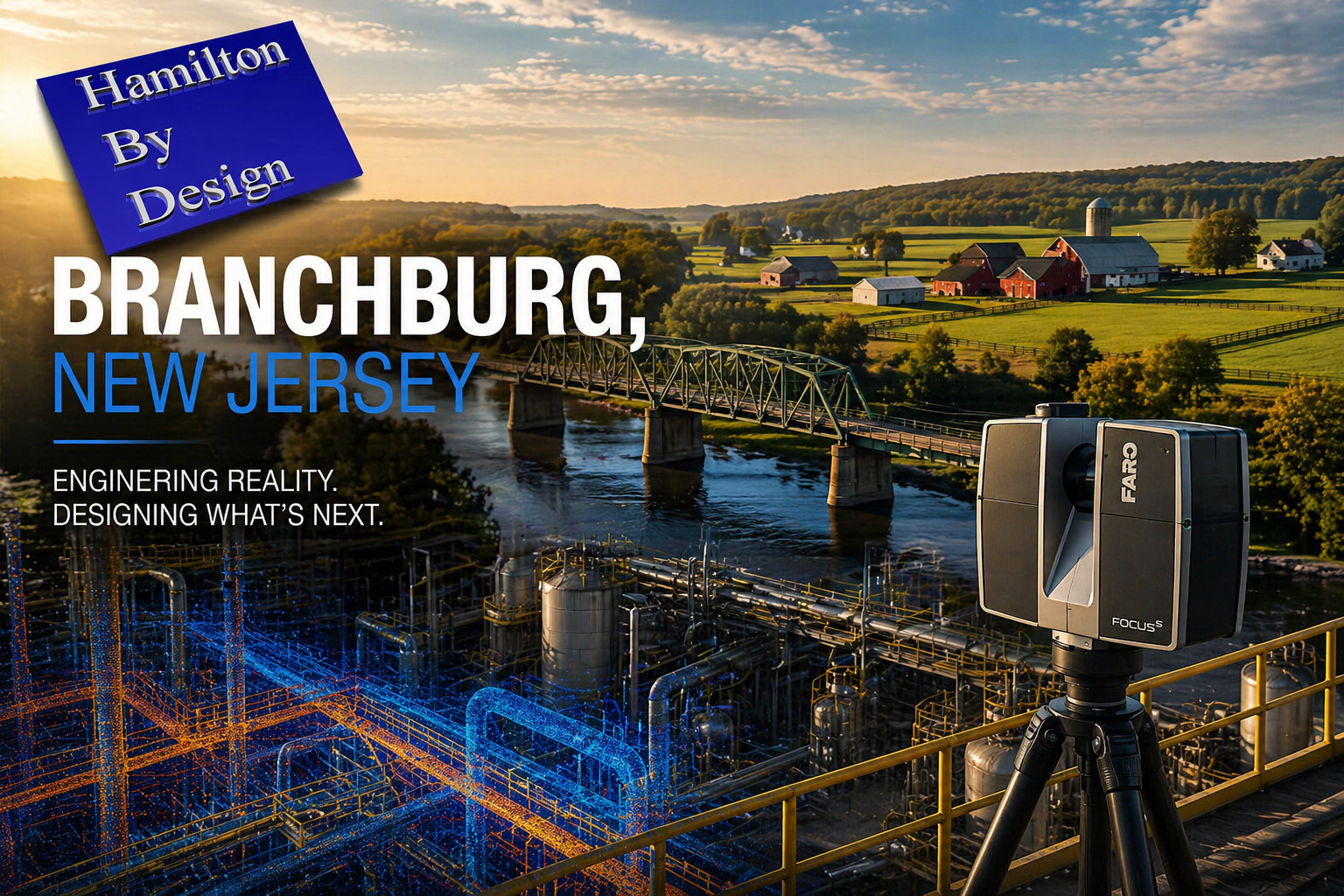
Hamilton By Design provides engineering-grade 3D laser scanning, scan-to-CAD, and mechanical drafting services to industrial and infrastructure clients in Branchburg, New Jersey and surrounding regions.
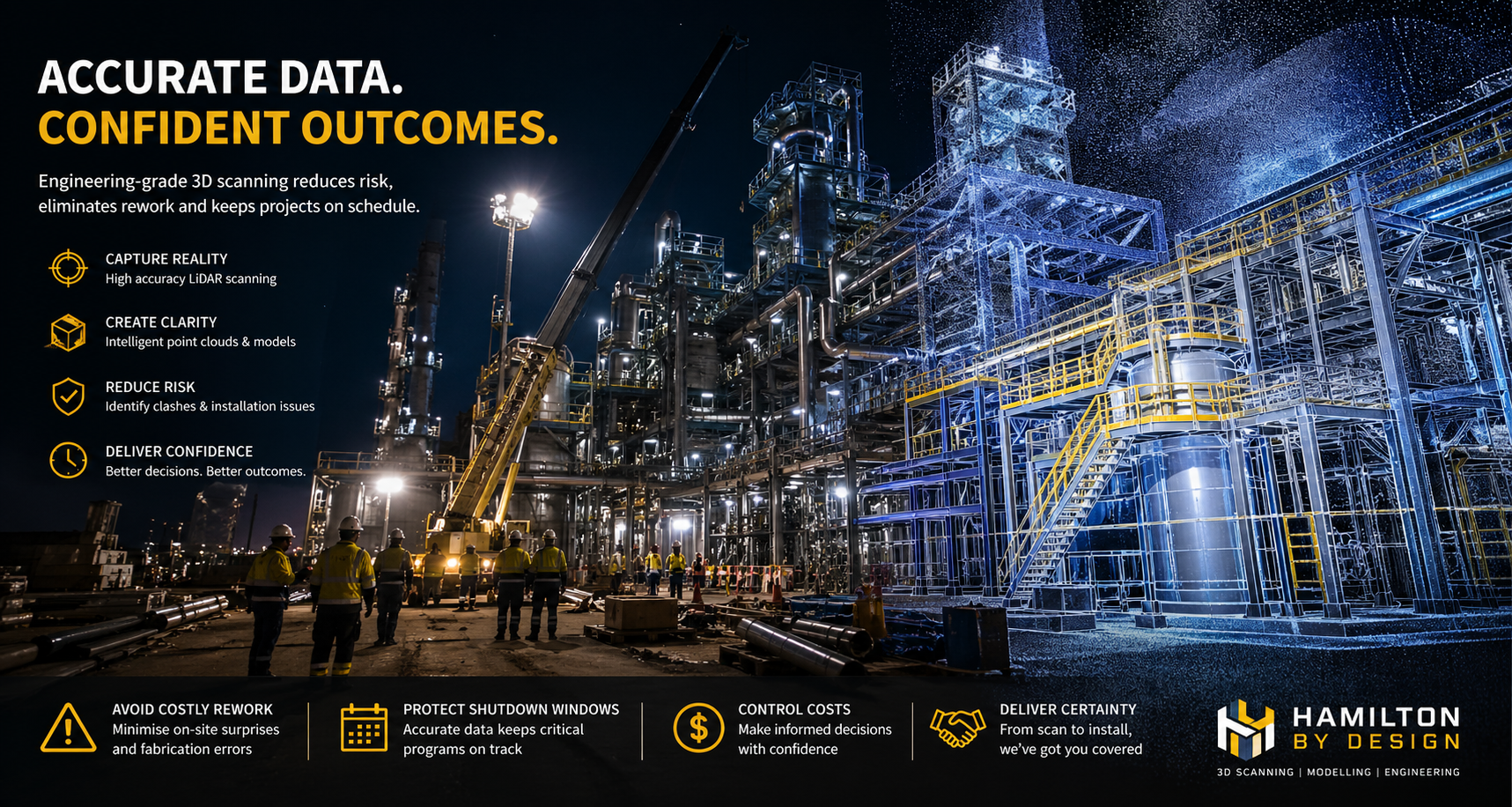
Unlike low-cost scanning providers that deliver raw meshes or unverified data, our approach is grounded in mechanical engineering outcomes—ensuring every scan translates into accurate, buildable, and fabrication-ready models.
Whether you are upgrading an industrial facility, planning a shutdown, or coordinating multi-disciplinary engineering works, our workflow ensures a clear bridge between reality and design intent.
Why Engineering-Led Scanning Matters
Many organisations underestimate the risk associated with poor-quality scan data. Cheap scans often result in:
Misaligned models
Missing geometry due to poor line-of-sight planning
Fabrication errors and costly rework
Delays during installation
At Hamilton By Design, we position scanning as the first step in engineering—not just data capture.
👉 Our focus is simple: Scan → Model → Detail → Verify → Deliver
This ensures your project progresses with confidence, accuracy, and traceability.
Our Services in Branchburg
1. 3D Laser Scanning (LiDAR)
We utilise professional-grade terrestrial LiDAR systems to capture high-density, survey-quality point clouds.
Typical applications include:
Industrial plants and processing facilities
Pipework systems and structural steel
Conveyor systems and bulk handling infrastructure
Brownfield upgrades and retrofit projects
Deliverables:
Registered point clouds (.E57, .RCP, .LAS)
Scan reports and alignment verification
Optional Scene LT viewer access
2. Scan-to-CAD / Scan-to-Model
We convert point cloud data into accurate, usable engineering models.
Outputs include:
STEP / Parasolid models for fabrication
AutoCAD 2D drawings (GA, sections, elevations)
Revit-compatible geometry (where required)
This is where most scanning providers fall short— we ensure models are usable for engineering, not just visualisation.
3. Mechanical Engineering & Drafting
Our team supports:
Equipment design and modification
Pipework and structural detailing
Shutdown engineering support
Reverse engineering of legacy assets
We understand brownfield constraints, ensuring designs fit first time.
Applications Across Industry
We support projects across:
Manufacturing facilities
Mining and bulk materials handling
Energy and utilities infrastructure
Water treatment and pumping stations
For clients in Branchburg and the broader New Jersey region, our services are particularly valuable for:
✔ Engineering-first approach ✔ Fabrication-ready deliverables ✔ Proven experience in brownfield environments ✔ Advanced LiDAR and CAD capabilities ✔ Focus on risk reduction and project certainty
Conclusion
For organisations in Branchburg, New Jersey, the difference between a successful project and a costly rework often comes down to data quality and engineering interpretation.
Hamilton By Design ensures your project starts with accurate, reliable, and usable data—ready for real-world application.
Get in Touch
If you are planning a project in Branchburg or the surrounding New Jersey region, reach out to discuss how we can support:
Strengthen Your Project with Australian Engineering
A Risk-Based Perspective for Project Managers and Company Directors
Executive Summary
The increasing availability of low-cost 3D scanning services has led to a perception that reality capture is a commoditised input to engineering projects. However, within fabrication-driven environments—particularly in mining, heavy industry, and brownfield infrastructure—this assumption is fundamentally flawed.
3D scanning is not an isolated deliverable; it is a foundational dataset upon which design, fabrication, and installation decisions are made. When this dataset lacks accuracy, completeness, or governance, downstream impacts emerge in the form of rework, delays, cost overruns, and elevated operational risk.
This paper outlines why low-cost scanning solutions frequently result in higher total project costs and provides a framework for evaluating scanning methodologies from a lifecycle and risk perspective.
1. The Role of Reality Capture in the Project Lifecycle
In modern engineering workflows, 3D scanning underpins a sequence of dependent activities:
Site capture (point cloud acquisition)
Data registration and validation
3D modelling and design development
Detailing for fabrication
Installation and commissioning
Each stage inherits the quality of the preceding one. As a result, deficiencies in the initial scan propagate throughout the project lifecycle. Errors introduced at the data capture stage are rarely isolated and are often only fully realised during fabrication or installation—when rectification costs are at their highest.
2. Accuracy as a Determinant of Fabrication Success
Fabrication processes require dimensional certainty. Tolerances associated with structural steel, piping systems, and mechanical assemblies are typically measured in millimetres. Deviations beyond these tolerances can render components unfit for purpose.
Lower-cost scanning methodologies, particularly those relying on unstructured workflows or drift-prone systems, often exhibit:
Accumulated positional error over distance
Inconsistent alignment between scan sets
Limited or absent survey control
Reduced reliability in complex industrial environments
While such datasets may appear visually acceptable, they frequently lack the dimensional integrity required for fabrication-grade outputs. The result is misalignment, rework, and increased reliance on site-based modification.
3. Cost Amplification Through Downstream Rework
The primary issue with low-cost scanning is not the initial saving, but the amplification of costs downstream.
A typical failure pathway includes:
Design based on inaccurate geometry
Fabrication to incorrect specifications
Installation conflicts and misalignment
At the installation stage, corrective actions may include:
Cutting and re-welding on site
Redesign under time constraints
Expedited fabrication of replacement components
Additional labour and supervision
A relatively small saving in scanning costs can therefore result in significant increases in total project cost, particularly in time-critical environments.
4. Operational Risk and Downtime Implications
In industrial environments, downtime represents one of the most significant cost drivers. Inaccurate scan data introduces risks that extend beyond fabrication and into operations, including:
Extended shutdown durations
Delayed commissioning
Installation clashes
Disruption to production schedules
Given the high cost of downtime in mining and processing facilities, even minor delays can have substantial financial consequences. Low-cost scanning therefore introduces not only technical risk but also operational and commercial risk.
5. Visual Fidelity Versus Engineering Validity
A common misconception is that visually impressive scan data equates to engineering accuracy. Modern software platforms can present dense, colourised point clouds that appear complete and reliable.
However, visual quality does not guarantee:
Verified spatial accuracy
Consistent coordinate alignment
Defined tolerances
Reliable integration into engineering workflows
For decision-makers, the critical question is whether the data is demonstrably accurate and suitable for its intended engineering purpose—not whether it appears visually convincing.
6. Data Completeness and Design Integrity
In addition to accuracy, completeness of data capture is essential.
Low-cost scanning approaches often result in incomplete datasets due to time constraints, access limitations, or insufficient planning. Common omissions include:
Undersides of structures
Connection points and bolt details
Congested or hard-to-reach areas
Critical interfaces between systems
Incomplete data forces engineers to make assumptions, which introduces uncertainty into the design process. This often leads to conservative design, increased material usage, additional site visits, and iterative revisions.
7. Governance and Traceability
Effective project delivery requires a clear and controlled data environment.
Engineering-grade scanning workflows typically include:
Registration reports and validation metrics
Defined coordinate systems
Version control and data management
Traceability from scan to model to drawing
Low-cost scanning services often lack these controls, resulting in:
Multiple conflicting datasets
Poor coordination between disciplines
Limited accountability
Increased risk during audits or dispute resolution
Without a single source of truth, project risk increases significantly.
8. Fabrication Constraints and Irreversibility
Fabrication environments operate on precision and adherence to documented design. Workshops do not reinterpret data—they execute it.
When inaccurate scan data informs fabrication:
Errors are embedded in physical components
Materials and labour are consumed unnecessarily
Corrections become costly and complex
By the time issues are identified, the opportunity for low-cost correction has passed.
9. Reframing the Investment Decision
The evaluation of scanning services should be based on total project cost rather than initial expenditure.
Engineering-grade scanning: moderate upfront cost, reduced risk and greater predictability
Given that scanning represents a small proportion of overall project cost, decisions based solely on price are often misaligned with project objectives.
10. A Structured Approach to Risk Mitigation
To reduce risk and improve outcomes, the following approach is recommended:
Define accuracy requirements aligned with fabrication tolerances
Select appropriate scanning methodologies
Implement controlled data acquisition and registration
Validate datasets prior to design development
Integrate scan data into coordinated modelling workflows
Maintain governance and version control throughout the project lifecycle
This ensures that reality capture supports, rather than undermines, project delivery.
Conclusion
Low-cost 3D scanning services may appear cost-effective at the outset, but they frequently result in increased costs, delays, and risk when evaluated across the full project lifecycle.
For project managers and company directors, the critical consideration is the integrity of the data informing engineering decisions. In fabrication-driven environments, accuracy and reliability are essential.
Investment in engineering-grade scanning should therefore be viewed not as an optional expense, but as a risk mitigation strategy that underpins successful project delivery.
Related Services
To support fabrication certainty and reduce project risk, the following engineering-led services are available:
These services are specifically structured to deliver accurate, validated datasets suitable for engineering design and fabrication.
Ensuring Confidence in Fabrication Data
Where projects involve brownfield modifications, shutdown execution, or critical structural and mechanical installations, the reliability of underlying data is a key determinant of success.
Engineering-grade 3D LiDAR scanning provides a controlled and verifiable foundation for design, reducing uncertainty and enabling informed decision-making throughout the project lifecycle.
At Hamilton By Design, the focus is on delivering fit-for-purpose engineering data—ensuring that models, drawings, and fabrication outputs align with real-world conditions.
Independent Review of Existing Scan Data
Where scan data has already been captured, an independent review can be undertaken to assess its suitability for engineering and fabrication use.
This includes evaluation of:
Registration quality and alignment integrity
Dimensional accuracy relative to project requirements
Completeness of captured geometry
Suitability for downstream modelling and detailing
This approach provides clarity before further design or fabrication investment is committed.
Servicing Wyong, Gosford, Tuggerah & the Central Coast Region
At Hamilton By Design, we are not just a remote scanning provider — we operate locally on the Central Coast, delivering engineering-grade 3D LiDAR scanning services across:
Wyong Gosford Tuggerah Erina Somersby Newcastle & Hunter Valley
We understand the realities of working within active industrial plants, brownfield sites, and construction environments across the Central Coast region.
Local Response. Engineering-Level Outcomes.
When you engage Hamilton By Design, you are working with a Central Coast-based engineering team that can:
Mobilise quickly to site
Work around shutdown schedules
Integrate with local contractors and fabricators
Deliver scan-to-fabrication workflows
This is not just scanning — this is engineering-grade data capture that supports real project delivery.
Supporting Central Coast Industrial Projects
We regularly support projects involving:
Plant upgrades and modifications
Structural steel retrofits
Conveyor and materials handling systems
Pump stations and pipework
Brownfield shutdown planning
Our focus is simple: Capture reality accurately so your design fits first time.
Why Local Matters
Many scanning providers operate remotely or treat the Central Coast as an extension of Sydney.
We don’t.
Being locally positioned means:
Reduced mobilisation costs
Faster site attendance
Better understanding of local industry
Ongoing project support (not just a one-off scan)
When issues arise on site, you need a team that can respond — not one that has to travel hours to get there.
LiDAR Scanning Built for Engineering – Not Just Visualisation
We utilise terrestrial LiDAR scanning, not handheld SLAM systems, for critical engineering work.
Why this matters:
Controlled scan setups = higher accuracy
Registered point clouds = reliable geometry
Suitable for fabrication and design
This ensures your project avoids:
Rework
Misalignment
Fabrication errors
Our Local Service Offering
We provide a complete Central Coast workflow:
1. Site-Based LiDAR Scanning
High-resolution terrestrial scanning
Full site coverage based on line-of-sight planning
2. Point Cloud Processing
Registered and structured datasets
Industry-standard formats (.E57, .RCP, .LAS)
3. 3D Modelling & CAD
SolidWorks / AutoCAD deliverables
Simplified or detailed models depending on scope
4. Engineering & Drawing Development
Fabrication-ready drawings
Layouts, sections, and design integration
Who We Work With on the Central Coast
We support:
Mechanical contractors
Fabricators
Construction companies
Plant operators
Engineering teams
Whether it’s a small modification or a full plant upgrade, our role is to provide accurate, usable data that reduces risk.
Get Started – Local Support You Can Trust
If your project is based on the Central Coast and requires:
Accurate site capture
Reliable engineering data
Fast local response
We’re ready to assist.
Contact Hamilton By Design today to discuss your project in Wyong, Gosford, or the wider Central Coast region.
Our clients
3D LiDAR Scanning Central Coast | Wyong, Gosford Industrial Scanning
From the waterfront of Gosford through the industrial expansion of Tuggerah and into the developing corridors of Wyong, the Central Coast is changing.
What was once a region defined by lifestyle is now becoming a hub for logistics, manufacturing, and commercial development. Warehouses are rising, steel frames are going up, and existing buildings are being repurposed and upgraded.
But beneath every successful project across the Central Coast sits something far less visible — accurate engineering data and well-executed design.
Gosford: Starting with What Already Exists
In Gosford, many projects don’t begin with a blank canvas. They begin with an existing structure — a building that needs to be extended, upgraded, or completely rethought.
This is where 3D scanning in Gosford becomes critical.
Instead of relying on outdated drawings or assumptions, projects begin with:
3D laser scanning
Reality capture
As-built surveys
Using LiDAR, existing structures are captured as detailed point cloud data. From there, that data is transformed into usable engineering information.
For projects across Gosford, this approach reduces uncertainty and provides a clear foundation for design.
Here, the focus is on industrial growth — warehouses, distribution centres, and manufacturing facilities. Steel frames define the skyline, and projects move quickly from concept to construction.
Delivering steel frames on the Central Coast requires more than just fabrication. It requires:
Structural drafting
Steel detailing
CAD modelling
Integration with real-world site conditions
This is where engineering-led scanning and drafting comes into play.
For projects that extend beyond the Central Coast into the Hunter region, services such as:
Across the Central Coast, successful projects follow a consistent process:
Capture – Using LiDAR to scan real-world conditions Model – Converting point cloud data into CAD and BIM Design – Developing structural and mechanical solutions Deliver – Issuing drawings for fabrication and construction
This approach ensures that steel frames fit, equipment aligns, and installations proceed without costly rework.
Why Engineering-Led Scanning Matters
There are many providers offering scanning services.
But scanning alone is not enough.
What matters is how that data is used.
Hamilton By Design focuses on:
Engineering-grade point cloud data
CAD models that can be used for design and fabrication
Integration between scanning, drafting, and engineering
Deliverables that support real construction outcomes
Conclusion: Building the Central Coast with Confidence
From Gosford to Tuggerah and Wyong, the Central Coast is growing — and with that growth comes complexity.
Projects are no longer simple builds. They involve upgrades, integration, and coordination between existing and new systems.
With the right combination of:
3D scanning
Steel frame design
Mechanical engineering
CAD drafting
projects can move forward with confidence — from initial concept through to final construction.
A professional 3D scanning company does more than capture data — it delivers accurate, engineering-ready information that can be used for design, construction, and asset management.
At Hamilton By Design, we provide engineering-led 3D laser scanning services, converting real-world conditions into precise digital models for industrial, mining, and infrastructure projects.
What We Do
We provide 3D scanning services including:
Terrestrial LiDAR scanning
Point cloud to CAD modelling
Reverse engineering
Industrial plant scanning
Brownfield project support
Our focus is on delivering accurate data that can be used for real engineering outcomes.
LiDAR Scanning
We use high-accuracy LiDAR scanners to capture millions of data points across your site.
This allows us to:
Capture true as-built conditions
Measure complex environments
Improve design accuracy
Reduce reliance on outdated drawings
Point Cloud to CAD
Captured scan data is processed into usable engineering models.
This helps:
Reduce design clashes
Improve installation accuracy
Minimise rework
Models are developed in platforms such as SolidWorks and delivered in formats suitable for design and fabrication.
Reverse Engineering
We convert scan data into detailed models where drawings are missing or outdated.
This is ideal for:
Legacy equipment
Conveyor systems
Pipework and mechanical assemblies
Brownfield Projects
Most scanning work is carried out in existing plants where drawings are limited or inaccurate.
We support these projects by:
Scanning existing infrastructure
Developing accurate 3D models
Supporting design that fits first time
Deliverables
We provide:
Registered point clouds (.E57, .RCP, .LAS)
3D CAD models
General arrangement drawings
Fabrication drawings
We also offer drawing management through the 3DEXPERIENCE Platform, providing secure access to project data.
Why Choose Hamilton By Design
Engineering-led approach
High-accuracy LiDAR scanning
Integration with CAD workflows
Fast turnaround times
Experience in mining and industrial environments
Get Started
If you need a reliable 3D scanning company, Hamilton By Design can support your project from scan through to design and fabrication.
To provide the best experiences, we use technologies like cookies to store and/or access device information. Consenting to these technologies will allow us to process data such as browsing behaviour or unique IDs on this site. Not consenting or withdrawing consent, may adversely affect certain features and functions.
Functional
Always active
The technical storage or access is strictly necessary for the legitimate purpose of enabling the use of a specific service explicitly requested by the subscriber or user, or for the sole purpose of carrying out the transmission of a communication over an electronic communications network.
Preferences
The technical storage or access is necessary for the legitimate purpose of storing preferences that are not requested by the subscriber or user.
Statistics
The technical storage or access that is used exclusively for statistical purposes.The technical storage or access that is used exclusively for anonymous statistical purposes. Without a subpoena, voluntary compliance on the part of your Internet Service Provider, or additional records from a third party, information stored or retrieved for this purpose alone cannot usually be used to identify you.
Marketing
The technical storage or access is required to create user profiles to send advertising, or to track the user on a website or across several websites for similar marketing purposes.