Mechanical Engineering | 3D Scanning | 3D Modelling
Category: 3D Scanning & Digital Engineering
3D Laser Scanning & Reality Capture covers the practical use of engineering-grade 3D laser scanning, LiDAR, and reality capture technologies to accurately document existing assets and site conditions.
This category focuses on how scan data is planned, captured, verified, and converted into usable engineering outputs, including as-built drawings, 3D CAD models, and scan-to-CAD workflows. Content explores real-world applications across power generation, manufacturing, mining, and building & construction, particularly in brownfield and live-site environments where accuracy and control are critical.
Articles in this category examine the difference between visual capture and engineering-grade scanning, the importance of datums, tolerances, and registration, and how reality capture supports Australian Standards–aligned design and documentation.
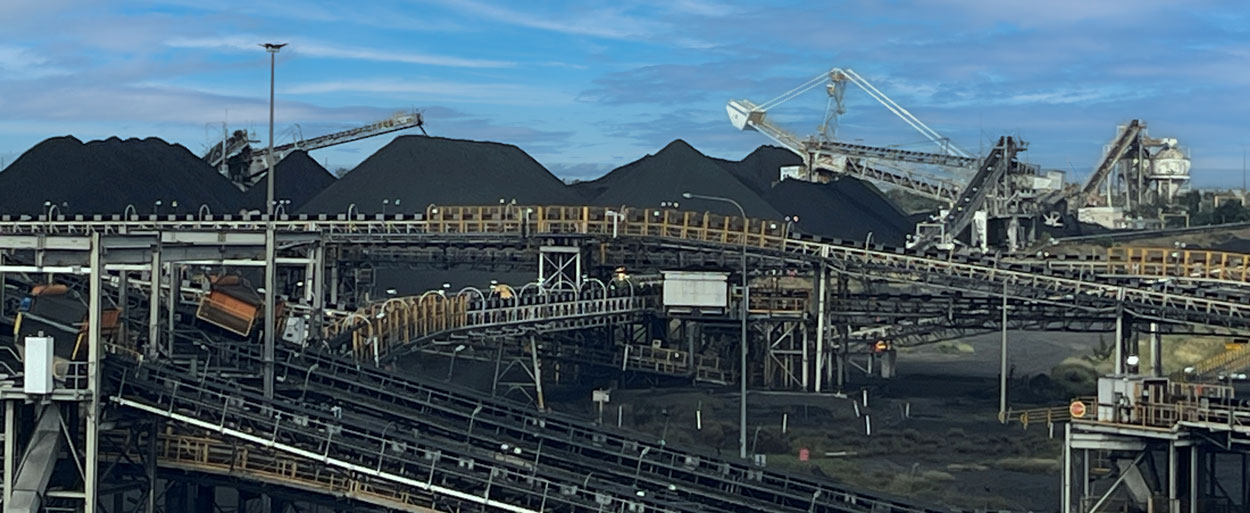
Mining is no longer just about moving tonnes — it’s about precision, predictability, and performance. Across Australia’s mining sector, the most forward-looking operators are adopting 3D scanning to transform the way they maintain and optimise chutes, hoppers, and material-handling systems.
At Hamilton By Design, we’ve been applying advanced scanning technology to reduce downtime, improve plant design accuracy, and extend asset life. You can read our detailed technical overview here: 👉 3D Scanning Chutes, Hoppers & Mining
But here’s the bigger picture — why this shift matters for the future of mining.
From Manual Inspection to Measured Insight
Traditional inspections rely on tape measures, hand sketches, and assumptions. 3D laser scanning replaces that guesswork with millimetre-accurate data captured safely, often without shutting down production.
Reduced risk: Personnel spend less time inside confined spaces.
Shorter shutdowns: Entire structures can be captured in minutes.
Design-ready models: Engineers receive CAD-compatible data for modification or replacement.
This means decisions are made on facts, not estimates.
Integrating Data into the Design Cycle
The true value of scanning is unlocked when the data feeds directly into design and maintenance workflows. Once a chute or hopper is scanned, engineers can:
Compare actual geometry to design intent.
Detect deformation, wear patterns, and misalignment early.
Pre-fit replacement liners or components in CAD — reducing on-site rework.
This seamless link between field reality and digital design enables data-driven engineering, saving both time and capital.
A New Standard for Asset Reliability
3D scanning creates a living record of your assets. Each scan becomes a baseline for future condition monitoring, allowing for proactive maintenance scheduling.
When combined with finite-element analysis (FEA) or wear modelling, site managers can predict failures before they happen. That means safer plants, lower maintenance costs, and fewer unplanned stoppages.
Part of a Larger Digital Ecosystem
The rise of digital twins and predictive analytics in mining depends on accurate base geometry — and that’s where scanning fits in. By capturing exact dimensions, operators can:
Link asset data into their digital twin models.
Simulate flow behaviour and wear progression.
Train AI models using accurate 3D data.
3D scanning isn’t just a tool — it’s the foundation of intelligent mining operations.
Why Hamilton By Design?
Our engineering approach combines field experience with digital precision. We integrate scanning, modelling, and mechanical design into a single workflow — from problem definition to implementable solutions.
Whether you’re replacing a worn-out chute, upgrading a hopper, or building a new transfer station, our 3D scanning process gives you clarity, accuracy, and confidence.
A Systems Engineering Approach for Reliable Coal Handling
In coal mining operations, transfer chutes play a deceptively small role with disproportionately large impacts. They sit quietly between conveyors, crushers, and stockpiles, directing tonnes of coal every hour. Yet when a chute is poorly designed or not maintained, the whole coal handling system suffers: blockages stop production, dust creates safety and environmental hazards, and worn liners demand costly maintenance shutdowns.
At Hamilton by Design, we believe coal chute design should be treated not as a piece of steelwork, but as a systems engineering challenge. By applying systems thinking, we connect stakeholder requirements, material behaviour, environmental factors, and lifecycle performance into a holistic design approach that delivers long-term value for mining operations in the Hunter Valley and beyond.
Coal Chutes in the Mining Value Chain
Coal chutes form the links in a chain of bulk material handling equipment:
ROM bins and crushers feed coal into the system.
Conveyors carry coal across site, often over long distances.
Transfer chutes guide coal between conveyors or onto stockpiles.
Load-out stations deliver coal to trains or ports for export.
Although they are small compared to conveyors or crushers, coal chutes are often where problems first appear. A well-designed chute keeps coal flowing consistently; a poorly designed one causes buildup, spillage, dust emissions, and accelerated wear. That’s why leading operators now see chute design as a critical system integration problem rather than just a fabrication task.
Systems Engineering in Coal Chute Design
Systems engineering is the discipline of managing complexity in engineering projects. It recognises that every component is part of a bigger system, with interdependencies and trade-offs. Applying this mindset to coal chute design ensures that each chute is considered not in isolation, but as part of the broader coal handling plant.
1. Requirements Analysis
The first step is gathering and analysing stakeholder and system requirements:
Throughput capacity: e.g. handling 4,000 tonnes per hour of coal.
Material properties: coal size distribution, moisture content, abrasiveness, stickiness.
Safety requirements: compliance with AS/NZS 4024 conveyor safety standards, confined space entry protocols, guarding, and interlocks.
Environmental compliance: dust, noise, and spillage limits.
Maintenance objectives: target liner life (e.g. 6 months), maximum downtime per liner change (e.g. 30 minutes with two workers).
A structured requirements phase reduces the risk of costly redesign later in the project.
2. System Design and Integration
Once requirements are defined, the design process considers how the chute integrates into the coal handling system:
Flow optimisation using DEM: Discrete Element Modelling allows engineers to simulate coal particle behaviour, test different geometries, and reduce blockages before steel is ever cut.
Dust control strategies: designing chutes with enclosures, sprays, and extraction ports to minimise airborne dust.
Wear management: predicting wear zones, selecting suitable liner materials (ceramic, Bisplate, rubber composites), and ensuring easy access for replacement.
Structural and safety design: ensuring the chute can withstand dynamic loads, vibration, and impact, while providing safe access platforms and guarding.
Interfaces with conveyors and crushers: alignment, skirt seals, trip circuits, and integration with PLC/SCADA control systems.
By treating the chute as a subsystem with multiple interfaces, designers avoid the “bolt-on” mentality that often leads to operational headaches.
3. Verification and Validation
The systems engineering V-model reminds us that every requirement must be verified and validated:
System validation: commissioning with live coal flow, dust monitoring against limits, maintainability time trials for liner change.
By linking requirements directly to tests in a traceability matrix, operators can be confident that the chute is not only built to spec, but proven in operation.
Lifecycle Engineering: Beyond Installation
Good chute design doesn’t stop at commissioning. A lifecycle engineering mindset ensures the chute continues to deliver performance over years of operation.
Maintainability: modular liners, captive fasteners, hinged access doors, and clear procedures reduce downtime and improve worker safety.
Reliability: DEM-informed designs and wear-resistant materials reduce the frequency of blockages and rebuilds.
Sustainability: dust suppression and enclosure strategies reduce environmental impact and support community and regulatory compliance.
Continuous improvement: feedback loops from operators and maintenance teams feed into the next design iteration, closing the systems engineering cycle.
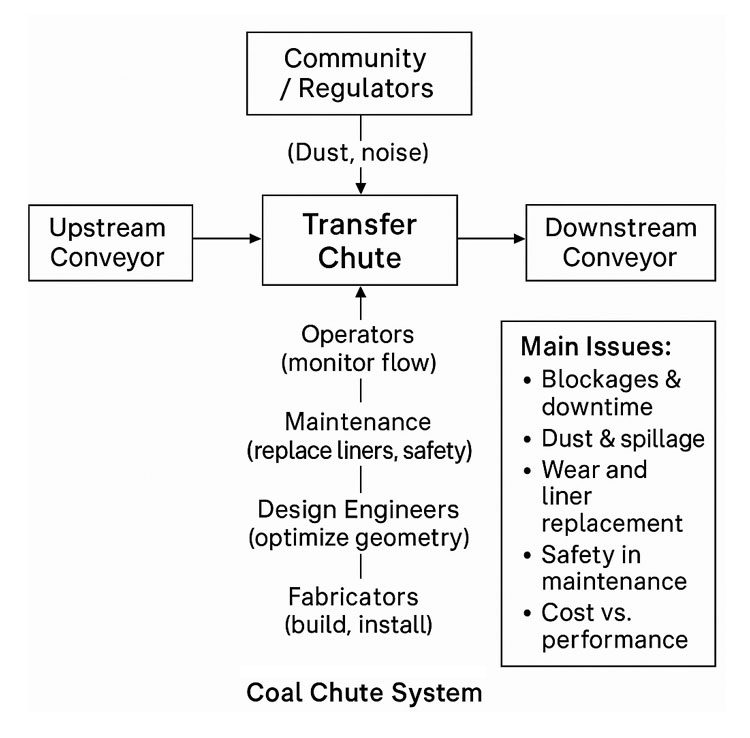
A Rich Picture of Coal Chute Complexity
Visualising the coal chute system as a rich picture reveals its complexity:
Operators monitoring flow from control rooms.
Maintenance crews working in confined spaces, replacing liners.
Design engineers using DEM simulations to model coal flow.
Fabricators welding heavy plate sections on site.
Environmental officers measuring dust levels near transfer points.
Regulators and community monitoring compliance.
This web of relationships shows why coal chute design benefits from systems thinking. No single stakeholder sees the whole picture—but systems engineering does.
Benefits of a Systems Engineering Approach
When coal chute design is guided by systems engineering principles, operators gain:
Higher reliability: smoother coal flow with fewer blockages.
Lower maintenance costs: liners that last longer and can be swapped quickly.
Improved compliance: dust, spillage, and safety issues designed out, not patched later.
Lifecycle value: less unplanned downtime and a lower total cost of ownership.
In short, systems engineering transforms coal chutes from weak links into strong connectors in the mining value chain.
Case Study: Hunter Valley Context
In the Hunter Valley, coal mines have long struggled with transfer chute problems. Companies like T.W. Woods, Chute Technology, HIC Services, and TUNRA Bulk Solids have all demonstrated the value of combining local fabrication expertise with advanced design tools. Hamilton by Design builds on this ecosystem by applying structured systems engineering methods, ensuring each chute project balances performance, safety, cost, and sustainability.
Conclusion
Coal chute design might seem like a small detail, but in mining, details matter. When transfer chutes fail, production stops. By applying systems engineering principles—from requirements analysis and DEM modelling to verification, lifecycle planning, and continuous improvement—we can design coal chutes that are reliable, maintainable, and compliant.
At Hamilton by Design, we believe in tackling these challenges with a systems mindset, delivering solutions that stand up to the realities of coal mining.
Are you struggling with coal chute blockages, dust, or costly downtime in your coal handling system?
Contact Hamilton by Design today and discover how our systems engineering expertise in coal chute design can optimise your mining operations for performance, safety, and sustainability.
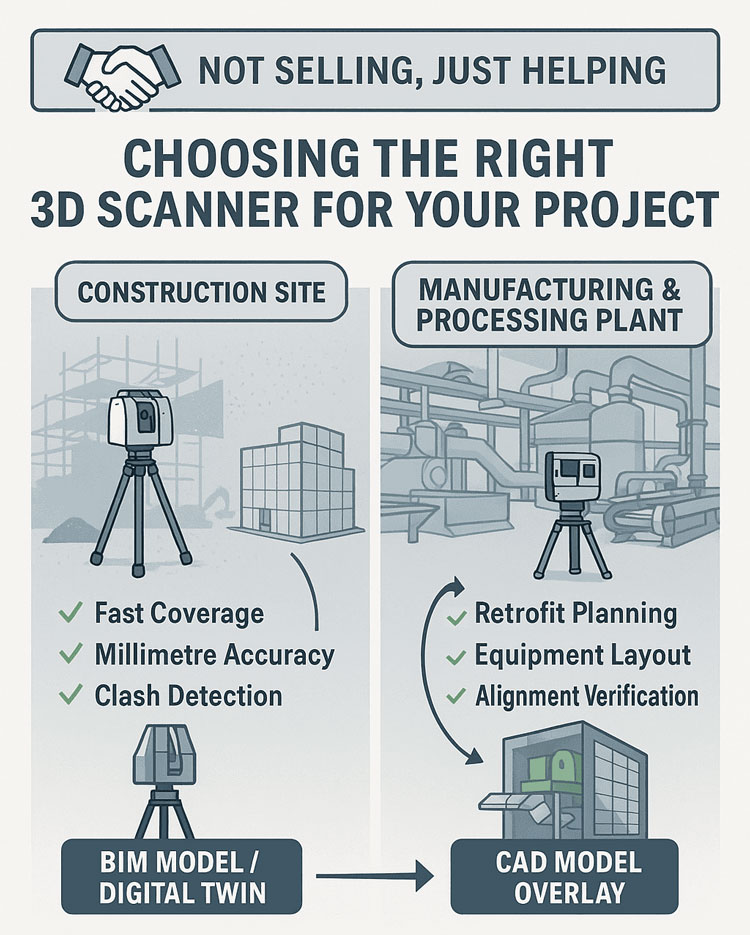
At Hamilton By Design, we know that 3D scanning has become an essential tool for modern engineering — from capturing as-built conditions on construction sites to modeling complex processing plants and validating manufacturing layouts. But not all scanners are created equal, and selecting the right technology is crucial to getting reliable data and avoiding costly surprises later in the project.
3D Scanning for Construction Sites
For construction and infrastructure projects, coverage and speed are the top priorities. Terrestrial Laser Scanning (TLS) and LiDAR systems like the FARO Focus S70 are ideal for quickly capturing entire job sites with millimetre-level accuracy. These scanners allow engineers and project managers to:
Verify as-built conditions against design models
Detect clashes early in the process
Support accurate quantity take-offs and progress documentation
TLS works well in tough environments — dust, sunlight, and complex geometry — making it a perfect fit for active building sites.
3D Scanning for Manufacturing & Processing Plants
When it comes to manufacturing facilities and mining processing plants, accuracy and detail matter even more. Scans are often used for:
Retrofit planning and clash detection in tight plant rooms
Structural steel and conveyor alignment checks
Equipment layout for expansion projects
Here, combining TLS with feature-based CAD modeling allows us to deliver data that is usable for engineering design, ensuring that new equipment fits exactly as intended.
We’re Here to Help
Hamilton By Design doesn’t sell scanners — we focus on providing unbiased, engineering-driven advice. If you’re unsure which scanning approach is right for your project, we’re happy to share our experience and guide you toward the best solution.
Feel free to get in touch to discuss your project needs — whether it’s a construction site, manufacturing facility, or processing plant, we can help you turn accurate scan data into actionable engineering insights.
3D Laser Scanning & Mechanical Engineering Solutions
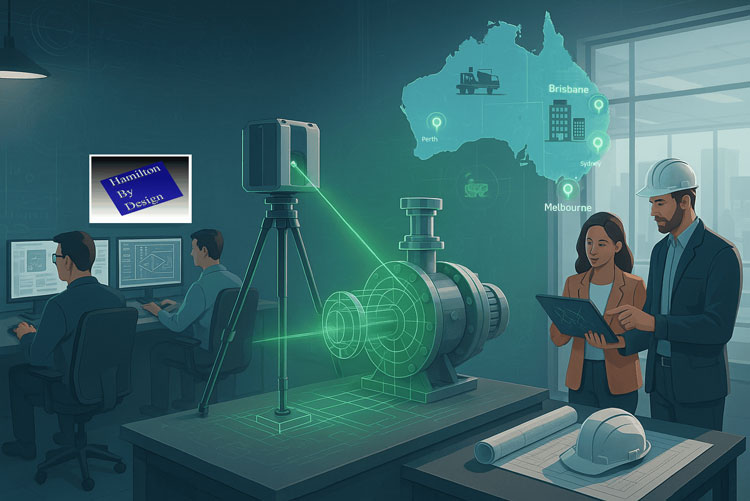
In today’s fast-paced engineering and construction industries, precision and efficiency are everything. Whether you’re managing a large-scale infrastructure project in Brisbane, creating a mechanical prototype in Perth, or needing accurate as-built data for a site in the Hunter Valley, 3D laser scanning and expert mechanical design services are game changers.
At Hamilton By Design, we specialise in connecting cutting-edge scanning technology with skilled mechanical designers and structural drafting services to deliver seamless, accurate solutions for every stage of your project.
The Power of 3D Laser Scanning
3D laser scanning is transforming the way engineers, architects, and manufacturers work. By capturing millions of data points with millimetre accuracy, laser scanning creates a highly detailed 3D representation of your asset, site, or structure.
Our team provides 3D laser scanning services in Perth, Brisbane, and Melbourne, as well as laser scanning in the Hunter Valley, helping clients save time and avoid costly rework. This technology is ideal for:
Capturing as-built conditions before design or construction.
Supporting plant upgrades and facility expansions.
Documenting heritage structures and complex geometries.
Reducing site visits with accurate digital models.
Reverse Engineering & Mechanical Design
In addition to scanning, we offer reverse engineering services in Perth and beyond. By combining point cloud data with CAD modelling, we can recreate components, optimise designs, and prepare manufacturing-ready files.
Our mechanical engineers and mechanical designers bring years of experience in 3D mechanical engineering, design and manufacturing mechanical engineering, and problem-solving for a wide range of industries. From bespoke machinery to process equipment, we deliver solutions that work.
Structural Drafting & Project Support
No project is complete without clear, accurate documentation. Our skilled drafters at Hamilton By Design provide high-quality structural drafting services that integrate seamlessly with your workflows.
Whether you need shop drawings, fabrication details, or BIM-ready models, our team ensures every line and dimension is correct — saving you time and cost on-site.
Why Choose Hamilton By Design?
Nationwide Reach: Serving clients with 3D scanning services in Perth, Brisbane, and Melbourne, and supporting projects in the Hunter Valley.
Complete Solutions: From scanning to modelling to mechanical engineering design.
Accuracy & Efficiency: Reduce project risk and improve decision-making with reliable data.
Experienced Team: Skilled mechanical engineers and drafters who understand your industry.
Ready to Get Started?
If you’re looking for mechanical engineering companies that deliver precision, innovation, and reliability, Hamilton By Design is ready to help. Whether you need laser scanning in Perth or Brisbane, structural drafting, or full mechanical design services, our team can support your next project from concept to completion.
Contact us today to discuss your project requirements and find out how our 3D laser scanning and mechanical engineering design solutions can save you time and money.
In today’s world, accuracy and efficiency can make or break a project. Whether you’re working in architecture, construction, engineering, or product design, you need reliable data — and you need it fast. That’s where 3D point clouds come in.
But there’s an important catch: not all scans are created equal. The difference between an average scan and a great one often comes down to the person behind the scanner. Having someone who understands 3D modeling take the scans can dramatically improve your project’s accuracy, reliability, and overall success.
Let’s break down why.
The Power of 3D Point Clouds
Point clouds are essentially millions of tiny data points that capture the shape of an object, room, or entire site. Together, they create a highly detailed digital snapshot of the real world.
Here’s why this matters:
Precision you can trust – Point clouds deliver incredibly detailed measurements, capturing even the smallest curves and angles.
Nothing gets missed – Multiple scan angles ensure a full, 360° view of your site or object.
Speed and efficiency – What used to take hours (or days) with manual measurements can be captured in minutes.
Built-in context – You’re not just getting numbers; you’re getting a complete digital environment to work inside.
Future-proof data – Once you have a scan, you have a permanent record of your space, ready to use months or years later.
From clash detection to as-built verification, point clouds save time, reduce errors, and make collaboration across teams smoother than ever.
Why the Person Taking the Scan Matters
While technology is powerful, experience is what makes the results reliable. Having a skilled 3D modeler operate the scanner can be the difference between a good project and a great one.
Here’s why an expert makes all the difference:
They know what matters – A modeler understands which details are critical for your project and ensures they’re captured.
Fewer gaps, fewer surprises – Experienced pros know how to plan scan positions to cover every angle and avoid blind spots.
Cleaner, more accurate data – They reduce common issues like noise, misalignment, or missing sections that can throw off your model.
Time saved, headaches avoided – No one wants to redo a scan halfway through a project. A professional ensures you get it right the first time.
Confidence from start to finish – When you know your model is accurate, you can move forward with design and construction decisions without second-guessing.
In short: a great scanner operator doesn’t just deliver data — they deliver peace of mind.
The Bottom Line
3D point clouds are already transforming how projects are planned and delivered. But pairing them with an experienced 3D modeler takes things to the next level.
You’ll get better data, faster turnarounds, and a far lower risk of costly mistakes. And when your goal is to deliver projects on time, on budget, and with zero surprises, that’s an edge you can’t afford to miss.
How 3D Laser Scanning is Redefining Reality for Design, Construction & Heritage
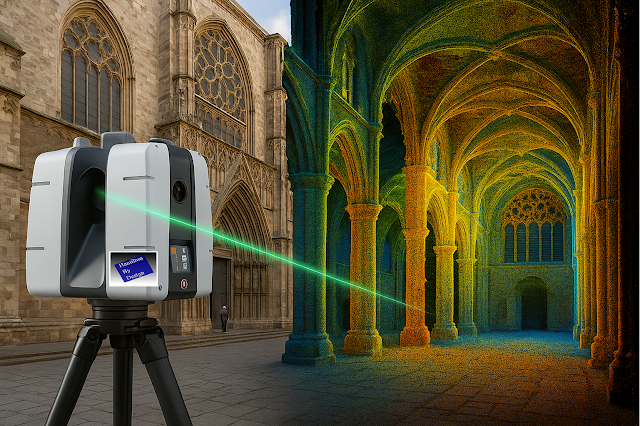
Imagine standing before a centuries-old cathedral, where every carved arch, every stained-glass pane, every weathered stone holds centuries of stories. Capturing its true form and condition with tape measure and camera? Tedious and prone to errors. But with 3D laser scanning, you can digitally freeze every detail—down to the imperfections—turning reality into an exact, manipulable model.
In an age where precision, speed, and data-driven decisions are non-negotiable, 3D laser scanning is no longer “nice to have”—it’s essential. Let’s explore what it is, why it’s transformative, where it’s being used most powerfully, and how you can harness its potential.
What Is 3D Laser Scanning?
At its core, 3D laser scanning sometimes called terrestrial laser scanning, (TLS) is the emission of laser pulses toward surfaces, recording the time it takes for those pulses to bounce back. From that comes a dense “point cloud” — billions of precise data points mapping shape, texture, orientation, and distance.
These point clouds become high-fidelity models, maps, meshes, or BIM ready files. Whether you’re scanning building exteriors, interiors, or industrial components, the result is more than just imagery—it’s measurable, analyzable geometry.
How It Works — The Process
Preparation & Planning
Define what you need: the level of detail (LOD), resolution, range, and whether external conditions (light, weather) will interfere.
Data Capture
Position the scanner at multiple stations to cover all surfaces. Use targets or reference markers for alignment and capture with overlapping scans.
Processing & Registration
Merge scans to align them properly, clean noise, filter out irrelevant data (like people, moving objects), calibrate.
Post-processing & Deliverables
Convert point clouds into usable outputs—floorplans, sections, elevations, 3D meshes, BIM models, virtual walkthroughs. Run analyses (clash detection, deformation etc.).
Integration & Use
Use the data in design, restoration, facility management, or documentation. The quality of integration (into BIM, GIS, CAD) is key to unlocking value.
Key Benefits
Benefit
What It Means in Practice
Real-World Impact
Extreme Precision
Sub-millimetre to millimetre accuracy depending on the scanner and conditions.
Less rework. Better fit for retrofit, renovation, or mechanical systems in tight tolerances.
Speed + Efficiency
Collect large amounts of spatial data in far less time than traditional measurement.
Faster project turnaround. Reduced site time costs.
Non-Contact / Low Disruption
Good for fragile structures, hazardous or difficult-to-access places.
Preserves integrity of heritage buildings; safer for workers.
Comprehensive Documentation
Full visual & geometric context.
Informs future maintenance. Acts as an archival record.
Better Decision Making & Conflict Detection
Early clash detection; scenario simulation; what-if modelling.
Avoids costly mistakes; helps build consensus among stakeholders.
Enhanced Visualisation & Communication
Stakeholders can see exactly what exists vs. what’s being proposed.
Facility Management: Digital twins, maintenance, asset tracking.
Environment & Surveying: Terrain mapping, forestry, flood risk mapping (especially when combined with aerial systems or mobile scanning).
Challenges & Best Practices
Nothing is perfect. To get the most out of 3D laser scanning, anticipate and mitigate:
Environmental factors: Light, dust, rain, reflective surfaces can introduce noise.
Data overload: Massive point clouds are large; need strong hardware & efficient workflows.
Alignment & registration errors: Overlaps, control points, and calibration are vital.
Skill & Planning: Good operators + good planning = much better outcomes.
Key best practices:
Use reference targets for precise registration.
Capture overlap of 30-50% between scan positions.
Break project into manageable segments.
Clean noise early.
Think ahead about deliverables and how clients will use the data (design, BIM, VR etc.).
Case Studies & Stories
Heritage in Danger: A cathedral in Europe threatened by pollution and structural decay was laser scanned. The point cloud revealed minute deformations, enabling an accurate restoration plan—saving costs and preserving history.
Infrastructure Efficiency: A civil engineering firm reduced design clashes by 80% on a complex highway project by integrating scans with their BIM workflow.
Industrial Switch-Over: Manufacturing plant layout was reconfigured using scan data; downtime reduced because the virtual model matched reality better than the old blueprints.
Software, Tools & Ecosystem
While scanners are vital, the software ecosystem is what unlocks value. Tools that turn raw data into actionable insights include:
Reality capture tools (processing point clouds).
BIM / CAD integration (e.g. Revit, AutoCAD).
Visualization tools (VR, AR, walkthrough).
Data sharing & collaboration platforms.
Cloud storage / processing if large point clouds.
SaaS/cloud-based workflows are increasingly important to share among remote teams, facilitate stakeholder review, and ensure data is accessible beyond just technical users.
Why It Matters Now
Global pressures (heritage, sustainability, faster build cycles, remote work) are raising the bar.
Regulatory compliance and “as-built” requirements are stricter.
Digital twins & smart infrastructure demand high fidelity data.
3D laser scanning acts as a bridge: between physical world and digital twin; between heritage past and future; between design promise and build reality. If you have a survey scan and want to make sense of point cloud data, contact Hamilton By Design
To provide the best experiences, we use technologies like cookies to store and/or access device information. Consenting to these technologies will allow us to process data such as browsing behaviour or unique IDs on this site. Not consenting or withdrawing consent, may adversely affect certain features and functions.
Functional
Always active
The technical storage or access is strictly necessary for the legitimate purpose of enabling the use of a specific service explicitly requested by the subscriber or user, or for the sole purpose of carrying out the transmission of a communication over an electronic communications network.
Preferences
The technical storage or access is necessary for the legitimate purpose of storing preferences that are not requested by the subscriber or user.
Statistics
The technical storage or access that is used exclusively for statistical purposes.The technical storage or access that is used exclusively for anonymous statistical purposes. Without a subpoena, voluntary compliance on the part of your Internet Service Provider, or additional records from a third party, information stored or retrieved for this purpose alone cannot usually be used to identify you.
Marketing
The technical storage or access is required to create user profiles to send advertising, or to track the user on a website or across several websites for similar marketing purposes.