Mechanical Engineering | 3D Scanning | 3D Modelling
Category: 3D Scanning & Digital Engineering
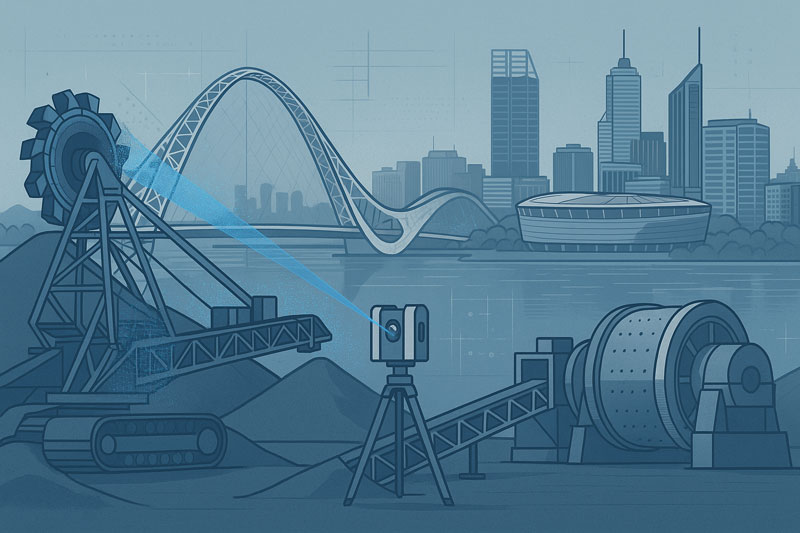
3D Laser Scanning & Reality Capture covers the practical use of engineering-grade 3D laser scanning, LiDAR, and reality capture technologies to accurately document existing assets and site conditions.
This category focuses on how scan data is planned, captured, verified, and converted into usable engineering outputs, including as-built drawings, 3D CAD models, and scan-to-CAD workflows. Content explores real-world applications across power generation, manufacturing, mining, and building & construction, particularly in brownfield and live-site environments where accuracy and control are critical.
Articles in this category examine the difference between visual capture and engineering-grade scanning, the importance of datums, tolerances, and registration, and how reality capture supports Australian Standards–aligned design and documentation.
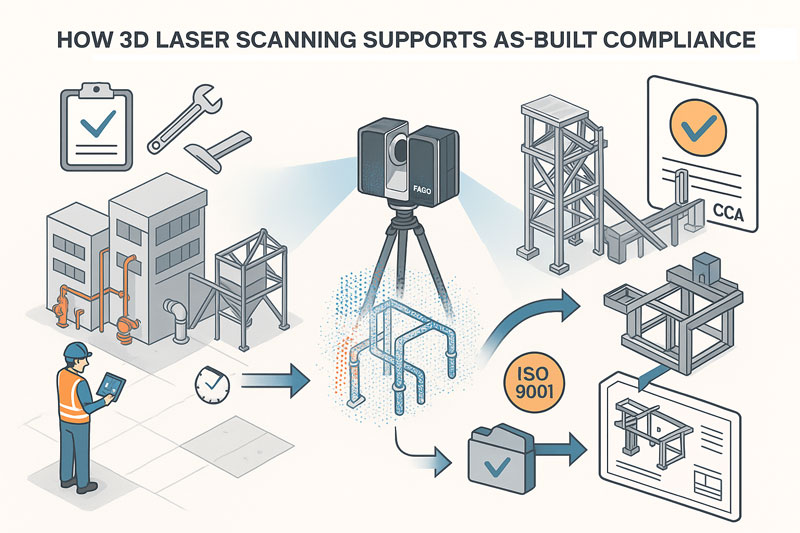
✔ Simplifies BCA Documentation for Fire, Mechanical & Structural Systems
Scanning assists with validating:
Fire Safety Systems
Hydrants, hose reels, fire pump rooms
Fire damper locations
Egress paths and spatial compliance
Service penetrations
Mechanical Systems
Duct routes
Plant room layouts
Fan coil units / AHU placement
Shaft centre-lines
Compliant access paths
Structural Elements
Columns
Beams
Brackets
Plant mounts
Retrofitted steelwork
Tolerance checks
The point cloud provides certifiers with confidence that what was installed does not deviate from approved plans beyond allowable tolerances.
✔ Strengthens ISO 9001 & Government QA Requirements
Most government tenders (TfNSW, Defence, Health Infrastructure, QBuild, etc.) require:
Traceable QA
As-constructed verification
Digital documentation
A 3D scan becomes proof of measurement, improving your QA process by providing:
Verifiable dimensional control
Pre-fabrication QA
Handover packages that exceed minimum compliance
4. How Hamilton By Design Can Position This Service
3D Laser Scanning Enables:
NCC-compliant as-built documentation
Faster certifier approval
Fewer construction disputes
Reduced rework during commissioning
Better safety compliance
Accurate digital twins for maintenance and lifecycle management
You can state (truthfully):
“Our 3D scans provide defensible, audit-ready as-built records that satisfy NCC, engineering, and certification requirements. Certifiers appreciate the precision because it removes ambiguity and reduces approval delays.”
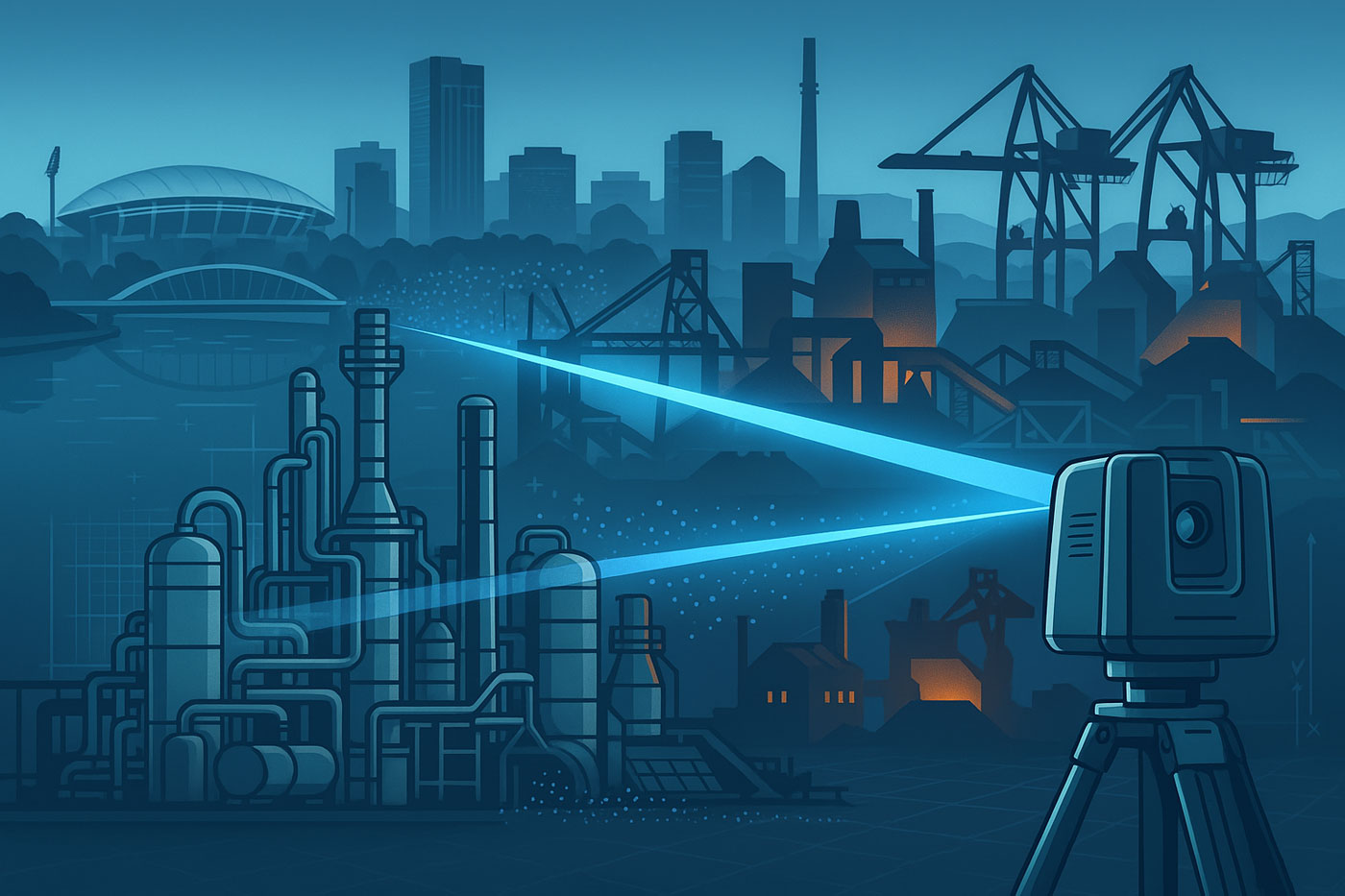
Adelaide is the engineering hub for South Australia’s gas plants, mining operations and the Whyalla steelworks. Hamilton By Design supports these assets with high-accuracy 3D LiDAR scanning, 3D modelling, mechanical and structural engineering and FEA, so upgrades and shutdowns go together first time, every time.
We help project teams reduce rework, improve safety and make better decisions with reliable, engineering-ready as-built data.
Who We Work With in South Australia
We provide 3D scanning and engineering support for:
Gas & power operations
Torrens Island power station and associated gas infrastructure near Adelaide
Gas processing, compressor stations and pipelines linked to Moomba and Cooper Basin supply
Mining operations engineered from Adelaide
Olympic Dam, Prominent Hill, Carrapateena and other copper, gold and uranium operations
Satellite processing plants, conveyors, crushers and SAG mills that feed these mines
Steel and heavy industrial assets
Whyalla Steelworks – Australia’s only manufacturer of rail and a major producer of structural steel
Associated ports, materials-handling systems and mining operations in the Middleback Range
Fabrication and maintenance workshops around Adelaide, Port Adelaide, Wingfield, Osborne and Whyalla handling heavy steel, OEM equipment and modular skids.
If your plant moves gas, ore, concentrate or steel, we can scan it, model it and help you engineer changes with confidence.
3D LiDAR Scanning for Gas, Mining & Steel
We deploy 3D laser scanners to capture dense point clouds of complex brownfield environments, including:
Gas plants, compressor stations and power station pipe racks
Process plants, crushers, screens, SAG/ball mills and transfer towers
Conveyors, stacker-reclaimers and stockpile systems
Structural steel, platforms, stairs and access ways
Tank farms, pump skids and utility systems
Steelmaking plant and materials-handling systems at Whyalla
Why use 3D scanning?
Accurate as-built data when drawings are outdated or missing
Less time on site and fewer return visits
Safer measurement in congested or high-risk areas
Better shutdown planning and tie-in design
Reduced rework when installing new equipment or modules
We can scan during shutdowns, night shifts or live-plant windows, working under your permit-to-work and safety systems.
From Point Cloud to Engineering-Ready Models
Using the scan data, we create clean 3D models suitable for design, verification and fabrication:
Piping and equipment models for gas plants and power stations
Mechanical models of crushers, feeders, chutes, SAG mills and associated structures
Structural steel models for access, maintenance and support frames
As-built models of conveyors, galleries and transfer towers
Key areas of the Whyalla steelworks where modifications or replacements are planned
Deliverables can include:
Registered point clouds (E57, RCP/RCS, LAS)
3D CAD models (SolidWorks, STEP/IGES, IFC)
2D drawings for fabrication and installation
Sections, clearances and clash-check views for design teams
Digital QA for Fabrication & Site Fit-Up
For Adelaide and Whyalla workshops fabricating for remote mines, gas plants or the steelworks, we provide digital quality assurance:
Scan fabricated skids, frames, spools or chutes in the workshop
Compare against the design model and/or original plant scan
Check flange positions, bolt patterns, centre distances and critical interfaces
Issue a clear report before the gear is shipped to site
This approach can catch misalignment and build issues early, avoiding costly rework at remote SA sites or within the Whyalla plant itself.
Mechanical, Structural & FEA Support
Where required, we combine scanning and modelling with engineering analysis:
Mechanical design and verification of chutes, hoppers, frames and supports
Structural checks on platforms, access systems and equipment supports
FEA on high-load or fatigue-critical components (e.g. mill components, support brackets)
Assessment of temporary lifting, transport or installation configurations
Results are documented in practical engineering reports, suited to internal review or third-party verification.
Why Adelaide & Whyalla Benefit from 3D Scanning
Centralised engineering in Adelaide, remote assets in the field – scan once, work from the digital twin for months or years
Brownfield plant everywhere – expansions, life-extension and decarbonisation projects all need accurate data
Tight shutdowns and limited access windows – better information = fewer surprises
Complex equipment such as mills, crushers, kilns and gas process skids that are difficult to measure by hand
3D scanning and digital workflows help owners and project teams manage risk on high-value, safety-critical assets.
Let’s Talk About Your SA Project
Whether you’re planning:
A gas plant upgrade near Adelaide
A mining project engineered in the CBD
Fabrication for Whyalla Steelworks or related mines
A shutdown requiring accurate as-built information
Hamilton By Design can support you with 3D LiDAR scanning, modelling and engineering.
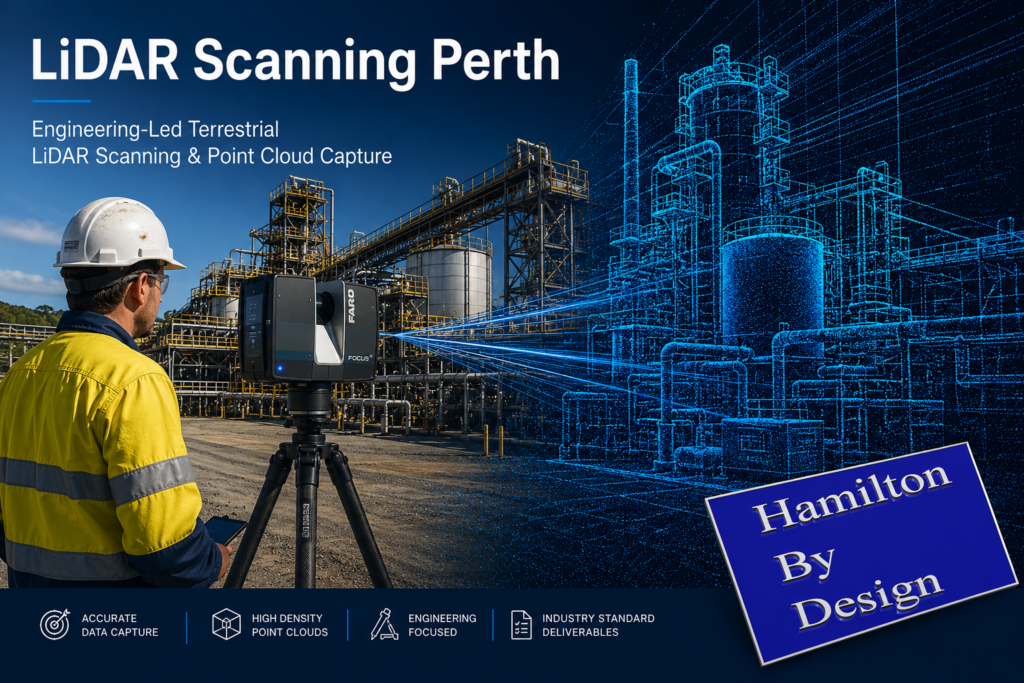
Engineering-Grade Terrestrial LiDAR Scanning Services Across Perth and Western Australia
Hamilton By Design delivers high-precision 3D LiDAR scanning for Perth-based engineering teams, fabrication workshops and remote WA mining operations. Whether your project is in Welshpool, the Pilbara, Kalgoorlie, or anywhere across regional WA, our 3D scans provide the accurate as-built data you need to design, model and install with confidence.
LiDAR scanning has become one of the most effective methods for capturing accurate three-dimensional information from existing industrial facilities, infrastructure assets and commercial buildings. By using terrestrial laser scanning technology, millions of survey-grade measurement points can be collected in a matter of hours, creating a highly detailed digital representation of real-world environments.
Hamilton By Design provides engineering-led LiDAR scanning services throughout Perth and Western Australia, supporting mining operations, mineral processing facilities, manufacturing plants, infrastructure projects and complex industrial environments.
Unlike traditional measurement methods that rely on individual dimensions and manual site sketches, terrestrial LiDAR captures complete environments, enabling project teams to work from measured reality rather than assumptions.
The resulting point cloud data provides an accurate digital record of existing conditions and can be used to support asset management, engineering studies, refurbishment projects, shutdown planning, construction verification and digital transformation initiatives.
What Is LiDAR Scanning?
LiDAR (Light Detection and Ranging) is a measurement technology that uses laser pulses to determine the position of objects and surfaces within an environment. By recording the time taken for each laser pulse to travel to a surface and return to the scanner, millions of highly accurate measurements can be captured and converted into a three-dimensional digital representation of the real world.
Modern terrestrial LiDAR scanners can collect hundreds of thousands of measurements per second, enabling large industrial facilities, processing plants, infrastructure assets and commercial buildings to be documented quickly and accurately.
The resulting dataset is commonly referred to as a point cloud. Each point represents a measured location in three-dimensional space and collectively forms a detailed digital record of the scanned environment.
For industrial and engineering projects, LiDAR scanning provides a practical alternative to traditional tape measures, manual surveys and incomplete legacy drawings. Rather than measuring individual dimensions, entire facilities can be captured in a single coordinated dataset, allowing project teams to review, analyse and measure existing conditions long after the site visit has been completed.
LiDAR scanning is now widely used throughout mining, mineral processing, manufacturing, power generation, water treatment, transport infrastructure and commercial construction projects where accurate existing-condition information is essential for successful project delivery.
Terrestrial LiDAR scanners are positioned at multiple locations throughout a site to capture measurements from different viewpoints. During each scan, the instrument emits laser pulses that reflect from surrounding surfaces and return to the scanner. These measurements are combined with angular position information to determine the precise three-dimensional location of each point.
Because industrial facilities often contain equipment, structures, pipework and other objects that can obstruct the line of sight, multiple scan positions are typically required to capture the complete environment. The individual scans are then aligned and registered together to create a unified point cloud representing the entire site.
Modern LiDAR systems can capture millions of measurements within a relatively short period, allowing large areas to be documented efficiently while maintaining a high level of detail. Colour imagery can also be captured during the scanning process, providing additional visual context for project teams reviewing the data.
Once registration and quality checks have been completed, the resulting point cloud can be viewed, measured and analysed using specialised software platforms. Engineers, designers, asset owners and project managers can then access accurate existing-condition information without requiring repeated site visits.
This process creates a digital record of the facility at the time of capture, providing valuable information for refurbishment projects, shutdown planning, asset management, engineering studies, construction verification and future modifications.
Benefits of LiDAR Scanning for Industrial Facilities
Industrial facilities are constantly evolving. Equipment is upgraded, pipework is rerouted, structures are modified and assets are replaced over time. In many cases, existing drawings no longer accurately represent current site conditions, creating challenges for maintenance teams, engineers, contractors and asset owners.
LiDAR scanning provides a reliable method of capturing accurate existing-condition information before project work begins. By collecting millions of measurement points across an entire facility, project teams gain access to a detailed digital representation of the site that can be reviewed and measured long after fieldwork has been completed.
One of the primary benefits of LiDAR scanning is the reduction in repeat site visits. Rather than returning to site to confirm dimensions or investigate potential clashes, teams can often access the required information directly from the registered point cloud.
LiDAR scanning can also improve project planning and coordination. Designers, engineers and stakeholders can review existing conditions using a common dataset, helping to identify spatial constraints, access requirements and potential conflicts before fabrication or construction activities commence.
For operational facilities, data capture can often be completed while minimising disruption to production activities. This allows project teams to obtain accurate site information without the extended downtime that may be associated with traditional measurement methods.
Additional benefits of LiDAR scanning include:
Rapid capture of complex environments
Improved visibility of existing conditions
Reduced reliance on legacy drawings
Enhanced project planning and coordination
Better understanding of spatial relationships
Reduced risk of measurement errors
Improved documentation of assets and infrastructure
Support for digital engineering and asset management initiatives
As industrial facilities continue to adopt digital engineering workflows, LiDAR scanning is increasingly becoming a foundational tool for capturing reliable information that supports decision-making throughout the asset lifecycle.
LiDAR Scanning for Mining and Resources Projects
The mining and resources sector operates some of the most complex industrial facilities in Australia. Processing plants, conveyors, crushers, transfer stations, stockpile systems, workshops, tank farms, smelters and materials handling infrastructure often undergo continuous modification throughout their operational life.
Accurate existing-condition information is essential when planning upgrades, shutdowns, equipment replacements and brownfield expansion projects. Unfortunately, many sites rely on legacy drawings that may no longer accurately reflect the current configuration of the facility.
Terrestrial LiDAR scanning provides a practical solution by capturing the actual physical environment as it exists on site. Millions of measurement points can be collected across plant areas, creating a detailed digital record that supports engineering, maintenance and asset management activities.
Within mining and resource operations, LiDAR scanning is commonly used to document:
Processing plants and beneficiation facilities
Conveyors and materials handling systems
Crushers, screens and transfer stations
Smelters and refining operations
Structural steel and access platforms
Pipe racks and process services
Tank farms and storage facilities
Workshops and maintenance infrastructure
Shutdown and turnaround project areas
Brownfield expansion locations
The resulting point cloud provides project teams with a reliable source of information for planning and decision-making. Existing conditions can be reviewed before personnel return to site, helping improve project preparation and reducing uncertainty during design and construction activities.
LiDAR scanning is particularly valuable where access is difficult, production schedules are constrained or facilities have undergone numerous modifications over time. By capturing measured reality, project teams can work from current site information rather than assumptions or outdated documentation.
Across Western Australia, LiDAR scanning is increasingly supporting mining, mineral processing, oil and gas, bulk materials handling and heavy industrial facilities as organisations continue to adopt digital engineering and asset management practices.
Point Cloud Registration and Quality Assurance
The quality of a LiDAR scanning project is determined not only by the data collected in the field but also by the processes used to align, verify and validate that information after capture. Individual scans must be accurately combined to create a single coordinated dataset that represents the facility as a whole.
This process is known as point cloud registration. During registration, overlapping scan positions are aligned using common reference points and geometric features captured throughout the scanning process. The objective is to ensure that all scans occupy the correct position within the three-dimensional environment and accurately represent the physical site conditions.
For industrial facilities, registration is particularly important because projects often involve multiple scan locations, complex structures and extensive plant areas. Without proper registration, measurement accuracy can be reduced and inconsistencies may be introduced into the final dataset.
Quality assurance procedures are typically undertaken throughout both fieldwork and data processing activities. These checks may include:
Verification of scan coverage
Review of registration quality reports
Validation of overlapping scan positions
Identification of missing or obscured areas
Assessment of point cloud consistency
Confirmation of coordinate systems where applicable
Review of deliverable requirements
By applying structured registration and quality assurance processes, project teams can have greater confidence that the resulting point cloud accurately reflects the conditions present at the time of capture.
A well-registered point cloud provides a reliable foundation for future project activities including asset documentation, engineering studies, refurbishment planning, digital engineering workflows and construction verification. It also enables stakeholders to extract measurements, review spatial relationships and investigate site conditions without relying solely on field observations.
As industrial facilities become increasingly reliant on digital information, point cloud registration and quality assurance remain essential components of delivering accurate, dependable and usable LiDAR scanning data.
Engineering-Grade Accuracy and Data Validation
Accuracy is one of the primary reasons organisations choose terrestrial LiDAR scanning for industrial, infrastructure and asset management projects. The ability to capture millions of measured points across an environment provides project teams with a detailed representation of existing site conditions that can support planning, design and decision-making activities.
However, achieving reliable results requires more than simply operating a scanner. The quality of the final point cloud is influenced by factors including scan planning, equipment selection, site conditions, registration workflows and quality assurance procedures.
Engineering-grade LiDAR scanning focuses on capturing data that is suitable for practical project applications. This begins with identifying the objectives of the survey and understanding the level of detail required. Different projects may require different scanning resolutions, coverage areas and validation procedures depending on how the data will ultimately be used.
Several factors can influence data quality, including:
Distance between the scanner and the target
Surface characteristics and material reflectivity
Environmental conditions during capture
Line-of-sight restrictions
Plant congestion and equipment density
Scan position planning
Registration quality between scans
Industrial facilities can present additional challenges due to elevated structures, confined spaces, complex pipework arrangements and restricted access areas. Effective scan planning helps minimise these challenges and improves overall dataset quality.
Data validation is an important part of the workflow and helps confirm that the point cloud accurately represents the physical environment. Validation activities may include reviewing registration reports, checking critical dimensions, assessing coverage and confirming that project-specific requirements have been achieved.
It is also important to recognise that no measurement technology is entirely free from limitations. Areas hidden from the scanner’s line of sight, highly reflective surfaces and inaccessible locations may require additional scan positions or supplementary verification methods. Understanding these limitations helps ensure realistic project expectations and reliable outcomes.
When supported by appropriate planning, registration and quality assurance procedures, terrestrial LiDAR scanning provides a dependable source of existing-condition information for industrial facilities, mining operations, infrastructure assets and complex engineering environments.
As digital engineering and asset management practices continue to evolve, accurate and validated point cloud data is becoming an increasingly important resource for organisations seeking to make informed decisions based on measured reality rather than assumptions.
Point Cloud Deliverables and Data Formats
One of the advantages of terrestrial LiDAR scanning is the flexibility of the data that can be generated and shared with project stakeholders. The information collected during scanning can be processed into a range of deliverables depending on project objectives, software requirements and intended workflows.
The primary output of a LiDAR scanning project is typically a registered point cloud. This dataset contains millions of measured points representing the surfaces and geometry of the scanned environment. Point clouds can be viewed, measured and analysed using a variety of industry-standard software platforms.
Depending on project requirements, point cloud data may be delivered in formats such as:
E57
RCP
RCS
LAS
XYZ
PTS
PTX
These formats allow owners, engineers, consultants and contractors to access and utilise the captured information within their preferred software environment.
Point cloud data can support a wide range of activities including:
Existing-condition documentation
Asset management
Engineering studies
Refurbishment planning
Construction verification
Shutdown planning
Clash detection
Digital engineering workflows
Digital twin development
In addition to point cloud deliverables, project teams may use the captured data to generate drawings, models and visualisations that assist with planning and communication. The level of detail required will depend on the intended use of the information and the objectives of the project.
An important advantage of maintaining point cloud datasets is that measurements can often be extracted after the site visit has been completed. This allows stakeholders to review dimensions, investigate site conditions and obtain additional information without necessarily returning to the field.
As organisations continue to adopt digital engineering and asset management practices, LiDAR-generated datasets are becoming an increasingly valuable source of information for understanding, documenting and managing existing assets throughout their lifecycle.
By providing accurate and accessible digital representations of real-world environments, LiDAR scanning helps establish a foundation for informed decision-making across planning, design, operations and maintenance activities.
LiDAR Scanning Applications Across Western Australia
Western Australia is home to some of the world’s largest mining, processing, manufacturing and infrastructure assets. From metropolitan Perth through to the Pilbara, Goldfields and South West regions, organisations are increasingly adopting LiDAR scanning technologies to improve the way existing assets are documented, maintained and upgraded.
LiDAR scanning is particularly well suited to environments where accurate existing-condition information is critical for planning, engineering, construction and asset management activities. By capturing millions of measurement points, facilities can be documented quickly and accurately, providing stakeholders with a reliable digital representation of the physical environment.
Across Western Australia, LiDAR scanning is commonly applied within:
Mining Operations
Mining facilities often contain extensive materials handling systems, processing infrastructure, workshops, storage facilities and supporting assets. LiDAR scanning can assist with documenting existing conditions, planning upgrades and supporting brownfield expansion projects while reducing reliance on outdated drawings and manual measurements.
Mineral Processing Facilities
Mineral processing plants are continuously evolving as equipment is upgraded, replaced or modified to improve performance. LiDAR scanning enables plant operators and project teams to capture current site conditions before undertaking engineering studies, shutdown activities or capital projects.
Refineries and Smelters
Refineries and smelting operations contain complex networks of process equipment, pipework, structural steel and access systems. Accurate digital records can support maintenance planning, asset management initiatives and future project development by providing a detailed understanding of the existing facility layout.
Ports and Bulk Materials Handling Infrastructure
Western Australia’s export industries rely on extensive bulk materials handling infrastructure including conveyors, transfer stations, stockpile facilities and ship-loading systems. LiDAR scanning can assist with documenting these assets and supporting maintenance, refurbishment and expansion activities.
Industrial Manufacturing Facilities
Manufacturing facilities frequently require equipment upgrades, production line modifications and plant optimisation projects. LiDAR scanning provides a comprehensive record of existing conditions that can support planning and project coordination activities.
Commercial and Institutional Assets
In addition to industrial facilities, LiDAR scanning is increasingly used to document commercial buildings, hospitals, educational campuses, transport infrastructure and public facilities. Accurate digital records can support refurbishment projects, asset management programs and long-term maintenance planning.
Hamilton By Design supports LiDAR scanning projects throughout Perth and Western Australia, including Kwinana, Pinjarra, Wagerup, Bunbury, Geraldton, Kalgoorlie, Port Hedland, Karratha and the Pilbara region. Our engineering-led approach combines practical industrial experience with advanced reality capture technologies to deliver accurate and reliable digital representations of existing assets.
As organisations continue to invest in digital engineering, asset management and operational efficiency, LiDAR scanning is becoming an increasingly valuable tool for understanding existing conditions and supporting informed decision-making across the entire asset lifecycle.
Why Choose Hamilton By Design for LiDAR Scanning Perth
Successful LiDAR scanning projects require more than the ability to operate a laser scanner. The real value lies in understanding how the captured information will be used and ensuring that the resulting dataset supports project objectives.
Hamilton By Design combines terrestrial LiDAR scanning technology with practical engineering, drafting and industrial experience. This enables us to understand the challenges commonly encountered within mining operations, mineral processing facilities, manufacturing plants, infrastructure assets and complex industrial environments.
Our approach focuses on capturing information that supports informed decision-making. By understanding project requirements before fieldwork begins, scan coverage, resolution and deliverables can be aligned with the intended use of the data, helping project teams obtain information that is relevant, accurate and practical.
We regularly support projects involving:
Mining and resource operations
Mineral processing facilities
Refineries and smelters
Materials handling systems
Manufacturing facilities
Infrastructure assets
Commercial and institutional buildings
Brownfield expansion projects
Asset management initiatives
Digital engineering programs
Hamilton By Design utilises professional terrestrial LiDAR scanning equipment and industry-standard processing workflows to produce registered point cloud datasets suitable for a wide range of engineering, operational and asset management applications.
Beyond data capture, our team understands how point cloud information is commonly used throughout the project lifecycle. This broader understanding assists in identifying critical areas for capture, supporting quality outcomes and ensuring project stakeholders receive information that can be effectively integrated into existing workflows.
We support projects throughout Perth and Western Australia, including regional mining and industrial locations where accurate existing-condition information is essential for planning, maintenance, engineering and capital works activities.
As organisations continue to adopt digital engineering and asset management practices, LiDAR scanning is becoming an increasingly important tool for capturing measured reality and establishing a reliable foundation for future project activities.
Hamilton By Design remains committed to providing engineering-led LiDAR scanning services that deliver accurate, dependable and practical digital information for industrial, infrastructure and commercial projects across Western Australia.
Frequently Asked Questions
What is LiDAR scanning?
LiDAR (Light Detection and Ranging) is a technology that uses laser pulses to measure the position of objects and surfaces within an environment. The collected measurements are combined to create a highly detailed three-dimensional representation known as a point cloud. LiDAR scanning is widely used to document existing facilities, infrastructure and industrial assets.
How accurate is terrestrial LiDAR scanning?
Accuracy depends on the equipment used, scan planning, site conditions and registration processes. Modern terrestrial LiDAR scanners are capable of capturing highly accurate measurements suitable for engineering, asset management and industrial applications. Quality assurance and data validation procedures are important to ensure reliable project outcomes.
What is a point cloud?
A point cloud is a collection of millions of individual measurement points captured during the scanning process. Each point represents a location in three-dimensional space. When combined, these points create a digital representation of the scanned environment that can be viewed, measured and analysed using specialised software.
What deliverables can be provided?
LiDAR scanning projects can produce a variety of deliverables depending on project requirements. Common outputs include registered point clouds, E57 files, RCP files, RCS files, LAS files and other industry-standard formats that can be used within engineering, construction and asset management workflows.
Can LiDAR scanning be completed during plant shutdowns?
Yes. LiDAR scanning is frequently used during shutdowns, maintenance outages and capital works projects. Capturing accurate existing-condition information before work begins can help project teams plan modifications, identify potential constraints and improve overall project coordination.
How long does a LiDAR scanning project take?
Project duration depends on the size and complexity of the facility being captured. Small areas may be completed within a single day, while large industrial facilities, processing plants or mining operations may require multiple days of fieldwork and additional processing time to register and validate the point cloud data.
Do you provide LiDAR scanning services outside Perth?
Yes. Hamilton By Design supports projects throughout Western Australia, including mining, industrial and infrastructure locations. Services can be provided across Perth, Kwinana, Pinjarra, Wagerup, Bunbury, Geraldton, Kalgoorlie, Port Hedland, Karratha and the Pilbara region, as well as interstate locations where required.
What industries commonly use LiDAR scanning?
LiDAR scanning is used across a wide range of industries including mining, mineral processing, manufacturing, oil and gas, infrastructure, utilities, water treatment, ports, transport, commercial construction and asset management. The technology provides accurate existing-condition information that can support planning, maintenance, engineering and operational activities.
Why is LiDAR scanning becoming more popular?
Many organisations are adopting digital engineering and asset management practices that require reliable existing-condition information. LiDAR scanning enables facilities to be captured quickly and accurately, providing a digital record that can support decision-making throughout the lifecycle of an asset.
Can point cloud data be used in engineering software?
Yes. Point cloud datasets can typically be imported into a range of engineering, design and modelling software platforms. This allows project teams to reference existing site conditions, extract measurements and integrate scanned information into digital engineering workflows.
Discuss Your LiDAR Scanning Project
Whether you are planning a plant upgrade, documenting existing assets, preparing for a shutdown, or investigating digital engineering opportunities, accurate existing-condition information is the foundation of successful project delivery.
Hamilton By Design provides engineering-led terrestrial LiDAR scanning services throughout Perth and Western Australia, supporting mining operations, processing facilities, industrial plants, infrastructure assets and commercial projects.
Our team can help determine the most suitable scanning approach, required deliverables and level of detail needed to achieve your project objectives.
Complete the enquiry form below and tell us about your project requirements.
A member of our team will review your information and contact you to discuss scope, site access, deliverables, project timing and any technical requirements.
Typical Information to Include
Project location
Facility or asset type
Approximate area to be scanned
Required deliverables
Project timeframe
Site access requirements
Shutdown or outage windows
Any existing drawings or reference information
Need advice before requesting a quotation?
We are happy to discuss your project requirements and provide guidance on scanning methodology, deliverables and project planning before work commences.
Ready for 3D Scanning in Perth or WA?
Speak to our engineering team about your project, shutdown or scanning requirements.
Melbourne hosts some of Australia’s largest engineering, fabrication, and industrial project teams. Hamilton By Design provides high-accuracy 3D laser scanning, point-cloud modelling, and fabrication-ready engineering that supports projects across the CBD, northern manufacturing precincts, and major industrial corridors.
Whether you’re upgrading brownfield plant, validating as-built conditions, or preparing a new fabrication package, our scan-to-model workflow ensures your work fits first time, every time.
Why Melbourne Chooses 3D Laser Scanning for Engineering Projects
Fast, accurate data for complex industrial environments
Millimetre-accurate as-built geometry
No shutdown required for most scans
Safely capture hard-to-access or hazardous areas
Better engineering decisions
True as-built point clouds
Clash-free design
Better layout planning
Stronger understanding of interfaces and constraints
Reduced rework and project delays
Eliminate incorrect measurements
Avoid onsite modifications
Reduce fabrication errors
Simplify installation and commissioning
Where We Deliver 3D Laser Scanning Across Melbourne
“We remove project risk by combining high-accuracy scanning, engineering judgement, and construction-ready documentation under one accountable team.” – Anthony Hamilton
Melbourne’s industrial and engineering sectors commonly requiring scanning include:
1. Manufacturing Precincts
Campbellfield
Thomastown
Dandenong South
Sunshine West
Broadmeadows
Typical projects:
Equipment skids
Process piping
Assembly jigs
Heavy fabrication QA
2. Inner-City Infrastructure
Yarra River bridges
Tram depots
Tunnels, stations, public assets
Civil upgrades around Docklands and CBD
Projects include:
Structural interfaces
Brownfield works
Fit-for-purpose access and maintenance upgrades
3. Food, Beverage & Pharmaceutical Plants
West Melbourne
Port Melbourne
Clayton & Notting Hill biotech precinct
Typical scanning:
Stainless piping
Conveyor systems
Plant expansions
Services coordination
4. Power, Utilities & Water Treatment
Sites across:
Werribee
Eastern Treatment Plant
Newport & Laverton industrial zones
Scanning supports:
Pump stations
Tanks
Filtration systems
Valve changes
Platform and access upgrades
5. Fabrication Workshops Throughout Greater Melbourne
High-accuracy pre-delivery QA for:
Structural frames
Pump skids
Modular process rooms
Pipe spools
Chutes and transfer systems
Ensure your fabrication matches the client’s as-built plant before it leaves the workshop.
Our Scan-to-Engineering Workflow
1. On-Site 3D Laser Scan
Using high-accuracy terrestrial scanners, we capture all mechanical, structural, and spatial geometry.
2. Point Cloud Processing
We register and clean the data to produce engineering-grade point clouds.
3. CAD Modelling
We convert the point cloud into:
SolidWorks models
STEP or Parasolid geometry
Fabrication drawings
Interface surfaces
4. Engineering Validation
We check:
Flange alignment
Centreline accuracy
Structural fit
Access and maintenance space
Clash-free positioning
5. Digital Deliverables
Delivered in the format your engineering or fabrication team needs.
Why Melbourne Clients Choose Hamilton By Design
Trusted by mining, energy, fabrication, and industrial clients across Australia
Strong mechanical engineering background (not just scanning technicians)
Deep experience with brownfield upgrades & shutdown constraints
Ability to support remote sites from Melbourne-based engineering teams
Everything designed to go together first time
Ready to Start Your Melbourne 3D Laser Scanning Project?
Brisbane CBD is the decision-making hub for many of Queensland’s mining, energy and infrastructure projects. Hamilton By Design brings 3D laser scanning engineering capability into the heart of the city, giving project teams accurate, engineering-ready data without leaving the office.
From CBD boardrooms and EPCM design offices, you can plan, review and approve upgrades for remote mine sites and processing plants using trusted 3D scan data, detailed models and fabrication-ready drawings.
Why 3D Laser Scanning Engineering in Brisbane CBD?
Many of Queensland’s mines, CHPPs and processing plants are hundreds or thousands of kilometres from Brisbane. Yet:
Concept design and approvals happen in Brisbane CBD.
EPCM engineers, asset managers and project managers are based in or around the city.
Fabrication and modular assembly is often done in South East Queensland workshops.
By combining 3D laser scanning with engineering expertise in Brisbane, you can:
Make confident decisions using current, accurate geometry.
Resolve clashes and access issues before shutdowns.
Reduce re-work on remote sites where crane time and labour are expensive.
Coordinate Brisbane-based engineers, fabricators and site teams around a single source of truth.
Typical 3D Laser Scanning Projects Linked to Brisbane CBD
Workshop and fabrication QA (before shipping to site)
Many Brisbane and SEQ workshops build equipment for mines and heavy industry:
Pump skids, pipe spools and manifolds
Transfer chutes, bins and hoppers
Platforms, walkways and access structures
Modular plant sections and switchrooms
We 3D scan the finished item, compare it to the design model or to an existing site scan, and provide an engineering report so you know it will bolt-up first time on the remote site.
Brownfield tie-ins and retrofits for Queensland mines
Brisbane-based engineering and projects teams often plan complex brownfield works such as:
New screens, crushers or conveyors into existing structures
Replacement pipework and valves using existing flange sets
Upgrades to sampling systems, diverter chutes or transfer points
Hamilton By Design uses 3D laser scanning engineering to:
Capture the real geometry on site (or work with your existing point cloud).
Build clean, accurate 3D models of the brownfield area.
Design new components and tie-ins that fit the first time.
Provide detailed drawings for fabrication and installation.
OEM equipment and test bays around Brisbane
Original Equipment Manufacturers in and around Brisbane often build:
Pumps, valves and slurry systems
Dosing skids and process skids
Filter press and thickener components
Containerised switchrooms and MCCs
We can scan prototype or first-off units and create a digital twin that:
Supports repeat installations at multiple remote sites.
Gives the mine’s engineering team a verified 3D model before the equipment ships.
Helps with lifting studies, foundations and access planning.
Our 3D Laser Scanning Engineering Workflow
1. Project briefing
We start with a practical engineering discussion:
What is being upgraded, replaced or inspected?
What decisions need to be made in Brisbane?
What information do fabricators and site crews need?
From this we determine the scan scope, level of detail and deliverables.
2. Capture – 3D laser scanning
Using high-accuracy 3D laser scanners, we capture:
Full plant areas, structures and equipment on site, or
Finished components and modules in Brisbane workshops.
The result is a dense, registered point cloud with millimetre-level accuracy, suitable for engineering design and verification.
3. 3D modelling and engineering
From the scan data, Hamilton By Design creates:
Clean 3D models suitable for SolidWorks and other CAD platforms
Pipe spools, structural frames and detailed components
Interface geometry for flanges, bolt patterns and weld prep
Optional simulation (e.g. vibration checks) where required
We always work with an engineering mindset, not just a scanning mindset – focusing on how the model will be used for design, checking and fabrication.
4. Deliverables for Brisbane-based teams
Your Brisbane CBD project team receives:
3D CAD models (STEP, Parasolid, SolidWorks or as agreed)
2D fabrication and installation drawings
Point cloud files for further coordination
Clear mark-ups or reports highlighting critical measurements, clashes and risks
This enables faster reviews and approvals in the CBD, while giving remote site teams the confidence that new work will integrate smoothly.
Benefits for Mining and Heavy Industry Clients
Partnering with Hamilton By Design for 3D laser scanning engineering in Brisbane CBD offers:
Reduced shutdown risk – fewer surprises on site, less hot-work and re-work.
Better communication – everyone, from Brisbane engineers to site crews, works from the same geometry.
Shorter project timelines – clashes and access issues are solved earlier in the design process.
Improved safety – accurate models support safer lifting, access and maintenance planning.
Lower total cost – a small investment in scanning and modelling can prevent very expensive field modifications.
Who We Work With in Brisbane CBD and Beyond
We support:
Mining companies and asset owners
EPCM and engineering consultants based in Brisbane CBD
Fabrication and modularisation workshops across SEQ
OEMs and specialist equipment suppliers
Construction and maintenance contractors working on heavy industrial sites
Whether you are planning a brownfield upgrade for a Bowen Basin CHPP, a structural modification in Mount Isa, or a new export asset near the coast, you can coordinate everything from Brisbane CBD using reliable 3D laser scanning data.
Why Hamilton By Design?
Hamilton By Design combines:
Practical mechanical engineering experience in mining and heavy industry
Certified 3D CAD and SolidWorks capability
On-site LiDAR / 3D laser scanning expertise
A track record of helping fabrication workshops and site teams achieve “goes together first time” outcomes
We understand the realities of shutdown windows, crane bookings, isolation plans and remote-site logistics, and tailor our 3D scanning and modelling to support those needs.
Service Area – Brisbane CBD and Across Queensland
Our team is based in Queensland and regularly works with:
Brisbane CBD and inner-city project offices
Workshops and OEMs across Greater Brisbane and South East Queensland
Remote mines and processing plants throughout the state
Ready to Talk 3D Laser Scanning Engineering in Brisbane CBD?
If you’re planning a project from Brisbane CBD that relies on accurate as-built data, we can help.
Call / Email Hamilton By Design to discuss:
Upcoming shutdowns and brownfield upgrades
Fabrication QA before shipping to site
OEM equipment scans and digital twins
Ongoing digital engineering and asset information requirements
Let’s turn your next project into a data-driven, well-planned upgrade – with 3D laser scanning engineering that connects Brisbane CBD decision-makers to remote Queensland sites.
High-Accuracy LiDAR, As-Built Documentation & Scan-to-BIM for Complex City Projects
Sydney CBD is one of Australia’s most complex built environments — dense buildings, heritage structures, deep plant rooms, and construction sites with limited access. Hamilton By Design provides precise 3D laser scanning and engineering-grade modelling to help contractors, consultants, and building owners deliver accurate, compliant and efficient projects across the CBD and inner suburbs.
Why 3D Scanning Is Essential in Sydney CBD
Sydney CBD projects require millimetre-accurate data, especially where buildings are:
tightly packed
aged or heritage-protected
undocumented or modified over decades
congested with mechanical, electrical and hydraulic services
undergoing refurbishment, upgrade or fit-out
LiDAR scanning captures everything in one pass, giving you the as-built truth needed for confident design, fabrication and installation.
Our Services – 3D Scanning & Digital Engineering for Sydney CBD
1. Heritage Scanning & Conservation Documentation
Sydney CBD contains some of Australia’s most significant heritage buildings. Our LiDAR scanning captures:
façades
internal structures
decorative features
irregular geometry
damaged or inaccessible areas
Deliverables can include high-resolution point clouds, CAD models, 3D digital twins and measured drawings, ensuring accurate conservation and refurbishment.
2. High-Accuracy LiDAR Scanning
We use advanced LiDAR scanners to produce engineering-grade point clouds for:
building refurbishments
tenant fit-outs
structural investigations
plant upgrades
redevelopment planning
Data is delivered in E57, RCP, RCS, PTS and other industry formats.
3. As-Built Documentation (Sydney CBD Buildings)
Many CBD buildings lack accurate drawings or have seen undocumented alterations. We provide:
Mechanical, structural and architectural as-builts
Fast, accurate, minimal-disruption data capture Ideal for occupied buildings and operational sites.
Fabrication-ready outputs Unlike generic scanning companies, we deliver engineering-ready models.
Local to Sydney and NSW Fast response and strong knowledge of CBD building constraints.
Our clients
Related Sydney Services
Hamilton By Design provides engineering-led 3D scanning, LiDAR scanning, mechanical engineering and digital engineering services throughout Sydney and Greater Sydney.
Explore our related Sydney services:
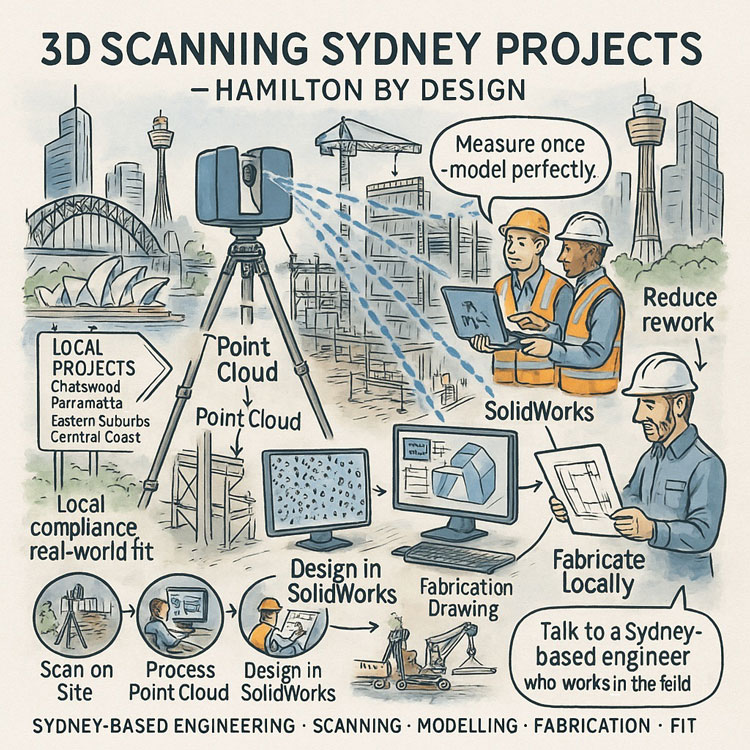
3D Scanning Sydney – Engineering-grade terrestrial laser scanning, as-built surveys and point cloud capture for industrial, infrastructure and commercial projects.
Reality Capture Sydney – High-accuracy reality capture, digital twins, asset documentation and engineering-grade site verification.
Scan to CAD Sydney – Convert point cloud data into AutoCAD, SolidWorks, Inventor and other engineering-ready CAD deliverables.
Point Cloud Modelling Sydney– Engineering-grade point cloud processing, clash detection, as-built verification and 3D modelling.
Mechanical Engineering Sydney – Mechanical design, plant upgrades, materials handling systems, conveyors, chutes, platforms and engineering support.
Structural Drafting Sydney– Structural steel drafting, fabrication drawings, GA drawings, workshop detailing and as-built documentation.
Hamilton By Design supports projects throughout Sydney CBD, Parramatta, Liverpool, Penrith, Blacktown, Chatswood, Alexandria, Mascot, Newcastle and the Central Coast.
To provide the best experiences, we use technologies like cookies to store and/or access device information. Consenting to these technologies will allow us to process data such as browsing behaviour or unique IDs on this site. Not consenting or withdrawing consent, may adversely affect certain features and functions.
Functional
Always active
The technical storage or access is strictly necessary for the legitimate purpose of enabling the use of a specific service explicitly requested by the subscriber or user, or for the sole purpose of carrying out the transmission of a communication over an electronic communications network.
Preferences
The technical storage or access is necessary for the legitimate purpose of storing preferences that are not requested by the subscriber or user.
Statistics
The technical storage or access that is used exclusively for statistical purposes.The technical storage or access that is used exclusively for anonymous statistical purposes. Without a subpoena, voluntary compliance on the part of your Internet Service Provider, or additional records from a third party, information stored or retrieved for this purpose alone cannot usually be used to identify you.
Marketing
The technical storage or access is required to create user profiles to send advertising, or to track the user on a website or across several websites for similar marketing purposes.