Mechanical Engineering | 3D Scanning | 3D Modelling
Category: 3D Scanning & Digital Engineering
3D Laser Scanning & Reality Capture covers the practical use of engineering-grade 3D laser scanning, LiDAR, and reality capture technologies to accurately document existing assets and site conditions.
This category focuses on how scan data is planned, captured, verified, and converted into usable engineering outputs, including as-built drawings, 3D CAD models, and scan-to-CAD workflows. Content explores real-world applications across power generation, manufacturing, mining, and building & construction, particularly in brownfield and live-site environments where accuracy and control are critical.
Articles in this category examine the difference between visual capture and engineering-grade scanning, the importance of datums, tolerances, and registration, and how reality capture supports Australian Standardsโaligned design and documentation.
Engineering-Ready Models Built From Accurate As-Built Data
LiDAR scanning captures the reality of your site. 3D modelling makes that reality usable.
This page builds on our 3D LiDAR Scanning service and explains how Hamilton By Design converts scanned data into precise, structured engineering models that support design, fabrication, shutdown planning, and installation.
Why Modelling Matters After Scanning
A point cloud provides accuracy, but it is not a working deliverable. Engineering teams need:
clean geometry
defined features and planes
recognisable interfaces
predictable reference points
controlled design space
Project managers need:
reduced risk
fewer clashes
fewer RFIs
predictable shutdown and installation outcomes
Managers need:
workflow reliability
cost control
documentation that stands up to review
3D modelling is the bridge between raw data and real project outcomes.
What We Deliver
1. Engineering-Grade SolidWorks Models
We convert point clouds into structured 3D models with:
parametric parts
welded structures and frames
pipework, flanges, fittings, valves
sheetmetal, platework and fabricated items
access systems and guarding
exact mechanical interfaces
Models are organised, logical, and suitable for engineering design, fabrication, and planning.
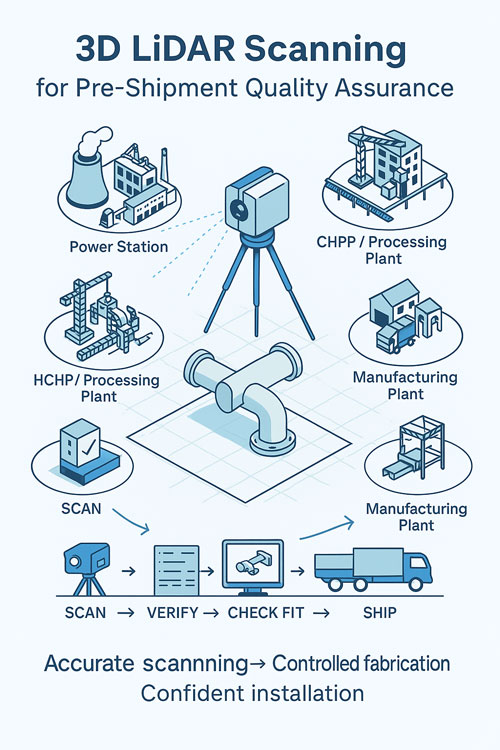
2. As-Built Models for Brownfield Sites
For CHPP plants, hard-rock processing facilities, conveyor systems, power stations, and industrial environments, we provide:
cleaned, registered models of existing geometry
accurate structural and mechanical references
deviation reports (design vs as-built)
clash-ready assemblies for new work
You receive the site โas it is,โ not as drawings say it should be.
3. Fabrication-Ready Models
We convert validated geometry into workshop deliverables:
fabrication assemblies
weldment cut lists
DXF profiles and unfolded sheetmetal
platework and bracketry
bolt patterns and interface geometry
tolerance-controlled connection details
Fabricators receive accurate, buildable models that reduce shop and site rework.
4. Shutdown & Installation Support Models
Models built from LiDAR data support:
pre-fit checks
spanner-swing analysis
bolt alignment verification
access and removal clearances
lift and cranage planning
installation sequencing
This gives shutdown teams clarity and control before mobilisation.
Many sites require components tailored to real-world constraints. Using the validated scan, we develop custom designs that:
match existing geometry
maintain required clearances
align with real plant conditions
support safe access and maintenance
comply with engineering and fabrication standards
We design chutes, hoppers, launders, spools, platforms, frames, adapters, guards, and specialty items that integrate seamlessly with your plant.
Full Project Management Capability
Hamilton By Design can manage the full workflow from concept to installation:
Scope Development
We define objectives, constraints, shutdown windows, and deliverables with your team.
Data Capture & Verification
LiDAR scanning provides the baseline for accurate modelling.
Engineering & 3D Modelling
We create controlled, engineering-grade models and drawings.
Fabrication Coordination
We supply workshop files or work with your chosen fabricator.
Installation & Fit-Up Support
We ensure components align with verified as-built conditions.
This provides a controlled, traceable process from problem โ design โ fabrication โ installation.
Why Engineering Teams Choose Hamilton By Design
Engineer-Led Modelling
Models are created by a mechanical engineer who understands:
tolerances
access
load paths
fabrication constraints
shutdown requirements
This produces models that work on site โ not just on screen.
Optimised for Industrial Environments
We specialise in:
CHPP and mineral processing
conveyors and transfer stations
power stations
heavy industrial pipework
mechanical plant
manufacturing facilities
Our workflows are built for brownfield complexity.
Reduced Risk Across the Project
Every model is produced to reduce:
clashes
rework
crane delays
shutdown extensions
uncertainty in fabrication
incorrect assumptions in design
Better data โ better engineering โ better project outcomes.
Deliverables
You receive:
SolidWorks assemblies and parts
STEP models
DWG / DXF fabrication files
E57 / RCP point clouds (optional)
deviation reports
installation check models
structured file organisation
Everything is delivered in a clean, logical format suitable for engineering use.
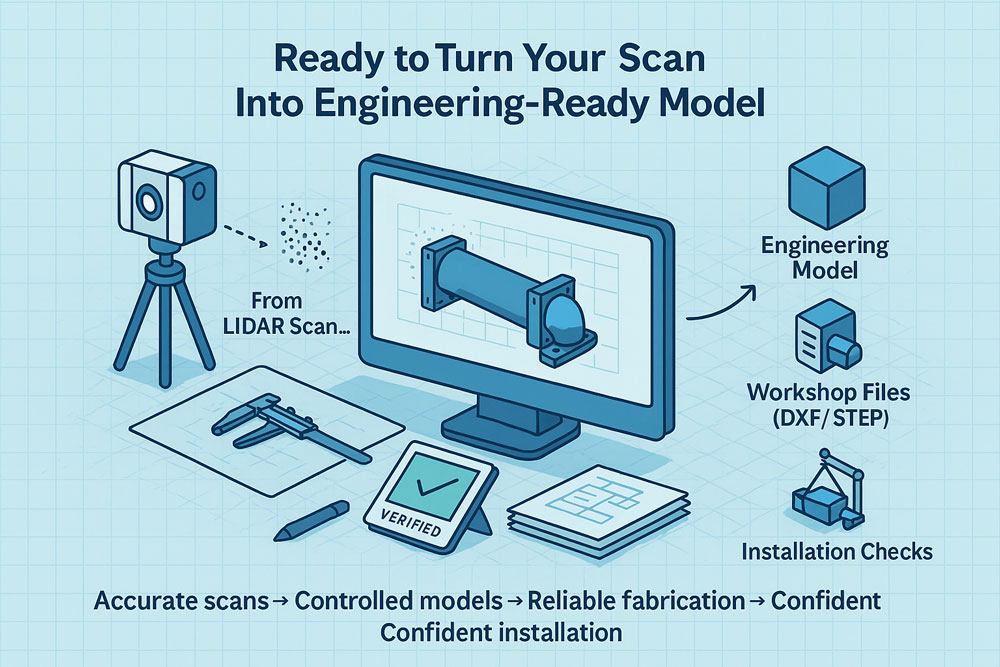
Ready to Turn Your Scan into an Engineering-Ready Model?
We convert LiDAR scans โ whether captured by us or supplied by your team โ into precise, reliable models that support engineering, fabrication, shutdown planning, and installation.
Contact us to request a proposal or upload your scan data for review.

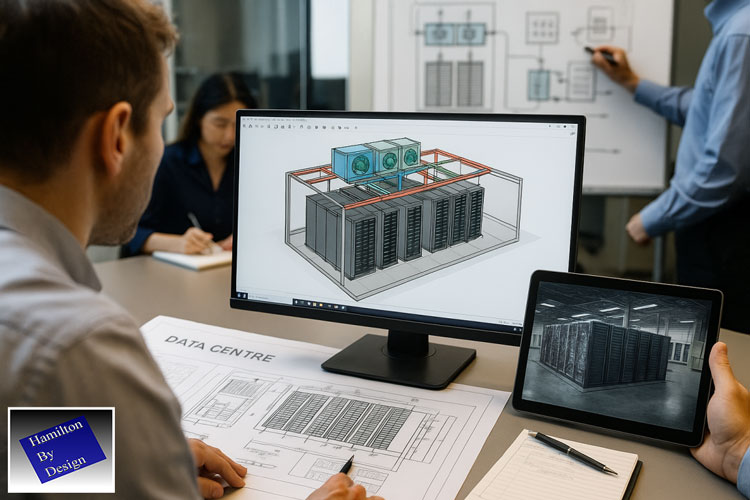
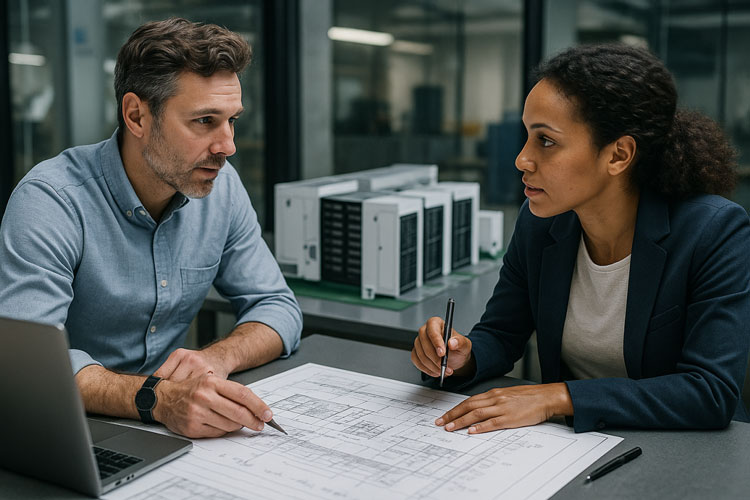
Australiaโs digital infrastructure is expanding rapidly โ and so is the demand for Data Centre Design that delivers reliability, performance, and scalability.
At Hamilton By Design, our team transforms concept and intent into manufacturable, modular, and compliant systems.
We specialise in Data Centre Design, mechanical and structural systems engineering, and fabrication-ready modelling that connect advanced engineering with real-world delivery. Every project is supported by traceable documentation, detailed verification, and hands-on manufacturing experience โ ensuring confidence from start to finish.
Our Team Understands the Pressures of Data Centre Design
Our team understands that Data Centre Design is not just about drawings โ itโs about precision, coordination, and absolute reliability.
We recognise the pressures of delivering mission-critical infrastructure: tight timelines, technical complexity, regulatory compliance, and no margin for downtime. Thatโs why our approach to Data Centre Design is built on clarity, accountability, and engineering confidence.
By combining advanced modelling with practical fabrication knowledge, our team ensures every interface aligns, every system performs, and every project milestone builds trust. Our goal is to make the journey from design to delivery simpler, faster, and more certain.
Our Integrated Data Centre Design Offerings
1. Modular & Prefabricated Systems
Factory-Built Reliability Our team delivers modular systems that make Data Centre Design faster, safer, and more predictable. We design and fabricate plug-and-play assemblies โ cooling skids, racking frames, HVAC supports, and power-distribution modules โ engineered for repeatability and verified off-site before installation. From design to deployment โ built locally.
2. Mechanical & Structural Systems Engineering
Engineered for the Workshop Our team converts design concepts into fabrication-ready 3D models, optimised for Data Centre Design precision and installation accuracy. Using LiDAR scanning and FEA validation, we eliminate tolerance issues and ensure perfect fit-up on site. Designs that build themselves.
3. Energy & Water Integration
Engineered Sustainability Modules Modern Data Centre Design requires efficient energy and cooling systems. Our team develops renewable-ready modules, including battery enclosures, hybrid cooling loops, and water-recycling assemblies. These systems improve energy performance, reduce water consumption, and support sustainability targets. Turning sustainability into engineered reality.
4. Retrofit & Upgrade Engineering
Upgrades Without Downtime Our team delivers Data Centre Design solutions for live facilities needing upgrades or expansion. Through LiDAR scanning and modular fabrication, we create retrofit systems that fit precisely within existing structures โ enabling capacity growth without disrupting operations.
Upgrades engineered to fit.
5. Documentation & Compliance
Audit-Ready Fabrication In Data Centre Design, compliance and traceability are critical. Our team provides complete documentation: material certificates, weld maps, QA records, and 3D-model traceability. Processes align with ISO 9001, AS 1554, and AS 4100, ensuring full accountability across every project phase. Every weld certified. Every drawing traceable.
Why Organisations Choose Hamilton By Design for Data Centre Design
Challenge
Our Response
Tight construction schedules
Off-site modular fabrication and verified fit-ups reduce rework and on-site time.
Design-to-fabrication disconnects
Integrated SolidWorks modelling, LiDAR scanning, and FEA deliver workshop-ready accuracy.
Risk and compliance pressures
Documented QA, full traceability, and standards-aligned processes protect project integrity.
Retrofit constraints
Modular upgrade solutions minimise downtime and maintain performance.
Sustainability goals
Energy-efficient and water-recycling modules lower PUE and environmental impact.
Partner With Hamilton By Design
Whether you are developing a new hyperscale facility or upgrading an existing site, Hamilton By Design provides Data Centre Design solutions that combine engineering precision, modular flexibility, and compliance confidence.
Our team doesnโt just fabricate โ it engineers confidence into every component.
Contact our team today to discuss modular systems, retrofit upgrades, or compliant fabrication for your next Data Centre Design project.
Few regions in Australia represent heavy industry quite like Newcastle and the Hunter Valley. From the coal mines at Bengalla and Mount Thorley, to the power stations at Bayswater and Eraring, to the Port of Newcastleโs massive shiploaders and conveyors, this region has powered Australia for generations.
But with age, complexity, and constant upgrades come challenges:
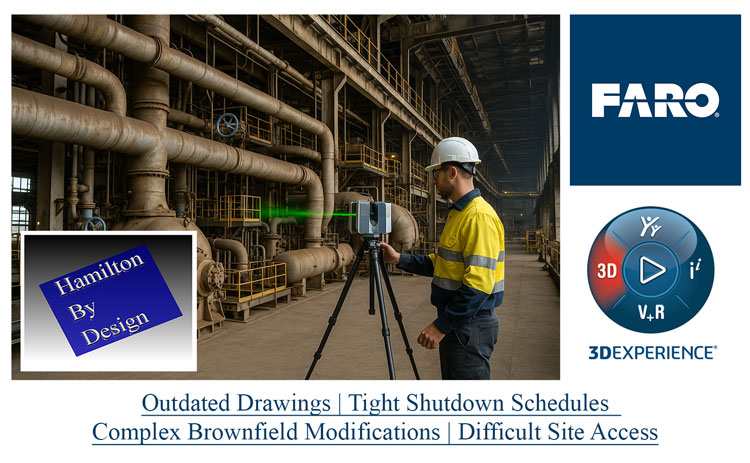
Outdated drawings
Tight shutdown schedules
Complex brownfield modifications
Difficult site access
Thatโs where 3D scanning and LiDAR modelling are transforming how industrial projects are designed, verified, and delivered โ ensuring every bolt, beam, and bracket fits perfectly the first time.
At Hamilton By Design, we bring together field experience, digital precision, and local knowledge to help the Hunterโs industries design, maintain, and modernise with confidence.
What Is 3D Scanning โ and Why It Matters in Industry
3D laser scanning, also known as LiDAR (Light Detection and Ranging), captures millions of data points across an industrial site to create a precise digital representation โ known as a point cloud.
This point cloud forms the foundation of a digital twin of your plant or asset โ an exact, measurable 3D environment that engineers can design within using SolidWorks, AutoCAD, or Navisworks.
The result? Every measurement is accurate, every clash is detected before fabrication, and every installation happens exactly as planned.
Why Newcastle and the Hunter Valley Need Scanning More Than Ever
The Hunter is an engineering powerhouse โ but much of its infrastructure was built decades ago. Many coal handling plants, power stations, and smelters are now in a constant cycle of refurbishment, retrofit, and compliance upgrade.
The challenges are familiar:
Old 2D drawings donโt reflect todayโs reality.
Assets have been modified repeatedly over decades.
Shutdown windows are shrinking.
Every error adds cost and delays production.
By scanning before you design, you remove uncertainty. You donโt guess clearances โ you know them. You donโt estimate tie-in points โ you model them. You donโt hope it fits โ you prove it digitally.
Thatโs the power of 3D scanning in todayโs industrial environment.
Where Scanning Adds Value Across the Hunterโs Industries
โ๏ธ Power Generation
The Bayswater, Eraring, and Vales Point Power Stations are engineering icons. Upgrades to cooling systems, ducts, platforms, and access structures require millimetre accuracy. 3D scanning ensures:
Every retrofit aligns with existing steelwork and pipework.
Structural interferences are caught before fabrication.
Shutdown work can be completed on time โ without rework.
Whether itโs a fan casing replacement or a duct reroute, laser scanning removes the guesswork from aging assets.
โ๏ธ Coal Handling and CHPP Facilities
The Hunter Valleyโs CHPP network โ Mount Thorley Warkworth, Ravensworth, Bengalla, Hunter Valley Operations โ all depend on reliable mechanical systems. These plants evolve continuously: diverter chutes, screen replacements, conveyors, and wash plant modifications.
Scanning delivers:
Accurate as-built geometry for plant upgrades.
Clash detection between new and existing equipment.
Shutdown planning certainty โ no unexpected fit-up issues.
Integration of SolidWorks models directly into point clouds for visual verification.
For CHPP managers and maintenance engineers, 3D scanning is now as essential as the plant itself.
โ Port of Newcastle and Coal Export Terminals
Newcastleโs port is the lifeline of the Hunterโs economy. Facilities such as Port Waratah Coal Services (PWCS), Newcastle Coal Infrastructure Group (NCIG), and Carrington Terminal handle massive volumes of coal every hour.
The complexity of these sites โ shiploaders, conveyors, gantries, and stacker-reclaimers โ demands accuracy during maintenance and upgrade works. 3D scanning supports:
Shiploader upgrades and boom extensions.
Conveyor and transfer tower alignment checks.
Wharf structure condition monitoring.
Integration with mechanical and electrical systems.
By scanning before modification, downtime is reduced, safety improves, and project teams gain total confidence in every fit-up.
๐ญ Aluminium and Heavy Manufacturing
At Tomago Aluminium Smelter, precision is everything. The scale of the site โ from potlines to switchyards โ makes manual measurement impractical and unsafe.
Laser scanning captures geometry accurately across large areas, enabling:
Retrofit planning without full shutdowns.
Clearance checks for cranes, ducts, and potline infrastructure.
Digital twins for long-term maintenance and asset management.
Beyond Tomago, manufacturers in Waratah, Beresfield, and Thornton use scanning to validate jigs, fixtures, and workshop layouts โ ensuring local fabrication accuracy that matches site requirements.
๐ Emerging Energy and Infrastructure
As the Hunter region transitions toward renewable and low-emission industries, scanning plays a critical role in planning new infrastructure around existing sites. This includes:
Hydrogen and gas pipeline tie-ins.
Solar and battery installations near existing grid connections.
Conversion of existing power plant structures for new technology.
Accurate point-cloud data ensures new energy meets old infrastructure safely and efficiently.
From Field to Fabrication: The Hamilton By Design Process
At Hamilton By Design, our 3D scanning workflow is built around practical, industrial needs:
Site Scan & Data Capture Using high-precision LiDAR scanners, we safely capture full site geometry in hours, not weeks. Scans are performed during operation or short shutdowns, without interrupting production.
Point Cloud Registration & Processing Multiple scans are aligned to create a unified, accurate model of your facility. The result is a true โdigital twinโ of your asset, complete with millimetre accuracy.
SolidWorks Modelling & Integration Our design team converts scan data into fully functional 3D models โ chutes, pipework, platforms, or structural frames โ ready for fabrication.
Clash Detection & Design Validation Every new design is tested within the digital twin, ensuring it fits the first time.
Fabrication Drawings & e-Drawings Detailed 2D and 3D deliverables are provided for fabricators, site crews, and certifiers โ ensuring seamless communication between design and construction.
Why Local Expertise Matters
Many engineering firms offer scanning โ but few understand what it takes to work on a live plant in the Hunter Valley.
Hamilton By Design combines trade experience, mechanical design, and regional understanding. Weโve worked with the same assets, fabricators, and contractors who keep the regionโs power, port, and manufacturing industries running.
We design for real fabrication conditions โ using Australian Standards, local materials, and practical build methods. That means fewer redesigns, faster turnarounds, and safer installations.
Safety and Access: Scanning Without Shutdowns
Traditional site measurement often means working at heights, in confined spaces, or around operating equipment. 3D scanning eliminates those risks.
Our scanners capture data safely from the ground โ even in restricted or hazardous areas. This not only improves safety but also allows projects to continue without halting production.
For large plants like Eraring or PWCS, scanning entire structures during live operation is now standard practice โ enabling ongoing maintenance and long-term asset integrity planning.
Case Example: Port Upgrade Without Rework
A local contractor approached Hamilton By Design for a conveyor and tower modification project at the Port of Newcastle. Existing drawings were decades old, and the structure had been modified repeatedly.
We performed a 3D scan of the tower and adjacent conveyors, capturing the as-built geometry in one day. The resulting model revealed several misalignments between the planned chute and existing supports. By correcting these in SolidWorks before fabrication, the contractor avoided at least 48 hours of site rework and kept the shutdown on schedule.
Thatโs measurable ROI โ precision that pays for itself.
The ROI of 3D Scanning in Heavy Industry
A single hour of lost production at a CHPP or power station can cost $20,000 to $50,000. A single dayโs delay can exceed $500,000 in lost revenue and labour costs.
3D scanning reduces that risk by eliminating rework and ensuring every component fits right the first time. Typical return on investment (ROI):
Scanning cost: <1% of total project value.
Rework savings: 3โ10% of total cost.
Downtime reduction: 1โ3 days saved per shutdown.
When accuracy drives reliability, 3D scanning isnโt an expense โ itโs insurance.
Supporting the Hunterโs Future
Newcastle and the Hunter Valley are evolving โ from coal and power to renewables, advanced manufacturing, and logistics. But one thing hasnโt changed: the regionโs foundation in engineering, precision, and hard work.
Hamilton By Design supports that legacy with the next generation of technology โ scanning, digital modelling, and mechanical design that keep the regionโs assets efficient, safe, and ready for the future.
Weโre not an offshore CAD vendor. Weโre local engineers whoโve worked in the field, understand your equipment, and speak the same language as your crews.
Letโs Build the Future of Hunter Industry โ Accurately
Every project starts with one question: โDo we have accurate site data?โ
With Hamilton By Design, the answer is always yes.
We deliver: โ 3D laser scanning and LiDAR modelling โ Point-cloud to SolidWorks integration โ Reverse engineering and FEA validation โ Fabrication drawings tailored for local workshops โ On-site consultation with practical engineering insight
Whether youโre upgrading a conveyor at Bayswater, fabricating platforms for Tomago, or retrofitting process piping at Kooragang, we ensure your next project fits perfectly โ before steel is cut.
๐ Get your industrial site scanned and modelled before your next shutdown. Visit www.hamiltonbydesign.com.au or contact us to request a capability statement today.
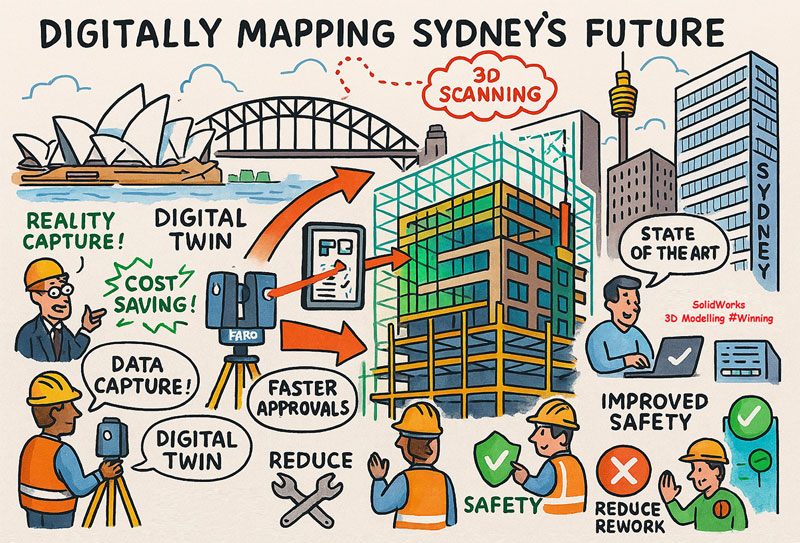
From the growing commercial hubs of Parramatta and Chatswood to the complex redevelopments across Sydneyโs Eastern Suburbs, the construction industry is demanding more accuracy, faster turnaround, and fewer on-site surprises.
At Hamilton By Design, we use 3D scanning and LiDAR technology to help builders, engineers, and developers capture, model, and verify real site conditions with millimetre accuracy.
Our advanced 3D models ensure every structural, mechanical, or architectural component fits perfectly on site โ helping Sydneyโs construction professionals deliver projects right the first time.
High-Precision Site Capture with LiDAR Scanning
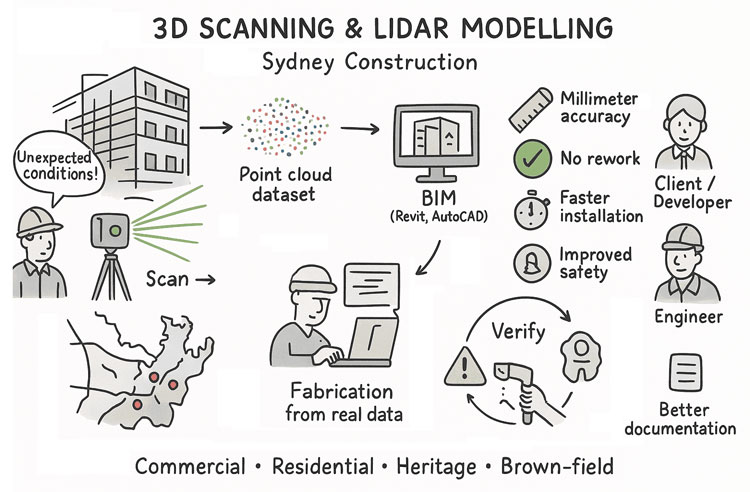
Using advanced LiDAR (Light Detection and Ranging) technology, our scanners record millions of laser points per second to create a complete 3D โpoint cloudโ of your site or structure.
Whether weโre scanning a commercial building in Chatswood, a multi-level development in Parramatta, or a heritage renovation in Sydneyโs Eastern Suburbs, LiDAR scanning allows us to document every detail โ without disruption to your workflow.
The result is a digital twin of your project site that forms the foundation for precise design, fabrication, and installation.
From Point Cloud to Construction-Ready Model
Once scanning is complete, our engineers convert the LiDAR data into accurate 3D CAD and BIM models that integrate seamlessly into platforms such as Revit, AutoCAD, Navisworks, and SolidWorks.
This digital workflow allows your team to:
Validate as-built conditions before design or fabrication
Identify clashes and alignment issues early
Plan site installations with confidence
Reduce rework and delays during construction
By designing and fabricating to real-world data, Sydney contractors can save valuable time and eliminate unnecessary on-site adjustments.
Why Sydney Contractors Choose 3D Scanning and LiDAR
Millimetre Accuracy: Perfect alignment between fabricated and existing structures.
Reduced Rework: Detect and fix issues before they reach site.
Improved Safety: Non-invasive scanning of hard-to-reach areas.
Faster Installation: Minimise downtime and site delays.
Better Documentation: Maintain accurate records for QA and future maintenance.
Across Chatswood, Parramatta, and Sydneyโs Eastern Suburbs, our clients use LiDAR scanning to bring greater certainty to every phase of construction.
Supporting Projects Across Sydney
Hamilton By Design supports a wide range of construction and engineering projects across metropolitan Sydney, including:
Commercial and retail developments in Chatswood and Parramatta
Luxury residential projects and architectural fit-outs in Sydneyโs Eastern Suburbs
Industrial and infrastructure upgrades throughout Greater Sydney
Brownfield and refurbishment projects requiring accurate as-built data
Whether itโs a new build or a complex retrofit, we make sure every part of your design fits the first time.
Partner with Hamilton By Design
If youโre managing or planning a construction project in Chatswood, Parramatta, or Sydneyโs Eastern Suburbs, Hamilton By Design offers the experience and technology to capture, model, and verify your site with precision.
Our 3D scanning and LiDAR services help Sydney builders, designers, and fabricators deliver more accurate results โ reducing risk, rework, and cost.
Sydneyโs construction industry is booming โ from commercial towers and infrastructure upgrades to industrial developments and complex refurbishments. But as sites become more congested and designs more complex, achieving perfect alignment between fabricated and installed components has never been more challenging.
Thatโs where 3D scanning and LiDAR technology come in. At Hamilton By Design, we provide high-precision digital capture and 3D modelling services that ensure every element of your construction project fits seamlessly together, saving time, cost, and effort onsite.
Capturing the Real Site with LiDAR Scanning
Using LiDAR (Light Detection and Ranging) scanners, we capture millions of laser measurements per second to create an exact 3D digital record โ known as a point cloud โ of your construction site or structure.
This means we can document existing conditions, monitor progress, and verify installations with millimetre-level precision. For Sydney builders, engineers, and contractors, that data eliminates the guesswork and drastically reduces costly clashes and rework later on.
From Point Cloud to 3D Model
Once the LiDAR data is captured, itโs processed into detailed 3D CAD and BIM models compatible with leading design software such as Revit, AutoCAD, SolidWorks, and Navisworks.
These accurate models allow design teams to:
Validate and update as-built conditions before fabrication
Detect clashes and misalignments before installation
Plan modifications and extensions with confidence
Coordinate between mechanical, structural, and architectural disciplines
By working from a true digital twin of your Sydney site, you can be sure every part โ from prefabricated frames to pipe runs โ will fit exactly where it should.
Why Sydney Construction Projects Are Turning to 3D Scanning
Reduced Rework: Identify design and fabrication issues before they reach site.
Improved Safety: Capture high or restricted areas without scaffolding or shutdowns.
Shorter Installation Times: Minimise downtime and delays during fit-up.
Precise Documentation: Maintain accurate records for QA and handover.
Better Collaboration: Integrate real-world data into your BIM environment.
From commercial fit-outs to infrastructure projects across Greater Sydney, 3D scanning provides a single source of truth for every stakeholder.
Typical Sydney Projects Using LiDAR and 3D Modelling
Hamilton By Design supports a range of construction and engineering clients, including:
Commercial and residential developments in the CBD and inner suburbs
Industrial plant upgrades across Western Sydney
Transport and infrastructure projects under NSW Government programs
Refurbishment and brownfield works requiring detailed as-built verification
Each project benefits from faster delivery, greater precision, and stronger communication between designers, builders, and clients.
Partner with Hamilton By Design
If youโre working on a Sydney construction or infrastructure project and need accurate 3D site data, as-built modelling, or fit-up verification, Hamilton By Design can help.
Our experienced mechanical and design specialists combine field scanning with advanced 3D modelling to deliver practical, reliable results that make construction smoother โ and smarter.
Capture. Model. Verify. Deliver โ precision that builds Sydney better.
Our Clients:
Related Sydney Services
Hamilton By Design provides engineering-led 3D scanning, LiDAR scanning, mechanical engineering and digital engineering services throughout Sydney and Greater Sydney.
Explore our related Sydney services:
3D Scanning Sydney โ Engineering-grade terrestrial laser scanning, as-built surveys and point cloud capture for industrial, infrastructure and commercial projects.
Reality Capture Sydney โ High-accuracy reality capture, digital twins, asset documentation and engineering-grade site verification.
Scan to CAD Sydney โ Convert point cloud data into AutoCAD, SolidWorks, Inventor and other engineering-ready CAD deliverables.
Point Cloud Modelling Sydneyโ Engineering-grade point cloud processing, clash detection, as-built verification and 3D modelling.
Mechanical Engineering Sydney โ Mechanical design, plant upgrades, materials handling systems, conveyors, chutes, platforms and engineering support.
Structural Drafting Sydneyโ Structural steel drafting, fabrication drawings, GA drawings, workshop detailing and as-built documentation.
Hamilton By Design supports projects throughout Sydney CBD, Parramatta, Liverpool, Penrith, Blacktown, Chatswood, Alexandria, Mascot, Newcastle and the Central Coast.
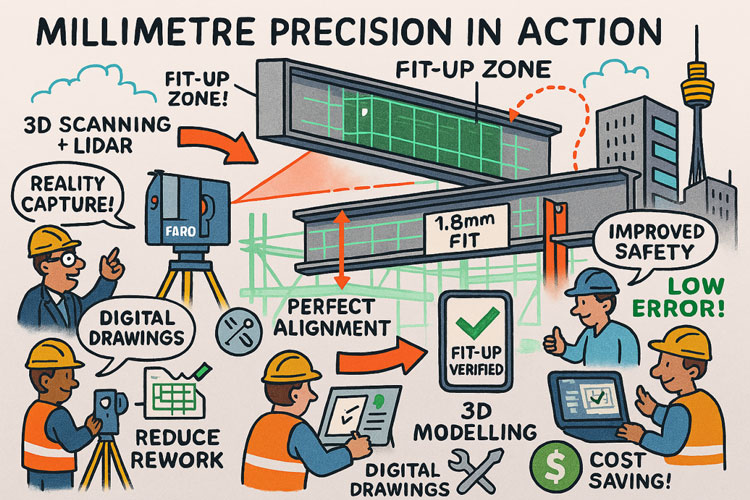
When youโre fabricating or installing mechanical, structural or piping components on site, even a small misalignment of a few millimeters can lead to costly rework, construction delays, and wasted resources.
Thatโs why โgood enoughโ isnโt good enough. For modern projects โ especially in mining, processing, retrofit, or shutdown environments โ you need millimeter precision.
At Hamilton By Design, we combine LiDAR 3D scanning, advanced point-cloud processing, and robust 3D modelling to capture the exact as-built conditions of your site โ delivering accurate, install-ready digital models that reduce risk and increase confidence.
What Is LiDAR 3D Scanning โ And Why It Gives True Precision
LiDAR (Light Detection and Ranging) uses laser-based scanning to generate detailed, high-density point cloud data that reflects the real-world geometry of your plant, structure or equipment. Traditional surveying and manual measurements can introduce errors and assumptions โ but LiDAR captures actual surfaces, edges, and spatial relationships without guesswork. Hamilton By Design+2Measure Australia+2
With a properly calibrated LiDAR system and experienced processing, itโs possible to achieve high repeatability and precision, generating data that forms a reliable foundation for 3D CAD or BIM modelling. Measure Australia+1
From Scan to 3D Model: How We Turn Data into Build-Ready Accuracy
Once the LiDAR scan is complete, Hamilton By Designโs workflow transforms raw point-cloud data into intelligent 3D CAD models:
Clean and register the point cloud to remove noise or distortions
Rebuild accurate geometry (structural frames, piping, equipment surfaces)
Import into major CAD/BIM platforms (e.g. SolidWorks, AutoCAD, Revit, Plant 3D) for seamless integration with your design workflows Hamilton By Design
Perform clash detection, alignment checks, and clearance validation before fabrication
Generate fabrication-ready drawings and installation documentation
This digital-first workflow delivers confidence that whatโs built in the shop will fit perfectly on site โ first time.
Key Benefits of Millimeter-Precision LiDAR Scanning & 3D Modelling
True-to-site accuracy โ Reduce guesswork; measure the real plant geometry. Fibrox 3D+1
Less rework, fewer delays โ Early clash detection means fewer surprises during installation. Hamilton By Design
Faster turnaround โ Rapid data capture, even in complex or hard-to-access zones. Fibrox 3D+1
Improved safety โ Scan from a safe distance; limit time in hazardous environments. Hamilton By Design
Better coordination across disciplines โ Mechanical, structural, and piping engineers all working from the same accurate model. Hamilton By Design
Who Benefits โ Applications That Demand Precision
This level of accuracy is critical for:
Mining and mineral-processing plants (brownfield upgrades, retrofit)
Oil, gas, and energy facilities
Heavy manufacturing and industrial plants
Water and wastewater treatment plants
Shutdown / maintenance / upgrade projects with tight tolerances
No matter how complex the site or tight the installation requirements, LiDAR-based scanning + precise 3D modelling removes the guesswork. Hamilton By Design
Real-World Outcomes: What Clients Actually See
Clients who adopt our millimeter-precision workflow often report:
Up to 50% reduction in on-site rework
Faster install times and shorter shutdown windows
Smooth cross-discipline collaboration
Higher quality fabrication and installation finishes
By identifying spatial conflicts before procurement or fabrication, projects run smoother โ saving time, materials, and risk. Hamilton By Design
Why โMillimeter Precision Through LiDAR Scanningโ Is More Than Just a Buzzphrase
Some 3D scanning or survey methods capture approximate geometry โ fine for rough layout, but insufficient for precision fabrication and fit-up.
With high-quality LiDAR scanning, proper registration, and careful modelling, we deliver real millimeter-level precision โ the kind that avoids costly rework, ensures first-fit alignment, and delivers project certainty.
If your project demands this level of accuracy โ whether for plant upgrades, mechanical fit-up, pipe spooling, structural retrofits or brownfield refurbishments โ you need the reliability that only a LiDAR-based digital workflow can deliver.
Talk to Hamilton By Design: Get Millimeter-Accurate Data That Fits
If your next project needs tight tolerances, retrofit accuracy, or complex mechanical fit-ups, our team can help. Based in Australia but working nationwide โ combining cutting-edge scanning tech with real-world engineering know-how.
To provide the best experiences, we use technologies like cookies to store and/or access device information. Consenting to these technologies will allow us to process data such as browsing behaviour or unique IDs on this site. Not consenting or withdrawing consent, may adversely affect certain features and functions.
Functional
Always active
The technical storage or access is strictly necessary for the legitimate purpose of enabling the use of a specific service explicitly requested by the subscriber or user, or for the sole purpose of carrying out the transmission of a communication over an electronic communications network.
Preferences
The technical storage or access is necessary for the legitimate purpose of storing preferences that are not requested by the subscriber or user.
Statistics
The technical storage or access that is used exclusively for statistical purposes.The technical storage or access that is used exclusively for anonymous statistical purposes. Without a subpoena, voluntary compliance on the part of your Internet Service Provider, or additional records from a third party, information stored or retrieved for this purpose alone cannot usually be used to identify you.
Marketing
The technical storage or access is required to create user profiles to send advertising, or to track the user on a website or across several websites for similar marketing purposes.