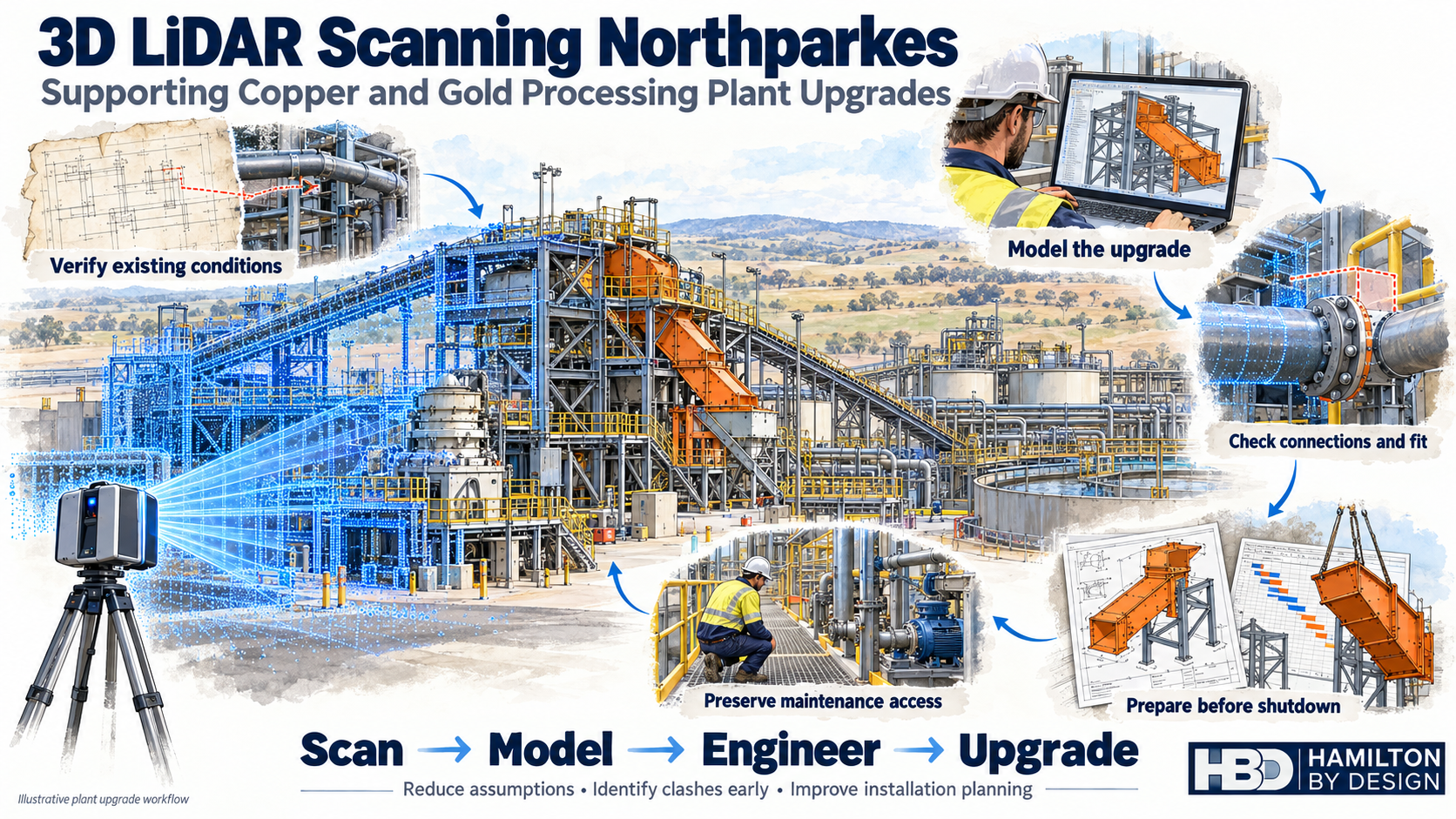

Plant upgrades start with understanding what is already on site. When a replacement chute, pipe spool, pump skid or access platform must fit into an existing processing plant, incomplete drawings can leave critical dimensions uncertain.
Hamilton By Design offers 3D LiDAR scanning for projects at Northparkes and across the Parkes region, helping engineering teams capture existing conditions before design, fabrication and installation.
By combining laser scanning with mechanical engineering, 3D modelling and drafting, we can turn site measurements into practical information for plant modifications and shutdown planning.
Supporting Copper and Gold Processing Infrastructure
Northparkes is a copper-gold mining operation located approximately 27 kilometres north-west of Parkes in Central West NSW. Its onsite processing plant produces copper-gold-silver concentrate.
Modifications in this type of operating plant often involve working around existing equipment, pipework, support steel and maintenance access. The challenge is understanding how the proposed work will connect to the surrounding infrastructure.
A replacement component may need to:
- Match existing flange positions and connection points.
- Fit between conveyors, equipment and support steel.
- Preserve access for inspection and maintenance.
- Allow space for lifting, removal and installation.
- Be installed within a planned shutdown window.
3D LiDAR scanning helps establish these constraints before the design progresses.
For broader regional coverage, see our Engineering-Grade 3D LiDAR Scanning in Parkes NSW services.
Capture Existing Conditions Before Design Begins
Existing plant drawings may not reflect years of repairs, equipment replacements and site modifications. Manual measurements can also miss surrounding obstructions or important offsets.
A registered point cloud provides a measurable three-dimensional record of the surfaces captured during scanning. Engineers and designers can use this information to check equipment locations, connection geometry and available space.
Depending on access and the project scope, scanning can capture:
- Conveyors, transfer points, chutes and hoppers.
- Crushers, screens and surrounding equipment.
- Pumps, tanks, pipework and service routes.
- Structural steel and equipment supports.
- Platforms, stairs, ladders and handrails.
- Equipment bases, floor levels and installation areas.
The scan scope should focus on the interfaces that determine whether the new component will fit. Critical dimensions and obscured connections may require additional measurement or verification.
Chute and Conveyor Upgrade Planning
Chute replacements depend on more than the dimensions of the chute itself. The design must account for the discharge position, receiving conveyor, support arrangement, surrounding steelwork and maintenance clearances.
For a chute or conveyor modification, Hamilton By Design can use scan data to help establish the existing layout and develop a model of the proposed arrangement.
This supports checks for:
- Alignment between new and existing equipment.
- Clashes with steelwork, pipework and platforms.
- Liner replacement and inspection access.
- Available space for guards and maintenance.
- Installation and removal constraints.
Capturing the surrounding plant helps designers assess how the modification will work within the existing installation.
Pipework, Pumps and Equipment Fit-Up
Pipework modifications can become difficult when existing flange positions, elevations or support locations are uncertain.
3D LiDAR scanning can help establish the spatial arrangement around pump stations, pipe racks and equipment connections. Scan-to-CAD modelling can then support proposed pipe routes, pump skid layouts and equipment positioning.
Where fabrication depends on precise connection details, we establish the required accuracy and verification approach before work begins. Some interfaces may need closer scanning, direct measurement or inspection during a shutdown.
From Point Cloud to Engineering Deliverables
Hamilton By Design can develop the captured information into deliverables suited to the project, including:
- Registered point clouds.
- Existing-condition 3D CAD models.
- General arrangement drawings.
- Proposed equipment and pipework layouts.
- Clash reviews and fit-up assessments.
- Fabrication drawings within the agreed design scope.
Point clouds can be supplied in formats such as E57 or RCP, with CAD models and drawings prepared to suit the client’s software and documentation requirements.
Our 3D Scanning for Central West NSW Gold and Copper Processing Plants post explains how this workflow supports regional processing facilities.
Better Information for Shutdown Planning
Reliable site information allows more engineering and fabrication work to be completed before a shutdown starts.
A scan-based model can help teams identify installation constraints, review component clearances and coordinate proposed work around existing assets. It can also reduce the need for repeated site visits to collect missing dimensions.
These benefits depend on capturing the required areas and checking critical interfaces early.
Discuss Your Northparkes Scanning Requirements
Planning a chute replacement, conveyor modification, pipework upgrade or equipment installation?
Hamilton By Design can assist with 3D LiDAR scanning Northparkes, scan-to-CAD modelling, mechanical design and fabrication documentation.
Provide the proposed work area, available drawings, required deliverables and shutdown timing so we can establish a suitable scanning and engineering scope.
Frequently Asked Questions
Can scanning be undertaken while the plant is operating?
Some areas can be scanned during operation, subject to site approval, safe access and visibility. Restricted areas or obscured interfaces may require shutdown access.
Can the point cloud be converted into SolidWorks or AutoCAD deliverables?
Yes. Selected plant geometry can be developed into CAD models and drawings according to the agreed scope.
Can scanning confirm whether replacement equipment will fit?
Scan data can support fit-up checks against captured existing geometry. Critical connections, tolerances and areas hidden from the scanner require suitable verification.
Contact Us – Talk To Us
Our clients: