


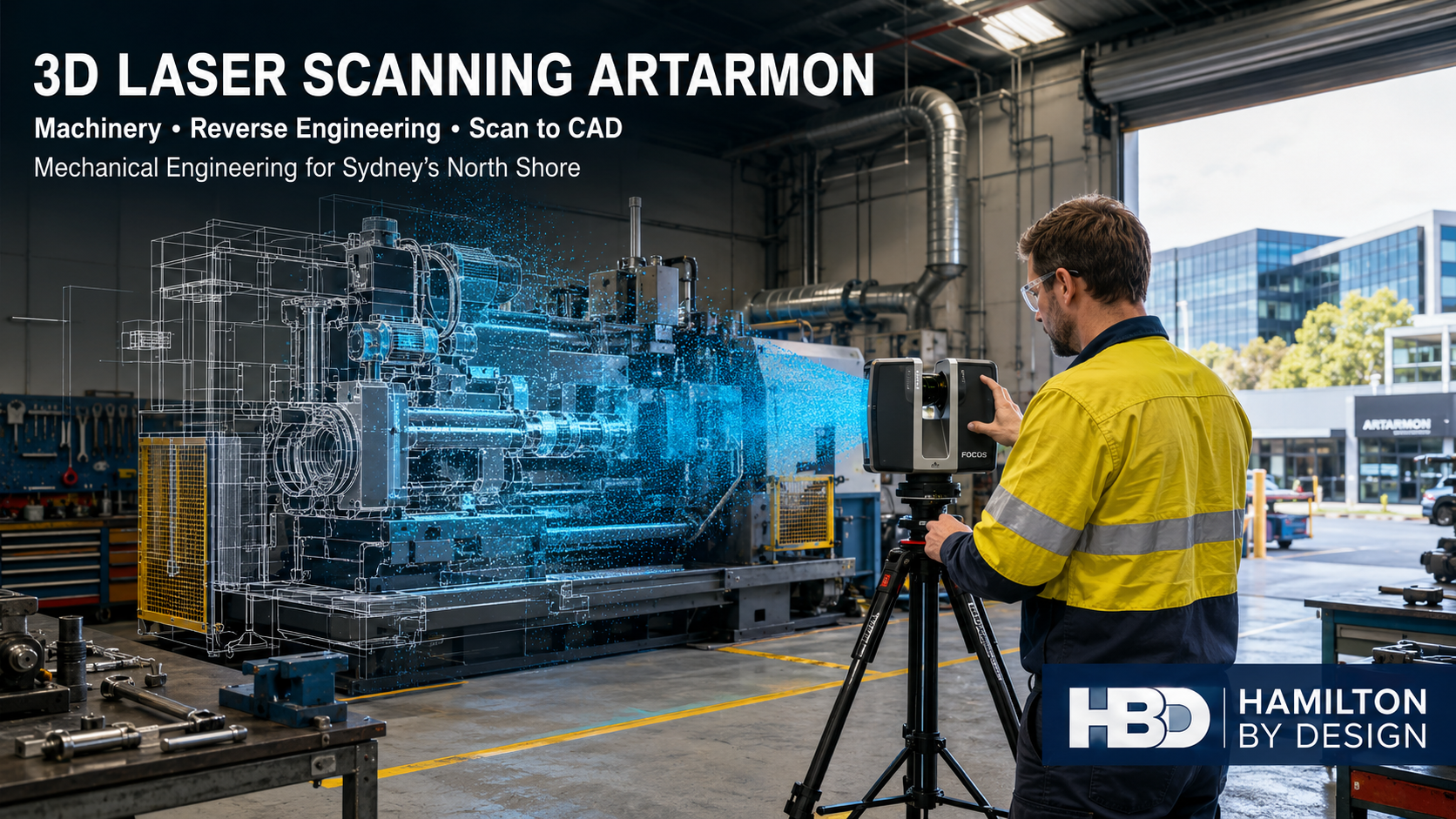
Laser Scanning Artarmon: Machinery, Reverse Engineering and CAD Support

Artarmon is one of Sydney’s most strategically positioned urban industrial areas. Located close to the Sydney CBD, North Sydney, Chatswood and St Leonards, the precinct supports a diverse combination of specialised manufacturing, automotive servicing, machinery maintenance, broadcasting, construction materials, warehousing, logistics and technical businesses.
This industrial diversity creates a particular engineering challenge. Many Artarmon businesses operate from established facilities containing machinery, services and building elements that have been modified progressively over many years. Original drawings may be incomplete, existing layouts may not reflect actual site conditions, and replacement components may no longer be available from the original manufacturer.
Hamilton By Design provides engineering-led 3D laser scanning in Artarmon, supported by reverse engineering, mechanical design, point-cloud processing and CAD drafting. These services help businesses understand what currently exists, plan modifications with greater confidence and retain dependable engineering information for future maintenance and asset management.
Our wider 3D laser scanning services for Sydney combine site capture with practical mechanical and digital-engineering experience. This means the scan is not treated merely as a visual record. It becomes the foundation for drawings, equipment layouts, replacement parts, fabrication models, clearance assessments and safer brownfield modifications.
Supporting Artarmon’s diverse industrial character
Artarmon is significantly different from a conventional outer-metropolitan industrial estate. It is a compact urban-services precinct with close connections to the Pacific Highway, Gore Hill Freeway, Lane Cove Tunnel and Sydney’s North Shore commercial and healthcare centres.
Its industrial character includes:
- Automotive dealerships, service centres and repair workshops
- Specialised manufacturing and engineering workshops
- Concrete-production and construction-material facilities
- Waste transfer and resource-recovery operations
- Broadcasting, media and technical facilities
- Warehouses and integrated office–distribution operations
- Bulky-goods retail and trade supplies
- Medical-equipment and hospital-support businesses
- Machinery servicing and maintenance providers
- Building-services and technical contractors
These businesses may operate very different equipment, but they often face similar engineering problems: restricted floor space, incomplete records, congested services, limited shutdown periods and the need to modify existing facilities without disrupting normal operations.
Hamilton By Design’s broader Greater Sydney 3D scanning and digital-twin services are particularly applicable to these brownfield conditions. Accurate point-cloud data allows project teams to work from the physical facility rather than relying solely on drawings that may be outdated.
What is engineering-grade 3D laser scanning?
A terrestrial laser scanner captures large numbers of spatial measurements from the surfaces around it. Together, these measurements create a three-dimensional point cloud representing the visible geometry of machinery, buildings, structural elements, pipework, services and other physical assets.
Multiple scans can be registered into a common coordinate system to create a coordinated record of the required work area. Depending on the project scope, this data can then be supplied as a registered point cloud or converted into engineering deliverables.
Typical deliverables include:
- E57, RCP, RCS or LAS point-cloud files
- Existing facility and workshop layouts
- Plans, elevations and sections
- General arrangement drawings
- SolidWorks machinery and equipment models
- AutoCAD drawings
- STEP, Parasolid and DXF files
- Simplified coordination models
- As-built drawings
- Fabrication and manufacturing documentation
- Clearance and clash-review models
Hamilton By Design’s 3D laser scanning for engineering projects is intended to connect reality capture with a defined engineering purpose. Before scanning begins, the required deliverables, areas of interest, critical interfaces, coordinate requirements and appropriate level of detail should be established.
This is important because a visually impressive point cloud is not automatically an engineering model. The dataset must be captured, registered, checked and interpreted according to the decisions it is expected to support.
Machinery scanning in Artarmon
Machinery scanning is valuable when equipment must be modified, relocated, documented or integrated with new systems. Conventional hand measurement can be effective for simple components, but it becomes difficult when a machine contains complex geometry, inaccessible surfaces or numerous interfaces.
An engineering scan can capture:
- Overall machine envelopes
- Mounting points and baseplates
- Connections and service interfaces
- Guarding arrangements
- Operator and maintenance access
- Adjacent columns, walls and equipment
- Platforms, stairs and walkways
- Pipework and ducting near the machine
- Overhead restrictions
- Removal and installation routes
The scan can then be used to develop a simplified but accurate CAD representation. Rather than modelling every bolt or minor feature, the model can concentrate on the geometry required for the project.
For example, an automotive workshop may need to install a new vehicle lift, exhaust-extraction system or specialised test machine. A manufacturing business may need to extend an existing machine, add guarding or replace a feed arrangement. A technical facility may need new equipment installed around existing cable trays, cooling services and access routes.
Hamilton By Design’s mechanical engineering services for plant and production problems can connect the captured geometry with practical modification design, equipment layouts and production-focused engineering decisions.
Reverse engineering obsolete components
Artarmon’s machinery, automotive and specialist technical businesses may operate equipment for which original drawings, replacement parts or OEM support are no longer available. Replacing an entire machine because one component is obsolete can be financially inefficient and operationally disruptive.
Reverse engineering provides another option.
The process may include:
- Examining the component and understanding its function.
- Recording its relationship with the surrounding assembly.
- Scanning or measuring the existing geometry.
- Identifying worn, damaged or deliberately modified features.
- Reconstructing the intended geometry in CAD.
- Reviewing materials, tolerances and manufacturing methods.
- Producing a manufacturing model and controlled drawing.
- Supporting prototype manufacture, fit checking and testing.
This process requires engineering judgement. A worn component should not always be copied exactly because the scanned surface may represent damage rather than the original design. Critical dimensions, fits, sealing surfaces, load paths and operating conditions must be considered.
Hamilton By Design’s approach to 3D laser scanning for engineering integrates physical measurement with CAD modelling and mechanical assessment. Where necessary, stress calculations or finite element analysis can be considered, subject to the information available and the significance of the component.
Reverse-engineered deliverables can include SolidWorks models, STEP files, Parasolid files, DXF profiles, machining drawings, fabrication drawings, assembly drawings and bills of materials.
Scan to CAD for brownfield modifications
Brownfield engineering begins with an existing asset or facility. This creates a different set of constraints from greenfield design because the new work must fit around what is already present.
Common brownfield risks include:
- Existing drawings not matching the site
- Previously undocumented modifications
- Services crossing the proposed installation area
- Insufficient maintenance access
- Equipment that cannot pass through available openings
- Structural or mechanical interfaces in unexpected locations
- Fabrication based on assumed dimensions
- New guarding conflicting with normal operations
- Inadequate installation or lifting space
Hamilton By Design’s CAD services in Sydney can convert point-cloud information into engineering-ready models and drawings. Depending on the project, this may include an existing-condition model, a proposed design model and a combined model used for spatial coordination.
The practical workflow is:
scan → register → model → engineer → detail → review → fabricate
This process reduces the dependence on repeated site measurement and provides designers, operators and fabricators with a shared spatial reference.
It does not remove the need for engineering review or installation planning. Instead, it improves the quality of information used in those activities.
Mechanical engineering for equipment modifications
Three-dimensional scanning establishes geometry, but geometry alone does not determine whether a modification is safe, functional or suitable for manufacture.
Hamilton By Design can support Artarmon clients with mechanical engineering for:
- Machinery modifications
- Equipment relocation
- Machine bases and support frames
- Guards, covers and barriers
- Maintenance platforms and access
- Brackets, frames and enclosures
- Conveyor and material-handling modifications
- Lifting attachments
- Component replacement
- Workshop and production layouts
- Fabrication support
- Load and clearance assessments
- Preliminary FEA where appropriate
The company’s mechanical engineering services in Sydney can be delivered as a defined in-house package or integrated with the client’s existing project, maintenance or fabrication team.
Relevant Australian Standards depend on the equipment and the nature of the modification. They may include the AS/NZS 4024 machinery-safety series, AS ISO 12100 for machinery risk assessment, AS 1657 for fixed access, AS 3990 for mechanical equipment steelwork, AS 4991 for lifting devices and relevant parts of AS 1418 and AS 2550 for lifting equipment.
Where structural, electrical, fire or other specialist disciplines are involved, those aspects should be reviewed by appropriately qualified practitioners.
Mechanical drafting and manufacturing documentation
Good engineering information must be communicated clearly. A 3D model may assist visualisation, but workshops, fabricators, machine shops and site teams still require controlled documentation.
Hamilton By Design can prepare:
- General arrangement drawings
- Part and assembly drawings
- Fabrication drawings
- Machining drawings
- Sheet-metal developments
- Welded assembly details
- Equipment and workshop layouts
- Installation drawings
- Exploded assembly views
- Bills of materials
- As-built drawings
- DXF cutting profiles
- STEP and Parasolid models
- Revision-controlled drawing packages
The CAD and drafting services available in Sydney can also support drawing registers, revision tracking and issue statuses such as Issue for Review, Issue for Approval and Issue for Construction.
Where relevant, drawings can be prepared with reference to the AS 1100 technical-drawing series. Project-specific documentation should clearly communicate critical dimensions, tolerances, materials, finishes, weld requirements, interfaces and revision status.
Machinery safety and risk management
Modifying an existing machine may introduce new hazards even when the modification appears minor. A relocated guard may create a reach-through hazard. A new access platform may restrict emergency egress. Moving equipment may introduce a collision risk between forklifts and pedestrians.
Hamilton By Design can assist with engineering-focused risk reduction by documenting existing conditions and considering hazards such as:
- Rotating and reciprocating components
- Crushing and shearing points
- Drawing-in and entanglement hazards
- Ejected materials or failed components
- Unexpected movement
- Maintenance and isolation access
- Falls from platforms or machinery
- Vehicle and pedestrian interaction
- Manual handling
- Restricted emergency access
Three-dimensional scanning can make these risks easier to understand because proposed controls can be modelled in their actual physical context. Guards, barriers, access platforms and exclusion zones can be reviewed against the surrounding machinery before fabrication begins.
Risk management should follow a systematic process: identify hazards, assess credible consequences, apply the hierarchy of controls, document residual risks and review the effectiveness of the completed modification.
Logistics, warehousing and workshop layouts
Artarmon’s proximity to major arterial roads supports warehousing, local distribution, trade supplies and automotive operations. However, its urban location also creates constrained sites, limited parking and frequent interaction between delivery vehicles, forklifts, workers and visitors.
Facility scanning can assist with:
- Warehouse and workshop layouts
- Loading and unloading zones
- Storage-racking arrangements
- Pedestrian and forklift separation
- Bollards and impact protection
- Equipment and production-flow planning
- Material-handling systems
- Truck access
- Maintenance routes
- Emergency access
- Equipment relocation
- Clearance beneath services and structures
Applicable requirements may include AS 4084 for steel storage racking, AS/NZS 4024.3610 for conveyors, AS 1657 for fixed access and relevant workplace traffic-management guidance.
A coordinated model allows safety, operations and engineering personnel to review a proposed layout together. This is particularly useful where additional equipment must be introduced without reducing access, storage capacity or operational safety.
From point cloud to digital asset record
The value of a scan does not necessarily end when the immediate project is completed. Properly managed data can become part of the organisation’s engineering information system.
Hamilton By Design can retain:
- Registered facility point clouds
- Machine scans
- CAD models
- Workshop and warehouse layouts
- Replacement-part models
- Fabrication and machining drawings
- Equipment interfaces
- Revision histories
- As-built project data
The principles discussed in digital twin creation and long-term asset management are relevant to Artarmon facilities that expect continuing modification, maintenance or tenancy change.
For larger facilities, selected information can also be incorporated into a Scan to BIM workflow. The appropriate approach depends on the intended use. A mechanical workshop may need fabrication-ready equipment geometry, while a commercial or technical facility may require a broader coordination or asset-management model.
Why use an engineering-led scanning service?
The most important question is not simply, “How accurately can the scanner measure?” It is, “What decision must be made using the resulting information?”
An engineering-led service considers:
- Why the area is being scanned
- Which interfaces are critical
- What level of detail is necessary
- Which output formats the client can use
- Whether the model is for coordination, fabrication or asset records
- How scanning uncertainty affects the design
- Whether verification measurements are required
- How data and revisions will be managed
- What specialist reviews are needed
Hamilton By Design combines reality capture with mechanical engineering, reverse engineering and drafting. Its wider Sydney LiDAR scanning services support projects from initial site capture through to usable engineering documentation.
Examples of related applications can also be found through Hamilton By Design’s engineering and 3D scanning case studies.
Frequently asked questions
What can be scanned in an Artarmon industrial facility?
Hamilton By Design can scan machinery, workshops, warehouses, plantrooms, equipment layouts, access platforms, structural interfaces, pipework and other visible facility elements. Smaller components may require a dedicated close-range scanning or measurement method.
Can machinery be scanned while a facility remains operational?
Often it can, provided the scan can be completed safely and moving people, vehicles or equipment do not prevent reliable data capture. Restricted or hazardous areas may require isolation, barricading, an escort or scanning during a planned quiet period.
How accurate is 3D laser scanning?
Accuracy depends on the scanner, range, environment, surface condition, scan geometry and registration method. Component reverse engineering and whole-facility capture may require different instruments and verification methods. Accuracy requirements should therefore be defined during scoping rather than assumed.
Can the point cloud be converted into SolidWorks or AutoCAD?
Yes. Required geometry can be converted into SolidWorks models, AutoCAD drawings, STEP files, Parasolid files, DXF profiles or simplified coordination models. The level of modelling should be selected according to the intended engineering use.
Can Hamilton By Design recreate an obsolete replacement part?
Potentially. The component must first be inspected to understand its function, damage, wear, interfaces, material and operating conditions. The objective is to reconstruct the intended functional geometry rather than blindly reproduce a worn surface.
Can scanning assist with machinery guarding?
Yes. Scanning can capture the machine, access routes, operating positions and surrounding obstructions. This information can support the design of guards, barriers and maintenance access with reference to the AS/NZS 4024 machinery-safety series.
Is a point cloud the same as a CAD model?
No. A point cloud is a measured collection of spatial points. A CAD model is interpreted geometry created for a defined purpose. Hamilton By Design can supply the registered point cloud, develop selected CAD geometry or provide both.
Can scanning help relocate machinery?
Yes. The existing machine and destination facility can be captured and compared. The resulting information can support equipment-envelope checks, access-route planning, service coordination, baseplate design and maintenance-clearance assessment.
What information can Hamilton By Design retain?
Subject to the agreed scope and data arrangements, Hamilton By Design can retain machine scans, facility point clouds, CAD models, layouts, replacement-part data and controlled drawings for future maintenance or modification work.
Does Hamilton By Design service areas near Artarmon?
Yes. Hamilton By Design supports projects across Artarmon, Chatswood, St Leonards, North Sydney and Greater Sydney. Related regional coverage is outlined on the Engineering and 3D Scanning Services NSW page, while Sydney construction applications are discussed in Building with Precision: 3D Scanning and LiDAR Modelling.
Discuss a 3D laser scanning project in Artarmon
Whether the requirement involves an undocumented machine, an obsolete component, a workshop modification or a complete facility layout, accurate existing-condition information provides a stronger basis for engineering decisions.
Hamilton By Design provides 3D laser scanning in Artarmon, reverse engineering, mechanical design, scan-to-CAD and engineering drafting for industrial, automotive, technical, warehousing and urban-service businesses across Sydney’s North Shore.
Our approach connects the physical asset with practical engineering deliverables:
scan → model → engineer → document → modify
Contact Hamilton By Design to discuss machinery scanning, reverse engineering, facility documentation or equipment modifications in Artarmon and the surrounding North Sydney region.

Contact Us – Talk To Us
Our clients:
























