
Reverse Engineering St Marys NSW: Supporting Manufacturing, Machinery and Industrial Operations

St Marys and North St Marys form one of Western Sydney’s longest-established industrial areas. The precinct supports manufacturing, heavy and precision machining, metal fabrication, construction products, rail equipment, materials handling, warehousing and industrial engineering.
Many local businesses operate machinery that has been modified, repaired or upgraded over several decades. Original drawings may be incomplete, obsolete or no longer representative of the equipment installed on site. Replacement components can also become difficult to obtain when an original equipment manufacturer stops supporting an older machine.
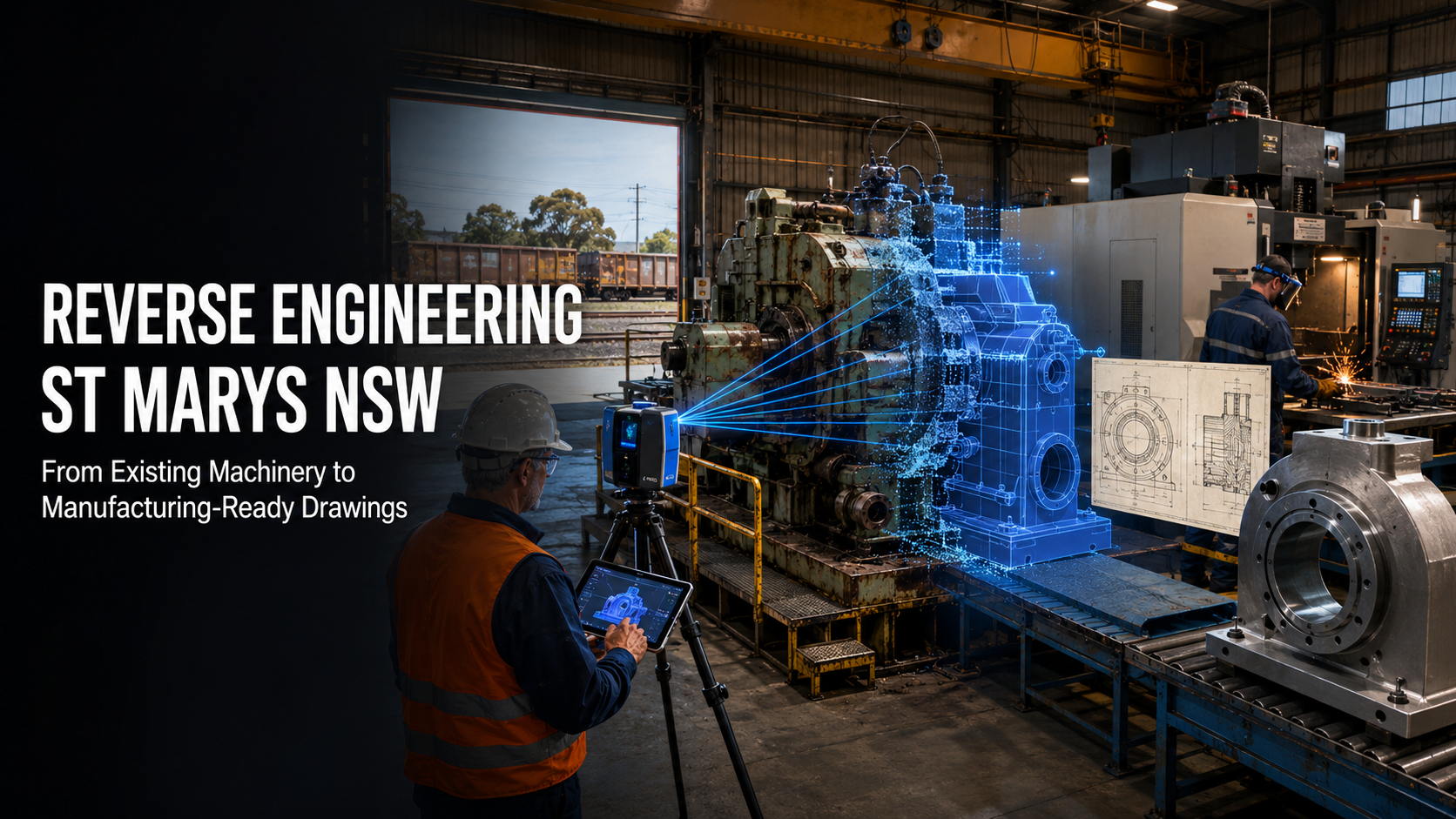
Hamilton By Design provides reverse-engineering and 3D scanning services for St Marys manufacturers that need to understand, reproduce or modify existing machinery. By combining physical measurement, 3D scanning, mechanical engineering, CAD modelling and fabrication drawings, existing equipment can be converted into practical digital information for maintenance and manufacturing.
Common Machinery Problems in St Marys
Obsolete machinery parts
A machine may remain productive long after its original manufacturer has discontinued replacement parts. When a shaft, housing, bracket, guard, roller, casting or fabricated component fails, the absence of drawings can result in extended production downtime.
Reverse engineering allows the existing component and its surrounding interfaces to be measured. A replacement model can then be developed with consideration for wear, tolerances, material selection and the way the component connects to the remaining machinery.
Missing or inaccurate drawings
Older factories commonly retain drawings that no longer reflect the installed equipment. Machines may have been relocated, guards replaced, frames reinforced or production lines modified without the drawings being updated.
Hamilton By Design can use engineering-grade LiDAR scanning to document machinery, structures, platforms, conveyors, pipework and surrounding building conditions. The resulting point cloud provides a measurable record of what exists rather than relying entirely on historical information.
Limited shutdown time
Manufacturers cannot always stop machinery for several days while measurements are taken. Where practical, scanning can capture a large amount of dimensional information during a planned site visit or short shutdown.
The captured information can then be processed away from the production area. Models, modifications and drawings can be prepared before the next shutdown, reducing the amount of engineering work that must be completed while the equipment is unavailable.
Worn or complicated geometry
A worn part should not always be copied exactly. Wear may have changed its profile, hole positions, clearances or mating surfaces.
Three-dimensional scan data can be combined with vernier measurements, micrometers, bore gauges, thread gauges or coordinate measuring equipment. Critical fits and tolerances should be independently verified rather than relying only on plant-scale LiDAR.
This combined process helps distinguish the intended component geometry from the damage or wear that has developed during service.
Safety risks introduced by modifications
A machinery modification can introduce new trapping, crushing, entanglement, access or structural risks. A new guard may restrict maintenance access, while a relocated machine may interfere with a walkway, forklift route or emergency access area.
The objective is therefore not simply to reproduce an old design. It is to understand the equipment, its operating environment and the risks associated with the proposed change.
Engineering and Digital Tools
Different measurement and engineering tools suit different project scales.
Terrestrial LiDAR is suitable for complete machines, factories, platforms, conveyors and equipment interfaces. Mobile LiDAR can assist with the rapid capture of larger production, warehouse and logistics areas. Smaller components may require a validated handheld laser or structured-light scanner supported by precision manual measurements.
FARO SCENE and Autodesk ReCap can be used to register, review and manage point-cloud information. SolidWorks can then support component modelling, assemblies, sheet-metal development, weldments and machinery modifications. AutoCAD can be used for layouts and two-dimensional documentation, while Navisworks can assist with clash detection and installation planning.
Where structural performance needs to be investigated, Hamilton By Design can provide Finite Element Analysis and mechanical assessment. Depending on the project, FEA may examine stress, deflection, fatigue, buckling, vibration or the effect of different load conditions.
For chutes, hoppers and bulk-material systems, Rocky DEM can assist with material-flow, blockage, impact and wear investigations.
Mechanical Engineering Services for St Marys
Hamilton By Design’s mechanical engineering consulting services can assist with:
- Reverse engineering of machinery and components
- Production-equipment modifications
- Replacement shafts, rollers, brackets and fabricated assemblies
- Equipment frames, supports and access arrangements
- Machinery guards and enclosures
- Conveyor and transfer-point modifications
- Maintenance and installation planning
- Component comparison and design review
- FEA and mechanical assessment
- Fabrication and commissioning support
Depending on the equipment, work may be developed with reference to AS/NZS 4024 for machinery safety, AS 4100 for steel structures, AS 1657 for fixed platforms and access systems, AS/NZS 1170 for structural actions and AS 4991 for certain lifting devices.
The applicable standards, loads and acceptance criteria should be established for each project. FEA is an engineering analysis method, but it does not replace the need to define the governing design standard and service conditions.
Mechanical Drafting for Manufacturing
Clear drawings are essential once the engineering work moves into manufacturing. Hamilton By Design provides mechanical drafting services that can include:
- General arrangement drawings
- Machining and component drawings
- Fabrication and welding drawings
- Assembly drawings
- Sheet-metal developments
- DXF cutting profiles
- Exploded views
- Bills of materials
- Installation details
- As-built drawing updates
- STEP, Parasolid, DWG, DXF and PDF deliverables
Mechanical drawings may be prepared with reference to AS 1100.201, while structural drawings may reference AS/NZS 1100.501. Structural steel fabrication can also require consideration of AS/NZS 1554.1 and AS/NZS 5131.
Hamilton By Design’s broader manufacturing and production services can connect the drafting process with practical fabrication, assembly and installation requirements.
Machinery Guarding and Safe Access
Machinery hazards may include exposed shafts, couplings, pulleys, belt drives, conveyor nip points, rotating tools, hot surfaces, ejected material and unexpected startup.
Hamilton By Design can assist with the mechanical aspects of guarding by scanning the equipment, identifying physical interfaces, developing guard arrangements and producing fabrication drawings. The design should provide protection without making inspection, cleaning and maintenance unnecessarily difficult.
The machine-guarding information provided by Hamilton By Design explains why guarding must be treated as an engineering and risk-management issue rather than simply adding mesh around moving parts.
Relevant standards can include AS/NZS 4024.1201 for risk assessment, AS/NZS 4024.1601 for safety distances and AS/NZS 4024.1603 for preventing unexpected startup.
For conveyors, the current references generally include AS/NZS 4024.3610 for general conveyor requirements and AS/NZS 4024.3611 for bulk-material belt conveyors. AS 1755:2000 has been superseded and should not be presented as the primary current conveyor standard for new projects.
Electrical interlocks, emergency-stop circuits and safety-control systems may require input and validation from an appropriately qualified electrical or functional-safety specialist.
Logistics and Materials-Handling Assistance
St Marys also supports warehousing, freight, distribution and construction-product operations. Hamilton By Design can assist with the physical engineering of logistics facilities through manufacturing layout design, equipment arrangements, conveyor modifications, stillages, transport frames, access structures and fabrication drawings.
Three-dimensional scanning can identify existing columns, racking, machinery, doors, services and access restrictions before a revised layout is developed. This helps assess equipment clearances, forklift routes, pedestrian separation, maintenance access and installation sequencing.
For bulk-material facilities, HBD’s chute and materials-handling engineering can assist with transfer chutes, hoppers, conveyors, wear liners, dust-control interfaces and maintenance access.
Depending on the scope, relevant standards may include AS 4084.1 and AS 4084.2 for steel storage racking, AS 2359 for powered industrial trucks, AS/NZS 4024.3610 for conveyors, AS 1657 for access systems and AS 3774 for loads on bulk-solids containers.
Engineering-Led Risk Management
Effective risk management begins before a component is manufactured or a machine is modified.
Hamilton By Design can assist by documenting the existing conditions, defining the machinery’s intended use, identifying hazards and developing engineering controls. Operators and maintenance personnel should be consulted because they often understand problems that are not visible in historical drawings.
The design process can include a hazard register, design assumptions, hierarchy-of-control review, documented residual risks, fabrication review and post-installation verification.
For NSW projects, this work should also consider the Work Health and Safety Act 2011, Work Health and Safety Regulation 2025 and the SafeWork NSW Code of Practice for managing plant risks.
Retaining Machinery Information for the Future
Subject to the client’s confidentiality and document-control requirements, Hamilton By Design can retain machinery scans, replacement-part CAD models, dimensional data, drawings, FEA records and modification histories.
This creates a reusable digital engineering record. If another component fails or the machinery requires a future upgrade, the business has a stronger starting point than an old paper drawing or an undocumented repair.
Frequently Asked Questions
What is reverse engineering?
Reverse engineering is the process of examining and measuring an existing component or machine to understand its geometry, function and interfaces. The information can then be used to produce CAD models, replacement-part drawings or machinery modifications.
Can a replacement part be produced without an original drawing?
Yes, in many cases. The existing component and mating equipment can be scanned and measured. Critical dimensions, materials, tolerances and service loads must still be verified before manufacturing.
Can Hamilton By Design scan both small parts and complete factories?
Yes, but different tools may be required. Terrestrial LiDAR is suitable for factories and large machinery, while smaller precision components may require close-range scanning, CMM inspection or manual metrology.
How accurate is 3D scanning?
Accuracy depends on the scanner, component size, surface condition, distance and required tolerance. Precision bearing fits, threads and sealing surfaces should be confirmed using appropriate dimensional inspection tools.
Can Hamilton By Design design machinery guards?
Hamilton By Design can assist with mechanical guard layouts, support frames, access considerations and fabrication drawings. Electrical interlocks and safety-control systems may require a qualified electrical or functional-safety specialist.
What drawings can be supplied to manufacturers?
Deliverables can include PDFs, AutoCAD drawings, DXF profiles, SolidWorks files, STEP or Parasolid models, assembly drawings, fabrication details and bills of materials.
What Australian Standards apply?
The applicable standards depend on the equipment. Common references include AS/NZS 4024 for machinery safety, AS 1657 for industrial access, AS 4100 for steel structures, AS/NZS 1554.1 for structural welding and AS 1100 for engineering drawings.
Can scan and CAD information be retained for later projects?
Yes. Subject to the agreed data-retention and confidentiality arrangements, HBD can maintain scan data, CAD models, drawings, FEA records and machinery modification histories for future maintenance and upgrades.
Contact Us – Talk To Us
Our clients: