Engineering Solutions for Manufacturers, Fabricators & Industrial Facilities Across the Coffs Coast
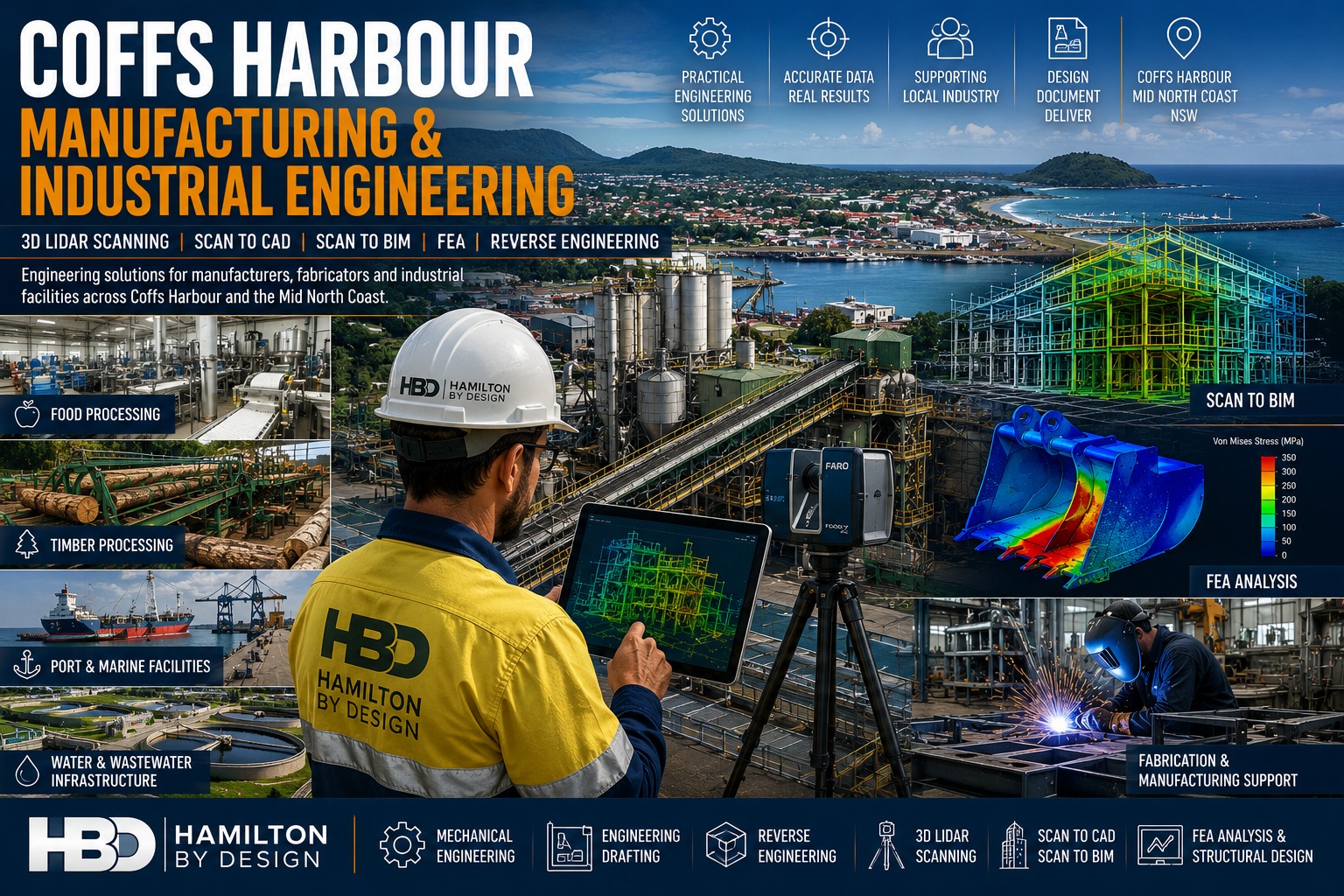
Hamilton By Design provides engineering-led mechanical engineering, 3D LiDAR scanning, Scan to CAD, Scan to BIM, reverse engineering, finite element analysis (FEA) and engineering drafting services throughout Coffs Harbour, Toormina, Sawtell, Woolgoolga, Grafton and the wider North Coast region.
Coffs Harbour is one of regional New South Wales’ most diverse industrial centres, supporting manufacturing, food processing, timber processing, transport infrastructure, marine industries, water utilities and industrial facilities.
As facilities expand and equipment ages, accurate engineering information becomes critical for reducing project risk, improving asset reliability and supporting future growth.
Hamilton By Design helps manufacturers, engineers, fabricators and industrial asset owners capture existing conditions, develop accurate engineering models and deliver practical engineering solutions for both brownfield and greenfield projects.
Engineering Services for Manufacturing & Industry
Supporting Regional Industry Growth
Our services support:
Manufacturers
Fabricators
Timber Processing Facilities
Food Processing Plants
Water Utilities
Industrial Workshops
Logistics Facilities
Airport Infrastructure
Marine Facilities
Government Infrastructure
Services include:
Mechanical Engineering
Engineering Design
Reverse Engineering
Engineering Drafting
FEA Analysis
3D LiDAR Scanning
Scan to CAD
Scan to BIM
Asset Documentation
3D LiDAR Scanning Coffs Harbour
Engineering Grade Reality Capture
Hamilton By Design provides engineering-grade terrestrial laser scanning services throughout Coffs Harbour and Northern NSW.
Laser scanning captures highly accurate site information that can be used for:
Existing Condition Surveys
Industrial Plant Upgrades
Manufacturing Facility Modifications
Structural Steel Modelling
Pipework Modelling
Asset Management
Construction Verification
Applications include:
Food Processing Facilities
Capture production equipment, processing lines, conveyors and services prior to upgrades and expansions.
Timber Processing Facilities
Accurately model sawmills, conveyors, log handling systems and timber processing infrastructure.
Industrial Manufacturing Facilities
Document existing plant conditions for engineering design and construction planning.
Sawmill & Timber Processing Engineering
Supporting Brownfield Upgrades
The North Coast has a strong timber processing industry with facilities often containing decades of modifications and undocumented changes.
Hamilton By Design supports:
Sawmill Expansions
Conveyor Upgrades
Dust Extraction Systems
Structural Modifications
Equipment Replacements
Facility Modernisation Projects
Using 3D LiDAR scanning and engineering modelling, we help reduce project risk and improve fabrication accuracy.
Scan to BIM Services
Building Information Modelling for Existing Assets
Hamilton By Design develops BIM models from laser scan data for:
Buildings
Manufacturing Facilities
Industrial Plants
Water Infrastructure
Utilities
Government Assets
Airport Infrastructure
Processing Facilities
Benefits include:
Improved project coordination
Reduced design clashes
Better asset management
Digital Twin Development
Enhanced project planning
Finite Element Analysis (FEA)
Engineering Validation Before Fabrication
Hamilton By Design provides FEA services for:
Loader Buckets
Wear analysis
Structural assessment
Reinforcement design
Excavator Buckets
Impact load analysis
Structural integrity reviews
Grader Blades
Ground engagement loading
Structural performance verification
Chutes & Hoppers
Material loading analysis
Wear zone identification
Structural optimisation
Industrial Structures
Platforms
Walkways
Support frames
Access systems
Reverse Engineering Services
When drawings are unavailable or outdated, reverse engineering allows valuable engineering information to be recovered.
Applications include:
Pumps
Shafts
Castings
Conveyor Components
Machine Components
Structural Assemblies
Wear Parts
Deliverables include:
SolidWorks Models
STEP Files
SAT Files
Manufacturing Drawings
Fabrication Documentation
Why Choose Hamilton By Design?
Engineering-Led Solutions
We understand how engineering information is used throughout the project lifecycle.
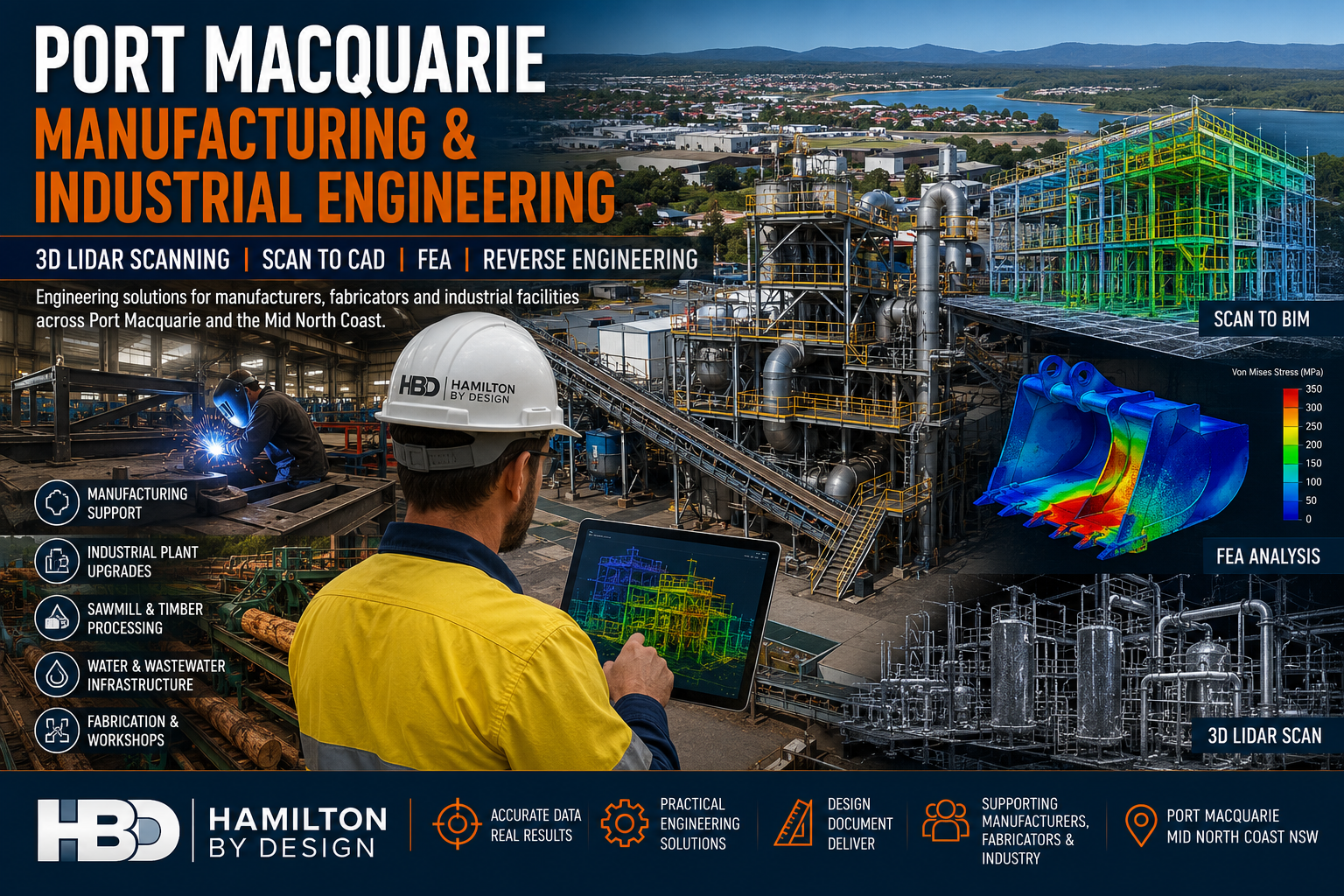
Port Macquarie Manufacturing & Industrial Engineering
Engineering Solutions for Manufacturers, Fabricators & Industrial Facilities Across the Mid North Coast
Hamilton By Design provides engineering-led mechanical engineering, 3D LiDAR scanning, Scan to CAD, Scan to BIM, reverse engineering, finite element analysis (FEA) and engineering drafting services throughout Port Macquarie, Wauchope, Kempsey, Southwest Rocks, Laurieton and the wider Mid North Coast region.
The Port Macquarie region is home to a growing manufacturing and industrial sector that supports timber processing, food manufacturing, fabrication workshops, transport operators, water infrastructure, marine industries and industrial processing facilities.
As facilities grow and equipment ages, accurate engineering information becomes critical for maintaining productivity, reducing downtime and planning future upgrades.
Hamilton By Design helps manufacturers, engineers, fabricators and asset owners capture existing conditions, develop accurate engineering models and deliver practical solutions for brownfield and greenfield projects.
Whether your project involves upgrading a sawmill, replacing ageing equipment, scanning a processing plant, developing fabrication drawings or validating a design using Finite Element Analysis, our team provides practical engineering support backed by decades of industry experience.
Engineering Services for Manufacturers
Supporting Manufacturing Growth Across Port Macquarie
Manufacturing businesses face increasing pressure to improve productivity, reduce maintenance costs and modernise existing facilities.
Hamilton By Design supports manufacturers by providing:
Mechanical Engineering
Equipment Design
Plant Layout Design
Reverse Engineering
Engineering Drafting
3D Laser Scanning
Scan to CAD
Finite Element Analysis
Asset Documentation
Brownfield Upgrade Support
Our engineering services help manufacturers make informed decisions based on accurate site information and engineering data.
Industrial Plant Engineering
Engineering Support for Existing Facilities
Many industrial facilities have evolved over decades through multiple modifications and expansions.
Unfortunately, original drawings often no longer reflect actual site conditions.
Hamilton By Design provides engineering solutions that allow businesses to accurately document and understand their facilities before commencing upgrades or maintenance projects.
Typical facilities include:
Manufacturing Plants
Timber Processing Facilities
Food Processing Facilities
Water Treatment Plants
Wastewater Facilities
Recycling Facilities
Quarry Operations
Industrial Workshops
Processing Plants
3D LiDAR Scanning Port Macquarie
Engineering Grade Reality Capture
Hamilton By Design provides engineering-grade terrestrial laser scanning services that capture millions of highly accurate measurements.
Laser scanning creates an accurate digital representation of existing facilities and equipment, allowing engineering teams to design with confidence.
Applications include:
Manufacturing Facilities
Industrial Plants
Sawmills
Warehouses
Water Infrastructure
Processing Facilities
Structural Steel
Pipework Systems
Mechanical Equipment
Deliverables include:
E57 Files
RCP Files
RCS Files
LAS Files
Registered Point Clouds
Existing Condition Models
Engineering Drawings
Sawmill & Timber Processing Engineering
Supporting Brownfield Upgrades
The Mid North Coast has a long history of timber processing and sawmill operations.
Many facilities have grown over decades and contain a mixture of original equipment, modifications and undocumented changes.
Hamilton By Design supports sawmill operators with:
Existing Condition Surveys
3D Laser Scanning
Conveyor Design
Structural Modifications
Dust Extraction Upgrades
Equipment Replacement Projects
Scan to CAD Services
Engineering Documentation
Laser scanning enables accurate modelling of existing plant conditions, reducing project risk and improving installation outcomes.
Scan to CAD Services
Converting Reality into Engineering Information
Point cloud data becomes significantly more valuable when converted into usable engineering deliverables.
Hamilton By Design converts laser scan data into:
AutoCAD Drawings
Plant Layouts
General Arrangement Drawings
Equipment Layout Drawings
Structural Drawings
Mechanical Drawings
Fabrication Drawings
These deliverables assist engineers, fabricators and project teams during design and construction activities.
Scan to BIM Services
Building Information Modelling for Existing Assets
Hamilton By Design develops BIM models from laser scan data to support engineering, construction and asset management projects.
We develop BIM models for:
Buildings
Infrastructure
Industrial Facilities
Processing Plants
Utilities
Manufacturing Facilities
Water Treatment Facilities
Government Assets
Benefits include:
Improved project coordination
Reduced design clashes
Improved construction planning
Better asset management
Digital Twin Development
Enhanced lifecycle management
For industrial facilities and manufacturing operations, Scan to BIM provides an accurate digital foundation for future upgrades and expansion projects.
Mechanical Engineering Services
Practical Engineering Solutions
Hamilton By Design provides mechanical engineering services focused on practical, buildable and maintainable outcomes.
Services include:
Mechanical Design
Equipment Design
Conveyor Design
Chute Design
Hopper Design
Materials Handling Systems
Structural Interfaces
Equipment Modifications
Design Reviews
Shutdown Engineering
Our experience spans manufacturing, mining, industrial processing and infrastructure projects throughout Australia.
Finite Element Analysis (FEA)
Engineering Validation Before Fabrication
Finite Element Analysis allows engineers to assess how components and structures perform under load before manufacturing begins.
Hamilton By Design provides FEA services for:
Loader Buckets
Assessment of:
Wear zones
Reinforcement design
Fatigue performance
Structural adequacy
Excavator Buckets
Analysis of:
Impact loading
Structural integrity
Wear protection systems
Load distribution
Grader Blades
Verification of:
Structural support systems
Ground engagement loads
Deflection performance
Wear areas
Chutes & Hoppers
Evaluation of:
Material loading
Structural performance
Impact zones
Reinforcement requirements
Industrial Structures
Assessment of:
Platforms
Walkways
Equipment Supports
Access Systems
Structural Frames
FEA provides confidence that designs will perform safely and efficiently under operational conditions.
Reverse Engineering Services
Recreating Existing Assets
When original engineering drawings are unavailable, reverse engineering can recover valuable engineering information.
Hamilton By Design provides reverse engineering services for:
Mechanical Components
Pumps
Shafts
Castings
Conveyor Components
Wear Liners
Structural Components
Machinery Assemblies
Deliverables include:
SolidWorks Models
STEP Files
SAT Files
Fabrication Drawings
Manufacturing Drawings
Engineering Drafting Services
Professional Documentation for Construction & Fabrication
Our drafting services provide accurate engineering documentation for manufacturing, industrial and infrastructure projects.
Services include:
Mechanical Drafting
Structural Drafting
Fabrication Drawings
Workshop Drawings
As-Built Drawings
Construction Documentation
Plant Layout Drawings
Using:
SolidWorks
Autodesk Inventor
AutoCAD
Navisworks
FARO SCENE
Autodesk ReCap
Why Choose Hamilton By Design?
Engineering-Led Approach
We understand how engineering information is used throughout the project lifecycle.
Practical Industry Experience
Experience supporting:
Manufacturers
Fabricators
Mining Operations
Industrial Facilities
Utilities
Infrastructure Owners
Advanced Technology
Including:
FARO Focus Laser Scanners
FARO Orbis Mobile Scanning
FARO SCENE
SolidWorks
ANSYS
Autodesk Inventor
AutoCAD
Navisworks
Australia-Wide Capability
Supporting projects across:
Port Macquarie
Mid North Coast
Newcastle & Hunter
Sydney
Brisbane
Melbourne
Adelaide
Perth
Need Engineering Support in Port Macquarie?
Whether your project involves manufacturing facilities, industrial plants, sawmills, water infrastructure or brownfield upgrades, Hamilton By Design provides practical engineering solutions backed by real industry experience.
Our Services
✔ Manufacturing Engineering ✔ Industrial Engineering ✔ Mechanical Engineering ✔ 3D LiDAR Scanning ✔ Scan to CAD ✔ Scan to BIM ✔ Reverse Engineering ✔ Finite Element Analysis (FEA) ✔ Engineering Drafting ✔ Sawmill Engineering Support ✔ Industrial Plant Upgrades ✔ Brownfield Engineering Projects
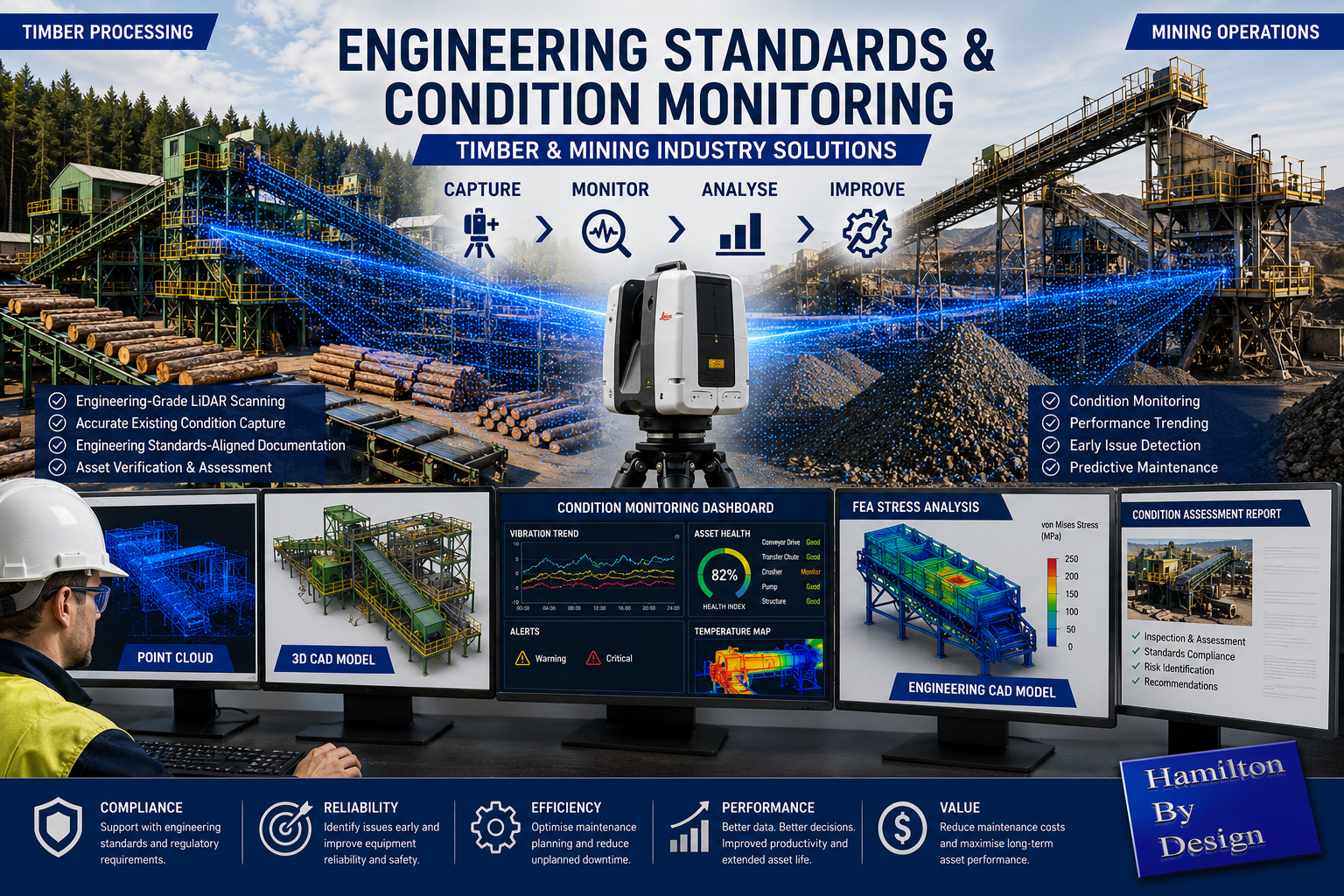
Industries such as timber processing and mining operate in demanding environments where equipment reliability directly affects productivity, maintenance costs, and operational performance. Conveyor systems, transfer chutes, rotating equipment, processing machinery, structural assets, and supporting infrastructure are often exposed to continuous loading, wear, vibration, fatigue, and harsh operating conditions.
While machinery failures may appear sudden, many develop gradually through changes in operating conditions, deterioration, or inadequate monitoring and maintenance practices.
Engineering standards and condition monitoring help organisations move from reactive maintenance toward informed engineering decisions and improved asset performance.
At Hamilton By Design, we support mining and timber processing industries through engineering-led approaches that combine engineering standards, digital engineering workflows, reality capture technologies, and practical engineering solutions.
Why Engineering Standards Matter
Engineering standards provide a structured framework for designing, assessing, operating, and maintaining equipment.
Standards help organisations achieve:
Improved safety
Greater consistency
Reduced risk
Improved reliability
Better maintenance planning
Regulatory compliance
Improved operational performance
Examples of standards commonly applied within industrial projects may include:
Structural and Mechanical Standards
AS 4100 – Steel structures
AS 1170 – Structural design actions
AS 3996 – Access covers and grates
AS 1657 – Fixed platforms, walkways, stairways and ladders
AS 1554 – Structural welding
Asset and Equipment Considerations
Fatigue assessment
Structural integrity
Mechanical reliability
Equipment life assessment
Materials handling performance
Engineering standards support more than design compliance. They help establish long-term operational reliability.
What is Condition Monitoring?
Condition monitoring involves collecting information about equipment performance and asset condition to identify potential issues before failures occur.
Rather than waiting for breakdowns, monitoring allows maintenance and engineering teams to make decisions using measurable data.
Condition monitoring can involve:
Equipment inspections
Structural assessments
Wear monitoring
Vibration monitoring
Alignment assessment
Existing condition capture
Thermal assessments
Trend analysis
Performance assessment
The objective is identifying deterioration before operational impacts occur.
Timber Industry Applications
Timber processing facilities operate continuously with significant material handling demands.
Common assets include:
Log conveyors
Timber handling systems
Chippers
Screening systems
Structural platforms
Transfer systems
Processing machinery
Typical challenges may include:
Equipment wear
Misalignment
Build-up
Fatigue
Structural deterioration
Conveyor performance issues
Engineering monitoring and assessment can improve:
Throughput
Reliability
Maintenance planning
Downtime reduction
Equipment life
Mining Industry Applications
Mining operations often involve harsh operating environments and heavy-duty equipment subjected to high loading conditions.
Applications can include:
Conveyor systems
Transfer chutes
Processing plants
Crushers
Pump systems
Structural assets
Materials handling systems
Common challenges may include:
Wear
Fatigue loading
Structural movement
Equipment deterioration
Production interruptions
Condition monitoring allows operational teams to move toward predictive maintenance approaches rather than emergency repairs.
How Hamilton By Design Supports Engineering Standards and Condition Monitoring
Hamilton By Design supports projects through a combination of engineering tools and practical experience.
Our services can include:
Engineering-Grade 3D LiDAR Scanning
Capture accurate existing conditions and generate point cloud information for:
Existing plant geometry
Structural assessment
Brownfield modifications
Asset verification
Scan-to-CAD Workflows
Convert site information into:
Editable engineering models
Existing condition documentation
Engineering drawings
Engineering Analysis and Simulation
Support asset assessments through:
Finite Element Analysis (FEA)
Structural assessments
Load analysis
Design validation
Engineering Documentation
Deliver:
Drawings
Assessment reports
Design documentation
Asset information
Supporting Long-Term Asset Performance
Successful operations are not built around simply repairing equipment after failure.
Long-term value often comes from:
Improved reliability
Reduced maintenance costs
Better planning
Increased productivity
Reduced downtime
Improved asset life
Better engineering decisions
By combining engineering standards, condition monitoring, digital engineering workflows, and practical engineering solutions, organisations can move beyond assumptions and improve operational performance.
Hamilton By Design supports timber processing and mining industries by helping transform engineering information into practical decisions and measurable outcomes.
The forestry and timber processing industries operate in demanding environments where productivity, reliability, and equipment performance directly influence profitability. Whether processing logs, handling timber products, operating sawmills, or managing materials handling systems, machinery downtime and inefficiencies can significantly affect production output and operating costs.
Modern engineering is moving beyond traditional design approaches and increasingly using digital engineering tools to optimise equipment before fabrication and installation begins.
At Hamilton By Design, we combine engineering-grade 3D LiDAR scanning, 3D modelling, and Finite Element Analysis (FEA) to support forestry and timber processing operations by delivering machinery and engineered systems designed for productivity, reliability, and long-term return on investment.
Designing for More Than Initial Cost
The lowest purchase price does not always provide the lowest operating cost.
Machinery and processing systems can incur substantial ongoing costs through:
Excessive wear
Unplanned maintenance
Downtime
Energy consumption
Material build-up
Inefficient layouts
Reduced production capacity
Premature equipment failure
Engineering decisions made during the design stage can influence the total lifecycle cost of equipment for many years after installation.
The objective is not simply designing machinery that works.
The objective is designing machinery that continues to perform efficiently throughout its operational life.
Engineering-Grade 3D LiDAR Scanning
For existing timber processing plants and brownfield facilities, one of the biggest challenges is understanding current conditions accurately.
Many facilities contain:
Existing conveyors
Timber processing machinery
Structural steel
Pipework
Platforms and access systems
Building constraints
Historical modifications
Outdated drawings or manual measurements can introduce risk into engineering projects.
Hamilton By Design uses engineering-grade 3D LiDAR scanning to capture accurate existing conditions and generate high-quality point cloud data.
This provides:
Accurate plant geometry
Existing condition verification
Reduced design assumptions
Improved fit-up accuracy
Reduced installation risk
Faster project development
Rather than designing around assumptions, engineering decisions can be based on actual site information.
3D Modelling for Better Project Outcomes
Once site information has been captured, point cloud data can be converted into editable engineering models.
3D modelling provides benefits including:
Improved visualisation
Clash detection
Layout optimisation
Equipment integration
Fabrication planning
Improved communication
For forestry and timber processing projects this may include:
Log handling systems
Conveyors
Transfer systems
Chutes
Processing equipment
Access platforms
Structural modifications
Production upgrades
Digital models help identify issues before they become site problems.
Finite Element Analysis (FEA)
Engineering performance extends beyond appearance and fit-up.
Equipment must withstand:
Dynamic loading
Material impacts
Fatigue
Wear
Structural loading
Operational forces
Hamilton By Design can support projects through Finite Element Analysis (FEA) to evaluate equipment and structural performance before fabrication begins.
FEA can assist with:
Stress assessment
Deflection analysis
Structural performance
Design optimisation
Weight reduction opportunities
Reliability improvements
Rather than overdesigning equipment or relying on assumptions, designs can be refined using measurable engineering information.
Maximising Return on Investment
A successful project should not simply focus on reducing initial capital cost.
The real value often comes from:
Increased production rates
Reduced maintenance costs
Improved reliability
Reduced downtime
Improved safety
Lower lifecycle costs
Longer equipment life
Improved operational efficiency
Engineering decisions made early in a project often have long-term financial impacts.
How Hamilton By Design Supports Forestry and Timber Processing
Hamilton By Design combines digital engineering tools with practical engineering experience to support projects from concept through to delivery.
Our services include:
Engineering-grade 3D LiDAR scanning
Scan-to-CAD workflows
3D modelling
Mechanical engineering design
Finite Element Analysis (FEA)
Engineering drawings
Fabrication documentation
Existing condition verification
Brownfield project support
By integrating reality capture, digital modelling, and engineering analysis, projects can move from assumptions toward measurable engineering outcomes.
The goal is simple:
Design machinery and systems that maximise productivity while delivering stronger long-term returns on investment.
Across Australia’s forestry, sawmill and timber processing industries, industrial infrastructure continues to evolve through ongoing maintenance, shutdown upgrades, plant expansions and operational modifications. Conveyor systems are extended, timber transfer systems are upgraded, structural steel platforms are altered, machinery is relocated and new processing equipment is integrated into ageing brownfield facilities that may have operated continuously for decades.
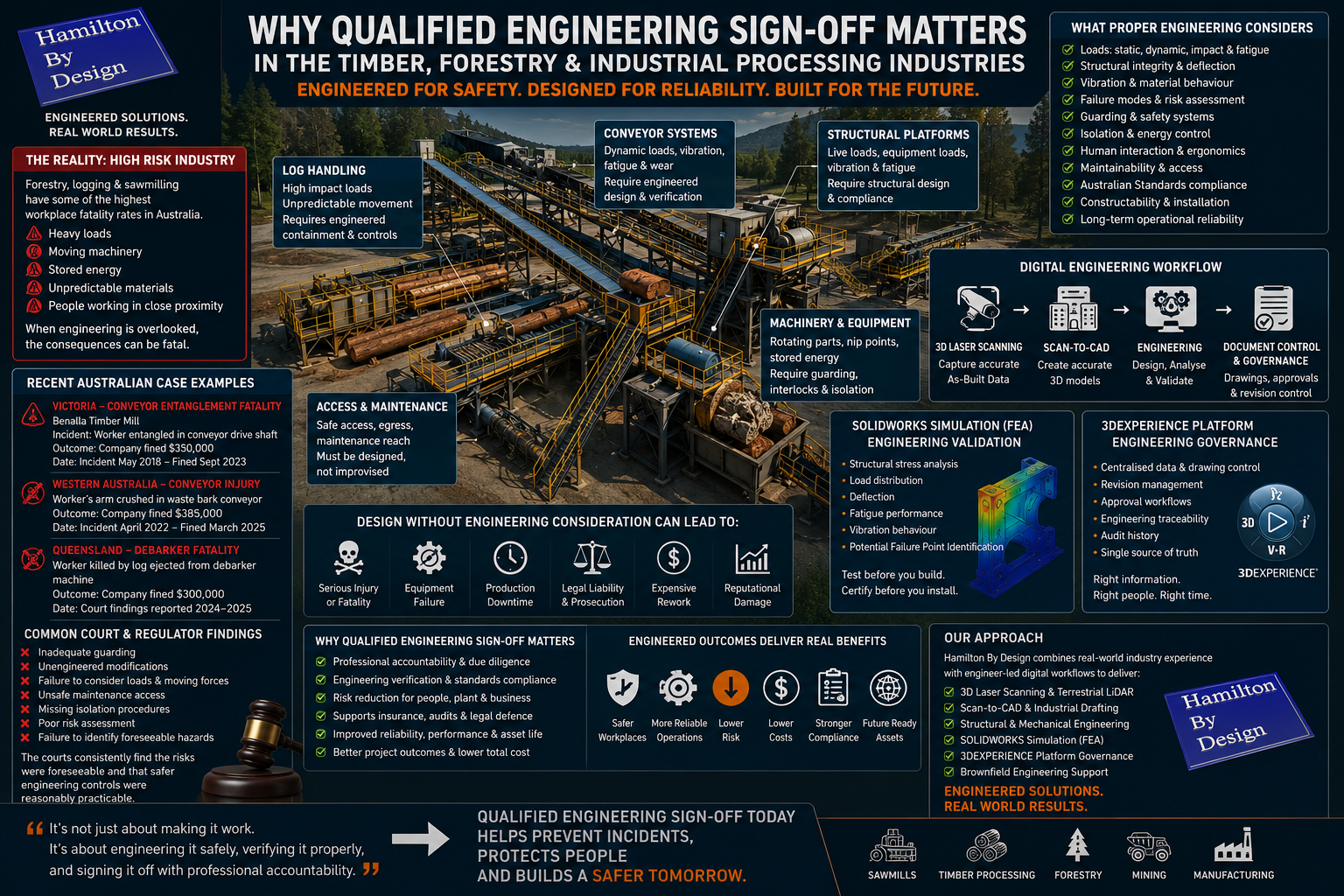
While many of these changes are often completed to improve productivity or maintain operational continuity, one of the greatest hidden risks within industrial environments is modifying or designing plant equipment without proper engineering review, engineering governance and qualified engineering sign-off.
In many industrial workplaces, practical trade experience is highly respected — and rightly so. Skilled tradespeople are essential to fabrication, installation, shutdown works, plant maintenance and operational reliability. However, building something that functions mechanically is not the same as engineering a system that is safe, compliant, reliable and suitable for long-term industrial operation.
This distinction becomes critically important in industries such as forestry, logging and timber processing where machinery regularly handles heavy loads, rotating equipment, moving conveyors, unstable timber products, stored energy and high-throughput material handling systems.
Across sawmills and timber processing facilities throughout Australia, industrial systems are exposed to continuous operational stresses involving vibration, shock loading, impact forces, moisture, abrasive materials, dust contamination and changing environmental conditions. Conveyor systems, debarkers, screw augers, bucket elevators, log transfer systems and structural platforms must all operate safely while supporting continuous production under demanding industrial conditions.
Without proper engineering consideration, even seemingly simple modifications can introduce serious risk.
Over the past several decades, Australian workplace regulators and courts have repeatedly prosecuted companies following incidents involving timber handling systems, conveyors, rotating shafts, sawmill machinery and plant modifications that failed to adequately consider engineering safety requirements.
In one Victorian timber mill incident, a worker died after becoming entangled in a conveyor drive shaft. WorkSafe Victoria later found that engineering controls and guarding solutions were reasonably practicable and could have prevented the fatality. In Western Australia, a timber processing company was fined after a worker suffered catastrophic arm injuries involving inadequately guarded conveyor equipment. In Queensland, a timber company faced prosecution after a worker was killed by a log ejected from a debarker machine.
Although each incident involved different operational circumstances, the underlying engineering failures followed remarkably similar patterns:
inadequate guarding,
unengineered plant modifications,
failure to consider loads and moving forces,
unsafe maintenance access,
missing isolation procedures,
poor risk assessment,
insufficient structural verification,
lack of engineering review,
and failure to identify foreseeable operational hazards.
These are engineering failures — not simply fabrication problems.
A tradesperson may know how to weld, fabricate, cut or assemble industrial equipment, but engineering requires a much deeper understanding of how systems behave under operational conditions over time.
Proper engineering design must consider:
static and dynamic loading,
fatigue and cyclic stresses,
vibration,
structural deflection,
torque and rotational forces,
impact loading,
material behaviour,
wear characteristics,
human interaction with machinery,
guarding requirements,
maintainability,
failure modes,
constructability,
Australian Standards compliance,
and long-term operational reliability.
This is why qualified engineering sign-off matters.
Engineering sign-off is not simply a signature placed on a drawing. It represents professional accountability that the design has been reviewed, assessed and verified against engineering principles, foreseeable operational conditions and applicable standards.
Without proper engineering oversight, industrial businesses expose themselves to major commercial, operational and legal risk.
Poorly engineered modifications can lead to:
worker injury or fatalities,
structural failure,
conveyor collapse,
equipment damage,
production downtime,
voided insurance claims,
failed audits,
regulatory prosecution,
expensive shutdown rework,
project delays,
and reputational damage.
In many industrial facilities, the risk develops gradually over time. Equipment modifications are often completed during shutdowns or urgent maintenance periods where production pressure overrides long-term engineering review. Small undocumented changes accumulate over years until facilities no longer reflect their original engineered design intent.
Drawings become outdated. Loads change. Access paths are altered. Equipment is relocated. Platforms are modified. Conveyors are extended. Additional services are added.
Over time, facilities can drift significantly away from their original engineered condition.
This is where engineering governance becomes critically important.
At Hamilton By Design, we are an engineer-led organisation focused on delivering engineered outcomes rather than simply trade-based solutions.
While practical trade experience remains essential within industrial environments, our approach extends beyond fabrication and installation alone. We apply engineering thinking, digital engineering workflows and industrial experience to support long-term operational reliability, constructability and risk reduction.
Using engineering-grade 3D laser scanning, terrestrial LiDAR capture and scan-to-CAD workflows, we help industrial clients establish accurate as-built conditions before design or fabrication work begins.
Rather than relying on outdated PDFs or manual measurements, project teams gain access to highly accurate point cloud data that reflects real-world plant conditions. This allows engineers, fabricators and project managers to identify operational risks earlier and improve confidence before fabrication or construction begins.
Engineering-grade point clouds can then be converted into detailed CAD models suitable for:
structural analysis,
equipment integration,
plant upgrades,
fabrication detailing,
conveyor layouts,
clash detection,
and engineering verification.
One of the major advantages of modern digital engineering workflows is the ability to perform engineering validation before equipment is manufactured or installed onsite.
Using SOLIDWORKS Simulation and Finite Element Analysis (FEA), industrial components and structures can be digitally tested under operational loading conditions to assess how equipment may behave before fabrication occurs.
FEA allows engineers to evaluate:
structural stress,
deflection,
load distribution,
fatigue performance,
vibration behaviour,
and potential failure points.
This becomes particularly valuable within forestry and timber processing facilities where conveyor systems, transfer structures, platforms and machinery supports are exposed to continuous operational loading and vibration.
Rather than relying on assumptions or “rule of thumb” workshop modifications, FEA allows engineering decisions to be supported by measurable analysis and engineering verification.
This significantly improves confidence in the design process while helping reduce the risk of structural failure, overloading or premature wear.
At Hamilton By Design, digital engineering workflows can also be supported through the 3DEXPERIENCE platform, providing engineering governance and controlled management of industrial drawing systems and project information.
Modern industrial projects increasingly require:
revision control,
controlled approvals,
drawing issue states,
engineering traceability,
audit history,
and a single source of truth across multiple project stakeholders.
The 3DEXPERIENCE platform supports this by allowing controlled management of CAD models, drawings, revisions and engineering workflows within a centralised digital environment.
This provides significant advantages for industrial and brownfield projects where multiple contractors, engineers, fabricators and maintenance teams may all be interacting with the same plant infrastructure over long operational lifecycles.
Engineering governance through structured drawing control helps ensure:
approved drawings remain current,
revision history is traceable,
superseded drawings are controlled,
engineering changes are documented,
and project teams are working from reliable information.
In industries such as forestry, timber processing, mining and manufacturing, poor drawing control can create major operational and safety risks if outdated or unverified information is used during fabrication or construction activities.
At Hamilton By Design, our workflows focus on engineering-grade deliverables designed to support practical industrial outcomes.
This includes:
engineering-grade 3D laser scanning,
terrestrial LiDAR capture,
scan-to-CAD workflows,
industrial drafting,
structural and mechanical modelling,
FEA-supported engineering workflows,
revision-controlled drawing systems,
and brownfield engineering support.
We do not simply create geometry or visualisation models.
We focus on engineering workflows designed to support real-world industrial reliability, constructability and operational performance.
Because in high-risk industrial environments, “it works” is not the same as “it has been engineered safely.”
Qualified engineering sign-off matters because the consequences of poor engineering decisions can extend far beyond production downtime — affecting worker safety, operational reliability, legal liability and the long-term success of industrial infrastructure.
If your business is seeking engineered outcomes that outlast short-term fixes, Hamilton By Design provides engineer-led digital engineering support designed to help reduce risk and engineer success across industrial operations throughout Australia.
To provide the best experiences, we use technologies like cookies to store and/or access device information. Consenting to these technologies will allow us to process data such as browsing behaviour or unique IDs on this site. Not consenting or withdrawing consent, may adversely affect certain features and functions.
Functional
Always active
The technical storage or access is strictly necessary for the legitimate purpose of enabling the use of a specific service explicitly requested by the subscriber or user, or for the sole purpose of carrying out the transmission of a communication over an electronic communications network.
Preferences
The technical storage or access is necessary for the legitimate purpose of storing preferences that are not requested by the subscriber or user.
Statistics
The technical storage or access that is used exclusively for statistical purposes.The technical storage or access that is used exclusively for anonymous statistical purposes. Without a subpoena, voluntary compliance on the part of your Internet Service Provider, or additional records from a third party, information stored or retrieved for this purpose alone cannot usually be used to identify you.
Marketing
The technical storage or access is required to create user profiles to send advertising, or to track the user on a website or across several websites for similar marketing purposes.