Mechanical Engineering | 3D Scanning | 3D Modelling
Tag: sawmilling-machinery
Hamilton By Design provides mechanical engineering, 3D LiDAR scanning and CAD support for sawmilling machinery and timber-processing facilities.
Sawmills often contain interconnected conveyors, rollers, saw lines, transfer systems, guards, extraction ducting and materials-handling equipment. Modifying this machinery requires accurate information about existing equipment, interfaces, access requirements and the surrounding facility.
Our services can include existing-condition scanning, point-cloud registration, mechanical design, scan-to-CAD modelling, equipment layouts, clash detection, machine guarding and fabrication drawings. LiDAR scanning can capture the installed machinery and surrounding structures while reducing reliance on manual measurements around complex equipment.
The resulting point clouds and 3D CAD models can support machinery upgrades, conveyor modifications, equipment replacement, guarding improvements and installation planning. Proposed designs can be checked against existing site geometry to identify restricted clearances and potential clashes before fabrication begins.
Deliverables may include registered point clouds, SolidWorks models, STEP or Parasolid files, general arrangement drawings, fabrication drawings and data suitable for AutoCAD, Inventor, ReCap and Navisworks workflows.
Machine-safety and guarding requirements should be assessed against the relevant parts of the AS/NZS 4024 series and the particular hazards associated with the machinery.
The forestry and timber processing industries operate in demanding environments where productivity, reliability, and equipment performance directly influence profitability. Whether processing logs, handling timber products, operating sawmills, or managing materials handling systems, machinery downtime and inefficiencies can significantly affect production output and operating costs.
Modern engineering is moving beyond traditional design approaches and increasingly using digital engineering tools to optimise equipment before fabrication and installation begins.
At Hamilton By Design, we combine engineering-grade 3D LiDAR scanning, 3D modelling, and Finite Element Analysis (FEA) to support forestry and timber processing operations by delivering machinery and engineered systems designed for productivity, reliability, and long-term return on investment.
Designing for More Than Initial Cost
The lowest purchase price does not always provide the lowest operating cost.
Machinery and processing systems can incur substantial ongoing costs through:
Excessive wear
Unplanned maintenance
Downtime
Energy consumption
Material build-up
Inefficient layouts
Reduced production capacity
Premature equipment failure
Engineering decisions made during the design stage can influence the total lifecycle cost of equipment for many years after installation.
The objective is not simply designing machinery that works.
The objective is designing machinery that continues to perform efficiently throughout its operational life.
Engineering-Grade 3D LiDAR Scanning
For existing timber processing plants and brownfield facilities, one of the biggest challenges is understanding current conditions accurately.
Many facilities contain:
Existing conveyors
Timber processing machinery
Structural steel
Pipework
Platforms and access systems
Building constraints
Historical modifications
Outdated drawings or manual measurements can introduce risk into engineering projects.
Hamilton By Design uses engineering-grade 3D LiDAR scanning to capture accurate existing conditions and generate high-quality point cloud data.
This provides:
Accurate plant geometry
Existing condition verification
Reduced design assumptions
Improved fit-up accuracy
Reduced installation risk
Faster project development
Rather than designing around assumptions, engineering decisions can be based on actual site information.
3D Modelling for Better Project Outcomes
Once site information has been captured, point cloud data can be converted into editable engineering models.
3D modelling provides benefits including:
Improved visualisation
Clash detection
Layout optimisation
Equipment integration
Fabrication planning
Improved communication
For forestry and timber processing projects this may include:
Log handling systems
Conveyors
Transfer systems
Chutes
Processing equipment
Access platforms
Structural modifications
Production upgrades
Digital models help identify issues before they become site problems.
Finite Element Analysis (FEA)
Engineering performance extends beyond appearance and fit-up.
Equipment must withstand:
Dynamic loading
Material impacts
Fatigue
Wear
Structural loading
Operational forces
Hamilton By Design can support projects through Finite Element Analysis (FEA) to evaluate equipment and structural performance before fabrication begins.
FEA can assist with:
Stress assessment
Deflection analysis
Structural performance
Design optimisation
Weight reduction opportunities
Reliability improvements
Rather than overdesigning equipment or relying on assumptions, designs can be refined using measurable engineering information.
Maximising Return on Investment
A successful project should not simply focus on reducing initial capital cost.
The real value often comes from:
Increased production rates
Reduced maintenance costs
Improved reliability
Reduced downtime
Improved safety
Lower lifecycle costs
Longer equipment life
Improved operational efficiency
Engineering decisions made early in a project often have long-term financial impacts.
How Hamilton By Design Supports Forestry and Timber Processing
Hamilton By Design combines digital engineering tools with practical engineering experience to support projects from concept through to delivery.
Our services include:
Engineering-grade 3D LiDAR scanning
Scan-to-CAD workflows
3D modelling
Mechanical engineering design
Finite Element Analysis (FEA)
Engineering drawings
Fabrication documentation
Existing condition verification
Brownfield project support
By integrating reality capture, digital modelling, and engineering analysis, projects can move from assumptions toward measurable engineering outcomes.
The goal is simple:
Design machinery and systems that maximise productivity while delivering stronger long-term returns on investment.
Across Australia’s forestry, sawmill and timber processing industries, industrial infrastructure continues to evolve through ongoing maintenance, shutdown upgrades, plant expansions and operational modifications. Conveyor systems are extended, timber transfer systems are upgraded, structural steel platforms are altered, machinery is relocated and new processing equipment is integrated into ageing brownfield facilities that may have operated continuously for decades.
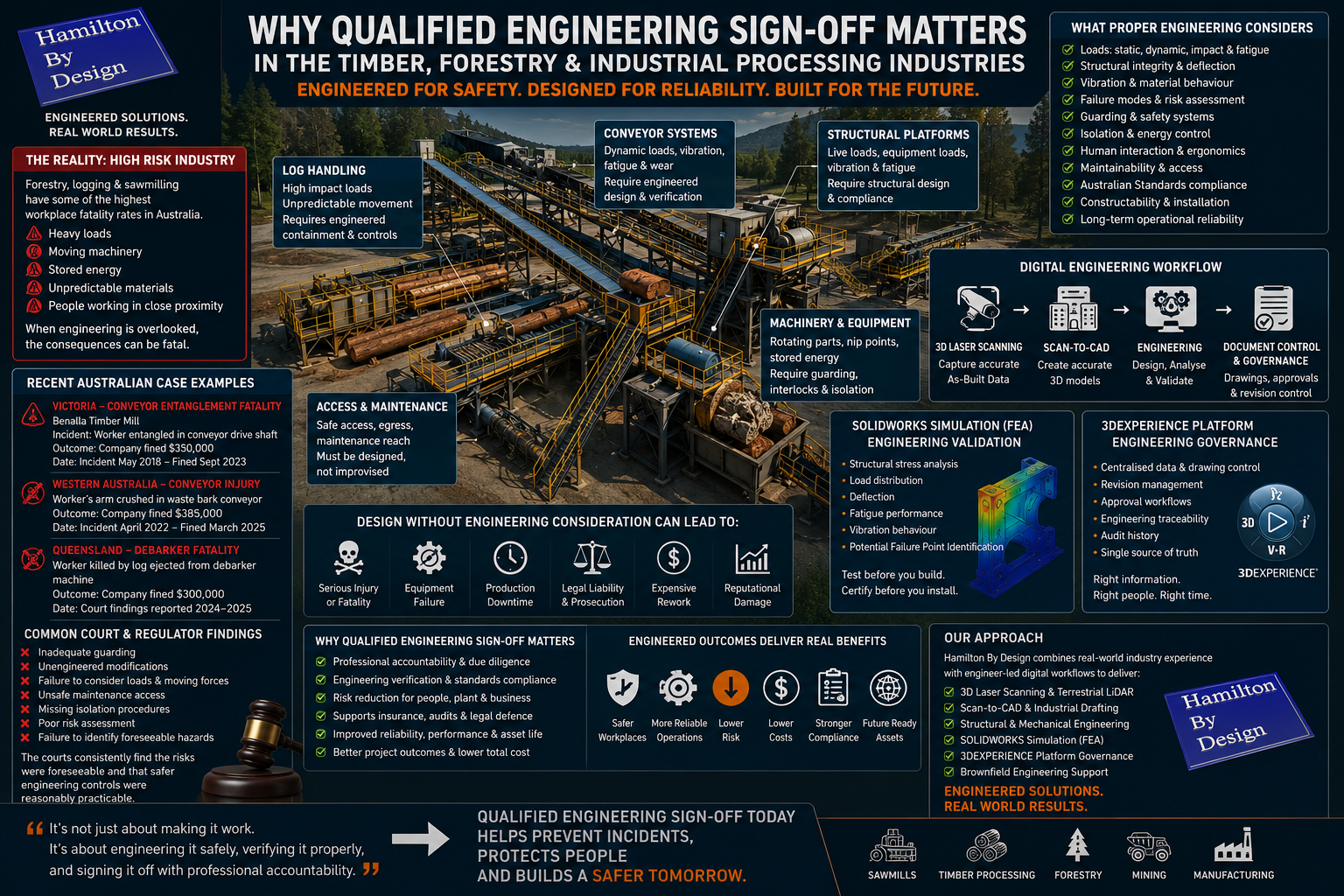
While many of these changes are often completed to improve productivity or maintain operational continuity, one of the greatest hidden risks within industrial environments is modifying or designing plant equipment without proper engineering review, engineering governance and qualified engineering sign-off.
In many industrial workplaces, practical trade experience is highly respected — and rightly so. Skilled tradespeople are essential to fabrication, installation, shutdown works, plant maintenance and operational reliability. However, building something that functions mechanically is not the same as engineering a system that is safe, compliant, reliable and suitable for long-term industrial operation.
This distinction becomes critically important in industries such as forestry, logging and timber processing where machinery regularly handles heavy loads, rotating equipment, moving conveyors, unstable timber products, stored energy and high-throughput material handling systems.
Across sawmills and timber processing facilities throughout Australia, industrial systems are exposed to continuous operational stresses involving vibration, shock loading, impact forces, moisture, abrasive materials, dust contamination and changing environmental conditions. Conveyor systems, debarkers, screw augers, bucket elevators, log transfer systems and structural platforms must all operate safely while supporting continuous production under demanding industrial conditions.
Without proper engineering consideration, even seemingly simple modifications can introduce serious risk.
Over the past several decades, Australian workplace regulators and courts have repeatedly prosecuted companies following incidents involving timber handling systems, conveyors, rotating shafts, sawmill machinery and plant modifications that failed to adequately consider engineering safety requirements.
In one Victorian timber mill incident, a worker died after becoming entangled in a conveyor drive shaft. WorkSafe Victoria later found that engineering controls and guarding solutions were reasonably practicable and could have prevented the fatality. In Western Australia, a timber processing company was fined after a worker suffered catastrophic arm injuries involving inadequately guarded conveyor equipment. In Queensland, a timber company faced prosecution after a worker was killed by a log ejected from a debarker machine.
Although each incident involved different operational circumstances, the underlying engineering failures followed remarkably similar patterns:
inadequate guarding,
unengineered plant modifications,
failure to consider loads and moving forces,
unsafe maintenance access,
missing isolation procedures,
poor risk assessment,
insufficient structural verification,
lack of engineering review,
and failure to identify foreseeable operational hazards.
These are engineering failures — not simply fabrication problems.
A tradesperson may know how to weld, fabricate, cut or assemble industrial equipment, but engineering requires a much deeper understanding of how systems behave under operational conditions over time.
Proper engineering design must consider:
static and dynamic loading,
fatigue and cyclic stresses,
vibration,
structural deflection,
torque and rotational forces,
impact loading,
material behaviour,
wear characteristics,
human interaction with machinery,
guarding requirements,
maintainability,
failure modes,
constructability,
Australian Standards compliance,
and long-term operational reliability.
This is why qualified engineering sign-off matters.
Engineering sign-off is not simply a signature placed on a drawing. It represents professional accountability that the design has been reviewed, assessed and verified against engineering principles, foreseeable operational conditions and applicable standards.
Without proper engineering oversight, industrial businesses expose themselves to major commercial, operational and legal risk.
Poorly engineered modifications can lead to:
worker injury or fatalities,
structural failure,
conveyor collapse,
equipment damage,
production downtime,
voided insurance claims,
failed audits,
regulatory prosecution,
expensive shutdown rework,
project delays,
and reputational damage.
In many industrial facilities, the risk develops gradually over time. Equipment modifications are often completed during shutdowns or urgent maintenance periods where production pressure overrides long-term engineering review. Small undocumented changes accumulate over years until facilities no longer reflect their original engineered design intent.
Drawings become outdated. Loads change. Access paths are altered. Equipment is relocated. Platforms are modified. Conveyors are extended. Additional services are added.
Over time, facilities can drift significantly away from their original engineered condition.
This is where engineering governance becomes critically important.
At Hamilton By Design, we are an engineer-led organisation focused on delivering engineered outcomes rather than simply trade-based solutions.
While practical trade experience remains essential within industrial environments, our approach extends beyond fabrication and installation alone. We apply engineering thinking, digital engineering workflows and industrial experience to support long-term operational reliability, constructability and risk reduction.
Using engineering-grade 3D laser scanning, terrestrial LiDAR capture and scan-to-CAD workflows, we help industrial clients establish accurate as-built conditions before design or fabrication work begins.
Rather than relying on outdated PDFs or manual measurements, project teams gain access to highly accurate point cloud data that reflects real-world plant conditions. This allows engineers, fabricators and project managers to identify operational risks earlier and improve confidence before fabrication or construction begins.
Engineering-grade point clouds can then be converted into detailed CAD models suitable for:
structural analysis,
equipment integration,
plant upgrades,
fabrication detailing,
conveyor layouts,
clash detection,
and engineering verification.
One of the major advantages of modern digital engineering workflows is the ability to perform engineering validation before equipment is manufactured or installed onsite.
Using SOLIDWORKS Simulation and Finite Element Analysis (FEA), industrial components and structures can be digitally tested under operational loading conditions to assess how equipment may behave before fabrication occurs.
FEA allows engineers to evaluate:
structural stress,
deflection,
load distribution,
fatigue performance,
vibration behaviour,
and potential failure points.
This becomes particularly valuable within forestry and timber processing facilities where conveyor systems, transfer structures, platforms and machinery supports are exposed to continuous operational loading and vibration.
Rather than relying on assumptions or “rule of thumb” workshop modifications, FEA allows engineering decisions to be supported by measurable analysis and engineering verification.
This significantly improves confidence in the design process while helping reduce the risk of structural failure, overloading or premature wear.
At Hamilton By Design, digital engineering workflows can also be supported through the 3DEXPERIENCE platform, providing engineering governance and controlled management of industrial drawing systems and project information.
Modern industrial projects increasingly require:
revision control,
controlled approvals,
drawing issue states,
engineering traceability,
audit history,
and a single source of truth across multiple project stakeholders.
The 3DEXPERIENCE platform supports this by allowing controlled management of CAD models, drawings, revisions and engineering workflows within a centralised digital environment.
This provides significant advantages for industrial and brownfield projects where multiple contractors, engineers, fabricators and maintenance teams may all be interacting with the same plant infrastructure over long operational lifecycles.
Engineering governance through structured drawing control helps ensure:
approved drawings remain current,
revision history is traceable,
superseded drawings are controlled,
engineering changes are documented,
and project teams are working from reliable information.
In industries such as forestry, timber processing, mining and manufacturing, poor drawing control can create major operational and safety risks if outdated or unverified information is used during fabrication or construction activities.
At Hamilton By Design, our workflows focus on engineering-grade deliverables designed to support practical industrial outcomes.
This includes:
engineering-grade 3D laser scanning,
terrestrial LiDAR capture,
scan-to-CAD workflows,
industrial drafting,
structural and mechanical modelling,
FEA-supported engineering workflows,
revision-controlled drawing systems,
and brownfield engineering support.
We do not simply create geometry or visualisation models.
We focus on engineering workflows designed to support real-world industrial reliability, constructability and operational performance.
Because in high-risk industrial environments, “it works” is not the same as “it has been engineered safely.”
Qualified engineering sign-off matters because the consequences of poor engineering decisions can extend far beyond production downtime — affecting worker safety, operational reliability, legal liability and the long-term success of industrial infrastructure.
If your business is seeking engineered outcomes that outlast short-term fixes, Hamilton By Design provides engineer-led digital engineering support designed to help reduce risk and engineer success across industrial operations throughout Australia.
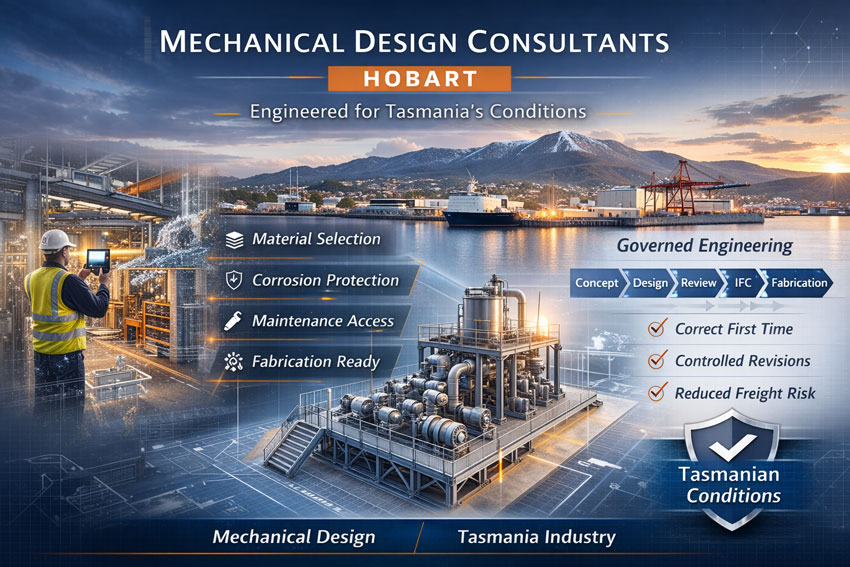
Hobart is unlike mainland capital cities. Its maritime environment, cooler climate and geographic isolation create unique engineering challenges. Mechanical design in Hobart requires practical thinking, accurate documentation and a strong understanding of local conditions.
Hamilton By Design provides mechanical design consulting services to Hobart and broader Tasmania. We deliver governed, fabrication-ready engineering solutions built for real site conditions.
What Makes Mechanical Design in Hobart Unique
Maritime Environment Hobart’s proximity to the Southern Ocean and the Port creates exposure to salt-laden air and high corrosion environments. Mechanical systems must consider material selection, protective coatings, long-term durability and maintainability in marine conditions.
Cool Climate and Variable Weather Tasmania’s cooler temperatures and moisture exposure affect thermal expansion, outdoor equipment performance and environmental protection requirements. Mechanical design must account for weather sealing, drainage and long-term asset performance.
Geographic Isolation Tasmania’s separation from the mainland increases freight costs and lead times. Rework is expensive and delays are amplified. Mechanical design must be correct the first time, with controlled revisions and clear fabrication documentation.
Unique Mechanical Design Projects in Hobart
Food and Beverage Processing Tasmania’s premium produce industry requires hygienic mechanical systems, stainless fabrication, conveyor design and washdown-compatible plant layouts.
Aquaculture and Marine Infrastructure Mechanical systems must withstand marine exposure while integrating with wharf structures, pumps, processing systems and coastal facilities.
Renewable and Energy Infrastructure Tasmania’s hydro and renewable energy assets require mechanical upgrades, maintenance platforms and brownfield integration within existing operational environments.
Industrial and Port Upgrades Materials handling systems, structural interfaces and mechanical modifications must work within live facilities while minimising disruption.
Our Mechanical Design Approach
Hamilton By Design integrates practical engineering with structured governance. We deliver:
Mechanical 2D and 3D modelling Brownfield site verification and measurement Fabrication-ready workshop drawings Revision-controlled issue states Clear approval pathways Maintainability-focused design
Mechanical design is not just geometry. It is accountability, constructability and lifecycle thinking.
Brownfield Engineering in Hobart
Many Hobart facilities operate within existing structures. Upgrades must work within tight spatial constraints and operational environments.
Clear documentation reduces risk and protects project budgets.
Why Engineering Governance Matters in Tasmania
When freight and remanufacture costs are high, mistakes become expensive quickly. Controlled documentation and disciplined revision management are essential.
Governed mechanical design ensures:
Correct drawing revision at fabrication Traceable design decisions Structured document control Reduced rework risk Clear communication between stakeholders
Supporting Hobart Industry
Hobart’s industrial sector is innovative and export-focused. From marine and aquaculture to food production and renewable infrastructure, mechanical design must reflect Tasmania’s environment and long-term asset strategy.
Hamilton By Design supports Hobart projects from concept through to detailed design and fabrication documentation, delivering practical engineering solutions built for site reality.
Mechanical Design Consultants Hobart – Let’s Discuss Your Project
If your Hobart-based project requires structured mechanical design support and disciplined documentation control, Hamilton By Design is ready to assist.
We provide engineering clarity, reduced risk and fabrication-ready outcomes for Tasmania industry.
Managing Loader Knee & Chainsaw Use – Work Safely in Australia
Years spent climbing in and out of loaders, dozers, and haul trucks can leave many operators with what is commonly called “loader knee.” It isn’t a single diagnosis — rather a collection of knee problems caused by repetitive climbing, whole-body vibration, and long hours in fixed seated positions.
For people who also need to use a chainsaw — on a mine site, rural property, or maintenance role — loader knee can become a serious safety risk. Chainsaw work demands balance, stable footing, and quick reactions. The good news is that with the right approach, many people can continue to work safely.
Why Loader Knee and Chainsaws Don’t Mix Easily
Chainsaw operation places unique demands on the lower body:
Knees remain slightly bent for long periods
Weight shifts constantly between legs
The operator must react instantly to kickback or timber movement
Work often occurs on uneven ground with vibration through the arms and body
If loader knee has caused instability, pain, or reduced strength, these demands can increase the likelihood of a slip, loss of control, or secondary injury.
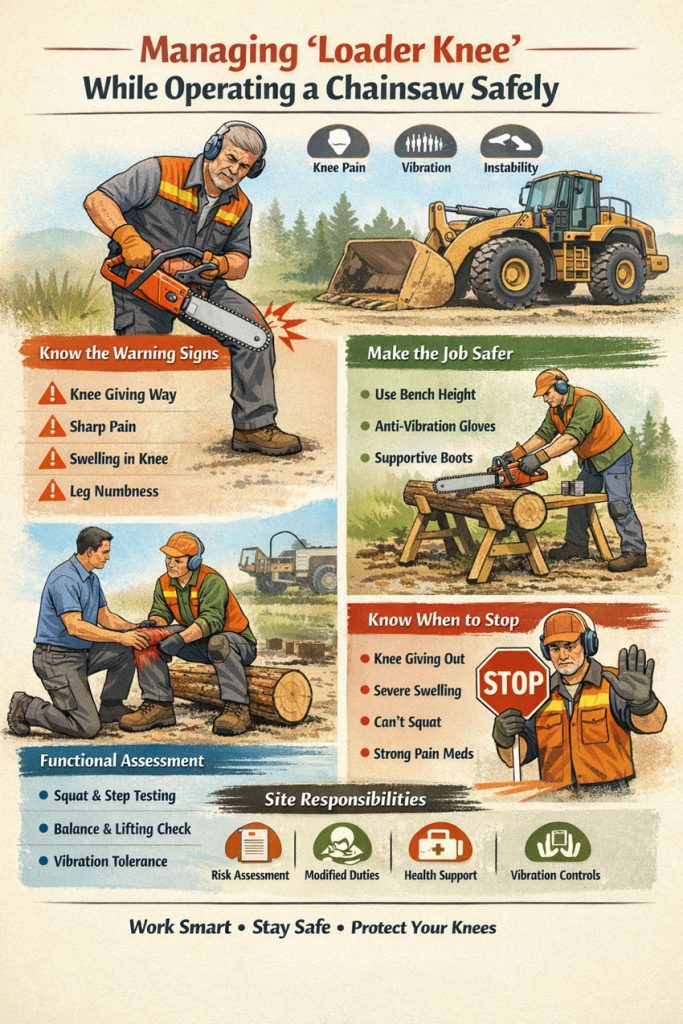
Step 1 – Recognise the Early Warning Signs
Do not push through symptoms when a running saw is in your hands. Stop immediately if you experience:
Knee giving way or locking
Sharp pain when weight bearing
Swelling during the task
Reduced ability to squat or step sideways
Numbness or altered sensation down the leg
Finishing “one last cut” is how many incidents occur.
Step 2 – Make the Task Safer Before You Start
Engineering and Equipment Controls
Work at bench height using saw horses or log stands rather than ground felling
Choose a low-vibration chainsaw with a well-maintained sharp chain
Use anti-vibration gloves and supportive footwear
Avoid slopes, loose ground, and awkward reaches
Keep cutting zones close to waist height where possible
Administrative Controls
Limit cutting to 15–20 minute blocks with rest breaks
Rotate to non-chainsaw duties
Use a second person for large or unstable timber
Complete a short warm-up before starting
Personal Supports
Knee brace with lateral support if recommended by a clinician
Strength program targeting quads, hamstrings, and glutes
Maintain healthy body weight to reduce joint load
Step 3 – Get the Right Type of Assessment
A general medical certificate often isn’t enough. A functional capacity assessment should test the movements actually required for chainsaw work:
Holding a half-squat stance
Stepping sideways with a 5–7 kg load
Recovering from a stumble
Tolerance to vibration
Repeated kneel-to-stand movements
This provides a realistic picture of whether the task is safe or needs modification.
Step 4 – Know When to Stop
Chainsaw use should cease — temporarily or permanently — if any of the following are present:
Recurrent knee collapse or instability
Inability to squat to approximately 70 degrees
Increasing swelling during work
Use of strong pain medication
Recent injections or acute injury
No production target is worth a life-changing accident.
Step 5 – Employer and Site Responsibilities
Under Australian WHS duties, a PCBU must ensure:
Task-specific risk assessments
Suitable duties or modified work
Review of vibration exposure
Access to occupational health support
Consideration of alternative methods such as pole saws or mechanical cutters
Managing loader knee is not just a personal issue — it is a workplace safety obligation.
A Practical Path Forward
Many experienced operators successfully continue chainsaw work by changing the way the task is done rather than ignoring the condition. The combination of smart engineering controls, realistic medical assessment, and sensible work planning keeps people productive and safe.
If you or your team need help developing:
Chainsaw SWMS and task risk assessments
Fitness-for-task guidance
Access and ergonomic improvements
Vibration exposure reviews
Hamilton By Design can assist with practical, site-focused solutions that protect both people and productivity.
Stay safe. Work smart. Look after your knees — they still have plenty of shifts left in them.
To provide the best experiences, we use technologies like cookies to store and/or access device information. Consenting to these technologies will allow us to process data such as browsing behaviour or unique IDs on this site. Not consenting or withdrawing consent, may adversely affect certain features and functions.
Functional
Always active
The technical storage or access is strictly necessary for the legitimate purpose of enabling the use of a specific service explicitly requested by the subscriber or user, or for the sole purpose of carrying out the transmission of a communication over an electronic communications network.
Preferences
The technical storage or access is necessary for the legitimate purpose of storing preferences that are not requested by the subscriber or user.
Statistics
The technical storage or access that is used exclusively for statistical purposes.The technical storage or access that is used exclusively for anonymous statistical purposes. Without a subpoena, voluntary compliance on the part of your Internet Service Provider, or additional records from a third party, information stored or retrieved for this purpose alone cannot usually be used to identify you.
Marketing
The technical storage or access is required to create user profiles to send advertising, or to track the user on a website or across several websites for similar marketing purposes.