3D Laser Scanning for Hotels

Infographic showing a hotel being captured with a 3D laser scanner, producing a point cloud and an as-built model. The cutaway building reveals internal rooms, ceiling voids and services, highlighting benefits such as accuracy, renovation readiness, clash-free design and fewer variations. A technician reviews the scan data on a tablet.

Renovating or expanding a hotel is hard enough without surprises behind the walls.
With 3D laser scanning, you get a precise digital record of your existing hotel โ€“ rooms, corridors, plant rooms, faรงades, and back-of-house areas โ€“ so designers, builders, and owners can make decisions with confidence.

At Hamilton By Design, we use LiDAR and 3D laser scanners to capture millions of accurate measurement points and convert them into usable engineering and architectural information: floor plans, BIM-ready models, and fabrication drawings for services and structures.

3D LiDAR scanning and 3D modelling service button โ€” laser scanner capturing a point cloud for engineering and CAD modelling
Mechanical engineering services

Why Hotels Need 3D Laser Scanning

Hotels are complex buildings:

  • Guest rooms on multiple levels
  • Tight ceiling cavities full of services
  • Kitchens, laundry, plant rooms, and back-of-house
  • Pools, gyms, restaurants, function spaces

Over time, changes and small upgrades make original drawings out of date. 3D laser scanning gives you current, reliable as-built data before you commit to design or construction.

Common reasons hotel owners and project teams use 3D scanning:

  • Refurbishments & Fitouts โ€“ capture the exact existing conditions before redesigning rooms, bathrooms, corridors, reception, bars, and public spaces.
  • Services Upgrades โ€“ document congested ceiling voids, risers, and plant rooms before installing new HVAC, plumbing, fire, or electrical systems.
  • Extensions & Additions โ€“ scan faรงades, roof levels, and structural elements before adding new floors, balconies, lifts, or external stairs.
  • Compliance & Safety โ€“ verify clearances, escape routes, accessibility upgrades, and structural modifications.

โ€œIf you want your upgrade to fit the first time, you start with LiDAR scanning.โ€
– Anthony Hamilton


What We Scan in a Typical Hotel

We tailor each scan to the project, but a typical scope might include:

Guest Areas

  • Room layouts, doors, windows, and joinery
  • Bathrooms and service penetrations
  • Corridors, lobbies, and stairwells

Public Spaces

  • Reception and concierge areas
  • Restaurants, bars, function and conference rooms
  • Pools, gyms, and spa facilities

Back-of-House & Plant

  • Kitchens, laundries, and stores
  • Plant rooms: HVAC, boilers, pumps, switch rooms
  • Service risers, shafts, and ceiling voids

External & Site

  • Hotel faรงades and architectural features
  • Roof levels, plant decks, balustrades, and access paths
  • Driveways, porte-cochรจre, loading docks, and carparks

From Scan to Model: Our Deliverables

We donโ€™t just hand over a point cloud and walk away. Hamilton By Design specialises in turning scan data into engineering-ready deliverables for architects, builders, and hotel operators:

  • Registered Point Clouds (RCP, E57, LAS, etc.)
  • 2D Drawings โ€“ floor plans, reflected ceiling plans, sections, and elevations
  • 3D CAD / BIM Models โ€“ Revit/IFC/SolidWorks models of rooms, structure, and services
  • Clash & Coordination Models โ€“ to plan new ductwork, pipework, cabling, and structural changes
  • Fabrication-Ready Models โ€“ spools, frames, and modular components that go together first time

We can align our outputs to your preferred software platforms, layering and naming conventions, and BIM execution plans.


Benefits for Hotel Owners & Project Teams

1. Fewer Surprises, Less Rework

Accurate as-built data dramatically reduces site clashes, rework, and RFIs, especially in congested ceilings and plant rooms.

2. Faster Design & Approvals

Architects and engineers can design directly from trusted geometry, speeding up design iterations and approvals.

3. Better Cost Control

Knowing what is actually on site helps QS and project managers build more reliable budgets and programs.

4. Minimized Disruption to Guests

We can scan off-peak, overnight, or floor-by-floor to fit around hotel operations โ€“ reducing downtime and guest impact.

5. Improved Asset Management

A digital record of your hotel becomes a long-term asset for maintenance, future upgrades, and compliance.


Our 3D Scanning Process for Hotels

We follow a clear, repeatable workflow to protect your operations and deliver the data you need.

1. Project Brief & Scope

We work with owners, facility managers, architects, and builders to define:

  • Areas to be scanned
  • Required outputs (2D, 3D, BIM, clash checks)
  • Time windows to avoid guest disruption

2. On-Site 3D Laser Scanning

Our team attends site with compact, tripod-mounted LiDAR scanners and:

  • Capture high-density 3D scan data of the agreed areas
  • Record colour imagery (if required) for visual context
  • Work quickly and discreetly in live hotel environments

3. Registration & Quality Checks

Back in the office we:

  • Register and align all scans into a single, accurate point cloud
  • Check for gaps and ensure tolerances meet project requirements
  • Apply control to survey grid if required

4. Modelling & Documentation

We convert the point cloud into:

  • 2D drawings for planning and design
  • 3D models suitable for interior design, services coordination, and structural changes
  • Optional analysis (clearances, volumes, compliance checks)

5. Handover & Support

We provide all agreed files along with:

  • Viewer options for non-technical stakeholders
  • Support to integrate the data into your design/BIM workflows
  • Ongoing scanning for staged refurbishments or future works

Who We Work With in the Hotel Sector

  • Hotel owners and asset managers
  • General managers and facility managers
  • Architects and interior designers
  • Services engineers (mechanical, electrical, hydraulic, fire)
  • Builders, fitout contractors, and modular/fabrication workshops
  • Investment groups and property developers

Whether youโ€™re refreshing a single floor, rebranding an entire property, or planning a major extension, we can scale the scanning to match.


Frequently Asked Questions

Will scanning disrupt guests?

We plan scanning around your occupancy and operations โ€“ often working off-peak, out of hours, or level-by-level. The scanners are quiet, fast, and compact.

How accurate is the data?

Our hotel scans typically achieve millimetre-level accuracy suitable for detailed design, services coordination, and fabrication.

What if we donโ€™t use BIM?

No problem. We can provide 2D drawings, PDFs, and viewer files alongside BIM models so all stakeholders can benefit.

Can you scan just part of the hotel?

Yes. We can focus on specific floors, wings, plant rooms, or public areas, then expand the dataset over time as projects progress.


Hamilton By Design logo displayed on a blue tilted rectangle with a grey gradient background

Ready to Scan Your Hotel?

If youโ€™re planning a refurbishment, services upgrade, or extension, 3D laser scanning is the most reliable way to start with accurate information.

Talk to Hamilton By Design about 3D laser scanning for your hotel.
Share your plans, existing drawings, and timeframes, and weโ€™ll propose a scanning scope, deliverables, and timelines tailored to your property.

Name
You would like to:

Engineering Projects

Finite Element Analysis (FEA) engineering simulation button
Mechanical engineering services

3D Point Clouds Are a Game-Changer for Your Projects

Your Experts in 3D Laser Scanning & Mechanical Design

3D CAD Modelling | 3D Scanning

3D Experience Platform Login

3D CAD Modelling | 3D Scanning

3D LiDAR Scanning Across Adelaide, SA Gas Plants, Mining & Whyalla Steelworks

Illiatration of Adelaide landmarks and industry gas plant mine and steelworks

Adelaide is the engineering hub for South Australiaโ€™s gas plants, mining operations and the Whyalla steelworks. Hamilton By Design supports these assets with high-accuracy 3D LiDAR scanning, 3D modelling, mechanical and structural engineering and FEA, so upgrades and shutdowns go together first time, every time.

We help project teams reduce rework, improve safety and make better decisions with reliable, engineering-ready as-built data.


Who We Work With in South Australia

We provide 3D scanning and engineering support for:

  • Gas & power operations
    • Torrens Island power station and associated gas infrastructure near Adelaide
    • Gas processing, compressor stations and pipelines linked to Moomba and Cooper Basin supply
  • Mining operations engineered from Adelaide
    • Olympic Dam, Prominent Hill, Carrapateena and other copper, gold and uranium operations
    • Satellite processing plants, conveyors, crushers and SAG mills that feed these mines
  • Steel and heavy industrial assets
    • Whyalla Steelworks โ€“ Australiaโ€™s only manufacturer of rail and a major producer of structural steel
    • Associated ports, materials-handling systems and mining operations in the Middleback Range
  • Fabrication and maintenance workshops around Adelaide, Port Adelaide, Wingfield, Osborne and Whyalla handling heavy steel, OEM equipment and modular skids.

If your plant moves gas, ore, concentrate or steel, we can scan it, model it and help you engineer changes with confidence.


3D LiDAR Scanning for Gas, Mining & Steel

We deploy 3D laser scanners to capture dense point clouds of complex brownfield environments, including:

  • Gas plants, compressor stations and power station pipe racks
  • Process plants, crushers, screens, SAG/ball mills and transfer towers
  • Conveyors, stacker-reclaimers and stockpile systems
  • Structural steel, platforms, stairs and access ways
  • Tank farms, pump skids and utility systems
  • Steelmaking plant and materials-handling systems at Whyalla

Why use 3D scanning?

  • Accurate as-built data when drawings are outdated or missing
  • Less time on site and fewer return visits
  • Safer measurement in congested or high-risk areas
  • Better shutdown planning and tie-in design
  • Reduced rework when installing new equipment or modules

We can scan during shutdowns, night shifts or live-plant windows, working under your permit-to-work and safety systems.


From Point Cloud to Engineering-Ready Models

Using the scan data, we create clean 3D models suitable for design, verification and fabrication:

  • Piping and equipment models for gas plants and power stations
  • Mechanical models of crushers, feeders, chutes, SAG mills and associated structures
  • Structural steel models for access, maintenance and support frames
  • As-built models of conveyors, galleries and transfer towers
  • Key areas of the Whyalla steelworks where modifications or replacements are planned

Deliverables can include:

  • Registered point clouds (E57, RCP/RCS, LAS)
  • 3D CAD models (SolidWorks, STEP/IGES, IFC)
  • 2D drawings for fabrication and installation
  • Sections, clearances and clash-check views for design teams

Digital QA for Fabrication & Site Fit-Up

For Adelaide and Whyalla workshops fabricating for remote mines, gas plants or the steelworks, we provide digital quality assurance:

  • Scan fabricated skids, frames, spools or chutes in the workshop
  • Compare against the design model and/or original plant scan
  • Check flange positions, bolt patterns, centre distances and critical interfaces
  • Issue a clear report before the gear is shipped to site

This approach can catch misalignment and build issues early, avoiding costly rework at remote SA sites or within the Whyalla plant itself.


Mechanical, Structural & FEA Support

Where required, we combine scanning and modelling with engineering analysis:

  • Mechanical design and verification of chutes, hoppers, frames and supports
  • Structural checks on platforms, access systems and equipment supports
  • FEA on high-load or fatigue-critical components (e.g. mill components, support brackets)
  • Assessment of temporary lifting, transport or installation configurations

Results are documented in practical engineering reports, suited to internal review or third-party verification.


Why Adelaide & Whyalla Benefit from 3D Scanning

  • Centralised engineering in Adelaide, remote assets in the field
    โ€“ scan once, work from the digital twin for months or years
  • Brownfield plant everywhere โ€“ expansions, life-extension and decarbonisation projects all need accurate data
  • Tight shutdowns and limited access windows
    โ€“ better information = fewer surprises
  • Complex equipment such as mills, crushers, kilns and gas process skids that are difficult to measure by hand

3D scanning and digital workflows help owners and project teams manage risk on high-value, safety-critical assets.


Hamilton By Design logo displayed on a blue tilted rectangle with a grey gradient background
3D LiDAR scanning and 3D modelling service button โ€” laser scanner capturing a point cloud for engineering and CAD modelling
Mechanical engineering services

Letโ€™s Talk About Your SA Project

Whether youโ€™re planning:

  • A gas plant upgrade near Adelaide
  • A mining project engineered in the CBD
  • Fabrication for Whyalla Steelworks or related mines
  • A shutdown requiring accurate as-built information

Hamilton By Design can support you with 3D LiDAR scanning, modelling and engineering.

Name
You would like to:

3D Laser Scanning

3D LiDAR Scanning โ€“ Digital Quality Assurance

3D LiDAR Laser Scanning & Drafting Services in Chatswood & Greater Sydney – Hamilton By Design

As-Built Drawings from a LiDAR Scanner

3D LiDAR Scanning and 3D Modelling – Hamilton By Design

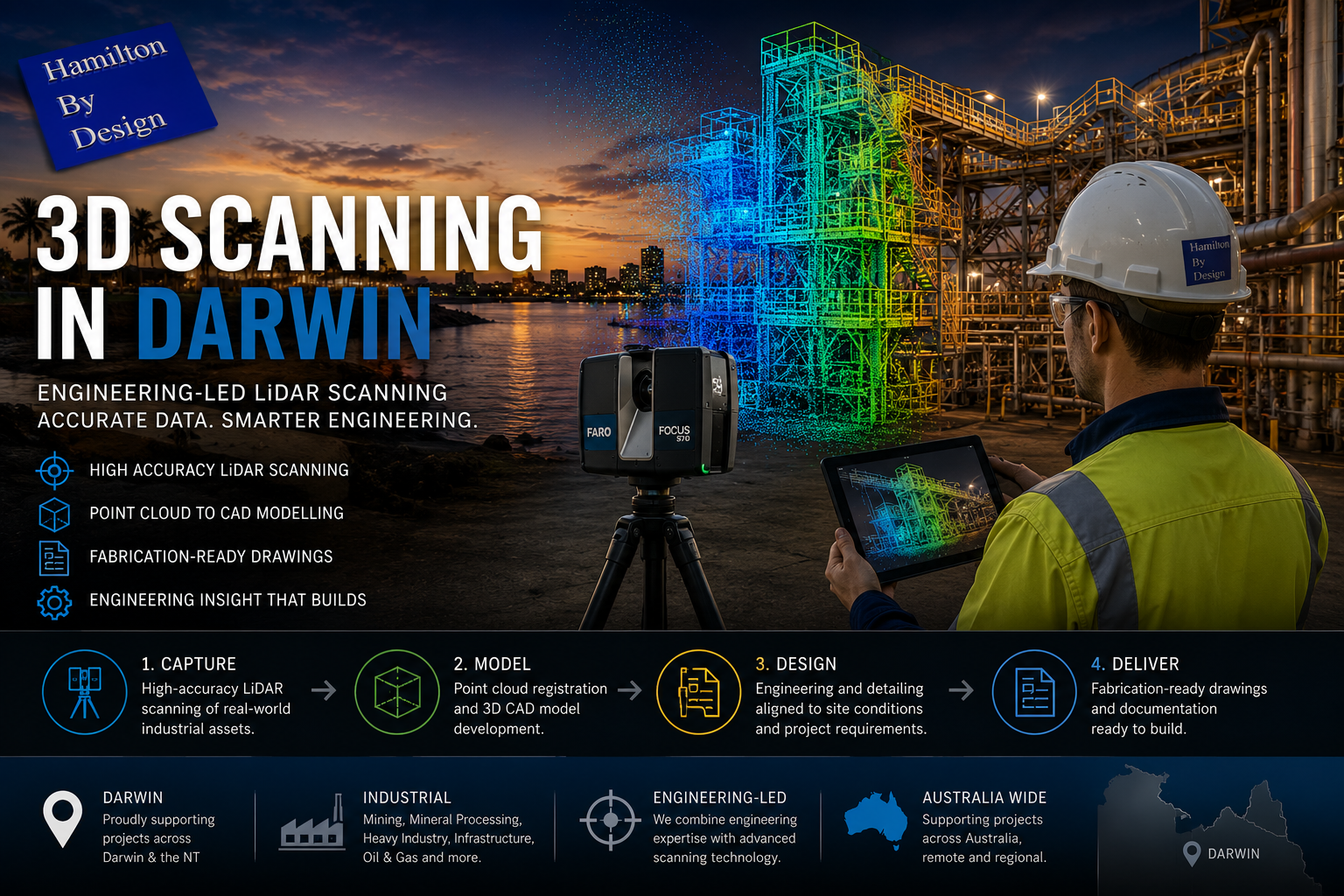
3D LiDAR Scanning in Perth & Western Australia

Stylised illustration of a 3D laser scanner capturing point-cloud data from mining equipment, including a reclaimer and a SAG mill, set against the Perth skyline. Visible landmarks include Matagarup Bridge, Optus Stadium, and city skyscrapers across the Swan River. The image represents industrial 3D scanning and engineering services in Western Australia

High-Accuracy Laser Scanning for Mining, Engineering & Fabrication

Blue 3D LiDAR scanner icon on a tripod with scanning waves

Hamilton By Design delivers high-precision 3D LiDAR scanning for Perth-based engineering teams, fabrication workshops and remote WA mining operations.
Whether your project is in Welshpool, the Pilbara, Kalgoorlie, or anywhere across regional WA, our 3D scans provide the accurate as-built data you need to design, model and install with confidence.


Why Perth Chooses Us for 3D Scanning

Perth is Australiaโ€™s engineering hub for remote mining operations.
Our scanning services support:

  • BHP, Rio Tinto, FMG & Roy Hill iron ore sites (Pilbara)
  • Gold Fields, Northern Star & Evolution Mining (Kalgoorlie / Goldfields)
  • Lithium & battery metal operations (Greenbushes, Kwinana, Mid-West)
  • LNG, ports & heavy industry across WA
  • Perth-based fabrication workshops and EPCMs

We capture reality with millimetre-grade accuracy so your fabrication, modelling and site work goes together first time, every time.


What We Scan

We provide 3D LiDAR scanning for:

Mining & Processing

  • CHPPs / ore handling plants
  • Conveyors, stackers, reclaimers
  • Crushers, screen decks, bins & hoppers
  • Process piping & pipe racks
  • Structural platforms & access systems

Fabrication & OEM

  • Skids & modular assemblies
  • Pipe spools & mechanical packages
  • Reverse engineering of components
  • Digital QA before shipping to site

Commercial & Industrial

  • Plant rooms & building services
  • Warehouses & industrial facilities
  • Ports, load-out systems & conveyors

If it needs to fit up on site, we can scan it.


What You Receive

After scanning, you can receive:

โœ” Registered Point Cloud

  • E57 / LAS / RCP / RCS
  • Ready for design teams or consultants

โœ” 3D CAD Models

  • SolidWorks
  • STEP / IGES
  • IFC (for BIM workflows)

โœ” 2D Drawings & Deliverables

  • Fabrication drawings
  • GA layouts
  • Section cuts & clearance checks

โœ” Digital QA

  • Verify workshop fabrication
  • Ensure your modules fit onsite conditions
  • Clash checks & alignment reports

Scanning in High-Risk Areas

We can scan in:

  • Confined spaces
  • At heights / on platforms
  • Inside process plants
  • In EWPs
  • Hazardous or restricted zones

Our personnel hold current high-risk licences, WAHA, confined space, and full site-induction compliance.


Why 3D Scanning Matters in Perth & WA Mining

WA projects require absolute accuracy because:

  • Remote shutdowns are expensive
  • Fabrication is done in Perth but installed hundreds of km away
  • Rework on site costs millions
  • Design teams need reliable as-built data
  • Upgrades must match existing plant exactly

A single scanning campaign in Perth or onsite can eliminate months of guesswork, site revisits and costly clashes during installation.


Industries We Support

  • Iron ore
  • Gold
  • Nickel
  • Lithium & battery metals
  • Oil & gas
  • Ports & materials handling
  • Fabrication & OEM
  • EPCMs and design houses

Typical Use Cases

  • Brownfield plant upgrades
  • Reverse engineering worn components
  • Shutdown planning & tie-ins
  • Structural steel replacements
  • Pipe spool fabrication
  • Chute modifications
  • Access & safety improvements

How We Work

1. Scoping

Send photos, drawings or describe your site needs.

2. Scan Capture

We mobilise to Perth metro or remote WA.

3. Processing & Modelling

Point cloud registration, 3D modelling, documentation.

4. Review & Delivery

Clear, workshop-ready deliverables and QA reports.


Service Areas

We provide 3D LiDAR scanning across:

Perth Metro

Welshpool, Kewdale, Canning Vale, Henderson, Naval Base, Wangara, Joondalup.

Pilbara

  • Port Hedland
  • Newman
  • Tom Price
  • Paraburdoo
  • Karratha
  • Dampier

Goldfields / Kalgoorlie

  • Kalgoorlie
  • Kambalda
  • Leonora
  • Norseman

Mid-West / South West

  • Geraldton
  • Bunbury
  • Collie
  • Greenbushes

No matter the distance, we provide a reliable scanning solution for complex WA sites.


Hamilton By Design logo displayed on a blue tilted rectangle with a grey gradient background
3D LiDAR scanning and 3D modelling service button โ€” laser scanner capturing a point cloud for engineering and CAD modelling
Mechanical engineering services

Ready for 3D Scanning in Perth or WA?

Speak to our engineering team about your project, shutdown or scanning requirements.

Name
You would like to:

As-Built Drawings from a LiDAR Scanner

3D LiDAR Scanning and 3D Modelling – Hamilton By Design

3D Laser Scanning

3D LiDAR Scanning โ€“ Digital Quality Assurance

Engineering Projects

Mechanical Engineering Perth WA banner for Hamilton By Design featuring white text on a blue background.
3D Laser Scanning Perth WA banner for Hamilton By Design with white text on a blue background.
SolidWorks Perth WA banner for Hamilton By Design featuring white text on a blue background.
3D LiDAR scanning and 3D modelling service button โ€” laser scanner capturing a point cloud for engineering and CAD modelling
Mechanical engineering services

3D CAD Modelling Australia service banner for Hamilton By Design


CHPP Engineering title graphic featuring bold white text reading "CHPP Engineering" centred on a blue rounded rectangle background.
Pipework Drafting title graphic featuring bold white text reading "Pipework Drafting" centred on a blue rounded rectangle background.
3D LiDAR Scanning for Engineering Projects title graphic featuring bold white text on a blue rounded rectangle background.


Finite Element Analysis (FEA) engineering simulation button
Structural drafting services button
Mechanical drafting services button


Australian Drafting logo featuring bold white text reading "Australian Drafting" centred on a blue rounded rectangle background.
Engineering Governance title graphic featuring bold white text reading "Engineering Governance" centred on a blue rounded rectangle background.
Engineering-Grade LiDAR Scanning title graphic featuring bold white text on a blue rounded rectangle background.


Mechanical drafting services button
Structural drafting services button


Fabrication and product design services
3D CAD Modelling Australia service banner for Hamilton By Design
Mechanical, Structural & Pipework Drafting service banner by Hamilton By Design featuring white text on a blue background.


3D LiDAR scanning and 3D modelling service button โ€” laser scanner capturing a point cloud for engineering and CAD modelling
Mechanical engineering services

3D Scanning

How 3D Laser Scanning is Redefining Reality for Design, Construction & Heritage

Imagine standing before a centuries-old cathedral, where every carved arch, every stained-glass pane, every weathered stone holds centuries of stories. Capturing its true form and condition with tape measure and camera? Tedious and prone to errors. But with 3D laser scanning, you can digitally freeze every detailโ€”down to the imperfectionsโ€”turning reality into an exact, manipulable model.

In an age where precision, speed, and data-driven decisions are non-negotiable, 3D laser scanning is no longer โ€œnice to haveโ€โ€”itโ€™s essential. Letโ€™s explore what it is, why itโ€™s transformative, where itโ€™s being used most powerfully, and how you can harness its potential.

What Is 3D Laser Scanning?

At its core, 3D laser scanning sometimes called terrestrial laser scanning, (TLS) is the emission of laser pulses toward surfaces, recording the time it takes for those pulses to bounce back. From that comes a dense โ€œpoint cloudโ€ โ€” billions of precise data points mapping shape, texture, orientation, and distance.

These point clouds become high-fidelity models, maps, meshes, or BIM ready files. Whether youโ€™re scanning building exteriors, interiors, or industrial components, the result is more than just imageryโ€”itโ€™s measurable, analyzable geometry.

How It Works โ€” The Process

  1. Preparation & Planning

    Define what you need: the level of detail (LOD), resolution, range, and whether external conditions (light, weather) will interfere.

  2. Data Capture

    Position the scanner at multiple stations to cover all surfaces. Use targets or reference markers for alignment and capture with overlapping scans.

  3. Processing & Registration

    Merge scans to align them properly, clean noise, filter out irrelevant data (like people, moving objects), calibrate.

  4. Post-processing & Deliverables

    Convert point clouds into usable outputsโ€”floorplans, sections, elevations, 3D meshes, BIM models, virtual walkthroughs. Run analyses (clash detection, deformation etc.).

  5. Integration & Use

    Use the data in design, restoration, facility management, or documentation. The quality of integration (into BIM, GIS, CAD) is key to unlocking value.

ย 

Key Benefits

Benefit What It Means in Practice Real-World Impact
Extreme Precision Sub-millimetre to millimetre accuracy depending on the scanner and conditions. Less rework. Better fit for retrofit, renovation, or mechanical systems in tight tolerances.
Speed + Efficiency Collect large amounts of spatial data in far less time than traditional measurement. Faster project turnaround. Reduced site time costs.
Non-Contact / Low Disruption Good for fragile structures, hazardous or difficult-to-access places. Preserves integrity of heritage buildings; safer for workers.
Comprehensive Documentation Full visual & geometric context. Informs future maintenance. Acts as an archival record.
Better Decision Making & Conflict Detection Early clash detection; scenario simulation; what-if modelling. Avoids costly mistakes; helps build consensus among stakeholders.
Enhanced Visualisation & Communication Stakeholders can see exactly what exists vs. whatโ€™s being proposed. Improves client buy-in, regulatory approvals, fundraising.

ย 

Applications: Where It Shines

  • Architecture & Renovation: As-built models, restoration of heritage sites.

  • Infrastructure & Civil Engineering: Bridges, tunnels, rail track alignments.

  • Industrial & Manufacturing: Machine part audits, reverse-engineering, plant layout.

  • Heritage & Preservation: Documenting fragile monuments, archaeological sites.

  • Facility Management: Digital twins, maintenance, asset tracking.

  • Environment & Surveying: Terrain mapping, forestry, flood risk mapping (especially when combined with aerial systems or mobile scanning).

Challenges & Best Practices

Nothing is perfect. To get the most out of 3D laser scanning, anticipate and mitigate:

  • Environmental factors: Light, dust, rain, reflective surfaces can introduce noise.

  • Data overload: Massive point clouds are large; need strong hardware & efficient workflows.

  • Alignment & registration errors: Overlaps, control points, and calibration are vital.

  • Skill & Planning: Good operators + good planning = much better outcomes.

Key best practices:

  • Use reference targets for precise registration.

  • Capture overlap of 30-50% between scan positions.

  • Break project into manageable segments.

  • Clean noise early.

  • Think ahead about deliverables and how clients will use the data (design, BIM, VR etc.).
Case Studies & Stories

  • Heritage in Danger: A cathedral in Europe threatened by pollution and structural decay was laser scanned. The point cloud revealed minute deformations, enabling an accurate restoration planโ€”saving costs and preserving history.

  • Infrastructure Efficiency: A civil engineering firm reduced design clashes by 80% on a complex highway project by integrating scans with their BIM workflow.

  • Industrial Switch-Over: Manufacturing plant layout was reconfigured using scan data; downtime reduced because the virtual model matched reality better than the old blueprints.

Software, Tools & Ecosystem

While scanners are vital, the software ecosystem is what unlocks value. Tools that turn raw data into actionable insights include:

  • Reality capture tools (processing point clouds).

  • BIM / CAD integration (e.g. Revit, AutoCAD).

  • Visualization tools (VR, AR, walkthrough).

  • Data sharing & collaboration platforms.

  • Cloud storage / processing if large point clouds.

SaaS/cloud-based workflows are increasingly important to share among remote teams, facilitate stakeholder review, and ensure data is accessible beyond just technical users.

Why It Matters Now

  • Global pressures (heritage, sustainability, faster build cycles, remote work) are raising the bar.

  • Clients expect transparency, accuracy, minimized risk.
  • Regulatory compliance and โ€œas-builtโ€ requirements are stricter.
  • Digital twins & smart infrastructure demand high fidelity data.

3D laser scanning acts as a bridge: between physical world and digital twin; between heritage past and future; between design promise and build reality. Ifย you have a survey scan and want to make sense of point cloud data, contact Hamilton By Design

ย 
ย 
ย 
ย 

Our clients:

Name
Would you like us to arrange a phone consultation for you?
Address
Finite Element Analysis (FEA) engineering simulation button
Mechanical engineering services