Wastewater Treatment Plant Upgrades in Newcastle and the Hunter: 3D Scanning and Mechanical Engineering

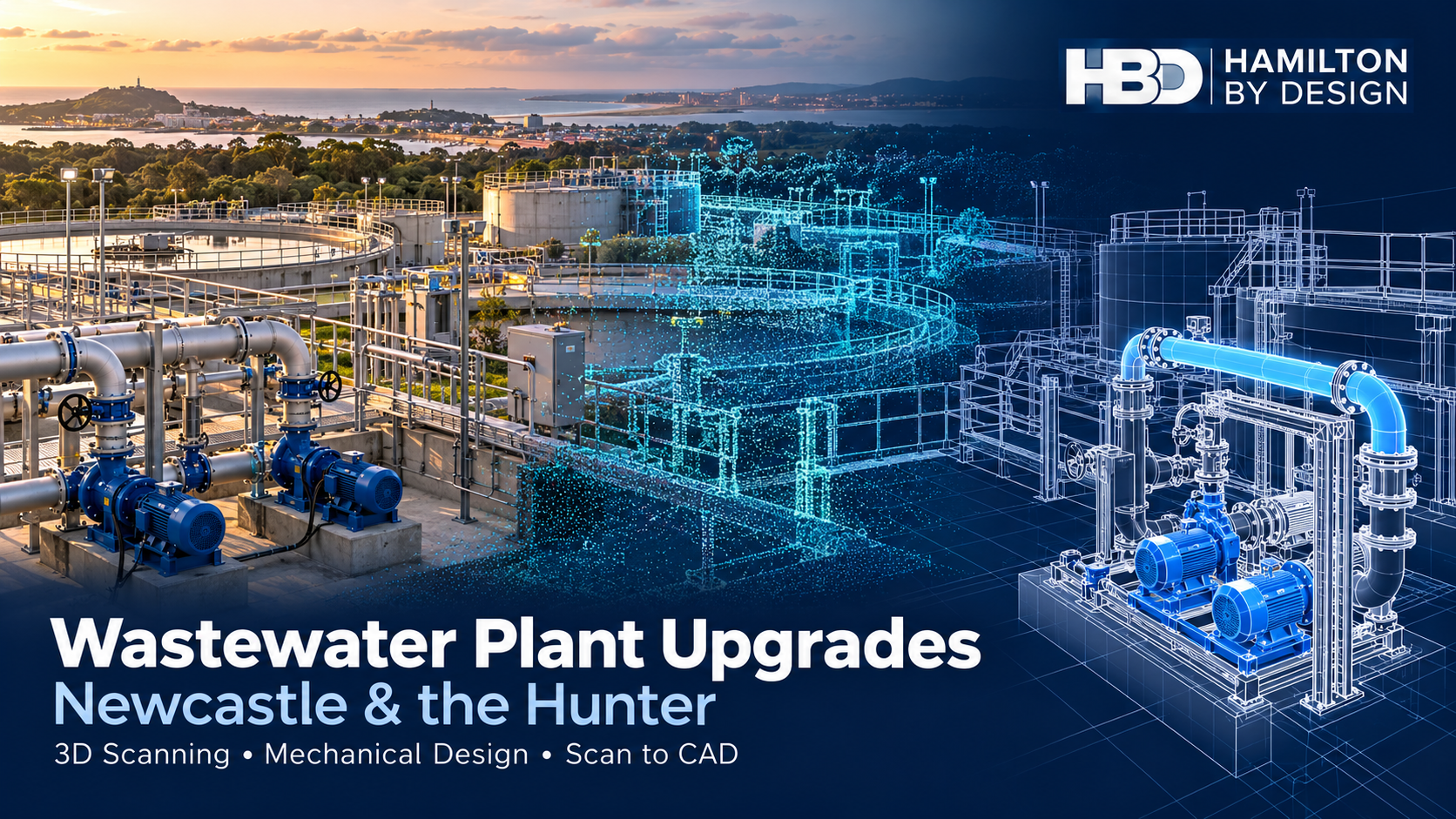
Wastewater treatment plant transitioning from an operating facility through a LiDAR point cloud to a CAD model of proposed pump and pipework upgrades.
Wastewater treatment plant icon showing a clarifier, treatment tanks and process building in a blue engineering line-art style.

Upgrading a wastewater treatment works can be difficult when the plant must remain operational and existing drawings no longer match what is on site. New pumps, pipework and equipment have to fit around established assets, often within crowded areas and limited shutdown windows.

Hamilton By Design supports wastewater infrastructure projects across Newcastle, Lake Macquarie, Port Stephens, Maitland and the Hunter Valley. We combine 3D LiDAR scanning, point cloud modelling, mechanical design and fabrication documentation to help project teams plan upgrades around actual site conditions.

Wastewater treatment works across the region

Hunter Water lists wastewater treatment works at Belmont, Boulder Bay, Branxton, Burwood Beach, Cessnock, Clarence Town, Dora Creek, Dungog, Edgeworth, Farley, Karuah, Kearsley, Kurri Kurri, Morpeth, Paxton, Raymond Terrace, Shortland, Tanilba Bay and Toronto. Each facility has its own layout, equipment and operating constraints. www.hunterwater.com.au

Hamilton By Design can assist utilities, engineering consultants, contractors, maintenance teams and fabricators working on these types of facilities. Our involvement can range from surveying a single equipment area to developing models and drawings for a broader mechanical upgrade.

Capture existing conditions before designing

Older drawings provide a starting point, but years of repairs and modifications can change a plant substantially. A 3D laser scan records visible equipment, pipework, platforms, structural elements and available space as a point cloud.

That survey can help a project team answer practical questions:

• Will a replacement pump or skid fit?

• Where can new pipework run without clashing with existing assets?

• Is there enough access to install and maintain the equipment?

• Which dimensions need direct measurement before fabrication?

Scanning cannot reveal concealed services or verify every connection dimension. Those details should be identified and checked as part of the project scope.

From point cloud to mechanical design

Hamilton By Design can turn relevant parts of a point cloud into 3D CAD models and use them to develop a proposed modification. Depending on the project, this may include pump layouts, pipe routes, equipment bases, supports, guarding interfaces, general arrangements and fabrication drawings.

The model should suit the decision being made. A concept study may need an overall layout and a list of constraints. Fabrication requires more detailed information and verification of critical interfaces.

Planning upgrades around an operating plant

A pump replacement involves more than matching the footprint of the old unit. The design may also need to address suction and discharge connections, lifting access, maintenance clearance, the existing base and the route for removing and installing equipment.

The same applies to new pipework. Reviewing a proposed route against a scan of the surrounding plant can expose conflicts before spools are detailed. Where the survey does not show a critical feature clearly, the project team can arrange a targeted inspection or measurement.

One workflow from survey to drawings

Hamilton By Design can capture the relevant area, model existing constraints, develop the mechanical arrangement and prepare the agreed drawings. Keeping those steps connected helps the design team recognise where information is missing and where site verification is needed.

Deliverables can be tailored to the project stage and may include a registered point cloud, selected 3D CAD models, general arrangement drawings, interface details and fabrication documentation.

Frequently asked questions

Can a wastewater treatment works be scanned while operating?

Many survey tasks can be planned around normal operations, subject to the operator’s access, induction and safety requirements. The survey area and required detail should be agreed before the site visit.

Do we need to scan the entire facility?

Often, surveying the equipment area and its immediate interfaces is enough. A wider survey may be useful for long pipe routes, multiple work areas or staged upgrades.

Can a point cloud be used directly for fabrication?

A point cloud records surveyed surfaces. Critical connections, concealed details and installation tolerances still need to be checked before fabrication.

Can Hamilton By Design help after the survey?

Yes. We can use the survey information to support 3D modelling, mechanical design, drawing production and fabrication planning, according to the agreed scope.

Discuss a wastewater plant upgrade

If you are planning a pump replacement, pipework modification, equipment installation or wider treatment works upgrade in Newcastle or the Hunter, contact Hamilton By Design to discuss the site, the proposed change and the information your project team needs.


Hamilton By Design logo displayed on a blue tilted rectangle with a grey gradient background

Contact Us – Talk To Us

Name
Would you like us to arrange a phone consultation for you?
Address

Our clients:


Mechanical Engineering and 3D Scanning for Sewage Treatment Plants on the NSW Central Coast

Practical support for treatment plant upgrades in Bateau Bay, Charmhaven, Gwandalan, Kincumber, Mannering Park, Toukley and Woy Woy

Wastewater treatment plant icon showing a clarifier, treatment tanks and process building in a blue engineering line-art style.

Upgrading an operating sewage treatment plant starts with understanding what is actually on site. Pumps, pipework, valves, tanks, platforms and access routes may have changed since the original drawings were produced. A replacement item can look straightforward on a drawing but prove difficult to install once existing equipment and maintenance clearances are taken into account.

Hamilton By Design brings together 3D laser scanning, scan-to-CAD modelling, mechanical engineering and drafting to support wastewater infrastructure upgrades across the NSW Central Coast. Based in Wyong, we can capture existing plant geometry and use it to develop practical designs for equipment replacement, pipework changes and other mechanical modifications.

Our work can support asset owners, water utilities, principal contractors, equipment suppliers and fabricators from the first site assessment through to installation documentation.

Start with an accurate picture of the existing plant

Sewage treatment plants are often upgraded in stages while they continue to operate. Over time, equipment is replaced, pipe routes change and new services are fitted around older assets. Existing drawings remain useful, but critical interfaces should be checked against current site conditions before fabrication.

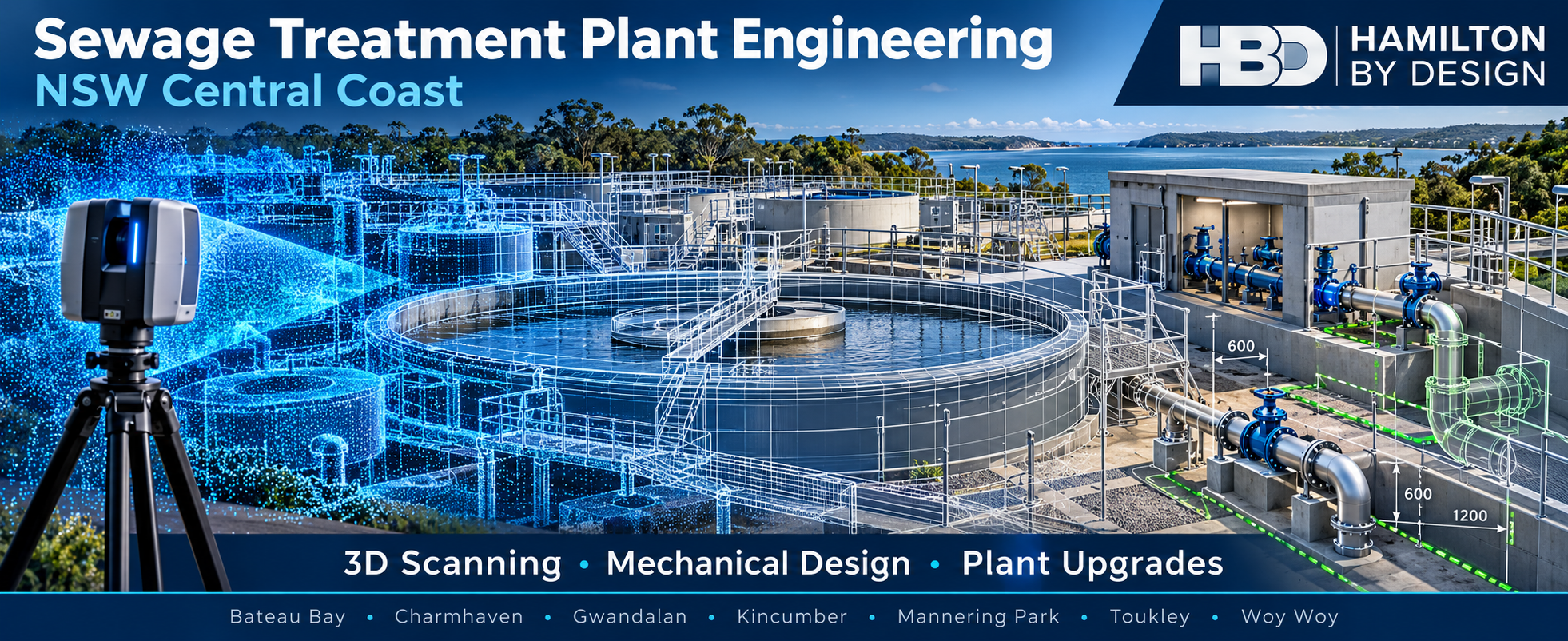
A 3D laser scan records visible plant geometry as a point cloud. Depending on the project scope, we can capture:

  • Pump rooms, equipment bays and treatment plant structures
  • Existing pipework, valves, flanges and supports
  • Tanks, walkways, platforms and access areas
  • Equipment footprints and available installation space
  • Interfaces between new equipment and existing assets

The point cloud can then be used to develop a focused 3D model or drawings for the proposed work. Where dimensions are critical to manufacture or installation, those interfaces can be identified for closer measurement and verification.

Mechanical engineering for plant upgrades

Good as-built information is the starting point. The next step is a design that can be installed, operated and maintained within the available space.

Hamilton By Design can assist with mechanical layouts and design documentation for projects involving:

  • Pump replacement and associated pipework changes
  • Valve and equipment access improvements
  • Pipe supports, equipment mounts and skids
  • Replacement or modification of mechanical components
  • Maintenance platforms and guarding
  • Retrofit layouts for existing treatment plant areas
  • General arrangement and fabrication drawings

For a brownfield upgrade, we can model a proposed item within the scanned surroundings to review fit, access and potential clashes before drawings are issued. The required engineering checks and specialist inputs can then be defined around the actual project scope.

From site scan to upgrade drawings

A typical project can be staged so the information is useful at each decision point:

  1. Define the upgrade area. Identify the equipment, interfaces, deliverables and dimensions that matter to the project.
  2. Capture the existing conditions. Scan the accessible plant areas and gather any additional measurements needed at critical connections.
  3. Register and review the point cloud. Check coverage and identify areas hidden from the scanner that need further inspection.
  4. Develop the design. Model the relevant existing assets and proposed mechanical changes.
  5. Prepare documentation. Provide agreed outputs such as CAD models, general arrangements, sections or fabrication drawings.
  6. Support installation planning. Review access, sequencing and site questions as the upgrade moves toward construction.

Deliverables can include registered point clouds in formats such as E57 or RCP, 3D CAD models, AutoCAD drawings and PDF drawing packs, according to the client’s requirements. Hamilton By Design also describes these scanning and engineering deliverables across its existing water infrastructure and industrial scanning services. Hamilton By Design Co.

Supporting treatment plants across the Central Coast

The seven locations below are established sewage treatment plant locations on the Central Coast. Each upgrade still needs its own site assessment, operating constraints and agreed scope. Central Coast Council

Bateau Bay

For work at Bateau Bay, a targeted scan can document the existing mechanical area before equipment or pipework is changed. Modelling the proposed arrangement against site conditions can help the project team check interfaces and access early.

Charmhaven

Major works at Charmhaven make coordination of existing and proposed infrastructure particularly important. Hamilton By Design can support defined mechanical work packages with site capture, 3D modelling and drawings for interfaces within the agreed area. Central Coast Council has published information about its Charmhaven sewage treatment plant upgrade. Central Coast Council

Gwandalan

At Gwandalan, scanning can provide a current record of an upgrade area where existing equipment and services need to be understood before design. That record can support pump, pipework or equipment layout changes and discussions with fabricators.
Kincumber

Mechanical modifications at Kincumber may involve fitting new components into established plant spaces. A point cloud and focused CAD model can help identify the available envelope and the connections that need direct verification.

Mannering Park

For Mannering Park projects, measured site information can support the design of replacement equipment, pipe supports and access improvements. Capturing the surrounding plant helps make installation constraints visible before fabrication.

Toukley

Toukley upgrade work can benefit from documenting existing pipe routes, equipment positions and maintenance access. Scan-to-CAD models give designers and contractors a common reference when planning a modification.

Woy Woy

At Woy Woy, scanning and mechanical drafting can help teams plan replacement or retrofit work around existing assets. Deliverables can be limited to a particular pump room or expanded to a larger plant area, depending on the project.

Why combine scanning and mechanical design?

A point cloud is valuable as a site record, but a project team also needs to decide what to build. By connecting scanning with mechanical design, Hamilton By Design can help turn site measurements into layouts and drawings suited to the upgrade task.

This approach is particularly useful when:

  • Original drawings are incomplete or no longer reflect the installed plant
  • Equipment must be replaced within a confined space
  • New pipework has to connect to existing systems
  • Fabrication is being planned before a shutdown
  • Several contractors need a shared view of the same work area

The scan records visible geometry; it does not reveal buried services, internal equipment condition or hidden connections. We identify those limits during scoping so the project team can arrange the inspections and checks needed for its design.
Talk to Hamilton By Design about a Central Coast plant upgrade

If you are planning mechanical work at a sewage treatment plant in Bateau Bay, Charmhaven, Gwandalan, Kincumber, Mannering Park, Toukley or Woy Woy, Hamilton By Design can help define a practical scanning and engineering package.

Send us the plant location, the proposed change, any available drawings and the dates that matter to your project. We can discuss the area to capture, the interfaces to verify and the models or drawings your team needs.

Contact Hamilton By Design to discuss your wastewater treatment plant upgrade.

Mechanical Engineering and 3D Scanning for Sewage Treatment Plants on the NSW Central Coast

Practical support for treatment plant upgrades in Bateau Bay, Charmhaven, Gwandalan, Kincumber, Mannering Park, Toukley and Woy Woy

Upgrading an operating sewage treatment plant starts with understanding what is actually on site. Pumps, pipework, valves, tanks, platforms and access routes may have changed since the original drawings were produced. A replacement item can look straightforward on a drawing but prove difficult to install once existing equipment and maintenance clearances are taken into account.

Hamilton By Design brings together 3D laser scanning, scan-to-CAD modelling, mechanical engineering and drafting to support wastewater infrastructure upgrades across the NSW Central Coast. Based in Wyong, we can capture existing plant geometry and use it to develop practical designs for equipment replacement, pipework changes and other mechanical modifications.

Our work can support asset owners, water utilities, principal contractors, equipment suppliers and fabricators from the first site assessment through to installation documentation.

Start with an accurate picture of the existing plant

Sewage treatment plants are often upgraded in stages while they continue to operate. Over time, equipment is replaced, pipe routes change and new services are fitted around older assets. Existing drawings remain useful, but critical interfaces should be checked against current site conditions before fabrication.

A 3D laser scan records visible plant geometry as a point cloud. Depending on the project scope, we can capture:

  • Pump rooms, equipment bays and treatment plant structures
  • Existing pipework, valves, flanges and supports
  • Tanks, walkways, platforms and access areas
  • Equipment footprints and available installation space
  • Interfaces between new equipment and existing assets

The point cloud can then be used to develop a focused 3D model or drawings for the proposed work. Where dimensions are critical to manufacture or installation, those interfaces can be identified for closer measurement and verification.

Mechanical engineering for plant upgrades

Good as-built information is the starting point. The next step is a design that can be installed, operated and maintained within the available space.

Hamilton By Design can assist with mechanical layouts and design documentation for projects involving:

  • Pump replacement and associated pipework changes
  • Valve and equipment access improvements
  • Pipe supports, equipment mounts and skids
  • Replacement or modification of mechanical components
  • Maintenance platforms and guarding
  • Retrofit layouts for existing treatment plant areas
  • General arrangement and fabrication drawings

For a brownfield upgrade, we can model a proposed item within the scanned surroundings to review fit, access and potential clashes before drawings are issued. The required engineering checks and specialist inputs can then be defined around the actual project scope.

From site scan to upgrade drawings

A typical project can be staged so the information is useful at each decision point:

  1. Define the upgrade area. Identify the equipment, interfaces, deliverables and dimensions that matter to the project.
  2. Capture the existing conditions. Scan the accessible plant areas and gather any additional measurements needed at critical connections.
  3. Register and review the point cloud. Check coverage and identify areas hidden from the scanner that need further inspection.
  4. Develop the design. Model the relevant existing assets and proposed mechanical changes.

  5. Prepare documentation. Provide agreed outputs such as CAD models, general arrangements, sections or fabrication drawings.
  6. Support installation planning. Review access, sequencing and site questions as the upgrade moves toward construction.

Deliverables can include registered point clouds in formats such as E57 or RCP, 3D CAD models, AutoCAD drawings and PDF drawing packs, according to the client’s requirements. Hamilton By Design also describes these scanning and engineering deliverables across its existing water infrastructure and industrial scanning services. Hamilton By Design Co.

Supporting treatment plants across the Central Coast

The seven locations below are established sewage treatment plant locations on the Central Coast. Each upgrade still needs its own site assessment, operating constraints and agreed scope. Central Coast Council

Bateau Bay

For work at Bateau Bay, a targeted scan can document the existing mechanical area before equipment or pipework is changed. Modelling the proposed arrangement against site conditions can help the project team check interfaces and access early.

Charmhaven

Major works at Charmhaven make coordination of existing and proposed infrastructure particularly important. Hamilton By Design can support defined mechanical work packages with site capture, 3D modelling and drawings for interfaces within the agreed area. Central Coast Council has published information about its Charmhaven sewage treatment plant upgrade. Central Coast Council

Gwandalan

At Gwandalan, scanning can provide a current record of an upgrade area where existing equipment and services need to be understood before design. That record can support pump, pipework or equipment layout changes and discussions with fabricators.
Kincumber

Mechanical modifications at Kincumber may involve fitting new components into established plant spaces. A point cloud and focused CAD model can help identify the available envelope and the connections that need direct verification.

Mannering Park

For Mannering Park projects, measured site information can support the design of replacement equipment, pipe supports and access improvements. Capturing the surrounding plant helps make installation constraints visible before fabrication.

Toukley

Toukley upgrade work can benefit from documenting existing pipe routes, equipment positions and maintenance access. Scan-to-CAD models give designers and contractors a common reference when planning a modification.

Woy Woy

At Woy Woy, scanning and mechanical drafting can help teams plan replacement or retrofit work around existing assets. Deliverables can be limited to a particular pump room or expanded to a larger plant area, depending on the project.

Why combine scanning and mechanical design?

A point cloud is valuable as a site record, but a project team also needs to decide what to build. By connecting scanning with mechanical design, Hamilton By Design can help turn site measurements into layouts and drawings suited to the upgrade task.

This approach is particularly useful when:

  • Original drawings are incomplete or no longer reflect the installed plant
  • Equipment must be replaced within a confined space
  • New pipework has to connect to existing systems
  • Fabrication is being planned before a shutdown
  • Several contractors need a shared view of the same work area

The scan records visible geometry; it does not reveal buried services, internal equipment condition or hidden connections. We identify those limits during scoping so the project team can arrange the inspections and checks needed for its design.

Talk to Hamilton By Design about a Central Coast plant upgrade

If you are planning mechanical work at a sewage treatment plant in Bateau Bay, Charmhaven, Gwandalan, Kincumber, Mannering Park, Toukley or Woy Woy, Hamilton By Design can help define a practical scanning and engineering package.

Send us the plant location, the proposed change, any available drawings and the dates that matter to your project. We can discuss the area to capture, the interfaces to verify and the models or drawings your team needs.

Contact Hamilton By Design to discuss your wastewater treatment plant upgrade.


Hamilton By Design logo displayed on a blue tilted rectangle with a grey gradient background

Contact Us – Talk To Us

Name
Would you like us to arrange a phone consultation for you?
Address

Our clients:


Explore services that can support the planning, design and documentation of sewage treatment plant upgrades across the NSW Central Coast.

Sydney Water Infrastructure Asset Life Extension Through Reverse Engineering

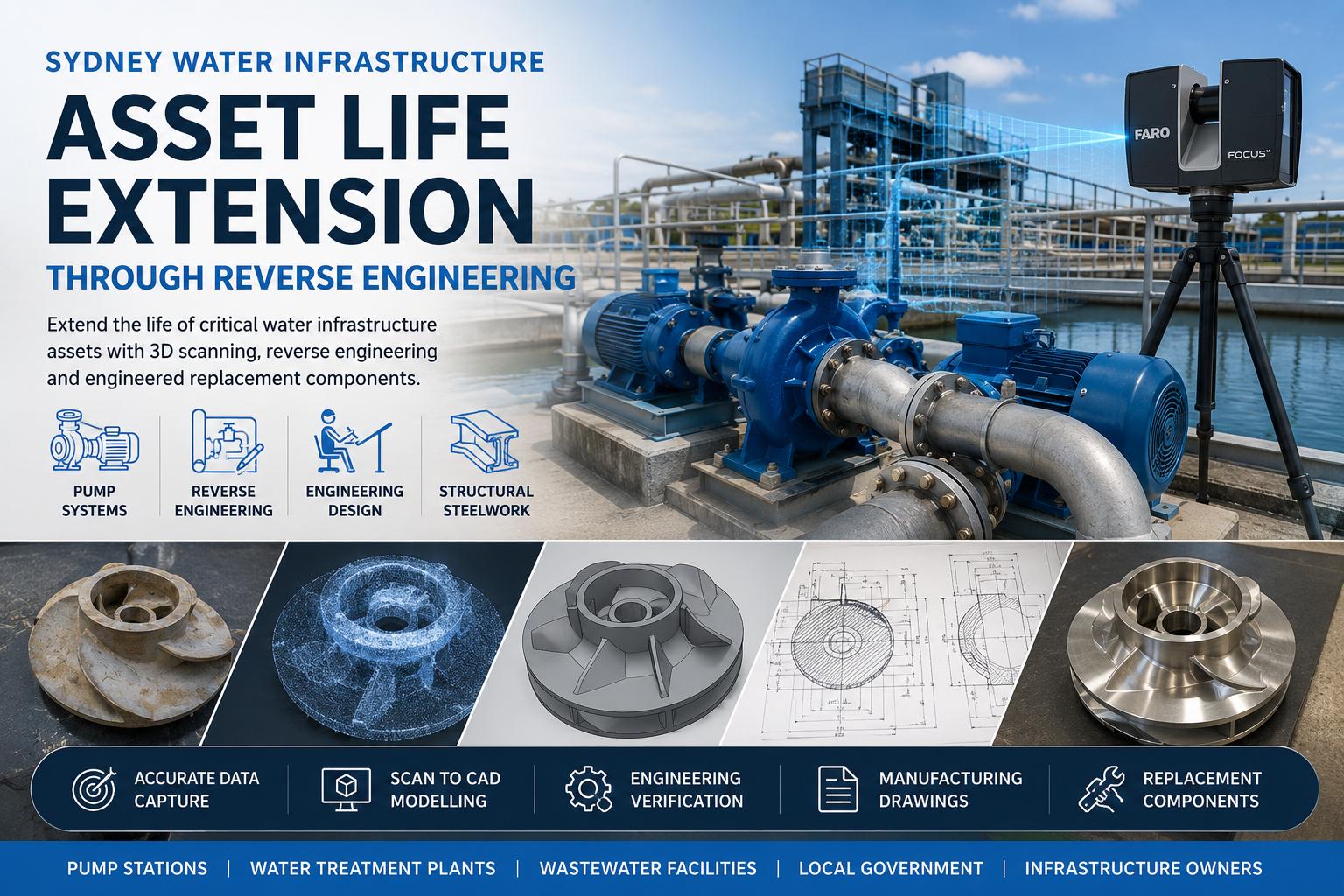
Sydney water infrastructure asset life extension through reverse engineering, 3D scanning, pump system modelling and replacement component engineering

Extend the Life of Critical Water Infrastructure Assets Across Sydney NSW

Pump and Motor Assembly Icon for Reverse Engineering and Water Infrastructure Engineering Services

Hamilton By Design provides reverse engineering, 3D LiDAR scanning, Scan-to-CAD, engineering design and replacement component development services for water infrastructure assets throughout Sydney NSW. We help water utilities, local government authorities, wastewater treatment facilities, sewer pump stations, power stations and infrastructure operators extend the life of critical assets when OEM support is no longer available, replacement parts are obsolete, original manufacturers no longer exist, or complete asset replacement is prohibitively expensive.

Many water infrastructure assets continue to operate effectively long after original equipment manufacturers have discontinued support. Rather than replacing entire systems, Hamilton By Design uses engineering-grade 3D scanning, reverse engineering and detailed design documentation to recreate components, assemblies and equipment that can no longer be sourced through traditional supply channels.

Our services help asset owners reduce downtime, minimise capital expenditure, improve maintenance planning and extend the operational life of critical infrastructure assets.


Reverse Engineering Solutions for Sydney Water Infrastructure

Water and wastewater infrastructure across Sydney contains thousands of mechanical and structural assets that have been operating for decades. Many of these systems remain structurally sound but are increasingly difficult to maintain due to unavailable spare parts, missing documentation and ageing equipment.

Hamilton By Design specialises in reverse engineering and asset life extension for:

  • Pump Stations
  • Water Treatment Plants
  • Wastewater Treatment Plants
  • Sewer Pump Stations
  • Water Distribution Infrastructure
  • Reservoir Facilities
  • Power Stations
  • Mining Water Infrastructure
  • Mechanical Equipment
  • Structural Steelwork
  • Pipework Systems
  • Valve Assemblies
  • Access Platforms and Walkways

Our engineering-led approach enables clients to maintain existing infrastructure while avoiding unnecessary replacement of complete systems.


Common Challenges Facing Asset Owners

OEM Support Has Been Discontinued

Many infrastructure assets continue operating long after manufacturers cease supporting equipment. Spare parts become difficult or impossible to obtain, creating maintenance challenges and increasing operational risk.

Hamilton By Design can reverse engineer existing components and develop manufacturing documentation for replacement parts when OEM support is no longer available.

Obsolete Replacement Parts

Asset owners frequently encounter situations where pumps, valves, gearboxes, hydraulic systems or structural components remain operational but replacement parts are no longer manufactured.

Using 3D scanning and reverse engineering, we recreate obsolete components from existing assets, worn parts or physical samples.

Original Manufacturers No Longer Exist

Many water infrastructure assets installed decades ago were supplied by manufacturers that have since merged, changed ownership or ceased operations entirely.

Where original design information is unavailable, our engineering team can reconstruct components using physical measurements, laser scanning and engineering analysis.

Missing Drawings and Documentation

Many facilities operate equipment with limited or incomplete documentation. Original drawings may be lost, outdated or unavailable.
Hamilton By Design develops accurate digital engineering documentation including:

  • General Arrangement Drawings
  • Manufacturing Drawings
  • Assembly Drawings
  • Fabrication Drawings
  • 3D CAD Models
  • Asset Records

Long Lead Times for Imported Components

Critical infrastructure often depends on specialised equipment with long procurement lead times.

Reverse engineering can significantly reduce downtime by enabling local manufacture of replacement components rather than waiting months for imported parts.

Asset Replacement Costs Are Prohibitive

Replacing entire systems may involve significant capital expenditure, extensive shutdown periods and operational disruption.

Asset life extension strategies often provide substantial cost savings by replacing only the components that have deteriorated while retaining serviceable infrastructure.


Engineering-Grade 3D LiDAR Scanning

Successful reverse engineering begins with accurate data capture.

Hamilton By Design uses advanced FARO 3D scanning technology to capture precise measurements of existing infrastructure, equipment and plant environments.

Applications include:

  • Pump Stations
  • Treatment Plants
  • Pipework Networks
  • Valve Assemblies
  • Structural Steelwork
  • Mechanical Equipment
  • Brownfield Facilities

Benefits include:

  • Accurate As-Built Information
  • Reduced Site Rework
  • Improved Design Accuracy
  • Faster Engineering Delivery
  • Enhanced Project Planning

Scan-to-CAD and Digital Asset Capture

Following site capture, point cloud data is processed and converted into engineering deliverables suitable for design, maintenance and manufacturing activities.

Deliverables may include:

  • E57 Point Clouds
  • RCP Files
  • RCS Files
  • AutoCAD Models
  • SolidWorks Models
  • STEP Files
  • Parasolid Files
  • DWG Drawings
  • DXF Files

This process provides asset owners with accurate digital records of existing infrastructure for future maintenance and upgrade projects.


Reverse Engineering of Critical Infrastructure Components

Hamilton By Design regularly reverse engineers components that are no longer available through original manufacturers.

Typical components include:

Pump Components

  • Impellers
  • Pump Casings
  • Pump Shafts
  • Wear Rings
  • Mechanical Assemblies

Valve Assemblies

  • Valve Bodies
  • Actuation Components
  • Sealing Systems
  • Mounting Arrangements

Mechanical Equipment

  • Bearing Housings
  • Couplings
  • Gearbox Components
  • Hydraulic Cylinders
  • Rotating Equipment

Structural Infrastructure

  • Access Platforms
  • Walkways
  • Handrails
  • Structural Steelwork
  • Equipment Supports

Process Plant Equipment

  • Pipe Spools
  • Conveyor Components
  • Chute Liners
  • Material Handling Equipment

Engineering Design and Verification

Reverse engineering involves more than reproducing geometry.

Hamilton By Design applies engineering principles to evaluate:

  • Material Selection
  • Structural Performance
  • Manufacturing Methods
  • Operational Requirements
  • Installation Constraints
  • Long-Term Reliability

Where required, Finite Element Analysis (FEA) can be undertaken to assess component performance and identify opportunities for improvement over the original design.

This ensures replacement components are suitable for ongoing operation within demanding infrastructure environments.


Manufacturing Documentation and Deliverables

Following reverse engineering, Hamilton By Design develops manufacturing-ready documentation suitable for fabrication, machining and procurement.

Typical deliverables include:

  • Manufacturing Drawings
  • Fabrication Drawings
  • Assembly Drawings
  • General Arrangement Drawings
  • Bills of Materials
  • CAD Models
  • STEP Files
  • Parasolid Files
  • DWG Files
  • DXF Files
  • Material Specifications
  • Engineering Reports

These deliverables provide asset owners and contractors with the information required to manufacture replacement components accurately and efficiently.


Our Reverse Engineering Process

1. Site Inspection and Asset Assessment

Existing infrastructure is reviewed to determine project requirements, access constraints and available documentation.

2. 3D LiDAR Scanning and Measurement

Engineering-grade scanning captures accurate asset geometry and surrounding infrastructure.

3. Point Cloud Processing

Captured data is registered, validated and prepared for engineering use.

4. Reverse Engineering

Components and assemblies are modelled using SolidWorks and AutoCAD.

5. Engineering Verification

Materials, fitment, functionality and operational requirements are assessed.

6. Manufacturing Documentation

Detailed engineering drawings and models are prepared.

7. Installation and Ongoing Support

Hamilton By Design can provide engineering support during manufacture, installation and commissioning activities.


Supporting Water Utilities and Infrastructure Owners Across Sydney

Hamilton By Design supports organisations responsible for maintaining critical infrastructure throughout Sydney NSW.

Our clients include:

  • Water Utilities
  • Water Treatment Facilities
  • Wastewater Treatment Facilities
  • Local Government Authorities
  • Infrastructure Owners
  • Power Generation Facilities
  • Mining Operations
  • Engineering Consultancies
  • Maintenance Contractors

By combining reverse engineering, 3D LiDAR scanning, engineering design and manufacturing documentation, we help asset owners extend the life of critical infrastructure while reducing replacement costs and operational risk.


Hamilton By Design logo displayed on a blue tilted rectangle with a grey gradient background

Need Assistance Extending the Life of Water Infrastructure Assets?

If your organisation is facing obsolete equipment, missing documentation, discontinued OEM support or long lead times for replacement parts, Hamilton By Design can help.

Our engineering team provides Sydney-based reverse engineering, 3D scanning and asset life extension services designed to keep critical infrastructure operating safely and efficiently.

Contact Hamilton By Design to discuss your water infrastructure asset life extension project.

Talk to Us – Contact Us

Name
Would you like us to arrange a phone consultation for you?
Address

Our clients:


https://www.hamiltonbydesign.com.au/scan-to-bim-services-australia-lidar-point-clouds-cad-modelling

AS ISO 10816 / 20816 – Mechanical Vibration

AS ISO 10816 & 20816 – Mechanical Vibration | Hamilton By Design

Mechanical vibration is one of the earliest indicators that rotating equipment is developing a fault. Standards such as AS ISO 10816 and AS ISO 20816 provide a consistent framework for measuring, evaluating, and managing vibration in industrial machinery.

At Hamilton By Design, we help clients apply these standards in a practical, engineering-led way by connecting vibration data with mechanical design, asset condition, and real-world site conditions.


What Are AS ISO 10816 and AS ISO 20816?

The AS ISO 10816 / 20816 standards define:

  • How mechanical vibration should be measured on machines
  • How vibration severity should be evaluated
  • What vibration levels are considered acceptable, marginal, or unacceptable

These standards are commonly applied to motors, pumps, gearboxes, compressors, fans, conveyors, and other rotating equipment where vibration provides an early warning of mechanical or structural issues.


Why Mechanical Vibration Standards Matter

Using vibration data without a recognised standard often leads to inconsistent interpretation and delayed action. Applying AS ISO 10816 / 20816 helps organisations to:

  • Identify mechanical problems early
  • Reduce unplanned downtime and breakdowns
  • Prevent secondary damage to bearings, shafts, and foundations
  • Improve overall equipment reliability
  • Support condition-based and predictive maintenance strategies

When vibration is assessed against an accepted standard, maintenance decisions become clearer and more defensible.


The Common Gap: Vibration Data Without Engineering Context

Many sites collect vibration data but struggle to connect it to:

  • As-installed geometry and alignment
  • Structural stiffness and support conditions
  • Design intent versus site reality
  • Maintenance and modification history

Vibration issues are often symptoms of broader mechanical or structural problems. Without engineering context, vibration data alone can be misleading.

This is where vibration assessment benefits from being connected to engineering-grade site information.

Engineering-Grade 3D LiDAR Scanning
https://www.hamiltonbydesign.com.au/home/engineering-services/engineering-grade-lidar-scanning/


How Hamilton By Design Helps

Hamilton By Design connects vibration standards with practical engineering outcomes through a coordinated service offering.

Engineering-Led Vibration Interpretation

We assess vibration results against AS ISO 10816 / 20816 using engineering judgement rather than relying solely on alarm limits. Machine type, operating duty, and site conditions are all considered.

Understanding the Physical Asset

By linking vibration data with mechanical layouts, drawings, and 3D models, we help identify whether vibration is driven by alignment issues, inadequate stiffness, foundation behaviour, or design constraints.

Mechanical Engineering Services
https://www.hamiltonbydesign.com.au/home/mechanical-engineering-consulting/mechanical-engineering/

SolidWorks & Mechanical CAD Services
https://www.hamiltonbydesign.com.au/home/engineering-services/solidworks/

Analysis Where Required

Where vibration levels indicate potential resonance, flexibility, or dynamic response issues, we support deeper investigation using structural and mechanical analysis tools.

SolidWorks FEA & Simulation
https://www.hamiltonbydesign.com.au/home/engineering-services/solidworks/solidworks-fea-simulation/

FEA Capabilities
https://www.hamiltonbydesign.com.au/home/engineering-services/fea-capabilities/

Clear, Usable Reporting

Our reporting focuses on:

  • What the vibration levels indicate
  • Why the issue matters to the asset
  • What actions are recommended

This ensures vibration results directly support maintenance and engineering decisions.


Where This Approach Adds Value

A connected vibration and engineering approach is particularly valuable in:

  • Mining and mineral processing plants
  • Heavy industrial facilities
  • Energy and utilities infrastructure
  • Brownfield upgrades and asset life-extension projects

Vibration issues are frequently linked to steelwork design, support conditions, or historical modifications that were not fully engineered.

Challenges of Not Consulting AS 3990 – Mechanical Equipment Steelwork
https://www.hamiltonbydesign.com.au/challenges-of-not-consulting-as-3990-mechanical-equipment-steelwork/

AS 1755 – Conveyor Safety
https://www.hamiltonbydesign.com.au/as-1755-conveyor-safety/


Summary

AS ISO 10816 and AS ISO 20816 provide the benchmark for assessing mechanical vibration.
Hamilton By Design provides the engineering connection that turns those benchmarks into practical action.

By linking vibration data with 3D scanning, mechanical design, and engineering analysis, vibration assessments become clearer, more accurate, and far more useful across the asset lifecycle.


Hamilton By Design logo displayed on a blue tilted rectangle with a grey gradient background
3D LiDAR scanning and 3D modelling service button — laser scanner capturing a point cloud for engineering and CAD modelling
Mechanical engineering services

Related Engineering Services

3D Laser Scanning & Mechanical Design
https://www.hamiltonbydesign.com.au/3d-laser-scanning-mechanical-design-australia/

Mining Engineering Services
https://www.hamiltonbydesign.com.au/home/engineering-services/mining-engineering-services-australia/

3D LiDAR scanning and 3D modelling service button — laser scanner capturing a point cloud for engineering and CAD modelling
Mechanical engineering services
Finite Element Analysis (FEA) engineering simulation button
Mechanical engineering services