Reverse Engineering 3D Scanning Sydney

Engineer-led reverse engineering with 3D scanning and drafting overlooking Sydney Harbour and the Harbour Bridge

One Accountable Engineer from Scan to Fabrication โ€” Supporting NSW & Remote Sites

At Hamilton By Design, we provide reverse engineering supported by engineering-grade 3D LiDAR scanning from our Sydney engineering hub, helping maintenance teams, project engineers, and manufacturers replace, reproduce, or validate critical components when drawings are missing, obsolete, or no longer reflect reality.

We specialise in like-for-like replacement and fit-for-purpose engineering, particularly for CHPP plants, conveyors, and brownfield industrial assets, where shutdown time is limited and poor fit-up is not an option.
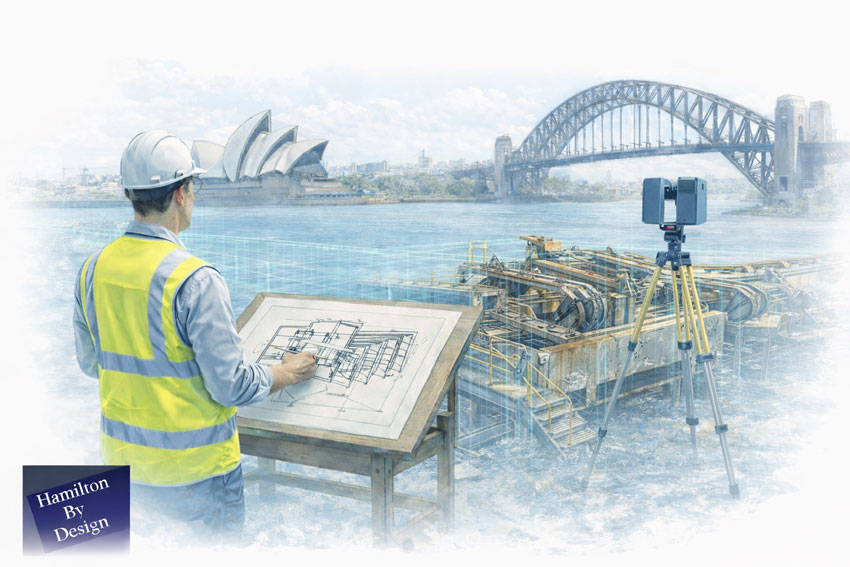

Mechanical engineer reverse engineering industrial equipment using 3D LiDAR scanning beside Sydney Harbour

Reverse Engineering Built on Real Site Data

Reverse engineering only works when it is based on accurate, defensible data.

We use engineering-grade LiDAR 3D scanning as the foundation for reverse engineeringโ€”capturing real geometry from worn, modified, or undocumented assets and converting that data into engineered models and drawings suitable for fabrication and installation.

This removes reliance on:

  • Missing or outdated drawings
  • OEM data that no longer reflects site reality
  • Assumptions made during manual measurement
  • โ€œBest guessโ€ modelling during shutdowns

Managing Director Insight

โ€œReverse engineering isnโ€™t about copying what you see โ€” itโ€™s about understanding how an asset actually works, how itโ€™s worn, and how it needs to fit during a shutdown. We use 3D scanning to capture reality, but itโ€™s engineering judgement that turns that data into something that can be fabricated and installed with confidence.โ€

โ€” Anthony Hamilton, Managing Director, Hamilton By Design


What We Reverse Engineer

From our Sydney engineering base, we support NSW and remote operations with reverse engineering of:

  • Conveyor components (pulleys, frames, guards, transfer assemblies)
  • CHPP plant equipment (chutes, hoppers, screens, wear liners)
  • Worn or damaged components requiring like-for-like replacement
  • Obsolete or unsupported OEM parts
  • Structural steel components and assemblies
  • Machined components and housings

These are typically assets that cannot be easily re-measured, are already worn or distorted, or must be replaced accurately within tight shutdown windows.


Engineering-Grade Accuracy for Shutdown-Critical Fit-Up

Our reverse engineering approach is designed for shutdown-critical fit-up, not visual modelling.

We emphasise:

  • Engineering-grade LiDAR suitable for fit-for-purpose replacement parts
  • Accuracy verified through engineering judgement, not just point clouds
  • Manual verification of critical interfaces where required
  • Deliverables suitable for fabrication and installation

Our work is engineering-grade and defensibleโ€”not survey-grade, but appropriate for mechanical and structural replacement in operating plant environments.


Reverse Engineering as an Engineering Process

We treat reverse engineering as a full engineering process, with 3D scanning as one inputโ€”not the answer by itself.

Our typical workflow includes:

3D LiDAR scanning โ†’ point-cloud review โ†’ engineered 3D modelling โ†’ design intent definition โ†’ drawings and fabrication documentation

Where required, this process may also include:

  • Mechanical or structural checks
  • Fit-for-purpose assessment
  • Review of wear patterns and failure modes

This ensures replacement components are designed to work, not simply copied.


Engineering Ownership, Accountability & Risk Management

Reverse engineering carries real risk, particularly during shutdowns.

Our approach includes:

  • Engineering sign-off and accountability
  • Clear documentation of assumptions and limitations
  • Fit-for-purpose design intent (not blind replication)
  • Engineering judgement aligned with Australian Standards
  • Lessons learned from real shutdowns and replacement projects

Our documentation is suitable for internal reviews, audits, and compliance checks.


Our clients:


Sydney Engineering Hub Supporting NSW & Remote Sites

We operate with Sydney as our engineering base, supporting:

  • NSW industrial and mining operations
  • CHPP plants and bulk materials facilities
  • Remote sites supported from NSW
  • Fabricators and manufacturers requiring accurate reverse-engineered data

This model combines local engineering accountability with support for geographically dispersed assets.


Designed for Maintenance, Reliability & Project Engineers

This service is ideal for:

  • Maintenance and reliability engineers managing ageing assets
  • Project engineers planning shutdown replacements
  • Manufacturers reproducing legacy components
  • Asset owners dealing with undocumented modifications
  • CHPP operators requiring like-for-like replacement

We work collaboratively with your teams and fabricators, focusing on getting it right the first time.

Hamilton By Design logo displayed on a blue tilted rectangle with a grey gradient background
3D LiDAR scanning and 3D modelling service button โ€” laser scanner capturing a point cloud for engineering and CAD modelling
Mechanical engineering services

Talk to Us About Reverse Engineering 3D Scanning in Sydney

If youโ€™re dealing with missing drawings, obsolete parts, or shutdown-critical replacements, weโ€™d welcome the opportunity to help.

Submit an enquiry via our contact form
Name
Would you like us to arrange a phone consultation for you?
Address
3D Scanning Sydney banner promoting engineering-grade 3D laser scanning, LiDAR scanning, and reality capture services by Hamilton By Design.
Mechanical Engineering Sydney banner with white text on a blue background representing Hamilton By Design's mechanical engineering services in Sydney.
Mechanical Drafting and 3D Modelling Sydney banner highlighting Hamilton By Design's CAD drafting, 3D modelling, and engineering design services in Sydney.

Hamilton By Design provides engineering-led 3D scanning, LiDAR scanning, mechanical engineering and digital engineering services throughout Sydney and Greater Sydney.

Explore our related Sydney services:


  • 3D Scanning Sydney โ€“ Engineering-grade terrestrial laser scanning, as-built surveys and point cloud capture for industrial, infrastructure and commercial projects.
  • Reality Capture Sydney โ€“ High-accuracy reality capture, digital twins, asset documentation and engineering-grade site verification.
  • Scan to CAD Sydney โ€“ Convert point cloud data into AutoCAD, SolidWorks, Inventor and other engineering-ready CAD deliverables.
  • Point Cloud Modelling Sydney โ€“ Engineering-grade point cloud processing, clash detection, as-built verification and 3D modelling.
  • Mechanical Engineering Sydney โ€“ Mechanical design, plant upgrades, materials handling systems, conveyors, chutes, platforms and engineering support.
  • Structural Drafting Sydney โ€“ Structural steel drafting, fabrication drawings, GA drawings, workshop detailing and as-built documentation.

Hamilton By Design supports projects throughout Sydney CBD, Parramatta, Liverpool, Penrith, Blacktown, Chatswood, Alexandria, Mascot, Newcastle and the Central Coast.


Mechanical Engineering | Structural Engineering


Blue banner graphic displaying the text "Point Cloud to CAD - Australia" in large white lettering, representing point cloud processing, scan-to-CAD conversion and digital engineering services across Australia.
Blue banner graphic displaying the text "Scan to CAD Sydney" in large white lettering, representing engineering-led point cloud to CAD conversion, LiDAR scanning and digital engineering services in Sydney.
Blue banner graphic displaying the text "Reality Capture Sydney - CBD" in large white lettering, representing engineering-led reality capture, LiDAR scanning and digital engineering services within Sydney CBD commercial buildings and infrastructure.

3D Scanning Services in Melbourne

3D Scanning Services Melbourne | Engineering-Grade LiDAR for Construction & Manufacturing

Hamilton By Design provides engineering-grade 3D scanning services in Melbourne and Victoria, supporting local construction projects, manufacturing facilities, and industrial environments where accurate spatial data and engineering confidence are essential. Our services deliver reliable, measurable 3D data that feeds directly into design, coordination, fabrication, and compliance workflows, reducing risk and improving outcomes on complex projects.

Melbourneโ€™s diverse built environment includes major infrastructure, commercial and residential development, advanced manufacturing hubs, and precision fabrication facilities. These industries demand precise as-built documentation, engineering-ready models, spatial verification, and detailed capture workflows that support multi-discipline coordination and installation planning.


Why Melbourne Projects Benefit from Engineering-Grade 3D Scanning

3D scanning in Melbourne is not just about capture โ€” itโ€™s about delivering usable, accurate data that supports real engineering outcomes.

Construction Coordination & Verification
Melbourneโ€™s construction landscape involves high-density urban sites, retrofits, complex faรงade integration, and multi-trade coordination. High-accuracy 3D scan data supports clash detection, installation planning, and design validation.

Advanced Manufacturing & Fabrication
Manufacturing facilities โ€” from precision machine shops to large-scale fabrication plants โ€” rely on verified spatial information for layout verification, retrofit of plant and equipment, and precision assembly. Scan-to-CAD workflows ensure manufacturing outputs integrate correctly with existing infrastructure.

Brownfield & Retrofit Environments
Existing facilities and older infrastructure often lack reliable drawings. Engineering-grade scanning captures current conditions with measurable accuracy, allowing design and construction teams to work from a verified baseline.

Compliance & Documentation
As-built documentation is increasingly required for approvals, audits, regulatory compliance, and handover deliverables. Professional scanning workflows ensure outputs are traceable, measurable, and suitable for technical review.


Our 3D Scanning Services in Melbourne

We provide a comprehensive suite of engineering-focused 3D scanning services tailored to construction and manufacturing environments:

  • Engineering-Grade LiDAR & 3D Laser Scanning
    High-precision capture of buildings, structures, plant, and manufacturing assets.
  • Construction Verification & Clash Detection
    Spatial datasets aligned to design models to support coordination and sequencing.
  • Manufacturing Facility Scanning
    Accurate capture of machine centres, conveyors, jigs, fixtures, and factory layouts.
  • Brownfield & Retrofit Scanning
    Measurable site data for expansion, upgrade, and renovation projects.
  • Scan-to-CAD Modelling
    Transforming point clouds into usable 3D CAD models for engineering, fabrication, and drafting.
  • Verified Geometry for Compliance & Installation
    Deliverables suitable for engineering checks, compliance documentation, and construction execution.

Each scan is performed with the downstream use in mind โ€” data engineered for reliable decision-making, not just visual reference.


Our clients:

Typical Melbourne Project Applications

Our Melbourne 3D scanning services are frequently applied to:

  • High-density urban construction coordination
  • Structural and faรงade verification
  • Manufacturing plant layout and retrofit capture
  • Shop floor as-built documentation
  • Mechanical and ductwork coordination
  • Building systems integration and clash avoidance
  • Technical compliance and regulatory documentation

These use cases reflect real engineering and construction needs where traditional measurement methods fall short.


Supporting Engineering Services for Melbourne Projects

3D scanning is often integrated with broader engineering and documentation deliverables. Hamilton By Design provides:

  • 3D CAD Modelling (Scan-to-CAD)
    Delivering engineering-ready models from site capture data.
  • As-Built Drawings for Compliance & Procedural Use
    Documentation suitable for approvals, audits, and asset handover.
  • Emergency Exit & Egress Drawing Development
    Safety planning and compliance documentation based on verified geometry.
  • Finite Element Analysis (FEA)
    Engineering evaluation of load, deflection, or modification impacts.
  • 3D Rendering & Visual Models
    Supporting stakeholder reviews, approvals, and presentations.
  • Precision Scanning for Fabrication & Installation Planning
    Reducing onsite uncertainty and supporting fit-first-time outcomes.

Hamilton By Design logo displayed on a blue tilted rectangle with a grey gradient background
3D LiDAR scanning and 3D modelling service button โ€” laser scanner capturing a point cloud for engineering and CAD modelling
Mechanical engineering services

Engineering-Led 3D Scanning You Can Rely On

Hamilton By Designโ€™s 3D scanning services in Melbourne are deeply grounded in engineering practice, not just visual capture. We understand how scan data is used โ€” from initial design review through to fabrication and construction โ€” and we deliver 3D point clouds and models that integrate smoothly into engineering workflows. This ensures accuracy, confidence, and better project outcomes across the full lifecycle of your project.


Contact Us About a Melbourne 3D Scanning Project

If you are planning a construction project, manufacturing facility upgrade, or complex retrofit in Melbourne or regional Victoria and need engineering-grade 3D scanning, contact Hamilton By Design to discuss your requirements and ensure your data capture supports your engineering and project delivery objectives.

Name
Would you like us to arrange a phone consultation for you?
Address
3D LiDAR scanning and 3D modelling service button โ€” laser scanner capturing a point cloud for engineering and CAD modelling
Mechanical engineering services
Finite Element Analysis (FEA) engineering simulation button
Mechanical engineering services

3D Scanning Services in Brisbane

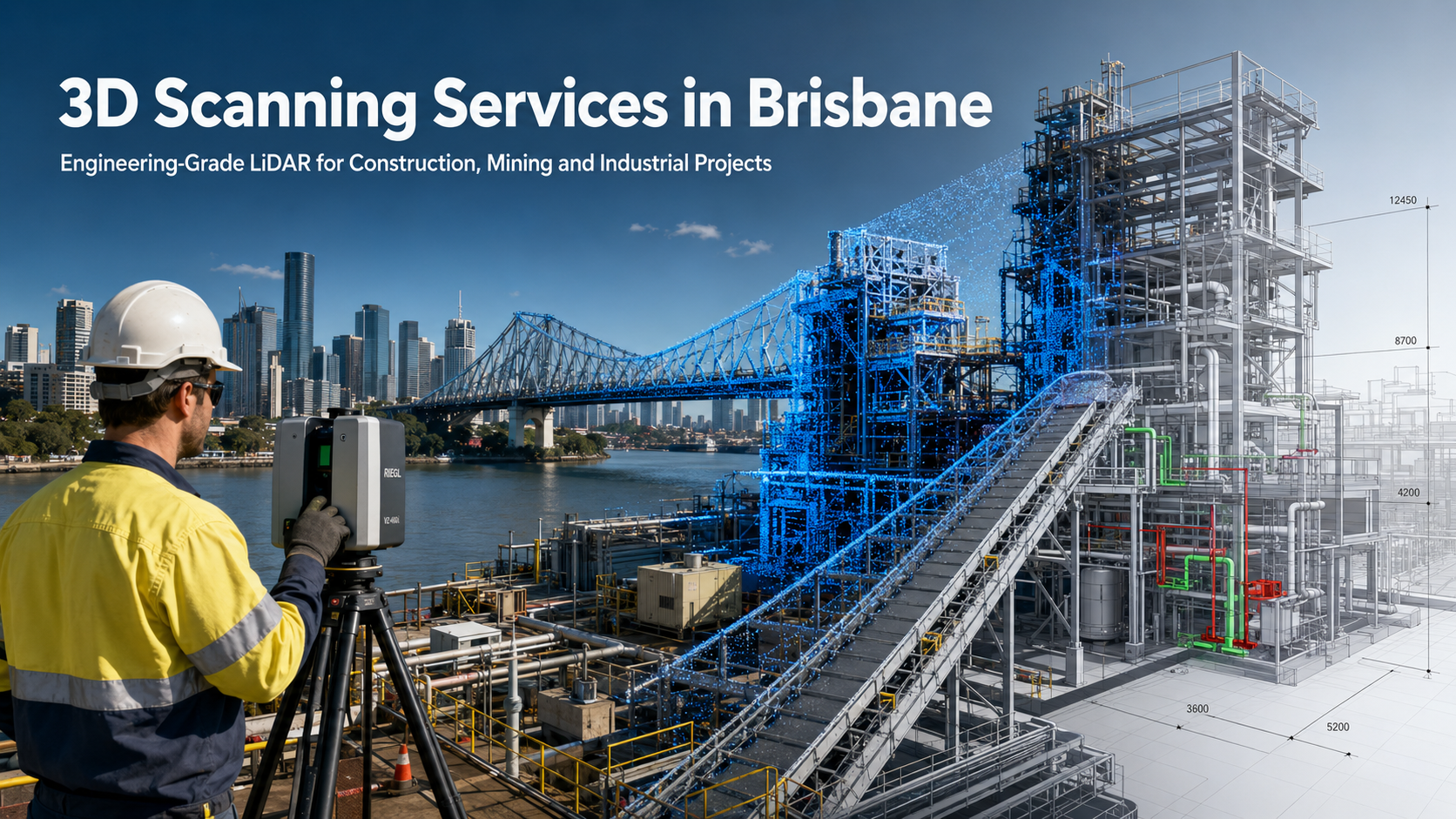
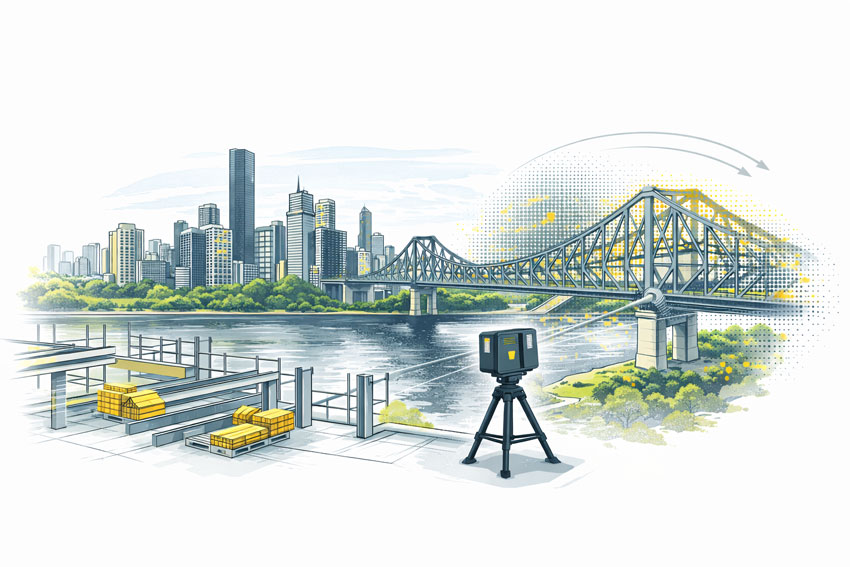
3D LiDAR scanning of an industrial facility in Brisbane with the Story Bridge, point cloud data and CAD modelling.

3D Scanning Services Brisbane | Engineering-Grade LiDAR for Construction & Mining

Hamilton By Design delivers engineering-grade 3D scanning services in Brisbane and throughout Queensland, supporting local construction developments, major infrastructure projects, and heavy industry โ€” including remote mining facilities and regional assets. Our services combine high-precision data capture with engineering insight to provide actionable deliverables that drive planning, design, construction, verification, and fabrication outcomes.

As Brisbane prepares for major international events such as the Olympics, infrastructure delivery, asset upgrades, and construction coordination will require data accuracy, risk reduction, and tightly integrated engineering workflows. 3D scanning plays a critical role in enabling these outcomes by providing reliable, measurable site data that informs decision-making across complex projects.


Why Brisbane Projects Need Engineering-Grade 3D Scanning

Brisbane and Queensland host a dynamic mix of construction, industrial assets, and regional resource operations where documented reality often differs from legacy drawings and assumptions.

Local Construction & Infrastructure
With significant urban development in Brisbane โ€” including transport infrastructure, public buildings, and precinct upgrades โ€” accurate spatial data is essential for clash detection, installation planning, and verifying existing conditions before works begin.

Remote Mining & Heavy Industrial Facilities
Queenslandโ€™s mining and resources sector spans regional and remote locations, with processing plants, conveyor systems, structural steelwork, and mechanical installations. Engineering-grade scanning supports retrofit verification, asset condition assessment, and design coordination on projects where precision reduces risk and cost.

Event-Driven Infrastructure Delivery
Brisbaneโ€™s upcoming global events are accelerating infrastructure delivery. High-resolution, engineering-ready scan data mitigates uncertainty on tight programs by providing objective measurements that feed directly into engineering models and construction coordination.

Regulatory & Compliance Requirements
Builders, engineers, and asset owners increasingly demand as-built documentation that is defensible, traceable, and usable for approvals, audits, and certification. Our scanning workflows are designed with these practical requirements in mind.


Our 3D Scanning Services in Brisbane

We deliver a full range of engineering-focused 3D scanning services that integrate with real project workflows:

  • Engineering-Grade LiDAR & 3D Laser Scanning
    High-accuracy capture of buildings, plant, structures, and industrial assets tailored to engineering and design needs.
  • Construction Verification & Clash Avoidance
    Spatial data that supports coordination, sequencing, and verification against design models.
  • Remote Mining Facility Scanning
    Accurate capture of processing plants, conveyors, structural systems, and equipment layouts at regional mining sites.
  • Brownfield & Retrofit Scanning
    Quantifiable site data for asset upgrades, expansions, and revision projects.
  • Scan-to-CAD Modelling
    Translating point cloud data into usable 3D CAD models for mechanical, structural, and fabrication workflows.
  • Verified Geometry & Engineering Deliverables
    Outputs suitable for engineering analysis, compliance documentation, and construction execution.

Each capture is executed with the downstream user in mind โ€” not simply a visual data set but engineered, measurable digital information that supports technical decision-making.


Our clients:

Typical Brisbane & Regional Project Applications

Our Brisbane 3D scanning services are widely used across heavy industry and complex construction environments, including:

  • Urban construction and infrastructure verification
  • High-rise faรงade and structural coordination
  • Precinct upgrades and multi-discipline installation planning
  • Regional mining plant and processing infrastructure capture
  • Conveyor systems and structural steelwork layouts
  • Compliance and regulatory as-built documentation

These applications are common where traditional measurement methods are inadequate or risk rework and delays.


Supporting Engineering Services for Brisbane Projects

In most projects, 3D scanning is just the start. Hamilton By Design frequently partners with clients to deliver the following integrated engineering services:

  • 3D CAD Modelling (Scan-to-CAD)
    Engineering-ready models derived from verified site data.
  • As-Built Drawings for Compliance & Procedural Use
    Documentation suitable for approvals, audits, and asset handover.
  • Emergency Exit & Egress Drawing Development
    Safety documentation based on verified geometry.
  • Finite Element Analysis (FEA)
    Engineering assessment where load-bearing performance or modification impact must be confirmed.
  • 3D Rendering & Virtual Models
    Visualisation that supports stakeholder reviews, approvals, and presentations.
  • Precision Scanning for Fabrication & Installation Planning
    Reducing onsite uncertainty and supporting fit-first-time outcomes.

Hamilton By Design logo displayed on a blue tilted rectangle with a grey gradient background
3D LiDAR scanning and 3D modelling service button โ€” laser scanner capturing a point cloud for engineering and CAD modelling
Mechanical engineering services

Engineering-Led 3D Scanning You Can Rely On

Hamilton By Designโ€™s 3D scanning services in Brisbane are grounded in engineering practice, not just capture. We understand how scan data will be used โ€” from design and coordination through to fabrication and installation โ€” and we deliver 3D point clouds and models that integrate seamlessly into engineering workflows. This ensures accuracy, improves insight, and supports confident decision-making across complex projects.


Contact Us About a Brisbane 3D Scanning Project

If you are planning a construction project, infrastructure upgrade, or regional mining facility work that requires precise, engineering-grade 3D scanning, contact Hamilton By Design to discuss your requirements and ensure the right data capture approach for your project.

Name
Would you like us to arrange a phone consultation for you?
Address
Finite Element Analysis (FEA) engineering simulation button
Mechanical engineering services
Reality Capture Brisbane title graphic with white text on a blue background promoting reality capture, LiDAR scanning and digital engineering services in Brisbane, Queensland.
3D Scanning Brisbane text graphic on a blue background promoting engineering-led laser scanning and reality capture services in Brisbane.

LiDAR Scanning Brisbane title graphic with white text on a blue background promoting terrestrial LiDAR scanning, point cloud capture and reality capture services in Brisbane, Queensland.
SolidWorks Brisbane title graphic with white text on a blue background promoting SolidWorks mechanical design, 3D CAD modelling and engineering drafting services in Brisbane, Queensland.


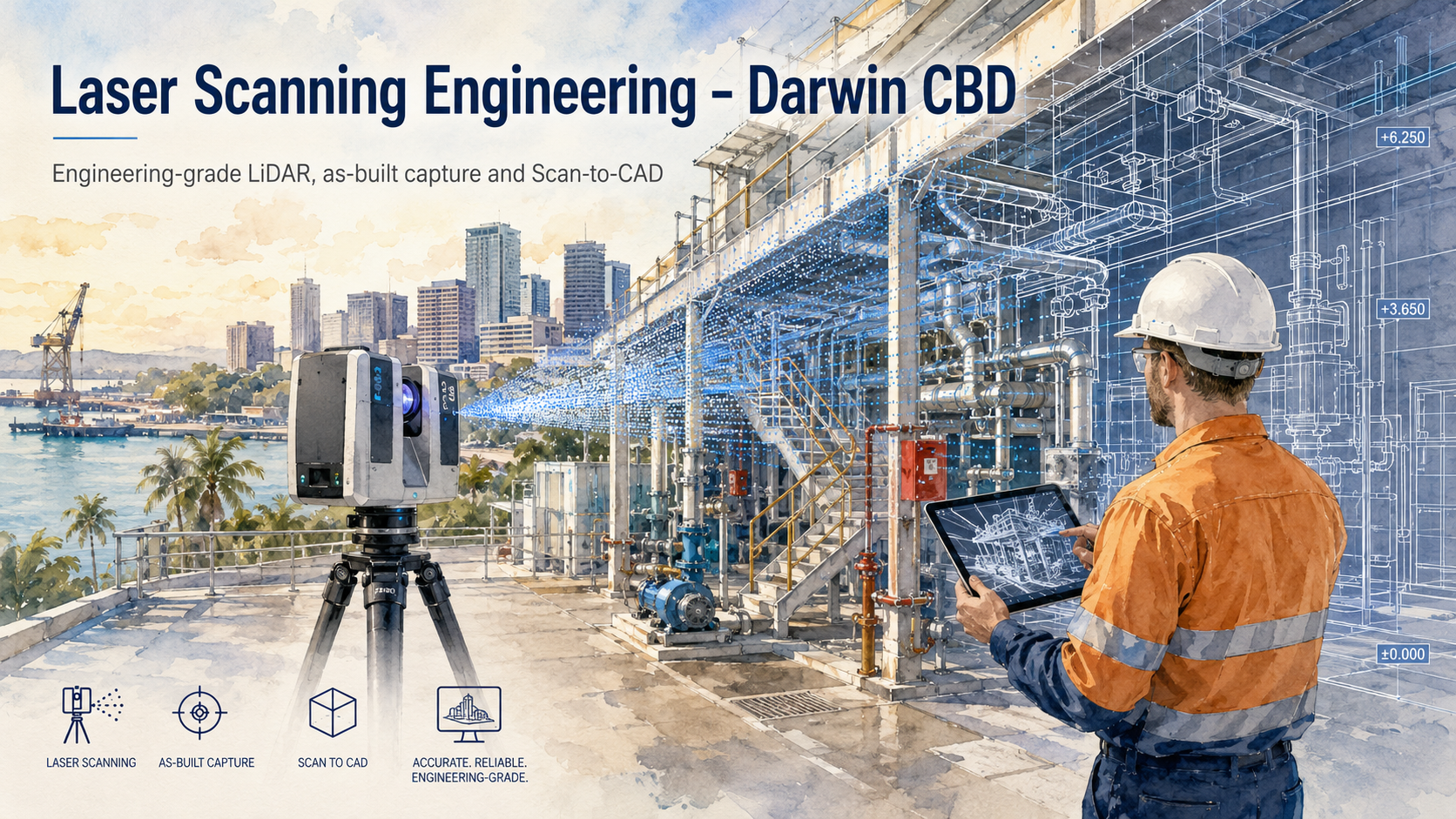
Laser Scanning Engineering โ€“ Darwin CBD

Watercolour hero image showing a 3D laser scanner capturing an industrial engineering site in Darwin CBD, with point-cloud data, CAD wireframe overlays, pipework, steelwork, harbour views and an engineer reviewing scan data on a tablet.

Hamilton By Design provides laser scanning engineering services in Darwin CBD for projects where designers and engineers need accurate existing-condition data before they commit to design, procurement, or construction.

Darwinโ€™s CBD and surrounding precincts combine tropical climate exposure, remote logistics, mixed-use infrastructure, and tight access windows. When scope is time-critical and site visits are expensive, engineering-grade LiDAR scanning and coordinated 3D modelling help teams make confident decisions early โ€” based on whatโ€™s actually there.

If youโ€™re looking for scanning that supports engineering outcomes (not just visuals), start here:


What We Deliver in Darwin CBD

Our Darwin CBD workflow is designed to produce usable engineering information, including:

  • 3D point clouds suitable for design coordination and verification
  • Existing-condition capture for refurbishments, upgrades, and staged works
  • Measured geometry for interfaces, clearances, penetrations, and plant tie-ins
  • Models and drawings that reflect real-world constraints

Our core scanning capability is outlined here:
https://www.hamiltonbydesign.com.au/3d-laser-scanning/


Why โ€œEngineering-Ledโ€ Scanning Matters

On CBD projects, small errors become big problems: tight plantrooms, congested service corridors, legacy construction, and compressed schedules leave little room for rework.

Engineering-led scanning means we capture what engineers actually need to know, such as:

  • critical interfaces and tie-in points
  • levels, plumb, alignment and deformation indicators
  • access constraints and installation pathways
  • โ€œunknownsโ€ that rarely appear on old drawings

This approach reduces RFIs, rework, fabrication errors, and site delays.


Hamilton By Design logo displayed on a blue tilted rectangle with a grey gradient background
3D LiDAR scanning and 3D modelling service button โ€” laser scanner capturing a point cloud for engineering and CAD modelling
Mechanical engineering services

From Scan to CAD: Turning Reality into a Design Environment

Laser scanning becomes truly valuable when it is converted into a coordinated 3D design environment.

Hamilton By Design supports Darwin CBD teams by converting scan data into structured CAD outputs that designers can use to develop the most appropriate solution for the scope of works.

Explore our 3D CAD capability here:


Mechanical Engineering Integration

Many Darwin CBD projects involve mechanical upgrades, asset life extension, or integration of new equipment into existing spaces. Accurate scan data enables mechanical designers to:

  • validate fit-up and installation clearances
  • design supports and interfaces correctly the first time
  • plan staged shutdown works with higher certainty
  • reduce the risk of โ€œsite surprisesโ€

Mechanical engineering capability:
https://www.hamiltonbydesign.com.au/mechanical-engineering/


Our clients


Typical Darwin CBD Use Cases

Our laser scanning engineering services are commonly used for:

  • Refurbishments and retrofits in occupied buildings
  • Plantroom and services coordination (tight spaces, complex interfaces)
  • Structural and mechanical integration (supports, platforms, equipment)
  • Upgrade scoping and feasibility (verify what exists before committing)
  • As-built documentation for handover and ongoing asset management

Why Laser Scanning Improves Design Quality

A 3D scan-based model gives designers and engineers a far stronger platform to develop the best design for the scope of works because it allows them to:

  • design to reality, not assumptions
  • test options digitally before issuing drawings
  • check installation constraints and access early
  • coordinate multiple disciplines with fewer clashes
  • reduce variations caused by missing or incorrect existing-condition data

For engineering project workflows specifically, see:


Talk to Us About Darwin CBD Laser Scanning

If your Darwin CBD project needs accurate, engineering-grade existing-condition capture to reduce risk and improve design outcomes, Hamilton By Design can help โ€” from scan planning through to CAD-ready deliverables.

Name
Would you like us to arrange a phone consultation for you?
Address

Detailing Transfer Stations in the Age of Digital Engineering

Transfer stations and chutes sit at the intersection of bulk materials handling, structural engineering, and fabrication practicality. While the fundamentals of good detailing have not changed, the way engineers now capture, coordinate, and validate these details has evolved significantly over the past decade.

This article revisits the principles of transfer station detailing and places them in a modern digital-engineering context, where accurate site data, constructability, and lifecycle performance are critical.


Engineering illustration of a transfer chute showing a LiDAR point cloud overlay aligned with the same chute geometry for as-built verification.
3D LiDAR scanning and 3D modelling service button โ€” laser scanner capturing a point cloud for engineering and CAD modelling
Mechanical engineering services

Why Transfer Station Detailing Still Matters

Poorly detailed transfer stations remain one of the most common sources of:

  • Material spillage and dust generation
  • Accelerated liner and structure wear
  • Unplanned downtime and maintenance escalation
  • Safety risks to operators and maintainers

In many cases, the root cause is not the concept design, but inadequate detailing and incomplete understanding of site geometry.

Even well-intended designs can fail if:

  • Existing structures are misrepresented
  • Conveyor interfaces are assumed rather than measured
  • Fabrication tolerances are not realistically achievable on site

The Shift from Assumed Geometry to Measured Reality

Historically, detailing relied heavily on:

  • Legacy drawings
  • Manual tape measurements
  • Partial site surveys
  • โ€œBest guessโ€ alignment assumptions

Today, engineering-grade reality capture has fundamentally changed what is possible.

Using 3D laser scanning (LiDAR), engineers can now work from:

  • Millimetre-accurate point clouds
  • Verified conveyor centre lines
  • True chute-to-structure interfaces
  • Real as-installed conditions rather than design intent

This shift dramatically reduces site rework and fabrication clashes.

This approach is central to how Hamilton By Design supports bulk materials handling upgrades across mining, ports, and heavy industry.


Detailing Considerations That Still Get Missed

Even with modern tools, certain detailing fundamentals remain critical.

1. Interface Accuracy

Transfer stations often interface with:

  • Existing conveyors
  • Walkways and access platforms
  • Structural steelwork installed decades earlier

Without accurate as-built data, small errors compound quickly. Laser scanning eliminates this uncertainty.

Related reading:
https://www.hamiltonbydesign.com.au/3d-laser-scanning-engineering/


2. Wear Liner Integration

Good detailing must account for:

  • Liner thickness variation
  • Fixing access and replacement paths
  • Load paths through liners into structure

Digitally modelling liners within the chute geometry allows engineers to validate:

  • Clearances
  • Installation sequence
  • Maintenance access before steel is cut

3. Fabrication Reality

A detail that looks acceptable in 2D can become problematic when fabricated.

Modern workflows now link:

  • 3D scanning
  • Solid modelling
  • Fabrication drawings
  • Digital QA checks

This reduces site modifications and ensures components fit first time.

Example of fabrication-ready workflows:
https://www.hamiltonbydesign.com.au/mechanical-engineering-design-services/


Transfer Stations as Systems, Not Isolated Chutes

A key lesson reinforced over time is that transfer stations must be treated as systems, not standalone components.

Good detailing considers:

  • Upstream and downstream belt tracking
  • Material trajectory consistency
  • Structural vibration and dynamic loading
  • Maintenance access under real operating conditions

Digital engineering allows these interactions to be reviewed early, reducing operational risk.


The Role of Engineering-Led Scanning

Not all scans are equal.

For engineering applications, scanning must be:

  • Performed with known accuracy
  • Registered and verified correctly
  • Interpreted by engineers, not just technicians

This distinction matters when designs are used for fabrication and compliance.

Hamilton By Designโ€™s approach combines engineering-led LiDAR scanning with mechanical design, ensuring the data collected is suitable for real engineering decisions.

Learn more:
https://www.hamiltonbydesign.com.au/engineering-led-3d-lidar-scanning/


Closing Thoughts

While detailing principles for transfer stations have stood the test of time, the tools and expectations have changed.

Modern projects demand:

  • Verified geometry
  • Fabrication-ready models
  • Reduced site risk
  • Higher confidence before steel is ordered

By integrating reality capture, detailed modelling, and constructability thinking, transfer station detailing can move from a risk point to a performance advantage.


Hamilton By Design logo displayed on a blue tilted rectangle with a grey gradient background

Our clients:


Name
Would you like us to arrange a phone consultation for you?
Address

Further Reading

3D LiDAR scanning and 3D modelling service button โ€” laser scanner capturing a point cloud for engineering and CAD modelling
Mechanical engineering services
Finite Element Analysis (FEA) engineering simulation button
Mechanical engineering services

3D Construction Scan in Brisbane

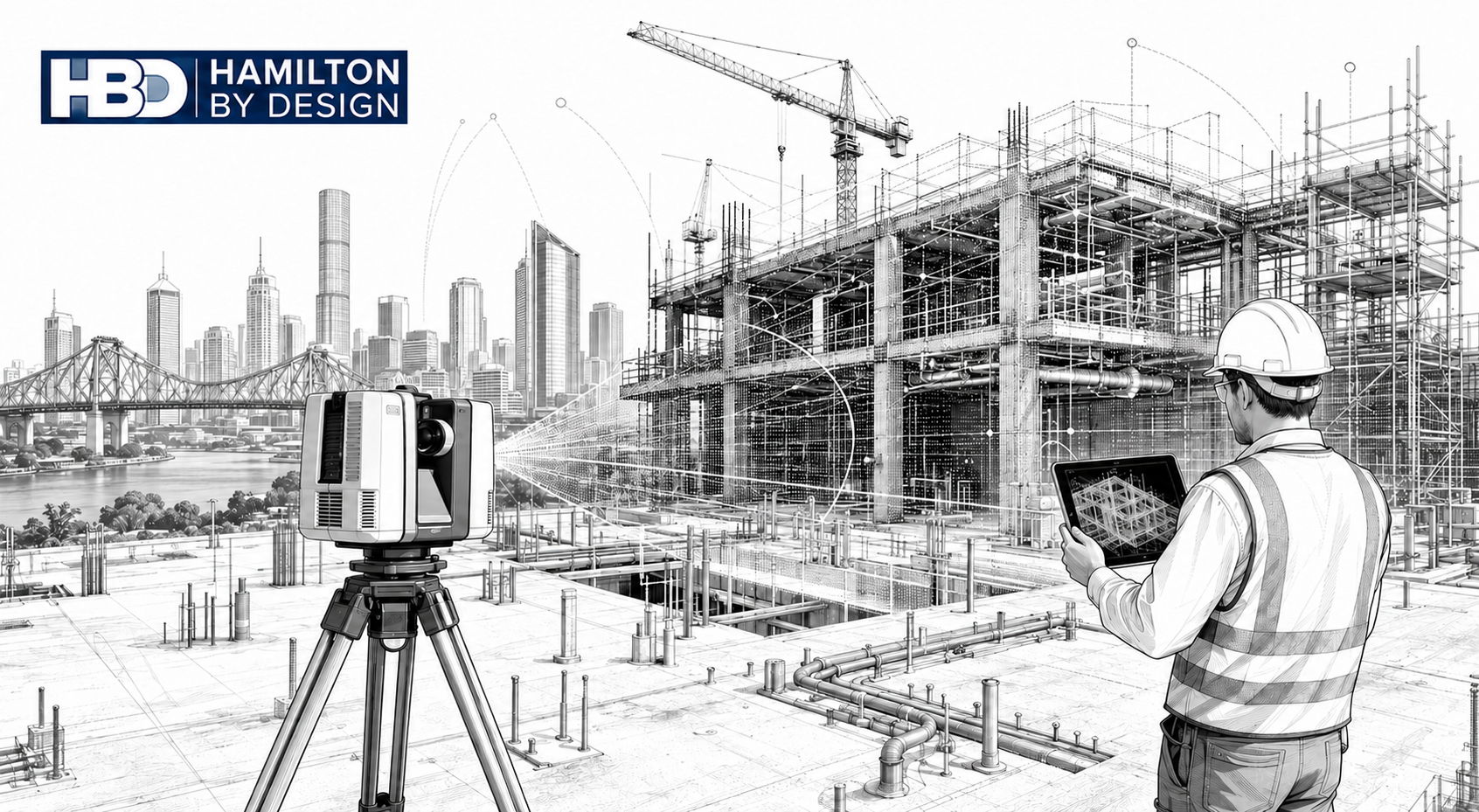
Black-and-white illustration of a 3D laser scanner capturing a Brisbane construction site, with point cloud data overlaid on steel framing, services, cranes, the Story Bridge and Hamilton By Design logo.

Engineering-Grade Reality Capture for Live Construction Environments

Construction projects in Brisbane operate under conditions that place unique pressure on engineers, builders, and asset owners. Subtropical climate, flood-affected sites, reactive soils, dense CBD logistics, and a strong reliance on brownfield upgrades all increase one fundamental risk: designing and constructing from incorrect or outdated site information.

A 3D construction scan in Brisbane provides engineering-grade certainty by capturing what actually exists on site, enabling informed decisions during live construction, refurbishment, and staged delivery projects.


3D construction scanning in Brisbane using a FARO laser scanner at a building site overlooking the Story Bridge and Brisbane River

3D LiDAR scanning and 3D modelling service button โ€” laser scanner capturing a point cloud for engineering and CAD modelling
Mechanical engineering services

What Is a 3D Construction Scan?

A 3D construction scan uses high-accuracy LiDAR laser scanning to capture the true as-built condition of a site at a specific point in time. Unlike visual scans or phone-based capture, engineering-grade scanning produces registered point clouds that can be trusted for:

  • Construction coordination
  • Design verification
  • Clash detection
  • Fabrication-ready modelling
  • As-built documentation

Hamilton By Design delivers these outcomes through its engineering-led laser scanning services, where accuracy, downstream use, and construction risk are defined before scanning begins.


Why Brisbane Construction Projects Require a Different Approach

Subtropical Climate & Structural Movement

Brisbaneโ€™s humidity and temperature cycles contribute to thermal expansion, contraction, and cumulative movement across steelwork, pipe runs, conveyors, faรงades, and plant installations.

When construction decisions rely on assumed geometry or legacy drawings, even small movements can result in:

  • Misaligned interfaces
  • Fabrication clashes
  • Installation delays

A 3D construction scan captures the current, in-situ geometry, allowing engineers to design and coordinate based on reality โ€” not historical intent.

Flood-Affected & Modified Assets

Many Brisbane sites โ€” particularly river-adjacent commercial and industrial facilities โ€” have undergone multiple flood recovery and modification cycles. Over time, this results in:

  • Changed floor levels
  • Unrecorded ramps and bunds
  • Altered drainage and gravity-dependent systems

Construction scanning establishes a true datum and elevation baseline, supporting engineering verification of falls, access clearances, and tie-in points.

This capability aligns directly with Hamilton By Designโ€™s broader reality capture and as-built verification workflows.


Brownfield Construction Is the Norm

A significant proportion of Brisbane construction work occurs in live, operational environments, including:

  • Commercial refurbishments
  • Industrial plant upgrades
  • Infrastructure modifications
  • Asset life-extension projects

These sites often contain undocumented steelwork, legacy penetrations, and accumulated modifications. A 3D construction scan enables non-intrusive capture of this complexity, supporting engineering coordination without disrupting operations.

Tight CBD Logistics & Vertical Construction

Brisbaneโ€™s CBD presents unique logistical challenges:

  • Limited laydown space
  • Vertical risers and congested services zones
  • Restricted crane and hoist access
  • Staged installation sequencing

In these environments, components must fit first time. Construction scanning supports:

  • Early clash detection
  • Verification before fabrication
  • Confident off-site prefabrication

This process integrates directly with Hamilton By Designโ€™s 3D point cloud modelling and coordination services.


Reactive Soils & Differential Settlement

Reactive clay soils common throughout South-East Queensland contribute to long-term differential settlement, particularly where new construction interfaces with older structures. Over time, this can lead to:

  • Misaligned columns and beams
  • Drift in conveyors and pipe racks
  • Geometry that no longer matches design intent

A construction scan captures current condition, enabling engineers to design extensions and upgrades that reflect actual site geometry.


Construction Scanning vs Generic 3D Scanning

Not all scanning is suitable for construction engineering.

AspectGeneric ScanEngineering-Led Construction Scan
AccuracyVisual or indicativeMillimetre-grade
OutputMeshes or imagesRegistered point clouds
Engineering UseLimitedDesign & fabrication
Risk ReductionLowHigh
Construction ReadyNoYes

Hamilton By Design positions construction scanning as part of an integrated engineering workflow, not a standalone data capture exercise.

3D Engineering Services in Brisbane


How 3D Construction Scans Are Used on Brisbane Projects

Engineering-grade construction scans are routinely used to support:

  • Clash detection across structure and services
  • Verification scans prior to fabrication
  • Construction sequencing and staging
  • As-built documentation for handover
  • Reduced RFIs, rework, and site delays

These outcomes are particularly valuable on commercial and construction projects where access, timing, and accuracy are critical.

Commercial & Construction 3D Scanning Services


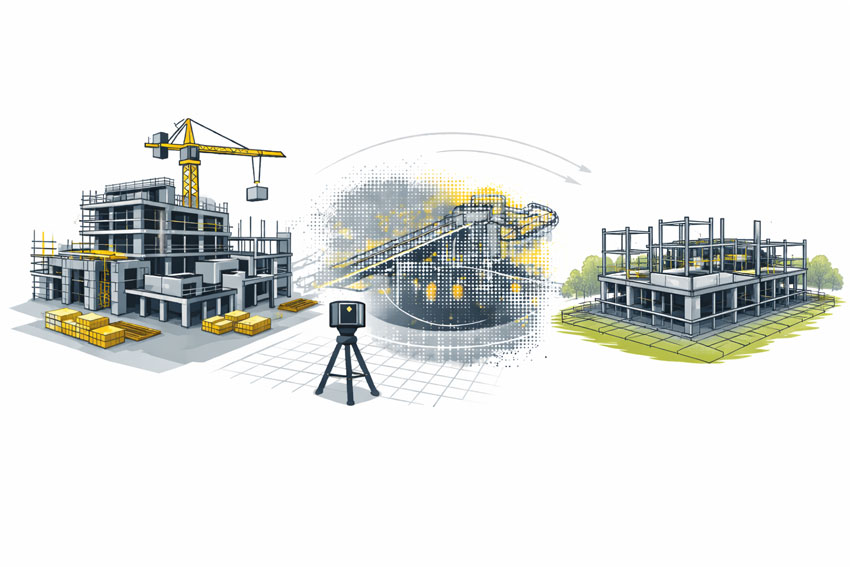
3D laser scanning of a commercial building under construction showing as-built capture and coordination before wall closure

The Hamilton By Design Difference

Hamilton By Design delivers engineering-grade 3D construction scanning with a clear focus on constructability and downstream use.

Our approach combines:

  • Engineer-led scanning strategies
  • Defined accuracy requirements
  • Integration with mechanical and structural design
  • Outputs suitable for fabrication and installation

This approach ensures construction teams can rely on scan data with confidence โ€” especially on complex Brisbane projects.


When should a 3D Construction Scan Be Used?

A 3D construction scan in Brisbane is most valuable when:

  • Working in brownfield or live environments
  • Verifying conditions before fabrication
  • Coordinating multiple trades in tight spaces
  • Managing staged refurbishments
  • Reducing construction risk and uncertainty

Hamilton By Design logo displayed on a blue tilted rectangle with a grey gradient background

In Brisbane, construction risk is rarely driven by poor engineering.
It is driven by decisions made using incorrect or outdated information.

A 3D Construction Scan in Brisbane provides one critical advantage:
certainty about what actually exists on site, at the moment decisions are made.

Finite Element Analysis (FEA) engineering simulation button
3D LiDAR scanning and 3D modelling services button
Building and construction services button

Our clients:

Name
Would you like us to arrange a phone consultation for you?
Address
Finite Element Analysis (FEA) engineering simulation button
Mechanical engineering services
Reality Capture Brisbane title graphic with white text on a blue background promoting reality capture, LiDAR scanning and digital engineering services in Brisbane, Queensland.
3D Scanning Brisbane text graphic on a blue background promoting engineering-led laser scanning and reality capture services in Brisbane.

LiDAR Scanning Brisbane title graphic with white text on a blue background promoting terrestrial LiDAR scanning, point cloud capture and reality capture services in Brisbane, Queensland.
SolidWorks Brisbane title graphic with white text on a blue background promoting SolidWorks mechanical design, 3D CAD modelling and engineering drafting services in Brisbane, Queensland.