Mechanical Engineering | 3D Scanning | 3D Modelling
Tag: point-cloud-data
Hamilton By Design provides registered point-cloud data and processing services for industrial facilities, buildings, machinery and fixed plant.
A point cloud is a three-dimensional collection of measured points captured using LiDAR or other 3D scanning technology. Together, these points create a measurable digital representation of the visible surfaces, geometry and spatial relationships within an existing environment.
Our point-cloud data can support:
Existing-condition and as-built documentation
Scan-to-CAD and Scan-to-BIM modelling
Industrial plant and machinery layouts
Brownfield modifications and equipment upgrades
Clash detection and clearance checking
Shutdown and installation planning
As-built and installation verification
Digital asset records
Individual scan positions are processed and registered into a coordinated dataset. Quality checks can include registration review, coverage assessment, visual alignment checks and identification of inaccessible or incomplete areas.
Deliverables may include E57, RCP or LAS files, scan plans, viewing files and data prepared for use in ReCap, AutoCAD, SolidWorks, Inventor and Navisworks workflows.
The required file format, coordinate system, accuracy, point density and project scope should be agreed before scanning. Point-cloud accuracy depends on the scanning method, site conditions, registration approach and intended application.
Hamilton By Design can also convert relevant areas of the point cloud into 2D drawings, 3D CAD models or BIM models at an agreed level of detail.
The Central Coast of New South Wales is a region defined by balance — where coastal living meets industrial progress, and where families, businesses, and innovation all thrive together. Perfectly positioned between Sydney and Newcastle, the Central Coast offers the advantages of urban connectivity without sacrificing the relaxed pace and natural beauty of a regional lifestyle.
A Great Place to Raise a Family
The Central Coast is widely recognised as one of Australia’s most liveable regions. With its pristine beaches, lakes, and bushland, it provides an exceptional environment for families seeking space, safety, and community. The area features quality schools, TAFE NSW campuses, and the University of Newcastle’s Ourimbah campus — offering pathways from education to skilled employment close to home. Local parks, sports clubs, and community centres strengthen neighbourhood connections, while the mild coastal climate supports year-round outdoor living.
Families enjoy affordable housing, short commute times, and access to both Sydney and Newcastle via the M1 Pacific Motorway and rail network. This lifestyle balance makes the Central Coast a region where professionals can build meaningful careers while enjoying family life in a welcoming, coastal community.
A Thriving Region for Business and Industry
Beyond its lifestyle appeal, the Central Coast has evolved into one of NSW’s most active regional economies. Centred around Wyong, Tuggerah, Somersby, and West Gosford, the region’s industrial estates host a diverse range of businesses in manufacturing, logistics, food processing, engineering, and advanced fabrication.
Infrastructure investment continues to strengthen the local economy, with upgrades to road, rail, and utilities improving connectivity and efficiency. This makes the region an attractive base for both established firms and growing enterprises.
For companies involved in mechanical engineering, fabrication, and industrial design, the Central Coast provides ready access to skilled tradespeople, degree-qualified engineers, and specialised suppliers. The strong network of local industries encourages collaboration, innovation, and shared growth.
Engineering and Innovation on the Central Coast
Mechanical engineering plays a vital role in the region’s industrial success. Local firms design and build systems for manufacturing, water management, food processing, and construction — translating mechanical calculations and CAD drawings into reliable, real-world solutions.
Mechanical engineers on the Central Coast contribute to:
The design of platforms, frames, and lifting systems.
Efficiency upgrades in manufacturing and packaging plants.
Water treatment and stormwater infrastructure.
Automation and materials handling systems.
These services support not only local companies but also council and state infrastructure projects, helping the region grow sustainably while maintaining technical excellence.
Strong Community, Strong Opportunity
What makes the Central Coast unique is its sense of community. Businesses here operate in a collaborative environment where partnerships often extend beyond contracts — where reputation, reliability, and relationships truly matter. The Central Coast Council, Regional Development Australia, and Central Coast Industry Connect provide active support to local enterprises, fostering innovation and sustainable development.
With an expanding population of more than 340,000 people, demand for skilled services, reliable infrastructure, and technical design continues to grow. This creates consistent opportunities for engineering firms to contribute to the region’s progress.
A Balanced Future
The Central Coast stands out as a region where family life and business success go hand in hand. It offers the resources of a major industrial hub, the natural appeal of a coastal community, and the connectivity of a key transport corridor. For companies and professionals in mechanical engineering, it provides the ideal setting to live, work, and build for the future — combining technical innovation with quality of life.
Mining is evolving faster than ever. What was once an industry defined by physical muscle — haul trucks, crushers, conveyors — is now being transformed by data intelligence, digital modelling, and real-time insight.
At the heart of this transformation lies a quiet revolution: 3D scanning. Once used primarily for design verification or plant modification, scanning is now the gateway technology that feeds the emerging world of digital twins — live, data-driven replicas of mine assets that help engineers predict, plan, and optimise before problems occur.
At Hamilton By Design, we’ve spent years scanning and modelling chutes, hoppers, and material-handling systems across Australia’s mining sector. Each project has shown us one thing clearly:
Scanning isn’t just about geometry — it’s about knowledge. And digital twins are the next logical step in turning that knowledge into action.
What Exactly Is a Digital Twin?
Think of a digital twin as the digital counterpart of a physical asset — a chute, a conveyor, a processing plant, even an entire mine site.
It’s not a static 3D model; it’s a dynamic, data-linked environment that mirrors the real system in near real time. Sensors feed performance data into the twin: wear rates, temperature, vibration, flow speed, throughput. The twin then responds, updating its state and allowing engineers to simulate scenarios, forecast failures, and test design changes before touching the physical equipment.
In essence, a digital twin gives you a real-time window into the life of your assets — one that’s predictive, not reactive.
How 3D Scanning Powers the Digital Twin
To create a digital twin, you first need an accurate foundation — and that’s where 3D scanning comes in. The twin can only be as good as the geometry beneath it.
Laser scanning or LiDAR technology captures millimetre-accurate measurements of chutes, hoppers, crushers, conveyors, and processing structures. This creates a precise 3D “as-is” model — not what the plant was designed to be, but what it actually is after years of wear, repair, and modification.
That baseline geometry is then aligned with:
Operational data from sensors and PLCs (e.g. flow rates, temperatures, vibrations)
Material behaviour data from CFD and wear simulations
Design intent data from CAD and engineering archives
Once these layers are synchronised, the model becomes a living system — continuously updated, measurable, and comparable to its physical twin.
From Reactive Maintenance to Predictive Performance
In most operations today, maintenance still works on a reactive cycle — wait for a fault, shut down, repair, restart. It’s expensive, unpredictable, and risky.
With digital twins, that model flips. Instead of waiting for wear to become a failure, the twin uses real-time and historical data to forecast when parts will reach their limits. The result is predictive maintenance — planning shutdowns based on evidence, not emergency.
Imagine being able to simulate how a chute will behave under new flow conditions, or when a liner will reach its critical wear thickness, before you commit to a shutdown. That’s not future-speak — it’s what forward-thinking operators are doing right now.
Every hour of avoided downtime can mean tens or even hundreds of thousands of dollars saved. Even a modest 5 % reduction in unplanned outages can add millions to annual output.
Integrating Scanning, Simulation, and Sensors
A full digital-twin workflow in mining usually includes four steps:
Capture: 3D scanning provides the exact geometry of the asset.
Model: Engineers integrate the geometry with CAD, CFD, and FEA models.
Connect: Real-time data from sensors is linked to the model.
Predict: Algorithms and engineers analyse the twin to predict future performance.
The power lies in connection. Each new scan or dataset strengthens the model, improving its predictive accuracy. Over time, the digital twin evolves into a decision-support system for engineers, planners, and maintenance teams.
Real-World Applications Across the Mining Value Chain
1. Chute & Hopper Optimisation
Flow issues, blockages, and uneven wear can be modelled digitally before modifications are made. This reduces trial-and-error shutdowns and improves throughput reliability.
2. Conveyor Alignment
Scanning allows engineers to identify misalignment over kilometres of belting. A digital twin can then simulate tracking and tension to prevent belt failures.
3. Crusher and Mill Wear
By combining periodic scans with wear sensors, operators can visualise material loss and forecast replacement schedules.
4. Structural Monitoring
3D scanning enables long-term comparison between “as-built” and “as-maintained” geometry, detecting distortion or settlement early.
Each of these applications reinforces a core insight:
The line between mechanical engineering and data engineering is disappearing.
Why Digital Twins Matter for Australia’s Mining Future
Australia’s competitive advantage has always been resource-based. But the next advantage will be knowledge-based — how well we understand, model, and optimise those resources.
Digital twins represent that shift from raw extraction to engineering intelligence. They help miners lower costs, reduce emissions, and improve safety, while extending asset life and reliability.
As Australia pushes toward decarbonisation and productivity targets, technologies like scanning and digital twinning will underpin the next generation of sustainable mining design.
The Hamilton By Design Approach
Our philosophy is simple: technology only matters if it serves engineering integrity. That’s why our process always begins with real-world problems — not software.
Field Capture: We conduct high-resolution 3D scans under live or shutdown conditions.
Engineering Integration: Our designers and mechanical engineers turn that data into usable CAD and FEA models.
Digital Twin Setup: We connect the digital model to operational data, creating a living reference that evolves with the asset.
Continuous Support: We monitor, re-scan, and update as assets change.
This approach ensures every digital twin remains a tool for decision-making, not just a visualisation exercise.
That piece explored how scanning replaces manual measurement with safe, precise, data-rich modelling. Digital twins take that same data and carry it forward — connecting it to predictive insights and automated planning.
The flow looks like this:
3D Scan → Model → Digital Twin → Predict → Improve → Re-scan
Each loop makes the operation smarter, safer, and more efficient.
Lessons from Global Mining Leaders
Rio Tinto and BHP are already trialling digital twins for rail networks, conveyors, and entire processing plants.
Anglo American uses twin models to monitor tailings dam integrity, integrating LiDAR scans with geotechnical sensors.
Fortescue has explored twin-based predictive maintenance for haulage and fixed plant systems.
Internationally, countries like Finland and Canada have established digital-twin testbeds for mine ventilation, environmental monitoring, and process control — demonstrating that twinning isn’t a luxury, it’s a competitive necessity.
Looking Forward: The Road to Real-Time Mines
The next decade will see digital twins move from project pilots to enterprise-wide ecosystems. Future systems will integrate:
IoT sensors streaming continuous data
AI algorithms identifying anomalies in real time
Augmented-reality tools allowing operators to “see” the twin overlaid on the physical plant
Combined, these will make mines safer, cleaner, and more efficient — driven by data instead of downtime.
The Broader Economic Story
The technology’s value doesn’t stop at the mine gate. As digital twins become standard across energy, infrastructure, and manufacturing, Australia’s engineering capability grows alongside GDP.
Every dollar invested in scanning and twin development creates long-term dividends in productivity and sustainability. By connecting our data and design skills to resource industries, we strengthen both our domestic economy and our global competitiveness.
Building Smarter, Safer, and More Predictable Mines
Mining will always be a physically demanding industry — but its future will be defined by how intelligently we manage that physicality.
From the first laser scan to the fully connected digital twin, every step tightens the link between information and performance.
At Hamilton By Design, we’re proud to stand at that intersection — where mechanical precision meets digital innovation. We help our clients not just capture data, but understand it — turning measurements into models, and models into insight.
Because when you can see your mine in full digital clarity, you can shape its future with confidence.
Mining is no longer just about moving tonnes — it’s about precision, predictability, and performance. Across Australia’s mining sector, the most forward-looking operators are adopting 3D scanning to transform the way they maintain and optimise chutes, hoppers, and material-handling systems.
At Hamilton By Design, we’ve been applying advanced scanning technology to reduce downtime, improve plant design accuracy, and extend asset life. You can read our detailed technical overview here: 👉 3D Scanning Chutes, Hoppers & Mining
But here’s the bigger picture — why this shift matters for the future of mining.
From Manual Inspection to Measured Insight
Traditional inspections rely on tape measures, hand sketches, and assumptions. 3D laser scanning replaces that guesswork with millimetre-accurate data captured safely, often without shutting down production.
Reduced risk: Personnel spend less time inside confined spaces.
Shorter shutdowns: Entire structures can be captured in minutes.
Design-ready models: Engineers receive CAD-compatible data for modification or replacement.
This means decisions are made on facts, not estimates.
Integrating Data into the Design Cycle
The true value of scanning is unlocked when the data feeds directly into design and maintenance workflows. Once a chute or hopper is scanned, engineers can:
Compare actual geometry to design intent.
Detect deformation, wear patterns, and misalignment early.
Pre-fit replacement liners or components in CAD — reducing on-site rework.
This seamless link between field reality and digital design enables data-driven engineering, saving both time and capital.
A New Standard for Asset Reliability
3D scanning creates a living record of your assets. Each scan becomes a baseline for future condition monitoring, allowing for proactive maintenance scheduling.
When combined with finite-element analysis (FEA) or wear modelling, site managers can predict failures before they happen. That means safer plants, lower maintenance costs, and fewer unplanned stoppages.
Part of a Larger Digital Ecosystem
The rise of digital twins and predictive analytics in mining depends on accurate base geometry — and that’s where scanning fits in. By capturing exact dimensions, operators can:
Link asset data into their digital twin models.
Simulate flow behaviour and wear progression.
Train AI models using accurate 3D data.
3D scanning isn’t just a tool — it’s the foundation of intelligent mining operations.
Why Hamilton By Design?
Our engineering approach combines field experience with digital precision. We integrate scanning, modelling, and mechanical design into a single workflow — from problem definition to implementable solutions.
Whether you’re replacing a worn-out chute, upgrading a hopper, or building a new transfer station, our 3D scanning process gives you clarity, accuracy, and confidence.
By Anthony Hamilton, Mechanical Engineer and Industry Analyst
Australia’s relationship with China has always been a balancing act between economic dependence and strategic independence. Nowhere is that tension clearer than in our trade of iron ore — the mineral that built both our national budget and China’s skyline.
Imagine, then, a bold decision: Australia deliberately cuts its iron ore exports to China by half and pivots toward domestic manufacturing — especially green steel and renewable-powered industry. What would that mean for our economy, our global influence, and our future as an industrial nation?
The answer is both disruptive and transformative.
The Shock: Short-Term Pain
Let’s be clear: halving iron ore exports would jolt the economy.
Australia exported about 900 million tonnes of iron ore in 2024–25, worth roughly A$160 billion, with China buying four-fifths of it. Slashing that volume by half would pull A$80–90 billion out of export revenue almost overnight. Even if prices spiked 50% amid global shortages, our GDP would still take a hit of 2–3% in the first years — a deliberate, self-imposed economic slowdown.
Western Australia, which lives and breathes the ore trade, would feel it most: reduced royalties, idle capacity, and strained state budgets. Canberra’s tax intake could drop by A$10–15 billion per year in the early phase.
But these are short-term tremors — not structural decline. The question is whether we can replace raw-ore exports with something better: value-added industrial activity on Australian soil.
The Transition: Turning Rocks into Revenue
If half of that diverted ore were converted into green steel, the economic story changes dramatically. One tonne of steel is worth four to six times more than the same tonne of ore. Even modest domestic processing could create an A$100 billion green industry within a decade — generating thousands of high-skill jobs across hydrogen, renewables, materials science, and engineering.
Projects in Whyalla, Gladstone, and the Pilbara already point the way. With the right investment — perhaps A$60–100 billion over ten years — Australia could build the capacity to supply its own construction, defence, and transport sectors while exporting carbon-neutral steel to the world.
That’s not deglobalisation. It’s smart industrialisation — keeping the value chain at home instead of shipping our competitive advantage overseas.
The Payoff: Long-Term Strength
By 2035, the payoff could be substantial:
GDP grows larger and more balanced, driven by advanced manufacturing.
Australia becomes a reliable producer of green steel, battery materials, and hydrogen infrastructure.
Dependence on Chinese demand declines, while new trade with India, Japan, Korea, and Europe expands.
In this scenario, Australia’s GDP could be 2–4% higher than the business-as-usual case — smaller mining exports, but far greater industrial depth. It’s a shift from volume to value, from being the world’s quarry to being part of its workshop again.
The Risk: A Test of Political Will
Such a move isn’t without risk. China would almost certainly retaliate — delaying other imports, applying political pressure, and exploiting our internal divisions. The mining lobby would fight hard to protect its margins. Politicians would face the same question every reformer does: why risk the comfortable present for an uncertain future?
Yet the uncomfortable truth is that comfort has bred complacency. Australia’s prosperity is overly reliant on shipping low-value resources to one buyer. That’s not economic freedom — its dependency dressed as success.
The Opportunity: Building the Next Holden Moment
Half a century ago, Holden symbolised a confident, self-sufficient industrial Australia. Its closure marked the end of that era. A green-steel renaissance could be the new Holden moment — a chance to reconnect engineering, manufacturing, and national purpose. It would anchor new jobs, restore industrial pride, and ensure that Australia competes not on cost, but on competence.
We’d still dig things up — but we’d also make things again.
Conclusion: A Strategic Rebalance, Not an Economic Gamble
Cutting 50% of iron ore exports to China would be a strategic recalibration, not an act of economic self-harm. It would cost us in the short run, but it could redefine us in the long run — from a resource economy to a resilient, innovation-driven nation.
For decades, Australia’s industrial conversation has ended with one refrain: “We can’t afford to make things anymore.” Perhaps the truth is the opposite.
At Hamilton By Design, we specialise in delivering practical and innovative solutions for industrial, commercial, and infrastructure projects. As experienced mechanical engineers in Sydney, we provide expert services in mechanical design, structural engineering, drafting, and 3D scanning. Our team is committed to helping clients across Sydney achieve safe, cost-effective, and fully compliant project outcomes.
Our Services in Sydney
Mechanical Engineering & Design
Custom design of process equipment such as chutes, hoppers, and conveyors
Pump and piping system layouts for reliable fluid and material transfer
Plant layout optimisation, retrofits, and system upgrades
Failure diagnosis, problem-solving, and performance improvement
Structural Engineering
Steel structures, platforms, and support framework design
Structural modifications and like-for-like replacements
Load assessments, foundation design, and audits for compliance
Integration of mechanical systems with structural solutions
Drafting & CAD Services
Accurate shop drawings, assemblies, and fabrication details
P&IDs, BOMs, and detailed documentation for construction and manufacturing
Mechanical and structural drafting compliant with Australian Standards
CAD drafting that integrates seamlessly with site data
3D Laser & LiDAR Scanning
High-precision scans of facilities, plants, and infrastructure in Sydney
As-built data capture to reduce costly site visits
Point cloud conversion into detailed CAD models
Digital twins, clash detection, and retrofit planning
SolidWorks & CAD Contracting
Expert SolidWorks design, modelling, and validation
Reverse engineering and interference detection
Flexible CAD resource support for Sydney businesses and projects
Project Support & Compliance
End-to-end project support from concept through to fabrication drawings
On-site validation, quality assurance, and safety compliance
Independent inspections and reporting for reliable project delivery
Collaboration with multidisciplinary teams across Sydney
Why Choose Hamilton By Design?
Trusted mechanical engineers in Sydney with national project experience
Flexible services tailored to projects of all sizes
Advanced tools including SolidWorks, CAD, and LiDAR scanning
Proven track record supporting manufacturing, industrial, and infrastructure clients
Industries We Support
Hamilton By Design provides mechanical engineering services throughout Sydney for manufacturing facilities, materials handling systems, water treatment plants, food processing facilities, mining infrastructure, industrial plants and commercial developments.
Hamilton By Design supports projects throughout Sydney CBD, Parramatta, Liverpool, Penrith, Chatswood, Alexandria, Mascot, Newcastle and the Central Coast with practical mechanical engineering services. Our experience includes materials handling systems, plant upgrades, shutdown engineering, equipment design and brownfield project support.
Our clients:
Looking for reliable mechanical engineers in Sydney to support your next project? Hamilton By Design offers the expertise and tools to get the job done right.
Hamilton By Design supports projects throughout Sydney CBD, Parramatta, Liverpool, Penrith, Blacktown, Chatswood, Alexandria, Mascot, Newcastle and the Central Coast.
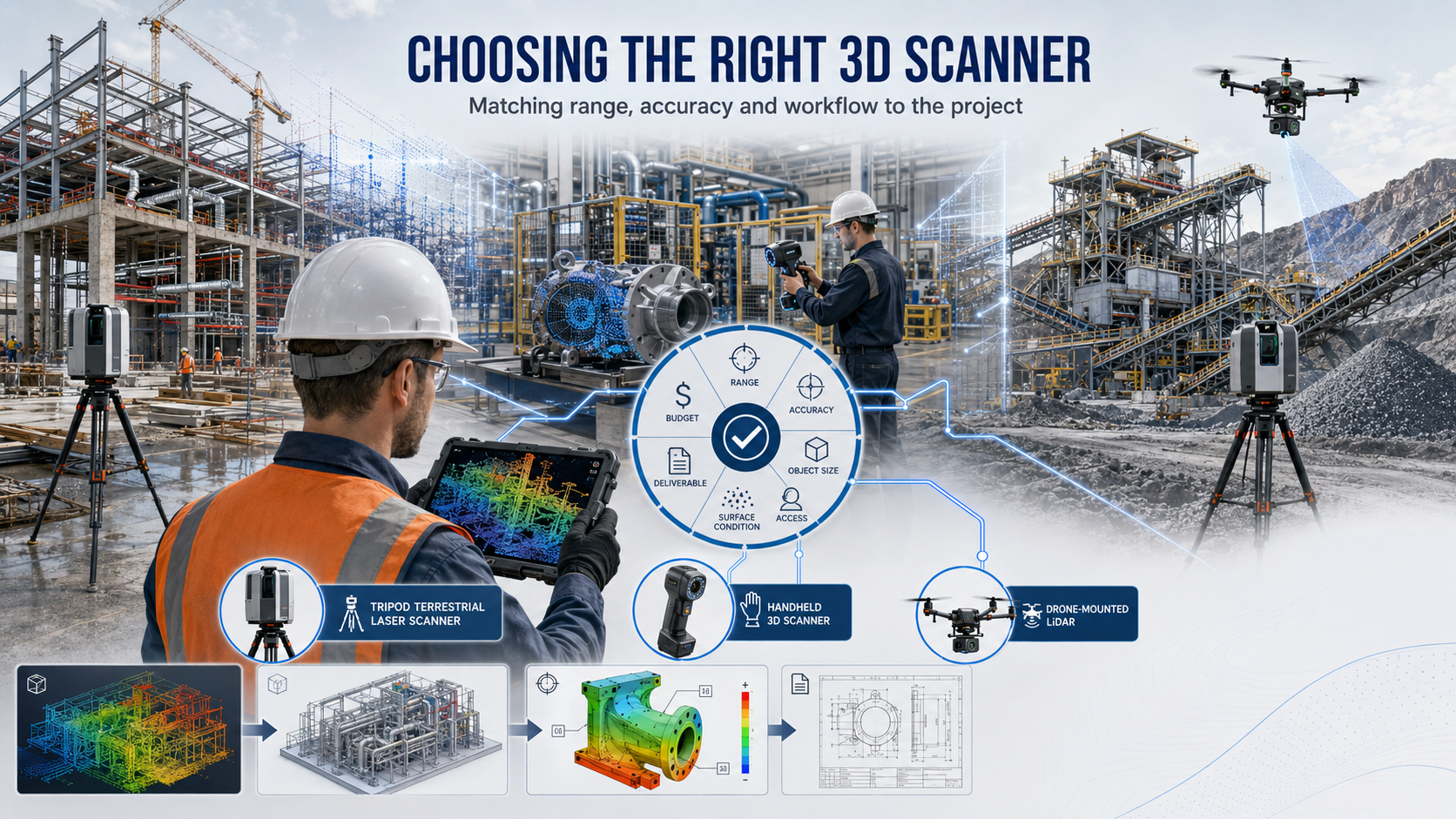
At Hamilton By Design, we know that 3D scanning has become an essential tool for modern engineering — from capturing as-built conditions on construction sites to modeling complex processing plants and validating manufacturing layouts. But not all scanners are created equal, and selecting the right technology is crucial to getting reliable data and avoiding costly surprises later in the project.
3D Scanning for Construction Sites
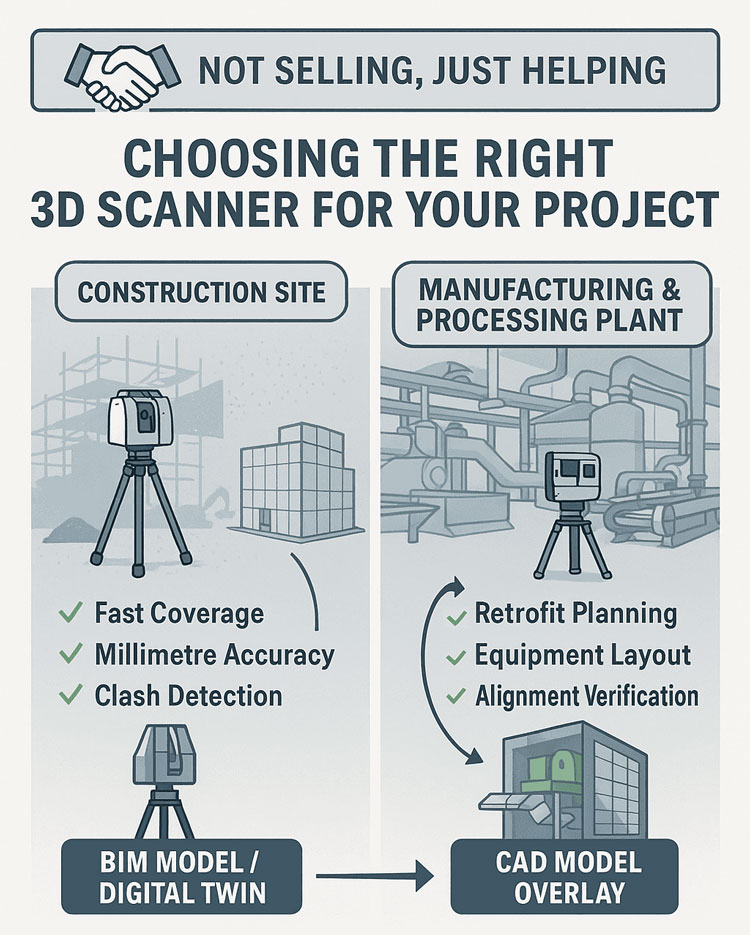
For construction and infrastructure projects, coverage and speed are the top priorities. Terrestrial Laser Scanning (TLS) and LiDAR systems like the FARO Focus S70 are ideal for quickly capturing entire job sites with millimetre-level accuracy. These scanners allow engineers and project managers to:
Verify as-built conditions against design models
Detect clashes early in the process
Support accurate quantity take-offs and progress documentation
TLS works well in tough environments — dust, sunlight, and complex geometry — making it a perfect fit for active building sites.
3D Scanning for Manufacturing & Processing Plants
When it comes to manufacturing facilities and mining processing plants, accuracy and detail matter even more. Scans are often used for:
Retrofit planning and clash detection in tight plant rooms
Structural steel and conveyor alignment checks
Equipment layout for expansion projects
Here, combining TLS with feature-based CAD modeling allows us to deliver data that is usable for engineering design, ensuring that new equipment fits exactly as intended.
We’re Here to Help
Hamilton By Design doesn’t sell scanners — we focus on providing unbiased, engineering-driven advice. If you’re unsure which scanning approach is right for your project, we’re happy to share our experience and guide you toward the best solution.
Feel free to get in touch to discuss your project needs — whether it’s a construction site, manufacturing facility, or processing plant, we can help you turn accurate scan data into actionable engineering insights.
To provide the best experiences, we use technologies like cookies to store and/or access device information. Consenting to these technologies will allow us to process data such as browsing behaviour or unique IDs on this site. Not consenting or withdrawing consent, may adversely affect certain features and functions.
Functional
Always active
The technical storage or access is strictly necessary for the legitimate purpose of enabling the use of a specific service explicitly requested by the subscriber or user, or for the sole purpose of carrying out the transmission of a communication over an electronic communications network.
Preferences
The technical storage or access is necessary for the legitimate purpose of storing preferences that are not requested by the subscriber or user.
Statistics
The technical storage or access that is used exclusively for statistical purposes.The technical storage or access that is used exclusively for anonymous statistical purposes. Without a subpoena, voluntary compliance on the part of your Internet Service Provider, or additional records from a third party, information stored or retrieved for this purpose alone cannot usually be used to identify you.
Marketing
The technical storage or access is required to create user profiles to send advertising, or to track the user on a website or across several websites for similar marketing purposes.