

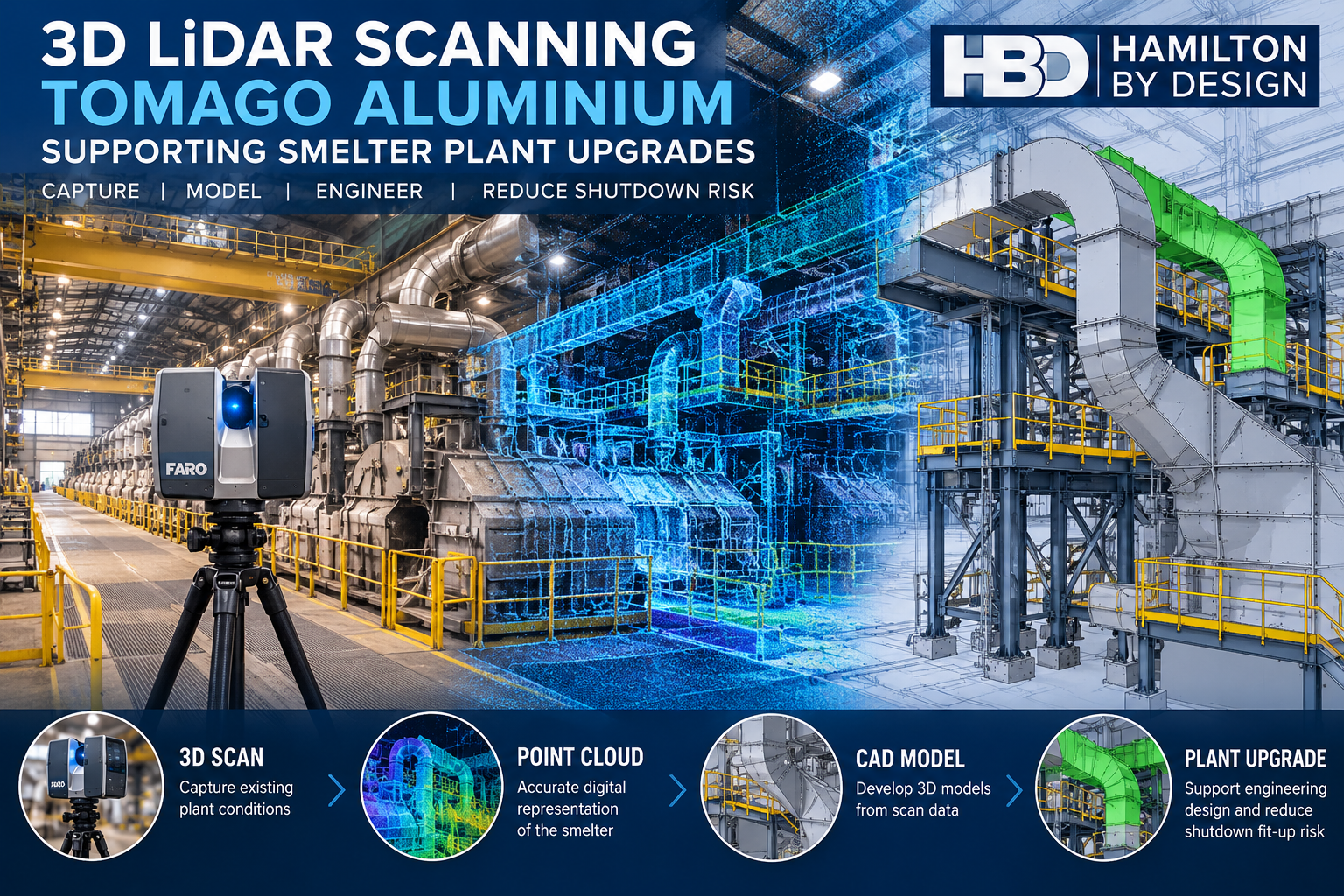
3D LiDAR Scanning Tomago Aluminium โ€“ Supporting Smelter Plant Upgrades

3D LiDAR scanning Tomago Aluminium smelter illustration showing FARO laser scanner, industrial point cloud, CAD modelling and plant upgrades.
Blue 3D LiDAR scanner icon on a tripod with scanning waves

Aluminium smelting facilities contain complex arrangements of mechanical equipment, structural steelwork, pipework, ventilation systems, conveyors and production infrastructure. When existing equipment requires modification or replacement, accurate dimensional information is essential to reducing installation risks and avoiding costly delays.

Hamilton By Design provides 3D LiDAR scanning, point cloud processing, scan-to-CAD modelling and mechanical engineering services for industrial facilities in Tomago, Newcastle and the Hunter Region.

Our services support maintenance teams, project engineers, shutdown planners and engineering contractors undertaking plant upgrades, equipment replacements and mechanical modifications.

By combining 3D laser scanning with practical mechanical engineering experience, we help project teams understand existing plant conditions before commencing detailed design, fabrication or installation.

Supporting Aluminium Smelter Upgrades at Tomago

Tomago Aluminium is a major aluminium smelting operation located near Newcastle in New South Wales. Its industrial environment contains extensive production equipment, mechanical infrastructure, structural steelwork and supporting services.

Aluminium smelters require ongoing maintenance, equipment replacement and engineering modifications to support plant reliability, operational efficiency and workplace safety.

Hamilton By Design offers engineering and dimensional measurement services relevant to these activities, including:

  • 3D LiDAR scanning of existing industrial equipment and structures.
  • Mechanical equipment replacement and retrofit design.
  • Fume extraction ductwork and ventilation modifications.
  • Conveyor and material handling system upgrades.
  • Structural steelwork and mechanical support arrangements.
  • Industrial pipework and service routing.
  • Equipment access platforms and machine guarding.
  • Point cloud modelling for plant modification projects.
  • General arrangement and fabrication drawing development.
  • Dimensional verification before planned shutdowns.

Our objective is to provide accurate existing-condition information that supports practical engineering decisions and reduces uncertainty during plant modifications.

Why 3D LiDAR Scanning Is Important for Aluminium Smelters

Industrial facilities frequently undergo modifications throughout their operating life. Equipment may be replaced, structural supports altered, pipework rerouted and access arrangements changed.

Over time, existing drawings may no longer accurately represent the installed plant.

Traditional measurement methods can also become difficult where equipment is congested, access is restricted or multiple mechanical systems occupy the same area.

3D LiDAR scanning provides a practical method of capturing existing plant geometry and developing a digital reference for engineering design.

The resulting point cloud can be used to identify existing equipment positions, structural interfaces, pipework routes and available installation clearances.

This information can help engineers develop modifications around actual site conditions rather than relying solely on historical drawings or assumed dimensions.

Fume Extraction and Ventilation System Modifications

Fume extraction and ventilation systems are important components of aluminium smelting operations.

These systems can include extensive ductwork, extraction hoods, support frames, transitions, fans and associated mechanical equipment.

Replacing or modifying existing ductwork can present dimensional challenges, particularly where new components must connect to equipment installed many years earlier.

Hamilton By Design can provide 3D LiDAR scanning to capture accessible existing ductwork arrangements and surrounding structures.

Point cloud information can then support:

  • Existing ductwork geometry assessment.
  • Replacement duct and transition design.
  • Flange and connection location assessment.
  • Structural support modifications.
  • Available clearance verification.
  • 3D modelling of proposed ductwork arrangements.
  • Fabrication and installation drawing development.

Critical connections and fabrication interfaces may require supplementary dimensional verification to achieve the required tolerances.

Mechanical Equipment and Potline Infrastructure

Aluminium smelting facilities contain closely integrated mechanical equipment, process infrastructure and associated services.

Modifying one component can affect surrounding structures, maintenance access, equipment clearances and service connections.

3D scanning can help establish the relationship between existing equipment and proposed modifications.

Hamilton By Design can assist with mechanical equipment support frames, access arrangements, guarding, service installations and other mechanical engineering modifications.

Where scanning is proposed near operating smelting equipment, site-specific conditions such as heat, electromagnetic interference, access restrictions and operational safety requirements must be assessed before work commences.

Conveyor and Material Handling System Upgrades

Material handling equipment is essential to industrial production facilities.

Conveyors, transfer points, support frames and associated equipment may require modifications to improve reliability, accommodate replacement components or support changing operational requirements.

Hamilton By Design provides mechanical engineering and 3D scanning services relevant to:

  • Conveyor modifications and equipment replacement.
  • Transfer chute design and replacement.
  • Material discharge arrangements.
  • Mechanical equipment support structures.
  • Conveyor guarding and maintenance access.
  • Existing equipment interface assessment.
  • Fabrication drawing development.

By scanning the surrounding equipment and structural arrangements, proposed modifications can be assessed against the available installation space before fabrication.

Industrial Pipework and Service Modifications

Aluminium smelting facilities rely on various industrial services, including cooling water, compressed air and other process utilities.

Pipework modifications can become difficult where existing systems are congested or where installation space is limited.

3D LiDAR scanning can capture the surrounding plant geometry and provide a reference for developing proposed pipe routes.

The point cloud can assist engineers in identifying potential clashes, assessing maintenance access and developing installation arrangements.

For precision-critical connections, flange positions, bolt patterns and other interfaces should be verified using measurement methods appropriate to the required fabrication accuracy.

Reducing Shutdown Fit-Up Risk with 3D Scanning

One of the greatest challenges in industrial maintenance and shutdown projects is ensuring that replacement equipment fits correctly when delivered to site.

A replacement duct, conveyor component, pipe spool or mechanical support may appear suitable during design but encounter unexpected interference during installation.

These conflicts can lead to site modifications, additional fabrication, rework and delays.

3D LiDAR scanning helps move dimensional uncertainty from the shutdown installation period into the engineering design stage.

By developing proposed equipment models against existing-condition point clouds, engineering teams can assess potential clashes and installation constraints before fabrication begins.

This approach can support:

  • Improved understanding of existing plant geometry.
  • Earlier identification of equipment clashes.
  • Better coordination between engineering and fabrication teams.
  • Reduced reliance on assumed site dimensions.
  • More informed shutdown planning.
  • Reduced risk of unexpected installation rework.

Although scanning cannot eliminate every installation risk, it provides valuable information for improving project preparation.

From 3D LiDAR Scanning to Engineering Drawings

Hamilton By Design offers an integrated workflow that combines site measurement, point cloud processing, mechanical engineering and drawing development.

Stage 1 โ€“ Site Assessment

Establish the scanning scope, project objectives, required deliverables, site access and dimensional accuracy requirements.

Stage 2 โ€“ 3D LiDAR Scanning

Capture accessible existing equipment, pipework, structures and surrounding infrastructure using terrestrial laser scanning equipment.

Stage 3 โ€“ Point Cloud Registration

Process and register the scan data to develop a coordinated digital reference of the scanned plant areas.

Stage 4 โ€“ Scan-to-CAD Modelling

Convert relevant point cloud information into 3D CAD models using engineering software such as SolidWorks and AutoCAD.

Stage 5 โ€“ Mechanical Engineering Design

Develop proposed equipment modifications, assess available clearances and review the arrangement against the existing plant geometry.

Stage 6 โ€“ Engineering Drawing Development

Prepare agreed general arrangement drawings, fabrication drawings and other project documentation.

This coordinated approach helps reduce repeated site measurement and provides continuity between dimensional capture and engineering design.

3D Scanning and Mechanical Engineering Deliverables

Depending on project requirements, Hamilton By Design can provide:

  • Registered 3D point cloud files in E57 and RCP formats.
  • 3D CAD models of existing mechanical equipment and structures.
  • STEP and Parasolid models for engineering coordination.
  • AutoCAD general arrangement drawings.
  • Mechanical equipment modification drawings.
  • Fabrication drawings for defined components.
  • Navisworks-compatible models for design coordination.
  • PDF drawing packages for project review and controlled issue.

The required level of detail, modelling scope and dimensional tolerances are established during project planning.

Engineering Experience Beyond 3D Scanning

Hamilton By Design combines dimensional measurement technology with practical mechanical engineering experience.

Our capabilities extend beyond collecting point cloud information to include mechanical design, reverse engineering, equipment modifications, engineering modelling and fabrication documentation.

We understand that successful plant modifications require more than a visually accurate 3D model.

Engineering teams also need to consider installation access, equipment interfaces, fabrication methods, structural support arrangements, maintenance requirements and operational constraints.

By combining scanning and mechanical engineering services, Hamilton By Design can support projects from existing-condition capture through to design and drawing development.

3D LiDAR Scanning Across Tomago, Newcastle and the Hunter Region

Hamilton By Design supports industrial engineering projects throughout Tomago and the surrounding Hunter Region.

Our services are relevant to facilities and contractors operating in:

  • Tomago
  • Newcastle
  • Hexham
  • Beresfield
  • Mayfield
  • Kooragang Island
  • Williamtown
  • Raymond Terrace
  • Port Stephens
  • The broader Hunter Region

We support projects involving aluminium production, industrial manufacturing, mining, mineral processing, material handling and heavy industrial maintenance.

Frequently Asked Questions

Can 3D LiDAR scanning be completed in an operating aluminium smelter?

Scanning may be possible during normal operations, depending on site access, safety requirements and environmental conditions. Heat, electromagnetic interference, moving equipment and restricted access areas must be assessed before mobilisation.

Can 3D scanning help with replacement ductwork?

Yes. Scanning can capture accessible existing ductwork and surrounding infrastructure to support replacement duct design, transition development and installation planning. Critical fabrication interfaces may require additional verification.

Can point cloud data be used to develop fabrication drawings?

Yes. Point cloud information can provide the basis for 3D CAD modelling and fabrication drawing development. Required dimensions and connection details must be verified to the tolerances appropriate for manufacturing.

What accuracy can be expected from industrial 3D LiDAR scanning?

Accuracy depends on equipment, scan distance, environmental conditions, registration quality and the geometry being measured. For larger registered industrial datasets, approximately ยฑ5โ€“10 mm may be a preliminary planning allowance, but the achievable project accuracy must be assessed and verified. Precision-critical connections may require supplementary measurement.

Can Hamilton By Design provide mechanical engineering as well as scanning?

Yes. Hamilton By Design provides 3D LiDAR scanning, scan-to-CAD modelling, mechanical equipment design, reverse engineering, general arrangement drawings and fabrication documentation.

Can 3D scanning reduce shutdown delays?

3D scanning can help identify dimensional conflicts before installation, reducing the risk of avoidable site rework. Actual time savings depend on the project scope, engineering verification and shutdown execution.

Discuss Your Tomago Aluminium Smelter Upgrade

Whether your project involves replacement ductwork, conveyor modifications, pipework changes, mechanical equipment replacement or structural support arrangements, accurate existing-condition information is an important starting point.

Hamilton By Design provides 3D LiDAR scanning and mechanical engineering services to support industrial plant upgrades in Tomago, Newcastle and the Hunter Region.

We can assist with capturing existing plant geometry, developing 3D CAD models, reviewing proposed equipment arrangements and preparing engineering drawings.

Contact Hamilton By Design to discuss your next industrial scanning or mechanical engineering project.

Website: https://www.hamiltonbydesign.com.au/

Hamilton By Design is an independent engineering service provider. This article describes services applicable to aluminium smelting facilities and does not imply an existing commercial relationship with Tomago Aluminium.


Hamilton By Design logo displayed on a blue tilted rectangle with a grey gradient background

Contact Us – Talk To Us

Name
Would you like us to arrange a phone consultation for you?
Address

Our clients:
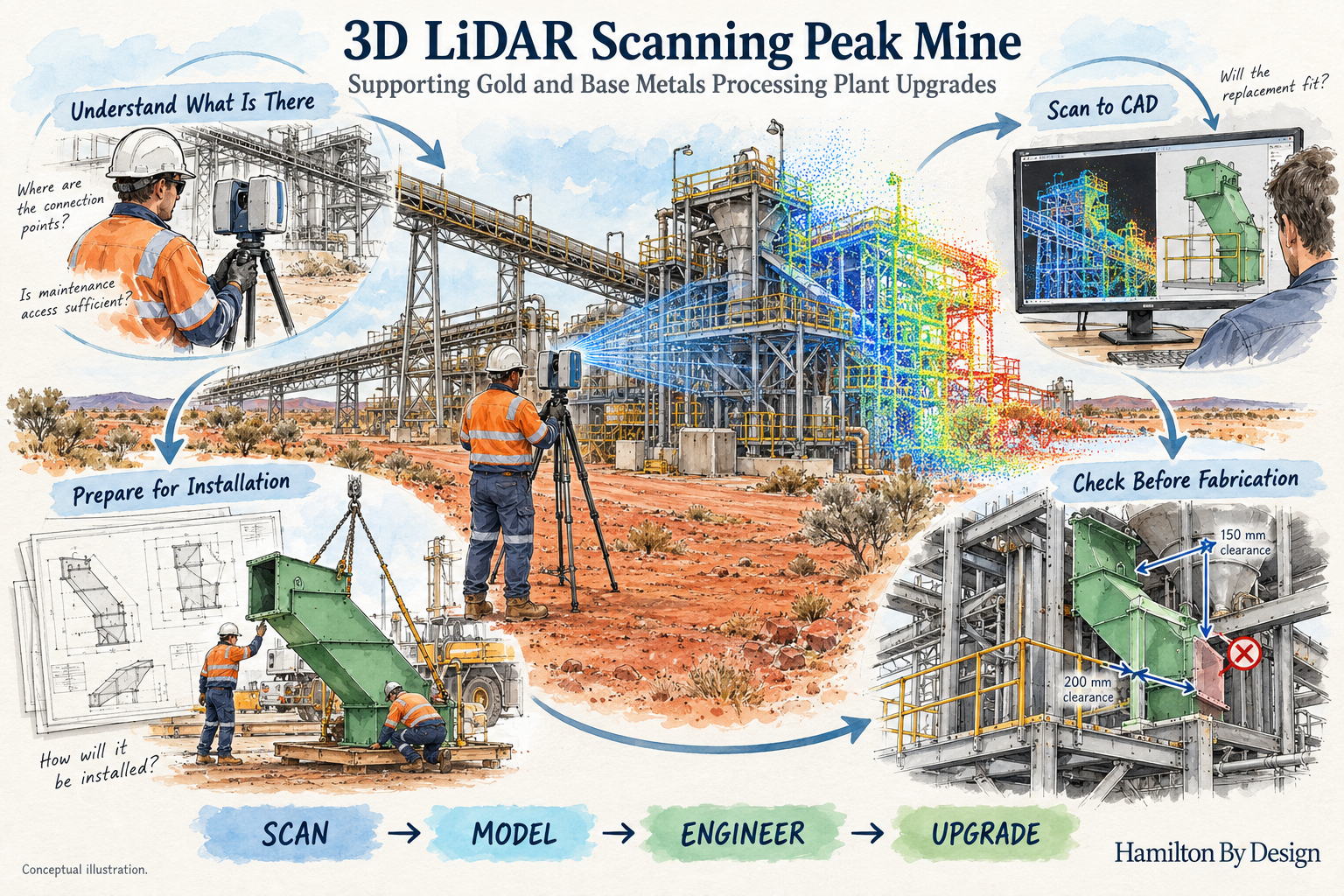


3D LiDAR Scanning Peak Mine โ€“ Supporting Gold and Base Metals Processing Plant Upgrades

Conceptual illustration of 3D LiDAR scanning for Peak Mine plant upgrades, showing point cloud capture, CAD modelling, chute clearance checks and installation planning.
Blue 3D LiDAR scanner icon on a tripod with scanning waves

Planning a chute replacement, pipework modification or equipment upgrade starts with understanding the plant that is already there. Hamilton By Design offers 3D LiDAR scanning for projects at Peak Mine and across the Cobar region, helping engineering and maintenance teams capture existing conditions before design and fabrication begin.

Our workflow connects site measurements with practical engineering deliverables:

Scan โ†’ Model โ†’ Engineer โ†’ Upgrade

Supporting Processing Plant Projects in the Cobar Region

Aurelia Metalsโ€™ Peak operation near Cobar includes underground mining areas and a gold and base metals processing plant handling lead-zinc-gold and copper-gold ores.

For modifications within an established processing plant, the challenge is often fitting new equipment around existing infrastructure. Older drawings may not reflect previous alterations, while congested areas can make manual measurements difficult.

3D LiDAR scanning captures visible plant geometry as a point cloud, providing a spatial reference for planning modifications, checking clearances and developing engineering models.

Hamilton By Design can support proposed Peak Mine projects with scanning, scan-to-CAD modelling, mechanical design and fabrication documentation.

Capture Existing Conditions Before Design

A registered point cloud allows designers to review the relationship between equipment, supporting steelwork, pipework and access routes.

Depending on the project scope and site access, scanning can capture:

  • Conveyors, transfer points and chute arrangements.
  • Accessible bins, hoppers and equipment exteriors.
  • Pipework, pump installations and service corridors.
  • Platforms, walkways, stairs and surrounding steelwork.
  • Equipment foundations and visible connection locations.
  • Available space for installation and maintenance access.

This information helps establish the constraints that influence a replacement component or plant modification.

Chute Replacement and Conveyor Modifications

A replacement chute needs to suit both the material handling duty and the available installation space.

Scanning can help establish the relationship between conveyor discharge points, receiving equipment, support steelwork and surrounding services. These measurements provide a basis for developing chute geometry and reviewing how the proposed assembly will be installed.

Hamilton By Design can assist with:

  • Existing chute and transfer point modelling.
  • Replacement chute layouts.
  • Flange and interface positioning.
  • Liner arrangements and maintenance access.
  • General arrangement and fabrication drawings.
  • Installation clearance reviews.

Material flow performance, wear protection and supporting loads require engineering assessment alongside the captured geometry.

Pipework, Pumps and Equipment Fit-Up

Pipe routes and equipment installations often pass through areas with limited clearance. A point cloud helps designers assess proposed arrangements against the surrounding plant before components are fabricated.

Typical applications include pump skid replacements, pipe spool layouts, service rerouting, equipment relocations and maintenance access improvements.

Critical interfacesโ€”such as flange faces, bolt patterns and equipment connection pointsโ€”can require supplementary measurements or closer inspection. We identify these requirements when defining the scanning and design scope.

From Point Clouds to Engineering Models and Drawings

The most useful deliverable depends on what the project team needs to decide or build.

DeliverableProject application
Registered point cloudReviewing existing plant conditions
3D CAD modelDeveloping equipment layouts and modifications
Combined point cloud and design reviewChecking clearances and potential clashes
General arrangement drawingsCommunicating position, dimensions and interfaces
Fabrication drawingsDocumenting approved components for manufacture
Installation viewsSupporting assembly and shutdown planning

Deliverable formats can include E57, RCP, STEP, DXF and PDF, as agreed for the project.

Plan Fabrication and Shutdown Work Earlier

Discovering an interference during installation can lead to site modifications, additional labour and delays.

By comparing proposed designs with captured site conditions, project teams can identify potential problems earlier and make better-informed decisions about fabrication, transport, lifting and assembly.

Scanning also helps teams review areas remotely, reducing the need for repeat measurement visits where the captured coverage is sufficient.

Site scanning is planned around inductions, permits, operating conditions and access restrictions. Equipment movement, obstructions and inaccessible surfaces affect what can be captured, so coverage and measurement requirements are agreed before mobilisation.

Discuss 3D LiDAR Scanning for Your Peak Mine Project

If you are planning a processing plant modification at Peak Mine or elsewhere in the Cobar region, Hamilton By Design can help establish the existing geometry and develop the models and drawings needed to progress the work.

Send through available drawings, photographs and a brief description of the proposed modification. We can define the scanning area, identify critical interfaces and prepare a scope suited to your project.

Contact Hamilton By Design to discuss 3D LiDAR scanning, mechanical design and scan-to-CAD support for your next plant upgrade.

Hamilton By Design is an independent engineering service provider. References to Peak Mine and Aurelia Metals identify the location and project context and do not imply an existing engagement or endorsement.


Hamilton By Design logo displayed on a blue tilted rectangle with a grey gradient background

Contact Us – Talk To Us

Name
Would you like us to arrange a phone consultation for you?
Address

Our clients:
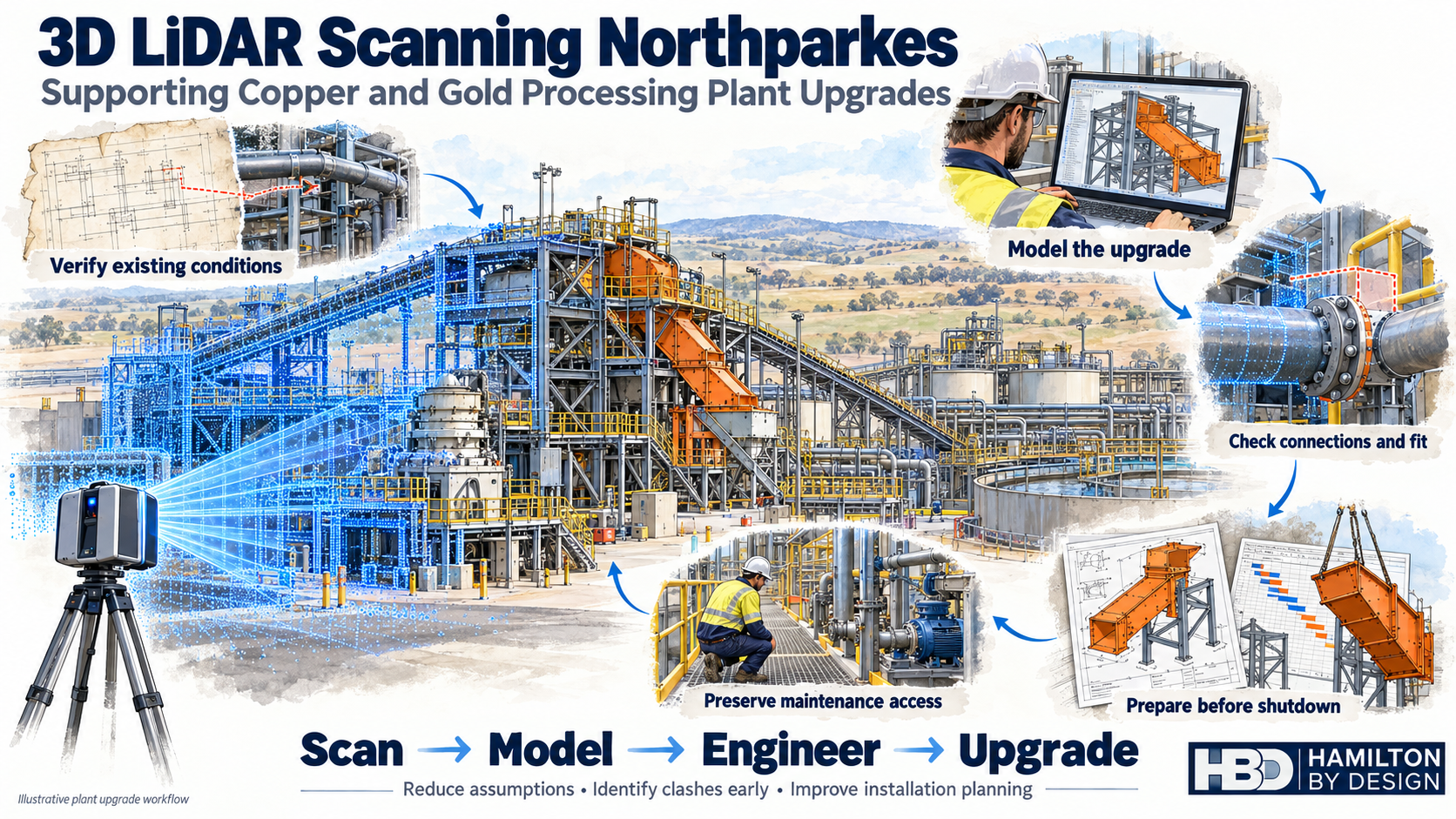


3D LiDAR Scanning Northparkes โ€“ Supporting Copper and Gold Processing Plant Upgrades

Illustration of 3D LiDAR scanning for Northparkes plant upgrades, showing point-cloud capture, CAD modelling, connection checks and shutdown planning.
Blue 3D LiDAR scanner icon on a tripod with scanning waves

Plant upgrades start with understanding what is already on site. When a replacement chute, pipe spool, pump skid or access platform must fit into an existing processing plant, incomplete drawings can leave critical dimensions uncertain.

Hamilton By Design offers 3D LiDAR scanning for projects at Northparkes and across the Parkes region, helping engineering teams capture existing conditions before design, fabrication and installation.

By combining laser scanning with mechanical engineering, 3D modelling and drafting, we can turn site measurements into practical information for plant modifications and shutdown planning.

Supporting Copper and Gold Processing Infrastructure

Northparkes is a copper-gold mining operation located approximately 27 kilometres north-west of Parkes in Central West NSW. Its onsite processing plant produces copper-gold-silver concentrate.

Modifications in this type of operating plant often involve working around existing equipment, pipework, support steel and maintenance access. The challenge is understanding how the proposed work will connect to the surrounding infrastructure.

A replacement component may need to:

  • Match existing flange positions and connection points.
  • Fit between conveyors, equipment and support steel.
  • Preserve access for inspection and maintenance.
  • Allow space for lifting, removal and installation.
  • Be installed within a planned shutdown window.

3D LiDAR scanning helps establish these constraints before the design progresses.

For broader regional coverage, see our Engineering-Grade 3D LiDAR Scanning in Parkes NSW services.

Capture Existing Conditions Before Design Begins

Existing plant drawings may not reflect years of repairs, equipment replacements and site modifications. Manual measurements can also miss surrounding obstructions or important offsets.

A registered point cloud provides a measurable three-dimensional record of the surfaces captured during scanning. Engineers and designers can use this information to check equipment locations, connection geometry and available space.

Depending on access and the project scope, scanning can capture:

  • Conveyors, transfer points, chutes and hoppers.
  • Crushers, screens and surrounding equipment.
  • Pumps, tanks, pipework and service routes.
  • Structural steel and equipment supports.
  • Platforms, stairs, ladders and handrails.
  • Equipment bases, floor levels and installation areas.

The scan scope should focus on the interfaces that determine whether the new component will fit. Critical dimensions and obscured connections may require additional measurement or verification.

Chute and Conveyor Upgrade Planning

Chute replacements depend on more than the dimensions of the chute itself. The design must account for the discharge position, receiving conveyor, support arrangement, surrounding steelwork and maintenance clearances.

For a chute or conveyor modification, Hamilton By Design can use scan data to help establish the existing layout and develop a model of the proposed arrangement.

This supports checks for:

  • Alignment between new and existing equipment.
  • Clashes with steelwork, pipework and platforms.
  • Liner replacement and inspection access.
  • Available space for guards and maintenance.
  • Installation and removal constraints.

Capturing the surrounding plant helps designers assess how the modification will work within the existing installation.

Pipework, Pumps and Equipment Fit-Up

Pipework modifications can become difficult when existing flange positions, elevations or support locations are uncertain.

3D LiDAR scanning can help establish the spatial arrangement around pump stations, pipe racks and equipment connections. Scan-to-CAD modelling can then support proposed pipe routes, pump skid layouts and equipment positioning.

Where fabrication depends on precise connection details, we establish the required accuracy and verification approach before work begins. Some interfaces may need closer scanning, direct measurement or inspection during a shutdown.

From Point Cloud to Engineering Deliverables

Hamilton By Design can develop the captured information into deliverables suited to the project, including:

  • Registered point clouds.
  • Existing-condition 3D CAD models.
  • General arrangement drawings.
  • Proposed equipment and pipework layouts.
  • Clash reviews and fit-up assessments.
  • Fabrication drawings within the agreed design scope.

Point clouds can be supplied in formats such as E57 or RCP, with CAD models and drawings prepared to suit the clientโ€™s software and documentation requirements.

Our 3D Scanning for Central West NSW Gold and Copper Processing Plants post explains how this workflow supports regional processing facilities.

Better Information for Shutdown Planning

Reliable site information allows more engineering and fabrication work to be completed before a shutdown starts.

A scan-based model can help teams identify installation constraints, review component clearances and coordinate proposed work around existing assets. It can also reduce the need for repeated site visits to collect missing dimensions.

These benefits depend on capturing the required areas and checking critical interfaces early.

Discuss Your Northparkes Scanning Requirements

Planning a chute replacement, conveyor modification, pipework upgrade or equipment installation?

Hamilton By Design can assist with 3D LiDAR scanning Northparkes, scan-to-CAD modelling, mechanical design and fabrication documentation.

Provide the proposed work area, available drawings, required deliverables and shutdown timing so we can establish a suitable scanning and engineering scope.

Frequently Asked Questions

Can scanning be undertaken while the plant is operating?
Some areas can be scanned during operation, subject to site approval, safe access and visibility. Restricted areas or obscured interfaces may require shutdown access.

Can the point cloud be converted into SolidWorks or AutoCAD deliverables?
Yes. Selected plant geometry can be developed into CAD models and drawings according to the agreed scope.

Can scanning confirm whether replacement equipment will fit?
Scan data can support fit-up checks against captured existing geometry. Critical connections, tolerances and areas hidden from the scanner require suitable verification.


Hamilton By Design logo displayed on a blue tilted rectangle with a grey gradient background

Contact Us – Talk To Us

Name
Would you like us to arrange a phone consultation for you?
Address

Our clients:
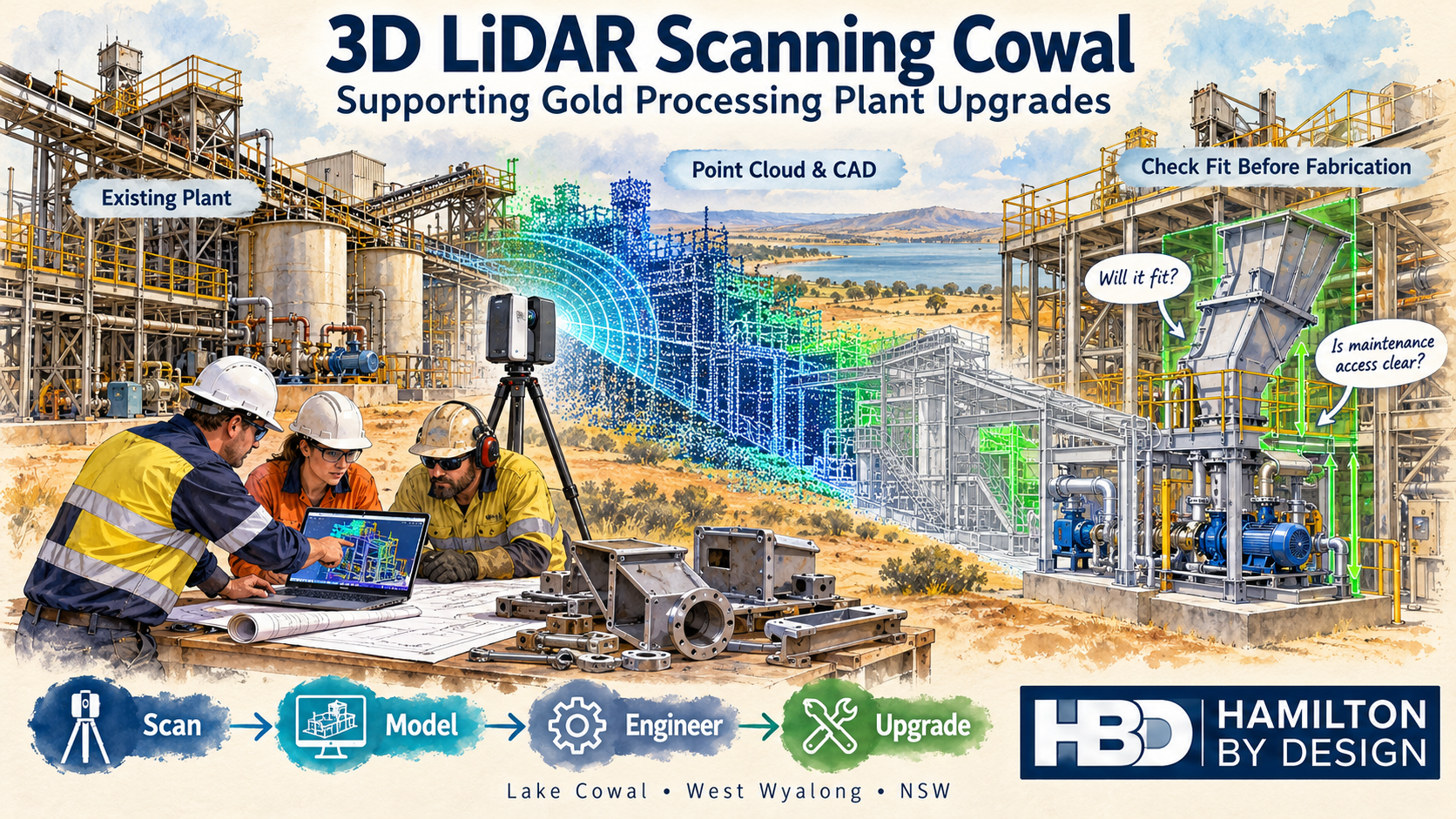


3D LiDAR Scanning Cowal โ€“ Supporting Gold Processing Plant Upgrades

Watercolour illustration of 3D LiDAR scanning for Cowal gold processing plant upgrades, showing a scanner, point cloud, CAD model and Hamilton By Design logo.
Blue 3D LiDAR scanner icon on a tripod with scanning waves

Hamilton By Design offers 3D LiDAR scanning in the Cowal and West Wyalong region to support mechanical engineering, equipment replacement and gold processing plant upgrades. By capturing existing plant geometry before design begins, we help project teams understand available space, assess equipment interfaces and plan modifications with greater confidence.

From a replacement transfer chute to a new pump skid or revised pipe route, reliable information about the existing installation provides a stronger starting point for engineering and fabrication.

Our approach is straightforward: scan โ†’ model โ†’ engineer โ†’ upgrade.

Supporting Gold Processing Projects Near Lake Cowal

Evolution Miningโ€™s Cowal Gold Operations is located near Lake Cowal, approximately 40 kilometres northeast of West Wyalong in New South Wales. The operation includes both open-pit and underground gold mining.

For contractors and engineering teams working on established processing plants, an important challenge is understanding how proposed equipment will fit around the existing installation.

Original drawings provide useful background, but subsequent modifications may have changed pipe routes, equipment positions, access platforms and support arrangements. A new component designed from incomplete information can encounter unexpected clashes during installation.

Hamilton By Design provides scanning and mechanical design services that can support projects in this region, helping teams establish existing conditions before committing to fabrication.

Why Scan Before Designing a Plant Upgrade?

A processing plant upgrade involves more than finding space for a new machine. The design also needs to consider its connections, surrounding equipment, installation route and future maintenance access.

3D LiDAR scanning captures visible surfaces as a point cloud. This creates a spatial record that can be reviewed, measured and used as a reference within compatible CAD software.

Depending on the agreed scope and site access, scanning can help establish:

  • Existing equipment positions and surrounding geometry.
  • Conveyor and transfer chute interfaces.
  • Pipe routes and accessible connection locations.
  • Platform, stair and walkway arrangements.
  • Visible steelwork and support locations.
  • Space around pumps, tanks and mechanical equipment.
  • Potential clashes between proposed and existing installations.
  • Clearances for maintenance and component removal.

Capturing these details early helps the design team identify questions while there is still time to resolve them.

Checking Component Fit Before Fabrication

One of the most useful applications of 3D LiDAR scanning Cowal is checking proposed components against the existing plant.

For example, a replacement chute may need to connect to an existing conveyor discharge, pass through a platform opening and avoid nearby pipework. Each interface affects the final design.

Using a registered point cloud, Hamilton By Design can develop a CAD model of the relevant area and position the proposed component within it.

This allows the project team to review questions such as:

  • Does the component fit within the available space?
  • Do its inlet and outlet positions suit the existing equipment?
  • Are there clashes with steelwork, pipes or platforms?
  • Can personnel reach inspection and maintenance points?
  • Is there enough room to remove liners, motors or other serviceable parts?
  • Does installation require temporary removal of surrounding equipment?

Checking fit in the model helps reduce uncertainty before steel is cut and equipment arrives on site.

Critical interfaces still need an agreed measurement and verification approach, particularly where tight tolerances apply.

Conveyor and Transfer Chute Modifications

Conveyors and transfer chutes bring together several mechanical interfaces within a relatively small area.

A modification may need to accommodate existing conveyor geometry, support steelwork, liner arrangements, access doors and nearby services. Measuring each feature separately can make it difficult to understand their relationship.

3D scanning provides a common spatial reference for reviewing the installation.

Hamilton By Design can use scan data to support:

  • Replacement transfer chute layouts.
  • Conveyor discharge and receiving interfaces.
  • Chute relocation and connection geometry.
  • Wear liner and access door arrangements.
  • Guarding layouts.
  • Maintenance access reviews.
  • General arrangement and fabrication drawings.

The point cloud establishes the visible geometry. Mechanical design then considers operating requirements, material characteristics and the intended function of the equipment.

Pump Skids, Pipework and Equipment Replacement

Replacing a pump or installing a new skid can affect more than its immediate footprint.

Suction and discharge connections, surrounding pipework, motor access, lifting arrangements and maintenance space all influence the layout.

A scan of the installation area can help the design team assess these relationships before selecting a final arrangement.

Typical applications include:

  • Positioning replacement pump skids.
  • Reviewing accessible pipe connection locations.
  • Developing preliminary pipe routes.
  • Checking equipment footprints.
  • Assessing space for valves and maintenance tasks.
  • Identifying clashes with existing services.
  • Preparing coordinated mechanical layouts.

Where flange faces, bolt patterns or other connection details are critical, additional measurements may be required. The capture method should match the tolerance needed for the job.

Scan-to-CAD for Gold Processing Plant Upgrades

A point cloud is a valuable reference, but many projects also need a practical CAD model.

Hamilton By Design can convert selected scan geometry into a model suitable for the agreed design task. This may involve modelling an equipment installation, a transfer area or the surrounding plant layout.

The level of detail should reflect the projectโ€™s purpose.

A preliminary layout may only need equipment envelopes and major obstacles. A replacement component may require more detailed modelling of its connection points and surrounding interfaces.

Depending on the scope, deliverables can include:

  • Registered point clouds in agreed formats, such as E57 or RCP.
  • Selected existing-condition CAD models.
  • Proposed mechanical equipment models.
  • General arrangement drawings.
  • Fabrication drawings for agreed components.
  • STEP, DXF or other compatible CAD files.
  • PDF drawing packs for review and coordination.

Agreeing on the intended use of the data at the start helps ensure that scanning and modelling capture the information the project actually needs.

Planning Work Around Shutdowns

Shutdown installation periods place pressure on maintenance teams, fabricators and contractors. Discovering an unexpected clash during that window can lead to urgent modifications and additional work.

Scanning ahead of a shutdown gives the project team an opportunity to review the installation while design changes are still manageable.

A coordinated model can help teams assess:

  • Component delivery and installation routes.
  • Available space for assembly.
  • Nearby equipment that may restrict access.
  • Interfaces requiring confirmation.
  • Temporary removal requirements.
  • The proposed installation sequence.

Scanning access must be coordinated with site personnel. Equipment isolation, permits, elevated access and operating conditions may affect what can be captured and when.

Early planning helps establish a realistic scope and identify areas that require a separate visit or shutdown access.

Matching Accuracy to the Engineering Task

Different engineering tasks require different levels of measurement detail.

Plant layout scanning can provide a useful record of equipment positions and surrounding geometry. Small machined features, bolt holes and precision mating surfaces may require closer inspection, direct measurement or a suitable metrology scanning method.

For each project, Hamilton By Design considers:

  • The dimensions that matter to the design.
  • The required fit and tolerance.
  • Scanner access and viewing angles.
  • Surface conditions and visibility.
  • Registration requirements.
  • Features requiring supplementary measurement.

LiDAR captures visible surfaces. Hidden connections, internal geometry and obscured areas need further investigation where they affect the design.

The aim is to provide information suitable for the engineering decision being made.

A Practical Workflow from Site Capture to Drawings

Hamilton By Design combines scanning with mechanical engineering and drafting support.

Our workflow starts by defining the proposed modification and identifying its critical interfaces. We then plan the site capture, register the scan data and develop the models needed for review.

Once the proposed arrangement has been assessed and key details confirmed, drawings can be prepared for the agreed fabrication or installation scope.

This connects the site information to a practical outcome: a better-informed design, clearer drawings and fewer unresolved fit-up questions.

Frequently Asked Questions

Can 3D LiDAR scanning help check whether new equipment will fit?

Yes. Scan data can be used as a reference for positioning proposed equipment and checking surrounding clearances. Critical dimensions and interfaces should be verified to suit the required tolerance.

Can you develop fabrication drawings from scan data?

Yes. Hamilton By Design can develop selected CAD models and fabrication drawings from suitable scan data, subject to the agreed scope and confirmation of critical details.

Does the entire processing plant need to be scanned?

No. A targeted scan may be sufficient for a replacement chute, pump installation or local pipework modification. Wider capture can be useful where the project involves several connected areas.

Can scanning take place while the plant is operating?

Some areas may be accessible during operation, subject to site approval and safe access. Other areas may require isolation or shutdown access to capture the necessary geometry.

Can you work with existing point clouds?

Yes. Supplied point clouds can be reviewed for coverage, registration quality and suitability. Additional scanning or measurement may be needed where important interfaces are missing or unclear.

Discuss Your Cowal Plant Upgrade

Planning an equipment replacement, conveyor modification, transfer chute upgrade or pipework installation near Cowal or West Wyalong?

Hamilton By Design can help establish the existing geometry and develop the mechanical models and drawings needed to progress the project.

Send us an outline of the proposed work, site photographs and any available drawings or point cloud data. We can then assess the capture requirements and recommend an appropriate scope.

Contact Hamilton By Design to discuss 3D LiDAR scanning, scan-to-CAD and mechanical engineering support for your Cowal project.


Hamilton By Design logo displayed on a blue tilted rectangle with a grey gradient background

Contact Us – Talk To Us

Name
Would you like us to arrange a phone consultation for you?
Address

Our clients:
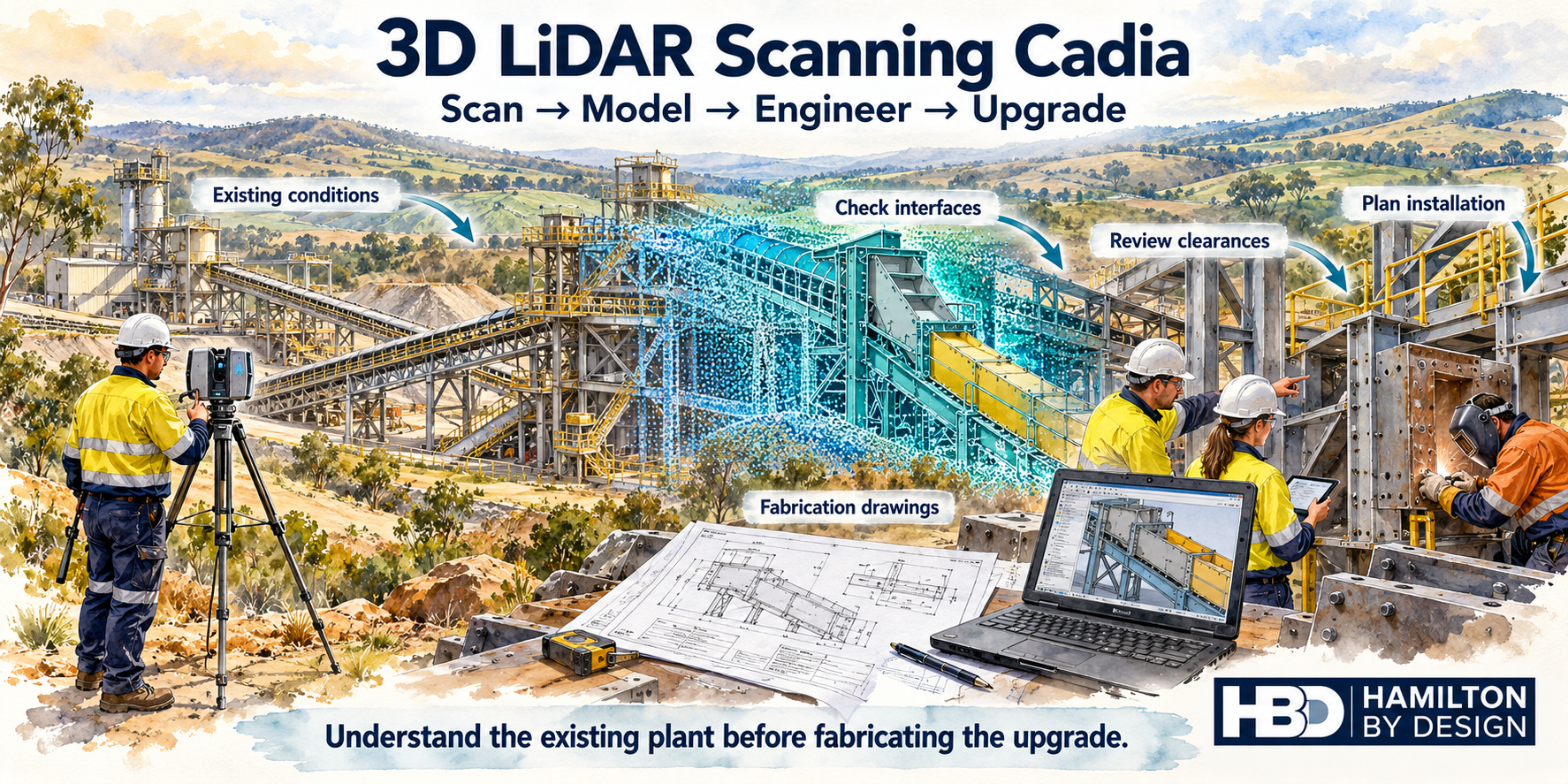


3D LiDAR Scanning for Cadia Mining and Processing Plant Projects

Watercolour illustration of 3D LiDAR scanning for Cadia plant upgrades, showing a scanner, point cloud model, fabrication drawings and engineers checking component fit.
Blue line icon of a tripod-mounted LiDAR scanner surveying a mineral processing plant with a hopper, conveyors and transfer chute.

Hamilton By Design offers 3D LiDAR scanning for Cadia mining and processing plant projects, helping engineers, maintenance teams and fabrication contractors understand existing plant geometry before designing and installing modifications.

From replacement chutes and conveyor interfaces to pump skids and pipework, successful upgrades depend on knowing what is already there. A registered point cloud provides a detailed spatial reference for developing designs, checking clearances and planning installation.

Our approach connects scan โ†’ model โ†’ engineer โ†’ upgrade, turning captured site geometry into practical engineering information.

Supporting Mining Projects Around Cadia and Orange

Cadia is a major gold and copper mining operation owned by Newmont, located approximately 25 kilometres from Orange in Central West NSW. Its scale and industrial setting make existing plant information an important consideration for maintenance and upgrade planning.

For projects in this environment, drawings may need to be checked against equipment that has changed over time. Added pipework, modified supports, replacement machinery and altered access arrangements can affect how a new component fits.

Hamilton By Design can support project teams working in the Cadia and Orange region with site scanning, point cloud processing, mechanical modelling and drawing development. Site work is arranged around the agreed scope, access requirements and operating conditions.

Why Scan Before Designing a Plant Upgrade?

A replacement component may match the original drawing yet still clash with the current installation.

Common sources of uncertainty include:

  • Connection points that differ from the drawings.
  • Pipework or cable trays crossing the proposed installation area.
  • Limited clearance around conveyors and transfer points.
  • Existing steelwork affecting equipment placement.
  • Restricted access for lifting, assembly and maintenance.
  • Changes made during previous shutdowns.

3D LiDAR scanning captures visible surfaces across the work area, allowing the proposed design to be reviewed against its surroundings.

This helps project teams identify potential problems earlier, when changes are generally easier to manage than during fabrication or installation.

3D LiDAR Scanning for Chutes and Conveyor Interfaces

Chute replacements and conveyor modifications require more than the dimensions of the component being replaced. The surrounding arrangement influences the design, installation sequence and future maintenance access.

Scanning can capture:

  • Conveyor positions and transfer point geometry.
  • Existing chute envelopes and accessible connections.
  • Supporting steelwork and nearby platforms.
  • Adjacent services and equipment.
  • Available space for removal and installation.

The point cloud can then support a mechanical model of the proposed arrangement.

For example, a replacement transfer chute can be reviewed against surrounding steelwork, pipework and access platforms before drawings are issued for fabrication. Critical connection dimensions can be identified for additional verification.

Pump Skids, Pipework and Service Modifications

Installing a new pump or changing a pipe route can create challenges in a congested processing plant.

An existing layout may provide enough space for the equipment itself while leaving insufficient room for valves, maintenance activities or removal of major components.

A scan-based model can help assess:

  • Pump skid placement and surrounding clearances.
  • Accessible flange locations and pipe routes.
  • Potential clashes with existing equipment.
  • Space for valve operation and maintenance.
  • Proposed support locations.
  • Installation and component removal paths.

Capturing the surrounding area provides context for these decisions. It helps the designer consider how the equipment will be installed, operated and maintained.

Scan-to-CAD for Mechanical Design and Fabrication

A point cloud becomes more useful when it is connected to the required engineering deliverable.

Hamilton By Design can use registered scan data as a reference for developing CAD models in SolidWorks and AutoCAD. Depending on the project scope, deliverables may include:

  • Registered point clouds.
  • Models of selected existing equipment.
  • Proposed mechanical equipment models.
  • General arrangement drawings.
  • Fabrication and assembly drawings.
  • Interface details and dimensional review information.
  • STEP, DXF or other agreed CAD exchange files.

The level of modelling is selected to suit the task. A layout study may need equipment envelopes and principal interfaces, while a fabrication package requires more detailed geometry and verified connection information.

This keeps the work focused on the decisions the project team needs to make.

Planning Component Fit Before Fabrication

One of the most useful applications of 3D LiDAR scanning at Cadia is checking the proposed component against the existing plant before fabrication begins.

A typical workflow is:

  1. Define the interfaces: Identify connection points, critical dimensions and required clearances.
  2. Capture the work area: Scan the component location and relevant surrounding equipment.
  3. Register and review the data: Check coverage and identify areas requiring further measurement.
  4. Develop the model: Position the proposed component within the existing geometry.
  5. Review fit and access: Assess clashes, assembly requirements and maintenance space.
  6. Prepare the drawings: Document the agreed arrangement and fabrication details.

Scanning supports fit-up planning, but concealed surfaces and fine features may require additional measurement. Bolt holes, machined faces and tight tolerance connections should be assessed individually rather than assumed to be fully defined by a general plant scan.

Supporting Shutdown and Installation Planning

Shutdown work benefits from early decisions about component fit, removal routes and installation access.

A scan-based model can help teams consider questions such as:

  • Can the existing component be removed through the available opening?
  • Will the replacement need to be installed in sections?
  • Does nearby pipework restrict the installation path?
  • Is there enough space to access the connections?
  • Which dimensions need verification before fabrication?

These reviews can support discussions between engineering, maintenance, fabrication and installation teams.

Scanning is most valuable when completed early enough for the findings to influence the design and work plan.

Accuracy Matched to the Engineering Task

The required accuracy should be established before scanning begins.

A broad plant layout study has different requirements from a replacement component with tightly controlled interfaces. Scan coverage, distance, surface condition, visibility and registration all affect the usefulness of the resulting data.

Hamilton By Design works with the project team to identify:

  • The purpose of the scan.
  • Critical interfaces and tolerances.
  • Areas requiring detailed capture.
  • Features needing supplementary measurement.
  • Required file formats and drawing outputs.

This creates a clear basis for the work and helps distinguish captured geometry from dimensions that still need verification.

Frequently Asked Questions

Can scanning help check whether a replacement chute will fit?

Yes. A point cloud can support a model of the replacement chute within the surrounding plant. This helps identify clashes and access constraints. Critical fabrication interfaces may also need direct measurement.

Can you work from an existing point cloud?

Yes. Hamilton By Design can review supplied scan data for modelling and drawing development. Its suitability depends on coverage, registration quality and the detail available around the required interfaces.

Does every scanned item need to be modelled?

No. Modelling can focus on the equipment, surfaces and connections relevant to the project. The remaining point cloud can provide surrounding context.

Can scanning take place while the plant is operating?

This depends on site approval, access and conditions. Moving equipment, dust, vibration and obstructed views may limit capture. Some areas may require isolation or shutdown access.

Can you provide drawings as well as scanning?

Yes. The scope can include point cloud processing, mechanical modelling, general arrangements and fabrication drawings, with deliverables agreed before work begins.

Discuss Your Cadia Scanning Project

Planning a chute replacement, conveyor modification, pump installation or processing plant upgrade near Cadia?

Contact Hamilton By Design to discuss 3D LiDAR scanning, scan-to-CAD modelling and mechanical design support.

Send photographs, existing drawings and a brief description of the proposed work so we can identify the required scan coverage, critical interfaces and suitable deliverables.

Capture the existing plant. Check the proposed fit. Develop the upgrade with better information.


Hamilton By Design logo displayed on a blue tilted rectangle with a grey gradient background

Contact Us – Talk To Us

Name
Would you like us to arrange a phone consultation for you?
Address

Our clients:


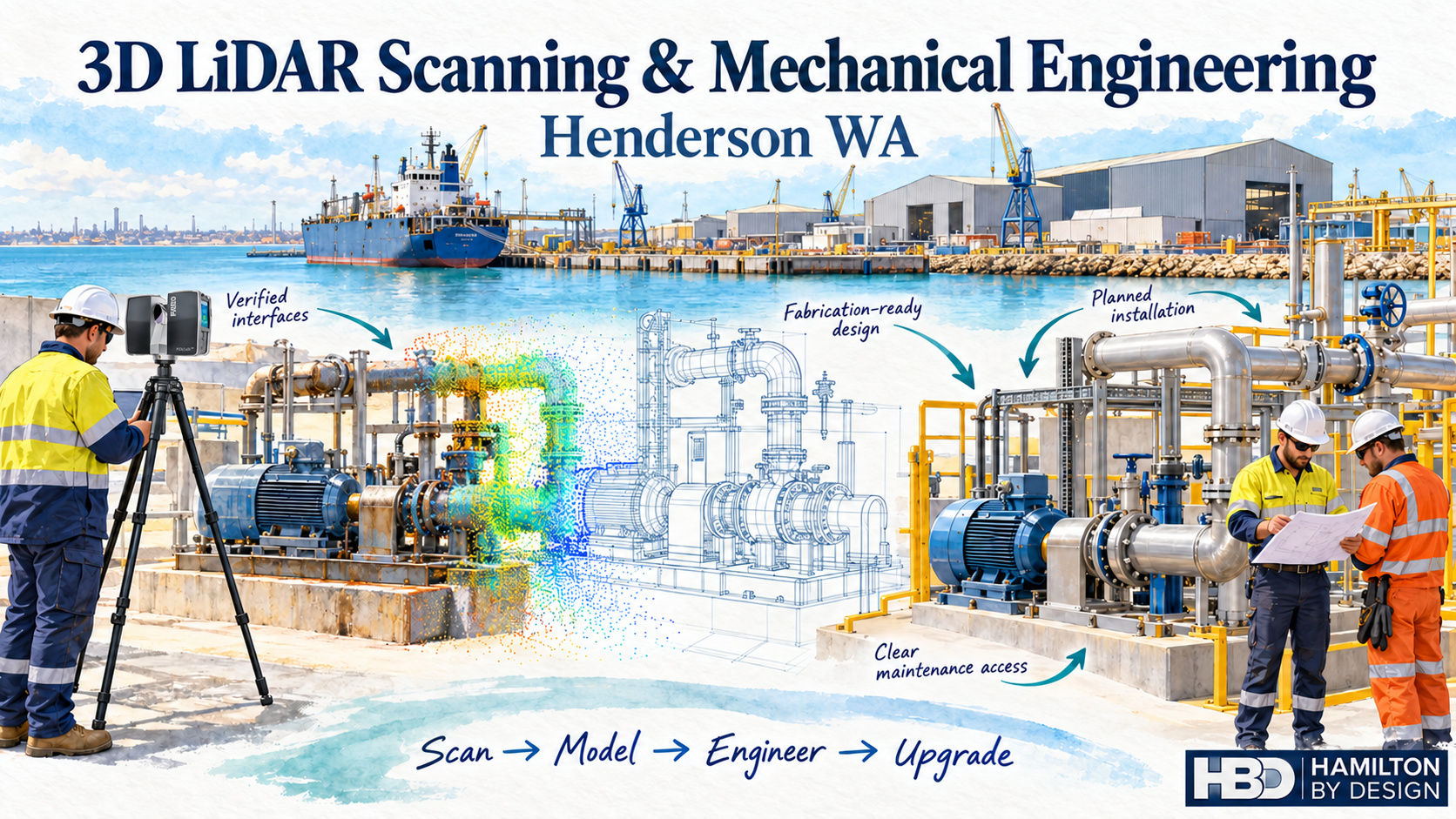
3D LiDAR Scanning and Mechanical Engineering Henderson WA

Illustration of FARO LiDAR scanning, point cloud modelling and a pump installation at a Henderson WA shipyard, with the Hamilton By Design logo.

Practical engineering for marine facilities, fabrication workshops and industrial plant

Blue 3D LiDAR scanner icon on a tripod with scanning waves

Hamilton By Design provides 3D LiDAR scanning and mechanical engineering support in Henderson, Western Australia, helping businesses capture existing equipment, develop CAD models and plan modifications before fabrication begins.

Our approach connects site measurement with mechanical design. Whether you are replacing a pump skid, modifying workshop equipment or planning a new installation within an existing facility, we help turn site conditions into usable engineering information.

Scan โ†’ Model โ†’ Engineer โ†’ Upgrade

Supporting Hendersonโ€™s marine and industrial precinct

Henderson is home to the Australian Marine Complex, a major precinct supporting manufacturing, fabrication, assembly and maintenance for the marine, defence, energy and resources industries. These activities create a strong need for reliable information about existing equipment and installation spaces.

For businesses working in these environments, an equipment upgrade often involves more than designing a new component. The design must also consider surrounding pipework, access routes, maintenance space and connections to existing assets.

Older drawings may not reflect modifications made during years of operation. A bracket may have moved, a pipe route may have changed, or additional equipment may now occupy the intended installation area.

3D LiDAR scanning helps establish what exists before decisions are made about what comes next.

3D LiDAR scanning for existing facilities and equipment

Laser scanning captures visible surfaces as a three-dimensional point cloud. This provides a spatial reference that can be reviewed during layout planning, modelling and design.

For a Henderson project, the scanning scope could include:

  • Workshop interiors and machinery layouts.
  • Pump installations and mechanical equipment packages.
  • Existing pipework routes and connection areas.
  • Fabricated assemblies and equipment interfaces.
  • Platforms, access areas and maintenance clearances.
  • Machinery foundations and surrounding installation space.
  • Selected vessel machinery spaces, subject to access and project requirements.

The scan coverage is planned around the engineering task. A replacement equipment package may require detailed capture of a small installation area, while a workshop reconfiguration may require a broader record of the facility.

Capturing the relevant surroundings early helps identify constraints that could otherwise emerge during installation.

Mechanical engineering that uses the scan data

A point cloud becomes more useful when it informs a practical engineering decision.

Hamilton By Design combines LiDAR scanning with mechanical design, CAD modelling and drafting to support equipment modifications, brownfield upgrades and fabrication documentation.

For Henderson businesses, this approach can support:

  • Pump skid layouts and equipment integration.
  • Mechanical brackets, mounts and fabricated assemblies.
  • Conveyor and materials handling modifications.
  • Machine guarding and maintenance access improvements.
  • Replacement component modelling.
  • General arrangement and fabrication drawings.
  • Coordination of mechanical equipment with surrounding services.

The aim is to understand both the equipment and its working environment. A component may fit within the available footprint but still obstruct maintenance access, interfere with nearby pipework or be difficult to install.

Considering these issues during design gives the workshop and installation team clearer information before work begins.

Marine equipment upgrades and machinery space planning

Marine refits and equipment replacements can involve confined spaces, complex arrangements and limited installation access.

A new pump, auxiliary unit or mechanical package may need to fit around existing services while retaining access for operation and maintenance.

A scan-informed design review can help assess:

  • Available space around the proposed equipment.
  • Connections to existing mechanical systems.
  • Installation and removal routes.
  • Access to serviceable components.
  • Interference with surrounding equipment.
  • Areas requiring further inspection or measurement.

For example, replacing a pump package could involve scanning the existing installation, modelling the proposed equipment and reviewing the arrangement before preparing modification drawings.

The project scope should identify any vessel-specific design approvals or specialist reviews required.

Scan-to-CAD for fabrication and installation

Scan-to-CAD converts selected information from the point cloud into CAD geometry that can be used for design and documentation.

The level of modelling depends on the project. An equipment layout may need simplified representations of surrounding assets, while a replacement assembly may require detailed geometry at its connection points.

Potential deliverables include:

  • Existing-condition CAD models.
  • Proposed equipment layouts.
  • General arrangement drawings.
  • Mechanical fabrication drawings.
  • Installation interface details.
  • Point cloud datasets for coordination.
  • Updated drawings reflecting the agreed scope.

Agreeing the deliverables at the start helps ensure the model contains the information needed by the people designing, fabricating and installing the equipment.

Reverse engineering when drawings are missing

When an existing component has no reliable drawing, reverse engineering can help establish a basis for replacement or modification.

Typical applications include guards, brackets, covers, housings and fabricated mechanical assemblies.

The measurement method must suit the component. Terrestrial LiDAR is useful for larger equipment and its surroundings. Small features, machined fits and tight tolerances may require handheld metrology scanning, direct measurement or additional inspection.

A worn part also needs careful interpretation. Its current shape may differ from the intended design, so reproducing the measured geometry alone may reproduce wear or damage.

The objective is a usable replacement design supported by appropriate measurements.

Plan upgrades before the shutdown begins

For operating facilities, preparation can make a substantial difference to installation planning.

Capturing existing conditions before a shutdown allows the project team to review proposed layouts, identify uncertain interfaces and prepare drawings while the equipment remains available for inspection.

Useful questions include:

  • Can the new assembly reach its installation position?
  • Is there enough space for tools and fastening?
  • Can maintenance personnel access the equipment afterwards?
  • Are nearby services likely to interfere?
  • Which dimensions need direct verification before fabrication?

Scanning provides a record of accessible, visible surfaces. Hidden connections and obstructed areas should be identified so that additional checks can be planned.

Our project approach

1. Define the engineering task

We establish what is being changed, the required outputs and the critical interfaces.

2. Capture existing conditions

Site scanning and supplementary measurements are planned around access, visibility and the required accuracy.

3. Develop the model and design

Relevant existing geometry is modelled and used to develop the proposed mechanical arrangement.

4. Review the installation

The design is reviewed for fit, access, maintainability and coordination with surrounding equipment.

5. Prepare the agreed documentation

CAD files and drawings are issued to support the agreed fabrication, installation or planning scope.

Frequently asked questions

Can you scan a workshop before new machinery is installed?

Yes. Scanning can provide an existing-condition reference for assessing machinery layouts, service connections, access routes and maintenance space.

Can LiDAR data be used in SolidWorks or AutoCAD workflows?

Yes. Point cloud information can be used as a reference for developing CAD models and drawings. The required file formats and modelling scope should be agreed before work starts.

Do we need to stop operations for scanning?

This depends on the site. Some areas may be captured during normal operations, while moving equipment, restricted access or isolation requirements may require a planned shutdown or controlled access period.

Can scanning guarantee that a fabricated assembly will fit?

Fit depends on the complete measurement, design and fabrication process. Critical interfaces require appropriate verification, particularly where surfaces are hidden or tolerances are tight.

Can you provide mechanical design as well as scanning?

Yes. Hamilton By Design can combine scanning, CAD modelling, mechanical design and drafting within an agreed project scope.

What information should we provide for a quotation?

Provide the site location, photographs, available drawings, equipment details, proposed modifications, access requirements and required delivery date. Identify any critical dimensions or installation constraints.

Discuss your Henderson project

Planning a workshop upgrade, equipment replacement or mechanical modification in Henderson?

Hamilton By Design can help capture existing conditions and develop practical engineering information for your next stage of work.

Send us your photographs, drawings and project requirements to discuss 3D LiDAR scanning and mechanical engineering support in Henderson WA.

[Explore our Perth 3D scanning

3D LiDAR Scanning and Mechanical Engineering Henderson WA

Practical engineering for marine facilities, fabrication workshops and industrial plant

Hamilton By Design provides 3D LiDAR scanning and mechanical engineering support in Henderson, Western Australia, helping businesses capture existing equipment, develop CAD models and plan modifications before fabrication begins.

Our approach connects site measurement with mechanical design. Whether you are replacing a pump skid, modifying workshop equipment or planning a new installation within an existing facility, we help turn site conditions into usable engineering information.

Scan โ†’ Model โ†’ Engineer โ†’ Upgrade

Supporting Hendersonโ€™s marine and industrial precinct

Henderson is home to the Australian Marine Complex, a major precinct supporting manufacturing, fabrication, assembly and maintenance for the marine, defence, energy and resources industries. These activities create a strong need for reliable information about existing equipment and installation spaces.

For businesses working in these environments, an equipment upgrade often involves more than designing a new component. The design must also consider surrounding pipework, access routes, maintenance space and connections to existing assets.

Older drawings may not reflect modifications made during years of operation. A bracket may have moved, a pipe route may have changed, or additional equipment may now occupy the intended installation area.

3D LiDAR scanning helps establish what exists before decisions are made about what comes next.

3D LiDAR scanning for existing facilities and equipment

Laser scanning captures visible surfaces as a three-dimensional point cloud. This provides a spatial reference that can be reviewed during layout planning, modelling and design.

For a Henderson project, the scanning scope could include:

  • Workshop interiors and machinery layouts.
  • Pump installations and mechanical equipment packages.
  • Existing pipework routes and connection areas.
  • Fabricated assemblies and equipment interfaces.
  • Platforms, access areas and maintenance clearances.
  • Machinery foundations and surrounding installation space.
  • Selected vessel machinery spaces, subject to access and project requirements.

The scan coverage is planned around the engineering task. A replacement equipment package may require detailed capture of a small installation area, while a workshop reconfiguration may require a broader record of the facility.

Capturing the relevant surroundings early helps identify constraints that could otherwise emerge during installation.

Mechanical engineering that uses the scan data

A point cloud becomes more useful when it informs a practical engineering decision.

Hamilton By Design combines LiDAR scanning with mechanical design, CAD modelling and drafting to support equipment modifications, brownfield upgrades and fabrication documentation.

For Henderson businesses, this approach can support:

  • Pump skid layouts and equipment integration.
  • Mechanical brackets, mounts and fabricated assemblies.
  • Conveyor and materials handling modifications.
  • Machine guarding and maintenance access improvements.
  • Replacement component modelling.
  • General arrangement and fabrication drawings.
  • Coordination of mechanical equipment with surrounding services.

The aim is to understand both the equipment and its working environment. A component may fit within the available footprint but still obstruct maintenance access, interfere with nearby pipework or be difficult to install.

Considering these issues during design gives the workshop and installation team clearer information before work begins.

Marine equipment upgrades and machinery space planning

Marine refits and equipment replacements can involve confined spaces, complex arrangements and limited installation access.

A new pump, auxiliary unit or mechanical package may need to fit around existing services while retaining access for operation and maintenance.

A scan-informed design review can help assess:

  • Available space around the proposed equipment.
  • Connections to existing mechanical systems.
  • Installation and removal routes.
  • Access to serviceable components.
  • Interference with surrounding equipment.
  • Areas requiring further inspection or measurement.

For example, replacing a pump package could involve scanning the existing installation, modelling the proposed equipment and reviewing the arrangement before preparing modification drawings.

The project scope should identify any vessel-specific design approvals or specialist reviews required.

Scan-to-CAD for fabrication and installation

Scan-to-CAD converts selected information from the point cloud into CAD geometry that can be used for design and documentation.

The level of modelling depends on the project. An equipment layout may need simplified representations of surrounding assets, while a replacement assembly may require detailed geometry at its connection points.

Potential deliverables include:

  • Existing-condition CAD models.
  • Proposed equipment layouts.
  • General arrangement drawings.
  • Mechanical fabrication drawings.
  • Installation interface details.
  • Point cloud datasets for coordination.
  • Updated drawings reflecting the agreed scope.

Agreeing the deliverables at the start helps ensure the model contains the information needed by the people designing, fabricating and installing the equipment.

Reverse engineering when drawings are missing

When an existing component has no reliable drawing, reverse engineering can help establish a basis for replacement or modification.

Typical applications include guards, brackets, covers, housings and fabricated mechanical assemblies.

The measurement method must suit the component. Terrestrial LiDAR is useful for larger equipment and its surroundings. Small features, machined fits and tight tolerances may require handheld metrology scanning, direct measurement or additional inspection.

A worn part also needs careful interpretation. Its current shape may differ from the intended design, so reproducing the measured geometry alone may reproduce wear or damage.

The objective is a usable replacement design supported by appropriate measurements.

Plan upgrades before the shutdown begins

For operating facilities, preparation can make a substantial difference to installation planning.

Capturing existing conditions before a shutdown allows the project team to review proposed layouts, identify uncertain interfaces and prepare drawings while the equipment remains available for inspection.

Useful questions include:

  • Can the new assembly reach its installation position?
  • Is there enough space for tools and fastening?
  • Can maintenance personnel access the equipment afterwards?
  • Are nearby services likely to interfere?
  • Which dimensions need direct verification before fabrication?

Scanning provides a record of accessible, visible surfaces. Hidden connections and obstructed areas should be identified so that additional checks can be planned.

Our project approach

1. Define the engineering task

We establish what is being changed, the required outputs and the critical interfaces.

2. Capture existing conditions

Site scanning and supplementary measurements are planned around access, visibility and the required accuracy.

3. Develop the model and design

Relevant existing geometry is modelled and used to develop the proposed mechanical arrangement.

4. Review the installation

The design is reviewed for fit, access, maintainability and coordination with surrounding equipment.

5. Prepare the agreed documentation

CAD files and drawings are issued to support the agreed fabrication, installation or planning scope.

Frequently asked questions

Can you scan a workshop before new machinery is installed?

Yes. Scanning can provide an existing-condition reference for assessing machinery layouts, service connections, access routes and maintenance space.

Can LiDAR data be used in SolidWorks or AutoCAD workflows?

Yes. Point cloud information can be used as a reference for developing CAD models and drawings. The required file formats and modelling scope should be agreed before work starts.

Do we need to stop operations for scanning?

This depends on the site. Some areas may be captured during normal operations, while moving equipment, restricted access or isolation requirements may require a planned shutdown or controlled access period.

Can scanning guarantee that a fabricated assembly will fit?

Fit depends on the complete measurement, design and fabrication process. Critical interfaces require appropriate verification, particularly where surfaces are hidden or tolerances are tight.

Can you provide mechanical design as well as scanning?

Yes. Hamilton By Design can combine scanning, CAD modelling, mechanical design and drafting within an agreed project scope.

What information should we provide for a quotation?

Provide the site location, photographs, available drawings, equipment details, proposed modifications, access requirements and required delivery date. Identify any critical dimensions or installation constraints.

Discuss your Henderson project

Planning a workshop upgrade, equipment replacement or mechanical modification in Henderson?

Hamilton By Design can help capture existing conditions and develop practical engineering information for your next stage of work.

Send us your photographs, drawings and project requirements to discuss 3D LiDAR scanning and mechanical engineering support in Henderson WA.


Hamilton By Design logo displayed on a blue tilted rectangle with a grey gradient background

Contact Us – Talk To Us

Name
Would you like us to arrange a phone consultation for you?
Address

Our clients:

Explore services supporting Henderson marine, fabrication and industrial projects, from existing-condition capture to CAD modelling and engineering documentation.























