Why Pump Skids Are Important in Mining Plants

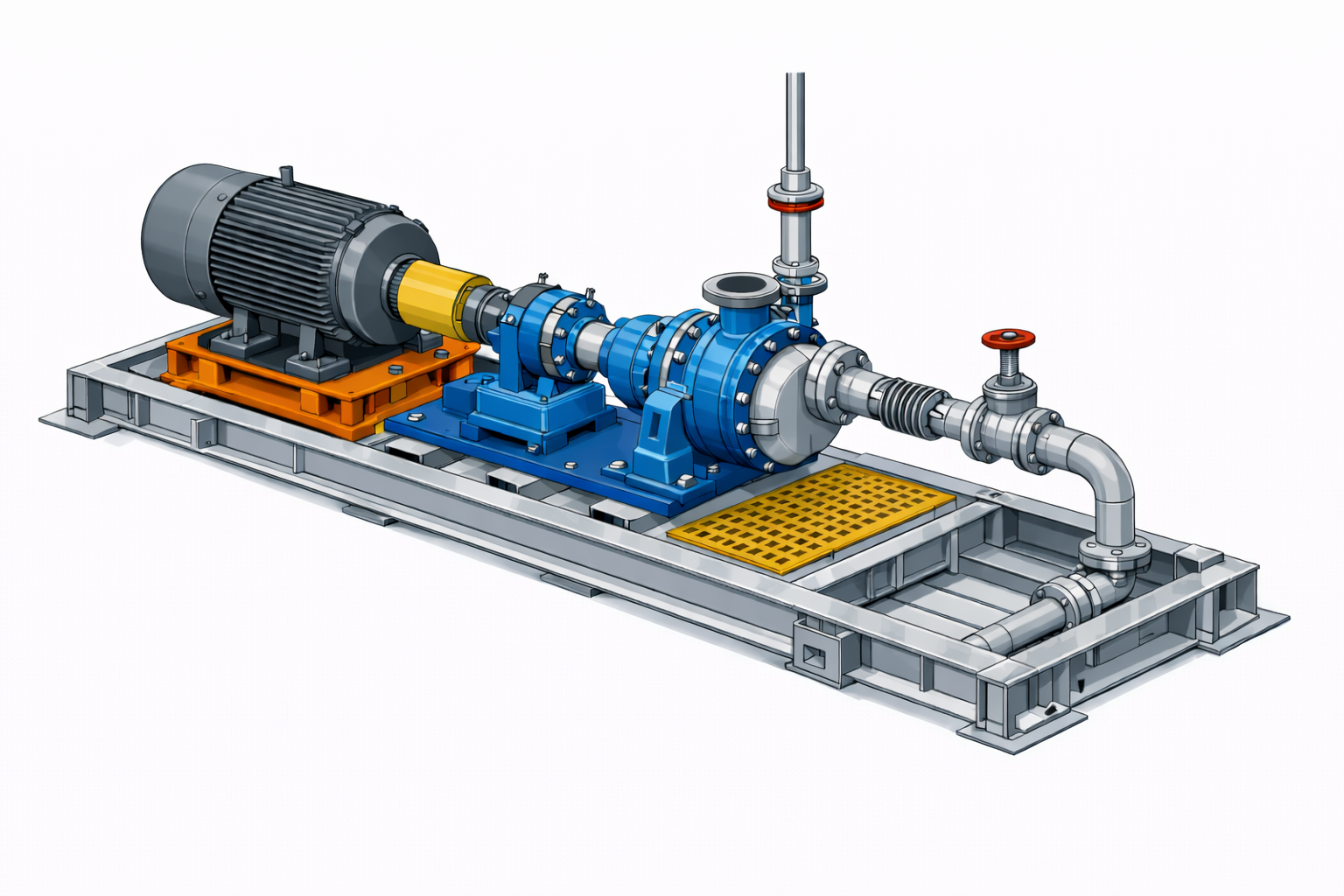
3D engineering model of a mining pump skid with motor, centrifugal pump, piping and structural skid frame

Pump systems are critical components in many mining operations. They are used to move slurry, process water, tailings, and chemicals throughout the plant.

To simplify installation and maintenance, engineers often package pumps and associated equipment into pump skids. A pump skid is a modular assembly that integrates the pump, motor, pipework, valves, instrumentation, and structural base into a single engineered unit.

Effective pump skid design in mining helps operations achieve:

  • faster installation
  • improved equipment reliability
  • easier maintenance access
  • reduced shutdown time

Because mining plants operate continuously, properly engineered pump skids are essential for maintaining plant reliability and operational efficiency.


What Is a Pump Skid?

A pump skid is a pre-engineered mechanical system mounted on a structural steel frame.

Typical components of a mining pump skid include:

  • centrifugal or slurry pump
  • electric motor or drive system
  • suction and discharge pipework
  • isolation and control valves
  • instrumentation and pressure gauges
  • base frame or skid structure

The entire assembly can be transported and installed as a single module, reducing site installation work.


Key Engineering Considerations in Pump Skid Design

Designing pump skids for mining environments requires careful attention to mechanical engineering principles, maintenance access, and operating conditions.

1. Structural Base Frame Design

The base frame must support the pump, motor, and piping loads while maintaining alignment.

Engineers design the skid structure to:

  • support dynamic loads from rotating equipment
  • minimise vibration
  • provide lifting points for transport and installation
  • ensure structural stability during operation

Structural stiffness is particularly important to maintain pump and motor alignment, which directly affects equipment life.


2. Pump and Motor Alignment

Misalignment between the pump and motor can cause:

  • excessive bearing wear
  • vibration issues
  • premature mechanical seal failure

During pump skid design, engineers consider:

  • mounting plate stiffness
  • adjustable motor bases
  • alignment tolerances
  • coupling selection

Accurate alignment is essential for ensuring long-term reliability of rotating equipment.


3. Pipework and Hydraulic Design

The suction and discharge pipework must be carefully designed to avoid performance issues.

Poor pipework design can lead to:

  • cavitation
  • pressure losses
  • vibration
  • premature pump wear

Engineering considerations include:

  • correct pipe sizing
  • smooth flow transitions
  • proper valve selection
  • adequate support for pipework loads

In slurry applications, pipe materials must also be selected to handle abrasive materials common in mining operations.


4. Maintenance Accessibility

Mining maintenance teams must be able to service pumps quickly, particularly during plant shutdowns.

Pump skid layouts should allow:

  • easy removal of pump components
  • access to motors and couplings
  • safe valve operation
  • space for lifting equipment

Maintenance accessibility is a major factor in reducing downtime during shutdown maintenance.


5. Integration With Existing Plant Infrastructure

In many mining facilities, new pump skids must be installed within existing processing plants.

Engineers often use 3D laser scanning and digital plant models to capture the existing environment and ensure the skid fits correctly within available space.

This digital approach helps engineers:

  • identify structural clashes
  • confirm installation clearances
  • verify pipe routing
  • reduce installation risk

More information about mining mechanical engineering design services can be found here:


Designing Pump Skids for Shutdown Installations

Many pump replacements or upgrades occur during planned shutdowns where installation time is limited.

Proper engineering preparation allows pump skid systems to be:

  • fabricated off-site
  • delivered as complete assemblies
  • installed quickly during shutdown windows

This approach significantly reduces the risk of delays during plant maintenance activities.

Learn more about engineering preparation for mining shutdowns here:


Using Digital Engineering to Reduce Installation Risk

Modern mining engineering increasingly relies on digital engineering models.

Using digital plant models allows engineers to:

  • position pump skids accurately within existing infrastructure
  • plan lifting and installation activities
  • verify piping connections before fabrication
  • minimise site modifications

This reduces uncertainty and ensures that equipment fits correctly during installation.

You can read more about this approach here:


Improving Reliability Through Good Equipment Design

Well-designed pump skids improve both equipment performance and plant maintainability.

By integrating mechanical, structural, and piping design into a single engineered assembly, mining operations benefit from:

  • faster equipment installation
  • simplified maintenance procedures
  • improved operational reliability

For mining operations seeking to upgrade plant equipment or install new pumping systems, engineered pump skid design provides a practical and reliable solution for modern processing plants.
Name
Would you like us to arrange a phone consultation for you?
Address
3D CAD Modelling Australia service banner for Hamilton By Design
CHPP Engineering title graphic featuring bold white text reading "CHPP Engineering" centred on a blue rounded rectangle background.
Pipework Drafting title graphic featuring bold white text reading "Pipework Drafting" centred on a blue rounded rectangle background.
3D LiDAR Scanning for Engineering Projects title graphic featuring bold white text on a blue rounded rectangle background.
Finite Element Analysis (FEA) engineering simulation button
Mechanical engineering services

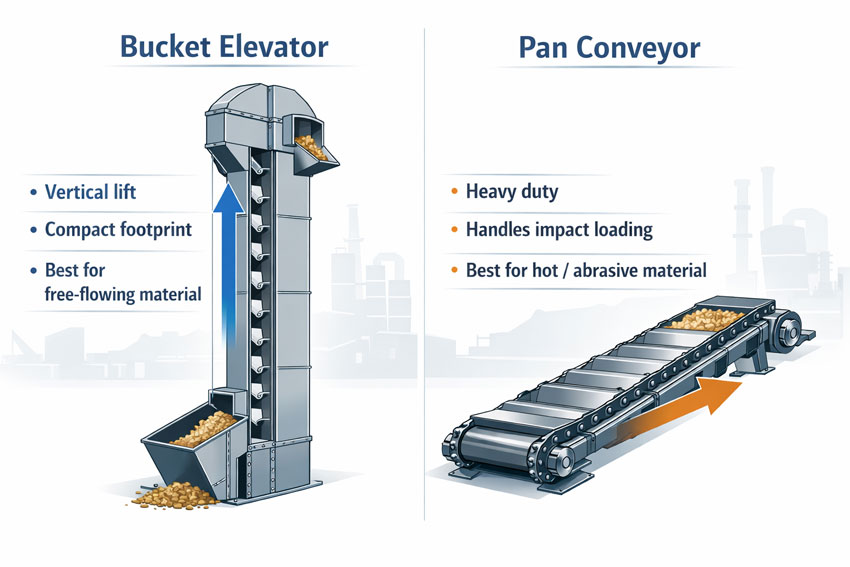
Designing Bucket Elevators vs Pan Conveyors in Industrial Material Handling

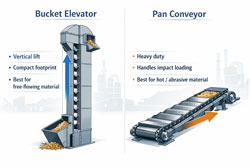
Engineering comparison diagram showing a bucket elevator lifting bulk material vertically and a pan conveyor transporting material horizontally.

Bucket Elevator vs Pan Conveyor Design | Industrial Material Handling Engineering

In bulk material handling industries such as mining, cement production, grain processing, and industrial manufacturing, selecting the right conveying system is critical to reliability, maintenance efficiency, and operating cost. Two commonly used systems are bucket elevators and pan conveyors. While both systems move bulk material efficiently, they are designed for very different operating conditions and material characteristics.

Understanding the difference between the two systems helps engineers select the correct solution for the application.


Bucket elevator vs pan conveyor industrial material handling comparison infographic.

What is a Bucket Elevator?

A bucket elevator is a vertical conveying system designed to lift bulk materials using a series of buckets attached to either a belt or chain. The buckets scoop material from the boot section and carry it upward to the discharge point.

Bucket elevators are widely used where material must be lifted vertically in a compact footprint.

Key Components

Buckets (steel, nylon, or HDPE)
Belt or chain drive
Boot section (material inlet)
Head section with drive and discharge
Casing or elevator trunking

Typical Applications

Grain handling
Fertiliser plants
Cement and lime processing
Mining concentrate handling
Sand, ash, or powder transport

Advantages

Efficient vertical lifting
Small plant footprint
High throughput capacity
Energy efficient for vertical transport

Limitations

Not ideal for very abrasive or large lump materials
Sensitive to overloading and blockages
Requires careful alignment and maintenance


What is a Pan Conveyor?

A pan conveyor, often called an apron conveyor, transports material horizontally or on shallow inclines using overlapping steel pans attached to heavy-duty chains.

The pans form a continuous moving surface that carries material along the conveyor frame.

Pan conveyors are commonly used in harsh industrial environments where materials are heavy, hot, or abrasive.

Key Components

Steel pans or plates
Heavy-duty conveyor chains
Sprockets and drive system
Conveyor frame
Impact loading zone

Typical Applications

Clinker transport in cement plants
Mining ore handling
Hot ash handling
Crusher discharge conveyors
Furnace feed systems

Advantages

Handles very heavy and abrasive materials
Suitable for impact loading
Reliable in harsh environments
Can operate at slow controlled speeds

Limitations

Larger footprint
Higher capital cost
More power consumption than bucket elevators


Key Differences Between Bucket Elevators and Pan Conveyors

Bucket Elevator
Vertical conveying system
Best for fine to medium bulk materials
Compact footprint
High energy efficiency for vertical transport
Requires controlled loading

Pan Conveyor
Horizontal or inclined conveying system
Handles heavy, abrasive or hot materials
Larger footprint
More robust construction
Handles high impact loading


When to Choose a Bucket Elevator

A bucket elevator is typically the preferred solution when:

Material must be lifted vertically
Plant space is limited
The material is free-flowing
Throughput is high but impact loading is low

Examples include grain silos, cement plants, fertiliser plants, and powder handling systems.

In these situations, bucket elevators provide a compact and energy-efficient solution.


When to Choose a Pan Conveyor

A pan conveyor is the better choice when:

Material is coarse, hot, or abrasive
There is high impact loading
The conveyor must operate continuously in harsh conditions
Reliability is more important than plant footprint

Examples include crusher discharge conveyors, furnace feed systems, clinker transport, and mining ore handling.

Pan conveyors are designed to survive the harshest bulk material handling environments.


Engineering Design Considerations

When designing either system, engineers must consider the following:

Bulk material characteristics
Lump size distribution
Abrasiveness
Moisture content
Throughput requirements
Loading conditions
Maintenance access
Structural support

Modern projects often integrate 3D laser scanning and point cloud modelling to ensure conveyors fit within existing plants and connect correctly to existing infrastructure. This approach reduces installation risk and helps engineers verify clearances, structural loads, and maintenance access before fabrication.

3D LiDAR scanning and 3D modelling service button โ€” laser scanner capturing a point cloud for engineering and CAD modelling
Mechanical engineering services

Hamilton By Design logo displayed on a blue tilted rectangle with a grey gradient background

Engineering Support for Conveyor Design

Hamilton By Design supports industrial projects with:

Mechanical conveyor design
3D laser scanning of existing plants
Conveyor chute and transfer design
Structural steel and support frames
Inspection and maintenance optimisation

Whether designing a bucket elevator for vertical material handling or a heavy-duty pan conveyor for mining operations, selecting the correct system is critical to long-term reliability and operational efficiency.


Name
Would you like us to arrange a phone consultation for you?
Address
3D CAD Modelling Australia service banner for Hamilton By Design

3D Scanning Engineering in Parkes

3D Scanning in Parkes NSW

Parks (Parkes), NSW is one of Australiaโ€™s most strategically important inland engineering centres. Known globally for the Parkes Radio Telescope and nationally for its role as a freight, rail, and agricultural hub, engineering in Parks is driven by precision, logistics, and reliability. Projects here often support large catchment areas, seasonal peak demand, and long-distance supply chains โ€” which means there is little tolerance for rework or uncertainty.

Hamilton By Design supports Parks projects with engineering-led 3D LiDAR laser scanning, mechanical and structural engineering, 3D modelling, FEA, and easy-to-build fabrication drawings, helping clients move from site data to construction with confidence.


Engineering in Parks: Precision Meets Logistics

Engineering in Parks is shaped by several unique factors:

  • National-scale scientific and communications infrastructure
  • Inland rail, intermodal freight, and bulk logistics
  • Grain handling, storage, and agricultural processing
  • Emerging industrial development through the Special Activation Precinct

These environments demand engineering solutions that are accurate, robust, and practical, especially where assets operate continuously or are difficult to access once installed.


3D Laser Scanning for Parks Projects

Accurate 3D LiDAR laser scanning is the foundation of successful engineering in Parks.

Hamilton By Design captures high-resolution as-built data for:

  • Rail and logistics infrastructure
  • Grain silos, conveyors, and bulk-handling systems
  • Industrial buildings and plant
  • Existing assets with limited or outdated drawings

3D scanning records the true geometry of assets โ€” including misalignment, deflection, settlement, and undocumented modifications. This is critical in Parks, where infrastructure is often upgraded in stages and must remain operational during works.

The result is fewer assumptions, fewer site visits, and reduced construction risk.

Learn more here:
3D Laser Scanning


3D Modelling from Real As-Built Conditions

From the point cloud, Hamilton By Design develops accurate 3D CAD models that reflect what is actually on site.

Our 3D modelling services support:

  • Brownfield upgrades and capacity increases
  • Clash detection around existing services and structures
  • Modular and transportable designs
  • Fabrication planning and installation sequencing
  • Long-term digital asset records

For Parks projects โ€” where components are often fabricated offsite and installed under tight timeframes โ€” modelling from real data significantly improves build confidence.

Explore our modelling capability:
3D CAD Modelling


FEA to Verify Performance and Reliability

Many assets in Parks operate under high cyclic loading, seasonal peaks, and demanding inland conditions. Finite Element Analysis (FEA) is used to confirm performance and guide upgrade decisions.

Hamilton By Design applies FEA to:

  • Verify structural capacity of existing assets
  • Assess fatigue, stress concentrations, and deflection
  • Check modifications to silos, frames, and handling systems
  • Support strengthening and life-extension strategies

By analysing as-built geometry, FEA results are more representative of real behaviour โ€” critical for assets that must operate reliably during harvest and freight peaks.

Learn more about our analysis services:
FEA Capabilities


Easy-to-Build Fabrication and Installation Drawings

Clear, practical documentation is essential for regional projects where fabrication and installation teams rely on drawings to get the job done efficiently.

Hamilton By Design produces easy-to-build fabrication drawings, including:

  • General arrangement drawings
  • Fabrication and workshop details
  • Installation and lifting layouts
  • As-built documentation

Because drawings are developed directly from scanned data and validated 3D models, they align closely with site reality, reduce ambiguity, and minimise rework.

View our drafting services here:
Drafting Services


Hamilton By Design logo displayed on a blue tilted rectangle with a grey gradient background
3D LiDAR scanning and 3D modelling service button โ€” laser scanner capturing a point cloud for engineering and CAD modelling
Mechanical engineering services

Why Hamilton By Design in Parks?

Hamilton By Design provides an integrated digital engineering workflow โ€” from site capture through to modelling, analysis, and construction documentation.

For Parks clients, this means:

  • Fewer assumptions in complex logistics environments
  • Reduced risk during upgrades and expansions
  • Designs that suit inland conditions and heavy utilisation
  • Fabrication-ready drawings that support efficient construction

Whether you are upgrading grain infrastructure, expanding logistics facilities, or modifying existing industrial assets, Hamilton By Design delivers practical, build-ready engineering solutions tailored to the unique demands of Parks, NSW.

If youโ€™re planning a project in Parks, weโ€™re ready to help โ€” starting with accurate data and carrying it through to construction-ready outcomes.

Our clients

Name
Would you like us to arrange a phone consultation for you?
Address

3D CAD Modelling Australia service banner for Hamilton By Design


CHPP Engineering title graphic featuring bold white text reading "CHPP Engineering" centred on a blue rounded rectangle background.
Pipework Drafting title graphic featuring bold white text reading "Pipework Drafting" centred on a blue rounded rectangle background.
3D LiDAR Scanning for Engineering Projects title graphic featuring bold white text on a blue rounded rectangle background.


Finite Element Analysis (FEA) engineering simulation button
Structural drafting services button
Mechanical drafting services button


Australian Drafting logo featuring bold white text reading "Australian Drafting" centred on a blue rounded rectangle background.
Engineering Governance title graphic featuring bold white text reading "Engineering Governance" centred on a blue rounded rectangle background.
Engineering-Grade LiDAR Scanning title graphic featuring bold white text on a blue rounded rectangle background.


Mechanical drafting services button
Structural drafting services button


Fabrication and product design services
3D CAD Modelling Australia service banner for Hamilton By Design
Mechanical, Structural & Pipework Drafting service banner by Hamilton By Design featuring white text on a blue background.


3D LiDAR scanning and 3D modelling service button โ€” laser scanner capturing a point cloud for engineering and CAD modelling
Mechanical engineering services

The Importance of AS 3990 in Mechanical Equipment Steelwork

In the world of engineering, adhering to standards is more than just a formality; itโ€™s a fundamental aspect of ensuring safety, reliability, and efficiency. One such critical standard is AS 3990, “Mechanical Equipment โ€“ Steelwork.” This guideline plays a vital role in the design and construction of steel structures for mechanical systems, providing the framework for materials selection, construction practices, and stress analysis. Ignoring AS 3990 can lead to a host of issues, from structural failures to safety hazards, yet itโ€™s a challenge that some organizations still face. By contrast, companies like Hamilton By Design have built a reputation for excellence by consistently applying these standards in their projects, ensuring optimal outcomes for their clients.

The Risks of Ignoring AS 3990

One of the most alarming consequences of bypassing AS 3990 is the heightened risk of structural failure. Mechanical equipment steelwork is often subjected to extreme stresses and environmental conditions, and without proper design parameters, the results can be catastrophic. Whether itโ€™s the collapse of a support structure or the malfunction of a mechanical component, the costโ€”both human and financialโ€”is often irreparable.

In addition to physical failures, neglecting AS 3990 invites a host of compliance and legal issues. Regulatory bodies across industries mandate adherence to such standards to protect workers and ensure operational safety. Non-compliance can lead to fines, project delays, or even legal action, tarnishing the reputation of those involved.ย 


The impact doesnโ€™t stop there. Poorly designed steelwork can suffer from premature wear and fatigue, significantly reducing the lifespan of the equipment. This leads to frequent maintenance, unplanned downtime, and increased costsโ€”a scenario no company wants to face. Moreover, these recurring issues not only affect the bottom line but also compromise the safety of workers, posing risks of injury or fatality. Finally, the reputational damage from delivering substandard systems can be devastating, as it erodes client trust and tarnishes an organizationโ€™s standing in the industry.

Hamilton By Design: A Commitment to Excellence

Faced with these potential pitfalls, an engineering company like Hamilton By Design offers a reassuring solution. With extensive experience in mechanical design and steelwork, they prioritize adherence to AS 3990 in every project. This commitment translates into tangible benefits for their clients and sets them apart in the industry.

Hamilton By Design approaches every project with structural integrity at the forefront. By leveraging advanced modeling tools and stress analysis techniques, they ensure that every design adheres to the stringent guidelines of AS 3990. Their expertise spans diverse industries, enabling them to tailor solutions that are both robust and reliable.

Compliance is another area where Hamilton By Design excels. The team stays up-to-date with the latest iterations of AS 3990, incorporating these requirements seamlessly into their work. This not only streamlines the approval process but also gives clients the confidence that their projects meet all necessary regulatory standards.

Material selection and durability are cornerstones of the companyโ€™s design philosophy. By carefully analyzing the operational stresses and environmental factors that each structure will face, Hamilton By Design creates systems that are built to last. This focus on longevity reduces the need for maintenance and ensures uninterrupted performance, saving clients time and money.

Safety is non-negotiable for Hamilton By Design. Every project undergoes rigorous risk assessments to identify and mitigate potential hazards. By adhering to AS 3990โ€™s safety protocols, the company not only protects workers but also fosters a culture of trust and reliability.

The Advantages of AS 3990 Compliance

The advantages of working with engineers who consult AS 3990 are clear. First and foremost, it ensures structural reliability. Steelwork designed under this standard can handle expected loads and stresses with ease, delivering dependable performance across a range of applications. For Hamilton By Design, this translates into designs that consistently exceed client expectations.

Regulatory compliance is another significant benefit. Projects that adhere to AS 3990 face fewer hurdles during inspections, avoiding costly delays and potential penalties. Hamilton By Designโ€™s meticulous approach to compliance ensures smooth project execution, freeing clients to focus on their core objectives.

Optimized design is yet another hallmark of AS 3990. By balancing safety, functionality, and cost-efficiency, the standard empowers engineers to deliver solutions that are both practical and innovative. Hamilton By Design takes this a step further by using advanced tools and methodologies to craft designs that align perfectly with their clientsโ€™ operational goals.

Safety, of course, remains a top priority. AS 3990 includes comprehensive guidelines for risk minimization, creating a safer environment for workers and operators. Hamilton By Designโ€™s adherence to these principles underscores their commitment to safeguarding everyone involved in their projects.

Cost savings and increased equipment lifespan are additional advantages of compliance. Properly designed steelwork not only reduces maintenance needs but also enhances durability, maximizing the return on investment for clients. For Hamilton By Design, these outcomes are the natural result of their dedication to quality and precision.

Real-World Applications

Hamilton By Designโ€™s expertise in applying AS 3990 is evident in their extensive portfolio. For instance, in a mining project involving heavy conveyor systems, the company used AS 3990 to identify critical stress points and optimize the design for dynamic loads. The result was a durable support structure that minimized maintenance and exceeded client expectations.

Similarly, in an industrial manufacturing facility, Hamilton By Design tackled the challenge of custom steelwork for robotic assembly lines. By adhering to AS 3990, they ensured that the structures could withstand repetitive stresses and environmental factors, enhancing both safety and efficiency.

Their experience extends to renewable energy projects as well. In designing steel frameworks for wind turbine foundations, Hamilton By Design accounted for wind loads, fatigue stresses, and environmental conditions, delivering solutions that met stringent safety and performance requirements.

Conclusion

Ignoring AS 3990 is a risk no company should take. The challengesโ€”from structural failures and compliance issues to safety hazards and reputational damageโ€”are simply too great. By contrast, working with experienced engineers who prioritize this standard offers a host of benefits, from enhanced reliability and safety to cost savings and competitive advantage.

Hamilton By Design exemplifies the best practices in applying AS 3990, turning potential challenges into opportunities for innovation and excellence. Their commitment to quality, compliance, and client satisfaction ensures that every project not only meets but exceeds industry standards. For organizations seeking dependable, high-performing mechanical equipment steelwork, Hamilton By Design is the partner of choice.

For More information contact Hamilton By Design – Email info@hamiltonbydesign.com.au

3D LiDAR scanning and 3D modelling service button โ€” laser scanner capturing a point cloud for engineering and CAD modelling
Mechanical engineering services

Our Clients:

Name
Would you like us to arrange a phone consultation for you?
Address

3D CAD in Sydney

3D Construction Scan in Sydney

https://www.hamiltonbydesign.com.au/home/engineering-services/3d-laser-scanning/3d-scanning-sydney/3d-point-cloud-modelling-in-sydney/

3D LiDAR Laser Scanning & Drafting Services in Chatswood & Greater Sydney

Finite Element Analysis (FEA) engineering simulation button
Mechanical engineering services