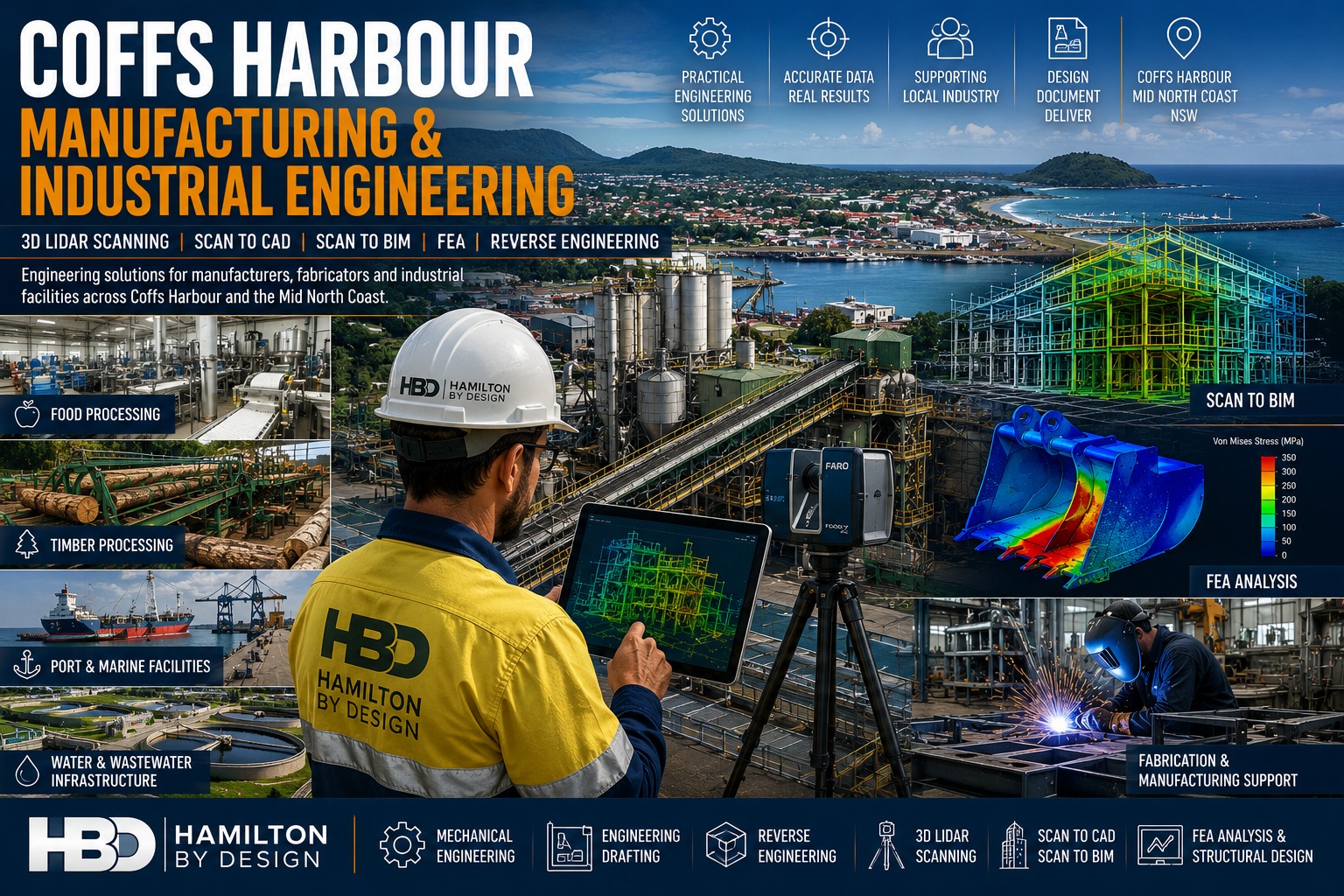
Coffs Harbour Manufacturing & Industrial Engineering

Coffs Harbour manufacturing and industrial engineering services featuring 3D LiDAR scanning, Scan to BIM, FEA analysis, food processing facilities, timber processing plants, marine infrastructure and fabrication workshops.

Coffs Harbour Manufacturing & Industrial Engineering

Engineering Solutions for Manufacturers, Fabricators & Industrial Facilities Across the Coffs Coast

Hamilton By Design provides engineering-led mechanical engineering, 3D LiDAR scanning, Scan to CAD, Scan to BIM, reverse engineering, finite element analysis (FEA) and engineering drafting services throughout Coffs Harbour, Toormina, Sawtell, Woolgoolga, Grafton and the wider North Coast region.

Coffs Harbour is one of regional New South Wales’ most diverse industrial centres, supporting manufacturing, food processing, timber processing, transport infrastructure, marine industries, water utilities and industrial facilities.

As facilities expand and equipment ages, accurate engineering information becomes critical for reducing project risk, improving asset reliability and supporting future growth.

Hamilton By Design helps manufacturers, engineers, fabricators and industrial asset owners capture existing conditions, develop accurate engineering models and deliver practical engineering solutions for both brownfield and greenfield projects.


Engineering Services for Manufacturing & Industry

Supporting Regional Industry Growth

Our services support:

  • Manufacturers
  • Fabricators
  • Timber Processing Facilities
  • Food Processing Plants
  • Water Utilities
  • Industrial Workshops
  • Logistics Facilities
  • Airport Infrastructure
  • Marine Facilities
  • Government Infrastructure

Services include:

  • Mechanical Engineering
  • Engineering Design
  • Reverse Engineering
  • Engineering Drafting
  • FEA Analysis
  • 3D LiDAR Scanning
  • Scan to CAD
  • Scan to BIM
  • Asset Documentation

3D LiDAR Scanning Coffs Harbour

Engineering Grade Reality Capture

Hamilton By Design provides engineering-grade terrestrial laser scanning services throughout Coffs Harbour and Northern NSW.

Laser scanning captures highly accurate site information that can be used for:

  • Existing Condition Surveys
  • Industrial Plant Upgrades
  • Manufacturing Facility Modifications
  • Structural Steel Modelling
  • Pipework Modelling
  • Asset Management
  • Construction Verification

Applications include:

Food Processing Facilities

Capture production equipment, processing lines, conveyors and services prior to upgrades and expansions.

Timber Processing Facilities

Accurately model sawmills, conveyors, log handling systems and timber processing infrastructure.

Industrial Manufacturing Facilities

Document existing plant conditions for engineering design and construction planning.


Sawmill & Timber Processing Engineering

Supporting Brownfield Upgrades

The North Coast has a strong timber processing industry with facilities often containing decades of modifications and undocumented changes.

Hamilton By Design supports:

  • Sawmill Expansions
  • Conveyor Upgrades
  • Dust Extraction Systems
  • Structural Modifications
  • Equipment Replacements
  • Facility Modernisation Projects

Using 3D LiDAR scanning and engineering modelling, we help reduce project risk and improve fabrication accuracy.


Scan to BIM Services

Building Information Modelling for Existing Assets

Hamilton By Design develops BIM models from laser scan data for:

  • Buildings
  • Manufacturing Facilities
  • Industrial Plants
  • Water Infrastructure
  • Utilities
  • Government Assets
  • Airport Infrastructure
  • Processing Facilities

Benefits include:

  • Improved project coordination
  • Reduced design clashes
  • Better asset management
  • Digital Twin Development
  • Enhanced project planning

Finite Element Analysis (FEA)

Engineering Validation Before Fabrication

Hamilton By Design provides FEA services for:

Loader Buckets

  • Wear analysis
  • Structural assessment
  • Reinforcement design

Excavator Buckets

  • Impact load analysis
  • Structural integrity reviews

Grader Blades

  • Ground engagement loading
  • Structural performance verification

Chutes & Hoppers

  • Material loading analysis
  • Wear zone identification
  • Structural optimisation

Industrial Structures

  • Platforms
  • Walkways
  • Support frames
  • Access systems

Reverse Engineering Services

When drawings are unavailable or outdated, reverse engineering allows valuable engineering information to be recovered.

Applications include:

  • Pumps
  • Shafts
  • Castings
  • Conveyor Components
  • Machine Components
  • Structural Assemblies
  • Wear Parts

Deliverables include:

  • SolidWorks Models
  • STEP Files
  • SAT Files
  • Manufacturing Drawings
  • Fabrication Documentation

Why Choose Hamilton By Design?

Engineering-Led Solutions

We understand how engineering information is used throughout the project lifecycle.

Practical Industry Experience

Supporting:

  • Manufacturing
  • Timber Processing
  • Food Processing
  • Utilities
  • Infrastructure
  • Industrial Facilities

Advanced Technology

Using:

  • FARO Focus Laser Scanners
  • FARO Orbis
  • FARO SCENE
  • SolidWorks
  • ANSYS
  • Autodesk Inventor
  • AutoCAD
  • Navisworks

Regional NSW Support

Providing engineering services throughout:

  • Coffs Harbour
  • Sawtell
  • Toormina
  • Woolgoolga
  • Grafton
  • Port Macquarie
  • Kempsey
  • Northern NSW
Hamilton By Design logo displayed on a blue tilted rectangle with a grey gradient background

Talk to Us – Contact Us

Name
Would you like us to arrange a phone consultation for you?
Address

Our clients:
3D LiDAR Scanning Darwin for engineering surveys, laser scanning, reality capture and point cloud modelling services
3D LiDAR Scanning Australia engineering services for laser scanning, reality capture, scan-to-CAD, Scan-to-BIM and as-built documentation across Australia
3D LiDAR scanning services on the Central Coast providing engineering-grade laser scanning, point cloud capture, scan-to-CAD modelling and industrial reality capture for infrastructure and industrial projects.

AI Needs a Body โ€“ Why Point Cloud Data Powers the Next Generation of Engineering

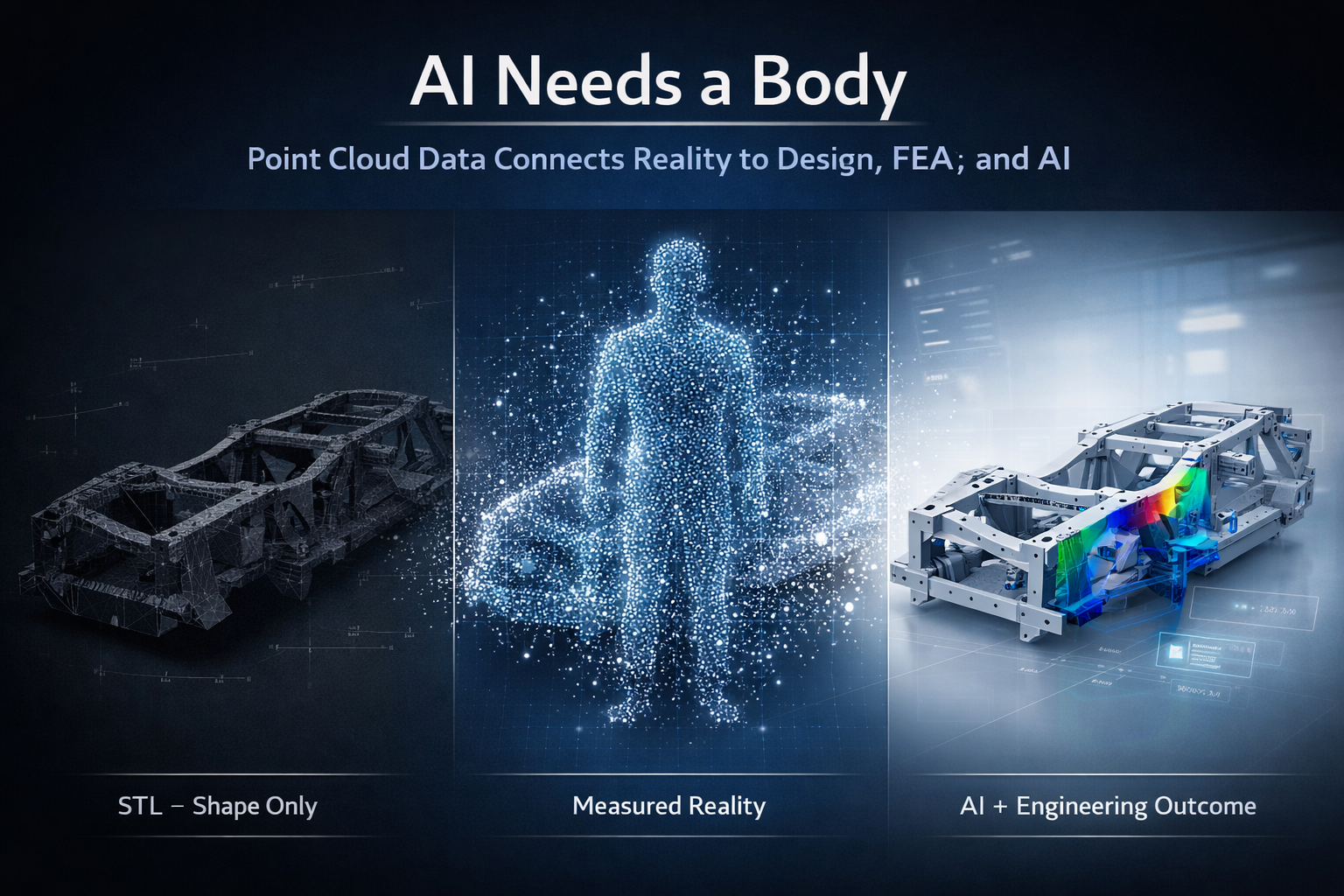
AI needs a body concept showing STL mesh, point cloud data, and CAD model with FEA for engineering workflow

Engineering is entering a new phase.

Artificial intelligence is being integrated into design platforms, automation is accelerating workflows, and digital engineering environments are becoming more connected than ever before. Tools such as SolidWorks are now introducing AI assistants like AURA, LEO, and Marie, promising smarter design, faster modelling, and improved decision-making.

But there is a fundamental issue that is often overlooked:

AI cannot design, validate, or optimise anything without a physical reference.

AI needs a body.

And in engineering, that body is real-world, measurable data.

3D point cloud scanning provides that foundation.


3D LiDAR scanning and 3D modelling service button โ€” laser scanner capturing a point cloud for engineering and CAD modelling
Mechanical engineering services

Gen 1, Gen 2, Gen 3 โ€“ The Evolution of Engineering

Engineering workflows can be broadly understood in three stages: Gen 1, Gen 2, and Gen 3.

Gen 1 was manual. Tape measures, site sketches, and experience-driven decisions formed the basis of design. While effective for its time, it relied heavily on interpretation and often resulted in rework due to incomplete data.

Gen 2 introduced CAD platforms such as SolidWorks, Autodesk Inventor, Autodesk Fusion, and Onshape. This enabled parametric modelling, faster iteration, and improved documentation. However, Gen 2 introduced a new problemโ€”designs were often disconnected from reality. Models were built based on assumptions, outdated drawings, or incomplete site data.

Even when scanning was introduced, the workflow often stopped at STL or OBJ files. These formats are visual representations only. They are static, faceted, and lack the structure required for engineering.

Gen 3 represents the shift to reality-based engineering. This is where point cloud scanning, CAD, FEA, AI, and lifecycle management systems all connect. The key difference is that models are no longer based on assumptionsโ€”they are derived from measured reality.


The Problem With STL Workflows

STL files are commonly produced by handheld or metrology-grade scanners. They are easy to generate and provide a visually accurate representation of a component.

However, an STL file is a triangulated mesh. It contains no features, no relationships, and no design intent. It is a surface approximation made up of flat facets.

This creates a major limitation.

An STL file can show what something looks like, but it cannot define how it functions, how it should be modified, or how it should be manufactured.


Why FEA on STL Is Not Best Practice

It is technically possible to run Finite Element Analysis (FEA) on an STL file, but it is not considered best practice.

The reasons are straightforward.

The geometry is not true. Surfaces are faceted, holes are not perfect circles, and edges are broken into triangles. This makes it difficult to apply loads and boundary conditions accurately.

Because the STL is already a mesh, FEA introduces a second mesh on top of it. This reduces control over element quality and can affect convergence and accuracy.

Most importantly, the results are based on an approximation rather than engineered geometry.

You are analysing a surface representation, not a design.

For engineering decisions, this creates risk. Results become difficult to verify, defend, or repeat.


AI Has the Same Limitation

AI assistants such as AURA, LEO, and Marie are designed to work inside CAD environments. They rely on structured, parametric data to assist with modelling, optimisation, and decision-making.

They are highly effective when working with:

  • Defined features
  • Parametric relationships
  • Clean geometry

But when given an STL file, AI faces the same problem as the engineer.

There are no features to interpret, no constraints to follow, and no design intent to understand. The data is simply a collection of triangles.

As a result:

AI cannot meaningfully design or optimise from an STL file.

It can attempt to approximate geometry, but it cannot guarantee accuracy, intent, or engineering reliability.


AI Needs a Body

AI is often described as the brain of the future engineering workflow.

But a brain alone is not enough.

Without a body:

  • There is no spatial context
  • No physical reference
  • No connection to reality

In engineering, the body is the physical asset captured in digital form.

This is where point cloud scanning becomes critical.


Point Cloud โ€“ The Body for Engineering and AI

Point cloud data captures millions of measured points in three-dimensional space. Each point represents a real-world coordinate.

This provides:

  • True geometry
  • Accurate spatial relationships
  • Complete environmental context

Unlike STL files, point clouds are not simplified or interpreted. They represent measured reality.

From this data, engineers can:

  • Extract accurate dimensions
  • Fit planes, cylinders, and features
  • Build parametric CAD models
  • Maintain traceability back to the original scan

This creates a reliable foundation for both engineering and AI.


The Correct Engineering Workflow

A robust, engineering-grade workflow follows a clear sequence:

Scan โ†’ Point Cloud โ†’ CAD Model โ†’ FEA โ†’ AI โ†’ Engineering Outcome

Each step adds value.

The scan captures reality.
The point cloud preserves it.
The CAD model structures it.
FEA validates it.
AI enhances it.

Without the point cloud, the entire process loses its connection to reality.


Vehicle Chassis Example

Consider the development or modification of a vehicle chassis.

Using an STL-based workflow, the process typically involves rebuilding geometry from a mesh, applying FEA to an approximation, and attempting to optimise the design without a reliable reference. This introduces risk in alignment, load paths, and final fitment.

Using a point cloud-based workflow, the chassis is scanned and modelled directly from measured data. FEA is applied to true geometry, and AI tools such as AURA, LEO, and Marie can assist in refining and optimising the design.

The result is accurate, repeatable, and ready for manufacturing.


Digital Twin, PLM, and the 3D Environment

Point cloud data also supports broader engineering systems, including Digital Mock-Up (DMU), Product Data Management (PDM), and Product Lifecycle Management (PLM).

These systems rely on a single source of truth.

Point cloud data provides that truth by ensuring alignment between the digital model and the physical asset.

This enables:

  • Lifecycle tracking
  • Design validation
  • Ongoing updates and modifications

It also supports Digital Twin environments, where the physical and digital worlds remain connected over time.


Manufacturing in Australia

For manufacturing, accuracy is critical.

Point cloud-driven workflows ensure that:

  • Components fit as intended
  • Drawings reflect real-world conditions
  • Rework is minimised
  • Fabrication is efficient

This is particularly important for local manufacturing in Australia, where precision and reliability directly impact cost and delivery.


The Bottom Line

It is not best practice to run FEA on an STL file. It is not effective to design from an STL file. And it is unrealistic to expect AI to compensate for poor input data.

STL files provide a visual reference, but they do not provide a foundation for engineering.

AI is a powerful tool, but it cannot operate without accurate, structured data.

AI cannot fix a workflow that starts with the wrong data.


Final Thought

Engineering is evolving.

Gen 1 was manual.
Gen 2 was digital.
Gen 3 is reality-based and AI-assisted.

AI is not the starting point. Data is.

And in modern engineering:

AI needs a body.
Point cloud scanning is that body.

Our Clients

Finite Element Analysis (FEA) engineering simulation button
Mechanical engineering services