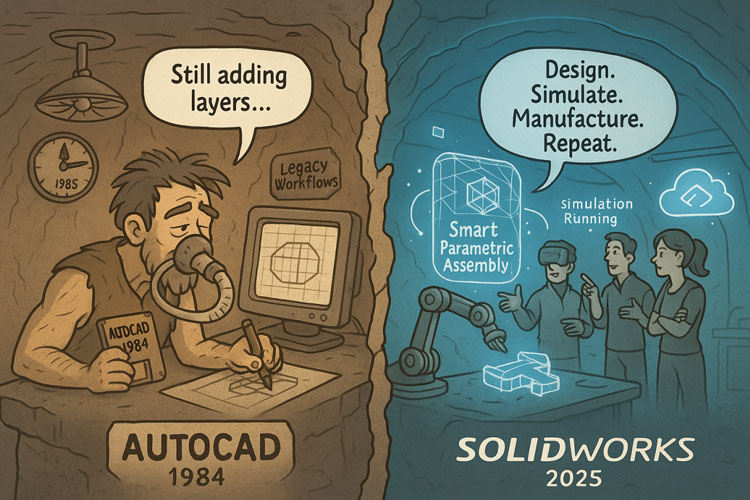
In the 1980s, AutoCAD was revolutionary. It replaced drafting boards and sharpened pencils with a digital drawing tool. Architects, engineers, and designers suddenly had a new way to bring ideas to life — faster, cleaner, and more accurate than ever before.
But here’s the problem: it’s 2025 now, and AutoCAD is still trying to breathe the same thin air it did back then.
Stuck in 2D While the World Moved On
Today’s engineering isn’t about drawing — it’s about designing. It’s about simulating real-world forces, visualizing assemblies, testing tolerances, and producing manufacturable parts before a single prototype is built.
AutoCAD, at its core, is still a 2D drafting platform trying to wear a 3D mask. The workflows are fragmented, the feature set feels patched together, and it lacks the intelligence modern teams demand.
By contrast, SOLIDWORKS was built for this century — fully parametric, model-driven, and collaborative. When you make a change to a design in SOLIDWORKS, every part, drawing, and assembly updates instantly. That’s not an upgrade; that’s evolution.
Design Needs Intelligence, Not Layers
AutoCAD still asks you to think in layers and lines — the language of draftsmen. SOLIDWORKS speaks the language of relationships, assemblies, and constraints — the language of engineers and innovators.
Modern design tools must integrate simulation, visualization, and manufacturability. They must predict behavior, test fit, and optimize before production. AutoCAD just can’t breathe in that environment anymore — it’s stuck flipping between tabs while SOLIDWORKS users are already printing parts.
Collaboration and Data: The New Oxygen
The world doesn’t design in isolation anymore. Teams are global, deadlines are tighter, and innovation cycles are shorter. AutoCAD’s file-based approach is like passing blueprints across a fax machine.
SOLIDWORKS integrates cloud data management, real-time collaboration, and digital twin technology — letting design teams iterate and innovate in real time, anywhere in the world.
The Future Is 3D — and It’s Already Here
You wouldn’t build an electric vehicle using a typewriter. So why design modern products with 1980s software?
SOLIDWORKS represents the present and the future — intelligent modeling, simulation-driven design, and integrated manufacturing tools that push boundaries instead of tracing them.
Final Thoughts
AutoCAD made history — no one can deny that. But history belongs in the museum, not the manufacturing floor.
If your software is still gasping for air in a 2D world, maybe it’s time to give it a well-earned retirement. SOLIDWORKS doesn’t imitate innovation — it defines it.
Mechanical engineering has always been a balance between creativity and certainty. Every bracket, frame, chute, or structural support we design must perform under real loads, temperatures, and conditions — often in environments where failure simply isn’t an option.
That’s where Finite Element Analysis (FEA) earns its place as one of the most powerful tools in modern design. It allows engineers to move from assumption to verification — transforming the way we predict, test, and optimise mechanical systems.
What Is FEA — and Why It Matters
FEA divides complex geometry into a network of small, interconnected elements. By solving the physical equations that govern stress, strain, and displacement across those elements, engineers can predict how a structure behaves under load, vibration, or temperature.
Instead of relying solely on hand calculations or over-built safety factors, FEA provides quantitative insight into performance — letting us see where structures flex, where stress concentrates, and how design choices affect real-world outcomes.
In mechanical engineering, that means fewer prototypes, lower material costs, and far greater design confidence.
1. Static Analysis — The Foundation of Structural Validation
Static linear analysis is the foundation of most FEA work. It evaluates how a structure responds to steady, time-independent loads such as gravity, pressure, or fixed equipment weight.
Through static analysis, engineers can:
Visualise stress and displacement distribution across a part or assembly.
Evaluate safety factors under different loading conditions.
Check stiffness and material utilisation before fabrication.
Identify weak points or stress concentrations early in design.
This baseline validation is the difference between a design that “should” work and one that will.
2. Assembly-Level Simulation — Seeing the Whole System
Few machines fail because a single part breaks. Most failures happen when components interact under load — bolts shear, brackets twist, or welds experience unplanned tension.
FEA allows engineers to simulate entire assemblies, including:
Contact between parts (bonded, sliding, or frictional).
Realistic boundary conditions such as bearings, springs, or pinned joints.
The influence of welds, fasteners, or gaskets on overall performance.
This system-level view helps mechanical engineers design not only for strength, but also for compatibility and reliability across the full structure.
3. Mesh Control — Accuracy Where It Counts
A simulation is only as good as its mesh. By controlling element size and density, engineers can capture critical detail in stress-sensitive regions like fillets, bolt holes, and weld toes.
Modern FEA tools use adaptive meshing — refining the model automatically in areas of high stress until the solution converges. That means precise, efficient results without excessive computation time.
4. Thermal-Structural Interaction — When Heat Becomes a Load
Many mechanical systems face thermal as well as mechanical challenges. Whether it’s ducting in a process plant or hoppers near heat sources, temperature gradients can cause expansion, distortion, or thermal stress.
FEA allows engineers to:
Model steady-state or transient heat transfer through solids.
Apply convection, radiation, or temperature boundary conditions.
Combine thermal and structural analyses to study thermal expansion and thermal fatigue.
Understanding how heat and load combine helps ensure equipment remains stable, safe, and accurate throughout its lifecycle.
5. Modal and Buckling Analysis — Designing Against Instability
Some risks are invisible until they’re simulated. Vibration and buckling are two of the most overlooked — yet most common — causes of structural failure.
Modal Analysis
Determines a structure’s natural frequencies and mode shapes, helping designers avoid resonance with operating machinery, fans, or conveyors.
Buckling Analysis
Predicts the critical load at which slender members or thin-walled panels lose stability — allowing engineers to reinforce and optimise designs early.
By identifying these limits before fabrication, engineers can prevent problems that are expensive and dangerous to discover on site.
Design Optimisation — Smarter, Lighter, Stronger
Good design is rarely about adding material; it’s about using it wisely. FEA supports parametric and goal-based optimisation, enabling engineers to vary geometry, thickness, or material and automatically test multiple configurations.
You can set objectives such as:
Minimising weight while maintaining strength.
Reducing deflection under fixed loads.
Optimising gusset or flange size for stiffness.
This process of “digital lightweighting” drives better performance and cost efficiency — especially valuable in industries where both material and downtime are expensive.
7. Communication and Confidence
FEA isn’t only a calculation tool — it’s a communication tool. Colour-coded plots, animations, and automated reports make it easier to explain complex mechanical behaviour to project managers, clients, or certifying bodies.
Clear visuals turn stress distributions and displacement fields into a shared language — helping stakeholders understand why certain design choices are made.
Real-World Applications Across Mechanical Engineering
Application
Type of Analysis
Key Benefit
Chutes & Hoppers
Static + Buckling
Confirm wall thickness and frame design for structural load and vibration
Conveyor Frames
Modal + Static
Avoid resonance and ensure adequate stiffness
Pressure Equipment
Thermal + Static
Evaluate thermal stress and hoop stress under load
Machine Brackets
Static + Optimisation
Reduce weight while maintaining rigidity
Platforms & Guarding
Buckling
Validate stability under safety loading
Welded Frames & Supports
Static
Check deformation, stress, and weld performance
These examples show how FEA becomes an everyday design partner — embedded in the workflow of mechanical engineers across manufacturing, resources, and infrastructure.
The Engineer’s Advantage: Data Over Assumption
In traditional design, engineers often relied on prototypes and conservative safety factors. Today, simulation delivers the same assurance — without the waste.
By applying FEA early in the design cycle, mechanical engineers can:
Predict failure modes before they occur.
Shorten development time.
Reduce material usage.
Justify design decisions with quantitative proof.
FEA enables engineers to focus less on guesswork and more on innovation — designing structures that are both efficient and dependable.
Engineering Integrity in Practice
At Hamilton By Design, we integrate FEA into every stage of mechanical design and development. It’s how we ensure that every frame, chute, and mechanical system we deliver performs as intended — safely, efficiently, and reliably.
We use FEA not just to find the limits of materials, but to push the boundaries of design quality — delivering engineering solutions that last in the toughest industrial environments.
Design backed by data isn’t a slogan — it’s how we engineer confidence.
Building a Culture of Verified Design
When FEA becomes part of everyday engineering culture, it changes how teams think. Designers begin to see structures not just as drawings, but as living systems under real forces.
That shift builds trust — between engineer and client, between concept and reality. It’s what defines the future of mechanical design: informed, optimised, and proven before the first bolt is tightened.
Australia is at an inflection point. For decades, we’ve debated the skills shortage, the housing crisis, and the disconnect between education and industry. What if the solution wasn’t three separate reforms — but one bold move?
Imagine if TAFE became the sole provider of vocational education and training (VET), phasing out the patchwork of private colleges over five years. Then imagine that re-built national system being spun out as a listed or privately held company — “TAFE Australia Ltd” — with government oversight but commercial freedom.
Add one more layer: before any student (local or international) enters university, they complete a TAFE English bridging course to lift language, employability, and readiness.
It sounds ambitious. But the economic logic is powerful — and the housing implications could be profound.
1. A Unified Skills Engine
Australia currently has over 4,000 registered training organisations (RTOs) — most of them private. Quality varies wildly, completion rates hover around 55 %, and duplication wastes billions.
Consolidating all vocational training under a single national brand — TAFE Australia — would fix that fragmentation. Over five years, TAFE would absorb or teach out private providers, modernise workshops, and scale capacity.
Once stable, corporatisation (either ASX-listing or private equity with a public charter) could inject capital for new campuses, digital delivery, and industry-specific facilities — especially in construction, renewable energy, aged care, and advanced manufacturing.
2. Short-Term Pain, Long-Term Productivity
The transition wouldn’t be painless. For the first two or three years:
Training capacity would dip as private RTOs wind down.
Labour shortages in construction might worsen temporarily.
Housing completions could fall 5–10 %, keeping rents tight.
But once the new TAFE pipeline matures, the effects reverse dramatically.
By year 6 to 8, completions of apprentices and trade certificates could rise by 20–30 %. That translates into 10–15 % more homes built each year — roughly 30,000 extra dwellings — easing vacancy rates and stabilising prices.
3. GDP: From Cost to Growth Driver
The macro picture is surprisingly strong.
Horizon
Economic effect
Approximate GDP impact
Years 1–3
Transition costs, slower training output
−0.2 % to −0.4 % p.a.
Years 4–8
Faster housing build, higher productivity
+0.5 % to +1.0 % by Year 8
Years 9–12
Mature skills base, advanced-industry output
+1.5 % to +2.5 % above BAU
Public investment of A$10–15 billion in the build-out is paid back through higher construction output, tax receipts, and exportable VET capacity. Once corporatised, TAFE Australia could even return A$2–4 billion annually to the budget through dividends, taxes, and reduced subsidies.
4. Housing Supply and Affordability
By the end of the decade, a steady flow of skilled tradies would lift completions from about 170,000 dwellings a year today to 200,000 plus. More supply means:
Vacancies returning to ~2 % (healthy market level)
Rent growth slowing to CPI
Price-to-income ratios stabilising after years of runaway inflation
It’s the kind of structural fix that interest-rate tweaks can never deliver.
5. The English Bridging Effect
Requiring every university entrant to complete a TAFE English for Tertiary Readiness (ETR) course has two knock-on benefits:
Quality & completion — domestic and international students arrive better prepared, cutting first-year attrition by up to 5 percentage points.
Housing stability — international students spend their first months in purpose-built student housing (PBSA) or regional campuses instead of competing for scarce CBD rentals.
It’s a subtle policy lever that improves both education quality and urban housing balance.
6. Fiscal and Governance Model
After corporatisation:
Government retains a golden share to enforce price caps and regional-service obligations.
TAFE Australia Ltd operates like a regulated utility — commercial, but mission-bound.
Public funding shifts from subsidies to outcome-based contracts and income-contingent loans.
The result: less budget drag, more private capital in education, and steady dividends from a profitable, skills-based enterprise.
7. Lessons from Abroad
Singapore’s ITE and Polytechnics show how centralised public training, partnered with industry, can achieve near-full employment for graduates.
Germany and Switzerland’s dual systems prove the value of strong employer alignment and national brand recognition.
New Zealand’s Te Pūkenga warns of transition risk: merging dozens of providers too quickly strains finances and morale. The key is staged rollout and clear accountability.
TAFE Australia could combine Singapore’s efficiency with Germany’s apprenticeship culture — if the politics stay disciplined.
8. Risks Worth Managing
Risk
Mitigation
Temporary trade-skill shortage
Transitional grants, accelerated trainer hiring, targeted skilled-migration visas
Skills sovereignty — training Australians (and skilled migrants) for the industries that matter.
Housing affordability — fixing the bottleneck that keeps supply chronically short.
Fiscal responsibility — turning education from a cost centre into a productive asset.
In a single move, Australia could re-engineer its training ecosystem, supercharge GDP growth, and make housing attainable again.
10. The Bigger Picture
For fifty years, we’ve talked about “closing the skills gap” and “fixing housing.” But those aren’t separate problems — they’re two sides of the same system. You can’t build homes without skilled people, and you can’t sustain skilled people without an education system that works.
TAFE Australia Ltd — a single, world-class, commercially driven, publicly accountable provider — could be the bridge between them.
And it might just be the reform that finally lets Australia build its own future again.
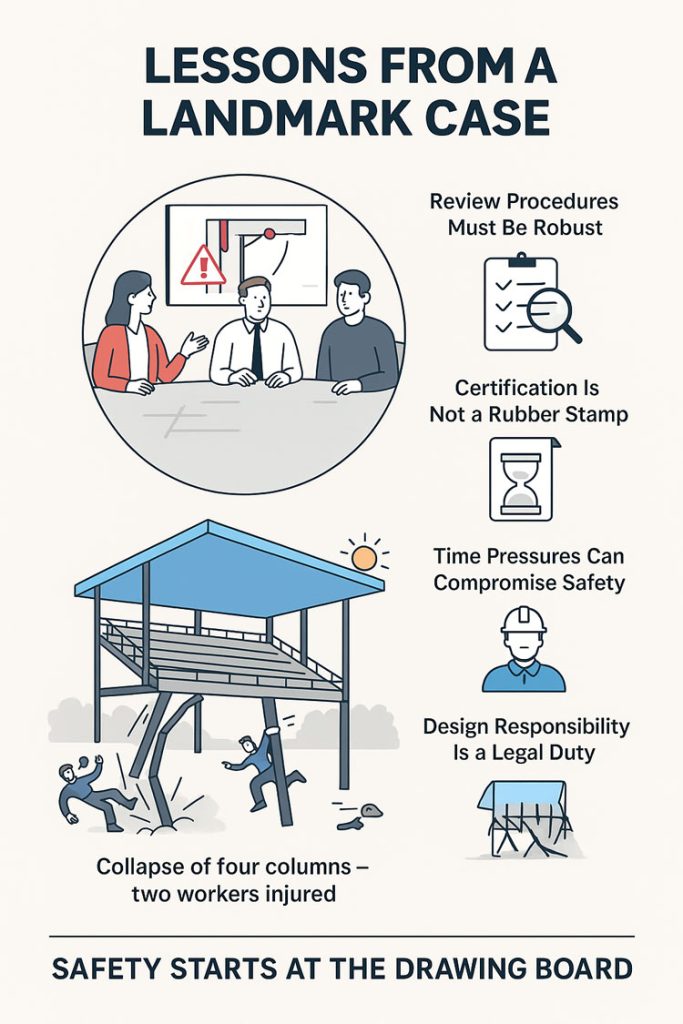
In 2024, SafeWork SA concluded a landmark case involving a spectator-roof collapse during a football club redevelopment project in South Australia. While no life-threatening injuries occurred, the incident highlighted how critical it is for design, review, and certification processes to work together to ensure safety on site.
This was the first successful design-related prosecution under South Australia’s Work Health and Safety Act, sending a clear signal to the engineering and construction sector: design decisions carry legal and safety obligations, not just technical ones.
What Happened (Briefly)
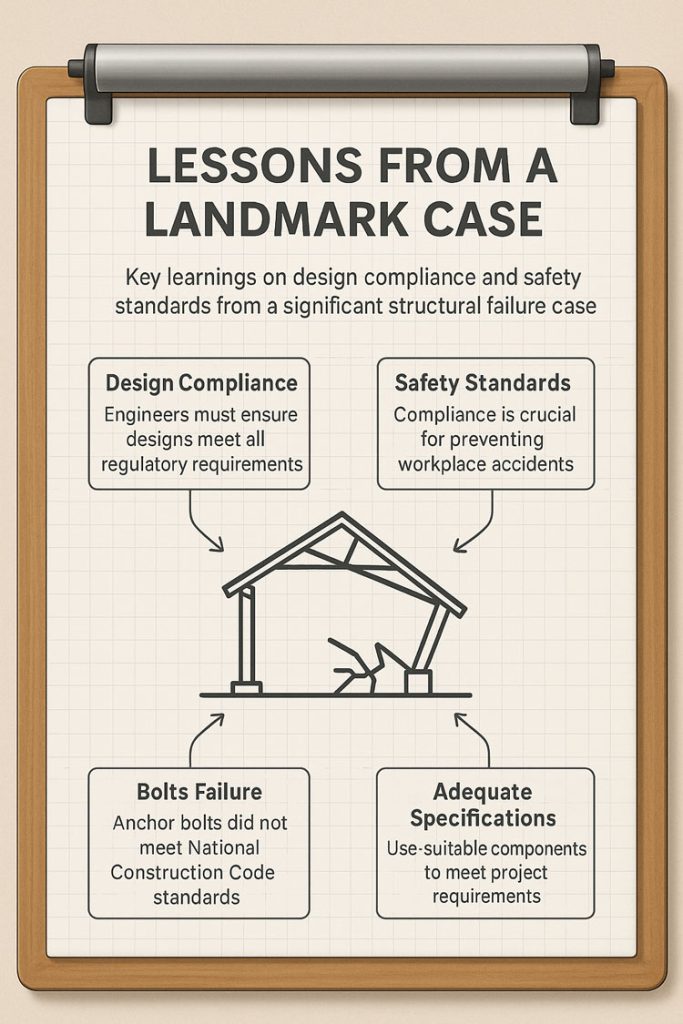
During roof sheeting works in late 2021, four of seven supporting columns of a cantilevered spectator roof failed, causing two apprentices to slide down the roof sheets. SafeWork SA’s investigation found that the anchor bolts specified for the column base plates were inadequate and did not meet the requirements of the National Construction Code (NCC).
An independent compliance review also failed to detect this issue, allowing the error to pass unchecked into construction. The result was a collapse that could have had far more severe consequences had the roof been fully loaded or occupied.
Key Learnings for the Industry
This case underscores several important lessons for engineers, designers, project managers, and certifiers:
1. Design Responsibility Is a WHS Duty
Under the WHS Act, designers have a duty to ensure their work is safe not just in its intended use, but during construction. This means bolts, connections, and base plates must be designed for real-world loads — including wind uplift, combined shear and tension, and concrete breakout limits per NCC and relevant Australian Standards.
2. Review Procedures Must Be Robust — and Followed
Having a documented review procedure is not enough if it isn’t rigorously applied. Independent verification and internal peer review are critical to catching design errors before they reach site.
3. Certification Is Not a Rubber Stamp
Independent certifiers play a key role in safeguarding public safety. They must actively verify that designs meet compliance, rather than simply sign off on documentation.
4. Time Pressures Can Compromise Safety
Compressed project timelines were noted as a factor in missed opportunities to catch the error. Project teams must resist the temptation to shortcut review steps when schedules are tight — safety must remain non-negotiable.
5. Documentation & Traceability Protect Everyone
Maintaining calculation records, checklists, and review signoffs creates a clear audit trail. This helps demonstrate due diligence if something goes wrong.
Why This Matters
The collapse at Angaston Football Club was a relatively small incident with minor injuries — but it could easily have been catastrophic. By learning from cases like this, the industry can improve its processes and prevent future failures.
As professionals, our role is to design for safety, verify rigorously, and document clearly. Doing so protects workers, end-users, and our own organisations.
Legal & Ethical Considerations
This post is intended as a learning resource, not as an allocation of blame. The case referenced is a matter of public record through SafeWork SA and SAET decisions, and all commentary here focuses on general principles of safe design and compliance.
We recommend that other practitioners review their own QA and certification procedures in light of this case to ensure compliance with the National Construction Code and WHS obligations.
Steel has been the backbone of industrial progress for over 150 years. It is the invisible framework behind our skyscrapers, bridges, transport systems, and modern cities. But the industry that gave us the Industrial Revolution is now facing one of the greatest transitions in its history. The combined pressures of climate change, regulatory scrutiny, fluctuating energy costs, and global trade realignments are forcing steelmakers to rethink how steel is made, used, and traded.
Recent news reports show a fascinating picture: a sector in the middle of transformation, experimenting with new technologies like hydrogen-based direct reduction, while still relying on traditional blast furnace smelting to meet soaring demand. In this article, we explore the future direction of the smelting and steelmaking industry, what challenges lie ahead, and where the biggest opportunities are likely to emerge.
The Push for Green Steel
Hydrogen & Direct Reduced Iron (DRI): A Pathway to Decarbonization
Hydrogen-based steel production remains the single most promising pathway for deep decarbonization in the steel sector. Instead of using metallurgical coal and coke to chemically reduce iron ore, hydrogen can be used to produce direct reduced iron (DRI) that can then be melted in an electric arc furnace (EAF). This dramatically cuts CO₂ emissions, especially if the hydrogen is produced using renewable energy.
Projects like Salzgitter’s Salcos program in Germany are leading the way. Salzgitter has been developing one of the most ambitious hydrogen-based steel transformation roadmaps in Europe, gradually phasing in hydrogen reduction units and retiring carbon-intensive blast furnaces. Similarly, Australia’s NeoSmelt initiative, backed by Rio Tinto and ARENA, is exploring a combination of DRI and electric smelting furnaces to create a pathway that works for Australian ore quality and energy markets.
But this transition is anything but smooth. Salzgitter has recently delayed later stages of its program, citing economic and regulatory headwinds, such as the high cost of hydrogen, uncertain carbon pricing, and the slow rollout of renewable energy infrastructure. This highlights a hard truth: the green transition will not be instant or cheap. The next decade will likely be defined by pilot projects, incremental scale-ups, and careful balancing between economic viability and climate commitments.
The Coal Paradox
Even as green steel makes headlines, metallurgical coal is seeing a surprising resurgence. Demand for coal-based blast furnace production remains robust, especially in China and India, where domestic infrastructure spending continues to grow. In fact, recent research from the Global Energy Monitor shows that coal-based capacity is still expanding, even as global climate targets call for steep reductions in emissions.
This paradox points to the transitional nature of the current era. For the foreseeable future, the world will be living in a dual-track steel economy: one track relying on traditional blast furnaces and coke ovens to meet near-term demand, and another experimenting with hydrogen, electric smelting, and alternative reduction technologies.
For businesses, this means they cannot simply abandon existing capacity overnight. Instead, expect to see retrofit investments to improve the efficiency of blast furnaces, capture more waste heat, and install carbon capture and storage (CCS) where feasible. This “cleaner coal” approach will act as a bridge until low-carbon technologies can compete at scale on cost and availability.
Regional Shifts & Strategic Investments
Australia’s Green Steel Ambitions
Australia is emerging as a key player in the global conversation on sustainable steelmaking. The country has vast high-grade iron ore resources, growing renewable energy capacity, and a strategic interest in maintaining domestic steelmaking capability.
BlueScope’s $1.15B blast furnace reline at Port Kembla is one of the largest industrial projects in the nation’s history, designed to keep steel production secure for another 20 years. This investment shows that Australia is taking a pragmatic approach — continuing to support blast furnace technology while planning for a green future.
The NeoSmelt project, which just secured nearly $20M in government funding, is a potential game-changer. It will explore how to combine renewable-powered hydrogen and electric furnaces to make a commercial-scale green steel process that works with Australian ore.
The potential takeover of Whyalla Steelworks by a consortium led by BlueScope could turn the plant into a testbed for low-emissions ironmaking, providing a national blueprint for decarbonizing heavy industry.
Global Trade & Policy Realignment
Meanwhile, trade policy is also shaping the future. The EU and U.S. have resumed talks to revisit steel and aluminium tariffs, with a focus on creating carbon-based trade measures. If implemented, this could reward producers who adopt low-carbon technologies while penalizing those that rely on high-emission processes. For global producers, this will accelerate investment in low-emissions capacity to stay competitive in export markets.
Innovation Beyond Furnaces
The transformation of steelmaking is not just about switching fuels — it’s about reimagining the entire production system.
Modular, low-emission smelting plants like those being developed in Western Australia by Metal Logic allow companies to build capacity closer to demand centers, reduce transport emissions, and scale production up or down as needed.
Digital twins and AI-driven process control are making smelting more efficient. By modeling every step of the steelmaking process, producers can optimize energy use, reduce material losses, and increase yield — all of which improve profitability and lower emissions simultaneously.
Circular economy practices, such as increased use of scrap steel in EAFs, are becoming a central strategy. Recycling steel uses a fraction of the energy required to make virgin steel and fits neatly into the industry’s sustainability narrative.
This convergence of physical and digital innovation will likely create a new generation of steel plants that are smaller, smarter, and cleaner than their 20th-century predecessors.
Where the Industry is Headed
Looking ahead, the future of smelting and steelmaking will be defined by hybridization, regulation, and resilience:
Hybrid production systems will dominate for at least the next decade. Expect blast furnaces to operate alongside hydrogen-based DRI units and electric smelters as companies transition gradually.
Stricter carbon regulations will push companies to adopt low-carbon pathways faster than market forces alone would dictate. Carbon border adjustment mechanisms (CBAMs) will effectively tax “dirty steel” in major economies, making investment in green capacity a competitive necessity.
Domestic capability building will remain critical. The COVID-era supply chain crises reminded governments why domestic production matters. Expect to see policies that support keeping steelmaking onshore, even if that requires subsidies or preferential procurement.
Collaborative innovation will become the norm. Mining giants, energy producers, and technology firms are already forming alliances to solve the “green steel puzzle.” This cross-industry collaboration will unlock new efficiencies and accelerate commercialization.
Final Thoughts
The smelting and steelmaking industry is standing at the crossroads of history. The coming years will test its ability to balance sustainability with profitability, scale with flexibility, and tradition with innovation.
Companies that embrace this challenge — investing in low-carbon technology, digital transformation, and strategic partnerships — will not just survive the coming disruption but thrive as leaders in a new, greener industrial age. Steel may be one of the oldest materials in human civilization, but its future is being forged right now, and it has never been more exciting.
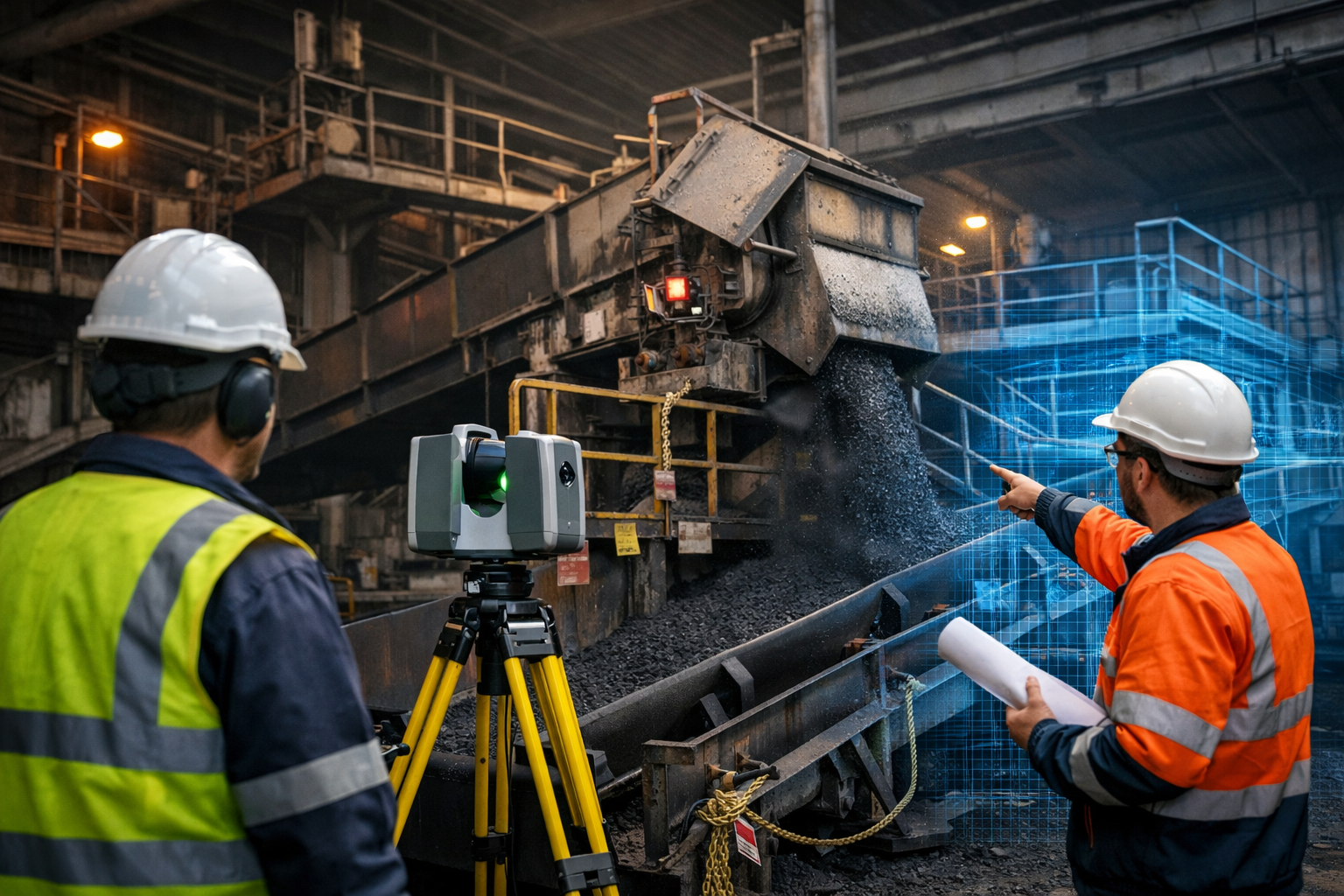
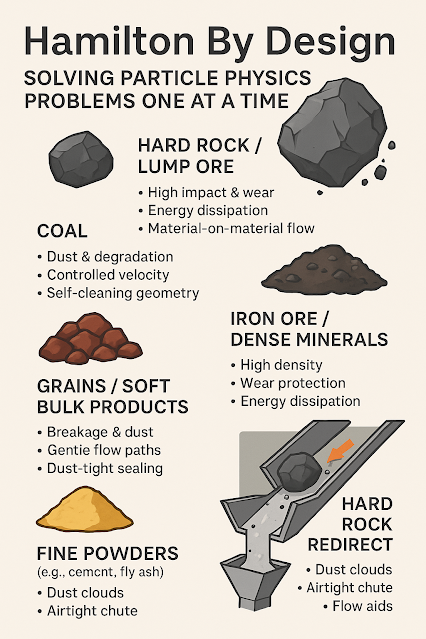
At Hamilton by Design, we believe that every bulk material transfer is an opportunity for improvement. What appears to be a simple flow of rock, coal, grain, or powder is, in reality, a particle physics problem waiting to be solved. By approaching these challenges with precision, creativity, and hands-on knowledge, we deliver chute designs that do more than move material — they protect assets, enhance performance, and improve the bottom line.
We are a small, specialised company with a wealth of on-site experience. Our engineers have spent years in the field, watching, listening, and learning how different materials behave under real conditions. This raw experience gives us a unique advantage: we can see and understand particle flow first-hand, not just through numbers on a screen. While many large organisations rely solely on computer models, we combine advanced simulation with practical insight, ensuring solutions that work not only in theory but also in practice.
Our team thrives on solving the complex problems others overlook:
Redirecting hard rock at speed without spillage or damage.
Handling sticky coal without blockages or hang-ups.
Containing fine powders without dust plumes or health risks.
Transferring fragile grains without breakage or product loss.
Extending chute, liner, and belt life with robust material-on-material flow designs.
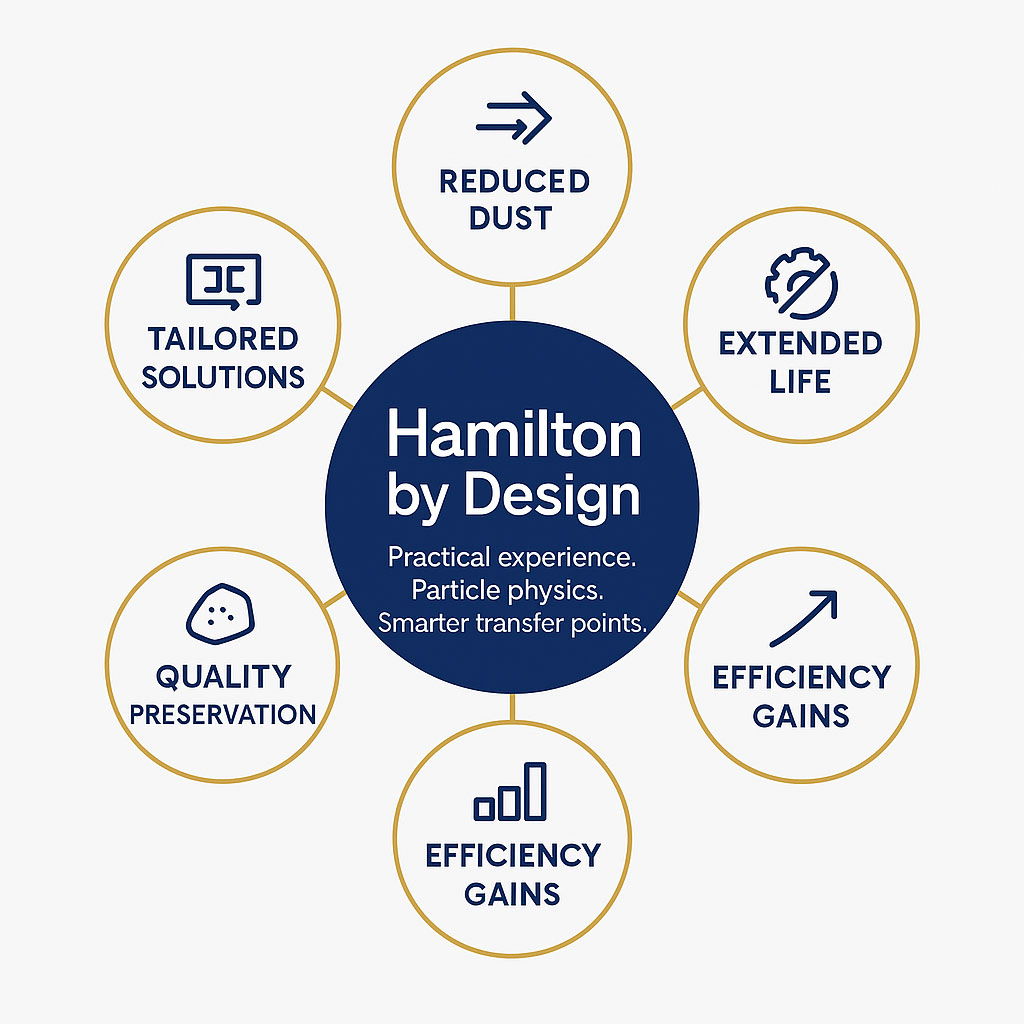
We approach every challenge with the mindset that your success is our success. When your plant runs reliably, safely, and efficiently, we succeed alongside you. That’s why we design transfer points that:
Absorb and dissipate energy from high-impact lumps.
Control dust and minimise degradation for cleaner, safer operations.
Extend equipment life by reducing wear and maintenance.
Adapt to variability in feed size, flow, and moisture.
Boost throughput and availability by minimising stoppages.
In a world where margins are tight and environmental responsibility is critical, Hamilton by Design offers a personal, client-focused approach that puts performance and partnership at the centre. We are not a large organisation pushing generic solutions — we are a dedicated team that listens, observes, and engineers smarter outcomes, one particle physics problem at a time.
To provide the best experiences, we use technologies like cookies to store and/or access device information. Consenting to these technologies will allow us to process data such as browsing behaviour or unique IDs on this site. Not consenting or withdrawing consent, may adversely affect certain features and functions.
Functional
Always active
The technical storage or access is strictly necessary for the legitimate purpose of enabling the use of a specific service explicitly requested by the subscriber or user, or for the sole purpose of carrying out the transmission of a communication over an electronic communications network.
Preferences
The technical storage or access is necessary for the legitimate purpose of storing preferences that are not requested by the subscriber or user.
Statistics
The technical storage or access that is used exclusively for statistical purposes.The technical storage or access that is used exclusively for anonymous statistical purposes. Without a subpoena, voluntary compliance on the part of your Internet Service Provider, or additional records from a third party, information stored or retrieved for this purpose alone cannot usually be used to identify you.
Marketing
The technical storage or access is required to create user profiles to send advertising, or to track the user on a website or across several websites for similar marketing purposes.