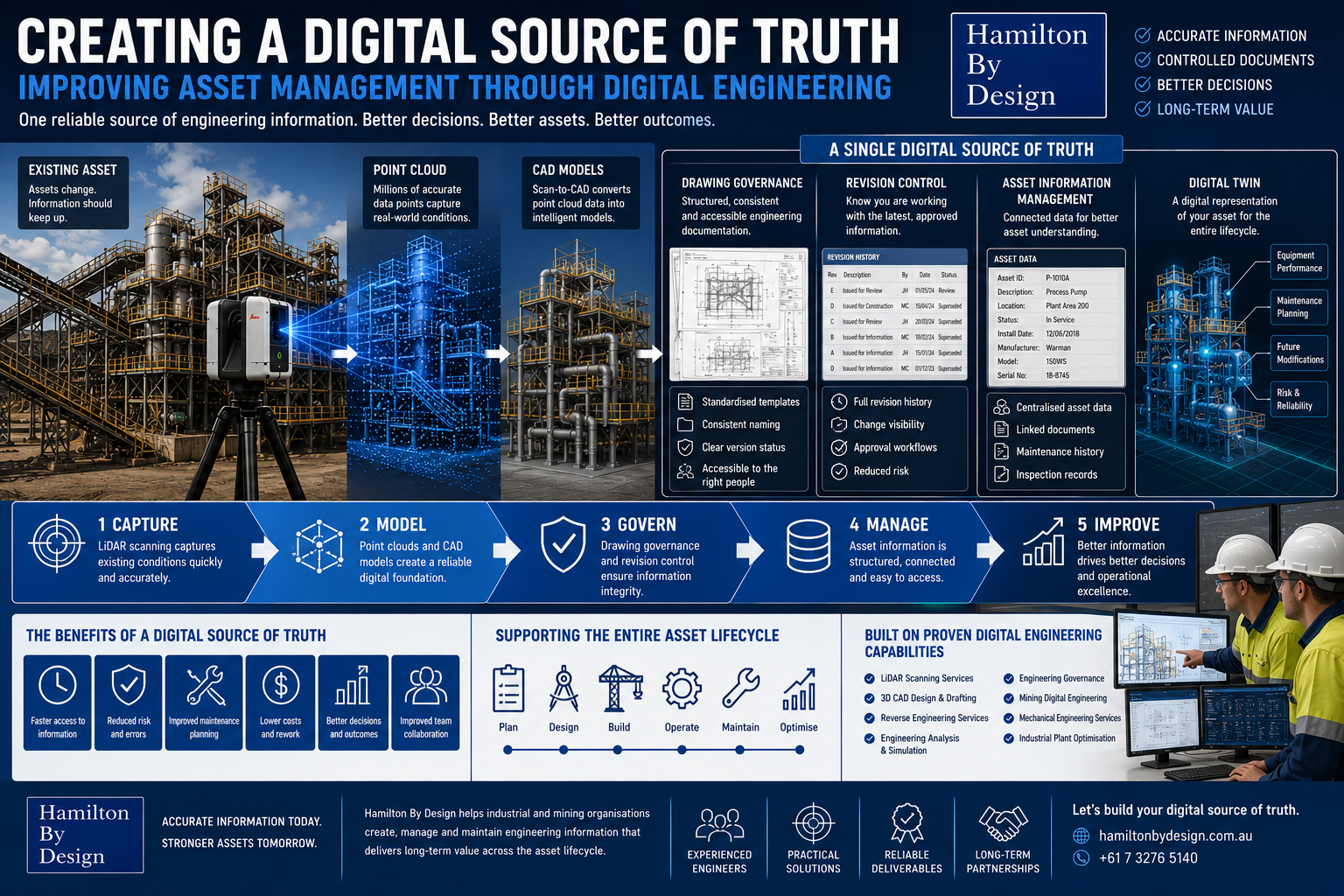
Industrial assets change over time. Equipment is upgraded, drawings are revised, platforms are modified, components are replaced, and maintenance activities gradually reshape the plant.
When engineering information is spread across old drawings, uncontrolled PDFs, manual mark-ups, spreadsheets, and individual folders, asset management becomes harder than it needs to be.
A digital source of truth helps bring engineering information together so teams can make decisions using reliable, current, and controlled data.
At Hamilton By Design, we support digital engineering asset management by combining LiDAR scanning, CAD modelling, drawing governance, revision control, and digital engineering workflows.
What is a Digital Source of Truth?
A digital source of truth is a controlled location where accurate engineering information can be stored, managed, accessed, and updated.
It may include:
- Engineering drawings
- CAD models
- Point cloud data
- Asset information
- Revision history
- Inspection records
- Fabrication documentation
- Engineering reports
The goal is simple:
One reliable place for engineering information.
Why Asset Information Management Matters
Poorly controlled information can create:
- Outdated drawings
- Duplicate files
- Missing revisions
- Conflicting information
- Fabrication errors
- Shutdown delays
- Maintenance confusion
Good asset information management improves:
- Decision making
- Project planning
- Maintenance efficiency
- Drawing control
- Long-term asset performance
Digital Engineering Workflows
Hamilton By Design can support workflows such as:
- Engineering-grade LiDAR scanning
- Existing condition capture
- Point cloud generation
- Scan-to-CAD conversion
- CAD modelling
- Engineering drawings
- Revision-controlled documentation
- Digital asset records
This turns real-world site information into usable engineering data.
Drawing Governance and Revision Control
Drawing governance helps ensure the right people are using the right information.
This includes:
- Controlled drawing revisions
- Clear document naming
- Updated engineering records
- Managed mark-ups
- Approval workflows
- Accessible project information
Without revision control, teams may unknowingly use superseded drawings.
Digital Twins and Long-Term Asset Management
A digital twin does not need to start as a complex system. For many industrial sites, it begins with accurate geometry, controlled drawings, and reliable asset records.
Digital engineering can support:
- Plant upgrades
- Maintenance planning
- Shutdown preparation
- Reverse engineering
- Engineering analysis
- Future modifications
Long-Term Operational Efficiency
A digital source of truth can reduce:
- Time spent searching for drawings
- Rework caused by outdated information
- Repeated site measurements
- Fabrication errors
- Project uncertainty
It can improve:
- Maintenance planning
- Engineering confidence
- Asset visibility
- Operational efficiency
- Project delivery
How Hamilton By Design Supports This
Hamilton By Design supports digital engineering asset management through:
- 3D CAD Design & Drafting
- Engineering Governance
- LiDAR Scanning Services
- Industrial Plant Optimisation
- Engineering Analysis & Simulation
- Mining Digital Engineering
- Mechanical Engineering Services
- Reverse Engineering Services
The objective is not just to create drawings or models.
The objective is to create engineering information that remains useful throughout the asset lifecycle.


Conclusion
Industrial asset management depends on reliable information.
A digital source of truth helps organisations move from scattered documents and outdated drawings toward controlled, current, and usable engineering data.
Better information supports better asset decisions.

Our Clients: