Rigid Body Dynamics vs Transient

Rigid Body Dynamics vs Transient Structural Analysis in Mining

Why Both Matter in Mechanical and Structural Engineering

In the fast-paced and high-stakes environment of the Australian mining industry, reliable engineering design isnโ€™t just a competitive advantage โ€” it’s a necessity. Across regions like the Pilbara, Kalgoorlie, the Hunter Valley, Bowen Basin, and Mount Isa, mining operations depend on complex mechanical systems that must perform under extreme loads, harsh conditions, and round-the-clock operation.

To ensure safety, reliability, and performance, mining engineers increasingly rely on advanced simulation tools like Rigid Body Dynamics (RBD) and Transient Structural Analysis (TSA). While these tools might appear similar, they serve fundamentally different purposes in mechanical and structural engineering. Using the right tool at the right time can dramatically reduce downtime, improve equipment longevity, and lower operating costs.

At Hamilton By Design, we bring the latest in engineering simulation and scanning technology directly to your mining operation โ€” wherever you are in Australia. Whether you’re operating in the iron-rich Pilbara, the gold-rich Kalgoorlie, or deep in Mount Isa’s underground hard rock mines, we deliver world-class engineering solutions on-site or remotely.


What is Transient Structural Analysis?

Transient Structural Analysis (TSA) is a Finite Element Analysis (FEA) technique that models how structures respond to time-varying loads. It provides insights into:

  • Displacement and deformation under dynamic loads
  • Stress and strain distribution over time
  • Vibrations and impact response
  • Fatigue life prediction

This type of simulation is essential when you’re dealing with high-frequency loading, shock events, or long-term structural wear and fatigue. TSA is invaluable for assessing risk in static and semi-dynamic systems across mining sites.

Typical TSA applications in mining include:

  • Vibrating screens and feeder structures
  • Crusher housings and foundations
  • Chutes and hoppers exposed to high-velocity ore impact
  • Structural skids for processing equipment
  • Equipment subject to cyclic fatigue (e.g., slurry pumps, reclaimer arms)

What is Rigid Body Dynamics?

Rigid Body Dynamics (RBD) focuses on the motion of bodies under the assumption they do not deform. This tool models:

  • Position, velocity, and acceleration
  • Reaction forces at joints and actuators
  • Dynamic behaviour of moving parts and linkages
  • Contact, impact, and frictional interaction

Unlike TSA, RBD doesnโ€™t solve for stress or strain. Instead, it calculates the kinematics and kinetics of motion systems โ€” making it ideal for analysing mechanical assemblies where movement, timing, and loads are key.

Common RBD applications in mining include:

  • Stacker-reclaimer arms and boom articulation
  • Mobile equipment with hydraulic or mechanical actuators
  • Diverter chutes and gating systems
  • Rockbreaker arm kinematics
  • Conveyor take-up and tensioning systems

RBD also plays a pivotal role in process optimisation and troubleshooting โ€” helping engineers simulate how mechanisms will respond under load, ensuring operational efficiency before physical prototypes are built.


Why TSA Canโ€™t Replace RBD (and Vice Versa)

While TSA includes rigid body motion as part of the total displacement field, it is not designed for efficient or accurate motion simulation. Trying to model the dynamics of a moving mechanism in TSA can:

  • Lead to slow solve times and high computational cost
  • Produce unstable results due to unconstrained motion
  • Provide limited insight into timing, velocity, or actuation behaviour

Conversely, using RBD for structures that flex, vibrate, or wear over time wonโ€™t give you the data needed to assess material failure or fatigue.

The takeaway? Use TSA when deformation matters. Use RBD when motion matters. Use both when you need the complete picture.


Regional Applications Across Australian Mining

Hamilton By Design supports clients across Australia’s mining regions with tailored simulation services designed to meet real operational needs.

Pilbara โ€“ Iron Ore

With high-capacity iron ore operations, this region depends on large-scale materials handling systems.

  • Use RBD to simulate boom movement, slewing systems, and travel paths of stackers.
  • Use TSA to assess fatigue on booms, rail frames, and conveyor supports exposed to cyclic load.

Hamilton By Design helps model these systems efficiently, ensuring both accurate motion control and structural durability. Contact us for help simulating your Pilbara handling systems.


Kalgoorlie โ€“ Goldfields (Eastern Gold Region)

Gold operations rely on compact, high-force machinery in confined processing facilities.

  • Use TSA to simulate vibration-induced stress in equipment frames and foundations.
  • Use RBD to model diverter gates, hydraulic arms, and transport carts in processing facilities.

Whether you’re retrofitting a plant or building a new line, Hamilton By Design provides flexible support wherever you operate. Email [email protected] to learn more.


Hunter Valley โ€“ Coal (Thermal)

Thermal coal operations in NSW require robust, wear-resistant infrastructure.

  • RBD helps simulate automated diverters, boom stackers, and actuated gates.
  • TSA ensures the wear-prone chutes and hoppers withstand repetitive impacts.

We provide quick-turn simulations for both brownfield and greenfield projects. Get in touch to scope your simulation needs.


Bowen Basin โ€“ Coal (Metallurgical)

Queenslandโ€™s met coal operations power the global steel industry.

  • RBD enables accurate simulation of take-up systems and longwall motion.
  • TSA supports design of structural supports under repetitive and impact loading.

Our experts work with surface and underground operators, reducing risk through advanced motion and stress analysis. Request a quote at [email protected].


Mount Isa โ€“ Hard Rock Mining

Mount Isaโ€™s deep and abrasive ore bodies test every piece of equipment.

  • RBD is ideal for simulating rockbreaker motion, loader paths, and mobile assets.
  • TSA provides insights into vibration effects on headframes, bins, and fixed plant.

Hamilton By Design offers full analysis support for operators in remote locations. Contact us today for tailored advice.


When to Use Both Tools Together

A real advantage emerges when RBD and TSA are used in combination:

  • RBD identifies dynamic forces and timing on moving parts
  • TSA then evaluates the structural response to those forces

For example, in a diverter chute:

  1. RBD determines the acceleration profile, impact forces, and system timing.
  2. TSA uses that input to analyse whether the chute will survive years of repeated service.

This integrated approach results in more accurate models, fewer design revisions, and significantly lower project risk.


Why Work with Hamilton By Design?

As mechanical engineering consultants with national reach, Hamilton By Design offers:

  • Combined RBD and TSA simulation capability
  • Lidar scanning and digital plant modelling
  • Experience with mining-specific assets and constraints
  • Mobile, responsive teams that bring technology to you

From site scoping to final design verification, we help our clients solve the right problem, the right way.

Have a project in mind? Reach out via our contact page or email [email protected].


Conclusion: Technology That Moves With You

Rigid Body Dynamics and Transient Structural Analysis are not interchangeable โ€” they are complementary. Each method offers unique insights into how a mining system performs โ€” whether moving, flexing, vibrating, or carrying tonnes of ore.

At Hamilton By Design, we believe engineering technology should move as fast and far as our clients do. Thatโ€™s why we bring simulation, scanning, and design tools directly to you, wherever you operate across Australia.

If your system moves, simulate it with RBD. If your structure flexes, vibrates, or wears, model it with TSA. For full insight? Use both.

Let us help you design smarter, safer mining systems.

Hamilton By Design โ€“ Bringing Engineering Technology to You, Wherever You Are in Australia

Hamilton By Design logo displayed on a blue tilted rectangle with a grey gradient background


3D LiDAR scanning and 3D modelling service button โ€” laser scanner capturing a point cloud for engineering and CAD modelling
Mechanical engineering services


Hamilton By Design | Mechanical Drafting | Structural Drafting | 3-D Lidar Scanning

Our clients:

Name
Would you like us to arrange a phone consultation for you?
Address

Mechanical Engineering at the Heart of Mining on the Central Coast

ย  ๐Ÿ› ๏ธ

1. Setting the Scene: The Central Coast & Its Industrial Backbone

Home to nearly 350,000 people across Gosford, Wyong, Terrigal, and beyond, the Central Coast is well-known for its beaches and bushlandโ€”yet it also supports a robust industrial and miningโ€‘services sector (Jora, Wikipedia). With growing infrastructure demands and proximity to resource projects like the Wallarahโ€ฏ2 coal proposal near Wyong (Wikipedia), mechanical engineers play a pivotal role behind the scenes.

2. What Do Mechanical Engineers Do in Mining on the Coast?

Mechanical engineers in mining and related heavy industries are responsible for:

  • Design & Maintenance: Planning, designing, and overseeing maintenance of critical mineral processing plants, machinery, conveyors, trucks and drilling rigs (Jobsora).

  • Automation Integration: Implementing robotics, programmable logic controllers (PLCs), remote operation systems, and predictive maintenance tools .

  • Health & Safety Compliance: Ensuring mechanical systems meet stringent safety regulations and operator protection standards (Jora).

  • Environmental Efficiency: Optimising equipment to reduce energy use, emissions, and noiseโ€”all while supporting mine rehabilitation efforts .


3. Job Opportunities in the Region

Recent job listings highlight robust opportunities for mechanical engineers across the Coast:

  • Mining Mechanical Engineer roles are regularly advertised in Gosford/Lisarow, appearing in SEEK and Jora job postings (SEEK).

  • Roles span senior design positions to handsโ€‘on maintenance engineeringโ€”offering full-time opportunities with firms like Wabtec, Hyundaiโ€ฏRotem, Boral, and Coffey (SEEK).

  • Entry-level and graduate engineering roles are also available through pathways like Central Coast Council traineeships and TAFE NSW programs (Central Coast Council).


4. Industry Trends and What Youโ€™ll Need

As described by Titan Recruitment, the mining sector is embracing several transformative trends (Titan Recruitment):

  1. Automation & Robotics: Engineers are tasked with integrating autonomous machinery and control systems.

  2. Digital & Data Analytics: Skills in condition monitoring, sensors, and predictive analytics are in demand.

  3. Sustainability Focus: Thereโ€™s emphasis on clean, efficient systems that reduce environmental footprint.

  4. Complex Machine Design: As equipment sophistication grows, so does the need for mechanical expertise.

  5. Asset Reliability & Safety: Mechanical engineers must ensure zero-fault operation in harsh mining environments.

  6. Site-to-System Integration: Engineers coordinate across disciplinesโ€”mechanical, electrical, structuralโ€”to optimise operations.

  7. Continuous Upskilling: Ongoing educationโ€”through TAFE NSW, professional certifications, and in-house trainingโ€”is critical.


5. Training & Career Pathways on the Central Coast

๐ŸŽ“ Education & Apprenticeships

  • TAFE NSW (Hunter & Central Coast) offers mechanical and engineering trade training, forming a strong foundation for local roles (Wikipedia).

  • Central Coast Council provides apprenticeships and traineeships in mechanical fieldsโ€”ideal stepping stones into industry .

๐Ÿข Local Industry Experience

  • Firms like Wabtec, Hyundaiโ€ฏRotem, Boral, Coffey, and Wright Engineering in Somersby/Gosford offer vital on-the-job training and progression (SEEK).

  • Mining-support businesses across the Central Coast employ engineers to design, maintain, and improve heavy-duty plant and machinery.


6. Why the Central Coast Is a Great Base for Mining Engineers

  • Proximity to Projects: Infrastructure supporting coal drilling and mineral processing connects easily with local towns via major transport routes in and out of Gosford (Jobsora, Wikipedia).

  • Balanced Lifestyle: Work-life harmony blends regional industry jobs with coastal living and access to national parks (Indeed).

  • Clear Career Pathways: Education, apprenticeships, and employers form a supportive ecosystemโ€”from bedrock training to senior site leadership.


Final Takeaway

Mechanical engineers are essential to mining operations on the Central Coastโ€”ensuring machinery runs efficiently, safely, and sustainably. With strong local education pathways, active job markets, and growing tech trends, the region offers rewarding careers tied to both industrial innovation and community lifestyle.

Ready to design, maintain, and optimise the backbone of mining? The Central Coast has the foundationโ€”and the opportunityโ€”awaiting mechanical engineers eager to build the future.

Hamilton By Designย |ย Mechanical Draftingย |ย Structural Draftingย |ย 3-D Lidar Scanning

Central Coast | Mount Isa | Brisbane | Cairns | Darwin


Published on Hamiltonโ€ฏbyโ€ฏDesign โ€” shaping engineering futures in NSWโ€™s Central Coast

Hamilton By Design logo displayed on a blue tilted rectangle with a grey gradient background
3D LiDAR scanning and 3D modelling service button โ€” laser scanner capturing a point cloud for engineering and CAD modelling
Mechanical engineering services

Our clients:
Name
Would you like us to arrange a phone consultation for you?
Address
Finite Element Analysis (FEA) engineering simulation button
Mechanical engineering services

The Importance of AS 3990 in Mechanical Equipment Steelwork

In the world of engineering, adhering to standards is more than just a formality; itโ€™s a fundamental aspect of ensuring safety, reliability, and efficiency. One such critical standard is AS 3990, “Mechanical Equipment โ€“ Steelwork.” This guideline plays a vital role in the design and construction of steel structures for mechanical systems, providing the framework for materials selection, construction practices, and stress analysis. Ignoring AS 3990 can lead to a host of issues, from structural failures to safety hazards, yet itโ€™s a challenge that some organizations still face. By contrast, companies like Hamilton By Design have built a reputation for excellence by consistently applying these standards in their projects, ensuring optimal outcomes for their clients.

The Risks of Ignoring AS 3990

One of the most alarming consequences of bypassing AS 3990 is the heightened risk of structural failure. Mechanical equipment steelwork is often subjected to extreme stresses and environmental conditions, and without proper design parameters, the results can be catastrophic. Whether itโ€™s the collapse of a support structure or the malfunction of a mechanical component, the costโ€”both human and financialโ€”is often irreparable.

In addition to physical failures, neglecting AS 3990 invites a host of compliance and legal issues. Regulatory bodies across industries mandate adherence to such standards to protect workers and ensure operational safety. Non-compliance can lead to fines, project delays, or even legal action, tarnishing the reputation of those involved.ย 

The impact doesnโ€™t stop there. Poorly designed steelwork can suffer from premature wear and fatigue, significantly reducing the lifespan of the equipment. This leads to frequent maintenance, unplanned downtime, and increased costsโ€”a scenario no company wants to face. Moreover, these recurring issues not only affect the bottom line but also compromise the safety of workers, posing risks of injury or fatality. Finally, the reputational damage from delivering substandard systems can be devastating, as it erodes client trust and tarnishes an organizationโ€™s standing in the industry.

Hamilton By Design: A Commitment to Excellence

Faced with these potential pitfalls, an engineering company like Hamilton By Design offers a reassuring solution. With extensive experience in mechanical design and steelwork, they prioritize adherence to AS 3990 in every project. This commitment translates into tangible benefits for their clients and sets them apart in the industry.

Hamilton By Design approaches every project with structural integrity at the forefront. By leveraging advanced modeling tools and stress analysis techniques, they ensure that every design adheres to the stringent guidelines of AS 3990. Their expertise spans diverse industries, enabling them to tailor solutions that are both robust and reliable.

Compliance is another area where Hamilton By Design excels. The team stays up-to-date with the latest iterations of AS 3990, incorporating these requirements seamlessly into their work. This not only streamlines the approval process but also gives clients the confidence that their projects meet all necessary regulatory standards.

Material selection and durability are cornerstones of the companyโ€™s design philosophy. By carefully analyzing the operational stresses and environmental factors that each structure will face, Hamilton By Design creates systems that are built to last. This focus on longevity reduces the need for maintenance and ensures uninterrupted performance, saving clients time and money.

Safety is non-negotiable for Hamilton By Design. Every project undergoes rigorous risk assessments to identify and mitigate potential hazards. By adhering to AS 3990โ€™s safety protocols, the company not only protects workers but also fosters a culture of trust and reliability.

The Advantages of AS 3990 Compliance

The advantages of working with engineers who consult AS 3990 are clear. First and foremost, it ensures structural reliability. Steelwork designed under this standard can handle expected loads and stresses with ease, delivering dependable performance across a range of applications. For Hamilton By Design, this translates into designs that consistently exceed client expectations.

Regulatory compliance is another significant benefit. Projects that adhere to AS 3990 face fewer hurdles during inspections, avoiding costly delays and potential penalties. Hamilton By Designโ€™s meticulous approach to compliance ensures smooth project execution, freeing clients to focus on their core objectives.

Optimized design is yet another hallmark of AS 3990. By balancing safety, functionality, and cost-efficiency, the standard empowers engineers to deliver solutions that are both practical and innovative. Hamilton By Design takes this a step further by using advanced tools and methodologies to craft designs that align perfectly with their clientsโ€™ operational goals.

Safety, of course, remains a top priority. AS 3990 includes comprehensive guidelines for risk minimization, creating a safer environment for workers and operators. Hamilton By Designโ€™s adherence to these principles underscores their commitment to safeguarding everyone involved in their projects.

Cost savings and increased equipment lifespan are additional advantages of compliance. Properly designed steelwork not only reduces maintenance needs but also enhances durability, maximizing the return on investment for clients. For Hamilton By Design, these outcomes are the natural result of their dedication to quality and precision.

Real-World Applications

Hamilton By Designโ€™s expertise in applying AS 3990 is evident in their extensive portfolio. For instance, in a mining project involving heavy conveyor systems, the company used AS 3990 to identify critical stress points and optimize the design for dynamic loads. The result was a durable support structure that minimized maintenance and exceeded client expectations.

Similarly, in an industrial manufacturing facility, Hamilton By Design tackled the challenge of custom steelwork for robotic assembly lines. By adhering to AS 3990, they ensured that the structures could withstand repetitive stresses and environmental factors, enhancing both safety and efficiency.

Their experience extends to renewable energy projects as well. In designing steel frameworks for wind turbine foundations, Hamilton By Design accounted for wind loads, fatigue stresses, and environmental conditions, delivering solutions that met stringent safety and performance requirements.

Conclusion

Ignoring AS 3990 is a risk no company should take. The challengesโ€”from structural failures and compliance issues to safety hazards and reputational damageโ€”are simply too great. By contrast, working with experienced engineers who prioritize this standard offers a host of benefits, from enhanced reliability and safety to cost savings and competitive advantage.

Hamilton By Design exemplifies the best practices in applying AS 3990, turning potential challenges into opportunities for innovation and excellence. Their commitment to quality, compliance, and client satisfaction ensures that every project not only meets but exceeds industry standards. For organizations seeking dependable, high-performing mechanical equipment steelwork, Hamilton By Design is the partner of choice.

For More information contact Hamilton By Design – Email [email protected]

3D LiDAR scanning and 3D modelling service button โ€” laser scanner capturing a point cloud for engineering and CAD modelling
Mechanical engineering services

Our Clients:

Name
Would you like us to arrange a phone consultation for you?
Address

3D CAD in Sydney

3D Construction Scan in Sydney

https://www.hamiltonbydesign.com.au/home/engineering-services/3d-laser-scanning/3d-scanning-sydney/3d-point-cloud-modelling-in-sydney/

3D LiDAR Laser Scanning & Drafting Services in Chatswood & Greater Sydney

Finite Element Analysis (FEA) engineering simulation button
Mechanical engineering services

3D Scanning Sydney banner promoting engineering-grade 3D laser scanning, LiDAR scanning, and reality capture services by Hamilton By Design.
Mechanical Engineering Sydney banner with white text on a blue background representing Hamilton By Design's mechanical engineering services in Sydney.
Mechanical Drafting and 3D Modelling Sydney banner highlighting Hamilton By Design's CAD drafting, 3D modelling, and engineering design services in Sydney.

Mechanical Engineering | Structural Engineering


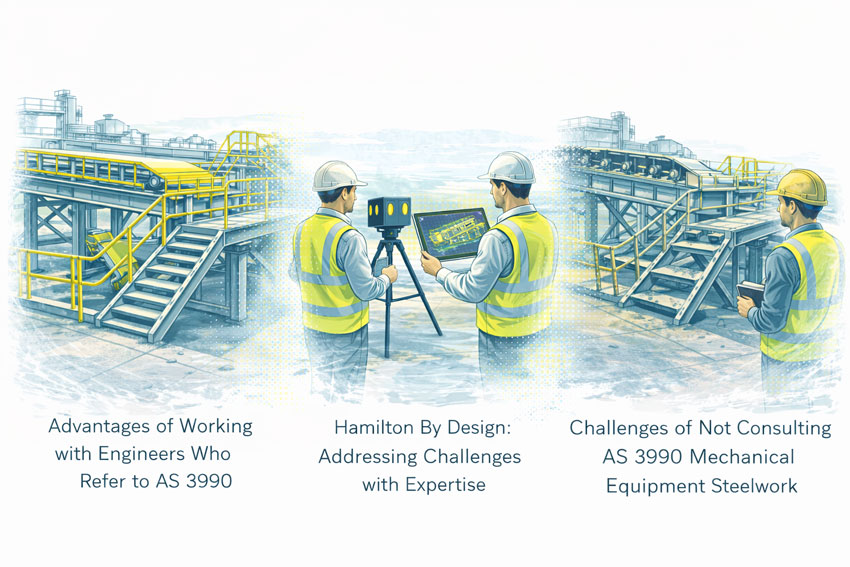
Challenges of Not Consulting AS 3990 Mechanical Equipment Steelwork

Engineering comparison showing AS 3990-compliant steelwork versus unverified mechanical equipment steelwork, assessed using LiDAR scanning and digital engineering

The Australian Standard AS 3990, “Mechanical Equipment โ€“ Steelwork,” is critical for ensuring the design and construction of safe, reliable, and durable steel structures in mechanical systems. It establishes guidelines for materials, construction practices, and stress analysis to meet the demanding requirements of industrial and mechanical applications. Failing to consult AS 3990 can lead to significant challenges for companies and individuals involved in engineering projects. Additionally, an engineering company like Hamilton By Design, with extensive experience in mechanical design and steelwork, can address these challenges effectively by leveraging its expertise and adherence to industry standards.

Our clients:
1. Structural Failures

One of the most severe consequences of not consulting AS 3990 is the risk of structural failures. Steelwork used in mechanical equipment must withstand specific stresses, loads, and environmental conditions. If these factors are not carefully calculated according to the standard, the structure may fail under operational stress, leading to catastrophic consequences.

Hamilton By Designโ€™s Approach:
Hamilton By Design ensures structural integrity through rigorous design analysis, leveraging advanced modeling tools and AS 3990 guidelines to predict and mitigate potential failure points. Their experience in various industries allows them to create robust steelwork designs that perform reliably under operational conditions.

Regulatory compliance is a cornerstone of modern engineering practices. Many industries, including mining, manufacturing, and construction, mandate adherence to AS 3990 for safety and operational approvals. Ignoring the standard can result in penalties, project delays, or even legal liabilities due to non-compliance.

Hamilton By Designโ€™s Approach:
The company prioritizes compliance by integrating AS 3990 requirements into every stage of the project. Their team stays updated with the latest revisions of the standard and ensures all designs meet regulatory expectations, providing clients with peace of mind and streamlined approval processes.

3. Reduced Equipment Longevity

Steel structures that do not conform to AS 3990 may suffer from premature wear, fatigue, or failure. This can lead to frequent repairs, replacements, or unplanned downtime, significantly reducing the lifespan of mechanical equipment.

Hamilton By Designโ€™s Approach:
Hamilton By Design employs precise material selection and stress analysis techniques, as prescribed by AS 3990, to optimize the durability and performance of their designs. Their focus on quality engineering ensures long-lasting equipment that minimizes maintenance requirements.

4. Safety Hazards

Non-compliance with AS 3990 poses serious safety risks. Equipment that fails unexpectedly can cause injuries or fatalities, creating an unsafe work environment and potential legal repercussions.

Hamilton By Designโ€™s Approach:
Safety is a core value for Hamilton By Design. The company conducts thorough risk assessments and designs steelwork that adheres to AS 3990โ€™s stringent safety standards. Their commitment to safety reduces risks to operators and protects the overall workforce.

5. Increased Maintenance Costs

Improperly designed steelwork often requires frequent maintenance due to unforeseen stress points, material fatigue, or environmental damage. This not only increases operational costs but also disrupts productivity.

Hamilton By Designโ€™s Approach:
Hamilton By Designโ€™s adherence to AS 3990 minimizes maintenance needs by delivering designs that perform reliably over extended periods. Their proactive approach to material selection and stress management ensures reduced long-term operational costs for their clients.

6. Loss of Reputation

Companies delivering substandard designs risk damaging their reputation and losing client trust. Poor performance or failure of mechanical equipment reflects negatively on both the engineers and the organization.

Hamilton By Designโ€™s Approach:
Hamilton By Design has built a solid reputation by consistently delivering high-quality, compliant designs. Their focus on excellence and attention to detail ensures that their clients receive reliable solutions, strengthening relationships and fostering repeat business.

Engineers using LiDAR scanning and digital models to address challenges caused by not consulting AS 3990 mechanical equipment steelwork standards

Advantages of Working with Engineers Who Refer to AS 3990

1. Enhanced Structural Reliability

Engineers who follow AS 3990 guidelines ensure that steel structures are designed to handle expected loads and stresses safely. This enhances the overall reliability and performance of mechanical equipment.

Hamilton By Designโ€™s Advantage:
Hamilton By Designโ€™s expertise in applying AS 3990 results in robust designs that exceed client expectations. Their thorough understanding of structural dynamics ensures optimal performance and safety.

2. Regulatory Compliance

Adhering to AS 3990 simplifies the process of meeting industry regulations, reducing risks of audits, fines, or project delays.

Hamilton By Designโ€™s Advantage:
Hamilton By Designโ€™s commitment to compliance ensures that their projects pass inspections and meet all regulatory requirements, helping clients avoid costly delays and legal issues.

3. Optimized Design

Following AS 3990 enables engineers to create designs that balance safety, functionality, and cost-efficiency.

Hamilton By Designโ€™s Advantage:
The company uses advanced engineering tools and methodologies to develop optimized designs that align with clientsโ€™ operational goals while maintaining compliance with AS 3990.

4. Improved Safety

AS 3990 includes comprehensive guidelines for minimizing risks, ensuring a safer working environment.

Hamilton By Designโ€™s Advantage:
Hamilton By Designโ€™s safety-first approach incorporates AS 3990โ€™s recommendations to deliver solutions that prioritize the well-being of workers and operators.

5. Cost Savings

Properly designed steelwork reduces maintenance, repair, and replacement costs over the equipmentโ€™s lifecycle.

Hamilton By Designโ€™s Advantage:
By adhering to AS 3990, Hamilton By Design delivers cost-effective solutions that reduce long-term expenses, helping clients maximize their return on investment.

6. Increased Equipment Lifespan

AS 3990-compliant designs are engineered to withstand operational stresses, enhancing the durability of mechanical systems.

Hamilton By Designโ€™s Advantage:
Hamilton By Designโ€™s focus on durability and reliability ensures that their designs deliver long-term performance, minimizing disruptions and extending equipment lifespan.

7. Competitive Advantage

Delivering high-quality, compliant systems provides a competitive edge, improving marketability and client trust.

Hamilton By Designโ€™s Advantage:
Hamilton By Designโ€™s track record of excellence and adherence to AS 3990 positions them as a trusted partner for engineering projects, helping clients achieve their goals efficiently and effectively.

8. Risk Mitigation

Following AS 3990 minimizes the risk of unexpected failures, accidents, or operational delays.

Hamilton By Designโ€™s Advantage:
The companyโ€™s comprehensive approach to risk management ensures that their designs perform reliably under real-world conditions, reducing risks for their clients.

Hamilton By Design: Addressing Challenges with Expertise

Hamilton By Design is an engineering firm renowned for its dedication to excellence and adherence to industry standards. Their extensive experience in mechanical equipment and steelwork enables them to address the challenges of non-compliance with AS 3990 effectively. Here are some examples of how Hamilton By Design applies its expertise to deliver superior outcomes:

Case Study 1: Mining Equipment Steelwork

In a project involving heavy mining equipment, Hamilton By Design was tasked with designing a support structure for a conveyor system. By consulting AS 3990, they identified critical stress points and optimized the design to handle dynamic loads. The result was a durable and reliable structure that exceeded client expectations and minimized maintenance costs.

Case Study 2: Industrial Manufacturing Facility

Hamilton By Design worked on a manufacturing facility requiring custom steelwork for robotic assembly lines. By adhering to AS 3990, they ensured the steel structures could withstand repetitive stress and environmental factors, enhancing the safety and efficiency of the facility.

Case Study 3: Renewable Energy Project

In a renewable energy project, Hamilton By Design designed steel frameworks for wind turbine foundations. By following AS 3990, they accounted for wind loads, fatigue stresses, and environmental conditions, delivering a solution that met stringent safety and performance requirements.

Conclusion

Failing to consult AS 3990 can lead to significant challenges, including structural failures, compliance issues, reduced equipment lifespan, safety hazards, increased maintenance costs, and reputational damage. However, working with experienced engineers who prioritize adherence to AS 3990, such as those at Hamilton By Design, provides numerous advantages, including enhanced reliability, regulatory compliance, optimized design, improved safety, cost savings, increased equipment lifespan, and risk mitigation.

Hamilton By Designโ€™s proven track record demonstrates their ability to navigate these challenges effectively, leveraging their expertise and commitment to quality to deliver exceptional results for their clients. By choosing Hamilton By Design, companies can ensure that their mechanical equipment steelwork projects are completed to the highest standards of safety, reliability, and performance.

Hamilton By Design logo displayed on a blue tilted rectangle with a grey gradient background

For more information on the Hamilton By Design Consulting approach, feel free to email [email protected]

Name
Would you like us to arrange a phone consultation for you?
Address
3D LiDAR scanning and 3D modelling service button โ€” laser scanner capturing a point cloud for engineering and CAD modelling
Mechanical engineering services
Finite Element Analysis (FEA) engineering simulation button
Mechanical engineering services
Finite Element Analysis (FEA) engineering simulation button
Mechanical engineering services

3D Scanning Sydney banner promoting engineering-grade 3D laser scanning, LiDAR scanning, and reality capture services by Hamilton By Design.
Mechanical Engineering Sydney banner with white text on a blue background representing Hamilton By Design's mechanical engineering services in Sydney.
Mechanical Drafting and 3D Modelling Sydney banner highlighting Hamilton By Design's CAD drafting, 3D modelling, and engineering design services in Sydney.

Mechanical Engineering | Structural Engineering


Maximizing Equipment Efficiency with ISO 18436.2 Maintenance Strategies

At Hamilton By Design, we know that keeping your equipment running efficiently isnโ€™t just about quick fixes; itโ€™s about adopting the right maintenance strategies to ensure long-term reliability and performance. With advancements in condition monitoring and diagnostic techniques, the ISO 18436.2 standard has become a cornerstone for effective maintenance practicesโ€”and itโ€™s at the heart of how we help our clients optimize their operations.

In this blog post, weโ€™ll explore the major maintenance strategies aligned with ISO 18436.2 and how they can transform your plantโ€™s productivity.


What is ISO 18436.2?

ISO 18436.2 is an internationally recognized standard that defines the competencies required for personnel performing condition monitoring and diagnostics. It focuses on advanced tools like vibration analysis, helping engineers identify equipment issues before they lead to costly downtime.

At Hamilton By Design, our team is ISO 18436.2-certified, meaning we bring the highest level of expertise to your maintenance needs.


Maintenance Strategies That Deliver Results

ISO 18436.2 aligns with several key maintenance strategies designed to improve reliability, minimize downtime, and optimize equipment performance. Hereโ€™s how they work:

1. Reactive Maintenance

Reactive maintenance is the traditional โ€œrun-to-failureโ€ approach where repairs are made after a breakdown. While not ideal for critical assets, tools like vibration analysis can still play a role by identifying root causes post-failure. This can help inform more proactive strategies in the future.

2. Preventive Maintenance (PM)

Preventive maintenance involves scheduling regular maintenance tasks to prevent failures. While effective to some extent, PM can lead to over-maintenance. By incorporating vibration analysis and other condition monitoring techniques, preventive measures can be more precisely targeted, reducing unnecessary downtime.

3. Condition-Based Maintenance (CBM)

Condition-Based Maintenance uses real-time equipment data to identify issues as they arise. This strategy is central to ISO 18436.2 and includes tools like vibration analysis, thermography, and ultrasonic testing. CBM ensures that maintenance is performed only when necessary, saving time and money.

Benefits:

  • Reduces unplanned downtime.
  • Optimizes maintenance schedules.
  • Extends equipment lifespan.

4. Predictive Maintenance (PdM)

Predictive Maintenance takes CBM a step further, using data trends and analytics to predict when failures are likely to occur. With the expertise of ISO 18436.2-certified personnel, PdM uses advanced tools to detect subtle signs of wear or stress, allowing for intervention before a problem becomes critical.

Key Tools:

  • Vibration analysis for early detection of imbalance or misalignment.
  • Infrared thermography to spot heat anomalies.
  • Ultrasonic testing to identify leaks and material defects.

5. Reliability-Centered Maintenance (RCM)

RCM focuses on understanding the specific failure modes of critical assets and tailoring maintenance strategies accordingly. This approach integrates condition monitoring insights to prioritize tasks that align with operational goals.

Benefits:

  • Aligns maintenance efforts with production priorities.
  • Reduces the risk of unexpected equipment failures.

6. Proactive Maintenance

Proactive maintenance identifies and addresses root causes of recurring issues. By analyzing data from vibration and other diagnostic tools, engineers can resolve underlying problems like misalignment, improper lubrication, or material fatigue.

Impact:

  • Prevents repetitive failures.
  • Improves long-term equipment reliability.

7. Total Productive Maintenance (TPM)

TPM involves a plant-wide effort, from operators to management, to ensure optimal equipment effectiveness. ISO 18436.2-certified personnel can support TPM by providing actionable condition monitoring insights and training operators in basic diagnostic techniques.


How Hamilton By Design Helps

At Hamilton By Design, we bring these strategies to life through tailored maintenance solutions that align with your plantโ€™s needs. Hereโ€™s how we can help:

1. Advanced Condition Monitoring:
Our team uses state-of-the-art tools to monitor equipment health, including vibration analysis, thermography, and ultrasonic testing.

2. Tailored Maintenance Plans:
Every plant is unique. We develop maintenance strategies based on your specific equipment, production goals, and operational priorities.

3. Expert Training and Certification:
We empower your team by offering ISO 18436.2 training, giving them the skills to sustain and enhance maintenance programs.

4. Ongoing Support:
Maintenance is a journey, not a destination. We provide continuous support to refine and optimize your practices as your operations evolve.


The Hamilton By Design Advantage

Adopting advanced maintenance strategies aligned with ISO 18436.2 isnโ€™t just about improving equipment reliabilityโ€”itโ€™s about unlocking greater productivity and profitability for your business.

With our expertise, you can transition from reactive to predictive maintenance, reduce unplanned downtime, and extend the lifespan of your critical assets.

Ready to take your plantโ€™s maintenance strategy to the next level? Contact Hamilton By Design today to find out how we can help.

3D LiDAR scanning and 3D modelling service button โ€” laser scanner capturing a point cloud for engineering and CAD modelling
Mechanical engineering services

Visit us at: www.hamiltonbydesign.com.au
Email us: [email protected]
Call us: +61 0477 002 249


Hamilton By Design | Transforming Maintenance | Elevating Performance | Mechanical Engineering

Name
Would you like us to arrange a phone consultation for you?
Address
3D CAD Modelling Australia service banner for Hamilton By Design
3D LiDAR scanning and 3D modelling service button โ€” laser scanner capturing a point cloud for engineering and CAD modelling
Mechanical engineering services
Mechanical drafting services button
Blue rounded button with the text โ€œSolidWorks Designโ€ in white.
Blue banner graphic displaying the text "Point Cloud to CAD - Australia" in large white lettering, representing point cloud processing, scan-to-CAD conversion and digital engineering services across Australia.
Mechanical, Structural & Pipework Drafting service banner by Hamilton By Design featuring white text on a blue background.
Engineering Governance title graphic featuring bold white text reading "Engineering Governance" centred on a blue rounded rectangle background.
Mining Plant Upgrades promotional graphic with bold white text on a blue background representing mining infrastructure, plant improvement, and engineering upgrade projects.
3D Pipework promotional graphic with bold white text on a blue background representing pipework design, modelling, drafting, and engineering services.
Australian Drafting logo featuring bold white text reading "Australian Drafting" centred on a blue rounded rectangle background.
3D Pipework promotional graphic with bold white text on a blue background representing pipework design, modelling, drafting, and engineering services.
Mining Plant Upgrades promotional graphic with bold white text on a blue background representing mining infrastructure, plant improvement, and engineering upgrade projects.
3D LiDAR Scanning for Engineering Projects title graphic featuring bold white text on a blue rounded rectangle background.
Australian Drafting logo featuring bold white text reading "Australian Drafting" centred on a blue rounded rectangle background.
Engineering Governance title graphic featuring bold white text reading "Engineering Governance" centred on a blue rounded rectangle background.
Mechanical, Structural & Pipework Drafting service banner by Hamilton By Design featuring white text on a blue background.
Mechanical engineering services
Blue rounded button with the text โ€œSolidWorks Designโ€ in white.
Finite Element Analysis (FEA) engineering simulation button

3D Scanning Sydney banner promoting engineering-grade 3D laser scanning, LiDAR scanning, and reality capture services by Hamilton By Design.
Mechanical Engineering Sydney banner with white text on a blue background representing Hamilton By Design's mechanical engineering services in Sydney.
Mechanical Drafting and 3D Modelling Sydney banner highlighting Hamilton By Design's CAD drafting, 3D modelling, and engineering design services in Sydney.

Mechanical Engineering | Structural Engineering


Best Maintenance Practices

For a Smarter More Reliable Future

Keeping machinery running isnโ€™t just about fixing things when they break โ€” itโ€™s about preventing problems before they stop production, cause delays, or create safety risks. In todayโ€™s competitive industrial world, companies are using smarter strategies, better data, and more skilled people to make maintenance a strategic advantage rather than just an expense.

This shift is supported by new research, industry reports, and technology innovations that are changing the way maintenance is done. Letโ€™s explore these best practices, the trends driving them, and how businesses are putting them into action.


Why Smarter Maintenance Matters

Every time a machine unexpectedly breaks down, it costs money โ€” sometimes thousands of dollars per hour โ€” not to mention the lost production and safety risks. This is why businesses are turning to condition monitoring โ€” the practice of keeping an eye on equipment health through vibration data, temperature readings, and other signals.

According to SNS Insider, the market for vibration sensors alone is set to exceed USD 8.19 billion by 2032, driven by demand for predictive maintenance and automation. In other words, smart maintenance is no longer a nice-to-have โ€” itโ€™s becoming the industry standard.


Building a Proactive Maintenance Approach

Continuous Equipment Monitoring

Rather than waiting for something to fail, companies now collect data from equipment in real time. This data reveals whether something is running smoothly or starting to show early signs of trouble โ€” like excessive vibration, heat, or noise.

Recent Cerexio research shows that condition-based maintenance is now a top trend in manufacturing, reducing unnecessary downtime and maintenance costs by focusing resources where they are actually needed.


Smarter Decision-Making

Not every machine needs the same treatment. Reliability-focused strategies look at each asset individually:

  • What is its purpose?
  • How likely is it to fail?
  • What would it cost if it did fail?

This allows businesses to focus on the machines that matter most to production, safety, and quality, instead of spreading resources too thinly across every piece of equipment.


Predicting Failures Before They Happen

Predictive maintenance is the next evolution โ€” using tools like vibration analysis, thermal imaging, and ultrasonic testing to spot problems weeks or months in advance.

Cutting-edge research is making this even more powerful. A 2025 arXiv study proposed robust methods for fault detection and severity estimation, allowing teams to find issues earlier and with greater accuracy. Another study showed how advanced neural networks can run these diagnostics on low-power edge devices, making predictive monitoring cheaper, faster, and more energy-efficient.


People at the Center of Maintenance Success

Even with advanced sensors, AI, and cloud software, the human factor is crucial. Skilled technicians and analysts know how to interpret data, identify root causes, and make the right call on whether to intervene now or keep watching.

The industry faces a global skills gap, with a shortage of qualified maintenance professionals. As WorkTrekโ€™s 2025 trends report points out, investing in training is now one of the most important things companies can do. Well-trained teams ensure that technology investments deliver real-world results.


Common Hurdles and How to Overcome Them

  1. Skill Shortage: Close the gap by training your workforce, hiring certified professionals, and encouraging knowledge sharing inside the organization.
  2. High Upfront Costs: Sensors, training, and software can be expensive, but companies often recover the cost quickly through fewer breakdowns and lower downtime.
  3. Data Overload: More data isnโ€™t always better โ€” use good analytics tools and qualified staff to filter out noise and focus on what matters most.

Where Maintenance Is Headed

The future of maintenance is smarter, faster, and more connected than ever before. MaintWorld forecasts that AI-powered predictive maintenance will grow into a $1.69 billion global market by 2030, and f7i.ai notes that wireless sensors and cloud platforms are rapidly becoming the standard way of doing vibration monitoring.

This means weโ€™ll see:

  • Always-on monitoring: Equipment continuously โ€œtalkingโ€ to maintenance teams
  • Fewer surprises: Early warnings will prevent expensive emergency shutdowns
  • Energy-efficient solutions: Low-power devices will make monitoring cheaper and greener
  • Smarter plants: Integrated systems will combine vibration data with temperature, pressure, and production data to make better decisions automatically
Final Thoughts

The way we maintain equipment is evolving fast. Instead of waiting for machines to break, businesses are using technology, data, and skilled people to stay ahead of problems. The result? Safer operations, fewer unexpected stoppages, and a stronger bottom line.

Maintenance is no longer just a cost โ€” itโ€™s a competitive advantage. Companies that invest in smarter practices today are setting themselves up for a more reliable, efficient future.


Mechanical Engineers Structural Engineers
3D LiDAR scanning and 3D modelling service button โ€” laser scanner capturing a point cloud for engineering and CAD modelling
Mechanical engineering services

Mechanical Designers

Mechanical Engineers Design

3D Mechanical Engineering

Mechanical Engineering Consultants

3D Laser Scanning

Finite Element Analysis (FEA) engineering simulation button
Mechanical engineering services