Fatigue Management Policy

Hamilton By Design – Fatigue Management Policy

1. Purpose

Hamilton By Design is committed to providing a safe, healthy, and productive work environment.
The purpose of this Fatigue Management Policy is to identify, assess, and manage fatigue-related risks to ensure work is performed safely and effectively.

Fatigue can impair judgement, reaction time, decision-making, and situational awareness. In engineering and site-based environments, unmanaged fatigue presents a significant safety risk.


2. Scope

This policy applies to:

  • Employees
  • Directors and officers
  • Contractors and consultants
  • Subcontractors
  • Any person performing work on behalf of Hamilton By Design

This policy applies to office work, remote work, travel, and site-based activities, including shutdowns and extended work periods.


3. Definition of Fatigue

Fatigue is a state of physical and/or mental exhaustion that reduces a personโ€™s ability to perform work safely and effectively.

Fatigue may result from:

  • Long work hours
  • Insufficient sleep or rest
  • Extended travel or commuting
  • High mental workload or sustained concentration
  • Night work or early starts
  • Poor work-life balance

4. Responsibilities

4.1 Hamilton By Design

Hamilton By Design will:

  • Plan work to minimise fatigue risk
  • Monitor working hours, travel demands, and workload
  • Avoid scheduling excessive hours where practicable
  • Ensure fatigue risks are considered when planning site work and shutdown activities
  • Encourage open communication regarding fatigue concerns
  • Take reasonable action where fatigue risk is identified

4.2 Workers

All workers are responsible for:

  • Presenting fit for work and adequately rested
  • Managing personal fatigue and wellbeing
  • Not performing work when fatigued to the point it may affect safety
  • Reporting fatigue concerns to management as soon as practicable
  • Following client and site-specific fatigue management requirements

5. Working Hours and Rest

To manage fatigue, Hamilton By Design will, where reasonably practicable:

  • Plan work schedules to allow adequate rest between shifts
  • Consider cumulative fatigue during extended or consecutive workdays
  • Manage travel to avoid excessive driving hours, particularly after long workdays
  • Allow rest breaks during prolonged periods of work or travel

Workers must take reasonable steps to ensure they obtain sufficient sleep and rest prior to performing work.


6. Travel and Remote Work

Hamilton By Design recognises that travel and remote work can significantly contribute to fatigue.

  • Travel time will be considered when planning work schedules
  • Workers must not drive or operate vehicles when fatigued
  • Alternative arrangements (rest breaks, overnight accommodation, or schedule changes) will be implemented where practicable
  • Remote and isolated work will be planned to minimise fatigue risk

7. High-Risk and Safety-Critical Work

Additional fatigue controls may be implemented for:

  • Shutdowns and time-critical work
  • Work requiring high levels of concentration or judgement
  • Site activities with elevated safety risk

Where fatigue is identified as a risk, work may be modified, delayed, or suspended.


8. Reporting Fatigue

Workers are encouraged to report fatigue without fear of reprisal.

  • Fatigue reports will be treated seriously and confidentially
  • Reporting fatigue will not result in disciplinary action when raised in good faith
  • Early reporting helps prevent incidents and injuries

9. Non-Compliance

Failure to comply with this policy may result in:

  • Removal from work duties or site
  • Review of work arrangements
  • Disciplinary action where applicable
  • Termination of engagement in serious or repeated cases

10. Policy Review

This policy will be reviewed periodically to ensure alignment with:

  • Australian WHS legislation
  • Client and site requirements
  • Industry best practice

11. Commitment

Hamilton By Design is committed to managing fatigue proactively to protect the safety, wellbeing, and performance of all people engaged in our work.


Approved by:
Hamilton By Design Management

Effective Date: 06/12/2006

Hamilton By Design logo displayed on a blue tilted rectangle with a grey gradient background
3D LiDAR scanning and 3D modelling service button โ€” laser scanner capturing a point cloud for engineering and CAD modelling
Mechanical engineering services
3D LiDAR scanning and 3D modelling service button โ€” laser scanner capturing a point cloud for engineering and CAD modelling
Mechanical engineering services
Finite Element Analysis (FEA) engineering simulation button
Mechanical engineering services

Mechanical Engineering | Structural Engineering


Fitness for Work Policy

Hamilton By Design – Fitness for Work Policy

1. Purpose

Hamilton By Design is committed to providing a safe, healthy, and productive working environment for employees, contractors, clients, and visitors.
The purpose of this Fitness for Work Policy is to ensure that all persons performing work on behalf of Hamilton By Design are physically and mentally capable of safely carrying out their duties, without risk to themselves or others.

Fitness for work is critical to maintaining high standards of safety, engineering judgement, and professional performanceโ€”particularly when working on industrial sites, construction environments, and shutdown-critical projects.


2. Scope

This policy applies to:

  • Employees
  • Directors and officers
  • Contractors and consultants
  • Subcontractors
  • Any person performing work on behalf of Hamilton By Design

This policy applies to office-based work, remote work, and site-based activities, including travel to and from work sites where required as part of duties.


3. Definition of Fitness for Work

A person is considered fit for work when they are in a physical and mental condition that enables them to perform assigned tasks competently and safely.

Factors that may affect fitness for work include, but are not limited to:

  • Fatigue
  • Alcohol or drug use
  • Medical conditions or injuries
  • Stress or mental health concerns
  • Medication that may impair performance
  • Illness
  • Excessive working hours or insufficient rest

4. Responsibilities

4.1 Hamilton By Design

Hamilton By Design will:

  • Take reasonable steps to ensure workers are fit for work
  • Manage work hours, travel, and workload to reduce fatigue risk
  • Comply with client site fitness-for-work and drug & alcohol requirements
  • Provide a supportive environment where fitness-for-work concerns can be raised without fear of reprisal
  • Take appropriate action where fitness for work may be compromised

4.2 Workers

All workers are responsible for:

  • Presenting fit for work at all times
  • Managing personal health and fatigue
  • Not attending work while impaired by alcohol, drugs, fatigue, or illness
  • Complying with client and site-specific fitness-for-work requirements
  • Promptly reporting any condition that may affect their ability to work safely

5. Fatigue Management

Hamilton By Design recognises fatigue as a significant safety risk.

To manage fatigue:

  • Work hours and travel will be planned to allow adequate rest
  • Extended hours and high-risk activities will be assessed and managed
  • Workers must advise management if they believe fatigue may affect their safety or performance
  • Workers must not perform safety-critical tasks when fatigued

6. Alcohol and Drugs

Workers must not attend work while under the influence of alcohol or drugs that may impair judgement, coordination, or reaction time.

  • Zero tolerance applies where required by client or site rules
  • Workers must comply with client drug and alcohol testing requirements
  • Prescription and over-the-counter medications that may affect performance must be managed responsibly

Any concerns regarding impairment will be addressed immediately and may result in removal from work duties.


7. Medical Conditions and Medication

Workers must ensure that any medical condition, injury, or medication does not compromise their ability to work safely.

Where required:

  • Workers should inform management of any condition that may affect safety
  • Reasonable adjustments may be implemented where practicable
  • Medical clearance may be required for specific site or task requirements

All medical information will be treated confidentially.


8. Mental Health and Wellbeing

Hamilton By Design recognises that mental health is an important component of fitness for work.

  • Workers are encouraged to speak up if experiencing stress, anxiety, or other mental health concerns
  • Supportive and practical solutions will be considered where possible
  • No worker will be disadvantaged for raising genuine fitness-for-work concerns

9. Non-Compliance

Failure to comply with this policy may result in:

  • Removal from work duties or site
  • Further assessment of fitness for work
  • Disciplinary action, where applicable
  • Termination of engagement in serious cases

10. Review and Continuous Improvement

This policy will be reviewed periodically to ensure it remains current with legislative requirements, client expectations, and industry best practice.


11. Commitment

Hamilton By Design is committed to ensuring that all work is carried out by people who are fit for work, capable of exercising sound engineering judgement, and able to perform their duties safely and professionally.

Approved by:
Hamilton By Design Management

Effective Date: 06/12/2006

Hamilton By Design logo displayed on a blue tilted rectangle with a grey gradient background
3D LiDAR scanning and 3D modelling service button โ€” laser scanner capturing a point cloud for engineering and CAD modelling
Mechanical engineering services
3D LiDAR scanning and 3D modelling service button โ€” laser scanner capturing a point cloud for engineering and CAD modelling
Mechanical engineering services
Finite Element Analysis (FEA) engineering simulation button
Mechanical engineering services

Mechanical Engineering | Structural Engineering


Work Health & Safety Policy

Hamilton By Design – Work Health & Safety Policy

Hamilton By Design is committed to providing a safe and healthy work environment for all employees, contractors, clients, and visitors. We recognise that effective work health and safety management is fundamental to professional engineering practice and the successful delivery of our services.

This policy outlines our commitment to preventing injury and illness, managing workplace risks, and complying with all applicable work health and safety legislation.


Scope

This policy applies to all Hamilton By Design activities, including:

  • Mechanical and structural engineering services
  • 3D LiDAR scanning and site data capture
  • CAD modelling, drafting, and engineering analysis
  • Office-based work, workshops, and client sites
  • Interaction with clients, suppliers, and contractors

Our Commitment

Hamilton By Design is committed to:

  • Complying with all applicable Work Health and Safety (WHS) legislation, regulations, and codes of practice
  • Providing and maintaining a safe working environment and safe systems of work
  • Identifying hazards and implementing effective risk control measures
  • Preventing work-related injury, illness, and incidents
  • Consulting with workers on health and safety matters that affect them
  • Continually improving our WHS performance

Hazard Identification and Risk Management

Hamilton By Design applies a risk-based approach to health and safety by:

  • Identifying hazards associated with office-based and site-based activities
  • Assessing risks and implementing controls using the hierarchy of controls
  • Preparing and following Safe Work Method Statements (SWMS) and risk assessments where required
  • Reviewing risk controls to ensure they remain effective

Roles and Responsibilities

Management

Management is responsible for:

  • Implementing this policy and providing adequate resources to support WHS objectives
  • Ensuring risks are identified and controlled
  • Providing appropriate training, supervision, and instruction

Employees and Contractors

All employees and contractors are responsible for:

  • Taking reasonable care for their own health and safety
  • Ensuring their actions do not adversely affect others
  • Following WHS procedures, site rules, and client requirements
  • Reporting hazards, incidents, and near misses

Training and Competency

Hamilton By Design ensures that:

  • Personnel are appropriately trained and competent for the tasks they perform
  • Site-specific inductions are completed where required
  • WHS awareness is maintained through ongoing communication and engagement

Incident Reporting and Investigation

All incidents, injuries, and near misses must be reported promptly. Incidents are investigated to identify root causes and to implement corrective actions to prevent recurrence.


Site and Client Safety

When working on client or construction sites, Hamilton By Design will:

  • Comply with site-specific WHS requirements and permit systems
  • Use appropriate personal protective equipment (PPE)
  • Coordinate with clients and contractors to manage shared risks

Consultation and Communication

Hamilton By Design is committed to consulting with employees and contractors on WHS matters and encourages active participation in identifying hazards and improving safety outcomes.


Review and Continuous Improvement

This Work Health & Safety Policy is reviewed periodically to ensure it remains current, effective, and aligned with legislative requirements and industry best practice.


Approved by:
Hamilton By Design Management

Effective Date: 07/12/2006

Hamilton By Design logo displayed on a blue tilted rectangle with a grey gradient background
3D LiDAR scanning and 3D modelling service button โ€” laser scanner capturing a point cloud for engineering and CAD modelling
Mechanical engineering services
Finite Element Analysis (FEA) engineering simulation button
Mechanical engineering services

3D Scan Structural Draft Brisbane

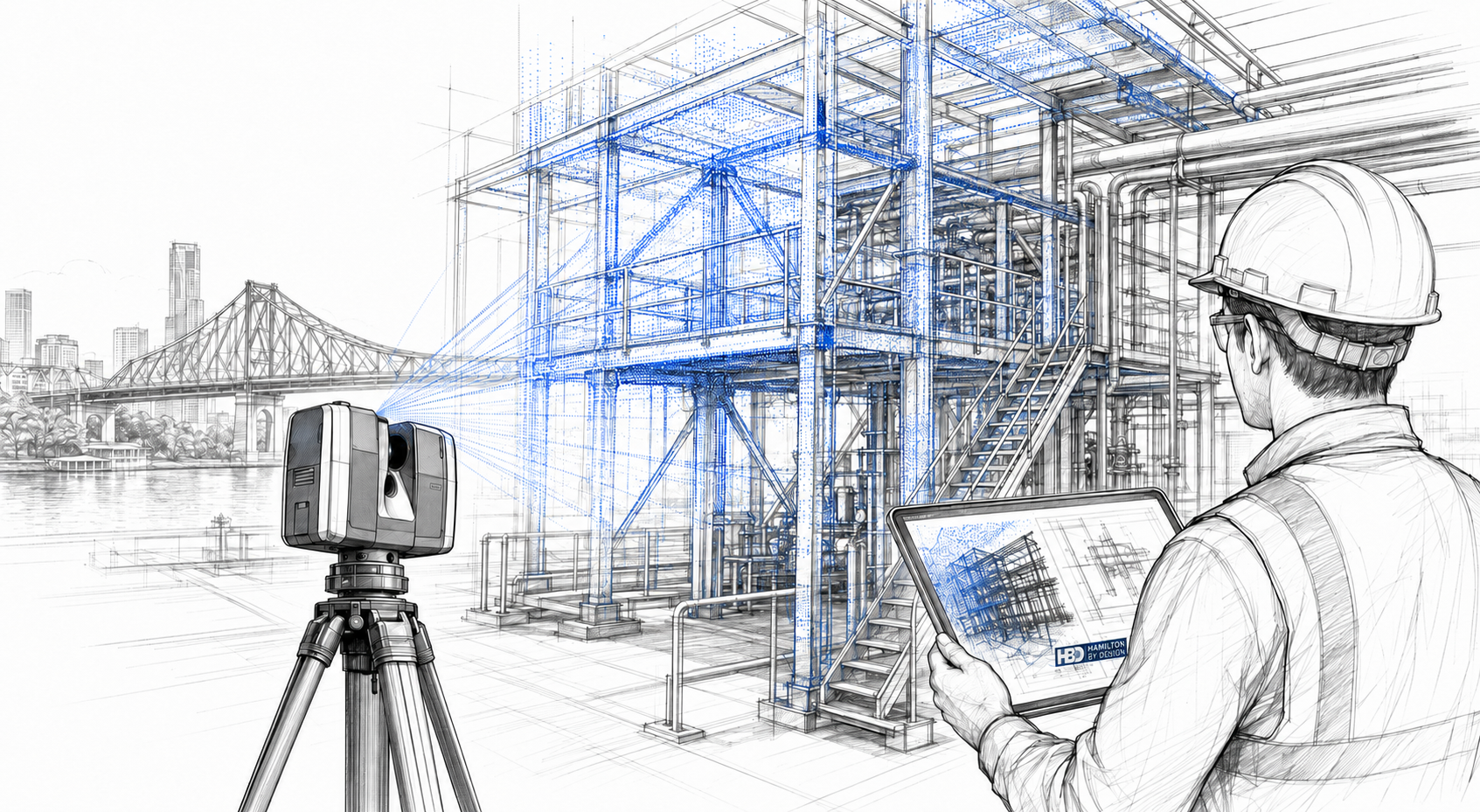
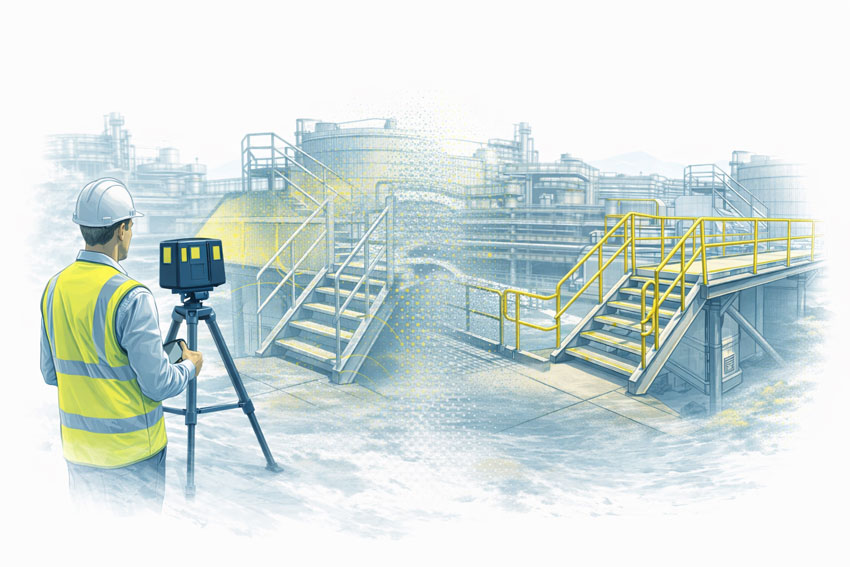
Architectural sketch of 3D LiDAR scanning for structural drafting in Brisbane, showing a laser scanner capturing steelwork, stairs and pipework with an engineer reviewing point cloud data.

3D Scanning for Structural Drafting Brisbane | Engineer-Led

Accurate As-Built Data for Structural Drafting โ€” No Guesswork

At Hamilton By Design, we provide 3D LiDAR scanning for structural drafting throughout Brisbane and Queensland, delivering accurate as-built data for project engineers, fabricators, councils, government agencies, and asset owners working across mining, infrastructure, and industrial environments.

In Brisbaneโ€™s diverse project landscape โ€” from remote mining support to commercial and infrastructure upgrades โ€” inaccurate or missing as-built drawings create risk. Our 3D scanning service captures real site conditions, eliminating guesswork, and feeding reliable data into structural drafting that you can trust.


3D LiDAR scanning and structural drafting in Brisbane with engineers working beside the Brisbane River and Story Bridge

Why 3D Scanning Matters for Structural Drafting in Brisbane

Brisbane projects often involve:

  • Brownfield industrial sites with undocumented steelwork
  • Live mining and logistics hubs with limited shutdown windows
  • Councils and government infrastructure requiring compliance
  • Fabrication and installation coordination across multiple stakeholders
  • Tight deadlines on construction and maintenance programs

Traditional survey methods introduce errors that lead to clashes, rework, and compliance risk. Engineering-grade 3D scanning provides a solid foundation for structural drafting, ensuring that what you design and detail reflects whatโ€™s actually on site.


3D Scanning as the Foundation for Structural Drafting

We position 3D scanning as a data capture tool that enables better structural drafting.

Our integrated workflow includes:

3D LiDAR scanning โ†’ 3D modelling โ†’ structural engineering โ†’ FEA (where required) โ†’ structural drafting

This ensures that:

  • Structural drawings are based on verified geometry
  • Clash risk for fabricated steel is significantly reduced
  • Engineering decisions are backed by accurate site data
  • Drafting aligns with constructability and installation sequences

One Local Team โ€” One Accountable Partner

Unlike fragmented processes that hand work between scanning and drafting vendors, we deliver the complete service:

  • 3D LiDAR scanning throughout Brisbane / Queensland
  • 3D model generation from as-built captures
  • Structural engineering and analysis
  • Finite Element Analysis (FEA), where required
  • Structural drafting and fabrication documentation

One contact. One accountable team. One integrated workflow.

This approach improves communication, reduces handover risk, and provides a single point of responsibility from site capture to final deliverables.


Brisbane-Based with Fast Turnaround

We are local to Brisbane and regularly work across:

  • Greater Brisbane and Southeast Queensland
  • Mining and logistics hubs (remote site support)
  • Government and council assets
  • Industrial and manufacturing facilities
  • Ports, wharves, and marine infrastructure

Being local allows us to mobilise quickly, respond to site constraints, and support projects with fast turnaround when time matters.


Typical Applications Across Brisbane & Queensland

Our 3D scanning for structural drafting services support:

  • Mining infrastructure and remote site steelwork
  • Brownfield industrial facilities
  • Bridges, transport infrastructure, and public assets
  • Council upgrades and compliance projects
  • Ports, shipyards, and marine structures
  • Manufacturing and warehouse structural works

Each engagement is approached with an emphasis on site access constraints, compliance, and practical installation outcomes.


Compliance You Can Rely On

All structural drafting is produced in accordance with:

  • The National Construction Code (NCC)
  • Relevant Australian Standards
  • Brisbane/Queensland government and council specifications

We understand that compliance is a key risk for clients. Our deliverables support defensible, data-backed documentation that aligns with project and regulatory requirements.


Designed for Project Engineers, Fabricators, and Asset Owners

This service is ideal for:

  • Project engineers needing high-confidence as-built data
  • Fabricators requiring accurate structural models
  • Consulting engineers supporting complex upgrades
  • Government and council clients with compliance mandates
  • Asset owners managing long-term structural integrity

We work collaboratively with project teams, fitting into existing delivery models rather than forcing new ones.


Hamilton By Design logo displayed on a blue tilted rectangle with a grey gradient background
3D LiDAR scanning and 3D modelling service button โ€” laser scanner capturing a point cloud for engineering and CAD modelling
Mechanical engineering services

Our clients:


Talk to Us About 3D Scanning for Structural Drafting in Brisbane

If you have a Brisbane-based project and need accurate as-built data to support structural drafting, weโ€™d welcome the opportunity to help.

Submit an enquiry via our contact form

Name
Would you like us to arrange a phone consultation for you?
Address

3D CAD Modelling Australia service banner for Hamilton By Design


CHPP Engineering title graphic featuring bold white text reading "CHPP Engineering" centred on a blue rounded rectangle background.
Pipework Drafting title graphic featuring bold white text reading "Pipework Drafting" centred on a blue rounded rectangle background.
3D LiDAR Scanning for Engineering Projects title graphic featuring bold white text on a blue rounded rectangle background.


Finite Element Analysis (FEA) engineering simulation button
Structural drafting services button
Mechanical drafting services button


Australian Drafting logo featuring bold white text reading "Australian Drafting" centred on a blue rounded rectangle background.
Engineering Governance title graphic featuring bold white text reading "Engineering Governance" centred on a blue rounded rectangle background.
Engineering-Grade LiDAR Scanning title graphic featuring bold white text on a blue rounded rectangle background.


Mechanical drafting services button
Structural drafting services button


Fabrication and product design services
3D CAD Modelling Australia service banner for Hamilton By Design
Mechanical, Structural & Pipework Drafting service banner by Hamilton By Design featuring white text on a blue background.


3D LiDAR scanning and 3D modelling service button โ€” laser scanner capturing a point cloud for engineering and CAD modelling
Mechanical engineering services
Reality Capture Brisbane title graphic with white text on a blue background promoting reality capture, LiDAR scanning and digital engineering services in Brisbane, Queensland.
3D Scanning Brisbane text graphic on a blue background promoting engineering-led laser scanning and reality capture services in Brisbane.

LiDAR Scanning Brisbane title graphic with white text on a blue background promoting terrestrial LiDAR scanning, point cloud capture and reality capture services in Brisbane, Queensland.
SolidWorks Brisbane title graphic with white text on a blue background promoting SolidWorks mechanical design, 3D CAD modelling and engineering drafting services in Brisbane, Queensland.


AS 1657 Access Compliance | Fixed Platforms, Walkways, Stairs & Ladders

Engineer using LiDAR scanner to assess a stairway with missing handrails, transitioning to AS 1657-compliant walkways and stairs in an operating plant

AS 1657 โ€“ Fixed Platforms, Walkways, Stairways & Ladders

One of the Most Enforced Standards on Mine Sites

Safe access is fundamental to operating plant. If people are required to inspect, operate, isolate, maintain, or repair equipment, they must be able to access it safely. This is why AS 1657 โ€“ Fixed platforms, walkways, stairways & ladders is one of the most actively enforced Australian Standards across mine sites, processing plants, and heavy industry.

Unlike many structural standards, AS 1657 compliance is highly visible, directly linked to injury risk, and simple for regulators to assess during inspections. As a result, access systems are often one of the first areas reviewed following incidents, audits, or site modifications.

Hamilton By Design supports asset owners by converting real as-built access steelwork into verified, engineering-grade digital records that can be assessed, upgraded, and documented with confidence.


Why AS 1657 Is Enforced So Frequently

AS 1657 governs how people physically move around plant. Regulators do not need detailed calculations to identify non-compliance โ€” they can see it immediately.

AS 1657 enforcement is commonly driven by:

  • Slips, trips and falls remaining a leading cause of mine-site injuries
  • Direct links to working-at-heights risk
  • Clear dimensional and geometric requirements
  • Strong alignment with WHS duty-of-care obligations

In practice, AS 1657 is enforced not because it is complex, but because non-compliance is visible and consequential.


LiDAR scanning of industrial stair and walkway access showing non-compliant handrails and the upgraded AS 1657-compliant access solution

Where AS 1657 Compliance Breaks Down in Operating Plant

Most access systems are originally designed with good intent. Problems develop over time as plant is modified, upgraded, or repurposed โ€” while access arrangements are not re-verified.

Common real-world scenarios include:

  • Walkways designed for inspection now used for routine maintenance
  • Increased personnel traffic driven by reliability or production demands
  • Temporary access becoming permanent
  • New guarding, chutes, pipework or services reducing clearances
  • Access steelwork modified during shutdowns with no formal review

The standard did not change โ€” the way the plant is used did.


Common AS 1657 Non-Conformances on Mine Sites

Across brownfield assets, the same access issues appear repeatedly:

  • Walkways narrower than required for the task being performed
  • Missing, incomplete, or inconsistent handrails and toe boards
  • Stairways outside allowable pitch or geometry limits
  • Inconsistent riser heights and tread depths
  • Ladders used where stairs should be provided
  • Unsafe access around conveyors, tanks, hoppers, and transfer stations
  • Ad-hoc access steelwork added without drawings or verification

Individually these issues may appear minor. Collectively, they represent a significant safety, compliance, and governance risk.


โ€œLooks Safeโ€ Is Not the Same as Compliant

A common industry assumption is that if access appears safe, it must be compliant. In reality:

  • Dimensional non-compliance is often subtle
  • Incremental changes hide cumulative risk
  • Visual acceptability does not equal compliance
  • Documentation is frequently missing or outdated

Most access systems do not fail catastrophically.
They fail audits, inspections, and incident reviews.


AS 1657 Interfaces with Other Standards

AS 1657 rarely exists in isolation on mine sites. It typically interfaces with:

  • AS 3990 โ€“ Mechanical equipment steelwork supporting access systems
  • AS 1755 โ€“ Conveyors and associated access and guarding
  • AS 4100 โ€“ Steel structures
  • WHS legislation โ€“ Enforcement and duty-holder accountability

Many compliance gaps occur at the interfaces between standards rather than within a single document.


The Documentation Gap in Access Compliance

A recurring challenge on older or modified sites is not necessarily unsafe access โ€” it is unverified access.

Common documentation gaps include:

  • Missing or obsolete access drawings
  • Handrails, stairs, and platforms never updated in CAD
  • Legacy drawings that no longer reflect site conditions
  • Inability to demonstrate compliance during audits

If you cannot prove what exists, it becomes difficult to prove compliance, fitness-for-purpose, or due diligence.


The Role of LiDAR Scanning in AS 1657 Compliance

Engineering-grade 3D LiDAR scanning provides a practical solution to access compliance challenges by capturing accurate as-built geometry.

LiDAR scanning allows asset owners to:

  • Measure real walkway widths, clearances, stair geometry and ladder access
  • Verify existing access systems against AS 1657 requirements
  • Identify non-compliances before audits or incidents
  • Design access upgrades that fit existing plant first time
  • Create reliable digital records for governance and lifecycle management

This approach replaces assumptions with measured reality.

Related service:
https://www.hamiltonbydesign.com.au/3d-laser-scanning/


AS 1657 in Brownfield Upgrades and Shutdowns

Access compliance is most commonly compromised during:

  • Tight shutdown windows
  • Conveyor and guarding upgrades
  • Debottlenecking and plant modifications
  • โ€œLike-for-likeโ€ replacements that repeat legacy issues

Without accurate as-built data, access upgrades risk fabrication rework, site clashes, and reinstating non-compliant geometry. Digital verification prior to fabrication significantly reduces these risks.


Our clients:

AS 1657 as a Due Diligence Issue for Asset Owners

For officers and senior leaders, AS 1657 compliance is not just an engineering detail โ€” it is a governance and due-diligence issue.

Demonstrating due diligence increasingly requires:

  • Evidence-based decision making
  • Documented verification of access systems
  • Clear linkage between identified risks and controls
  • Audit-ready engineering records

AS 1657 compliance is often one of the most visible indicators of how seriously an organisation treats safety and asset stewardship.


Practical Triggers to Review AS 1657 Compliance

An AS 1657 review should be considered when:

  • A near-miss or fall incident occurs
  • Maintenance frequency increases
  • New guarding or conveyors are installed
  • Access is modified during shutdowns
  • An audit or regulator inspection is upcoming
  • Assets are being sold, leased, or handed over

Early verification is significantly more cost-effective than reactive remediation.


Hamilton By Design logo displayed on a blue tilted rectangle with a grey gradient background
3D LiDAR scanning and 3D modelling service button โ€” laser scanner capturing a point cloud for engineering and CAD modelling
Mechanical engineering services

How Hamilton By Design Supports AS 1657 Compliance

Hamilton By Design supports access compliance by combining:

  • Engineering-grade LiDAR scanning
  • Accurate as-built CAD models
  • Practical upgrade and retrofit design
  • Fabrication-ready documentation

This enables asset owners to move from assumed compliance to verified compliance, with confidence in safety, constructability, and governance.

Name
Would you like us to arrange a phone consultation for you?
Address
Finite Element Analysis (FEA) engineering simulation button
Mechanical engineering services

AS 1755 Conveyor Safety

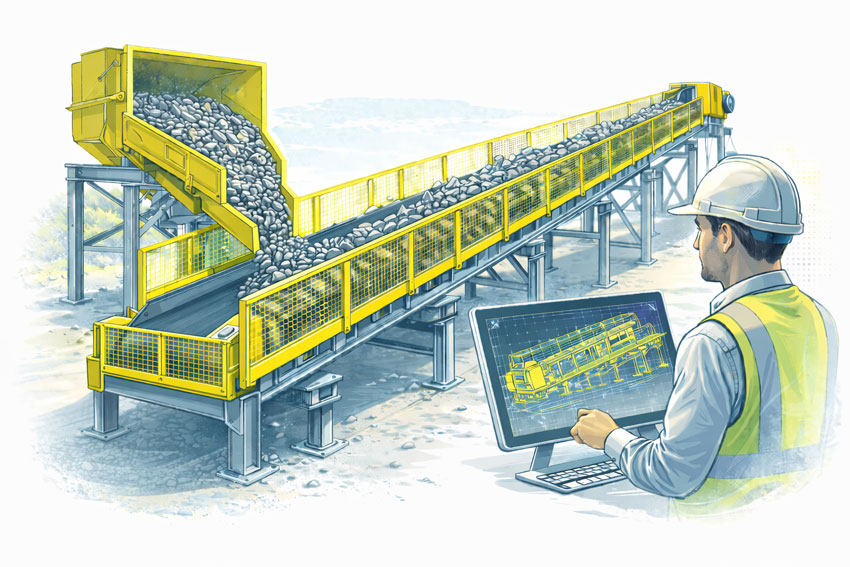
Engineer reviewing a guarded conveyor system with fixed side and nip-point guards designed to prevent access to moving parts.

Designing Conveyor Guarding for Compliance, Safety, and Practical Operation

Conveyors are widely used across processing, manufacturing, and materials-handling environments, but they also present some of the most persistent safety risks in industrial operations. Entrapment, nip points, rotating components, and maintenance access are all recognised hazards that must be managed through proper design and guarding.

In Australia, these risks are addressed through AS 1755 โ€“ Conveyors โ€“ Safety Requirements, which establishes the minimum safety expectations for conveyor systems across their full lifecycle, from design and installation through to operation and maintenance.

This article outlines what AS 1755 requires, why compliant conveyor guarding is critical, and how engineering-led design plays a key role in achieving practical safety outcomes.


Bulk materials conveyor with compliant safety guarding at the hopper, tail end, and along the conveyor, shown with an engineer reviewing guarding design drawings.
3D LiDAR scanning and 3D modelling service button โ€” laser scanner capturing a point cloud for engineering and CAD modelling
Mechanical engineering services

What Is AS 1755?

AS 1755 is the Australian Standard that defines safety requirements for belt conveyors and other conveyor systems. It addresses both new and existing installations and applies to conveyors used in industrial, commercial, and processing environments.

Rather than focusing on individual guarding components in isolation, AS 1755 considers the conveyor system as a whole, including how people interact with it during normal operation, inspection, cleaning, and maintenance.

The standard is referenced by regulators, safety professionals, and engineers as the primary benchmark for conveyor safety in Australia.


Key Safety Principles in AS 1755

AS 1755 is built around a number of core safety principles that influence how conveyor guarding should be designed.

These include eliminating hazards where possible, controlling remaining risks through engineering solutions, and ensuring that guarding does not introduce new risks by restricting access or encouraging unsafe behaviour.

In practice, this means that compliant guarding must be effective, durable, and suitable for the operating environment, while still allowing conveyors to be inspected, cleaned, and maintained safely.


Conveyor Guarding Requirements

A major focus of AS 1755 is the control of access to hazardous areas. This includes guarding of:

  • Drive pulleys and tail pulleys
  • Return rollers and idlers
  • Nip points and shear points
  • Rotating shafts and couplings
  • Chain drives, belt drives, and gearboxes

Guarding must be designed so that body parts cannot access hazardous zones, taking into account reach distances, openings, and the position of the conveyor relative to walkways or platforms.

Importantly, AS 1755 recognises that guarding must be fit for purpose. Poorly designed guards that are difficult to remove, inspect, or maintain are often bypassed or removed altogether, creating new safety risks.


Fixed Guards vs Interlocked Guards

AS 1755 allows for different types of guarding depending on the application and risk profile.

Fixed guards are commonly used where access is not required during normal operation. These guards must be securely fixed and require tools for removal.

Interlocked guards may be required where regular access is necessary. These systems ensure that the conveyor cannot operate while the guard is open or removed, reducing the risk of exposure to moving parts.

Selecting the appropriate guarding strategy requires an understanding of how the conveyor is used in practice, not just how it appears on drawings.


Existing Conveyors and Retrofit Challenges

Many conveyors currently in service were installed before the latest versions of AS 1755 were adopted. In these cases, compliance is often achieved through retrofit guarding rather than full replacement.

Retrofitting guarding to existing conveyors introduces additional challenges, including:

  • Limited space around existing equipment
  • Incomplete or outdated drawings
  • Structural constraints
  • Ongoing operation during upgrades

Engineering-led assessment and accurate documentation of existing conditions are critical when designing retrofit guarding solutions that comply with AS 1755 without disrupting operations.


The Role of Engineering in Conveyor Guarding Design

AS 1755 does not provide prescriptive โ€œone-size-fits-allโ€ guard designs. Instead, it sets performance requirements that must be interpreted and applied by competent professionals.

Engineering input is essential to ensure that conveyor guarding:

  • Addresses all relevant hazards
  • Integrates with existing mechanical and structural systems
  • Can be fabricated and installed accurately
  • Supports safe maintenance and inspection activities

Poorly engineered guarding may appear compliant on paper but fail in real-world use.


Documentation, Verification, and Ongoing Safety

Compliance with AS 1755 is not a one-time activity. Conveyor systems evolve over time as layouts change, equipment is upgraded, and operating practices shift.

Clear documentation of guarding design, installation, and assumptions provides a baseline for future modifications and safety reviews. This documentation is also critical when demonstrating due diligence to regulators or during incident investigations.


Why AS 1755 Matters

AS 1755 exists to prevent serious injuries and fatalities associated with conveyor systems. When applied correctly, it provides a structured framework for identifying hazards, implementing effective controls, and maintaining safe operation over the life of the equipment.

Achieving compliance requires more than installing mesh around moving parts. It requires understanding how people interact with conveyors and designing guarding that supports safe behaviour rather than working against it.


Hamilton By Design logo displayed on a blue tilted rectangle with a grey gradient background

Conveyor guarding designed in accordance with AS 1755 is a critical component of safe industrial operations. Engineering-led design, accurate documentation, and practical consideration of maintenance and operation are essential to achieving compliance that works in practice.

When conveyor safety is treated as an engineering problem rather than a checkbox exercise, the result is safer equipment, fewer incidents, and more reliable operations.

Manufacturing and production services button

Our clients


Name
Would you like us to arrange a phone consultation for you?
Address

3D CAD Modelling Australia service banner for Hamilton By Design


CHPP Engineering title graphic featuring bold white text reading "CHPP Engineering" centred on a blue rounded rectangle background.
Pipework Drafting title graphic featuring bold white text reading "Pipework Drafting" centred on a blue rounded rectangle background.
3D LiDAR Scanning for Engineering Projects title graphic featuring bold white text on a blue rounded rectangle background.


Finite Element Analysis (FEA) engineering simulation button
Structural drafting services button
Mechanical drafting services button


Australian Drafting logo featuring bold white text reading "Australian Drafting" centred on a blue rounded rectangle background.
Engineering Governance title graphic featuring bold white text reading "Engineering Governance" centred on a blue rounded rectangle background.
Engineering-Grade LiDAR Scanning title graphic featuring bold white text on a blue rounded rectangle background.


Mechanical drafting services button
Structural drafting services button


Fabrication and product design services
3D CAD Modelling Australia service banner for Hamilton By Design
Mechanical, Structural & Pipework Drafting service banner by Hamilton By Design featuring white text on a blue background.


3D LiDAR scanning and 3D modelling service button โ€” laser scanner capturing a point cloud for engineering and CAD modelling
Mechanical engineering services

Mechanical Engineering | Structural Engineering