The Hidden Problem in Most Workshops

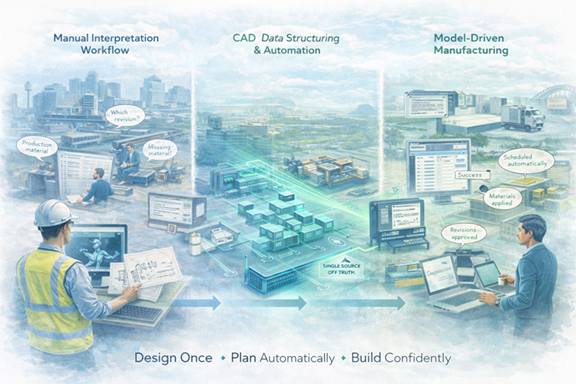
Illustration showing CAD models automatically generating manufacturing orders in a digital factory workflow.

Many manufacturers invest heavily in CAD modelling, yet the moment a drawing is finished someone still has to manually re-enter the same information into purchasing, inventory, or scheduling systems.

That means:

  • Part numbers typed again
  • Quantities re-counted
  • Materials guessed or re-checked
  • Work orders manually created

Every manual step introduces delay and risk.
The drawing may be correct โ€” but the data isnโ€™t trusted.

At Hamilton By Design, we specialise in converting engineering design information into operational manufacturing data so your workshop runs from a single source of truth.
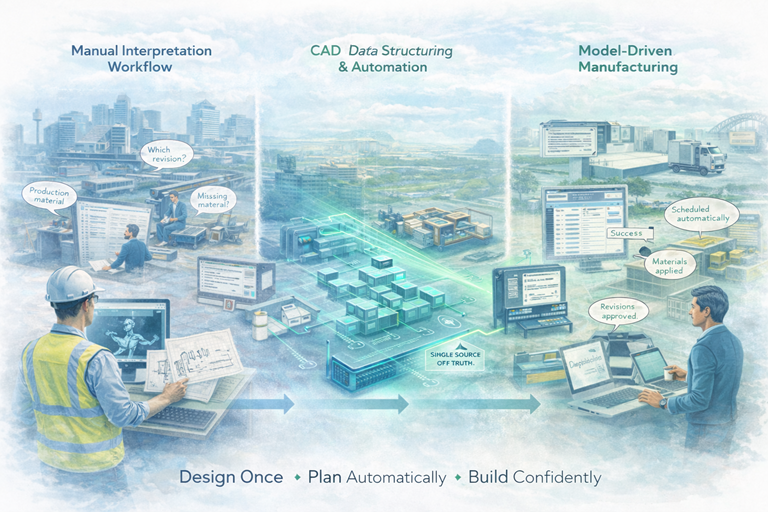

Engineering workflow transforming design drawings into live MRP production data.

What We Mean by โ€œRaw CAD Dataโ€

Raw CAD data typically contains far more intelligence than most businesses actually use:

  • Assembly structures
  • Component relationships
  • Material specifications
  • Mass & geometry
  • Fasteners & hardware
  • Configuration variations

Yet in many businesses, this intelligence is flattened into a PDF before production ever sees it.

The result?
Your ERP/MRP system becomes an administrative burden rather than an automation tool.


Turning CAD into Live MRP

We implement a workflow where the model drives the factory โ€” not paperwork.

Step 1 โ€” Data Structuring

We prepare your CAD models so every component carries meaningful manufacturing information:

  • Standardised naming conventions
  • Manufacturing classifications
  • Purchasing categories
  • Stock vs made items

Step 2 โ€” Bill of Materials Extraction

Instead of manually writing BOMs, they are generated directly from the model.

No re-typing.
No missed fasteners.
No version confusion.

Step 3 โ€” Live MRP Integration

The structured data feeds directly into your MRP system to automatically create:

  • Work orders
  • Material requirements
  • Purchase orders
  • Scheduling demand
  • Inventory reservations

Now your planning team works with live engineering data โ€” not interpreted drawings.


What This Changes Inside Your Business

Once CAD and MRP talk to each other, the workflow shifts dramatically.

Traditional WorkflowIntegrated Workflow
Draw โ†’ Print โ†’ Interpret โ†’ Re-enterModel โ†’ Validate โ†’ Manufacture
Planner guesses requirementsSystem calculates requirements
Revisions cause chaosRevisions update automatically
Production waits on adminProduction follows live data

The Real Value โ€” Engineering Becomes Operational

Your CAD system stops being a documentation tool and becomes the control system of the workshop.

This delivers measurable outcomes:

  • Reduced purchasing mistakes
  • Faster quoting
  • Accurate scheduling
  • Live material forecasting
  • Reliable cost tracking
  • Scalable production

Most importantly โ€” your team stops double handling information.


How Hamilton By Design Helps

We donโ€™t sell software โ€” we implement workflows.

Our team works between engineering and operations to:

  • Audit your current drawing workflow
  • Structure your CAD standards
  • Build automated BOM generation
  • Integrate with your MRP platform
  • Train staff in daily use
  • Support ongoing improvements

The goal is simple:
Design once. Manufacture confidently.


Hamilton By Design logo displayed on a blue tilted rectangle with a grey gradient background

3D LiDAR scanning and 3D modelling service button โ€” laser scanner capturing a point cloud for engineering and CAD modelling
Mechanical engineering services

Ready to Turn Drawings into Production?

If your workshop is still manually converting drawings into orders, the problem isnโ€™t your people โ€” itโ€™s the data flow.

Hamilton By Design helps manufacturers move from documents to systems.

Contact us to discuss turning your raw CAD data into live MRP data.

Name
Would you like us to arrange a phone consultation for you?
Address

3D LiDAR scanning and 3D modelling service button โ€” laser scanner capturing a point cloud for engineering and CAD modelling
Mechanical engineering services
Finite Element Analysis (FEA) engineering simulation button
Mechanical engineering services

Mechanical Engineering | Structural Engineering


Managing โ€œLoader Kneeโ€ While Operating a Chainsaw Safely

Managing Loader Knee & Chainsaw Use โ€“ Work Safely in Australia

Years spent climbing in and out of loaders, dozers, and haul trucks can leave many operators with what is commonly called โ€œloader knee.โ€ It isnโ€™t a single diagnosis โ€” rather a collection of knee problems caused by repetitive climbing, whole-body vibration, and long hours in fixed seated positions.

For people who also need to use a chainsaw โ€” on a mine site, rural property, or maintenance role โ€” loader knee can become a serious safety risk. Chainsaw work demands balance, stable footing, and quick reactions. The good news is that with the right approach, many people can continue to work safely.

Why Loader Knee and Chainsaws Donโ€™t Mix Easily

Chainsaw operation places unique demands on the lower body:

  • Knees remain slightly bent for long periods
  • Weight shifts constantly between legs
  • The operator must react instantly to kickback or timber movement
  • Work often occurs on uneven ground with vibration through the arms and body

If loader knee has caused instability, pain, or reduced strength, these demands can increase the likelihood of a slip, loss of control, or secondary injury.


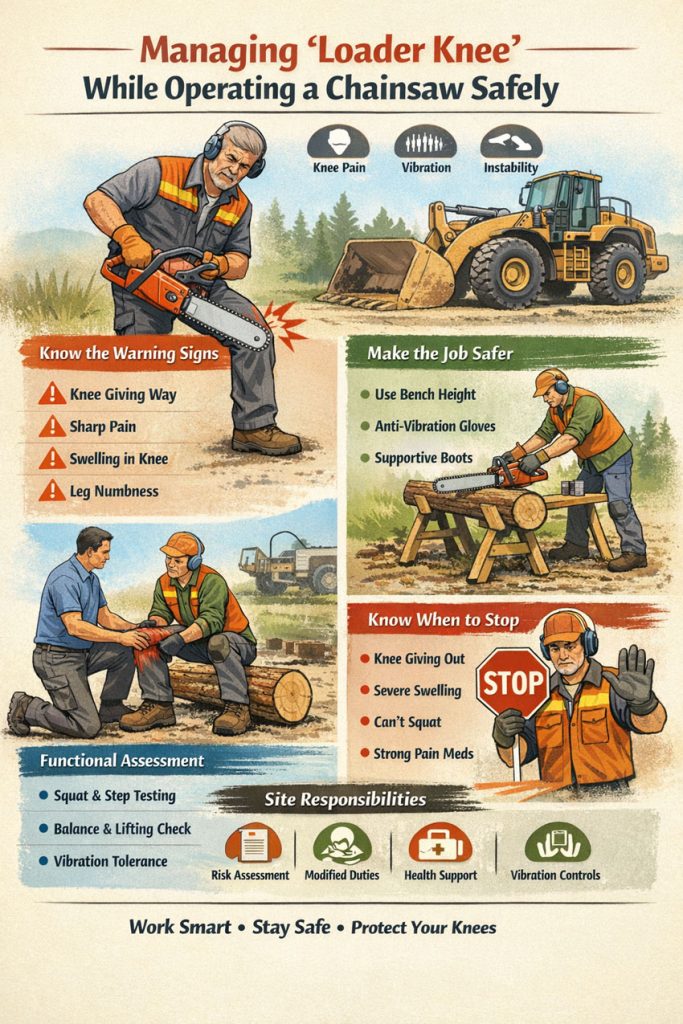
Infographic showing how to manage loader knee while operating a chainsaw safely with warnings, safe work methods and functional assessment steps.

Step 1 โ€“ Recognise the Early Warning Signs

Do not push through symptoms when a running saw is in your hands. Stop immediately if you experience:

  • Knee giving way or locking
  • Sharp pain when weight bearing
  • Swelling during the task
  • Reduced ability to squat or step sideways
  • Numbness or altered sensation down the leg

Finishing โ€œone last cutโ€ is how many incidents occur.


Step 2 โ€“ Make the Task Safer Before You Start

Engineering and Equipment Controls

  • Work at bench height using saw horses or log stands rather than ground felling
  • Choose a low-vibration chainsaw with a well-maintained sharp chain
  • Use anti-vibration gloves and supportive footwear
  • Avoid slopes, loose ground, and awkward reaches
  • Keep cutting zones close to waist height where possible

Administrative Controls

  • Limit cutting to 15โ€“20 minute blocks with rest breaks
  • Rotate to non-chainsaw duties
  • Use a second person for large or unstable timber
  • Complete a short warm-up before starting

Personal Supports

  • Knee brace with lateral support if recommended by a clinician
  • Strength program targeting quads, hamstrings, and glutes
  • Maintain healthy body weight to reduce joint load

Step 3 โ€“ Get the Right Type of Assessment

A general medical certificate often isnโ€™t enough. A functional capacity assessment should test the movements actually required for chainsaw work:

  • Holding a half-squat stance
  • Stepping sideways with a 5โ€“7 kg load
  • Recovering from a stumble
  • Tolerance to vibration
  • Repeated kneel-to-stand movements

This provides a realistic picture of whether the task is safe or needs modification.


Step 4 โ€“ Know When to Stop

Chainsaw use should cease โ€” temporarily or permanently โ€” if any of the following are present:

  • Recurrent knee collapse or instability
  • Inability to squat to approximately 70 degrees
  • Increasing swelling during work
  • Use of strong pain medication
  • Recent injections or acute injury

No production target is worth a life-changing accident.


Step 5 โ€“ Employer and Site Responsibilities

Under Australian WHS duties, a PCBU must ensure:

  • Task-specific risk assessments
  • Suitable duties or modified work
  • Review of vibration exposure
  • Access to occupational health support
  • Consideration of alternative methods such as pole saws or mechanical cutters

Managing loader knee is not just a personal issue โ€” it is a workplace safety obligation.


Hamilton By Design logo displayed on a blue tilted rectangle with a grey gradient background
3D Scanning Sydney banner promoting engineering-grade 3D laser scanning, LiDAR scanning, and reality capture services by Hamilton By Design.
Mechanical Engineering Sydney banner with white text on a blue background representing Hamilton By Design's mechanical engineering services in Sydney.
Mechanical Drafting and 3D Modelling Sydney banner highlighting Hamilton By Design's CAD drafting, 3D modelling, and engineering design services in Sydney.

A Practical Path Forward

Many experienced operators successfully continue chainsaw work by changing the way the task is done rather than ignoring the condition. The combination of smart engineering controls, realistic medical assessment, and sensible work planning keeps people productive and safe.

If you or your team need help developing:

  • Chainsaw SWMS and task risk assessments
  • Fitness-for-task guidance
  • Access and ergonomic improvements
  • Vibration exposure reviews

Hamilton By Design can assist with practical, site-focused solutions that protect both people and productivity.


Stay safe. Work smart. Look after your knees โ€” they still have plenty of shifts left in them.

3D LiDAR scanning and 3D modelling service button โ€” laser scanner capturing a point cloud for engineering and CAD modelling
Mechanical engineering services
Name
Would you like us to arrange a phone consultation for you?
Address
3D CAD Modelling Australia service banner for Hamilton By Design
3D LiDAR scanning and 3D modelling service button โ€” laser scanner capturing a point cloud for engineering and CAD modelling
Mechanical engineering services
Mechanical drafting services button
Blue rounded button with the text โ€œSolidWorks Designโ€ in white.
Blue banner graphic displaying the text "Point Cloud to CAD - Australia" in large white lettering, representing point cloud processing, scan-to-CAD conversion and digital engineering services across Australia.

Mechanical, Structural & Pipework Drafting service banner by Hamilton By Design featuring white text on a blue background.

Engineering Governance title graphic featuring bold white text reading "Engineering Governance" centred on a blue rounded rectangle background.
Mining Plant Upgrades promotional graphic with bold white text on a blue background representing mining infrastructure, plant improvement, and engineering upgrade projects.
3D Pipework promotional graphic with bold white text on a blue background representing pipework design, modelling, drafting, and engineering services.
Australian Drafting logo featuring bold white text reading "Australian Drafting" centred on a blue rounded rectangle background.
3D Pipework promotional graphic with bold white text on a blue background representing pipework design, modelling, drafting, and engineering services.
Mining Plant Upgrades promotional graphic with bold white text on a blue background representing mining infrastructure, plant improvement, and engineering upgrade projects.
3D LiDAR Scanning for Engineering Projects title graphic featuring bold white text on a blue rounded rectangle background.
Australian Drafting logo featuring bold white text reading "Australian Drafting" centred on a blue rounded rectangle background.
Engineering Governance title graphic featuring bold white text reading "Engineering Governance" centred on a blue rounded rectangle background.
Mechanical, Structural & Pipework Drafting service banner by Hamilton By Design featuring white text on a blue background.
Mechanical engineering services
Blue rounded button with the text โ€œSolidWorks Designโ€ in white.
Finite Element Analysis (FEA) engineering simulation button

Mechanical Engineering | Structural Engineering


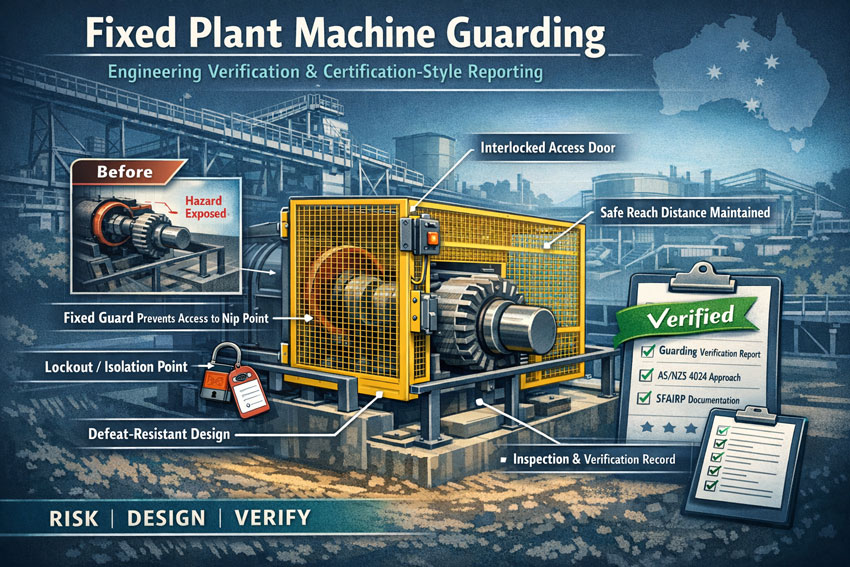
Industrial Machine Guarding Certification (Fixed Plant) โ€“ Engineering Verification & Guard Design

In industrial and mining environments, machine guarding is not a โ€œnice to haveโ€ โ€” itโ€™s a critical engineering control that protects people, prevents downtime, and demonstrates compliance with Australian WHS expectations.

Hamilton By Design Co. provides engineering-led design consulting and certification-style verification for fixed plant machine guarding, including new guarding systems, upgrades, and retrofit solutions for existing equipment.

Our focus is simple: protect workers, support safe production, and provide clear, defensible engineering documentation.


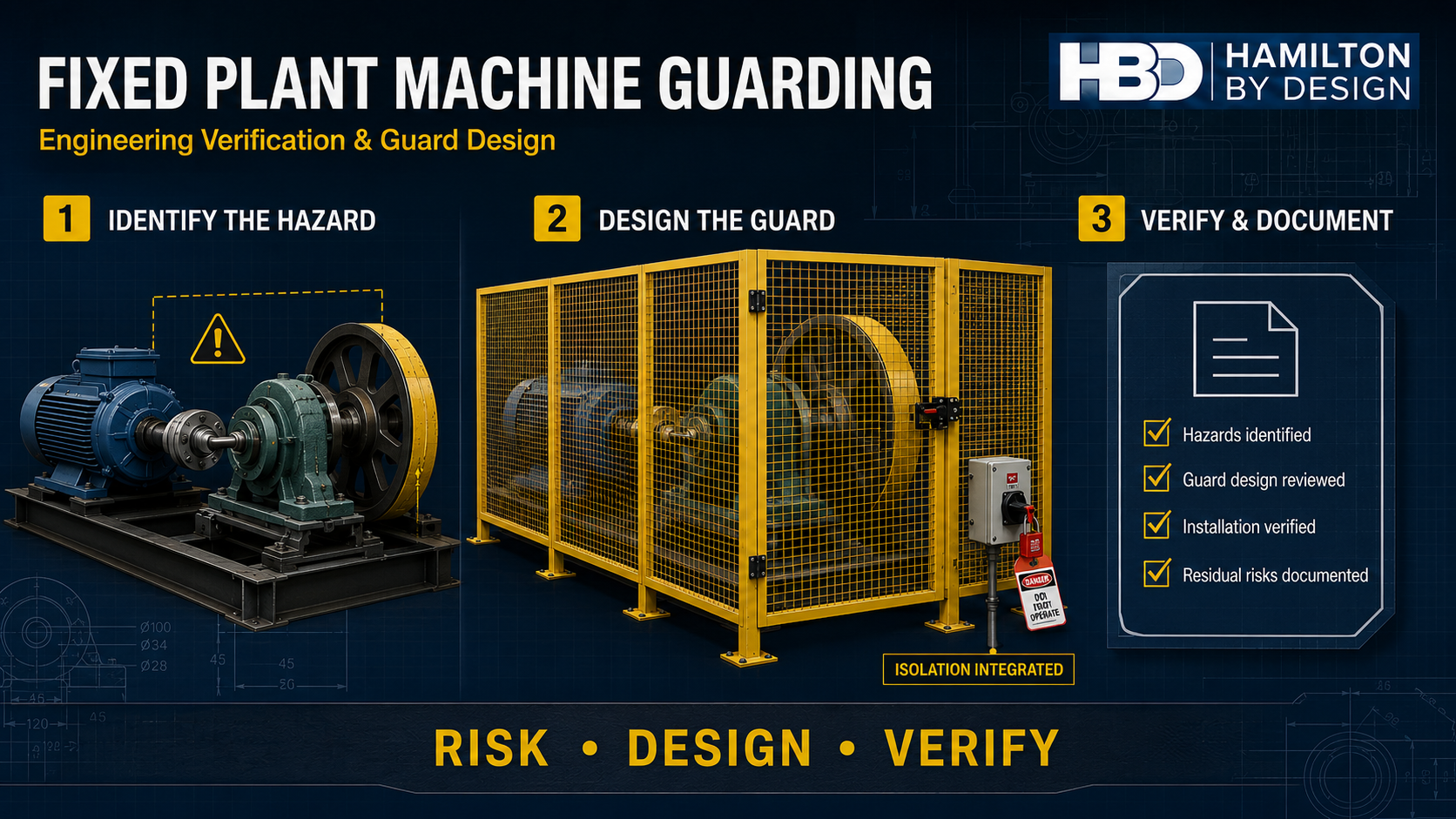
Engineering verification of fixed plant guarding with interlocked guard and inspection report.

What We Mean by โ€œGuarding Certificationโ€

In Australia, machine guarding is not typically certified under a single universal โ€œproduct stamp.โ€ Instead, machine guarding is assessed and verified through:

  • engineering design and risk-based safeguarding
  • alignment to recognised standards and good practice
  • site verification, inspection, and documentation that supports WHS duties

When we certify a guarding design, we provide an engineering verification that the guarding system has been assessed against Australian safety expectations and provides risk reduction so far as reasonably practicable (SFAIRP) for the intended use.


Fixed Plant Machine Guarding Services

We support fixed plant guarding across mining, processing, manufacturing, infrastructure and heavy industry, including:

Guarding Design & Retrofit Engineering

  • Fixed guards, mesh guards and perimeter guarding
  • Access prevention and safe maintenance access planning
  • Retrofit guarding upgrades for brownfields equipment
  • Guard structural design (frames, supports, fixings, corrosion allowance)

Guarding Verification & Certification Reports

  • Guard inspections (site verification and measurements)
  • Guarding compliance review and gap assessments
  • Design verification and risk reduction justification
  • Practical recommendations that balance safety and maintainability

Interlocks & Guarding Systems (Design Support)

  • Guard-associated interlocking concepts
  • Lock-out and isolation integration
  • Practical โ€œdefeat-resistantโ€ guard design principles

(Where functional safety calculations or specialist electrical control validation is required, we can work alongside your controls team or specialist partners.)


What We Deliver

Each project is documented for clarity and defensibility. Typical deliverables include:

  • Guarding risk review (hazards, access points, foreseeable misuse)
  • Design drawings / sketches and installation guidance
  • Verification checklist (inspection points and acceptance criteria)
  • Engineering Verification Report (often used as โ€œcertificationโ€ evidence)
  • Photo record and โ€œas-installedโ€ notes (where applicable)
  • Limitations, assumptions, and maintenance requirements

Standards & Compliance Approach

Our methodology is aligned with widely accepted Australian safeguarding practice, including:

  • AS/NZS 4024 (Safety of Machinery series)
  • Risk-based safeguarding methodology consistent with ISO 12100 principles
  • WHS duty expectations for plant and machinery risk control

We donโ€™t just reference standards โ€” we apply them to real conditions on your site: access, maintenance needs, exposure time, and realistic human behaviour around machines.


Who We Work With

We support:

  • mine sites and processing plants
  • maintenance departments
  • project teams (brownfields upgrades and shutdown work)
  • workshop supervisors and fabrication teams
  • OEMs and equipment suppliers needing Australian verification support

Whether your plant is locally built or imported, the end goal is the same: a safe guarding system that holds up under WHS scrutiny.


Why Hamilton By Design

Hamilton By Design is an engineer-led team that understands operational realities. We design guarding that:

  • protects people without creating unsafe workarounds
  • supports maintainability and inspection access
  • is practical to fabricate and install
  • is backed by professional engineering documentation

If you need a guarding solution that is fit-for-purpose and properly verified, we can support your team from assessment to final sign-off.


Typical Use Cases

  • Imported machinery requiring Australian guarding verification
  • Pre-commissioning guard reviews before handover
  • Incident-driven guarding upgrades
  • Shutdown retrofit packages and fabrication-ready guard designs
  • Periodic plant guarding audits and gap registers
3D LiDAR scanning and 3D modelling service button โ€” laser scanner capturing a point cloud for engineering and CAD modelling
Mechanical engineering services

Hamilton By Design logo displayed on a blue tilted rectangle with a grey gradient background

Call to Action

If you need a machine guarding certification-style verification or a complete fixed plant guarding design package, contact the Hamilton By Design team.

Letโ€™s reduce risk, protect your people, and keep your plant operating safely.

Name
Would you like us to arrange a phone consultation for you?
Address

3D CAD Modelling Australia service banner for Hamilton By Design
3D LiDAR scanning and 3D modelling service button โ€” laser scanner capturing a point cloud for engineering and CAD modelling
Mechanical engineering services
Mechanical drafting services button
Blue rounded button with the text โ€œSolidWorks Designโ€ in white.
Blue banner graphic displaying the text "Point Cloud to CAD - Australia" in large white lettering, representing point cloud processing, scan-to-CAD conversion and digital engineering services across Australia.
Mechanical, Structural & Pipework Drafting service banner by Hamilton By Design featuring white text on a blue background.
Engineering Governance title graphic featuring bold white text reading "Engineering Governance" centred on a blue rounded rectangle background.
Mining Plant Upgrades promotional graphic with bold white text on a blue background representing mining infrastructure, plant improvement, and engineering upgrade projects.
3D Pipework promotional graphic with bold white text on a blue background representing pipework design, modelling, drafting, and engineering services.
Australian Drafting logo featuring bold white text reading "Australian Drafting" centred on a blue rounded rectangle background.
3D Pipework promotional graphic with bold white text on a blue background representing pipework design, modelling, drafting, and engineering services.
Mining Plant Upgrades promotional graphic with bold white text on a blue background representing mining infrastructure, plant improvement, and engineering upgrade projects.
3D LiDAR Scanning for Engineering Projects title graphic featuring bold white text on a blue rounded rectangle background.
Australian Drafting logo featuring bold white text reading "Australian Drafting" centred on a blue rounded rectangle background.
Engineering Governance title graphic featuring bold white text reading "Engineering Governance" centred on a blue rounded rectangle background.
Mechanical, Structural & Pipework Drafting service banner by Hamilton By Design featuring white text on a blue background.
Mechanical engineering services
Blue rounded button with the text โ€œSolidWorks Designโ€ in white.
Finite Element Analysis (FEA) engineering simulation button

Mechanical Engineering | Structural Engineering


Learning From Industry Incidents

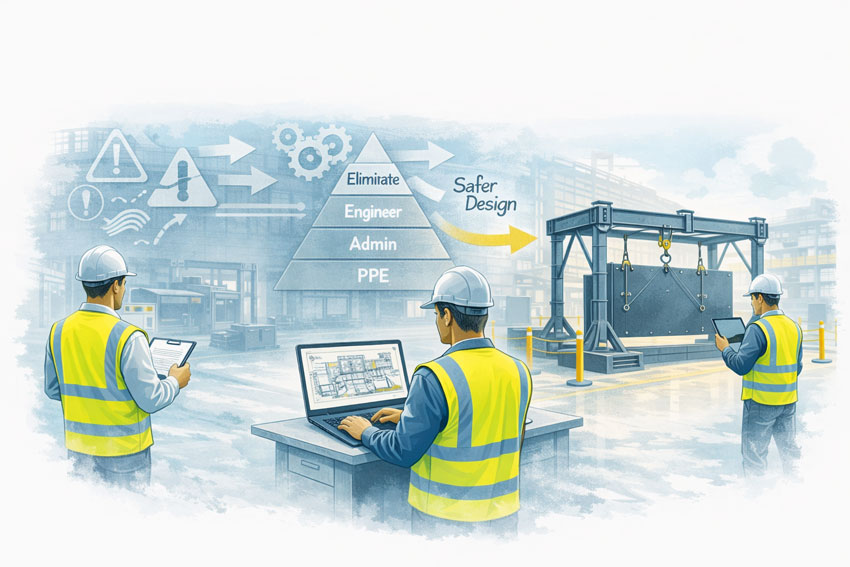
Engineers reviewing industrial design improvements in a mining fabrication workshop using engineering controls to reduce safety risks

Learning From Mining Industry Incidents | Engineering Insight

Why Engineers Study Failures Without Assigning Blame

In engineering, learning does not come only from success.

Some of the most valuable improvements in safety, reliability, and design practice come from studying incidents after they occur โ€” not to assign blame, but to better understand how systems behave under real-world conditions.

At Hamilton By Design, our interest in industry incidents is purely educational.
We do not provide legal opinions, and we do not involve ourselves in litigation.
Our focus is engineering learning and risk reduction.


Why Engineers Study Incidents

Engineering is a discipline built on:

  • Understanding failure modes
  • Learning from unintended outcomes
  • Improving designs so similar events are less likely to occur again

Courts determine liability.
Engineers determine how systems can be made safer.

These are very different roles.


Mining engineers applying design-for-safety principles to improve material handling systems in an industrial workshop

An Example From the Mining Fabrication Sector

A recent court-reported incident in the Australian mining fabrication sector involved a serious worker injury during the handling of a large steel plate.

This event has been widely reported in industry safety communications and regulator summaries.
The matter has been dealt with by the courts.

Our interest is not who was responsible โ€” but what can be learned from an engineering and design perspective.


When incidents are discussed publicly, it is easy for conversations to drift toward:

  • Fault
  • Error
  • Individual actions
  • Compliance outcomes

From an engineering standpoint, a more useful question is:

โ€œWhy was this failure mode possible in the first place?โ€

This shifts the focus from people to systems.


The Engineering Perspective: Systems, Not Individuals

In fabrication, mining, and heavy industry environments, engineers routinely work with:

  • Large masses
  • Stored energy
  • Gravity-driven hazards
  • Tight workspaces
  • Time pressure

In these environments, safe outcomes should not rely on:

  • Perfect timing
  • Continuous vigilance
  • People always being in the right place

Good engineering design assumes:

  • Humans make mistakes
  • Conditions change
  • Equipment can fail
  • Distractions occur

And it designs accordingly.


Learning Through the Hierarchy of Controls

One of the most useful tools engineers have for learning from incidents is the hierarchy of controls.

From a learning perspective, incidents often highlight opportunities to move risk higher up the hierarchy:

  • Can the hazard be eliminated?
  • Can the task be re-designed so people are not exposed?
  • Can engineering controls prevent a single failure from becoming an injury?
  • Are procedures being used where physical controls could exist instead?

These are design questions, not legal ones.


Why This Matters for Engineering Practice

Studying incidents like this helps engineers:

  • Identify hidden assumptions in workshop layouts
  • Improve material handling design
  • Reduce reliance on administrative controls
  • Design processes that are more tolerant of variation
  • Prevent โ€œnormalisedโ€ risk from becoming invisible

Importantly, these lessons apply well beyond a single incident or company.


The same learning approach is used when engineers study:

  • Structural failures
  • Mining incidents
  • Equipment damage
  • Tailings dam collapses
  • Process plant upsets

In each case, the goal is the same:

Understand how design decisions influence risk over time.

Not to judge โ€” but to improve.


Our Position at Hamilton By Design

To be clear:

  • We do not comment on legal responsibility
  • We do not provide expert opinions on prosecutions
  • We do not participate in legal proceedings

Our interest is strictly:

  • Engineering learning
  • Design improvement
  • Risk reduction
  • Better outcomes for industry

We believe that open, professional learning from incidents strengthens engineering practice and improves safety across the sector.


Final Thought

Engineering advances when professionals are willing to say:

โ€œWhat can we learn from this?โ€

Without blame.
Without legal positioning.
Without hindsight judgement.

Just better design, informed by real-world experience.


๐Ÿ“ฉ Engineering-Led Design Matters

If youโ€™re working in mining, fabrication, or heavy industry and want to reduce risk through better design decisions, Hamilton By Design supports engineering-led thinking that prioritises:

  • Hazard elimination
  • Fit-first-time outcomes
  • Design-for-fabrication
  • Systems that donโ€™t rely on perfect behaviour
Hamilton By Design logo displayed on a blue tilted rectangle with a grey gradient background
3D LiDAR scanning and 3D modelling service button โ€” laser scanner capturing a point cloud for engineering and CAD modelling
Mechanical engineering services

Talk to an engineer early.

Name
Would you like us to arrange a phone consultation for you?
Address
3D LiDAR scanning and 3D modelling service button โ€” laser scanner capturing a point cloud for engineering and CAD modelling
Mechanical engineering services
Finite Element Analysis (FEA) engineering simulation button
Mechanical engineering services

Mechanical Engineering | Structural Engineering


Project Management, Programme Control & Safety on Thai Infrastructure Projects

Engineers reviewing a project schedule beside live rail construction, illustrating the link between programme control, temporary works, and public safety in infrastructure projects.

Building the Case for Stronger Project-Management Governance on Thai Infrastructure Projects

Recent infrastructure failures in Thailand have highlighted an issue that extends beyond construction capability, technical standards, or nationality. The common thread running through these events is how large projects are governed, scheduled, and controlled.

This discussion is not about blame.
It is about delivery systems, incentives, and authority โ€” and whether current models are sufficiently robust for complex work undertaken beside live roads, rail, and the public.


The delivery context

Many major infrastructure projects in Thailand are delivered through government-to-government frameworks involving international state-linked partners, including Chinese state-owned enterprises such as China Railway Engineering Corporation and related entities.

Within these arrangements:

  • local contractors typically hold construction responsibility
  • international partners provide systems, standards, technical authority, or programme input
  • project milestones are tightly defined and politically significant

This model brings scale, funding certainty, and delivery speed. It also creates predictable pressure points that deserve closer examination.


Infrastructure project managers assessing schedules during crane operations near live rail, representing safety governance and programme control in complex urban construction.

What the recent failures tell us

The incidents that have triggered concern were not failures of rail technology or permanent structural design. They were predominantly:

  • temporary works failures
  • crane and staging incidents
  • work undertaken adjacent to live public corridors

These are execution and sequencing failures, not design failures โ€” and they are heavily influenced by programme structure and schedule control.

This leads to a fundamental governance question:

Who has the authority to change the programme when safe sequencing requires it?


Programme control is not neutral

When schedules are:

  • externally fixed
  • politically sensitive
  • commercially punitive to miss

risk does not disappear. It is transferred downward.

In practice, this often manifests as:

  • parallel work instead of sequential isolation
  • reduced exclusion zones
  • reliance on procedural controls rather than engineered separation
  • temporary works treated as โ€œmeans and methodsโ€ instead of engineered systems

None of this requires bad intent. It is a system response to inflexible programmes.


The role of Chinese state-owned enterprises

Chinese SOEs involved in these projects are not typically the principal construction contractors. However, they often exert significant influence over programme structure, milestones, and delivery expectations.

Across multiple countries, state-linked delivery models tend to exhibit consistent characteristics:

  • strong emphasis on schedule certainty
  • delegation of safety responsibility to downstream contractors
  • limited flexibility once programme commitments are set
  • incidents framed as execution issues rather than programme-design issues

Whether fair or not, this creates a perception that delivery behaviour is structurally stable and slow to change, even after serious failures.

That perception alone justifies a review of governance arrangements.


Why Australian project-management capability is relevant

Australian companies were not in project-management or programme-control roles on the projects that failed. As a result, Australian safety-governance practices were not embedded in the delivery model.

Australian project-management frameworks are shaped by:

  • acceptance that schedules must move to protect safety
  • independent temporary-works engineering and sign-off
  • explicit treatment of live-interface work as a programme risk
  • separation between commercial pressure and safety authority
  • deep experience in brownfield, shutdown, and live-asset environments

This does not make Australian firms better builders.
It makes them effective governance counterbalances in high-risk delivery environments.


The case for change

The argument is not to exclude existing partners.
It is to strengthen governance.

A more resilient delivery model could include:

  • Australian firms in programme-management or independent PM roles
  • independent temporary-works authorities reporting outside the construction chain
  • schedule-risk reviews with genuine authority to resequence work
  • clearer separation between political milestones and construction logic

These measures do not slow projects โ€” they prevent catastrophic delay caused by failure.


The central point

Safety outcomes are not determined by nationality or intent.
They are determined by who controls the programme, how flexible it is, and whether safety has real authority over time and cost.

Strengthening that authority is a rational, evidence-based step forward.


The power of the people

Real improvement in infrastructure delivery does not start with press releases.
It starts when engineers, supervisors, workers, and communities speak openly about how projects are actually delivered.

Those closest to the work experience programme pressure and safety trade-offs long before failures occur. Giving space to those voices is not about blame โ€” it is about learning, transparency, and better governance.

When people are allowed to speak, systems are forced to listen.


Hamilton By Design logo displayed on a blue tilted rectangle with a grey gradient background

Comments are open

This post is intended to encourage informed, professional discussion about project-management models, programme control, and safety governance.

The focus is on systems and incentives โ€” not nationality or individual blame.
Constructive perspectives from those with professional or on-the-ground experience are welcome.


3D LiDAR scanning and 3D modelling service button โ€” laser scanner capturing a point cloud for engineering and CAD modelling
Mechanical engineering services

Our clients:


Name
Would you like us to arrange a phone consultation for you?
Address
3D LiDAR scanning and 3D modelling service button โ€” laser scanner capturing a point cloud for engineering and CAD modelling
Mechanical engineering services
Finite Element Analysis (FEA) engineering simulation button
Mechanical engineering services

Mechanical Engineering | Structural Engineering


Emergency Management Policy

Hamilton By Design – Emergency Management Policy

Hamilton By Design is committed to protecting the health and safety of employees, contractors, clients, and visitors by ensuring effective planning, preparedness, and response to emergency situations.

This Emergency Management Policy outlines the framework for identifying potential emergency situations and responding in a timely, coordinated, and effective manner to minimise harm to people, property, and the environment.


Scope

This policy applies to all Hamilton By Design activities, including:

  • Office-based engineering and design work
  • 3D LiDAR scanning and site data capture
  • Engineering inspections and site visits
  • Work performed at client, construction, industrial, and mining sites
  • Interaction with clients, contractors, and visitors

Emergency Preparedness

Hamilton By Design will:

  • Identify potential emergency situations relevant to its activities, including but not limited to:
    • Fire and smoke
    • Medical emergencies
    • Chemical exposure or spills
    • Electrical incidents
    • Structural instability or collapse
    • Vehicle incidents
    • Extreme weather events
  • Maintain emergency response procedures appropriate to the nature of work being undertaken
  • Ensure access to emergency contact information and first aid resources
  • Comply with client and site-specific emergency management requirements when working off-site

Emergency Response

In the event of an emergency, Hamilton By Design will:

  • Prioritise the safety of people above all other considerations
  • Follow established emergency response procedures and site-specific emergency plans
  • Evacuate or isolate areas as required
  • Notify emergency services and relevant authorities when required
  • Communicate clearly with affected personnel, clients, and contractors

Roles and Responsibilities

Management

Management is responsible for:

  • Ensuring emergency management procedures are in place and maintained
  • Providing appropriate resources, training, and support
  • Coordinating emergency response where reasonably practicable

Employees and Contractors

Employees and contractors are responsible for:

  • Familiarising themselves with emergency procedures relevant to their work
  • Following emergency instructions and site rules
  • Reporting emergencies, hazards, or near misses immediately

Training and Awareness

Hamilton By Design ensures that:

  • Personnel are informed of emergency procedures applicable to their workplace or site
  • Site-specific emergency inductions are completed where required
  • Emergency awareness is maintained through ongoing communication

Incident Reporting and Review

All emergency incidents, near misses, and significant events must be reported. Hamilton By Design will investigate incidents to identify causes and implement corrective actions to prevent recurrence.


Business Continuity Considerations

Where appropriate, Hamilton By Design will take reasonable steps to:

  • Protect critical data and digital assets
  • Maintain continuity of engineering services following an emergency
  • Support recovery and return-to-work activities

Review and Continuous Improvement

This Emergency Management Policy is reviewed periodically to ensure it remains current, effective, and aligned with legislative requirements, operational changes, and industry best practice.


Approved by:
Hamilton By Design Management

Effective Date: 06/12/2006

Hamilton By Design logo displayed on a blue tilted rectangle with a grey gradient background
3D LiDAR scanning and 3D modelling service button โ€” laser scanner capturing a point cloud for engineering and CAD modelling
Mechanical engineering services
3D LiDAR scanning and 3D modelling service button โ€” laser scanner capturing a point cloud for engineering and CAD modelling
Mechanical engineering services
Finite Element Analysis (FEA) engineering simulation button
Mechanical engineering services

Mechanical Engineering | Structural Engineering