Wearable 3D Scanners vs LiDAR | Engineering Accuracy Explained
Why Speed Doesn’t Always Mean Accuracy in Industrial Scanning

Wearable 3D scanning systems — often referred to as backpack or body-mounted LiDAR scanners — are becoming increasingly common across mining, construction, and industrial environments.
These systems allow an operator to walk through a site and capture data in real time, significantly reducing time spent in the field.
However, while speed has improved, an important question remains:
Are wearable scanners suitable for engineering and fabrication work?
At Hamilton By Design, we take an engineering-led approach to scanning. The answer is not as simple as many vendors suggest.



What Are Wearable 3D Scanners?
Wearable scanners, also known as SLAM LiDAR systems, are designed to be worn while walking through a site.
They typically use a combination of:
- LiDAR sensors
- Cameras
- Inertial Measurement Units (IMU)
- SLAM (Simultaneous Localisation and Mapping) algorithms
This allows the system to generate a continuous 3D point cloud without the need for tripod setups or survey targets.
In simple terms, the operator becomes the scanner.
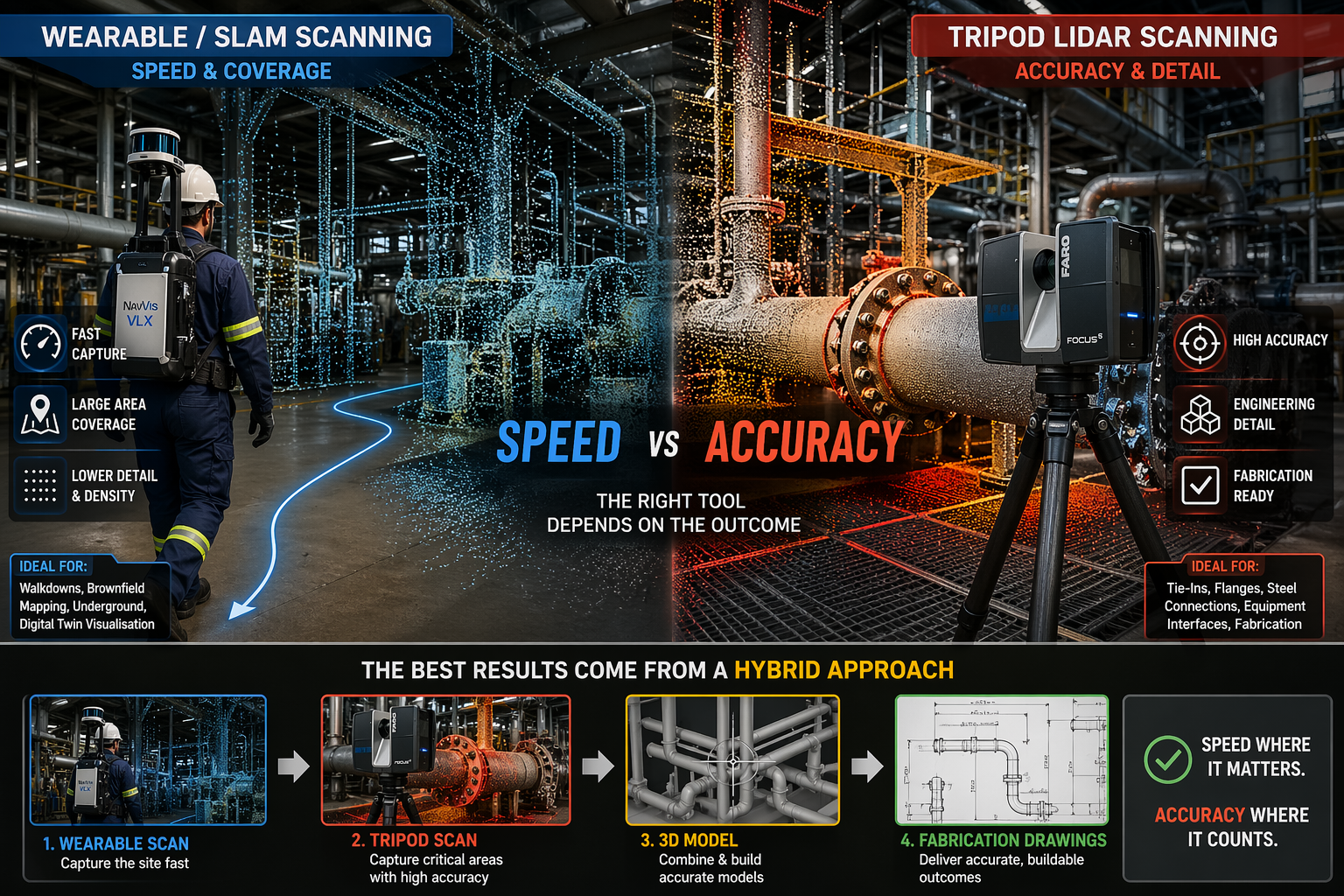
The Key Advantage: Speed
The main advantage of wearable systems is speed.
They allow for:
- Rapid site capture
- Minimal setup time
- Scanning of complex or confined environments
- Efficient coverage of large areas
For walkdowns, site familiarisation, and early-stage layouts, wearable scanning is highly effective.
The Trade-Off: Accuracy and Detail
While wearable systems offer speed, they come with trade-offs.
Wearable SLAM scanners typically produce:
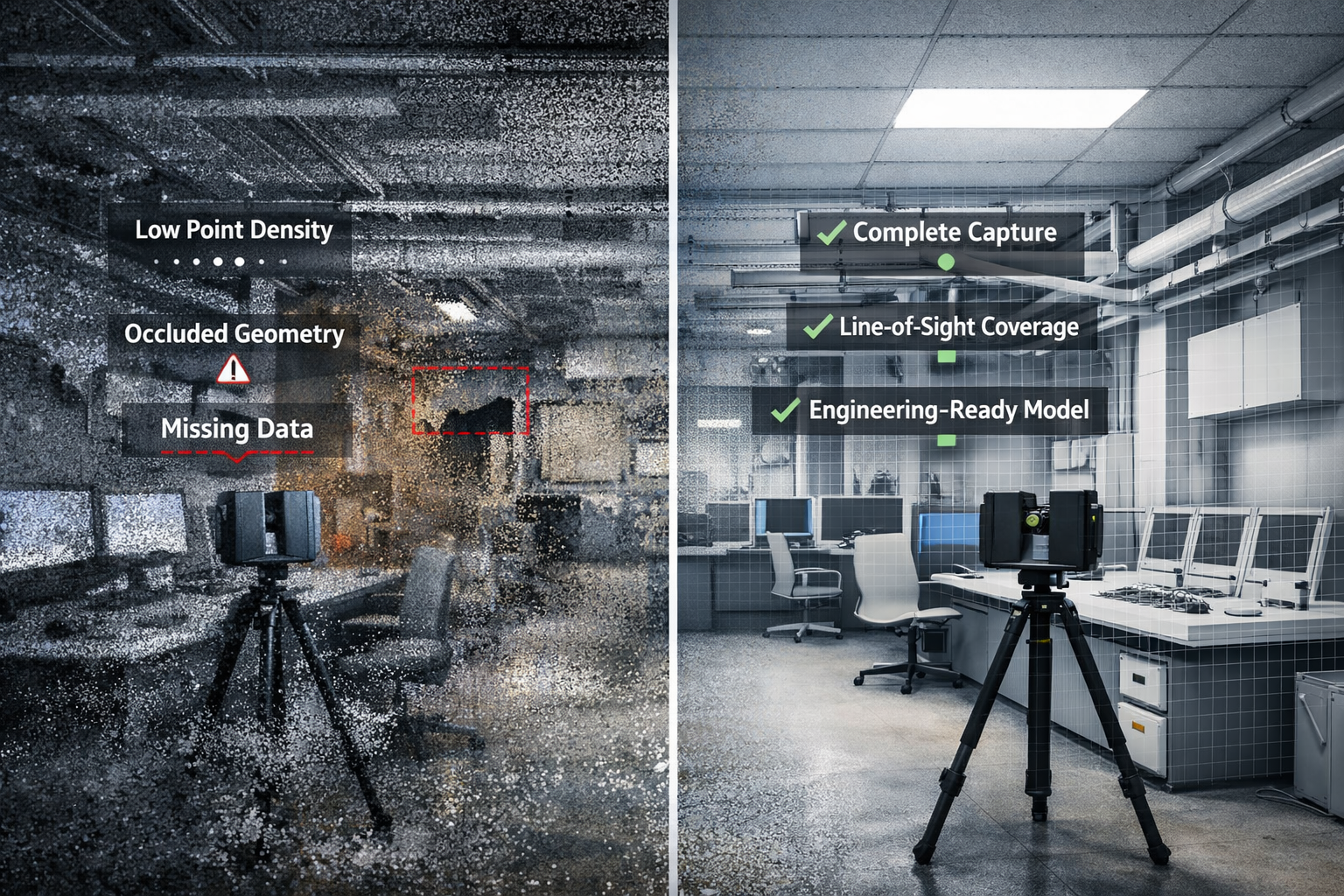
- Lower point density
- Reduced edge definition
- Positional drift over longer distances
In contrast, traditional terrestrial LiDAR scanners provide:
- High-density point clouds
- Sharp and well-defined geometry
- Millimetre-level accuracy
- Repeatable and verifiable results
Why This Matters for Engineering
In industrial environments, scan data is not just for visualisation. It is used for:
- Design modelling
- Clash detection
- Fabrication drawings
- Installation planning
If the data lacks accuracy, it can lead to:
- Misaligned pipework
- Incorrect steel fabrication
- Costly rework during shutdowns
A model that looks correct is not the same as a model that is correct.
Where Wearable Scanning Works Best
Wearable systems are well suited to:
- Large-scale site capture
- Underground environments
- Brownfield walkdowns
- Asset mapping
- Digital twin visualisation
They provide excellent coverage and speed, but are not always suitable for detailed engineering work.
Where Engineering-Grade LiDAR Is Essential
Tripod-based LiDAR scanning is critical for:
- Tie-in points
- Flanges and pipe interfaces
- Structural steel connections
- Equipment interfaces
- Fabrication-ready modelling
These are areas where millimetre-level accuracy is required.
The Reality: A Hybrid Approach
The most effective approach is not choosing one system over the other, but combining both.
A typical workflow includes:
- Wearable scanning to capture the full site quickly
- Tripod LiDAR scanning to capture critical areas with high accuracy
This provides both speed and precision.
Engineering-Led Scanning vs Fast Scanning
There is a common misconception that faster scanning leads to better outcomes.
In reality:
- Fast data is only useful if it is accurate
- Point clouds must support engineering decisions
- Accuracy must align with project risk
At Hamilton By Design, the focus is on delivering:
- Engineering-grade outputs
- Scan-to-model workflows
- Fabrication-ready data
Our clients


























Talk to us – Contact Us
Inspired By Jim