This page was last changed on 9 September 2026, last checked on 9 September 2026 and applies to citizens of Australia.
1. Introduction
Our website, https://www.hamiltonbydesign.com.au (hereinafter: "the website") uses cookies and other related technologies (for convenience all technologies are referred to as "cookies"). Cookies are also placed by third parties we have engaged. In the document below we inform you about the use of cookies on our website.
2. What are cookies?
A cookie is a small simple file that is sent along with pages of this website and stored by your browser on the hard drive of your computer or another device. The information stored therein may be returned to our servers or to the servers of the relevant third parties during a subsequent visit.
3. What are scripts?
A script is a piece of program code that is used to make our website function properly and interactively. This code is executed on our server or on your device.
4. What is a web beacon?
A web beacon (or a pixel tag) is a small, invisible piece of text or image on a website that is used to monitor traffic on a website. In order to do this, various data about you is stored using web beacons.
5. Consent
When you visit our website for the first time, we will show you a pop-up with an explanation about cookies. You do have the right to opt-out and to object against the further use of non-functional cookies.
5.1 Manage your consent settings
You have loaded the Cookie Policy without javascript support. On AMP, you can use the manage consent button on the bottom of the page.
You can also disable the use of cookies via your browser, but please note that our website may no longer work properly.
6. Cookies
6.1 Technical or functional cookies
Some cookies ensure that certain parts of the website work properly and that your user preferences remain known. By placing functional cookies, we make it easier for you to visit our website. This way, you do not need to repeatedly enter the same information when visiting our website and, for example, the items remain in your shopping cart until you have paid. We may place these cookies without your consent.
6.2 Analytical cookies
We use analytical cookies to optimize the website experience for our users. With these analytical cookies we get insights in the usage of our website.
6.3 Marketing/Tracking cookies
Marketing/Tracking cookies are cookies or any other form of local storage, used to create user profiles to display advertising or to track the user on this website or across several websites for similar marketing purposes.
6.4 Social media
On our website, we have included content from Instagram, X (Formerly Twitter) and LinkedIn to promote web pages (e.g. “like”, “pin”) or share (e.g. “tweet”) on social networks like Instagram, X (Formerly Twitter) and LinkedIn. This content is embedded with code derived from Instagram, X (Formerly Twitter) and LinkedIn and places cookies. This content might store and process certain information for personalized advertising.
Please read the privacy statement of these social networks (which can change regularly) to read what they do with your (personal) data which they process using these cookies. The data that is retrieved is anonymized as much as possible. Instagram, X (Formerly Twitter) and LinkedIn are located in the United States.
You can use your internet browser to automatically or manually delete cookies. You can also specify that certain cookies may not be placed. Another option is to change the settings of your internet browser so that you receive a message each time a cookie is placed. For more information about these options, please refer to the instructions in the Help section of your browser.
Please note that our website may not work properly if all cookies are disabled. If you do delete the cookies in your browser, they will be placed again after your consent when you visit our website again.
9. Your rights with respect to personal data
You have the following rights with respect to your personal data:
you may submit a request for access to the data we process about you;
you may request an overview, in a commonly used format, of the data we process about you;
you may request correction or deletion of the data if it is incorrect or not or no longer relevant for any purpose under the Privacy Act.
To exercise these rights, please contact us. Please refer to the contact details at the bottom of this cookie statement. If you have a complaint about how we handle your data, we would like to hear from you.
10. Contact details
For questions and/or comments about our Cookie Policy and this statement, please contact us by using the following contact details:
Hamilton By Design 10/11 Donaldson St,
Wyong NSW Australia 2259 Australia Website: https://www.hamiltonbydesign.com.au Email: anthony@ex.comhamiltonbydesign.com.au Phone number: 0477002249
This Cookie Policy was synchronised with cookiedatabase.org on 19 June 2026.
Proven Engineering. Real Results. Every project starts with a challenge — tight shutdowns, outdated drawings, structural fatigue, or a need to innovate fast. At Hamilton By Design, we bring practical design engineering, LiDAR scanning, and SolidWorks expertise together to deliver reliable, measurable outcomes for clients across mining, manufacturing, and data-centre infrastructure.
Explore some of our featured case studies below.
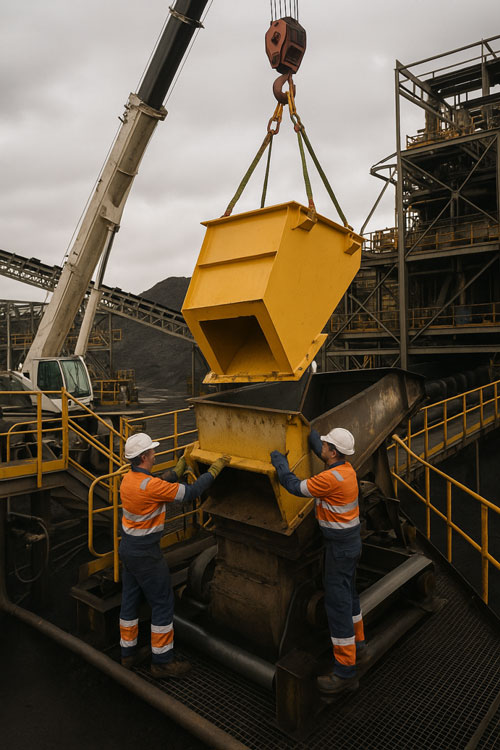
CHPP Chute & Launder Replacement – Hunter Valley
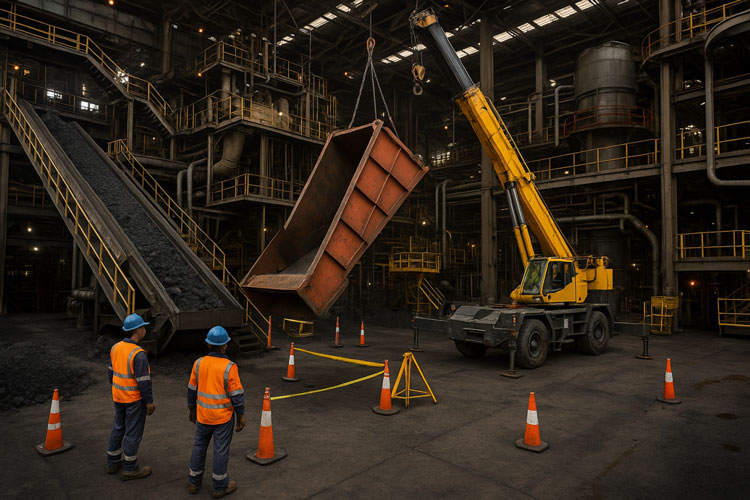
Scope: Redesign and replacement of a primary discharge chute and launder system within a coal wash plant shutdown. Challenge: The original chute geometry caused material hang-ups, high wear, and unplanned downtime. Our Approach:
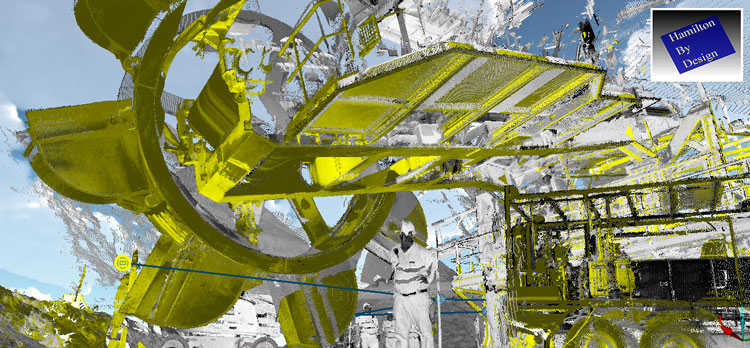
3D laser scan of as-built geometry to capture alignment constraints
SolidWorks 3D modelling and flow verification
FEA structural validation to AS 3990 and AS 4100
Prefabrication validation and bolt-access checks
Outcome: Reduced install time by 38 %, eliminated flow bottlenecks, and improved liner change-out safety.
3D LiDAR Scan-to-Model Retrofit – Central Coast
Scope: Full as-built capture of process plant and mechanical upgrade integration. Challenge: No reliable drawings existed; site shutdown window limited to 24 hours. Our Approach:
High-accuracy terrestrial LiDAR scanning
Point-cloud registration and SolidWorks conversion
Clash detection and layout optimisation
Deliverables in STEP and DWG formats
Outcome: Delivered verified as-built model within 48 hours, enabling prefabrication of pipe spools with zero site rework.
Scope: Lifting and access frame redesign for production line maintenance. Challenge: Existing frame lacked design documentation and had unknown load paths. Our Approach:
Reverse-engineered frame geometry using scanning
Conducted FEA load analysis to AS 4991 (Lifting Devices)
Every coal wash plant in Australia tells the same story: constant throughput pressure, harsh operating conditions, and the never-ending battle against wear, corrosion, and unplanned downtime. The reality is simple — if you don’t engineer for reliability, you’ll spend your time repairing failure.
At Hamilton By Design, we specialise in mechanical engineering, 3D scanning, and digital modelling for coal handling and preparation plants (CHPPs). Our goal is to help site teams transition from reactive maintenance to a precision, data-driven strategy that keeps production steady and predictable.
Design for Reliability — Not Reaction
Reliability begins with smart mechanical design. Poor geometry, limited access, and undersized components lead to fatigue and repeated downtime. Instead, modern CHPP maintenance programs start by engineering for fit, lift, and life:
Fit: Design components that align with the existing structure — every bolt, flange, and mating face verified digitally before fabrication.
Lift: Incorporate certified lifting points that comply with AS 4991 Lifting Devices, and ensure clear access paths for cranes or chain blocks.
Life: Select wear materials suited to the physics of the process — quenched and tempered steel for impact, rubber or ceramic for abrasion, and UHMWPE for slurry lines.
It’s not just about parts; it’s about engineering foresight. A well-designed plant component is safer to install, easier to inspect, and lasts longer between shutdowns.
Scan What You See — Not What You Think You Have
Over time, every wash plant drifts from its original drawings. Field welds, retrofits, and corrosion mean that “as-built” and “as-exists” are rarely the same thing.
That’s where LiDAR scanning transforms maintenance. Using sub-millimetre accuracy, 3D laser scans capture your plant exactly as it stands — every pipe spool, every chute, every bolt hole.
With this data, our engineers can:
Overlay new models directly into your point cloud to confirm fit-up before fabrication.
Identify alignment errors, corrosion zones, and clearance conflicts before shutdowns.
Generate true digital twins that allow for predictive maintenance and simulation.
LiDAR scanning isn’t just a measurement tool; it’s an insurance policy against rework and lost production.
Corrosion: The Hidden Killer in Every CHPP
Coal and water don’t just move material — they create acidic environments that eat through untreated or aging steel. In sumps, launders, and under conveyors, corrosion silently compromises strength until a structure is no longer safe to walk on.
Regular inspections are the first line of defence. At Hamilton By Design, we recommend combining:
Daily visual checks by operators for surface rust and coating damage.
Thickness testing during shutdowns to track wall loss on chutes and pipes.
3D scan comparisons every 6–12 months to quantify deformation and corrosion in critical structures.
With modern tools, you can see corrosion coming long before it becomes a failure.
From Data to Decision: Predictive Maintenance in Action
A coal wash plant produces a river of data — motor loads, vibration levels, pump pressures, liner thickness, and flow rates. The key is turning that data into insight.
By integrating scanning results, maintenance records, and sensor data, plant teams can identify trends that point to future breakdowns. For example:
Vibration trending can reveal bearing fatigue weeks before failure.
Load monitoring can detect screen blinding or misalignment.
Scan data overlays can show sagging supports or displaced chutes.
When you understand what your plant is telling you, you move from reacting to problems to predicting and preventing them.
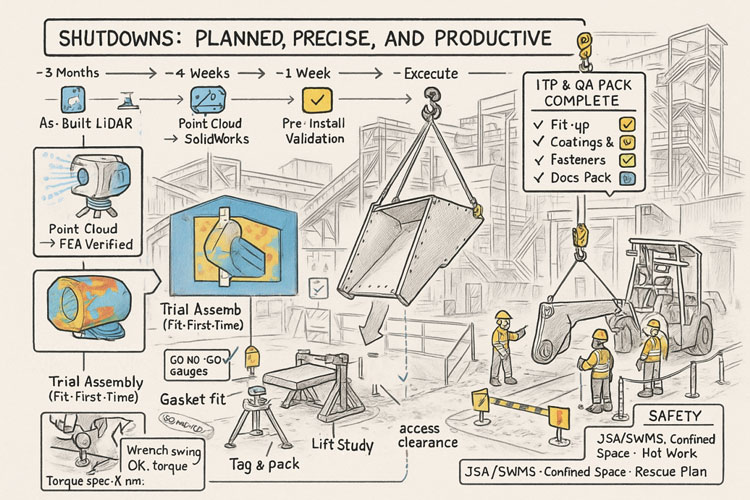
Shutdowns: Planned, Precise, and Productive
Every shutdown costs money — the real goal is to make every hour count. The best shutdowns start months ahead with validated design data and prefabrication QA.
Before you cut steel or mobilise cranes, every component should be digitally proven to fit. Trial assemblies, lifting studies, and bolt access checks prevent costly surprises once you’re on the clock.
At Hamilton By Design, our process combines:
LiDAR scanning to confirm as-built geometry.
SolidWorks modelling and FEA for mechanical verification.
Pre-installation validation to ensure bolt holes, flanges, and lift paths align on day one.
That’s how you replace chutes, spools, and launders in a fraction of the usual time — safely, and with confidence.
The Payoff: Reliability You Can Measure
The plants that invest in engineering-led maintenance see results that are tangible and repeatable:
Improvement Area
Typical Gain
Reduced unplanned downtime
30–40%
Increased liner lifespan
25–50%
Shorter shutdown duration
10–20%
Fewer fit-up issues and rework
60–80%
Improved safety performance
20–30%
Reliability isn’t luck — it’s engineered.
Your Next Step: A Confidential Mechanical Assessment
Whether your plant is in the Bowen Basin, Hunter Valley, or Central West NSW, our team can deliver a confidential mechanical and scanning assessment of your wash plant.
We’ll benchmark your current maintenance strategy, identify high-risk areas, and provide a clear roadmap toward predictive, engineered reliability.
📩 For a confidential assessment of your current wash plant, contact: [email protected]
Stop reacting. Start engineering. Build reliability that lasts.
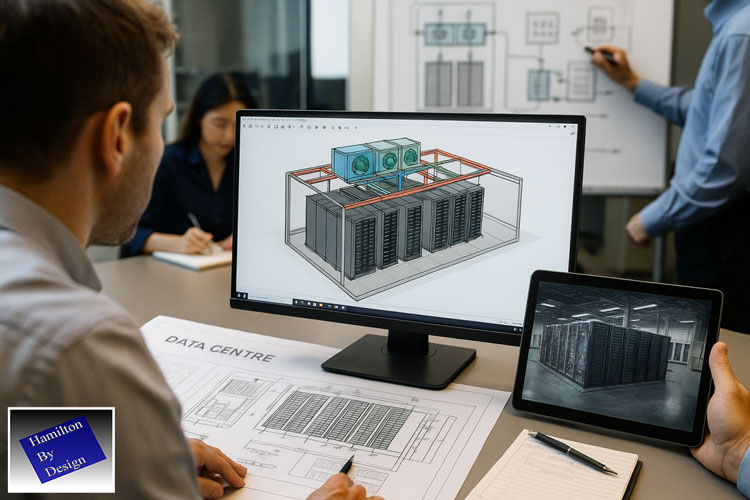
Australia’s digital infrastructure is expanding rapidly — and so is the demand for Data Centre Design that delivers reliability, performance, and scalability.
At Hamilton By Design, our team transforms concept and intent into manufacturable, modular, and compliant systems.
We specialise in Data Centre Design, mechanical and structural systems engineering, and fabrication-ready modelling that connect advanced engineering with real-world delivery. Every project is supported by traceable documentation, detailed verification, and hands-on manufacturing experience — ensuring confidence from start to finish.
Our Team Understands the Pressures of Data Centre Design
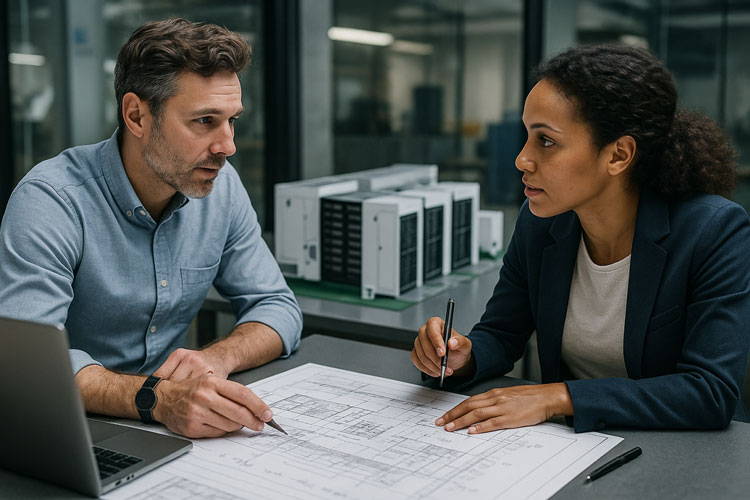
Our team understands that Data Centre Design is not just about drawings — it’s about precision, coordination, and absolute reliability.
We recognise the pressures of delivering mission-critical infrastructure: tight timelines, technical complexity, regulatory compliance, and no margin for downtime. That’s why our approach to Data Centre Design is built on clarity, accountability, and engineering confidence.
By combining advanced modelling with practical fabrication knowledge, our team ensures every interface aligns, every system performs, and every project milestone builds trust. Our goal is to make the journey from design to delivery simpler, faster, and more certain.
Our Integrated Data Centre Design Offerings
1. Modular & Prefabricated Systems
Factory-Built Reliability Our team delivers modular systems that make Data Centre Design faster, safer, and more predictable. We design and fabricate plug-and-play assemblies — cooling skids, racking frames, HVAC supports, and power-distribution modules — engineered for repeatability and verified off-site before installation. From design to deployment — built locally.
2. Mechanical & Structural Systems Engineering
Engineered for the Workshop Our team converts design concepts into fabrication-ready 3D models, optimised for Data Centre Design precision and installation accuracy. Using LiDAR scanning and FEA validation, we eliminate tolerance issues and ensure perfect fit-up on site. Designs that build themselves.
3. Energy & Water Integration
Engineered Sustainability Modules Modern Data Centre Design requires efficient energy and cooling systems. Our team develops renewable-ready modules, including battery enclosures, hybrid cooling loops, and water-recycling assemblies. These systems improve energy performance, reduce water consumption, and support sustainability targets. Turning sustainability into engineered reality.
4. Retrofit & Upgrade Engineering
Upgrades Without Downtime Our team delivers Data Centre Design solutions for live facilities needing upgrades or expansion. Through LiDAR scanning and modular fabrication, we create retrofit systems that fit precisely within existing structures — enabling capacity growth without disrupting operations.
Upgrades engineered to fit.
5. Documentation & Compliance
Audit-Ready Fabrication In Data Centre Design, compliance and traceability are critical. Our team provides complete documentation: material certificates, weld maps, QA records, and 3D-model traceability. Processes align with ISO 9001, AS 1554, and AS 4100, ensuring full accountability across every project phase. Every weld certified. Every drawing traceable.
Why Organisations Choose Hamilton By Design for Data Centre Design
Challenge
Our Response
Tight construction schedules
Off-site modular fabrication and verified fit-ups reduce rework and on-site time.
Design-to-fabrication disconnects
Integrated SolidWorks modelling, LiDAR scanning, and FEA deliver workshop-ready accuracy.
Risk and compliance pressures
Documented QA, full traceability, and standards-aligned processes protect project integrity.
Retrofit constraints
Modular upgrade solutions minimise downtime and maintain performance.
Sustainability goals
Energy-efficient and water-recycling modules lower PUE and environmental impact.
Partner With Hamilton By Design
Whether you are developing a new hyperscale facility or upgrading an existing site, Hamilton By Design provides Data Centre Design solutions that combine engineering precision, modular flexibility, and compliance confidence.
Our team doesn’t just fabricate — it engineers confidence into every component.
Contact our team today to discuss modular systems, retrofit upgrades, or compliant fabrication for your next Data Centre Design project.
Few regions in Australia represent heavy industry quite like Newcastle and the Hunter Valley. From the coal mines at Bengalla and Mount Thorley, to the power stations at Bayswater and Eraring, to the Port of Newcastle’s massive shiploaders and conveyors, this region has powered Australia for generations.
But with age, complexity, and constant upgrades come challenges:
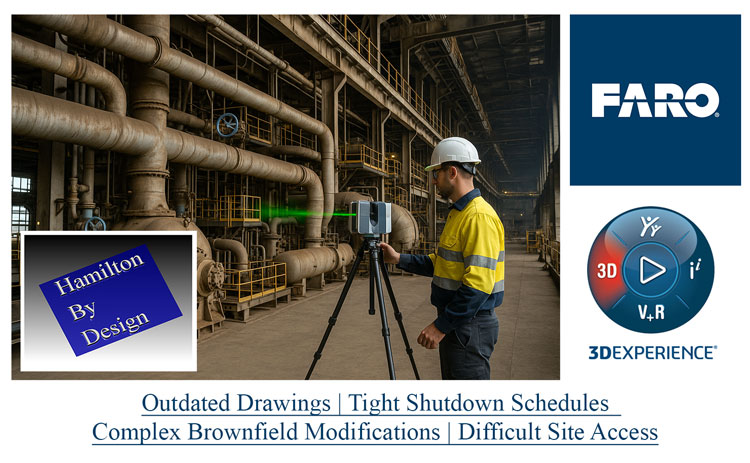
Outdated drawings
Tight shutdown schedules
Complex brownfield modifications
Difficult site access
That’s where 3D scanning and LiDAR modelling are transforming how industrial projects are designed, verified, and delivered — ensuring every bolt, beam, and bracket fits perfectly the first time.
At Hamilton By Design, we bring together field experience, digital precision, and local knowledge to help the Hunter’s industries design, maintain, and modernise with confidence.
What Is 3D Scanning — and Why It Matters in Industry
3D laser scanning, also known as LiDAR (Light Detection and Ranging), captures millions of data points across an industrial site to create a precise digital representation — known as a point cloud.
This point cloud forms the foundation of a digital twin of your plant or asset — an exact, measurable 3D environment that engineers can design within using SolidWorks, AutoCAD, or Navisworks.
The result? Every measurement is accurate, every clash is detected before fabrication, and every installation happens exactly as planned.
Why Newcastle and the Hunter Valley Need Scanning More Than Ever
The Hunter is an engineering powerhouse — but much of its infrastructure was built decades ago. Many coal handling plants, power stations, and smelters are now in a constant cycle of refurbishment, retrofit, and compliance upgrade.
The challenges are familiar:
Old 2D drawings don’t reflect today’s reality.
Assets have been modified repeatedly over decades.
Shutdown windows are shrinking.
Every error adds cost and delays production.
By scanning before you design, you remove uncertainty. You don’t guess clearances — you know them. You don’t estimate tie-in points — you model them. You don’t hope it fits — you prove it digitally.
That’s the power of 3D scanning in today’s industrial environment.
Where Scanning Adds Value Across the Hunter’s Industries
⚙️ Power Generation
The Bayswater, Eraring, and Vales Point Power Stations are engineering icons. Upgrades to cooling systems, ducts, platforms, and access structures require millimetre accuracy. 3D scanning ensures:
Every retrofit aligns with existing steelwork and pipework.
Structural interferences are caught before fabrication.
Shutdown work can be completed on time — without rework.
Whether it’s a fan casing replacement or a duct reroute, laser scanning removes the guesswork from aging assets.
⛏️ Coal Handling and CHPP Facilities
The Hunter Valley’s CHPP network — Mount Thorley Warkworth, Ravensworth, Bengalla, Hunter Valley Operations — all depend on reliable mechanical systems. These plants evolve continuously: diverter chutes, screen replacements, conveyors, and wash plant modifications.
Scanning delivers:
Accurate as-built geometry for plant upgrades.
Clash detection between new and existing equipment.
Shutdown planning certainty — no unexpected fit-up issues.
Integration of SolidWorks models directly into point clouds for visual verification.
For CHPP managers and maintenance engineers, 3D scanning is now as essential as the plant itself.
⚓ Port of Newcastle and Coal Export Terminals
Newcastle’s port is the lifeline of the Hunter’s economy. Facilities such as Port Waratah Coal Services (PWCS), Newcastle Coal Infrastructure Group (NCIG), and Carrington Terminal handle massive volumes of coal every hour.
The complexity of these sites — shiploaders, conveyors, gantries, and stacker-reclaimers — demands accuracy during maintenance and upgrade works. 3D scanning supports:
Shiploader upgrades and boom extensions.
Conveyor and transfer tower alignment checks.
Wharf structure condition monitoring.
Integration with mechanical and electrical systems.
By scanning before modification, downtime is reduced, safety improves, and project teams gain total confidence in every fit-up.
🏭 Aluminium and Heavy Manufacturing
At Tomago Aluminium Smelter, precision is everything. The scale of the site — from potlines to switchyards — makes manual measurement impractical and unsafe.
Laser scanning captures geometry accurately across large areas, enabling:
Retrofit planning without full shutdowns.
Clearance checks for cranes, ducts, and potline infrastructure.
Digital twins for long-term maintenance and asset management.
Beyond Tomago, manufacturers in Waratah, Beresfield, and Thornton use scanning to validate jigs, fixtures, and workshop layouts — ensuring local fabrication accuracy that matches site requirements.
🔋 Emerging Energy and Infrastructure
As the Hunter region transitions toward renewable and low-emission industries, scanning plays a critical role in planning new infrastructure around existing sites. This includes:
Hydrogen and gas pipeline tie-ins.
Solar and battery installations near existing grid connections.
Conversion of existing power plant structures for new technology.
Accurate point-cloud data ensures new energy meets old infrastructure safely and efficiently.
From Field to Fabrication: The Hamilton By Design Process
At Hamilton By Design, our 3D scanning workflow is built around practical, industrial needs:
Site Scan & Data Capture Using high-precision LiDAR scanners, we safely capture full site geometry in hours, not weeks. Scans are performed during operation or short shutdowns, without interrupting production.
Point Cloud Registration & Processing Multiple scans are aligned to create a unified, accurate model of your facility. The result is a true “digital twin” of your asset, complete with millimetre accuracy.
SolidWorks Modelling & Integration Our design team converts scan data into fully functional 3D models — chutes, pipework, platforms, or structural frames — ready for fabrication.
Clash Detection & Design Validation Every new design is tested within the digital twin, ensuring it fits the first time.
Fabrication Drawings & e-Drawings Detailed 2D and 3D deliverables are provided for fabricators, site crews, and certifiers — ensuring seamless communication between design and construction.
Why Local Expertise Matters
Many engineering firms offer scanning — but few understand what it takes to work on a live plant in the Hunter Valley.
Hamilton By Design combines trade experience, mechanical design, and regional understanding. We’ve worked with the same assets, fabricators, and contractors who keep the region’s power, port, and manufacturing industries running.
We design for real fabrication conditions — using Australian Standards, local materials, and practical build methods. That means fewer redesigns, faster turnarounds, and safer installations.
Safety and Access: Scanning Without Shutdowns
Traditional site measurement often means working at heights, in confined spaces, or around operating equipment. 3D scanning eliminates those risks.
Our scanners capture data safely from the ground — even in restricted or hazardous areas. This not only improves safety but also allows projects to continue without halting production.
For large plants like Eraring or PWCS, scanning entire structures during live operation is now standard practice — enabling ongoing maintenance and long-term asset integrity planning.
Case Example: Port Upgrade Without Rework
A local contractor approached Hamilton By Design for a conveyor and tower modification project at the Port of Newcastle. Existing drawings were decades old, and the structure had been modified repeatedly.
We performed a 3D scan of the tower and adjacent conveyors, capturing the as-built geometry in one day. The resulting model revealed several misalignments between the planned chute and existing supports. By correcting these in SolidWorks before fabrication, the contractor avoided at least 48 hours of site rework and kept the shutdown on schedule.
That’s measurable ROI — precision that pays for itself.
The ROI of 3D Scanning in Heavy Industry
A single hour of lost production at a CHPP or power station can cost $20,000 to $50,000. A single day’s delay can exceed $500,000 in lost revenue and labour costs.
3D scanning reduces that risk by eliminating rework and ensuring every component fits right the first time. Typical return on investment (ROI):
Scanning cost: <1% of total project value.
Rework savings: 3–10% of total cost.
Downtime reduction: 1–3 days saved per shutdown.
When accuracy drives reliability, 3D scanning isn’t an expense — it’s insurance.
Supporting the Hunter’s Future
Newcastle and the Hunter Valley are evolving — from coal and power to renewables, advanced manufacturing, and logistics. But one thing hasn’t changed: the region’s foundation in engineering, precision, and hard work.
Hamilton By Design supports that legacy with the next generation of technology — scanning, digital modelling, and mechanical design that keep the region’s assets efficient, safe, and ready for the future.
We’re not an offshore CAD vendor. We’re local engineers who’ve worked in the field, understand your equipment, and speak the same language as your crews.
Let’s Build the Future of Hunter Industry – Accurately
Every project starts with one question: “Do we have accurate site data?”
With Hamilton By Design, the answer is always yes.
We deliver: ✅ 3D laser scanning and LiDAR modelling ✅ Point-cloud to SolidWorks integration ✅ Reverse engineering and FEA validation ✅ Fabrication drawings tailored for local workshops ✅ On-site consultation with practical engineering insight
Whether you’re upgrading a conveyor at Bayswater, fabricating platforms for Tomago, or retrofitting process piping at Kooragang, we ensure your next project fits perfectly — before steel is cut.
👉 Get your industrial site scanned and modelled before your next shutdown. Visit www.hamiltonbydesign.com.au or contact us to request a capability statement today.
Every shutdown comes with pressure — time, budget, and safety. When mechanical upgrades or maintenance are based on outdated drawings or manual measurements, the risk of error skyrockets. A misaligned chute, an incorrectly measured pipe, or a bracket that doesn’t quite fit can turn a planned three-day outage into a five-day scramble. In industries where every hour offline costs tens of thousands of dollars, guesswork is expensive.
3D Laser Scanning: Seeing the Plant as It Really Is
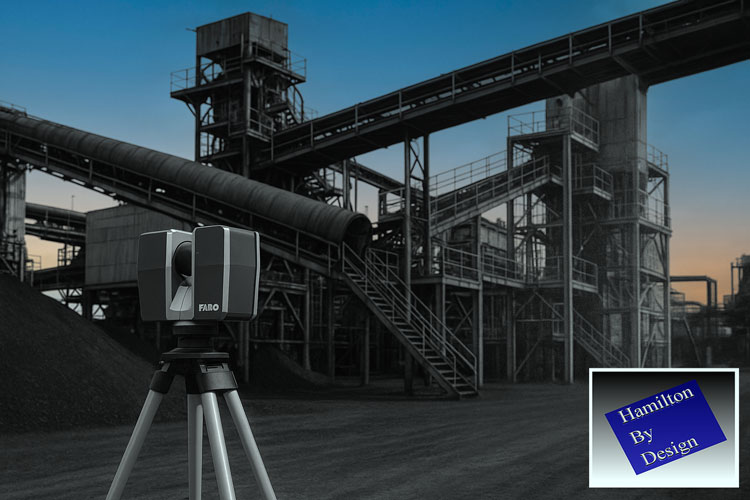
That’s where 3D laser scanning and LiDAR technology change the game. Using a FARO or similar high-accuracy scanner, Hamilton By Design captures millions of data points in a matter of minutes — creating a precise digital replica of your plant or structure. This point cloud model forms the foundation for all design work. Every pipe, beam, and bracket is located exactly where it exists in the real world, not where an old drawing says it should be.
From Scan to SolidWorks: Accurate Models, Confident Designs
Once the scan is complete, the data is reverse-modelled into SolidWorks or similar 3D design environments. This means upgrades, chutes, handrails, and structural supports can be designed within the scanned environment — guaranteeing they fit perfectly on installation day. Our clients use this workflow to plan shutdowns with confidence, knowing that every fabricated part will bolt straight in.
Eliminating Fit-Up Errors and Rework
Traditional upgrade projects rely on tape measures, rough sketches, or outdated general arrangement drawings. Even a 10 mm error can cause weeks of rework once site access is restricted. With 3D scanning, those errors disappear. Before fabrication begins, engineers can check for:
Clashes and interferences between new and existing plant structures.
Clearances for maintenance and access.
Alignment with conveyors, supports, and existing chutes.
That level of insight is impossible with 2D drawings alone.
Shorter Shutdowns, Safer Teams
Fewer surprises mean faster, safer installations. When every component is designed and verified within the scanned model, shutdown crews spend less time cutting, grinding, or reworking in the field. That’s not only a productivity win, it’s a safety win — fewer sparks, less manual handling, and minimal hot work in confined spaces.
Applications Across Mining and Processing
Hamilton By Design’s scanning and modelling process is trusted across the Bowen Basin, Surat Basin, Hunter Valley, and Central West NSW. Typical projects include:
Conveyor realignments — ensuring belt runs are perfectly centred before shutdown.
Pipework and pump station retrofits — avoiding rework when tie-ins occur.
Structural verification — validating as-built conditions before new platforms or walkways are installed.
Real-World ROI
Clients routinely report saving days of downtime and thousands in rework costs by scanning before fabrication. When you consider that a typical CHPP shutdown might cost $20,000–$50,000 per hour in lost production, the return on investment is obvious. A few hours spent scanning can mean days of avoided delay.
Stop Guessing, Start Scanning
If your next shutdown involves tight spaces, limited access, or unknown conditions — don’t rely on old drawings or assumptions. Hamilton By Design provides LiDAR scanning, point-cloud modelling, and SolidWorks-based mechanical design to ensure your upgrades install exactly as intended.
👉 Book a site scan before your next shutdown. Visit www.hamiltonbydesign.com.au or contact us to discuss your upcoming project.
To provide the best experiences, we use technologies like cookies to store and/or access device information. Consenting to these technologies will allow us to process data such as browsing behaviour or unique IDs on this site. Not consenting or withdrawing consent, may adversely affect certain features and functions.
Functional
Always active
The technical storage or access is strictly necessary for the legitimate purpose of enabling the use of a specific service explicitly requested by the subscriber or user, or for the sole purpose of carrying out the transmission of a communication over an electronic communications network.
Preferences
The technical storage or access is necessary for the legitimate purpose of storing preferences that are not requested by the subscriber or user.
Statistics
The technical storage or access that is used exclusively for statistical purposes.The technical storage or access that is used exclusively for anonymous statistical purposes. Without a subpoena, voluntary compliance on the part of your Internet Service Provider, or additional records from a third party, information stored or retrieved for this purpose alone cannot usually be used to identify you.
Marketing
The technical storage or access is required to create user profiles to send advertising, or to track the user on a website or across several websites for similar marketing purposes.