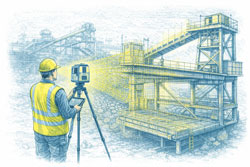
Mechanical Engineering | 3D Scanning | 3D Modelling
Category: Engineering Services
Engineering Services brings together practical engineering knowledge that supports real projects, real constraints, and real outcomes.
This category covers how engineering services are applied across design, verification, upgrades, and construction support, with a focus on mechanical and structural engineering in existing and live environments. Topics include engineering decision-making, design development, compliance considerations, and how engineering integrates with 3D scanning, CAD modelling, and as-built documentation.
Articles explain what professional engineering input actually delivers—helping project teams reduce risk, improve buildability, and make informed decisions based on accurate data and sound engineering judgement, not assumptions.
Content is written for asset owners, project engineers, builders, and contractors who want a clearer understanding of how engineering services add value across power, manufacturing, mining, and building & construction projects.
Structural Engineering: Turning Structural Concepts into Buildable, Compliant Outcomes
Structural engineering plays a critical role in ensuring that structures are safe, stable, and fit for purpose—not just on paper, but in the real world.
Across industrial facilities, mining sites, power infrastructure, and building projects, structural engineering is what turns concepts into buildable, verifiable outcomes. It requires more than calculations alone; it depends on accurate information, sound judgement, and clear documentation that can be understood and constructed on site.
At Hamilton By Design, structural engineering is delivered with a strong focus on existing conditions, constructability, and compliance, particularly for brownfield and live environments.
What structural engineering actually delivers
Structural engineering involves the assessment, design, and verification of structures that support loads safely over their intended life.
Typical applications include:
Structural steelwork and framing
Platforms, walkways, stairs, and access systems
Equipment support structures and foundations
Modifications to existing buildings and industrial assets
Strengthening, repair, and upgrade works
In many projects, especially upgrades and refurbishments, the challenge is not designing something new—but understanding what already exists and how it behaves.
Our clients:
Structural engineering on existing and brownfield sites
Many industrial and construction projects rely on incomplete or outdated drawings. Over time, assets are modified, reinforced, or repaired without full documentation, increasing risk when new works are planned.
Structural engineering in these environments often involves:
Verifying existing steel sizes and connections
Assessing capacity against current load requirements
Identifying undocumented changes or deterioration
Designing upgrades that integrate with existing structures
Accurate engineering input at this stage reduces rework, improves safety, and avoids costly site changes during construction.
The role of structural drafting in successful outcomes
Even the best structural design can fail if it is not clearly documented.
Structural drafting is the critical link between engineering intent and construction reality. It translates structural engineering decisions into clear, coordinated drawings that fabricators and builders can rely on.
Well-executed structural drafting ensures:
Load paths and connections are clearly communicated
Member sizes, levels, and interfaces are unambiguous
Drawings reflect actual site conditions
Fabrication and installation can proceed with confidence
Structural drafting underpins how assets are designed, reviewed, fabricated, and built. While there is no shortage of powerful drafting software on the market, successful project outcomes are not defined by software alone — they are defined by engineering judgement applied through the right tools.
At Hamilton By Design, we operate across multiple structural drafting platforms to suit asset risk, fabrication pathways, and project complexity. Below are the five most widely used structural drafting software platforms in industry today — and how they fit into an engineering-led workflow.
AutoCAD — The Industry Baseline for Structural Drafting
AutoCAD remains the most widely accepted platform for 2D structural drafting across Australia.
It is commonly used for:
General arrangement drawings
Structural sections and details
Retrofit and brownfield documentation
As-built drawings
AutoCAD’s strength lies in its universality and clarity, particularly for issuing IFC documentation. However, on complex or fabrication-heavy projects, AutoCAD alone relies heavily on the experience and discipline of the engineer and drafter producing the drawings.
Revit — Coordinated Structural Documentation in a BIM Environment
Revit enables a model-driven approach to structural drafting, where plans, sections, elevations, and schedules are generated from a single coordinated model.
It is well suited to:
Building structures
Multidiscipline coordination
Projects requiring digital handover or asset information models
While Revit is a powerful coordination tool, its effectiveness depends on engineering control of modelling assumptions, member sizing, and load paths. Without that oversight, models can appear complete while concealing risk.
Tekla Structures is widely recognised as the benchmark platform for steel and concrete detailing.
It is commonly used where:
Fabrication accuracy is critical
Connection design must be unambiguous
CNC data, BOMs, and shop drawings are required
Tekla excels in mining, heavy industry, and complex steel structures where what is modelled is what gets built. Its strength is not simply its software capability, but its ability to enforce constructability and clarity.
Advance Steel — Steel Detailing Within an AutoCAD Environment
Advance Steel extends traditional AutoCAD workflows into 3D steel detailing.
It is often selected where:
Fabricators operate primarily in AutoCAD
3D steel modelling is required without a full BIM transition
Fabrication drawings and NC data are needed
Advance Steel provides an efficient pathway from drafting to fabrication when applied within an engineering-controlled workflow.
Our clients:
SolidWorks — Structural Drafting for Industrial and Mechanical Assets
SolidWorks is widely used for industrial structures integrated with mechanical equipment.
It is particularly effective for:
Platforms, frames, skids, and support structures
Conveyors and transfer stations
Structures requiring integration with machinery and FEA
For industrial environments, SolidWorks enables structural drafting to be developed in context, reducing interface risk between mechanical and structural elements.
Software Is a Tool — Engineering Is the Outcome
No single software platform is “best” in all circumstances. Each has strengths depending on:
Asset type
Fabrication method
Risk profile
Compliance requirements
The real differentiator is engineering leadership — selecting the right platform, applying the correct standards, and ensuring drawings are fit-for-purpose and fit-for-fabrication.
Structural Drafting Done Properly
At Hamilton By Design, structural drafting is delivered as part of an engineering-led service, not a drafting-only output. Our work is supported by:
Engineering-grade 3D LiDAR scanning
Fabrication-ready documentation
Australian Standards-aligned detailing
Clear accountability from concept through to construction
If your project requires structural drafting that stands up to fabrication, construction, and long-term operation, we can help.
Need Structural Drafting Support?
If you’re planning a new structure, upgrading an existing asset, or preparing fabrication documentation, contact Hamilton By Design to discuss how an engineering-led drafting approach can reduce risk and improve outcomes.
Reality Capture Sydney for Real Estate & Property Assets
High-Accuracy Digital Records and Premium Visual Context
Sydney’s real estate and commercial property market demands accurate information, clear presentation, and confidence in decision-making. Whether supporting leasing, refurbishment, due diligence, or long-term asset management, reality capture in Sydney provides property owners and managers with a reliable digital record of what exists today.
Hamilton By Design delivers professional reality capture services in Sydney, combining high-accuracy spatial data with high-end visual outputs suited to commercial and premium property assets.
What Is Reality Capture for Real Estate?
In a property context, reality capture is the process of digitally recording buildings and spaces using advanced laser scanning and spatial capture technologies. The result is a dimensionally accurate digital representation of an asset that can be reused across multiple projects without repeated site visits.
Reality capture is commonly used across Sydney for:
Accurate existing-condition records
Leasing and tenancy planning
Commercial fit-outs and refurbishments
Asset documentation and compliance support
Due diligence during acquisition or divestment
Unlike traditional photography or basic floor plans, reality capture provides measurable, verifiable data that reduces uncertainty and risk.
High-End Capture of Sydney’s Harbour & Landmark Context
For premium assets, context matters. Hamilton By Design captures high-resolution reality capture imagery that includes Sydney’s built environment and surrounding landmark context, where appropriate.
This may include:
Harbour-front commercial buildings
Assets with views or proximity to Sydney Harbour
Visual context incorporating the Sydney Harbour Bridge
CBD and waterfront developments
These high-end visuals support investor presentations, leasing material, and executive-level decision-making, while remaining grounded in accurate spatial data.
Why Reality Capture Matters in Sydney’s Property Market
Sydney properties often involve:
High asset values
Live, occupied buildings
Tight refurbishment timeframes
Complex services and structural interfaces
Reality capture helps property stakeholders to:
✔ Verify what exists before committing capital ✔ Reduce surprises during refurbishments ✔ Support consultants with reliable base information ✔ Minimise disruption to tenants ✔ Maintain a long-term digital record of the asset
For property owners and managers, this translates directly to reduced risk and better outcomes.
Typical Real Estate Applications
As-Built Property Records
Create accurate digital records where original drawings are missing, outdated, or unreliable.
Leasing & Tenancy Planning
Support test fits, space planning, and consultant coordination with trusted spatial data.
Refurbishment & Upgrade Projects
Capture existing conditions prior to works to reduce redesign, delays, and cost overruns.
Due Diligence & Asset Review
Provide clarity and confidence during acquisition, divestment, or asset reviews.
A Professional, Asset-Focused Approach
While many services focus on visual outputs alone, Hamilton By Design approaches reality capture from an asset and decision-support perspective. Our deliverables are:
Dimensionally reliable
Fit for professional use
Suitable for consultants and contractors
Appropriate for commercial and executive audiences
This ensures reality capture data can be relied upon when property decisions carry financial and contractual significance.
Deliverables to Suit Property Clients
Depending on your requirements, we can provide:
Registered point clouds
CAD-ready base files
Accurate spatial references
Section views and area verification
Digital records suitable for future upgrades
All outputs are tailored to the intended property use, not generic scanning deliverables.
Our clients:
Reality Capture Sydney — Confidence for Property Decisions
Reality capture removes uncertainty from property decisions. By accurately capturing what exists today, Sydney property owners and managers can plan, lease, refurbish, and manage assets with confidence.
Hamilton By Design supports Sydney real estate and commercial property clients with professional reality capture services that combine accuracy, clarity, and premium presentation.
Contact Hamilton By Design to discuss your Sydney property or real estate reality capture requirements.
Engineering-Grade LiDAR for Accurate As-Built & Construction Delivery
Construction projects in Darwin operate in a demanding environment — tropical weather, remote logistics, accelerated schedules, and complex interfaces between structural, mechanical, and architectural elements. 3D construction scanning provides a reliable digital foundation to reduce risk, eliminate rework, and support confident decision-making throughout the project lifecycle.
Hamilton By Design delivers engineering-grade 3D construction scanning in Darwin, supporting contractors, engineers, builders, and asset owners with accurate spatial data, as-built models, and construction-ready documentation.
3D construction scanning uses high-accuracy LiDAR laser scanners to capture the real-world geometry of construction sites, partially completed works, and existing assets. The output is a dense, survey-grade point cloud that can be used to create:
Accurate as-built drawings
BIM and digital twin models
Clash detection and coordination models
Verification of construction tolerances
Retrofit and upgrade designs
Unlike traditional tape or total-station methods, LiDAR captures millions of points per second, ensuring complex geometry is recorded correctly the first time.
Why 3D Construction Scanning Matters in Darwin
Construction in Darwin often involves:
Live brownfield sites
Remote or logistically constrained projects
Tight shutdown or installation windows
High consequences of dimensional errors
3D construction scanning enables:
✔ Reduced rework and RFIs ✔ Improved trade coordination ✔ Accurate verification before fabrication ✔ Faster design and approval cycles ✔ Safer site data capture with minimal disruption
This is particularly valuable for industrial buildings, ports, power generation facilities, defence infrastructure, and commercial developments across the Northern Territory.
Typical Construction Applications
As-Built Verification
Confirm what has actually been built — not what was assumed — before handover, certification, or the next construction stage.
Construction Progress Capture
Document progress at key milestones to support planning, claims, and coordination.
Retrofit & Upgrade Projects
Capture existing structures accurately before mechanical, electrical, or structural upgrades commence.
Clash Detection & Coordination
Overlay scanned data with design models to identify clashes early and avoid costly site changes.
Engineering-Led Scanning — Not Just Data Capture
At Hamilton By Design, 3D construction scanning is delivered by engineers, not just scanning technicians. This means:
Scan strategies aligned to engineering outcomes
Data captured at appropriate accuracy for construction tolerances
Deliverables tailored for CAD, BIM, and fabrication workflows
Clear accountability from scan to design to documentation
Our scanning integrates directly with mechanical design, structural analysis, and construction documentation services — providing a single source of truth for your project.
Deliverables to Suit Construction Teams
Depending on your requirements, we can provide:
Registered point clouds
CAD-ready models
Revit / BIM outputs
Section views and construction references
Engineering drawings derived from scan data
All deliverables are tailored to suit builders, engineers, subcontractors, and asset owners.
Our clients:
3D Construction Scanning Darwin — Partner with Confidence
Whether you are delivering a new build, managing a complex refurbishment, or upgrading an existing facility, 3D construction scanning in Darwin provides the clarity and accuracy needed to build with confidence.
Hamilton By Design supports construction projects across Darwin and the Northern Territory with engineering-grade LiDAR scanning, practical deliverables, and real-world construction experience.
Let Connect us to discuss your project requirements or arrange a site scan.
AS ISO 10816 & 20816 – Mechanical Vibration | Hamilton By Design
Mechanical vibration is one of the earliest indicators that rotating equipment is developing a fault. Standards such as AS ISO 10816 and AS ISO 20816 provide a consistent framework for measuring, evaluating, and managing vibration in industrial machinery.
At Hamilton By Design, we help clients apply these standards in a practical, engineering-led way by connecting vibration data with mechanical design, asset condition, and real-world site conditions.
What Are AS ISO 10816 and AS ISO 20816?
The AS ISO 10816 / 20816 standards define:
How mechanical vibration should be measured on machines
How vibration severity should be evaluated
What vibration levels are considered acceptable, marginal, or unacceptable
These standards are commonly applied to motors, pumps, gearboxes, compressors, fans, conveyors, and other rotating equipment where vibration provides an early warning of mechanical or structural issues.
Why Mechanical Vibration Standards Matter
Using vibration data without a recognised standard often leads to inconsistent interpretation and delayed action. Applying AS ISO 10816 / 20816 helps organisations to:
Identify mechanical problems early
Reduce unplanned downtime and breakdowns
Prevent secondary damage to bearings, shafts, and foundations
Improve overall equipment reliability
Support condition-based and predictive maintenance strategies
When vibration is assessed against an accepted standard, maintenance decisions become clearer and more defensible.
The Common Gap: Vibration Data Without Engineering Context
Many sites collect vibration data but struggle to connect it to:
As-installed geometry and alignment
Structural stiffness and support conditions
Design intent versus site reality
Maintenance and modification history
Vibration issues are often symptoms of broader mechanical or structural problems. Without engineering context, vibration data alone can be misleading.
This is where vibration assessment benefits from being connected to engineering-grade site information.
Hamilton By Design connects vibration standards with practical engineering outcomes through a coordinated service offering.
Engineering-Led Vibration Interpretation
We assess vibration results against AS ISO 10816 / 20816 using engineering judgement rather than relying solely on alarm limits. Machine type, operating duty, and site conditions are all considered.
Understanding the Physical Asset
By linking vibration data with mechanical layouts, drawings, and 3D models, we help identify whether vibration is driven by alignment issues, inadequate stiffness, foundation behaviour, or design constraints.
Where vibration levels indicate potential resonance, flexibility, or dynamic response issues, we support deeper investigation using structural and mechanical analysis tools.
AS ISO 10816 and AS ISO 20816 provide the benchmark for assessing mechanical vibration. Hamilton By Design provides the engineering connection that turns those benchmarks into practical action.
By linking vibration data with 3D scanning, mechanical design, and engineering analysis, vibration assessments become clearer, more accurate, and far more useful across the asset lifecycle.
AS 3774 – Loads on Bulk Solids Containers | Safety & Compliance
AS 3774 Loads on Bulk Solids Containers exists for a simple reason: bulk solids do not behave like fluids, and incorrect load assumptions can create serious structural and safety risks.
For asset owners, engineers, and project teams involved in mining, mineral processing, manufacturing, and bulk materials handling, AS 3774 provides the framework for understanding how loads actually develop in silos, bins, hoppers, chutes, transfer stations, and surge bins.
Yet despite its long-standing availability, many new installations are still being delivered without full consideration of AS 3774 load cases.
The risks created by this gap are often not immediately visible — but they are very real.
What AS 3774 Is Designed to Address
AS 3774 recognises that bulk solids behave in complex and sometimes counter-intuitive ways. Unlike liquids, bulk materials:
Develop non-uniform wall pressures
Apply eccentric and asymmetric loads
Change load paths depending on flow behaviour
Generate dynamic and cyclic forces during filling and discharge
The standard provides guidance for determining realistic design loads based on how material actually flows and interacts with container geometry.
This applies across all bulk solids containers, including:
Silos
Bins and surge bins
Hoppers
Chutes and transfer stations
Rail and ship loading structures
Feeders integrated with bins
Why Safety and Compliance Depend on AS 3774
The purpose of AS 3774 is not academic. It exists to prevent outcomes such as:
Progressive wall deformation
Fatigue cracking and bolt failure
Local buckling or plate tearing
Uncontrolled discharge or blockage release
Unexpected load transfer into supporting structures
What makes these issues particularly dangerous is that they often develop over time, not at commissioning.
A structure can appear “fine” on day one — while accumulating damage due to:
Cyclic loading
Eccentric discharge patterns
Inaccurate assumptions about material properties
Mixed construction materials behaving differently over time
Common Design Assumptions That Create Hidden Risk
In practice, many bulk solids containers are still designed using simplified or incorrect assumptions, including:
1. Treating Bulk Solids Like Fluids
Uniform hydrostatic pressure assumptions do not reflect real wall loading patterns and can significantly under-predict peak stresses.
2. Ignoring Eccentric Discharge
Off-centre outlets, partial blockages, or asymmetric flow paths can introduce large bending and torsional effects that are not obvious from geometry alone.
3. Incorrect or Assumed Material Properties
Bulk density, cohesion, moisture content, and flow behaviour are often assumed rather than verified — yet small changes can have large load implications.
4. Mixed Materials Without Long-Term Consideration
It is not uncommon to see hoppers fabricated from a combination of stainless steel and mild steel, without adequate consideration of:
Differential stiffness
Fatigue behaviour
Corrosion mechanisms
Galvanic interaction
These issues may not present as immediate failures, but they can significantly reduce structural life and reliability.
Why the Risk Is Often Not Evident Today
One of the most concerning aspects of non-compliance with AS 3774 is that failure is rarely immediate.
Instead, risk accumulates quietly through:
Repeated filling and discharge cycles
Minor operational changes
Variations in material condition
Small geometric imperfections
By the time visible cracking, deformation, or operational issues appear, the structure may already be compromised.
The Role of Modern Engineering Tools (Briefly)
While AS 3774 is fundamentally about load determination, modern engineering tools can support compliance by helping teams:
Verify as-built geometry against design assumptions
Identify eccentric discharge paths and flow constraints
Review interfaces, wall angles, and structural continuity
Support independent engineering assessment without extended shutdowns
These tools do not replace the standard — but they can help reveal whether its principles have been properly applied.
What Asset Owners and Project Managers Should Ask For
To demonstrate that AS 3774 has been adequately considered, asset owners and project managers should expect to see clear answers to questions such as:
What load cases were considered under AS 3774?
How were discharge conditions defined and assessed?
What assumptions were made about material properties?
How were eccentric and asymmetric loads addressed?
Was fatigue or cyclic loading considered?
How were mixed materials and interfaces assessed?
Has an independent engineering review been undertaken?
If this information cannot be clearly provided, compliance is difficult to demonstrate, regardless of how new the installation is.
Why This Matters for New Installations
AS 3774 compliance is not about legacy assets or historical practices. It is about ensuring that new installations are fit for purpose, safe, and defensible.
Where bulk solids containers are being delivered today without adequate consideration of realistic load behaviour, the risk is being transferred downstream — to operators, maintainers, and asset owners.
Our clients
A Practical Closing Thought
If you are unsure whether AS 3774 has been properly applied to a bulk solids container, an independent engineering review can provide clarity.
The cost of verifying load assumptions and structural adequacy is typically minor compared to the consequences of discovering load-related issues after commissioning.
Hamilton By Design supports asset owners and project teams with engineering review, verification, and redesign of bulk solids containers, helping ensure that safety and compliance are addressed before problems develop.
To provide the best experiences, we use technologies like cookies to store and/or access device information. Consenting to these technologies will allow us to process data such as browsing behaviour or unique IDs on this site. Not consenting or withdrawing consent, may adversely affect certain features and functions.
Functional
Always active
The technical storage or access is strictly necessary for the legitimate purpose of enabling the use of a specific service explicitly requested by the subscriber or user, or for the sole purpose of carrying out the transmission of a communication over an electronic communications network.
Preferences
The technical storage or access is necessary for the legitimate purpose of storing preferences that are not requested by the subscriber or user.
Statistics
The technical storage or access that is used exclusively for statistical purposes.The technical storage or access that is used exclusively for anonymous statistical purposes. Without a subpoena, voluntary compliance on the part of your Internet Service Provider, or additional records from a third party, information stored or retrieved for this purpose alone cannot usually be used to identify you.
Marketing
The technical storage or access is required to create user profiles to send advertising, or to track the user on a website or across several websites for similar marketing purposes.