


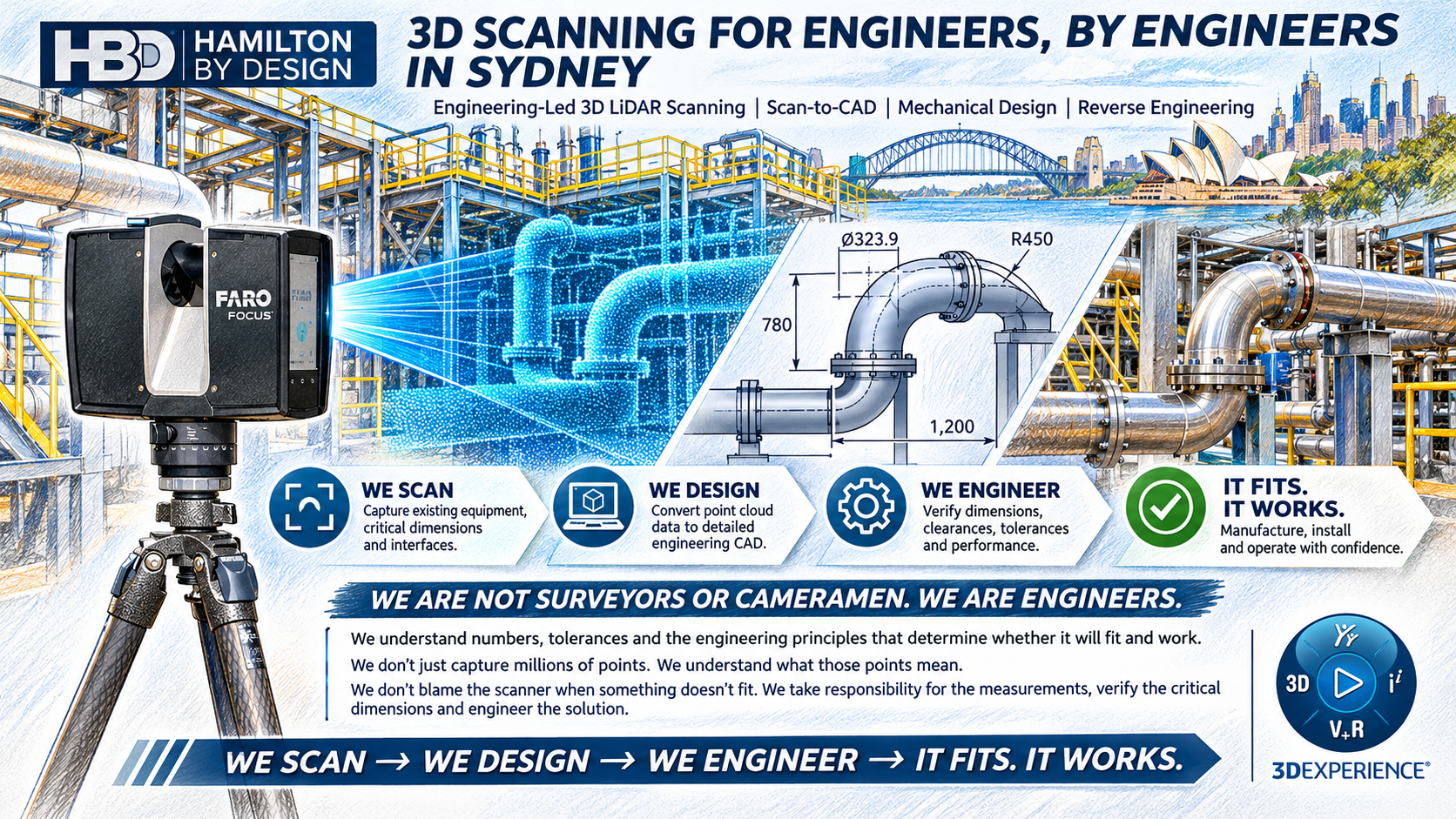
Engineering-Led 3D LiDAR Scanning | Scan-to-CAD | Mechanical Design | Reverse Engineering | Fabrication Drawings
WE SCAN → WE DESIGN → WE ENGINEER → IT FITS. IT WORKS.
We Are Not Surveyors or Cameramen. We Are Engineers.
At Hamilton By Design, we don’t approach 3D scanning as a photography exercise or simply a means of collecting millions of measurement points.
We are engineers who use 3D scanning to solve engineering problems.

We understand numbers, dimensions, tolerances, mechanical interfaces and the engineering principles that determine whether components will fit together and function as intended.
A point cloud may contain millions of measurements, but those measurements only become valuable when they are interpreted correctly and applied to a practical engineering outcome.
We don’t just capture millions of points. We understand what those points mean.
Our responsibility extends beyond operating a scanner and delivering a point cloud. We consider the engineering requirements, critical dimensions, fabrication tolerances, mechanical interfaces and installation clearances that determine whether equipment can be successfully designed, manufactured and installed.
We don’t blame the scanner when something doesn’t fit. We take responsibility for understanding the measurements, verifying critical dimensions and engineering the solution.
A scanner is a measurement tool. It is the engineer’s responsibility to understand its accuracy, limitations and suitability for the intended application.
Our engineering-led approach combines 3D LiDAR scanning, dimensional verification, CAD modelling and mechanical engineering to help reduce fabrication errors, installation conflicts and costly rework.
We don’t simply document what exists. We engineer what comes next.
3D Scanning for Engineering Outcomes — Not Just Point Clouds
Hamilton By Design provides engineering-grade 3D scanning services throughout Sydney, Greater Sydney and New South Wales.
Our services are designed for engineers, manufacturers, industrial operators, fabrication contractors, mining companies and asset owners who require more than a digital representation of an existing installation.
We use 3D LiDAR scanning as part of an integrated engineering process to support:
- Mechanical equipment design and modification
- Industrial plant upgrades and brownfield projects
- Conveyor and transfer chute design
- Pipework modifications and spool development
- Structural steelwork and equipment supports
- Mechanical component reverse engineering
- Machine guarding and safety improvements
- Fabrication and assembly drawings
- Installation planning and dimensional verification
- Engineering analysis and design assessment
Our objective is to establish accurate existing-condition information that can be used to develop practical engineering solutions.
The scanning process is not the end of the project. It is the beginning of an informed engineering design process.
Why Engineering Knowledge Matters Before Scanning Begins
Not every point in a point cloud has the same engineering significance.
A large industrial installation may contain millions of measured points, but a relatively small number of critical interfaces can determine whether a proposed modification will fit.
These may include:
- Mounting hole positions and bolt patterns
- Equipment centre lines and shaft alignments
- Pipe flange locations and orientations
- Structural steel connection points
- Conveyor belt elevations and transfer positions
- Installation and maintenance clearances
- Existing machinery envelopes
- Access requirements for fabrication and assembly
An engineer understands why these dimensions matter and how measurement uncertainty may affect the final design.
At Hamilton By Design, we consider the intended engineering outcome before determining the scanning methodology.
This allows us to identify where terrestrial LiDAR scanning is appropriate and where additional close-range scanning, direct measurement or dimensional verification may be necessary.
The objective is not to collect the greatest number of points. It is to collect the right information for the engineering problem.
WE SCAN — Engineering-Grade 3D LiDAR Scanning
Hamilton By Design uses engineering-grade scanning equipment to capture existing industrial facilities, machinery, mechanical components and structural installations.
Our equipment include but not limited to:
FARO Focus S70 Terrestrial LiDAR Scanner
Used for capturing large industrial installations, buildings, structural steelwork, mechanical equipment, pipework and complex existing environments.
Revopoint MetroY Ultra Handheld Blue-Laser Scanner
Used for close-range measurement and reverse engineering of smaller mechanical components where higher-detail geometric capture is required.
The scanning equipment and methodology are selected according to the scale, accessibility, surface characteristics, accuracy requirements and intended engineering application.
Understanding Scanning Accuracy
Scanner specifications do not automatically establish the accuracy of every dimension derived from a point cloud.
Measurement uncertainty can be influenced by:
- Scanner selection and calibration
- Measurement distance and angle
- Surface characteristics and reflectivity
- Line-of-sight limitations
- Point cloud registration
- Environmental conditions
- Data processing and modelling methods
For this reason, Hamilton By Design considers the suitability of the measurement data for the intended design.
Where critical dimensions exceed the practical accuracy of terrestrial scanning, supplementary measurement or higher-accuracy scanning may be required.
Engineering accuracy is not simply a scanner specification. It is the result of an appropriate measurement and verification process.
WE DESIGN — Turning Point Clouds into Practical Engineering Models
Capturing existing geometry is only the first stage.
The next challenge is converting the measured information into CAD models and engineering drawings that can be used for design, manufacture and installation.
Hamilton By Design uses SolidWorks, Autodesk Inventor and AutoCAD to develop engineering geometry from registered point clouds and verified dimensional information.
Our Scan-to-CAD Capabilities
Mechanical Equipment Modelling
Creation of CAD models representing existing machinery, mechanical assemblies, equipment interfaces and industrial installations.
Reverse Engineering
Reconstruction of mechanical components and assemblies where original manufacturing drawings or CAD models are unavailable.
Conveyor and Transfer Chute Design
Development of new or modified equipment to interface with existing conveyors, structural steelwork and surrounding machinery.
Industrial Pipework Design
Modelling of existing pipework and development of proposed pipe routes, equipment connections and spool arrangements.
Structural and Mechanical Interfaces
Development of supports, brackets, equipment frames and mechanical connections based on measured existing geometry.
Fabrication Drawings
Preparation of general arrangement drawings, assembly drawings, component drawings and fabrication documentation.
Our modelling approach is based on the intended engineering application.
We do not necessarily model every visible surface or point. We develop the geometry required to support the agreed design, verification and manufacturing requirements.
WE ENGINEER — Understanding Why Components Fit and Function
Engineering involves more than producing a three-dimensional CAD model.
A model may appear geometrically correct on a computer screen while still presenting problems during fabrication or installation.
Hamilton By Design considers the engineering requirements that influence whether a proposed modification is practical.
Depending on the agreed project scope, these may include:
- Mechanical loads and operating conditions
- Material selection
- Structural and mechanical interfaces
- Dimensional tolerances
- Installation and assembly requirements
- Maintenance and operational clearances
- Fabrication methods
- Equipment alignment
- Mechanical functionality
- Applicable Australian Standards
- Engineering calculations and Finite Element Analysis
Our mechanical engineering capability allows scanning data to be integrated into the design and assessment process.
We Understand Numbers — Not Just Point Clouds
Engineering requires an understanding of the relationship between measurement accuracy, manufacturing tolerances and functional requirements.
For example, a terrestrial point cloud may provide suitable geometry for the layout of a large industrial plant.
However, the same data may not provide sufficient accuracy to establish the fit of a precision-machined shaft, bearing housing or close-tolerance mechanical connection.
An engineering-led approach recognises these differences.
Rather than assuming that every dimension in the point cloud is equally reliable, we identify which measurements are critical and determine how they should be verified.
We understand that a measurement is only useful when its accuracy is appropriate for the engineering decision being made.
IT FITS. IT WORKS. — The Engineering Outcome
The ultimate objective of our engineering-led 3D scanning process is not the number of scans completed or the size of the point cloud.
It is developing an engineering solution that can be manufactured, installed and operated as intended.
IT FITS.
A successful design must account for the existing installation.
This includes:
- Available space
- Mounting interfaces
- Equipment alignment
- Structural connections
- Fabrication tolerances
- Installation access
- Mechanical clearances
- Assembly requirements
By capturing and verifying critical dimensions before fabrication, we aim to reduce the likelihood of discovering dimensional conflicts during installation.
IT WORKS.
A component fitting into the available space does not necessarily mean it will function correctly.
Engineering design must also consider mechanical performance, operational requirements, loads, materials, safety and maintainability.
Hamilton By Design integrates these considerations into the agreed engineering design process.
Fit is a dimensional requirement. Function is an engineering requirement. Both matter.
Successful outcomes also depend on appropriate fabrication quality, installation controls and verification of the finished work.
We Don’t Blame the Scanner
A common problem in engineering projects occurs when discrepancies are discovered between the CAD model, fabricated component and existing installation.
These discrepancies may arise from incomplete measurement coverage, incorrect assumptions, registration errors, inappropriate tolerances or changes to the site after scanning.
Simply stating that the scanner produced the measurement does not resolve the engineering problem.
At Hamilton By Design, we recognise that scanners are tools and that engineering judgement is required to interpret their data.
Our approach is to:
- Understand the intended engineering outcome.
- Identify critical dimensions and interfaces.
- Select a suitable measurement methodology.
- Review the quality and limitations of the captured data.
- Verify dimensions where the engineering application requires it.
- Develop CAD models using appropriate design assumptions.
- Review installation clearances and mechanical interfaces.
- Document relevant tolerances, limitations and verification requirements.
We don’t treat the point cloud as an unquestionable source of truth. We assess whether the data is suitable for the engineering decision.
This is particularly important where components must be fabricated off-site and installed into an existing operating facility.
Engineering-Led Scanning for Brownfield Industrial Projects
Brownfield engineering projects involve modifications to existing installations, often where original drawings are incomplete or no longer represent actual site conditions.
Over time, industrial facilities undergo equipment replacements, structural modifications, pipework changes and maintenance repairs.
The resulting installation may differ substantially from the original design documentation.
Engineering-led 3D scanning provides a method of capturing accessible existing geometry and developing updated CAD information.
Example — Conveyor Transfer Chute Replacement
Consider an existing conveyor transfer chute requiring replacement within a congested industrial installation.
The new chute must interface with existing conveyors, supporting steelwork, mechanical equipment and maintenance access arrangements.
The engineering process may involve:
Stage 1 — Existing-Condition Scanning
Capture the surrounding steelwork, conveyor equipment, chute geometry and accessible installation interfaces.
Stage 2 — Dimensional Verification
Identify critical mounting positions, conveyor centre lines, clearances and connection dimensions requiring verification.
Stage 3 — Mechanical CAD Design
Develop the replacement chute geometry using the measured installation as a dimensional reference.
Stage 4 — Engineering Assessment
Consider loads, materials, structural interfaces, mechanical clearances and operational requirements.
Stage 5 — Fabrication Documentation
Prepare the agreed general arrangement, assembly and component drawings.
Stage 6 — Installation Review
Check the proposed equipment envelope and interfaces against the captured geometry and verified measurements.
This integrated process aims to identify potential dimensional and design conflicts before fabrication.
The value is not simply knowing what the existing chute looks like. It is understanding how the replacement chute must fit and function.
3D Scanning for Fabrication and Mechanical Engineering
Hamilton By Design supports engineering and fabrication projects where new equipment must interface with existing structures or machinery.
Typical applications include:
Conveyor Systems and Bulk Materials Handling
3D scanning and mechanical design for conveyor modifications, transfer chutes, equipment supports and associated infrastructure.
Industrial Pipework and Spool Design
Existing-condition scanning and CAD modelling to assist with pipe routes, flange interfaces, equipment connections and fabrication documentation.
Mechanical Equipment Replacement
Dimensional capture and modelling of existing equipment envelopes to support the design and installation of replacement machinery.
Machine Guarding
Scanning and design of machine guarding around existing equipment, considering access, maintenance requirements and applicable safety standards.
Structural Steelwork and Equipment Supports
Existing-condition measurement and CAD modelling for equipment frames, brackets, platforms and structural interfaces.
Mechanical Reverse Engineering
High-detail scanning and CAD reconstruction of mechanical components where original design information is unavailable.
Plant Upgrades and Shutdowns
Engineering-led reality capture to support equipment modifications, installation planning and brownfield design coordination.
Engineering Deliverables — From Measurement to Manufacture
Hamilton By Design can provide an integrated range of deliverables depending on the project requirements.
3D Scanning Deliverables
- Registered E57 point clouds
- Autodesk ReCap RCP and RCS files
- Point cloud registration and quality documentation, where specified
- Existing-condition measurement data
CAD and Mechanical Design Deliverables
- SolidWorks models
- Autodesk Inventor models
- STEP and Parasolid files
- AutoCAD DWG drawings
- General arrangement drawings
- Assembly drawings
- Mechanical component drawings
- Fabrication and installation documentation
Engineering Deliverables
- Mechanical design calculations
- Finite Element Analysis, where required
- Engineering design reviews
- Dimensional verification documentation
- Engineering reports
- Technical specifications
The required accuracy, level of detail, engineering scope and deliverable formats are established during project scoping.
Our Integrated Engineering Workflow
1. Define the Engineering Problem
We establish what must be designed, modified, manufactured or installed.
2. Identify Critical Dimensions
We determine the interfaces, tolerances, clearances and measurements that influence the engineering outcome.
3. Develop the Scanning Methodology
We select the scanning equipment, measurement locations and verification methods appropriate to the project.
4. Capture and Process Existing Geometry
We undertake scanning, point cloud registration and data processing.
5. Develop the CAD Design
We convert the required measured geometry into practical mechanical CAD models and proposed design modifications.
6. Engineer and Verify
We assess the agreed engineering requirements, critical interfaces, design assumptions and installation constraints.
7. Prepare Technical Documentation
We issue the agreed point clouds, CAD models, fabrication drawings and engineering documentation.
One coordinated process, from existing-condition measurement through to engineering design.
Why Choose Hamilton By Design for 3D Scanning in Sydney?
Engineers First
Our scanning work is informed by mechanical engineering knowledge and an understanding of fabrication, assembly and installation requirements.
We Understand Dimensional Accuracy
We recognise the difference between scanner specifications, point cloud accuracy, CAD modelling assumptions and manufacturing tolerances.
We Design Around Existing Conditions
Our CAD models and engineering designs can be developed using measured site geometry rather than relying solely on outdated drawings.
We Provide More Than Point Clouds
We offer scanning, CAD modelling, reverse engineering, mechanical design and engineering assessment within an integrated service.
We Understand Fabrication
Our engineering approach considers how components will be manufactured, assembled and installed.
We Take Engineering Accountability Seriously
We recognise that engineering outcomes depend on appropriate measurement, verification, design assumptions and quality controls.
We Focus on the Finished Result
Our objective is to help clients develop practical engineering solutions that fit within existing installations and function as intended.
We are not simply collecting data. We are using measured information to solve engineering problems.
3D Scanning for Engineers Across Sydney and NSW
Hamilton By Design provides engineering-led 3D scanning and mechanical design services throughout Greater Sydney and surrounding industrial regions.
Our services are relevant to projects in:
- Sydney CBD and metropolitan Sydney
- Wetherill Park and Smithfield
- Eastern Creek and Blacktown
- Liverpool, Prestons and Ingleburn
- Bankstown and Milperra
- Brookvale and Northern Sydney
- Chatswood and surrounding industrial areas
- Kirrawee and Southern Sydney
- Central Coast and Newcastle
- Regional New South Wales
We also support industrial, mining and engineering projects throughout Australia.
Our services are particularly suited to manufacturers, mechanical engineering consultants, fabrication contractors, industrial asset owners and project teams requiring reliable dimensional information for engineering design.
Frequently Asked Questions
What is 3D scanning for engineers?
3D scanning for engineers involves collecting dimensional information with consideration for its intended engineering application, including mechanical design, fabrication, reverse engineering, equipment modification and installation.
Why use engineers for 3D scanning?
Engineers can identify critical mechanical interfaces, dimensional tolerances, installation constraints and design requirements that influence how scanning should be undertaken and verified.
Is a point cloud accurate enough for fabrication?
It depends on the scanning method, measurement uncertainty and fabrication tolerances. Critical dimensions may require supplementary measurement or verification before manufacturing.
Can Hamilton By Design convert point clouds into SolidWorks models?
Yes. We use registered point clouds and suitable dimensional information to develop SolidWorks models for mechanical design, reverse engineering and fabrication applications.
Can 3D scanning help prevent installation problems?
Engineering-led scanning can help identify dimensional conflicts and installation constraints before fabrication. It does not eliminate the need for appropriate design verification, manufacturing quality control and site checks.
Can Hamilton By Design provide fabrication drawings?
Yes. We can develop general arrangement drawings, assembly drawings and mechanical component drawings as part of an agreed engineering design scope.
Do you provide engineering analysis?
Yes. Depending on the project, our mechanical engineering services may include design calculations, Finite Element Analysis and engineering assessments.
Are you licensed land surveyors?
Hamilton By Design provides engineering-led dimensional scanning and mechanical design services. We do not represent these services as cadastral or other regulated surveying work requiring a registered surveyor.
Where a project requires statutory surveying, a suitably qualified surveyor should be engaged.
Request a Quotation — 3D Scanning for Engineers, by Engineers in Sydney
If your project involves designing, modifying, manufacturing or installing equipment within an existing facility, Hamilton By Design can assist with engineering-led 3D scanning and mechanical design.
We work with engineers, manufacturers, fabrication contractors, mining companies and industrial operators who need more than a point cloud.
We understand that successful engineering projects depend on accurate measurement, appropriate tolerances, practical design and verification of critical interfaces.
We don’t simply scan what exists. We engineer what comes next.
Contact Hamilton By Design to discuss your engineering-led 3D scanning, Scan-to-CAD, reverse engineering or mechanical design requirements in Sydney.

Contact Us – Talk To Us
Our clients:

























WE SCAN → WE DESIGN → WE ENGINEER → IT FITS. IT WORKS.
Hamilton By Design — 3D Scanning for Engineers, by Engineers.