
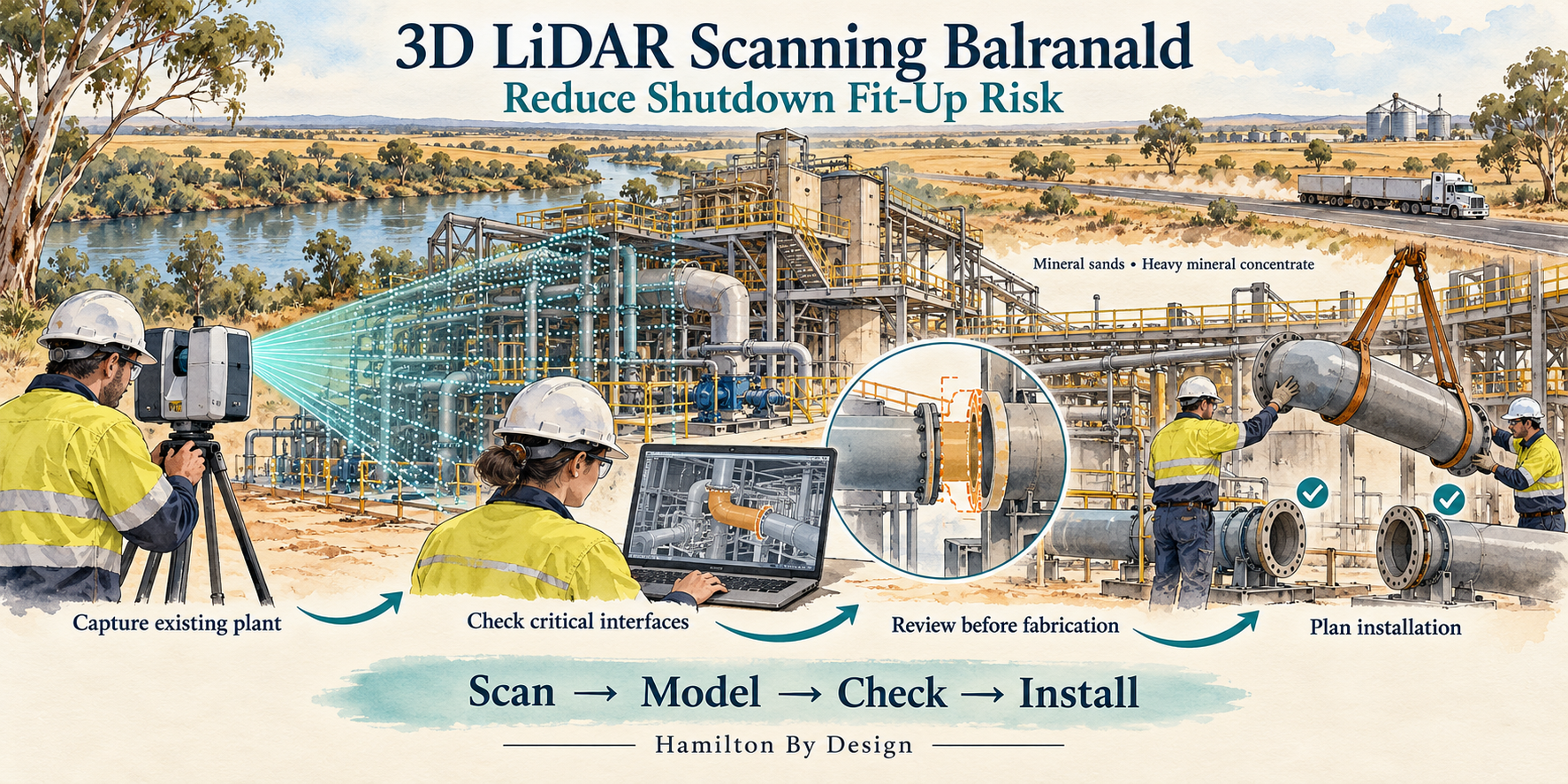

Check how replacement components connect to existing plant before fabrication and installation.
Hamilton By Design provides 3D LiDAR scanning, scan-to-CAD modelling and mechanical design services for mineral processing facilities in Balranald and south-western NSW.
For maintenance teams, engineering contractors and fabricators, the objective is practical: understand the installed geometry, check critical interfaces and identify clashes before equipment arrives on site.
Whether replacing a chute, modifying slurry pipework or installing a new pump skid, early scanning can help reduce the risk of components requiring unexpected modification during a shutdown.
Supporting Balranald’s Mineral Sands Industry
Iluka’s Balranald operation is located approximately 12 kilometres northwest of Balranald in south-western NSW. The mineral sands deposits contain rutile, zircon and rare earth-bearing minerals, with an on-site concentrating plant producing heavy mineral concentrate for further processing.
Iluka reports that mining and processing of run-of-mine ore commenced in January 2026.
For mineral sands and heavy mineral concentrate facilities, equipment modifications need to account for the plant as it exists today. Pipework, supports, access platforms and neighbouring equipment can all influence whether a replacement assembly fits.
Hamilton By Design offers scanning and mechanical design support for operators and contractors undertaking this type of work in the Balranald region.
Will the New Component Fit the Existing Plant?
A replacement component may match its drawing yet still encounter problems during installation.
Existing equipment may have been modified, supports may sit differently from their original design positions, or surrounding services may restrict access. Older drawings may also omit changes made during previous maintenance work.
Common fit-up problems include:
- Pipe flanges that do not align with replacement spools.
- Chute connections that differ from the original drawings.
- Pump skids that conflict with existing pipework or supports.
- Brackets and mounting plates positioned differently from the design.
- Guards that interfere with nearby equipment.
- Components that fit their final position but cannot pass through the installation route.
3D LiDAR scanning captures visible plant geometry so these interfaces can be reviewed before fabrication.
The aim is to resolve fit-up questions while there is time to change the design.
Capture the Plant Before the Shutdown
Scanning ahead of a planned shutdown creates a spatial reference for engineering and fabrication.
The survey can focus on the equipment being replaced, its connection points and the surrounding area needed for installation and maintenance.
Depending on the project, this may include:
- Equipment positions and external geometry.
- Pipe routes and accessible connection points.
- Chute inlet and outlet interfaces.
- Existing frames and support arrangements.
- Platforms, stairs, handrails and access restrictions.
- Nearby equipment and services.
- Available space for removal and installation.
Access, visibility and the required tolerances guide the scanning plan. Where operating equipment obscures critical features, additional capture may be needed during an agreed isolation or access window.
Check New Equipment Against the Point Cloud
A registered point cloud provides a three-dimensional record of the scanned area. Proposed equipment models can then be positioned within that record to assess how they connect to the existing plant.
Hamilton By Design can use this process to review:
- Replacement chute geometry and connection locations.
- Slurry and process pipework routes.
- Pump skid positions and service connections.
- Equipment support interfaces.
- Guarding arrangements.
- Maintenance clearances.
- Installation envelopes and potential clashes.
For example, a replacement pipe spool can be modelled against the surveyed route, with its end connections and nearby obstructions reviewed before drawings are released.
This gives engineers, fabricators and installation teams a common reference for discussing changes.
LiDAR Scanning and Critical Fit-Up Measurements
The measurement method needs to suit the connection being checked.
LiDAR scanning is useful for capturing plant layouts, equipment envelopes and surrounding geometry. Close-tolerance features such as small bolt holes, machined faces and shaft interfaces may require supplementary measurement or higher-resolution component scanning.
Hamilton By Design can combine plant scanning with targeted checks of critical interfaces.
Before mobilisation, we establish:
- Which components must connect.
- The required fit-up tolerances.
- Which surfaces and features are accessible.
- Where supplementary measurements are needed.
- Which dimensions require verification before fabrication.
This approach makes the scan useful for the installation decision. A clash-free model alone does not establish that every connection meets its required tolerance.
Mechanical Design for Mineral Processing Modifications
Capturing geometry is the first step. Turning it into usable engineering information helps the project move towards fabrication and installation.
Hamilton By Design can support:
Chute replacements and modifications
Model existing interfaces and develop replacement geometry around available space, connection points and maintenance access.
Pipework and spool arrangements
Capture existing routes and support positions to assist with replacement spools, rerouting and equipment connections.
Pump skids and equipment layouts
Review proposed equipment against the installed plant, including surrounding services and maintenance space.
Guarding and access arrangements
Develop geometry around existing equipment while considering inspection, maintenance and removal requirements.
Reverse engineering
Create CAD models of accessible components where suitable drawings are unavailable, with critical dimensions checked using an appropriate measurement method.
The scope can range from a focused interface survey to a broader scan-to-CAD and mechanical design package.
A Practical Workflow for Shutdown Planning
1. Define the fit-up problem
Identify the replacement equipment, connection points, shutdown constraints and required deliverables.
2. Capture the existing installation
Scan the relevant area and complete agreed supplementary measurements.
3. Build the spatial reference
Register the scan data and prepare the point cloud for engineering review.
4. Model and review the proposed components
Check interfaces,
Contact Us – Talk To Us
Our clients: