


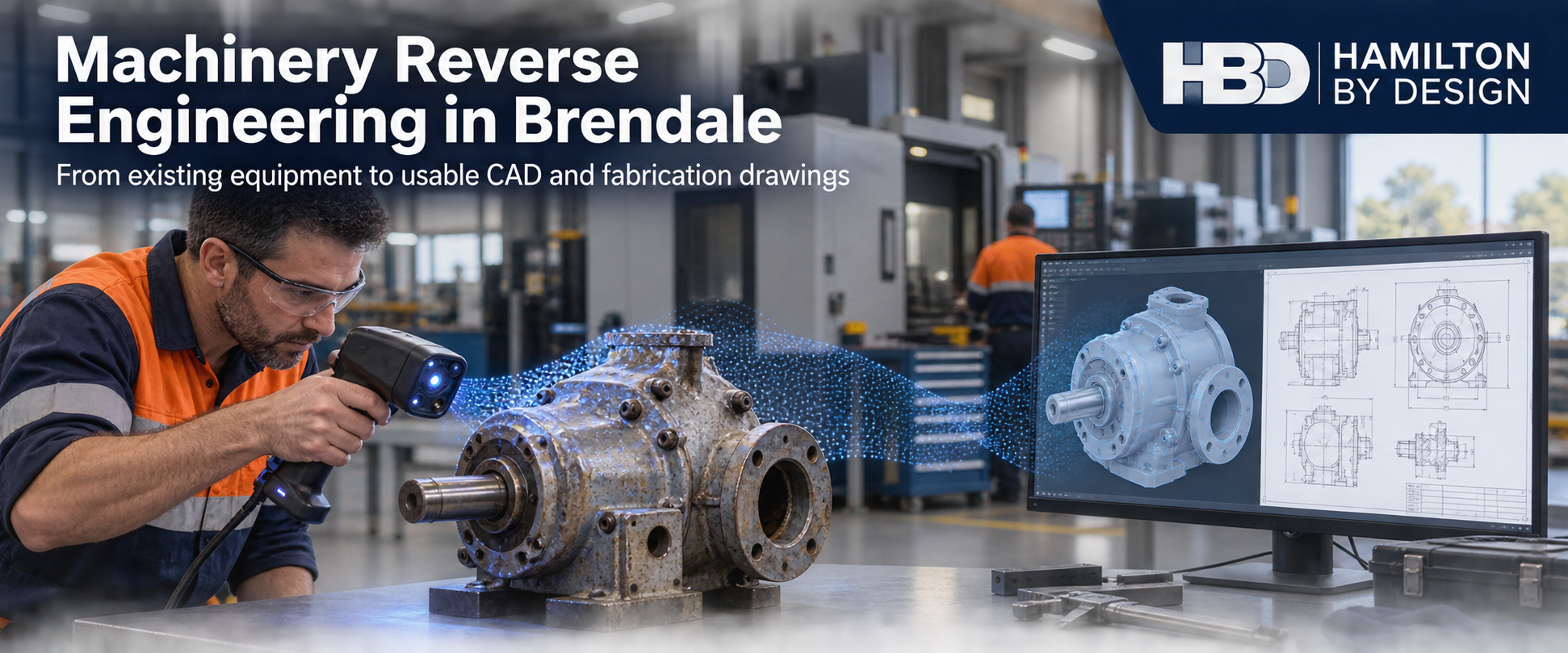

In a Brendale workshop, an old machine can still be central to production even when its original drawings have disappeared. A replacement component might be available only after a long lead time. The machine may have been repaired or modified several times, so an original manual no longer describes what is installed. When a part fails, the immediate question is practical: how can the team make a reliable replacement without creating another problem at assembly or start-up?
Brendale is well placed to make parts. Its industrial precinct brings together machining, fabrication, product development, engineering and distribution. The City of Moreton Bay identifies it as a leading advanced manufacturing location with access to the Bruce Highway and wider supply chains. The challenge for an individual business is often getting from a physical machine to the right engineering information for those capable local workshops to use.
Hamilton By Design (HBD) helps bridge that gap through machinery surveys, component scanning, reverse engineering, mechanical design and fabrication documentation. The aim is to capture what is actually there, understand what the component must do, and produce information that can be reviewed, manufactured and retained for future work.
A local manufacturing precinct with a practical advantage
Brendale is more than an address on the northern side of Brisbane. The City of Moreton Bay describes Brendale as a major advanced manufacturing precinct. Local operations include precision machining, pressing and tooling, engineered products, fabrication, equipment maintenance and product development. Some businesses make their own products; others manufacture or repair equipment used well beyond South East Queensland.
The range is visible in the precinct itself. Berg Engineering’s Brendale workshop describes large-capacity machining alongside fabrication, welding and pump and valve work. ARROWES describes an in-house team developing and manufacturing roadwork safety products for markets across Australia and New Zealand. These are examples of the local industrial mix, not claims that either business uses HBD’s services.
That mix creates an opportunity for maintenance and production teams. A workshop capable of making a part may be nearby, but the workshop still needs sound geometry, material requirements, critical fits and a clear drawing. A fitter’s sketch can be valuable, yet it may not show how a worn surface originally fitted its mating part. Similarly, a factory floor plan may show a proposed machine position without recording the pipework, access routes or equipment already in the way.
The strongest use of machinery reverse engineering in Brendale is therefore to connect local manufacturing capability with a dependable record of the existing asset. HBD’s scan-to-CAD reverse engineering process can turn suitable physical measurements into component models and fabrication information. The extent of scanning and engineering depends on the job: a small bracket, a worn pump component and a complete production cell need different methods.
When an obsolete part needs more than a copy
Reverse engineering begins with the purpose of the part. What does it locate, carry, seal, guide or protect? What connects to it? Has a bearing, shaft, gearbox or drive been changed since the machine was built? Those questions matter because the existing component may be damaged or worn. Copying every surface can preserve the very defect that caused the maintenance problem.
For a replacement component, HBD can inspect the available part and its installed interfaces, take direct measurements where needed, capture suitable surfaces with 3D scanning and develop an editable CAD model. A drawing package may then define geometry, critical dimensions, material, fits, finishes and revision information for the manufacturer. Where the operating loads or failure consequences call for it, the design also needs an appropriate engineering assessment.
This distinction is important. A scan records visible shape within the limits of the chosen equipment and site access. It does not, by itself, establish the original design intent, internal condition, material grade or correct machining tolerance. For close-fitting features, the team should agree which dimensions require direct measurement, inspection or another metrology method before release for manufacture.
HBD’s SolidWorks modelling services for Brisbane projects can support the next step: making the model useful for assemblies, alternative designs, workshop drawings and later revisions. Retaining the source scans alongside the final model helps explain what was measured and what was inferred.
Scanning the factory before moving the machine
Brendale’s manufacturing businesses also change their facilities as orders, products and equipment change. A new press, machining centre or packaging line might fit on a two-dimensional floor plan but leave too little room for a tool change, forklift movement or safe maintenance. A machine moved a short distance can affect ducting, cable trays, guarding, access and material flow.
For a small or medium factory, a targeted survey can be more useful than trying to model everything. HBD can identify the area that matters, capture the floor, major equipment, columns and relevant services, and prepare a point cloud or existing-condition model. Proposed equipment footprints can then be tested against the site record. The resulting layout can show practical clearances, likely clashes and interfaces requiring further measurement.
The broader Brisbane reality capture service explains how site data can feed mechanical drafting and plant modifications. For Brendale clients, the deliverable should be chosen at the start: a point cloud for a design team, a dimensioned equipment layout, an editable CAD model, or a more detailed installation package. A building scan alone does not automatically provide all four.
Guarding and access after a modification
An equipment change can create a new safety problem even when the original machine was properly guarded. A replacement drive may bring moving parts closer to a walkway. A new product path can require an opening in a guard. A relocated machine may leave an awkward maintenance position or restrict access to an isolation point.
HBD can use site measurements and scan data to develop guarding concepts, mounting details and fabrication drawings around the actual machine. Its machine guarding service considers operation, cleaning, maintenance and installation as well as the physical barrier. A useful design record identifies the hazard, proposed control, access needs, assumptions and review outcome.
The relevant parts of the AS/NZS 4024 safety of machinery series and Queensland’s Managing risks of plant in the workplace Code of Practice provide a framework for risk assessment and risk reduction. Where a project includes fixed platforms, walkways, stairs or ladders, AS 1657 may also apply. The exact requirements must be selected for the machine and task; a generic guard detail cannot resolve every operating risk.
Drawings that a workshop can use again
Good drafting is part of asset management. A drawing that shows a part’s shape but omits its material, interfaces or revision may be difficult to use on the next shutdown. The same applies when a modified machine is shown on an old general arrangement but its new guarding, mounting points and service connections are kept only in someone’s memory.
HBD’s mechanical drafting services can develop general arrangements, assembly drawings, component details, fabrication drawings and updated layouts from scans, measurements, existing drawings and site markups. Depending on the scope, a package might include a bill of materials, installation notes and a record of the as-built arrangement. Drawings can follow the applicable AS 1100 technical drawing series, together with project-specific dimensional, material and fabrication requirements.
The retained information can be particularly valuable for a smaller manufacturer without a dedicated drawing office. Machinery scans, component models, factory point clouds, guarding records, materials and revisions create a starting point for the next repair or modification. They also help a new employee or external fabricator understand which version represents the current machine.
A sensible sequence for a Brendale project
The first conversation should focus on the decision the client needs to make. Is production waiting for a replacement part? Is a machine move being priced? Has a guarding audit identified a specific hazard? The answer determines what to measure and how much documentation is useful.
A practical workflow is to inspect the equipment and available records, agree the critical interfaces, capture the relevant geometry, confirm uncertain dimensions, develop the CAD model or layout, review the design and issue controlled drawings. For a production change, it may also be useful to check how the proposed arrangement affects maintenance access, material handling and installation sequence before fabrication begins.
HBD can provide the scanning, modelling and drafting inputs and define the engineering assessment needed for the agreed scope. In Queensland, professional engineering services must be performed by an appropriately registered RPEQ, under direct RPEQ supervision, or only to a prescriptive standard where that exception applies. Registration and review arrangements should be established for any work requiring professional engineering judgement or certification.
The result should be proportionate to the problem. A single replacement part may need a measured model and machining drawing. A machinery relocation may need a factory point cloud, equipment layouts and several coordinated drawing revisions. The common thread is a usable record of what exists and what is proposed.
Frequently asked questions
Can HBD reverse engineer a component if we have no original drawing?
Yes, where the component and its interfaces can be inspected and enough information is available to define its function. HBD can capture geometry and develop a CAD model and drawing. Material, tolerances, loads and critical fits still need to be established for the particular application; they should not be guessed from the scan.
Is 3D scanning in Brendale suitable for both a small part and a whole factory?
Both can be surveyed, but they need different capture methods and levels of detail. A factory point cloud is useful for equipment layouts and surrounding conditions. A close-fitting component may require a suitable part scanner plus direct dimensional checks. HBD would select the approach around the required deliverable.
Can a factory scan help us move a production machine?
It can provide an existing-condition reference for columns, equipment and visible services. The proposed position can then be checked for fit, access and likely clashes. Confirmed dimensions, service requirements and operating clearances should be added to the layout before installation decisions are finalised.
Can you prepare drawings for a local Brendale fabricator or machinist?
HBD can prepare CAD models and workshop or fabrication drawings suited to the agreed component or assembly. Before manufacture, the client and manufacturer should confirm the drawing revision, material, tolerances, finish and any required engineering approval.
Can reverse engineering also improve machine safety?
It can support a safer modification by documenting the actual machine and its interfaces. Guarding still requires a task-specific risk assessment and design review. A scan is a useful input to that work, not a safety approval on its own.
Discuss a Brendale machinery or factory project
If an obsolete part, undocumented machine or changing factory layout is holding up a decision, send HBD photographs, any available drawings, the equipment location and a short description of the problem. We can discuss the capture method, the required CAD or drawing deliverable, and the appropriate engineering review before work begins. Contact Hamilton By Design to arrange a conversation about your Brendale project.

Contact Us – Talk To Us
Our clients:

























Related engineering resources
Reverse Engineering Industrial Equipment Using 3D Scanning
See how measurements of existing equipment can support CAD modelling, redesign and replacement components.
Why Scanning Quality Matters in Reverse Engineering
Explore why the capture method and verification of critical features matter when fit-up and fabrication are the goal.
Scan-to-CAD Versus Traditional Measurement
Compare reality capture with manual measurement when planning modifications to existing machinery or facilities.
3D CAD Modelling and Mechanical Drafting
Learn how models become assembly, workshop and fabrication drawings that support manufacture and installation.
Factory Scan to BIM Australia
Find out how an existing factory can be captured and modelled for equipment changes, upgrades and documentation.
Plant Layout Scan to BIM
Consider how measured plant conditions can inform equipment layouts and coordination before installation.
Manufacturing and Production Engineering
Explore support for production facilities, machinery upgrades, maintenance and asset life extension.
FEA and Mechanical Assessment
See where mechanical assessment can help evaluate a component or modification after its geometry and operating conditions are established.