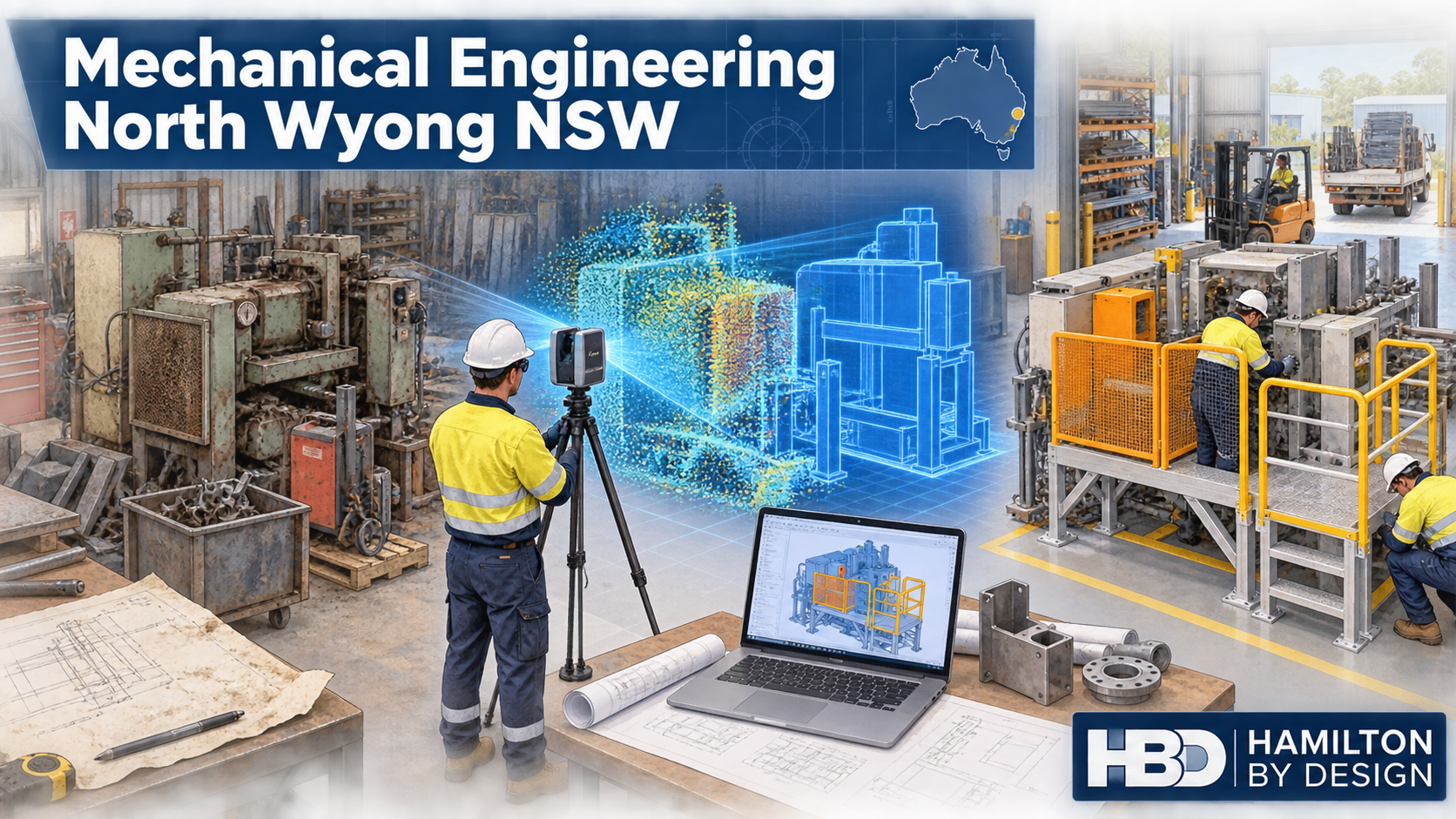

North Wyong is an important industrial and enterprise precinct on the northern Central Coast of New South Wales. Its workshops, manufacturers, equipment suppliers, food-processing businesses and construction-support companies contribute practical capability to the wider Wyong, Central Coast, Hunter and northern Sydney economies.
Unlike a large, uniform industrial estate, North Wyong contains a diverse mixture of fabrication workshops, service businesses, warehouses, commercial facilities and machinery-based operations. Many businesses occupy adaptable industrial units where equipment, storage systems and production layouts have evolved over time.
This creates a recurring engineering challenge: existing facilities and machinery do not always match their original drawings. In some cases, reliable drawings no longer exist.
Hamilton By Design provides local, engineer-led support for these brownfield environments. Our services combine mechanical engineering, 3D laser scanning, CAD modelling and fabrication documentation to help North Wyong businesses plan equipment modifications with greater confidence.
Our objective is straightforward: capture the existing condition accurately, develop a practical engineering solution and provide clear information that can be used for fabrication and installation.
An industrial precinct with practical capability
North Wyong’s industrial activity is concentrated around areas such as Lucca Road, Amsterdam Circuit and Donaldson Street. The precinct supports a mixture of fabrication, equipment servicing, automotive work, food processing, warehousing, distribution and construction-related operations.
Its location is one of its principal strengths. North Wyong is positioned close to the M1 Motorway and provides access to the Central Coast, Newcastle, the Hunter Region and northern Sydney. This makes it suitable for businesses supporting customers across several industrial markets.
Local operators understand that North Wyong is not simply an extension of Tuggerah Business Park. It has its own workshop-based character. Many businesses undertake repairs, machinery modifications, equipment servicing and one-off fabrication rather than relying solely on large-volume production.
These activities require practical engineering information. A design must account for the equipment already on site, the available access, the way operators use the machinery and the methods a local fabricator will employ to manufacture the proposed work.
Hamilton By Design’s existing mechanical engineering services in Wyong are particularly suited to this type of operating environment.
Why existing industrial equipment is difficult to modify
Modifying existing machinery is often more complicated than designing new equipment. A new machine can be developed around controlled dimensions and documented interfaces. An existing machine may have been repaired, relocated or altered several times during its working life.
Common problems include:
- Missing or outdated drawings
- Previous modifications that were never documented
- Machinery installed out of level or out of square
- Restricted maintenance access
- Guards removed to allow operation or servicing
- New equipment competing with existing services
- Unrecorded steelwork or concrete foundations
- Limited shutdown time for measurement and installation
- Congested workshops containing stored materials and mobile equipment
Traditional hand measurement remains useful, but it can be inefficient when the equipment contains complex geometry or numerous interfaces. Critical details may be obscured by guards, pipework, platforms or adjacent machinery.
Engineer-led 3D scanning provides a more complete record of the accessible site condition. It allows the design team to examine the equipment after leaving the site and reduces reliance on assumptions during the design process.
Hamilton By Design provides 3D laser scanning and mechanical engineering in Wyong for industrial facilities, brownfield assets and equipment-modification projects.
Engineer-led 3D laser scanning in North Wyong
A laser scanner records millions of measured points representing visible surfaces. When these measurements are processed and registered, they form a three-dimensional point cloud of the workshop, machine or installation.
For a North Wyong industrial project, the point cloud may capture:
- Machinery and equipment
- Structural columns and beams
- Floors and concrete foundations
- Platforms, stairs and ladders
- Pipework and ducting
- Conveyor routes
- Workshop walls and door openings
- Overhead obstructions
- Service connections
- Adjacent equipment
- Available installation clearances
The value of scanning does not come from the quantity of points alone. The information must be captured with an understanding of how it will be used.
For example, a survey intended to modify a conveyor must record more than the overall position of the conveyor. It may need to capture pulley centre lines, chute interfaces, drive arrangements, maintenance clearances, supporting steelwork and the proposed path for removing components.
This is why Hamilton By Design uses an engineer-led approach. The same team can consider the downstream requirements for modelling, mechanical design, fabrication and installation while planning the scan.
More information about this workflow is available on our 3D engineering scanning Wyong page.
From point cloud to usable CAD information
A point cloud is an important engineering reference, but it is not automatically a fabrication model. The relevant geometry must be interpreted and converted into suitable CAD information.
Depending on the project, Hamilton By Design can produce:
- Registered E57, RCP or LAS point-cloud files
- Two-dimensional workshop layouts
- Existing-condition plans and elevations
- Simplified spatial models
- Detailed mechanical CAD models
- Equipment interface models
- General arrangement drawings
- Fabrication and assembly drawings
- Bills of materials
- Plate profiles and DXF files
- STEP or Parasolid models
- Installation and verification dimensions
The required level of detail should be agreed at the beginning of the project. A workshop layout used for equipment planning does not require the same modelling detail as a replacement component intended for machining.
Our 3D scanning for fabrication in Wyong service focuses on converting captured site geometry into information that designers and fabricators can practically use.
Mechanical engineering for equipment modifications
North Wyong businesses frequently need to extend the working life of existing machinery rather than replace an entire system. A targeted modification may improve access, safety, reliability or production without requiring a complete plant replacement.
Hamilton By Design can assist with:
- Machinery and equipment modifications
- Reverse engineering of existing parts
- Replacement component modelling
- Machine guarding
- Chutes, hoppers and transfer arrangements
- Conveyor modifications
- Pump and motor skids
- Equipment support frames
- Pipework and duct layouts
- Maintenance platforms and access systems
- Lifting devices
- Installation planning
- Constructability reviews
- Finite element analysis where appropriate
An effective modification should consider the whole equipment lifecycle. It should be possible to manufacture, transport, install, operate, inspect and maintain the proposed design.
The designer must also understand the boundaries of the project. Mechanical engineering, structural engineering, electrical safety and functional safety may require different professional competencies. Where specialist structural or electrical certification is required, it should be identified and coordinated rather than implied.
Mechanical drafting for local manufacturers and fabricators
Good engineering documentation converts design intent into clear manufacturing information. Even a technically sound concept can produce poor results if its drawings contain ambiguous dimensions, missing interfaces or inconsistent revisions.
Hamilton By Design provides mechanical drafting and LiDAR scanning services that can include:
- General arrangement drawings
- Detail drawings
- Fabrication and assembly drawings
- Weld details
- Sheet-metal developments
- Cutting lists
- Bills of materials
- Machined-component drawings
- Pipe spool drawings
- Workshop and equipment layouts
- Guarding drawings
- Installation drawings
- As-built updates
Documentation can be managed through defined revision stages such as Issued for Review, Issued for Approval and Issued for Construction. This provides a traceable distinction between a developing design and information authorised for fabrication.
Relevant standards may include the AS 1100 technical-drawing series, AS/NZS 1554 for structural steel welding, AS 1657 for fixed access systems and the AS/NZS 4024 machinery-safety series. The precise standards depend on the equipment, materials, duty and agreed scope.
Improving machinery safety
Existing industrial machinery can accumulate hazards as production requirements change. A guard may be removed to improve access, an opening may be enlarged to accommodate a different product, or a maintenance task may expose workers to rotating equipment and stored energy.
Potential hazards include:
- Exposed shafts, belts, chains and couplings
- In-running nip points
- Rotating or reciprocating components
- Access to conveyor danger zones
- Heavy or difficult-to-remove guards
- Unsafe reach distances
- Inadequate maintenance access
- Falls from platforms or ladders
- Unexpected movement during maintenance
- Pneumatic, hydraulic or gravitational stored energy
- Interaction between forklifts and pedestrians
Hamilton By Design can assist by recording the existing arrangement, identifying physical interfaces and developing suitable engineering controls. These may include fixed guards, improved access covers, maintenance platforms, revised layouts or provisions for interlocked systems.
Machinery-safety work may refer to the AS/NZS 4024 series, while fixed platforms, walkways, stairs and ladders may be assessed against AS 1657. The NSW work health and safety framework and the hierarchy of controls must also be considered.
Electrical control systems, safety-rated interlocks and electrical isolation requirements should be developed or verified by suitably qualified electrical and functional-safety specialists.
Supporting logistics and materials handling
North Wyong’s manufacturers, warehouses and service businesses depend on efficient movement of products, components and materials. Poorly planned equipment layouts can restrict forklift movements, create pedestrian conflicts or make future maintenance difficult.
Hamilton By Design can assist with:
- Conveyor and transfer-point modifications
- Chutes and product-flow arrangements
- Equipment relocation studies
- Workshop layout planning
- Loading and unloading equipment
- Maintenance access
- Lifting beams and custom lifting devices
- Storage and handling frames
- Clash detection
- Installation sequencing
Potentially relevant standards include AS/NZS 4024.3610 for conveyors, AS 4991 for lifting devices, the AS 1418 and AS 2550 series for cranes and hoists, and AS 1657 for fixed access systems.
Where pallet racking, vehicle swept paths, fire egress or building structure is affected, input may also be required from appropriately qualified specialists.
Managing engineering risk
A practical risk-management process begins before the drawing stage. It requires the existing condition, design assumptions and project interfaces to be understood.
A typical HBD workflow is:
- Discuss the operational problem and required outcome.
- Inspect and scan the existing installation.
- Register and review the point cloud.
- Identify hazards, constraints and missing information.
- Model the relevant existing geometry.
- Develop and review the proposed modification.
- Prepare controlled engineering and fabrication drawings.
- Support fabrication and installation where required.
- Verify critical dimensions or update the as-built record.
This process supports the principles of AS ISO 31000:2018 – Risk management by making assumptions, interfaces and design decisions more visible.
It also creates an engineering record that can assist with future inspections, maintenance and modifications.
Retaining a reliable digital asset record
Industrial knowledge is often held by a small number of experienced employees. When those employees leave, undocumented information about machinery, repairs and previous modifications can be lost.
Subject to the client’s confidentiality and data-retention requirements, Hamilton By Design can maintain controlled project information including:
- Equipment point clouds
- Workshop layouts
- Steelwork measurements
- CAD models
- Modification drawings
- Fabrication packages
- Equipment-condition photographs
- Drawing revisions
- Design assumptions and interface records
A reliable digital record does not replace inspection or engineering verification. It provides a stronger starting point for later work and reduces dependence on memory, sketches and unverified legacy drawings.
Additional information about point-cloud capture and modelling is available through our 3D LiDAR scanning Wyong and reality capture in Wyong services.
Frequently asked questions
What mechanical engineering services does Hamilton By Design provide in North Wyong?
Hamilton By Design provides mechanical design, equipment-modification engineering, 3D laser scanning, reverse engineering, CAD modelling, fabrication drawings, machine-guarding design, access-system design and installation support. The exact service is tailored to the client’s equipment and intended outcome.
Can you scan a factory while it is operating?
In many cases, yes. The scan can be planned around production, vehicle movements and restricted areas. Some surfaces may remain hidden by equipment, stored materials or product build-up, so the required visibility should be discussed before the visit. Short shutdowns or weekend access may be recommended for critical areas.
Can a point cloud be used directly for fabrication?
Usually not without interpretation. A point cloud is a measured spatial reference rather than a complete engineering model. Relevant surfaces, centre lines, interfaces and fabrication dimensions must normally be extracted, modelled and verified.
Can HBD modify equipment when no drawings are available?
Yes. This is a common reason for using 3D scanning and reverse engineering. The accessible equipment can be measured, converted into a CAD reference and used to develop the proposed modification. Hidden features may still require dismantling, supplementary measurements or confirmation during fabrication.
What files can Hamilton By Design provide?
Typical deliverables include E57, RCP and LAS point clouds; PDF and DWG drawings; DXF cutting profiles; and STEP, Parasolid or native CAD models. The agreed deliverables should reflect how the client, fabricator and installer intend to use the information.
Does Hamilton By Design provide structural certification?
Hamilton By Design provides mechanical engineering and can prepare structural drafting and coordination information within an agreed scope. Where formal structural engineering certification is required, the design should be reviewed and certified by an appropriately qualified structural engineer.
Which Australian Standards apply?
The applicable standards depend on the machinery and modification. Common references may include AS/NZS 4024, AS 1657, AS 4100, AS/NZS 1170, AS 4991, AS 1418, AS 2550, AS 4041, AS 1210 and AS/NZS 1554. The project-specific requirements should be established during scoping.
How does 3D scanning reduce project risk?
Scanning provides a more comprehensive record of visible site geometry. It can expose clashes, restricted access and interface problems before fabrication begins. This reduces—but does not eliminate—the risk of inaccurate dimensions, unexpected site conditions and installation rework.
Can HBD support the fabricator after drawings are issued?
Yes. Subject to the agreed scope, HBD can respond to fabrication queries, review proposed changes, provide additional dimensions and assist with installation planning or final as-built documentation.
Speak with a local mechanical engineer
North Wyong businesses need engineering support that recognises the realities of working workshops and existing machinery. Accurate site information, practical mechanical design and clear fabrication drawings can reduce uncertainty before materials are ordered or equipment is taken out of service.
Hamilton By Design provides a coordinated workflow from site capture through to modelling, mechanical engineering and fabrication documentation. The core scanning and drawing process remains with the same team, reducing the loss of information that can occur when reality capture, design and drafting are separated.
If you are planning a machinery modification, workshop rearrangement, guarding upgrade or fabrication project in North Wyong, contact Hamilton By Design to discuss the existing equipment, required deliverables and the most appropriate inspection or scanning approach.

Contact Us – Talk To Us
Our clients: