


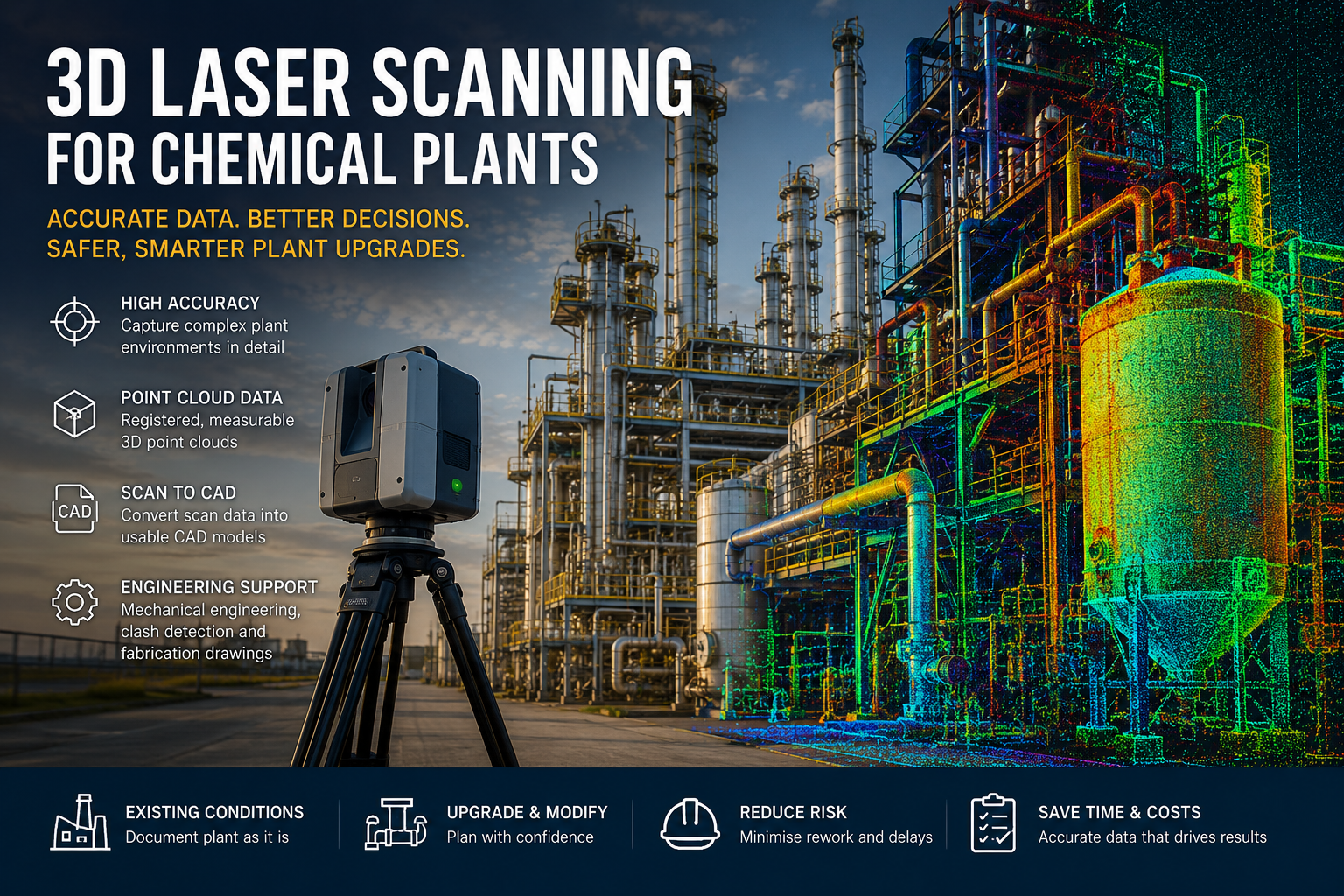
3D Laser Scanning for Chemical Plants
Chemical plants are often complex, congested and difficult to measure accurately. Existing drawings may be incomplete, outdated or no longer reflect modifications made during previous maintenance and upgrade projects.
Hamilton By Design provides engineering-led 3D laser scanning, point-cloud processing, CAD modelling and mechanical engineering support for chemical plants and process facilities across Australia.
Our service helps plant owners, engineering teams, maintenance departments and contractors capture accurate existing-condition information before equipment replacement, pipework modifications, structural upgrades or brownfield construction work begins.
The Goal
The goal of 3D laser scanning is to create an accurate and measurable digital record of the existing chemical plant.
This information can then be used to:
- Plan plant upgrades and modifications
- Verify existing dimensions
- Develop accurate CAD models and drawings
- Coordinate new equipment with existing infrastructure
- Identify potential clashes
- Reduce site measurement uncertainty
- Support fabrication and installation planning
- Improve shutdown preparation
- Document existing plant conditions
- Reduce rework and installation delays
Rather than designing from outdated drawings or site assumptions, project teams can work from captured plant geometry.
The Problem
Chemical plants can contain extensive networks of pipework, tanks, vessels, pumps, valves, structural steel, platforms, electrical services and process equipment.
These environments can be difficult to measure using traditional manual methods.
Common challenges include:
- Congested pipework and services
- Restricted access around equipment
- Limited shutdown or inspection windows
- Outdated or incomplete drawings
- Plant modifications that have not been documented
- Equipment positioned at different elevations
- Difficult-to-reach structural connections
- Tight fabrication and installation tolerances
- Safety restrictions around operating plant
- Limited visibility behind equipment and services
When engineering work is based on incomplete or inaccurate information, the result may include pipe spools that do not fit, equipment installation clashes, incorrect support locations, additional site welding, extended shutdowns and costly fabrication rework.
The Solution
Hamilton By Design uses terrestrial 3D laser scanning to capture the visible geometry of the existing chemical plant.
Multiple scans are taken from carefully selected positions and registered together to create a measurable three-dimensional point cloud.
The point cloud can then be used to develop practical engineering deliverables, including:
- Registered point-cloud datasets
- Existing-condition plant models
- Scan-to-CAD models
- SolidWorks models
- Equipment and pipework layouts
- General arrangement drawings
- Sections and elevations
- Fabrication drawings
- Structural steel models
- Clearance and access studies
- Clash-detection models
- Proposed plant modification models
This process gives engineers and designers a more reliable foundation for planning upgrades around actual site conditions.
Services Provided by Hamilton By Design
Hamilton By Design can provide a combination of onsite scanning, data processing, CAD modelling, drafting and mechanical engineering services.
Depending on the project requirements, the service may include:
3D Laser Scanning
Onsite capture of chemical plant areas using terrestrial LiDAR scanning equipment.
Point-Cloud Registration
Processing and registering individual scan positions into a coordinated and measurable point-cloud dataset.
Existing-Condition Documentation
Creation of an accurate digital record of existing equipment, pipework, structural steel, platforms and surrounding infrastructure.
Scan-to-CAD Modelling
Conversion of selected point-cloud information into usable 2D drawings or 3D CAD models.
SolidWorks Modelling
Development of SolidWorks parts, assemblies and plant models for engineering review, equipment coordination and modification planning.
Mechanical Engineering Support
Engineering input for equipment upgrades, maintenance projects, plant modifications and brownfield design work.
Fabrication Drawings
Preparation of drawings for structural steel, platforms, supports, equipment frames, pipe supports and other plant components.
Clash and Clearance Reviews
Assessment of proposed equipment, structures or pipework against the captured existing plant environment.
Shutdown Planning Support
Capture of existing conditions before a shutdown to help reduce uncertainty during fabrication and installation.
Typical Chemical Plant Areas That Can Be Scanned
3D laser scanning may be suitable for capturing:
- Process pipework
- Tanks and vessels
- Pumps and pump bases
- Valves and manifolds
- Pipe racks
- Structural steel
- Platforms and access ways
- Stairs and handrails
- Equipment foundations
- Skids and packaged equipment
- Ducting and ventilation systems
- Conveyors and material-handling equipment
- Maintenance access areas
- Plant rooms
- External processing areas
- Existing equipment interfaces
The final scanning scope should be based on the project objectives, access conditions and required engineering deliverables.
Common Applications
3D laser scanning can support a range of chemical plant projects, including:
- Brownfield plant upgrades
- Equipment replacement
- Pipework modifications
- New equipment installation
- Plant-layout verification
- Structural modifications
- Platform and access upgrades
- Pump and skid replacement
- Shutdown preparation
- Fabrication planning
- Existing-condition surveys
- Reverse engineering
- As-built documentation
- Clash detection
- Maintenance planning
- Asset documentation
Available Deliverables
Deliverables can be tailored to suit the client’s preferred software and intended use.
Typical file formats may include:
- E57 point-cloud files
- RCP and RCS files
- LAS files
- Registered scan project files
- SolidWorks part and assembly files
- STEP files
- SAT files
- Parasolid files
- DWG and DXF drawings
- Measurable eDrawings
- General arrangement drawings
- PDF drawings
- Sections and elevations
- Fabrication drawings
Before processing begins, it is important to confirm how the client intends to open, measure, review or modify the delivered files.
Important Scanning Limitations
A laser scanner captures visible surfaces from the scanner’s line of sight.
It does not automatically capture:
- Buried services
- Internal pipe conditions
- Equipment hidden behind cladding
- Internal vessel geometry without access
- Surfaces blocked by equipment or structures
- Areas obscured by steam, dust or process emissions
- Material specifications
- Wall thicknesses
- Internal corrosion
- Process operating information
Multiple scanning positions can reduce hidden areas, but some locations may still require manual measurement, existing drawings or additional inspection methods.
Safety and Site Access
Chemical plants may contain hazardous substances, operating machinery, pressurised equipment, hot surfaces and restricted work areas.
Scanning activities must therefore be planned around the facility’s existing safety requirements.
Project planning may include:
- Site inductions
- Permit requirements
- Hazardous-area restrictions
- Exclusion zones
- Personal protective equipment
- Plant operating conditions
- Access limitations
- Working-at-height requirements
- Confined-space restrictions
- Coordination with plant personnel
- Shutdown or isolation requirements
The scanning methodology should be developed in consultation with the client’s site and safety representatives.
Why Hamilton By Design?
Hamilton By Design combines 3D laser scanning with mechanical engineering, CAD modelling, drafting and practical plant experience.
This means the service is focused on creating useful engineering information rather than simply supplying raw scan data.
Clients can engage Hamilton By Design for the full workflow, including:
- Project scoping
- Onsite scanning
- Point-cloud registration
- Existing-condition review
- CAD modelling
- Engineering development
- Drawing preparation
- Fabrication and installation support
This integrated approach can help reduce the number of handovers between scanning, drafting, engineering and fabrication providers.
Frequently Asked Questions
What is 3D laser scanning for a chemical plant?
3D laser scanning is a non-contact measurement process that records millions of points from visible plant surfaces. These points form a three-dimensional point cloud representing the existing chemical plant environment.
Why use 3D laser scanning instead of manual measurements?
Manual measurements can be difficult in congested chemical plants. Laser scanning captures a much larger amount of spatial information and helps document the relationships between pipework, equipment, structures and access areas.
Can the scan data be measured?
Yes. A registered point cloud can be opened in compatible software and used to take measurements. The accuracy and suitability of those measurements depend on the scanning method, registration quality, site conditions and required project tolerance.
What accuracy can be expected?
Accuracy depends on the scanner, scan distance, plant conditions, registration method and project requirements. The required accuracy should be discussed before the scanning scope is finalised.
Can you create a SolidWorks model from the scans?
Yes. Selected equipment, structures, pipework and plant geometry can be modelled in SolidWorks using the registered point cloud as a reference.
The level of model detail should be agreed before work begins.
Can you model an entire chemical plant?
Potentially, but complete plant modelling can involve a significant amount of work. It is often more efficient to model only the areas and equipment required for the proposed project.
Can 3D scanning identify internal pipe corrosion?
No. Terrestrial laser scanning captures visible external surfaces. It does not measure internal corrosion, wall thickness or internal pipe condition.
Other inspection methods would be required.
Can scanning be completed while the plant is operating?
In some cases, yes. This depends on site access, safety requirements, hazardous areas, moving equipment, temperature, emissions and operational restrictions.
The client must determine whether the area is safe and accessible for scanning.
Does the scanner need to touch the equipment?
No. Terrestrial laser scanning is generally a non-contact measurement method.
Can scanning reduce shutdown time?
Scanning can improve shutdown preparation by allowing more design, coordination and fabrication work to be completed before site installation begins.
It cannot guarantee that delays or rework will be eliminated, but it can reduce uncertainty associated with existing plant conditions.
What information is required before scanning?
Useful project information includes:
- The plant location
- The areas to be scanned
- The purpose of the scan
- Required deliverables
- Preferred file formats
- Required accuracy
- Available access windows
- Site safety requirements
- Existing drawings
- The software the client intends to use
What software can be used to open the files?
This depends on the selected deliverables. Point-cloud and CAD files may be prepared for software such as Autodesk ReCap, AutoCAD, Navisworks, SolidWorks or other compatible engineering platforms.
Do you provide raw scan data?
Raw or registered scan data can be included if it is specified in the agreed project scope.
The client should confirm whether they require raw scans, registered point clouds, CAD models, drawings or a combination of deliverables.
Can the point cloud be used for clash detection?
Yes. A registered point cloud can be compared with proposed equipment, pipework or structural models to identify potential spatial conflicts.
Can you prepare fabrication drawings?
Yes. Hamilton By Design can use the scan data to support the preparation of fabrication drawings for selected plant components, structures, supports, platforms and equipment modifications.
Can you scan tanks and pressure vessels?
The external visible surfaces of tanks and vessels can generally be scanned where safe access and line of sight are available.
Internal scanning would require safe internal access, appropriate isolation and separate site approval.
Can you scan pipe racks and structural steel?
Yes. Pipe racks, structural steel, platforms, stairs and access systems can be captured where they are visible from suitable scanner positions.
Will the scan show every pipe and connection?
Not necessarily. Congested plant areas can create shadows where one object blocks another. Multiple scanning positions can reduce these hidden areas, but some concealed geometry may remain.
Do you provide engineering certification?
Engineering certification is separate from the scanning process. Any certification requirement must be clearly defined and assessed as part of the engineering scope.
How long does scanning take?
The duration depends on the size and complexity of the plant, site access, safety requirements, required coverage and number of scan positions.
A small plant area may be captured within a day, while a larger or more complex facility may require several days.
How long does point-cloud processing take?
Processing time depends on the number of scans, project size, registration complexity and required deliverables.
Point-cloud registration and CAD modelling should be treated as separate project stages.
What is the best first step?
The best first step is to define the area to be scanned, the reason for the scan and the required final deliverables.
It is also helpful to confirm what software the project team intends to use to open and review the files.
Request a Chemical Plant Scanning Assessment
Hamilton By Design can assist with 3D laser scanning, point-cloud registration, CAD modelling, mechanical engineering and drafting for chemical plant upgrades and existing-condition documentation.
To discuss a project, provide:
- The chemical plant location
- The approximate area to be scanned
- The proposed project or modification
- Available site access dates
- Required file formats
- Preferred engineering software
- Existing drawings or photographs
- Required accuracy or tolerances
- Expected final deliverables
Hamilton By Design can then help develop an appropriate scanning and engineering scope for the project.

Contact Us – Talk To Us
Our clients:

























Related 3D Laser Scanning & Engineering Services
Explore additional Hamilton By Design services for industrial plants, brownfield upgrades, point cloud modelling and mechanical engineering.
3D Laser Scanning Australia
Engineering-grade 3D laser scanning and LiDAR reality capture for industrial plants, infrastructure, mining and brownfield projects.
Engineering-Grade LiDAR Scanning
High-accuracy LiDAR scanning for industrial and mining assets where reliable existing-condition data is required for engineering decisions.
3D Laser Scanning for Engineering
Engineer-led scanning for plant upgrades, shutdown planning, fit-up verification, clash checking and fabrication-ready design.
3D Scanning for Mining & Industrial Projects
Engineering-grade point cloud capture and modelling for complex processing plants, industrial facilities and heavy infrastructure.
Point Cloud to AutoCAD
Convert registered laser scan data into practical AutoCAD layouts, plant models, sections and engineering drawings.
Point Cloud to Engineering Model Workflow
See how laser scan data progresses from site capture and registration through to usable CAD models and engineering documentation.
SolidWorks Point Cloud to CAD Workflow
Transform LiDAR point clouds into detailed SolidWorks engineering models, assemblies and fabrication documentation.
SolidWorks 3D Modelling Services
Detailed mechanical, structural, piping and equipment modelling developed from LiDAR scans, drawings and measured site information.
Mechanical Engineering Services
Mechanical design, plant modifications, equipment layouts, verification and engineering support for industrial facilities.
Engineering Services
Integrated LiDAR scanning, CAD modelling, mechanical engineering, drafting and verification for industrial and infrastructure projects.
Brownfield Industrial Upgrades
Reality capture and engineering design for existing plants where outdated drawings, restricted access and shutdown constraints increase risk.
LiDAR Scanning for Industrial Retrofit Engineering
Existing-condition capture for plant modifications, equipment replacement, retrofit projects and brownfield facility upgrades.
Reverse Engineering with 3D Scanning
Capture existing components and equipment to develop accurate replacement models, drawings and fabrication-ready information.
Scan-to-CAD for Reverse Engineering
Learn how physical plant and components can be converted into engineering CAD models and fabrication drawings.
Why 3D Scanning Accuracy Matters
Understand why scan coverage, point density and engineering context matter when point clouds are being used for design and fabrication.
Scan to BIM Australia
Convert accurate reality-capture data into structured digital models for existing buildings, industrial plants and infrastructure.