Mechanical Engineering | 3D Scanning | 3D Modelling
Tag: scan-to-bim
Hamilton By Design provides Scan to BIM services that convert 3D LiDAR point-cloud data into coordinated digital models of existing buildings, industrial facilities and mechanical plant.
The process begins with accurate laser scanning of the existing site. The registered point cloud is then used as a spatial reference for developing an as-built BIM model at an agreed level of detail. This provides project teams with more reliable information than relying solely on older drawings or manual measurements.
Our Scan to BIM services can capture building geometry, structural elements, equipment positions, pipework, conveyors, platforms and other project-relevant features. Models can support facility upgrades, equipment layouts, design coordination, clash detection, renovation planning and digital asset records.
The required model scope and level of detail are agreed before modelling begins. This ensures the BIM model includes the features needed for the project without adding unnecessary modelling time or cost.
Deliverables may include registered point clouds, 3D BIM or CAD models, coordinated layouts and 2D drawings suitable for use in ReCap, Navisworks, AutoCAD, Inventor and other compatible platforms.
Services are available throughout Sydney, Newcastle, the Hunter Valley, regional NSW and across Australia.
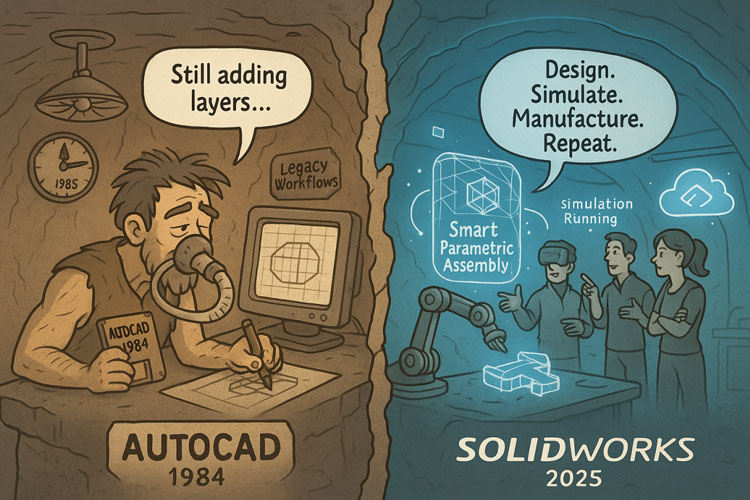
In the 1980s, AutoCAD was revolutionary. It replaced drafting boards and sharpened pencils with a digital drawing tool. Architects, engineers, and designers suddenly had a new way to bring ideas to life — faster, cleaner, and more accurate than ever before.
But here’s the problem: it’s 2025 now, and AutoCAD is still trying to breathe the same thin air it did back then.
Stuck in 2D While the World Moved On
Today’s engineering isn’t about drawing — it’s about designing. It’s about simulating real-world forces, visualizing assemblies, testing tolerances, and producing manufacturable parts before a single prototype is built.
AutoCAD, at its core, is still a 2D drafting platform trying to wear a 3D mask. The workflows are fragmented, the feature set feels patched together, and it lacks the intelligence modern teams demand.
By contrast, SOLIDWORKS was built for this century — fully parametric, model-driven, and collaborative. When you make a change to a design in SOLIDWORKS, every part, drawing, and assembly updates instantly. That’s not an upgrade; that’s evolution.
Design Needs Intelligence, Not Layers
AutoCAD still asks you to think in layers and lines — the language of draftsmen. SOLIDWORKS speaks the language of relationships, assemblies, and constraints — the language of engineers and innovators.
Modern design tools must integrate simulation, visualization, and manufacturability. They must predict behavior, test fit, and optimize before production. AutoCAD just can’t breathe in that environment anymore — it’s stuck flipping between tabs while SOLIDWORKS users are already printing parts.
Collaboration and Data: The New Oxygen
The world doesn’t design in isolation anymore. Teams are global, deadlines are tighter, and innovation cycles are shorter. AutoCAD’s file-based approach is like passing blueprints across a fax machine.
SOLIDWORKS integrates cloud data management, real-time collaboration, and digital twin technology — letting design teams iterate and innovate in real time, anywhere in the world.
The Future Is 3D — and It’s Already Here
You wouldn’t build an electric vehicle using a typewriter. So why design modern products with 1980s software?
SOLIDWORKS represents the present and the future — intelligent modeling, simulation-driven design, and integrated manufacturing tools that push boundaries instead of tracing them.
Final Thoughts
AutoCAD made history — no one can deny that. But history belongs in the museum, not the manufacturing floor.
If your software is still gasping for air in a 2D world, maybe it’s time to give it a well-earned retirement. SOLIDWORKS doesn’t imitate innovation — it defines it.
Mining is evolving faster than ever. What was once an industry defined by physical muscle — haul trucks, crushers, conveyors — is now being transformed by data intelligence, digital modelling, and real-time insight.
At the heart of this transformation lies a quiet revolution: 3D scanning. Once used primarily for design verification or plant modification, scanning is now the gateway technology that feeds the emerging world of digital twins — live, data-driven replicas of mine assets that help engineers predict, plan, and optimise before problems occur.
At Hamilton By Design, we’ve spent years scanning and modelling chutes, hoppers, and material-handling systems across Australia’s mining sector. Each project has shown us one thing clearly:
Scanning isn’t just about geometry — it’s about knowledge. And digital twins are the next logical step in turning that knowledge into action.
What Exactly Is a Digital Twin?
Think of a digital twin as the digital counterpart of a physical asset — a chute, a conveyor, a processing plant, even an entire mine site.
It’s not a static 3D model; it’s a dynamic, data-linked environment that mirrors the real system in near real time. Sensors feed performance data into the twin: wear rates, temperature, vibration, flow speed, throughput. The twin then responds, updating its state and allowing engineers to simulate scenarios, forecast failures, and test design changes before touching the physical equipment.
In essence, a digital twin gives you a real-time window into the life of your assets — one that’s predictive, not reactive.
How 3D Scanning Powers the Digital Twin
To create a digital twin, you first need an accurate foundation — and that’s where 3D scanning comes in. The twin can only be as good as the geometry beneath it.
Laser scanning or LiDAR technology captures millimetre-accurate measurements of chutes, hoppers, crushers, conveyors, and processing structures. This creates a precise 3D “as-is” model — not what the plant was designed to be, but what it actually is after years of wear, repair, and modification.
That baseline geometry is then aligned with:
Operational data from sensors and PLCs (e.g. flow rates, temperatures, vibrations)
Material behaviour data from CFD and wear simulations
Design intent data from CAD and engineering archives
Once these layers are synchronised, the model becomes a living system — continuously updated, measurable, and comparable to its physical twin.
From Reactive Maintenance to Predictive Performance
In most operations today, maintenance still works on a reactive cycle — wait for a fault, shut down, repair, restart. It’s expensive, unpredictable, and risky.
With digital twins, that model flips. Instead of waiting for wear to become a failure, the twin uses real-time and historical data to forecast when parts will reach their limits. The result is predictive maintenance — planning shutdowns based on evidence, not emergency.
Imagine being able to simulate how a chute will behave under new flow conditions, or when a liner will reach its critical wear thickness, before you commit to a shutdown. That’s not future-speak — it’s what forward-thinking operators are doing right now.
Every hour of avoided downtime can mean tens or even hundreds of thousands of dollars saved. Even a modest 5 % reduction in unplanned outages can add millions to annual output.
Integrating Scanning, Simulation, and Sensors
A full digital-twin workflow in mining usually includes four steps:
Capture: 3D scanning provides the exact geometry of the asset.
Model: Engineers integrate the geometry with CAD, CFD, and FEA models.
Connect: Real-time data from sensors is linked to the model.
Predict: Algorithms and engineers analyse the twin to predict future performance.
The power lies in connection. Each new scan or dataset strengthens the model, improving its predictive accuracy. Over time, the digital twin evolves into a decision-support system for engineers, planners, and maintenance teams.
Real-World Applications Across the Mining Value Chain
1. Chute & Hopper Optimisation
Flow issues, blockages, and uneven wear can be modelled digitally before modifications are made. This reduces trial-and-error shutdowns and improves throughput reliability.
2. Conveyor Alignment
Scanning allows engineers to identify misalignment over kilometres of belting. A digital twin can then simulate tracking and tension to prevent belt failures.
3. Crusher and Mill Wear
By combining periodic scans with wear sensors, operators can visualise material loss and forecast replacement schedules.
4. Structural Monitoring
3D scanning enables long-term comparison between “as-built” and “as-maintained” geometry, detecting distortion or settlement early.
Each of these applications reinforces a core insight:
The line between mechanical engineering and data engineering is disappearing.
Why Digital Twins Matter for Australia’s Mining Future
Australia’s competitive advantage has always been resource-based. But the next advantage will be knowledge-based — how well we understand, model, and optimise those resources.
Digital twins represent that shift from raw extraction to engineering intelligence. They help miners lower costs, reduce emissions, and improve safety, while extending asset life and reliability.
As Australia pushes toward decarbonisation and productivity targets, technologies like scanning and digital twinning will underpin the next generation of sustainable mining design.
The Hamilton By Design Approach
Our philosophy is simple: technology only matters if it serves engineering integrity. That’s why our process always begins with real-world problems — not software.
Field Capture: We conduct high-resolution 3D scans under live or shutdown conditions.
Engineering Integration: Our designers and mechanical engineers turn that data into usable CAD and FEA models.
Digital Twin Setup: We connect the digital model to operational data, creating a living reference that evolves with the asset.
Continuous Support: We monitor, re-scan, and update as assets change.
This approach ensures every digital twin remains a tool for decision-making, not just a visualisation exercise.
That piece explored how scanning replaces manual measurement with safe, precise, data-rich modelling. Digital twins take that same data and carry it forward — connecting it to predictive insights and automated planning.
The flow looks like this:
3D Scan → Model → Digital Twin → Predict → Improve → Re-scan
Each loop makes the operation smarter, safer, and more efficient.
Lessons from Global Mining Leaders
Rio Tinto and BHP are already trialling digital twins for rail networks, conveyors, and entire processing plants.
Anglo American uses twin models to monitor tailings dam integrity, integrating LiDAR scans with geotechnical sensors.
Fortescue has explored twin-based predictive maintenance for haulage and fixed plant systems.
Internationally, countries like Finland and Canada have established digital-twin testbeds for mine ventilation, environmental monitoring, and process control — demonstrating that twinning isn’t a luxury, it’s a competitive necessity.
Looking Forward: The Road to Real-Time Mines
The next decade will see digital twins move from project pilots to enterprise-wide ecosystems. Future systems will integrate:
IoT sensors streaming continuous data
AI algorithms identifying anomalies in real time
Augmented-reality tools allowing operators to “see” the twin overlaid on the physical plant
Combined, these will make mines safer, cleaner, and more efficient — driven by data instead of downtime.
The Broader Economic Story
The technology’s value doesn’t stop at the mine gate. As digital twins become standard across energy, infrastructure, and manufacturing, Australia’s engineering capability grows alongside GDP.
Every dollar invested in scanning and twin development creates long-term dividends in productivity and sustainability. By connecting our data and design skills to resource industries, we strengthen both our domestic economy and our global competitiveness.
Building Smarter, Safer, and More Predictable Mines
Mining will always be a physically demanding industry — but its future will be defined by how intelligently we manage that physicality.
From the first laser scan to the fully connected digital twin, every step tightens the link between information and performance.
At Hamilton By Design, we’re proud to stand at that intersection — where mechanical precision meets digital innovation. We help our clients not just capture data, but understand it — turning measurements into models, and models into insight.
Because when you can see your mine in full digital clarity, you can shape its future with confidence.
Mining is no longer just about moving tonnes — it’s about precision, predictability, and performance. Across Australia’s mining sector, the most forward-looking operators are adopting 3D scanning to transform the way they maintain and optimise chutes, hoppers, and material-handling systems.
At Hamilton By Design, we’ve been applying advanced scanning technology to reduce downtime, improve plant design accuracy, and extend asset life. You can read our detailed technical overview here: 👉 3D Scanning Chutes, Hoppers & Mining
But here’s the bigger picture — why this shift matters for the future of mining.
From Manual Inspection to Measured Insight
Traditional inspections rely on tape measures, hand sketches, and assumptions. 3D laser scanning replaces that guesswork with millimetre-accurate data captured safely, often without shutting down production.
Reduced risk: Personnel spend less time inside confined spaces.
Shorter shutdowns: Entire structures can be captured in minutes.
Design-ready models: Engineers receive CAD-compatible data for modification or replacement.
This means decisions are made on facts, not estimates.
Integrating Data into the Design Cycle
The true value of scanning is unlocked when the data feeds directly into design and maintenance workflows. Once a chute or hopper is scanned, engineers can:
Compare actual geometry to design intent.
Detect deformation, wear patterns, and misalignment early.
Pre-fit replacement liners or components in CAD — reducing on-site rework.
This seamless link between field reality and digital design enables data-driven engineering, saving both time and capital.
A New Standard for Asset Reliability
3D scanning creates a living record of your assets. Each scan becomes a baseline for future condition monitoring, allowing for proactive maintenance scheduling.
When combined with finite-element analysis (FEA) or wear modelling, site managers can predict failures before they happen. That means safer plants, lower maintenance costs, and fewer unplanned stoppages.
Part of a Larger Digital Ecosystem
The rise of digital twins and predictive analytics in mining depends on accurate base geometry — and that’s where scanning fits in. By capturing exact dimensions, operators can:
Link asset data into their digital twin models.
Simulate flow behaviour and wear progression.
Train AI models using accurate 3D data.
3D scanning isn’t just a tool — it’s the foundation of intelligent mining operations.
Why Hamilton By Design?
Our engineering approach combines field experience with digital precision. We integrate scanning, modelling, and mechanical design into a single workflow — from problem definition to implementable solutions.
Whether you’re replacing a worn-out chute, upgrading a hopper, or building a new transfer station, our 3D scanning process gives you clarity, accuracy, and confidence.
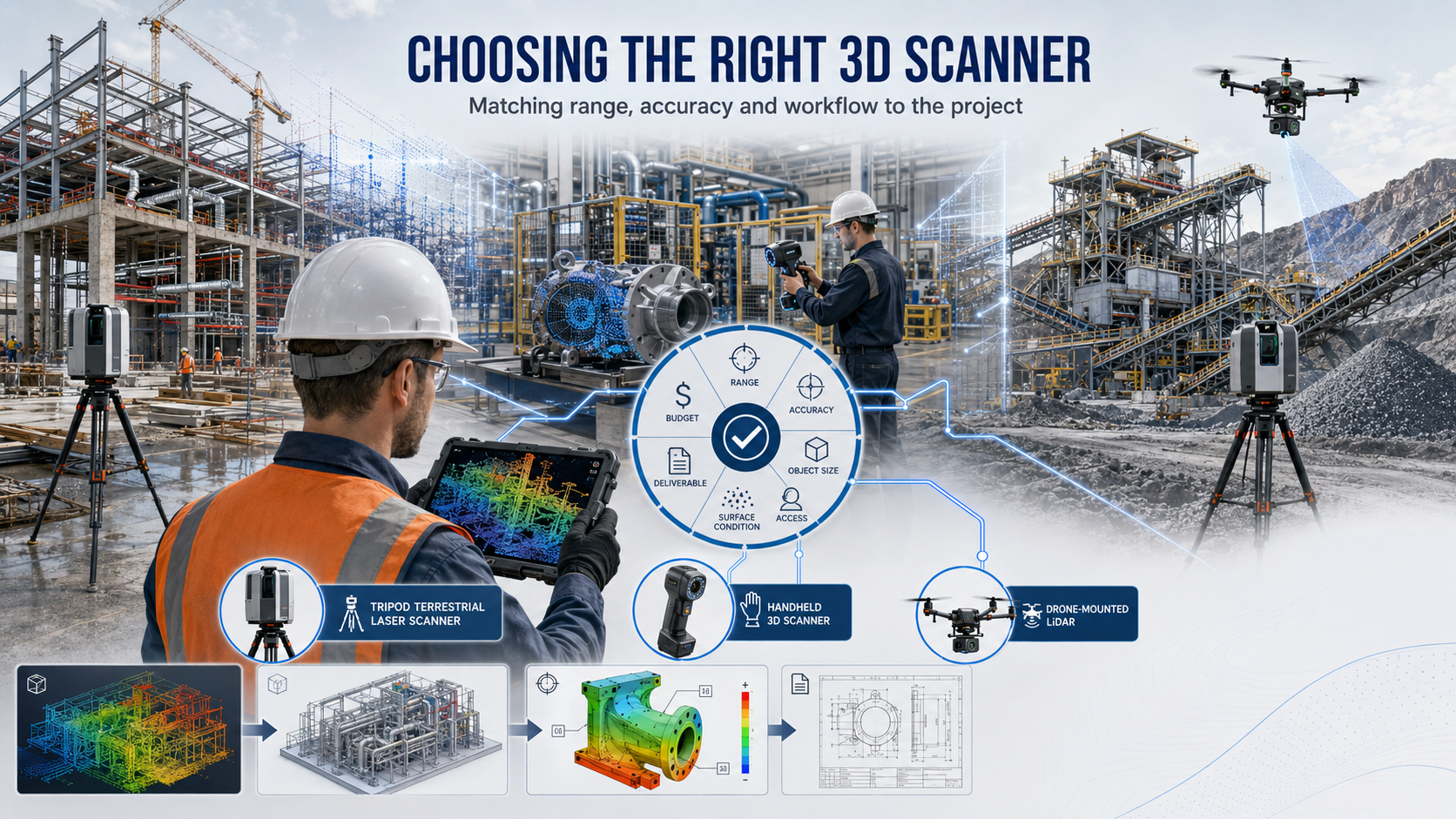
At Hamilton By Design, we know that 3D scanning has become an essential tool for modern engineering — from capturing as-built conditions on construction sites to modeling complex processing plants and validating manufacturing layouts. But not all scanners are created equal, and selecting the right technology is crucial to getting reliable data and avoiding costly surprises later in the project.
3D Scanning for Construction Sites
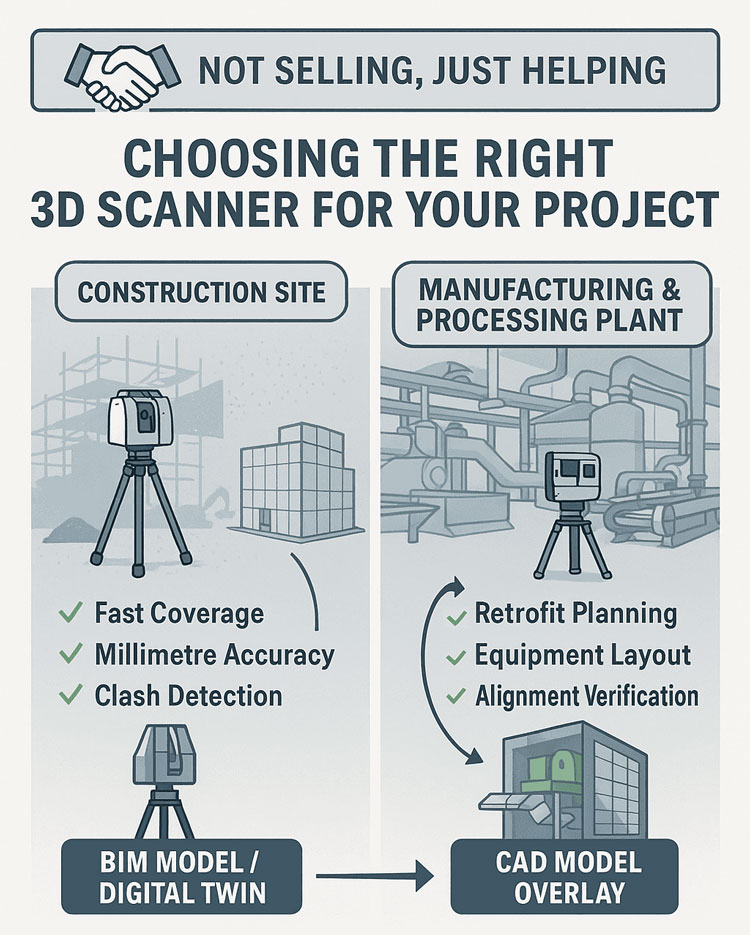
For construction and infrastructure projects, coverage and speed are the top priorities. Terrestrial Laser Scanning (TLS) and LiDAR systems like the FARO Focus S70 are ideal for quickly capturing entire job sites with millimetre-level accuracy. These scanners allow engineers and project managers to:
Verify as-built conditions against design models
Detect clashes early in the process
Support accurate quantity take-offs and progress documentation
TLS works well in tough environments — dust, sunlight, and complex geometry — making it a perfect fit for active building sites.
3D Scanning for Manufacturing & Processing Plants
When it comes to manufacturing facilities and mining processing plants, accuracy and detail matter even more. Scans are often used for:
Retrofit planning and clash detection in tight plant rooms
Structural steel and conveyor alignment checks
Equipment layout for expansion projects
Here, combining TLS with feature-based CAD modeling allows us to deliver data that is usable for engineering design, ensuring that new equipment fits exactly as intended.
We’re Here to Help
Hamilton By Design doesn’t sell scanners — we focus on providing unbiased, engineering-driven advice. If you’re unsure which scanning approach is right for your project, we’re happy to share our experience and guide you toward the best solution.
Feel free to get in touch to discuss your project needs — whether it’s a construction site, manufacturing facility, or processing plant, we can help you turn accurate scan data into actionable engineering insights.
In modern mining, where uptime is money and safety is non-negotiable, understanding the geometry of your process plant is critical. Every conveyor, chute, pipe rack, and piece of equipment must fit together seamlessly and operate reliably — but plants are messy, dusty, and constantly changing. Manual measurement with a tape or total station is slow, risky, and often incomplete.
This is where LiDAR scanning (Light Detection and Ranging) has become a game-changer. By capturing millions of precise 3D points per second, LiDAR gives engineers, maintenance planners, and operators an exact digital replica of the plant — without climbing scaffolds or shutting down equipment. In this post, we’ll explore how mining companies are using LiDAR scanning to solve real problems in processing plants, improve safety, and unlock operational efficiency.
What Is LiDAR Scanning?
LiDAR is a remote sensing technology that measures distance by firing pulses of laser light and recording the time it takes for them to return. Modern terrestrial and mobile LiDAR scanners can:
Capture hundreds of thousands to millions of points per second
Reach tens to hundreds of meters, depending on the instrument
Achieve millimeter-to-centimeter accuracy
Work in GPS-denied environments, such as inside mills, tunnels, or enclosed plants (using SLAM — Simultaneous Localization and Mapping)
The output is a point cloud — a dense 3D dataset representing surfaces, equipment, and structures with stunning accuracy. This point cloud can be used as-is for measurements or converted into CAD models and digital twins.
Why Process Plants Are Perfect for LiDAR
Unlike greenfield mine sites, processing plants are some of the most geometry-rich and access-constrained areas on site. They contain:
Complex networks of pipes, conveyors, tanks, and structural steel
Moving equipment such as crushers, mills, and feeders
Dusty, noisy, and hazardous environments with limited safe access
All these factors make traditional surveying difficult — and sometimes dangerous. LiDAR enables “no-touch” measurement from safe vantage points, even during operation. Multiple scans can be stitched together to create a complete model without shutting down the plant.
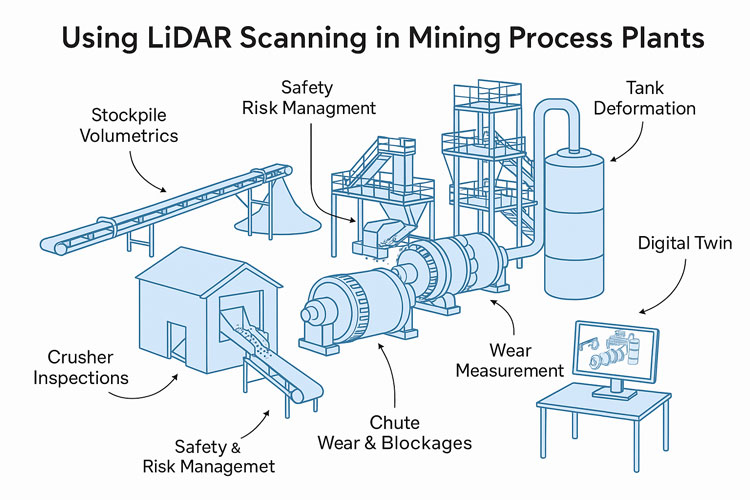
Applications of LiDAR in Process Plants
1. Wear Measurement and Maintenance Planning
LiDAR has revolutionized how mines measure and predict wear on critical process equipment:
SAG and Ball Mill Liners – Portable laser scanners can capture the exact wear profile of liners. Comparing scans over time reveals wear rates, helping maintenance teams schedule relines with confidence and avoid premature failures.
Crusher Chambers – Scanning inside primary and secondary crushers is now faster and safer than manual inspections. The resulting 3D model allows engineers to assess liner life and optimize chamber profiles.
Chutes and Hoppers – Internal scans show where material buildup occurs, enabling targeted cleaning and redesign to prevent blockages.
Result: Reduced downtime, safer inspections, and better forecasting of maintenance budgets.
2. Retrofit and Expansion Projects
When modifying a plant — installing a new pump, rerouting a pipe, or adding an entire circuit — having an accurate “as-built” model is crucial.
As-Built Capture – LiDAR provides an exact snapshot of the existing plant layout, eliminating guesswork.
Clash Detection – Designers can overlay new equipment models onto the point cloud to detect interferences before anything is fabricated.
Shutdown Optimization – With accurate geometry, crews know exactly what to cut, weld, and install — reducing surprise field modifications and shortening shutdown durations.
3. Inventory and Material Flow Monitoring
LiDAR is not just for geometry — it’s also a powerful tool for tracking material:
Stockpile Volumetrics – Mounted scanners on stackers or at fixed points can monitor ore, concentrate, and product stockpiles in real time.
Conveyor Load Measurement – Stationary LiDAR above belts calculates volumetric flow, giving a direct measure of throughput without contact.
Blending Control – Accurate inventory data improves blending plans, ensuring consistent plant feed quality.
4. Safety and Risk Management
Perhaps the most valuable application of LiDAR is keeping people out of harm’s way:
Hazardous Floor Areas – When flooring or gratings fail, robots or drones with LiDAR payloads can enter the area and collect data remotely.
Fall-of-Ground Risk – High walls, bin drawpoints, and ore passes can be scanned for unstable rock or buildup.
Escape Route Validation – Scans verify clearances for egress ladders, walkways, and platforms.
Every scan effectively becomes a permanent digital record — a baseline for monitoring ongoing structural integrity.
5. Digital Twins and Advanced Analytics
A plant-wide LiDAR scan is the foundation of a digital twin — a living, data-rich 3D model connected to operational data:
Combine scans with SCADA, IoT, and maintenance systems
Visualize live process variables in context (flow rates, temperatures, vibrations)
Run “what-if” simulations for debottlenecking or energy optimization
As AI and simulation tools mature, the combination of geometric fidelity and operational data opens new possibilities for predictive maintenance and autonomous plant operations.
Emerging Opportunities
Looking forward, there are several promising areas for LiDAR in mining process plants:
Autonomous Scan Missions – Using quadruped robots (like Spot) or SLAM-enabled drones to perform routine scanning in high-risk zones.
Real-Time Change Detection – Continuous scanning of critical assets with alerts when deformation exceeds thresholds.
AI-Driven Point Cloud Analysis – Automatic object recognition (valves, flanges, motors) to speed up model creation and condition reporting.
Integrated Planning Dashboards – Combining LiDAR scans, work orders, and shutdown schedules in a single interactive 3D environment.
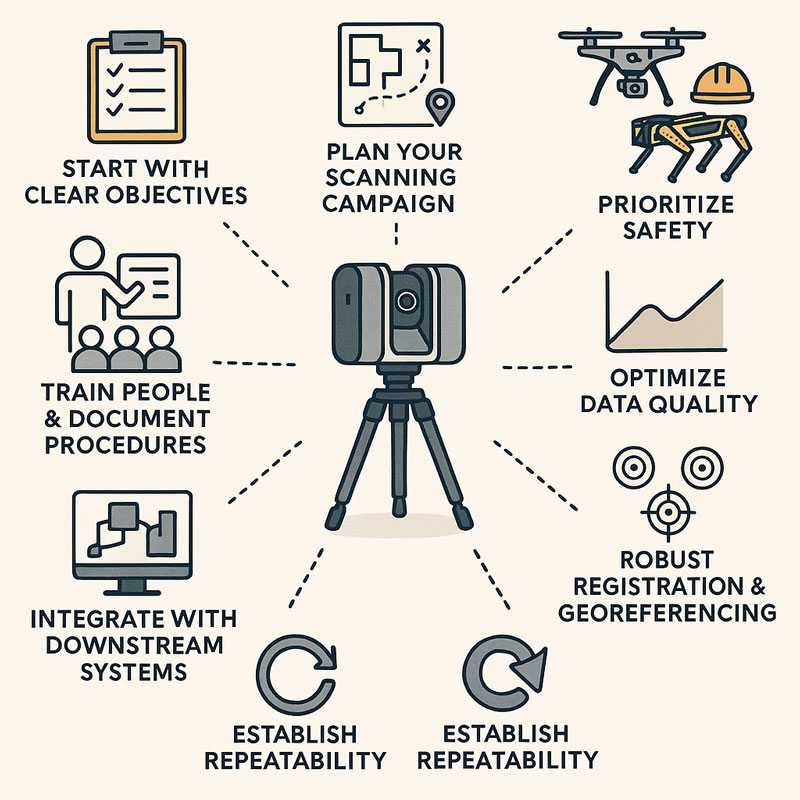
Best Practices for Implementing LiDAR
To maximize the value of LiDAR scanning, consider:
Define the Objective – Are you measuring wear, planning a retrofit, or building a digital twin? This affects scanner choice and resolution.
Plan Scan Positions – Minimize occlusions and shadow zones by preplanning vantage points.
Use Proper Registration – Tie scans to a control network for consistent alignment between surveys.
Mind the Environment – Dust, fog, and vibration can degrade data; choose scanners with appropriate filters or protective housings.
Invest in Processing Tools – The raw point cloud is only the start — software for meshing, modeling, and analysis is where value is extracted.
Train Your Team – Build internal capability for scanning, processing, and interpreting the results to avoid vendor bottlenecks.
LiDAR scanning is no longer a niche technology — it is rapidly becoming a standard tool for mining process plants that want to operate safely, efficiently, and with fewer surprises. From mill liners to stockpiles, from shutdown planning to digital twins, LiDAR provides a clear, measurable view of assets that was impossible a decade ago.
For operations teams under pressure to deliver more with less, the case is compelling: better data leads to better decisions. And in a high-stakes environment like mineral processing, better decisions translate directly to improved uptime, reduced costs, and safer workplaces.
The next time you’re planning a shutdown, a retrofit, or even just trying to understand why a chute is plugging, consider pointing a LiDAR scanner at the problem. You may be surprised at how much more you can see — and how much time and money you can save.
3D Laser Scanning & Mechanical Engineering Solutions
In today’s fast-paced engineering and construction industries, precision and efficiency are everything. Whether you’re managing a large-scale infrastructure project in Brisbane, creating a mechanical prototype in Perth, or needing accurate as-built data for a site in the Hunter Valley, 3D laser scanning and expert mechanical design services are game changers.
At Hamilton By Design, we specialise in connecting cutting-edge scanning technology with skilled mechanical designers and structural drafting services to deliver seamless, accurate solutions for every stage of your project.
The Power of 3D Laser Scanning
3D laser scanning is transforming the way engineers, architects, and manufacturers work. By capturing millions of data points with millimetre accuracy, laser scanning creates a highly detailed 3D representation of your asset, site, or structure.
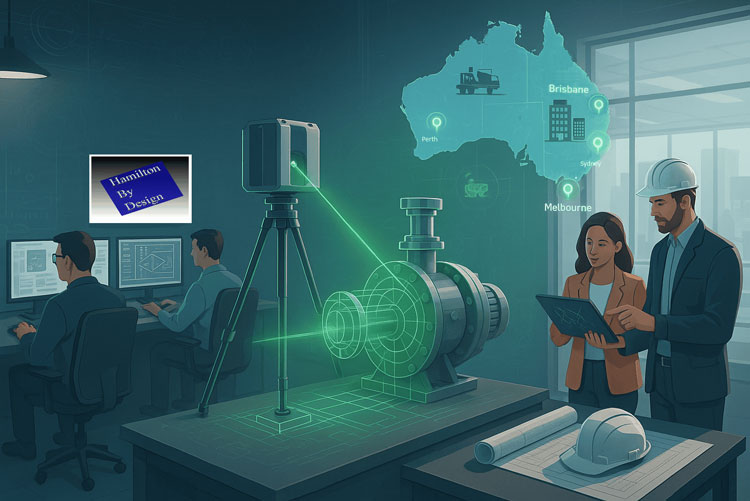
Our team provides 3D laser scanning services in Perth, Brisbane, and Melbourne, as well as laser scanning in the Hunter Valley, helping clients save time and avoid costly rework. This technology is ideal for:
Capturing as-built conditions before design or construction.
Supporting plant upgrades and facility expansions.
Documenting heritage structures and complex geometries.
Reducing site visits with accurate digital models.
Reverse Engineering & Mechanical Design
In addition to scanning, we offer reverse engineering services in Perth and beyond. By combining point cloud data with CAD modelling, we can recreate components, optimise designs, and prepare manufacturing-ready files.
Our mechanical engineers and mechanical designers bring years of experience in 3D mechanical engineering, design and manufacturing mechanical engineering, and problem-solving for a wide range of industries. From bespoke machinery to process equipment, we deliver solutions that work.
Structural Drafting & Project Support
No project is complete without clear, accurate documentation. Our skilled drafters at Hamilton By Design provide high-quality structural drafting services that integrate seamlessly with your workflows.
Whether you need shop drawings, fabrication details, or BIM-ready models, our team ensures every line and dimension is correct — saving you time and cost on-site.
Why Choose Hamilton By Design?
Nationwide Reach: Serving clients with 3D scanning services in Perth, Brisbane, and Melbourne, and supporting projects in the Hunter Valley.
Complete Solutions: From scanning to modelling to mechanical engineering design.
Accuracy & Efficiency: Reduce project risk and improve decision-making with reliable data.
Experienced Team: Skilled mechanical engineers and drafters who understand your industry.
Ready to Get Started?
If you’re looking for mechanical engineering companies that deliver precision, innovation, and reliability, Hamilton By Design is ready to help. Whether you need laser scanning in Perth or Brisbane, structural drafting, or full mechanical design services, our team can support your next project from concept to completion.
Contact us today to discuss your project requirements and find out how our 3D laser scanning and mechanical engineering design solutions can save you time and money.
To provide the best experiences, we use technologies like cookies to store and/or access device information. Consenting to these technologies will allow us to process data such as browsing behaviour or unique IDs on this site. Not consenting or withdrawing consent, may adversely affect certain features and functions.
Functional
Always active
The technical storage or access is strictly necessary for the legitimate purpose of enabling the use of a specific service explicitly requested by the subscriber or user, or for the sole purpose of carrying out the transmission of a communication over an electronic communications network.
Preferences
The technical storage or access is necessary for the legitimate purpose of storing preferences that are not requested by the subscriber or user.
Statistics
The technical storage or access that is used exclusively for statistical purposes.The technical storage or access that is used exclusively for anonymous statistical purposes. Without a subpoena, voluntary compliance on the part of your Internet Service Provider, or additional records from a third party, information stored or retrieved for this purpose alone cannot usually be used to identify you.
Marketing
The technical storage or access is required to create user profiles to send advertising, or to track the user on a website or across several websites for similar marketing purposes.