Mechanical Engineering Lift Sydney: Why Standards Like AS 4991 Matter

Safety and Precision in Mechanical Engineering Lifts

In the fast-paced world of Sydney construction and infrastructure, precision lifting is an everyday necessity. From hoisting prefabricated modules on high-rise towers to positioning steel frameworks and heavy plant components, each lift depends on one critical factor โ€” the integrity of the lifting device.

A mechanical engineering lift is more than just machinery; itโ€™s the result of careful design, analysis, and compliance with national safety standards. The Australian Standard AS 4991: Lifting Devices provides the engineering framework to ensure that every lifting beam, clamp, and spreader frame is designed, tested, and certified for safe performance.

In the dynamic environment of Sydneyโ€™s construction and manufacturing sectors, adhering to AS 4991 is not only a compliance issue โ€” itโ€™s essential to safety, reliability, and professional reputation.
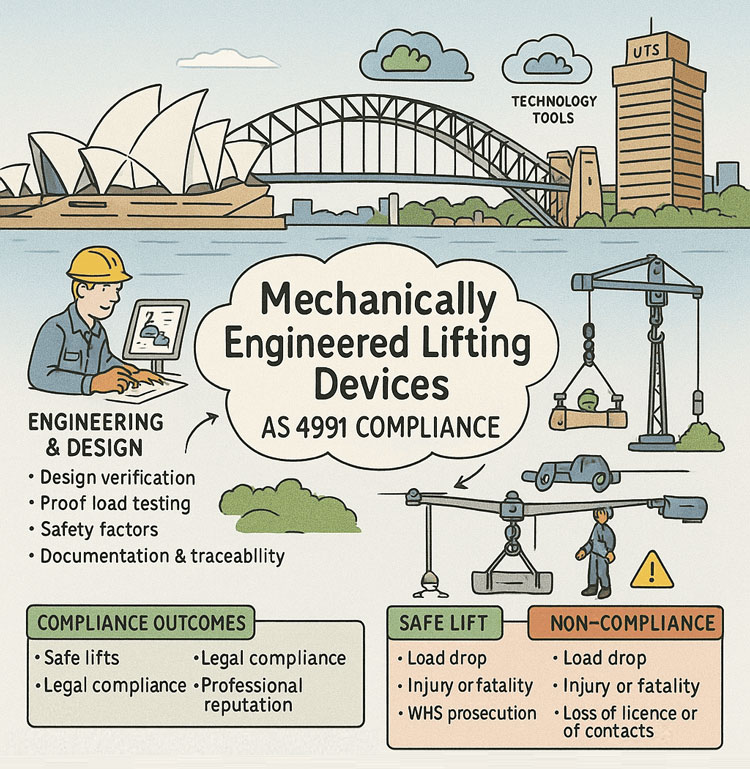
Illustrated infographic explaining AS 4991 mechanically engineered lifting devices, showing engineering design steps, safe lifting practices, compliance outcomes, and non-compliance risks, with Sydney landmarks in the background

3D LiDAR scanning and 3D modelling service button โ€” laser scanner capturing a point cloud for engineering and CAD modelling
Mechanical engineering services

What AS 4991 Means for Mechanical Engineering in Sydney

AS 4991: Lifting Devices is the Australian benchmark for the design, manufacture, proof testing, and maintenance of all mechanically engineered lifting attachments used with cranes and hoists.

It covers:

  • Design verification by qualified engineers
  • Proof load testing (typically 1.5 times the Working Load Limit)
  • Identification markings such as WLL, serial number, and manufacture date
  • Regular inspection and maintenance schedules
  • Documented certification and traceability

For Sydney-based mechanical engineering projects โ€” from Parramattaโ€™s commercial developments to the infrastructure of the Eastern Suburbs โ€” these requirements ensure every lift is carried out with confidence and safety.


The Role of Mechanical Engineers in Safe Lifting

Mechanical engineers play a vital role in ensuring every lifting device performs predictably under real-world conditions. Each lifting beam, frame, or clamp must be:

  • Designed for static and dynamic loading
  • Resistant to fatigue, buckling, and corrosion
  • Built from materials tested for strength and durability
  • Verified through engineering analysis and proof testing

By applying AS 4991, mechanical engineers in Sydney create lifting devices that not only meet technical standards but also withstand the operational demands of construction, mining, and industrial settings across New South Wales.


Why Non-Compliance is Never Worth the Risk

Sydneyโ€™s worksites are under strict safety scrutiny, and incidents involving lifting equipment failures have resulted in serious injuries, fatalities, and prosecutions.

Examples from across Australia include:

  • Unmarked or uncertified lifting beams that failed under load due to poor design.
  • Vacuum lifters that detached unexpectedly after seals deteriorated from lack of inspection.
  • Improvised lifting points on machinery leading to crush injuries and WHS enforcement actions.

These events share a common cause: failure to meet the design, inspection, and documentation requirements of AS 4991.

For any mechanical engineering lift in Sydney, non-compliance risks not just equipment damage but also:

  • Work Health and Safety (WHS) prosecutions
  • Civil negligence claims
  • Loss of accreditation and contracts
  • Damage to professional reputation

While AS 4991 is not legislation, it defines the expected standard of care under Australiaโ€™s WHS laws. Regulators such as SafeWork NSW use compliance with standards like AS 4991 as evidence of due diligence.

For mechanical engineers, fabricators, and construction managers, compliance means:

  • Designs verified by competent engineers
  • Devices tested and certified to meet load requirements
  • Inspection records that prove ongoing safety
  • Training to ensure operators understand correct usage

In Sydneyโ€™s competitive engineering market, adherence to AS 4991 isnโ€™t just about avoiding penalties โ€” itโ€™s about demonstrating leadership in professional safety.


Building a Culture of Inspection and Traceability

A key part of AS 4991 is documentation. Each lifting device should have a design verification report, proof load certificate, and inspection record.
This traceability ensures that every lift on a Sydney site can be traced back to certified engineering.

Companies should maintain:

  • A register of lifting devices with serial numbers and inspection dates
  • Clear tagging systems for quick identification
  • Routine re-certification for high-use environments
  • Operator awareness training on compliance indicators

These processes turn safety standards into practical habits that protect workers and ensure smooth site operations.


Mechanical Engineering Lift Sydney: Innovation Meets Safety

Sydney is a hub of engineering innovation, with advanced tools like 3D scanning, LiDAR, and Finite Element Analysis (FEA) enhancing how lifting devices are designed and validated.

At Hamilton By Design, our mechanical engineers use these technologies to create custom lifting systems for complex sites across Sydney โ€” from tight urban projects in Chatswood and Parramatta to industrial installations in the Inner West.

Yet, even with the latest modelling tools, every design is checked against AS 4991 to guarantee that each lift meets both engineering and safety expectations.


Conclusion: Lifting Sydney Safely

In mechanical engineering, safety begins long before the crane hook rises. It starts with standards โ€” and in Australia, AS 4991 is the foundation.

For every mechanical engineering lift in Sydney, compliance ensures more than safety: it provides reliability, traceability, and peace of mind. By following the standard, engineers not only protect lives but also elevate the quality and professionalism of Sydneyโ€™s construction and manufacturing industries.

At Hamilton By Design, our commitment is simple: lift Sydney safely, lift with engineering excellence, and lift to the standard โ€” AS 4991.


Hamilton By Design logo displayed on a blue tilted rectangle with a grey gradient background

Hamilton By Design provides engineering-led 3D scanning, LiDAR scanning, mechanical engineering and digital engineering services throughout Sydney and Greater Sydney.

Explore our related Sydney services:


  • 3D Scanning Sydney โ€“ Engineering-grade terrestrial laser scanning, as-built surveys and point cloud capture for industrial, infrastructure and commercial projects.
  • Reality Capture Sydney โ€“ High-accuracy reality capture, digital twins, asset documentation and engineering-grade site verification.
  • Scan to CAD Sydney โ€“ Convert point cloud data into AutoCAD, SolidWorks, Inventor and other engineering-ready CAD deliverables.
  • Point Cloud Modelling Sydney โ€“ Engineering-grade point cloud processing, clash detection, as-built verification and 3D modelling.
  • Mechanical Engineering Sydney โ€“ Mechanical design, plant upgrades, materials handling systems, conveyors, chutes, platforms and engineering support.
  • Structural Drafting Sydney โ€“ Structural steel drafting, fabrication drawings, GA drawings, workshop detailing and as-built documentation.

Hamilton By Design supports projects throughout Sydney CBD, Parramatta, Liverpool, Penrith, Blacktown, Chatswood, Alexandria, Mascot, Newcastle and the Central Coast.


Our clients:

Name
Would you like us to arrange a phone consultation for you?
Address
Blue banner graphic displaying the text "Point Cloud to CAD - Australia" in large white lettering, representing point cloud processing, scan-to-CAD conversion and digital engineering services across Australia.
Blue banner graphic displaying the text "Scan to CAD Sydney" in large white lettering, representing engineering-led point cloud to CAD conversion, LiDAR scanning and digital engineering services in Sydney.
Blue banner graphic displaying the text "Reality Capture Sydney - CBD" in large white lettering, representing engineering-led reality capture, LiDAR scanning and digital engineering services within Sydney CBD commercial buildings and infrastructure.

Mechanical Engineering | Structural Engineering


NSW Central Coast

The Unique Character of the NSW Central Coast

The Central Coast of New South Wales is a region defined by balance โ€” where coastal living meets industrial progress, and where families, businesses, and innovation all thrive together. Perfectly positioned between Sydney and Newcastle, the Central Coast offers the advantages of urban connectivity without sacrificing the relaxed pace and natural beauty of a regional lifestyle.


Composite image of three scenic coastal landscapes from the NSW Central Coast, with the text โ€˜NSW Central Coast โ€“ A Great Place for Businessโ€™ displayed below

A Great Place to Raise a Family

The Central Coast is widely recognised as one of Australiaโ€™s most liveable regions. With its pristine beaches, lakes, and bushland, it provides an exceptional environment for families seeking space, safety, and community.
The area features quality schools, TAFE NSW campuses, and the University of Newcastleโ€™s Ourimbah campus โ€” offering pathways from education to skilled employment close to home. Local parks, sports clubs, and community centres strengthen neighbourhood connections, while the mild coastal climate supports year-round outdoor living.

Families enjoy affordable housing, short commute times, and access to both Sydney and Newcastle via the M1 Pacific Motorway and rail network. This lifestyle balance makes the Central Coast a region where professionals can build meaningful careers while enjoying family life in a welcoming, coastal community.


3D LiDAR scanning services on the Central Coast providing engineering-grade laser scanning, point cloud capture, scan-to-CAD modelling and industrial reality capture for infrastructure and industrial projects.
Drafting services on the Central Coast providing engineering drawings, fabrication detailing, as-built documentation, reverse engineering and CAD drafting for industrial and infrastructure projects.
Mechanical engineering services on the Central Coast providing industrial design, plant inspections, pump calculations, reverse engineering and engineering support for manufacturing, infrastructure and heavy industry projects.

A Thriving Region for Business and Industry

Beyond its lifestyle appeal, the Central Coast has evolved into one of NSWโ€™s most active regional economies.
Centred around Wyong, Tuggerah, Somersby, and West Gosford, the regionโ€™s industrial estates host a diverse range of businesses in manufacturing, logistics, food processing, engineering, and advanced fabrication.

Infrastructure investment continues to strengthen the local economy, with upgrades to road, rail, and utilities improving connectivity and efficiency. This makes the region an attractive base for both established firms and growing enterprises.

For companies involved in mechanical engineering, fabrication, and industrial design, the Central Coast provides ready access to skilled tradespeople, degree-qualified engineers, and specialised suppliers. The strong network of local industries encourages collaboration, innovation, and shared growth.


Engineering and Innovation on the Central Coast

Mechanical engineering plays a vital role in the regionโ€™s industrial success.
Local firms design and build systems for manufacturing, water management, food processing, and construction โ€” translating mechanical calculations and CAD drawings into reliable, real-world solutions.

Mechanical engineers on the Central Coast contribute to:

  • The design of platforms, frames, and lifting systems.
  • Efficiency upgrades in manufacturing and packaging plants.
  • Water treatment and stormwater infrastructure.
  • Automation and materials handling systems.

These services support not only local companies but also council and state infrastructure projects, helping the region grow sustainably while maintaining technical excellence.


Strong Community, Strong Opportunity

What makes the Central Coast unique is its sense of community. Businesses here operate in a collaborative environment where partnerships often extend beyond contracts โ€” where reputation, reliability, and relationships truly matter.
The Central Coast Council, Regional Development Australia, and Central Coast Industry Connect provide active support to local enterprises, fostering innovation and sustainable development.

With an expanding population of more than 340,000 people, demand for skilled services, reliable infrastructure, and technical design continues to grow. This creates consistent opportunities for engineering firms to contribute to the regionโ€™s progress.


A Balanced Future

The Central Coast stands out as a region where family life and business success go hand in hand.
It offers the resources of a major industrial hub, the natural appeal of a coastal community, and the connectivity of a key transport corridor. For companies and professionals in mechanical engineering, it provides the ideal setting to live, work, and build for the future โ€” combining technical innovation with quality of life.

Mechanical Engineering | Structural Engineering

Hamilton By Design logo displayed on a blue tilted rectangle with a grey gradient background

Mechanical Drafting | Structural Drafting

3D CAD Modelling | 3D Scanning

3D LiDAR Scanning Hunter & Newcastle banner with white text on a blue background promoting engineering-grade laser scanning services for industrial, mining and infrastructure projects across the Hunter Valley and Newcastle region.
Mechanical Engineering Hunter & Newcastle banner promoting mechanical engineering services for mining, industrial plants, power generation, manufacturing and heavy industry throughout the Hunter Valley and Newcastle region.
Structural Drafting Hunter & Newcastle banner promoting structural drafting services for mining, industrial plants, power generation, manufacturing and infrastructure projects across the Hunter Valley and Newcastle region.

Our clients:

Name
Would you like us to arrange a phone consultation for you?
Address

3D Scanning Sydney banner promoting engineering-grade 3D laser scanning, LiDAR scanning, and reality capture services by Hamilton By Design.
Mechanical Engineering Sydney banner with white text on a blue background representing Hamilton By Design's mechanical engineering services in Sydney.
Mechanical Drafting and 3D Modelling Sydney banner highlighting Hamilton By Design's CAD drafting, 3D modelling, and engineering design services in Sydney.

Mechanical Engineering | Structural Engineering


Mechanical Engineers in Wyong

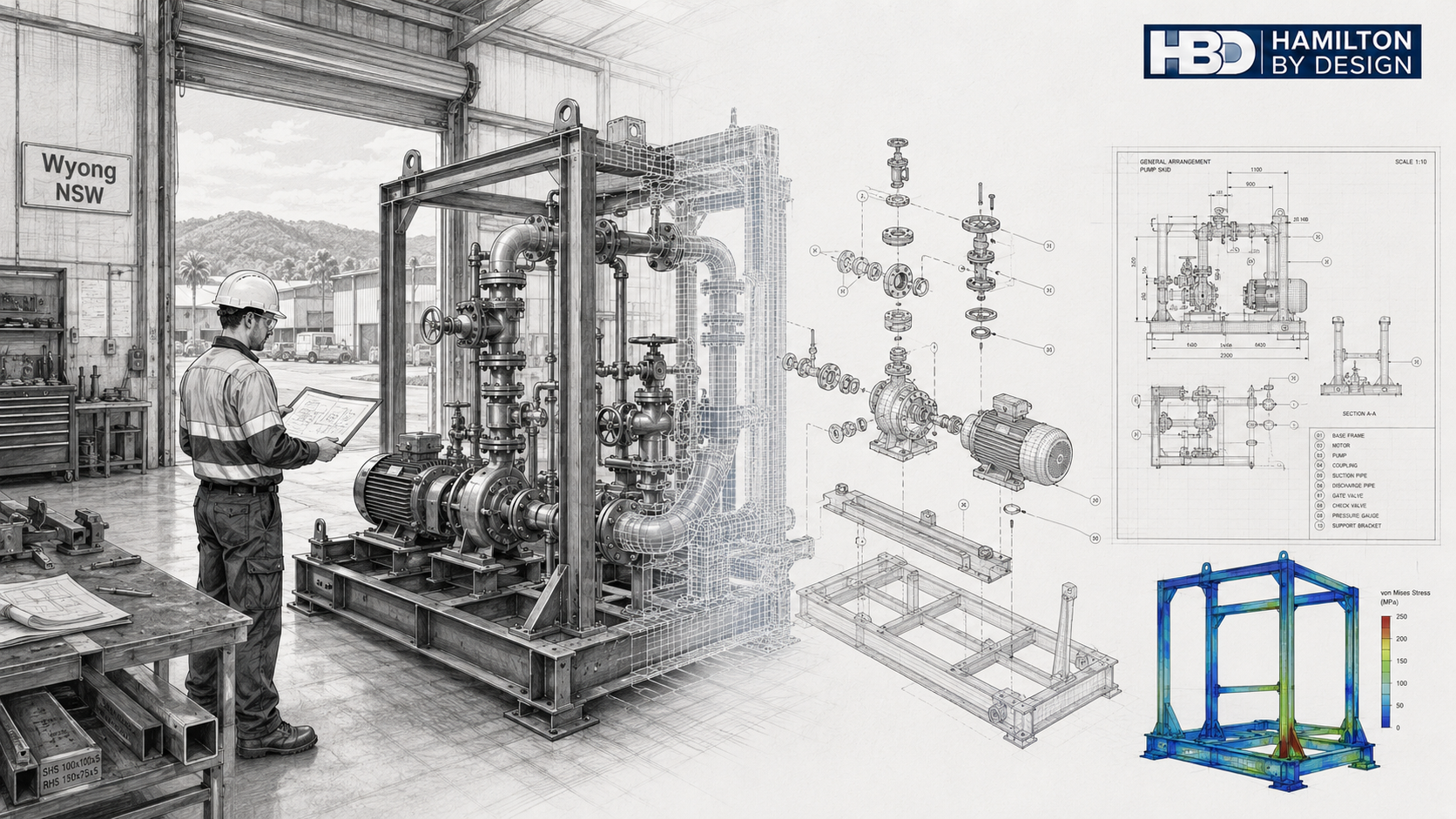
Mechanical engineer reviewing a pump and pipework skid in a Wyong workshop, with CAD wireframe, exploded aassembly, fabrication drawings and FEA analysis.

Innovative Design and Engineering Solutions

At Hamilton By Design, we are a team of degree-qualified mechanical engineers in Wyong, providing expert design, analysis, and build services for mechanical systems across the Central Coast and Hunter regions. We specialise in engineering design, mechanical systems integration, and prototype development โ€” not car repair or automotive servicing.

Our goal is simple: to design and deliver engineered systems that perform efficiently, safely, and reliably under real operating conditions.


Your Local Mechanical Engineering Specialists

Being locally based in Wyong allows us to deliver responsive, practical engineering solutions that suit regional industries. We understand the Central Coastโ€™s industrial landscape โ€” from manufacturing to infrastructure โ€” and provide mechanical engineering support tailored to each clientโ€™s specific operational and compliance needs.

Our services include:

  • Mechanical design and system modelling
  • 3D CAD drafting, assemblies, and technical documentation
  • Finite Element Analysis (FEA) and performance simulation
  • Prototype design, testing, and system optimisation
  • Fabrication support and workshop documentation
  • Process improvement and energy efficiency solutions
  • Structural-mechanical integration for equipment and machinery

Whether itโ€™s a custom mechanical assembly, plant upgrade, or new industrial installation, our engineers combine practical trade awareness with solid analytical expertise to ensure every solution works in the real world.


Why Businesses in Wyong Choose Us

Choosing a local mechanical engineering company in Wyong means partnering with professionals who know local suppliers, fabrication standards, and site conditions. We bring the precision of professional engineering to projects of all sizes while remaining approachable and cost-effective.

Our approach ensures each design is:

  • Safe: Compliant with Australian Standards and industry codes
  • Efficient: Engineered for performance and energy conservation
  • Maintainable: Designed with accessibility and lifecycle costs in mind
  • Economical: Delivering long-term value for the client

From the first sketch to the final bolt, our work reflects engineering discipline, accuracy, and accountability.


Our Engineering Process

Every project follows a structured, documented workflow that ensures consistency and quality:

  1. Concept and Feasibility โ€“ We define project scope, functional requirements, and design objectives through collaboration with clients and stakeholders.
  2. Design and Simulation โ€“ Using modern CAD platforms and FEA tools, we model real-world forces, stresses, and flows to optimise performance and safety.
  3. Verification and Prototyping โ€“ Our team validates designs with prototypes, testing, or detailed fabrication drawings.
  4. Implementation Support โ€“ We assist with workshop drawings, fabrication coordination, and commissioning.
  5. Lifecycle and Maintenance Review โ€“ Our post-installation support ensures long-term reliability and efficiency.

This process ensures traceability, compliance, and confidence at every stage of delivery.


Snapshot: Local Industries and Organisations We Support

Our experience extends across a wide range of local companies, manufacturers, and government organisations throughout Wyong and the Central Coast.

Here are some examples of the types of organisations we work with and the engineering value we bring:

Industrial and Manufacturing Clients

  • Donaldson Australasia (North Wyong) โ€“ A leading industrial filtration manufacturer. Our expertise supports the design and integration of mechanical handling, test rigs, and equipment frames for production systems.
  • Plateau Food Distributors (Wyong) โ€“ Food processing and cold storage facilities often rely on mechanical systems for refrigeration, materials handling, and ventilation. We assist with system design, structural support frames, and energy optimisation.
  • Fabrication and Alloy Manufacturers such as Manufactured Alloy Xtras โ€“ We provide structural design, stress analysis, and welding procedure documentation for aluminium and steel assemblies.
  • General Manufacturers and Industrial Workshops in the Wyongโ€“Tuggerah area โ€“ We support local businesses with prototype development, mechanical jigs, and tooling systems designed to Australian Standards.

Government and Public Infrastructure

  • Central Coast Council (formerly Wyong Shire Council) โ€“ Responsible for infrastructure, public buildings, and community assets. Our services include mechanical design for pumping stations, HVAC systems, and public facility upgrades.
  • NSW Infrastructure Projects (e.g. Pacific Highway Upgrade) โ€“ Large-scale transport and civil projects often require custom mechanical and structural integration. We assist contractors and consultants with system modelling and compliance documentation.
  • TAFE NSW โ€“ Wyong Campus โ€“ Facilities such as laboratories, animal care centres, and trade workshops require mechanical system design for ventilation, process equipment, and utilities.
  • Water and Wastewater Services โ€“ We provide engineering input on pumping systems, pipework layouts, and mechanical components for water infrastructure projects.

These partnerships reflect our capability to operate across both private and public sectors, supporting projects that range from individual components to fully integrated mechanical systems.


Our Capabilities and Technologies

Our engineers use industry-leading tools and software to ensure precision and compliance:

  • 3D CAD Modelling (SolidWorks, Autodesk Inventor, Fusion 360)
  • Finite Element Analysis (FEA) for stress and load validation
  • Computational Fluid Dynamics (CFD) for flow and heat transfer
  • P&ID and Mechanical Schematics for complex systems
  • Project Documentation including Bill of Materials (BOMs) and fabrication drawings

By combining digital design with engineering expertise, we can quickly move from concept to prototype, minimising rework and ensuring the design meets its operational goals.


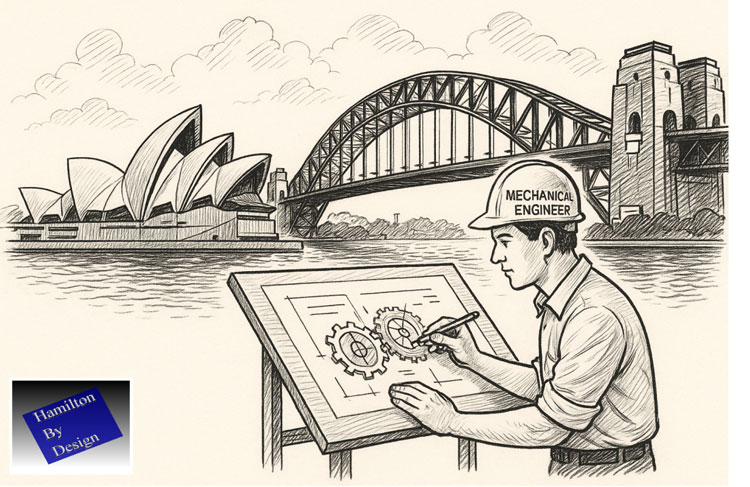
Illustrated mechanical engineer drafting technical gear drawings at a workstation with the Sydney Opera House and Harbour Bridge in the background, alongside the Hamilton By Design logo

Commitment to Engineering Excellence

Every project we deliver reflects our core principles:

  • Technical Integrity โ€“ Our engineers work to the highest professional standards.
  • Innovation โ€“ We continuously refine designs using simulation, prototyping, and feedback.
  • Safety and Compliance โ€“ We align with AS/NZS codes and WHS regulations in every design.
  • Sustainability โ€“ We promote energy-efficient design and reduced material waste through smart engineering.

Our clients appreciate that we think like engineers and communicate like partners. We bring clarity, technical rigour, and creativity to every project.


Contact Your Local Mechanical Engineers in Wyong

If youโ€™re searching for mechanical engineers in Wyong who can design, analyse, and build high-performance mechanical systems, Hamilton By Design is your trusted local partner.

We are not automotive mechanics โ€” we are qualified mechanical engineers who design and deliver engineered solutions that move industries forward.

Hamilton By Design logo displayed on a blue tilted rectangle with a grey gradient background

Phone: 047 700 2249
Email: [email protected]
Location: Wyong, NSW

Letโ€™s talk about your next project and discover how professional mechanical design can improve reliability, efficiency, and safety in your operations.

Mechanical Engineering | Structural Engineering

3D LiDAR scanning services on the Central Coast providing engineering-grade laser scanning, point cloud capture, scan-to-CAD modelling and industrial reality capture for infrastructure and industrial projects.
Drafting services on the Central Coast providing engineering drawings, fabrication detailing, as-built documentation, reverse engineering and CAD drafting for industrial and infrastructure projects.
Mechanical engineering services on the Central Coast providing industrial design, plant inspections, pump calculations, reverse engineering and engineering support for manufacturing, infrastructure and heavy industry projects.

Mechanical Drafting | Structural Drafting

3D CAD Modelling | 3D Scanning

Chute Design

SolidWorks Contractors in Australia

Hamilton By Design โ€“ Blog

Custom Designed – Shipping Containers

Coal Chute Design

Mechanical Engineers in Sydney

Engineering Design & Build Services | Hamilton By Design

Our clients:



3D Scanning Sydney banner promoting engineering-grade 3D laser scanning, LiDAR scanning, and reality capture services by Hamilton By Design.
Mechanical Engineering Sydney banner with white text on a blue background representing Hamilton By Design's mechanical engineering services in Sydney.
Mechanical Drafting and 3D Modelling Sydney banner highlighting Hamilton By Design's CAD drafting, 3D modelling, and engineering design services in Sydney.

Mechanical Engineering | Structural Engineering


The Future of Smelting & Steelmaking:

Trends Shaping a Greener, Smarter Industry


Steel has been the backbone of industrial progress for over 150 years. It is the invisible framework behind our skyscrapers, bridges, transport systems, and modern cities. But the industry that gave us the Industrial Revolution is now facing one of the greatest transitions in its history. The combined pressures of climate change, regulatory scrutiny, fluctuating energy costs, and global trade realignments are forcing steelmakers to rethink how steel is made, used, and traded.

Recent news reports show a fascinating picture: a sector in the middle of transformation, experimenting with new technologies like hydrogen-based direct reduction, while still relying on traditional blast furnace smelting to meet soaring demand. In this article, we explore the future direction of the smelting and steelmaking industry, what challenges lie ahead, and where the biggest opportunities are likely to emerge.


The Push for Green Steel

Hydrogen & Direct Reduced Iron (DRI): A Pathway to Decarbonization

Hydrogen-based steel production remains the single most promising pathway for deep decarbonization in the steel sector. Instead of using metallurgical coal and coke to chemically reduce iron ore, hydrogen can be used to produce direct reduced iron (DRI) that can then be melted in an electric arc furnace (EAF). This dramatically cuts COโ‚‚ emissions, especially if the hydrogen is produced using renewable energy.

Projects like Salzgitterโ€™s Salcos program in Germany are leading the way. Salzgitter has been developing one of the most ambitious hydrogen-based steel transformation roadmaps in Europe, gradually phasing in hydrogen reduction units and retiring carbon-intensive blast furnaces. Similarly, Australiaโ€™s NeoSmelt initiative, backed by Rio Tinto and ARENA, is exploring a combination of DRI and electric smelting furnaces to create a pathway that works for Australian ore quality and energy markets.

But this transition is anything but smooth. Salzgitter has recently delayed later stages of its program, citing economic and regulatory headwinds, such as the high cost of hydrogen, uncertain carbon pricing, and the slow rollout of renewable energy infrastructure. This highlights a hard truth: the green transition will not be instant or cheap. The next decade will likely be defined by pilot projects, incremental scale-ups, and careful balancing between economic viability and climate commitments.


The Coal Paradox

Even as green steel makes headlines, metallurgical coal is seeing a surprising resurgence. Demand for coal-based blast furnace production remains robust, especially in China and India, where domestic infrastructure spending continues to grow. In fact, recent research from the Global Energy Monitor shows that coal-based capacity is still expanding, even as global climate targets call for steep reductions in emissions.

This paradox points to the transitional nature of the current era. For the foreseeable future, the world will be living in a dual-track steel economy: one track relying on traditional blast furnaces and coke ovens to meet near-term demand, and another experimenting with hydrogen, electric smelting, and alternative reduction technologies.

For businesses, this means they cannot simply abandon existing capacity overnight. Instead, expect to see retrofit investments to improve the efficiency of blast furnaces, capture more waste heat, and install carbon capture and storage (CCS) where feasible. This โ€œcleaner coalโ€ approach will act as a bridge until low-carbon technologies can compete at scale on cost and availability.


Regional Shifts & Strategic Investments

Australiaโ€™s Green Steel Ambitions

Australia is emerging as a key player in the global conversation on sustainable steelmaking. The country has vast high-grade iron ore resources, growing renewable energy capacity, and a strategic interest in maintaining domestic steelmaking capability.

  • BlueScopeโ€™s $1.15B blast furnace reline at Port Kembla is one of the largest industrial projects in the nationโ€™s history, designed to keep steel production secure for another 20 years. This investment shows that Australia is taking a pragmatic approach โ€” continuing to support blast furnace technology while planning for a green future.
  • The NeoSmelt project, which just secured nearly $20M in government funding, is a potential game-changer. It will explore how to combine renewable-powered hydrogen and electric furnaces to make a commercial-scale green steel process that works with Australian ore.
  • The potential takeover of Whyalla Steelworks by a consortium led by BlueScope could turn the plant into a testbed for low-emissions ironmaking, providing a national blueprint for decarbonizing heavy industry.

Global Trade & Policy Realignment

Meanwhile, trade policy is also shaping the future. The EU and U.S. have resumed talks to revisit steel and aluminium tariffs, with a focus on creating carbon-based trade measures. If implemented, this could reward producers who adopt low-carbon technologies while penalizing those that rely on high-emission processes. For global producers, this will accelerate investment in low-emissions capacity to stay competitive in export markets.


Innovation Beyond Furnaces

The transformation of steelmaking is not just about switching fuels โ€” itโ€™s about reimagining the entire production system.

  • Modular, low-emission smelting plants like those being developed in Western Australia by Metal Logic allow companies to build capacity closer to demand centers, reduce transport emissions, and scale production up or down as needed.
  • Digital twins and AI-driven process control are making smelting more efficient. By modeling every step of the steelmaking process, producers can optimize energy use, reduce material losses, and increase yield โ€” all of which improve profitability and lower emissions simultaneously.
  • Circular economy practices, such as increased use of scrap steel in EAFs, are becoming a central strategy. Recycling steel uses a fraction of the energy required to make virgin steel and fits neatly into the industryโ€™s sustainability narrative.

This convergence of physical and digital innovation will likely create a new generation of steel plants that are smaller, smarter, and cleaner than their 20th-century predecessors.


Where the Industry is Headed

Looking ahead, the future of smelting and steelmaking will be defined by hybridization, regulation, and resilience:

  • Hybrid production systems will dominate for at least the next decade. Expect blast furnaces to operate alongside hydrogen-based DRI units and electric smelters as companies transition gradually.
  • Stricter carbon regulations will push companies to adopt low-carbon pathways faster than market forces alone would dictate. Carbon border adjustment mechanisms (CBAMs) will effectively tax โ€œdirty steelโ€ in major economies, making investment in green capacity a competitive necessity.
  • Domestic capability building will remain critical. The COVID-era supply chain crises reminded governments why domestic production matters. Expect to see policies that support keeping steelmaking onshore, even if that requires subsidies or preferential procurement.
  • Collaborative innovation will become the norm. Mining giants, energy producers, and technology firms are already forming alliances to solve the โ€œgreen steel puzzle.โ€ This cross-industry collaboration will unlock new efficiencies and accelerate commercialization.

Final Thoughts

The smelting and steelmaking industry is standing at the crossroads of history. The coming years will test its ability to balance sustainability with profitability, scale with flexibility, and tradition with innovation.

Companies that embrace this challenge โ€” investing in low-carbon technology, digital transformation, and strategic partnerships โ€” will not just survive the coming disruption but thrive as leaders in a new, greener industrial age. Steel may be one of the oldest materials in human civilization, but its future is being forged right now, and it has never been more exciting.

References

Salzgitter Salcos Project

Global Energy Monitor โ€“ Steel Sector Reports

ARENA NeoSmelt Funding Announcement

Challenges in the Australian Smelting Industry

3D LiDAR scanning and 3D modelling service button โ€” laser scanner capturing a point cloud for engineering and CAD modelling
Mechanical engineering services
Finite Element Analysis (FEA) engineering simulation button
Mechanical engineering services

Itโ€™s Time to Level Up

Itโ€™s Time to Level Up: Why Mechanical Engineering Consultants Are Key to Unlocking the Power of Point Cloud to 3D Modeling

In todayโ€™s competitive manufacturing and fabrication landscape, the difference between success and frustration often comes down to one thing: how well you capture and use data. Traditional methods of measurement, drafting, and design simply canโ€™t keep up with the complexity and pace of modern projects.

Enter point cloud scanning and 3D modeling โ€” a transformative approach that is reshaping how manufacturers, fabricators, and engineers work together. But as powerful as this technology is, getting the most from it takes more than just buying a scanner. It takes expertise, insight, and a partner who can integrate this digital transformation seamlessly into your workflows.

So, is it time to level up and engage mechanical engineering consultants who can make this happen?

We think so โ€” and hereโ€™s why.


From Point Cloud to 3D Model: A Game-Changer

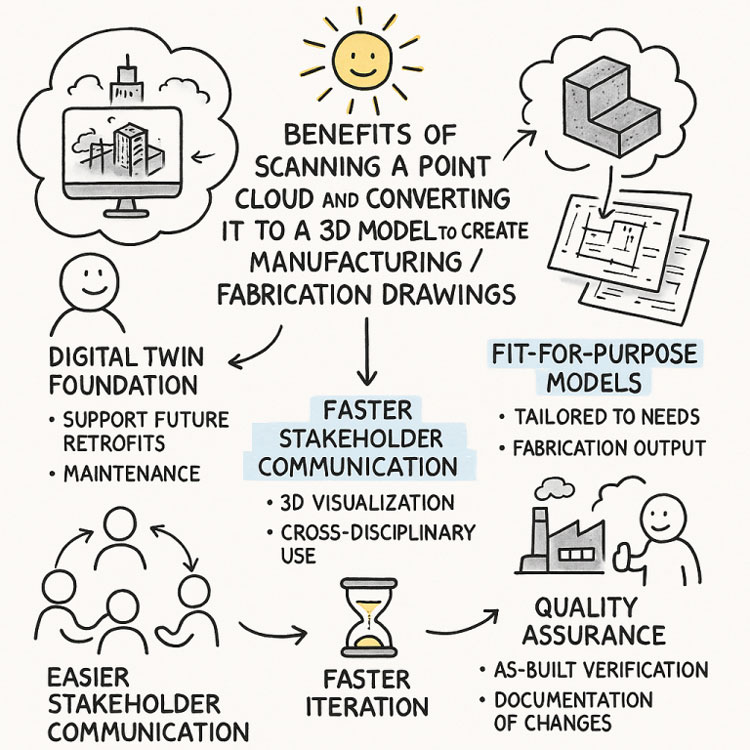
When you scan a physical space, component, or assembly using modern laser scanning or photogrammetry, you capture millions of data points โ€” a digital twin of reality. Converting that data into a precise 3D model opens the door to benefits like:

  • Pinpoint Accuracy: Say goodbye to guesswork and human measurement errors.
  • Faster Iteration: Generate manufacturing and fabrication drawings quickly, test design variations digitally, and accelerate your project timelines.
  • Improved Collaboration: Give engineers, fabricators, and stakeholders a single source of truth that everyone can see and work from.
  • Risk Reduction: Spot interferences, clashes, and potential problems before they become costly rework in the shop or on-site.
  • Future-Proofing: Create a digital foundation for maintenance, upgrades, and retrofits years down the line.

This isnโ€™t just better engineering โ€” itโ€™s smarter business.


3D LiDAR scanning and 3D modelling service button โ€” laser scanner capturing a point cloud for engineering and CAD modelling
Mechanical engineering services

The Missing Piece: Expertise

Technology alone doesnโ€™t guarantee success. A high-resolution point cloud is just data โ€” and without the right people turning that data into insight, it wonโ€™t deliver its full value.

Thatโ€™s where mechanical engineering consultants come in. By partnering with experts who understand both the technology and the application, you gain:

  • Tailored Workflows: A consultant knows how to align the process with your unique needs, whether itโ€™s structural steel, piping systems, or custom machinery.
  • Best-Practice Modeling: Avoid bloated, unusable models or drawings that donโ€™t reflect fabrication realities.
  • Integrated Solutions: Consultants ensure your 3D models, fabrication drawings, and QA processes work seamlessly with your existing systems.
  • Strategic Insight: Move beyond simply โ€œdrawing whatโ€™s thereโ€ to rethinking processes, improving efficiency, and reducing total cost of ownership.

Why Now Is the Perfect Time

Market pressures are increasing. Labor costs are rising. Margins are under strain. Mistakes are expensive โ€” but digital solutions are more accessible than ever.

Your competitors are already exploring Industry 4.0 technologies like point cloud scanning, 3D modeling, and digital twins. The companies that succeed are the ones that move early, learn fast, and embed these practices into their operations.

Bringing in mechanical engineering consultants allows you to leapfrog the painful trial-and-error phase and start reaping the benefits from day one.


Level Up Your Engineering Today

If youโ€™re still relying on outdated measurement methods, 2D drawings, and siloed workflows, now is the time to level up. Scanning, modeling, and digital collaboration arenโ€™t โ€œnice-to-havesโ€ anymore โ€” theyโ€™re the foundation of modern manufacturing and fabrication.

Engage a trusted mechanical engineering consultant who can:

  • Capture your as-built environment accurately
  • Convert point clouds into actionable 3D models
  • Deliver fabrication-ready drawings
  • Help you reduce risk, save time, and improve quality

The future of engineering is here. Donโ€™t just keep up โ€” get ahead.

Consulting Engineers

3D Scanning | Mechanical Engineering | Hamilton By Design

Contact us

3D LiDAR scanning and 3D modelling service button โ€” laser scanner capturing a point cloud for engineering and CAD modelling
Mechanical engineering services
Finite Element Analysis (FEA) engineering simulation button
Mechanical engineering services

$1.2โ€ฏB Critical Minerals

Australiaโ€™s Federal Government has announced an A$1.2โ€ฏbillion Critical Minerals Strategic Reserve, backed by a $1โ€ฏbillion top-up to its existing Critical Minerals Facility. With implementation set for the second half of 2026, the Reserve aims to secure critical mineralsโ€”lithium, cobalt, nickel, rare earthsโ€”through government offtake agreements and strategic stockpiling miningmonthly.com

Why It Matters for Mechanical Engineers

This isnโ€™t just political positioningโ€”itโ€™s a major call to action for mechanical engineering consultancies:

  • Scale and diversification of processing sites โ€“ More projects will need robust mechanical systems from crushing and conveying to structural and structural integrity assessments, especially for rare earths and heavy metals.
  • Advanced processing technologies โ€“ Selective stockpiling and refining of critical minerals will require high-precision mechanical design, wear management, and optimization of machinery performance.
  • Infrastructure and retrofit demand โ€“ The Reserve extends the Critical Minerals Facilityโ€™s reach to A$5โ€ฏbillion, catalysing greenfield builds and upgradesโ€”areas where Hamilton By Design excels.

Strategic Insights for Hamilton By Design

At Hamilton By Design, our strength lies in supporting projects from feasibility to commissioning, encompassing:

  • Materials handling systems โ€“ conveyors, stockpiles, chutes
  • Structural and fatigue engineering โ€“ ensuring safety and longevity under harsh industrial conditions
  • Wear and reliability optimisation โ€“ extending lifespan and uptime of mechanical assets
  • Digital tools โ€“ such as FEA, 3D scanning, and digital twins to enhance design accuracy and project efficiency

This Government-backed industrial growth is a signal for mining contractors and OEMs to engage expert mechanical consultants earlyโ€”ensuring streamlined, compliant, and future-proofed system integration.

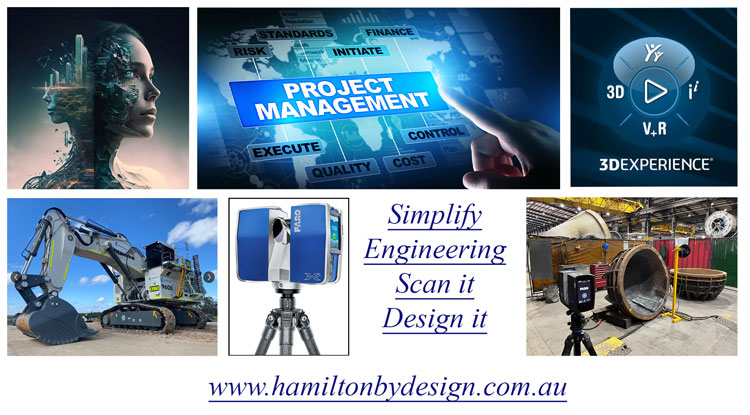
Collage showcasing Hamilton By Designโ€™s engineering and 3D scanning services. Images include a futuristic digital-engineering graphic, a project management interface, the Dassault Systรจmes 3DEXPERIENCE logo, a large excavator, a FARO 3D laser scanner, and an industrial scan setup inside a workshop. In the centre, text reads: โ€˜Simplify Engineering โ€” Scan it, Design it,โ€™ along with the website www.hamiltonbydesign.com.au.

๐Ÿ› ๏ธ How Hamilton By Design Adds Value

What You GetHow It Helps
Proven materials-handling systems designScalable, reliable conveyors and chutes for critical-mineral plants
End-to-end structural assessmentsEnables compliance with WHS, AS/NZS and long-term asset management
Wear analysis & maintenance planningReduces downtime and extends asset lifespan
Integration of digital engineeringImproves commissioning, reduces risk and cost overruns

With major investments planned and a strong industrial trajectory ahead, now is the time for OEMs and mining clients to tap into specialist mechanical consulting support.

Letโ€™s talk about how Hamilton By Design can partner to deliver cuttingโ€‘edge materials handling and structural engineering solutions for your next critical minerals project.

Hamilton By Design | Mechanical Drafting | Structural Drafting | 3-D Lidar Scanning

3D LiDAR scanning and 3D modelling service button โ€” laser scanner capturing a point cloud for engineering and CAD modelling
Mechanical engineering services
Finite Element Analysis (FEA) engineering simulation button
Mechanical engineering services