Detailing Transfer Stations in the Age of Digital Engineering

Transfer stations and chutes sit at the intersection of bulk materials handling, structural engineering, and fabrication practicality. While the fundamentals of good detailing have not changed, the way engineers now capture, coordinate, and validate these details has evolved significantly over the past decade.

This article revisits the principles of transfer station detailing and places them in a modern digital-engineering context, where accurate site data, constructability, and lifecycle performance are critical.



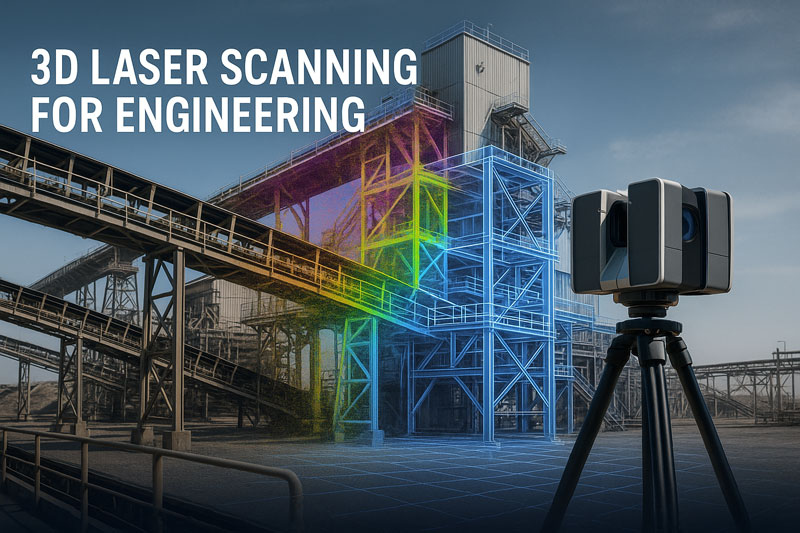
Engineering illustration of a transfer chute showing a LiDAR point cloud overlay aligned with the same chute geometry for as-built verification.
3D LiDAR scanning and 3D modelling service button โ€” laser scanner capturing a point cloud for engineering and CAD modelling
Mechanical engineering services

Why Transfer Station Detailing Still Matters

Poorly detailed transfer stations remain one of the most common sources of:

  • Material spillage and dust generation
  • Accelerated liner and structure wear
  • Unplanned downtime and maintenance escalation
  • Safety risks to operators and maintainers

In many cases, the root cause is not the concept design, but inadequate detailing and incomplete understanding of site geometry.

Even well-intended designs can fail if:

  • Existing structures are misrepresented
  • Conveyor interfaces are assumed rather than measured
  • Fabrication tolerances are not realistically achievable on site

The Shift from Assumed Geometry to Measured Reality

Historically, detailing relied heavily on:

  • Legacy drawings
  • Manual tape measurements
  • Partial site surveys
  • โ€œBest guessโ€ alignment assumptions

Today, engineering-grade reality capture has fundamentally changed what is possible.

Using 3D laser scanning (LiDAR), engineers can now work from:

  • Millimetre-accurate point clouds
  • Verified conveyor centre lines
  • True chute-to-structure interfaces
  • Real as-installed conditions rather than design intent

This shift dramatically reduces site rework and fabrication clashes.

This approach is central to how Hamilton By Design supports bulk materials handling upgrades across mining, ports, and heavy industry.


Detailing Considerations That Still Get Missed

Even with modern tools, certain detailing fundamentals remain critical.

1. Interface Accuracy

Transfer stations often interface with:

  • Existing conveyors
  • Walkways and access platforms
  • Structural steelwork installed decades earlier

Without accurate as-built data, small errors compound quickly. Laser scanning eliminates this uncertainty.

Related reading:
https://www.hamiltonbydesign.com.au/3d-laser-scanning-engineering/


2. Wear Liner Integration

Good detailing must account for:

  • Liner thickness variation
  • Fixing access and replacement paths
  • Load paths through liners into structure

Digitally modelling liners within the chute geometry allows engineers to validate:

  • Clearances
  • Installation sequence
  • Maintenance access before steel is cut

3. Fabrication Reality

A detail that looks acceptable in 2D can become problematic when fabricated.

Modern workflows now link:

  • 3D scanning
  • Solid modelling
  • Fabrication drawings
  • Digital QA checks

This reduces site modifications and ensures components fit first time.

Example of fabrication-ready workflows:
https://www.hamiltonbydesign.com.au/mechanical-engineering-design-services/


Transfer Stations as Systems, Not Isolated Chutes

A key lesson reinforced over time is that transfer stations must be treated as systems, not standalone components.

Good detailing considers:

  • Upstream and downstream belt tracking
  • Material trajectory consistency
  • Structural vibration and dynamic loading
  • Maintenance access under real operating conditions

Digital engineering allows these interactions to be reviewed early, reducing operational risk.


The Role of Engineering-Led Scanning

Not all scans are equal.

For engineering applications, scanning must be:

  • Performed with known accuracy
  • Registered and verified correctly
  • Interpreted by engineers, not just technicians

This distinction matters when designs are used for fabrication and compliance.

Hamilton By Designโ€™s approach combines engineering-led LiDAR scanning with mechanical design, ensuring the data collected is suitable for real engineering decisions.

Learn more:
https://www.hamiltonbydesign.com.au/engineering-led-3d-lidar-scanning/


Closing Thoughts

While detailing principles for transfer stations have stood the test of time, the tools and expectations have changed.

Modern projects demand:

  • Verified geometry
  • Fabrication-ready models
  • Reduced site risk
  • Higher confidence before steel is ordered

By integrating reality capture, detailed modelling, and constructability thinking, transfer station detailing can move from a risk point to a performance advantage.


Hamilton By Design logo displayed on a blue tilted rectangle with a grey gradient background

Our clients:


Name
Would you like us to arrange a phone consultation for you?
Address

Further Reading

3D LiDAR scanning and 3D modelling service button โ€” laser scanner capturing a point cloud for engineering and CAD modelling
Mechanical engineering services
Finite Element Analysis (FEA) engineering simulation button
Mechanical engineering services

3D Laser Scanning Northern Territory

Getting Engineering Geometry Right for Remote & Regional Projects

Across the Northern Territory, engineering projects operate under a very different set of constraints to those in metropolitan Australia. Vast distances, limited local fabrication capability, extreme environmental conditions and complex logistics mean that engineering accuracy is critical from the outset.

Hamilton By Design provides engineering-led 3D laser scanning services across the Northern Territory, supporting regional and remote projects where fabricated steel and mechanical components must often travel long distances before installation. In these conditions, the cost of getting the geometry wrong is significantly higher.

This page builds on our Darwin-focused scanning services, expanding the discussion to regional NT projects and explaining why laser scanning is essential when distance, logistics and fabrication risk are key drivers.


Engineering in the Northern Territory โ€“ Why Accuracy Is Non-Negotiable

Northern Territory projects frequently involve:

  • Remote or semi-remote sites
  • Limited access to specialist fabrication and trades
  • Long lead times for materials and equipment
  • High transport and mobilisation costs
  • Restricted shutdown or installation windows

In many NT projects, steelwork and mechanical assemblies are designed in one location, fabricated interstate, and transported hundreds or thousands of kilometres to site. Once components are in transit, design errors become extremely expensive to resolve.

This is why Hamilton By Design advocates for engineering-grade 3D laser scanning as the foundation for design and fabrication in the NT.


How This Page Fits with Our Darwin Scanning Services

This Northern Territory page complements our location-specific Darwin services:

  • 3D Scanning Darwin โ€“ focused on project types within Darwin and surrounding areas
  • Darwin LiDAR & Laser Scanning Services โ€“ focused on LiDAR technology and its advantages over traditional measurement

Together, these pages form a connected service offering:

  • Darwin-based projects
  • Regional and remote NT projects
  • Engineering-led scanning for fabrication-critical outcomes

By linking these services, clients can clearly see how scanning scales from urban Darwin projects to remote NT operations.


Why Geometry Matters More on Regional NT Projects

In metropolitan environments, incorrect geometry may result in:

  • A site revisit
  • Minor fabrication changes
  • Manageable delays

In the Northern Territory, the same issue can cause:

  • Fabricated steel arriving on site and not fitting
  • Extended shutdowns while solutions are found
  • Costly re-fabrication or scrapping of components
  • Emergency freight or remobilisation of contractors
  • Significant program delays

Laser scanning reduces these risks by ensuring that design and fabrication are based on verified, real-world geometry, not assumptions or incomplete measurements.


Engineering-Grade 3D Laser Scanning Explained

3D laser scanning uses terrestrial LiDAR to capture millions of spatial data points, creating an accurate digital representation of existing conditions.

Hamilton By Designโ€™s approach is engineering-led, meaning:

  • Scan scope is defined by mechanical and structural requirements
  • Interfaces, tolerances and critical geometry are prioritised
  • Data density supports modelling, detailing and fabrication

This ensures scanning data flows directly into scan-to-CAD, engineering design and fabrication documentation, rather than being a standalone visual output.


Regional Northern Territory Projects That Benefit From Laser Scanning

Mining & Mineral Processing Facilities

Mining operations across the NT often involve plant that has evolved through multiple upgrades.

Laser scanning supports:

  • Conveyor and chute upgrades
  • Crushing and screening plant modifications
  • Structural strengthening and fatigue mitigation

Accurate geometry allows fabrication drawings to be produced confidently, even where legacy drawings no longer reflect reality.


Ports, Marine & Export Infrastructure

Regional ports and export facilities operate in corrosive, high-load environments.

Laser scanning captures:

  • Deformed or corroded steelwork
  • Misalignment from settlement or loading
  • Complex interfaces between old and new structures

This ensures fabricated steel components fit correctly when delivered to site.


Oil, Gas & Energy Infrastructure

Energy projects often rely on prefabrication to minimise shutdown time.

Laser scanning enables:

  • Accurate pipework tie-ins
  • Modular skid installation
  • Structural verification prior to fabrication

This directly supports the Darwin LiDAR & Laser Scanning Services approach by extending it to regional energy assets.


Defence & Government Infrastructure

Defence and government assets across the NT often involve ageing buildings and undocumented modifications.

Laser scanning reduces:

  • Site access requirements
  • Rework during installation
  • Coordination issues between disciplines

This builds on the 3D Scanning Darwin service offering by supporting secure and regional assets.


Water, Sewer & Utilities Infrastructure

Utilities infrastructure must remain operational and reliable.

Laser scanning supports:

  • Pump station upgrades
  • Treatment plant modifications
  • Pipework routing in congested environments

Accurate geometry reduces excavation risk and improves installation certainty.


Fabrication Distance Changes the Risk Profile

In the Northern Territory, fabrication commonly occurs:

  • Interstate
  • In major capital cities
  • At specialist workshops far from site

Once components are fabricated and shipped:

  • Changes are slow and expensive
  • On-site fixes are limited
  • Schedules are exposed

Laser scanning reduces this risk by ensuring fabrication drawings are based on precise, verified geometry, giving confidence that components will fit on arrival.


Laser Scanning vs Traditional Measurement in the NT

AspectTraditional Measurement3D Laser Scanning
Data coverageSelectiveComprehensive
Ability to re-measure remotelyNoYes
Suitability for prefabricationLimitedExcellent
Risk of fabrication errorHighSignificantly reduced
Site revisits requiredFrequentMinimized
Cost impact of errorsSevereControlled

In remote NT projects, the margin for error is simply too small to rely on traditional methods alone.


Engineer-Led Scanning โ€“ A Key Differentiator

Hamilton By Designโ€™s scanning services are delivered by engineers who understand:

  • Fabrication tolerances
  • Structural behaviour
  • Installation sequencing
  • Construction realities

This ensures scanning data integrates seamlessly with:


From Northern Territory Scan to Fabrication-Ready Delivery

Typical NT projects progress from:

  1. On-site 3D laser scanning
  2. Registered point clouds
  3. Engineering-aligned 3D models
  4. Fabrication-ready drawings
  5. Installation-ready outcomes

This workflow supports fit-first-time fabrication, even when components must travel long distances to site.


3D Laser Scanning Northern Territory โ€“ Designed for Distance & Risk

In regional and remote NT projects, geometry errors do not remain isolated โ€” they cascade through fabrication, transport and installation.

By linking Darwin-based scanning services with Northern Territory-wide laser scanning, Hamilton By Design provides a scalable, engineering-focused solution that reduces risk where it matters most.

When steel and mechanical components need to travel long distances, accurate geometry is not optional โ€” it is the foundation of project success.

Hamilton By Design logo displayed on a blue tilted rectangle with a grey gradient background
3D LiDAR scanning and 3D modelling service button โ€” laser scanner capturing a point cloud for engineering and CAD modelling
Mechanical engineering services

Our clients:

Name
Would you like us to arrange a phone consultation for you?
Address

From Scan to Shutdown

3D laser scanner capturing an industrial structure for engineering-grade digital modelling and verification

Why Hamilton By Design Is the Engineering Partner of Choice in Moranbah and the Bowen Basin – Engineering where it matters most

Moranbah and the surrounding Bowen Basin sit at the centre of Australiaโ€™s coal production engine. This is not a region defined by conceptual studies or theoretical designโ€”it is defined by tonnes per hour, shutdown windows, safety performance, and whether plant modifications fit first time.

For mining companies operating in this regionโ€”including major operators such as BHP Mitsubishi Alliance, Anglo American, Glencore, Whitehaven Coal, QCoal Group, Yancoal Australia, Coronado Global Resources, and Bowen Coking Coalโ€”engineering success is measured by outcomes, not promises.

Hamilton By Design exists specifically for environments like Moranbah: brownfield, high-risk, shutdown-driven, and unforgiving of design errors. This article explains why our engineer-led, scan-to-fabrication workflow aligns so closely with the realities of mechanical engineering in the Bowen Basinโ€”and how it delivers value across CHPPs, materials-handling plants, and mine infrastructure.


Moranbah: a convergence of mining, mechanics, and margin

Mechanical engineering in Moranbah is unique because it operates at the intersection of:

  • Live production assets
  • Harsh environmental conditions
  • Compressed shutdown schedules
  • Zero tolerance for rework

Almost every mine in the region is supported by a CHPP, conveyors, crushers, stackers, reclaimers, and complex transfer stations. These assets are often decades old, modified many times, and poorly documented.

For operators, this creates constant engineering risk:

  • Unknown as-built conditions
  • Dimensional uncertainty
  • Legacy structural fatigue
  • Congested plant layouts
  • Safety constraints during access and installation

Hamilton By Design was formed to remove this uncertainty.


The core problem: brownfield uncertainty

Most engineering failures in the Bowen Basin are not caused by poor calculations. They are caused by poor information.

Traditional workflows often rely on:

  • Outdated drawings
  • Manual tape measurements
  • Partial site access
  • Assumptions made under time pressure

In Moranbah, these assumptions are expensive.

A single clash during a CHPP shutdown can cascade into:

  • Lost production
  • Extended outages
  • Emergency site modifications
  • Safety exposure
  • Cost overruns

Hamilton By Design addresses this problem at its source: accurate, engineer-owned site data.


Engineer-led 3D laser scanning: data you can trust

4

Hamilton By Design delivers engineering-grade 3D LiDAR scanning, not generic survey capture. This distinction matters.

Our scans are:

  • Planned by mechanical engineers
  • Captured with fabrication tolerances in mind
  • Registered and verified for design use
  • Interpreted by the same engineers who model and draft the solution

For Bowen Basin operators, this means:

  • Confidence in clearances
  • Reliable tie-in locations
  • Accurate centre-lines and datum references
  • Reduced site revisits
  • Fewer RFIs during fabrication and installation

This approach underpins everything that follows.


From scan to CAD: turning reality into buildable models

Point clouds are only valuable if they are converted into usable engineering models.

Hamilton By Design specialises in:

  • SolidWorks-based mechanical modelling
  • CHPP equipment modelling
  • Conveyor and chute systems
  • Structural steel and platforms
  • Pipework, transfer chutes, and guards

Unlike generic drafting services, our models are:

  • Built for fabrication
  • Aligned to Australian Standards
  • Structured for downstream FEA where required
  • Designed with maintenance and installation in mind

For Moranbah projects, this means the model becomes a single source of truthโ€”shared between engineering, fabrication, and site teams.


Shutdown-driven design: engineering to the clock

Shutdowns in the Bowen Basin are short, expensive, and unforgiving.

Hamilton By Design engineers design specifically for shutdown execution by:

  • Preferring modular assemblies
  • Designing for pre-fabrication and trial-fit
  • Minimising hot work on site
  • Reducing installation complexity
  • Embedding lift and access considerations early

Our experience working with fabricators and site crews ensures that drawings are not just correctโ€”they are buildable under shutdown conditions.


Fabrication-ready drawings that reduce risk

4

In Moranbah, fabrication errors propagate directly to site risk.

Hamilton By Design produces:

  • Detailed fabrication drawings
  • Clear GA and assembly drawings
  • Accurate BOMs
  • Weld-ready detailing
  • Clear tolerances and notes

Fabricators value our drawings because they:

  • Reduce shop-floor guesswork
  • Minimise RFIs
  • Support first-time assembly
  • Align with real-world workshop practices

For mining companies, this translates to smoother shutdowns and fewer surprises.


A 3D laser scanner on a tripod capturing an industrial plant structure, with a colourful point cloud and blue CAD wireframe overlay illustrating engineering-grade 3D laser scanning accuracy.
3D LiDAR scanning and 3D modelling service button โ€” laser scanner capturing a point cloud for engineering and CAD modelling
Mechanical engineering services

Structural verification and FEA where it counts

Many Bowen Basin assets were not designed for their current duty cycles. Increased throughput, equipment upgrades, and extended asset life introduce structural risk.

Hamilton By Design integrates:

  • Structural checks
  • Load-path verification
  • Fatigue considerations
  • Finite Element Analysis (where appropriate)

FEA is applied pragmaticallyโ€”not as an academic exercise, but as a decision-support tool to:

  • Validate modifications
  • Avoid over-design
  • Reduce unnecessary steel
  • Confirm safety margins

This approach supports compliance while respecting cost and schedule constraints.


Digital QA and as-built confidence

One of the most overlooked advantages of scan-based engineering is digital quality assurance.

Hamilton By Design can:

  • Validate fabricated components against the model
  • Confirm installed geometry post-shutdown
  • Provide updated as-built documentation
  • Support future modifications with confidence

For asset owners, this builds a cumulative digital assetโ€”each project improving the next.


Why this matters to Bowen Basin operators

For companies operating multiple sites across the region, the benefits compound:

  • Consistency across projects and sites
  • Reduced engineering rework
  • Improved shutdown reliability
  • Better collaboration with fabricators
  • Lower total project risk

Hamilton By Designโ€™s workflow aligns with how mining actually operates in Moranbahโ€”not how it is described in textbooks.


A partner, not just a consultant

Hamilton By Design does not operate as a detached design office. We work alongside:

  • Maintenance teams
  • Shutdown planners
  • Fabricators
  • Site supervisors

Our value lies in understanding why a design is needed, how it will be built, and when it must be installed.

This mindset resonates strongly in the Bowen Basin, where credibility is earned through delivery.


Why Moranbah companies choose Hamilton By Design

In summary, Hamilton By Design helps mining companies in Moranbah and the Bowen Basin because we:

  • Specialise in brownfield mining environments
  • Deliver engineer-led 3D scanning
  • Convert data into fabrication-ready models
  • Design for shutdown execution
  • Reduce risk across engineering, fabrication, and installation
  • Speak the language of site, not just design offices

Engineered for Moranbah

Moranbah is not a place for generic solutions. It demands engineering that is accurate, practical, and accountable.

Hamilton By Design was built for regions like thisโ€”where engineering decisions have immediate operational consequences and where doing it right the first time matters.

For mining companies across the Bowen Basin, we provide more than drawings.
We provide clarity, confidence, and constructable engineeringโ€”from scan to shut down.

Hamilton By Design logo displayed on a blue tilted rectangle with a grey gradient background

Our clients:

Name
Would you like us to arrange a phone consultation for you?
Address
Finite Element Analysis (FEA) engineering simulation button
Mechanical engineering services

Mining Engineering Services Australia

Mining Engineering Services Australia

Hamilton By Design provides specialist mining engineering services supporting brownfield upgrades, plant modifications, and asset life-extension projects across Australia.

Our mining services combine engineer-led 3D LiDAR scanning, SolidWorks-based mechanical design, finite element analysis (FEA), and fabrication-ready documentation to reduce site risk, rework, and downtime. We work closely with mine owners, EPCMs, and fabricators to deliver practical, buildable engineering solutions for operating sites.


Engineering Services for Mining Operations

Mining assets operate in demanding environments where legacy drawings are often incomplete or unreliable. Hamilton By Design specialises in engineering services that start with accurate as-built capture and finish with constructible design documentation.

We support:

  • Operating mines and CHPP facilities
  • Brownfield plant upgrades and retrofits
  • Shutdown and maintenance projects
  • Safety, access, and compliance upgrades
  • Life-of-asset improvement programs

Our approach is tailored to live operational sites, minimising disruption while delivering reliable engineering outcomes.


Engineer-Led 3D LiDAR Scanning for Mining Sites

Accurate site data is the foundation of effective mining engineering. Hamilton By Design delivers engineer-led 3D laser scanning, ensuring the person responsible for the design understands site constraints from the outset.

Our scanning services support:

  • CHPPs and materials handling facilities
  • Conveyors, transfer chutes, and hoppers
  • Structural steel, platforms, and walkways
  • Pipework, mechanical services, and plant rooms

๐Ÿ‘‰ Learn more about our scanning capability:
3D Laser Scanning Services


Scan-to-CAD & As-Built Modelling for Mining Projects

Hamilton By Design converts mining site scans into accurate SolidWorks 3D models, forming the basis for design development, clash detection, and fabrication planning.

Our Scan-to-CAD services enable:

  • Confident retrofit design in brownfield environments
  • Reduced rework during fabrication and installation
  • Improved coordination between disciplines
  • Digital QA against real-world geometry

View our CAD modelling services:
3D CAD Modelling Australia


Mechanical Engineering for Mining Infrastructure

We deliver mechanical engineering services tailored to mining and heavy industry, with a strong focus on constructability, safety, and compliance.

Services include:

  • Mechanical design and equipment integration
  • Structural and load assessments
  • Retrofit and upgrade engineering
  • Design verification and peer review
  • Compliance with relevant Australian Standards

Learn more about our mining-focused engineering capability:
Mechanical Engineering โ€“ Mining Industry


Finite Element Analysis (FEA) & Engineering Verification

Where required, Hamilton By Design applies Finite Element Analysis (FEA) to verify structural performance, fatigue risk, and load paths for mining assets.

FEA is commonly applied to:

  • Modified steel structures and platforms
  • Equipment supports and frames
  • Conveyor and chute modifications
  • Brownfield load changes

Explore our FEA services:
FEA Capabilities


Fabrication-Ready Drawings & Digital QA

In mining projects, fabrication errors can lead to costly delays and extended shutdowns. Hamilton By Design delivers fabrication-ready drawings developed directly from verified 3D models and scan data.

Our drafting services include:

  • General arrangement drawings
  • Fabrication and assembly drawings
  • BOMs and part schedules
  • Digital QA against point-cloud data

View drafting services:
Drafting & Documentation Services


Supporting Mining Projects in a Skills-Constrained Market

Across Australia, skilled engineering and construction resources are increasingly limited. Hamilton By Design helps mining clients reduce reliance on site-based engineering, streamline design workflows, and progress projects with greater certainty.

Our integrated scan-to-engineering delivery model:

  • Reduces site visits and re-measurement
  • Minimises RFIs and design revisions
  • Improves coordination with fabricators
  • Accelerates design-to-installation timelines

Hamilton By Design logo displayed on a blue tilted rectangle with a grey gradient background
3D LiDAR scanning and 3D modelling service button โ€” laser scanner capturing a point cloud for engineering and CAD modelling
Mechanical engineering services

Speak With a Mining Engineer

If youโ€™re planning a mining upgrade, shutdown scope, or brownfield modification, speak directly with an engineer who understands site realities and fabrication requirements.

Our clients:

Contact Hamilton By Design:
Contact Us
E-mail : [email protected]

Name
Would you like us to arrange a phone consultation for you?
Address
Mechanical Engineering Perth WA banner for Hamilton By Design featuring white text on a blue background.
3D Laser Scanning Perth WA banner for Hamilton By Design with white text on a blue background.
SolidWorks Perth WA banner for Hamilton By Design featuring white text on a blue background.


Mining & Processing Perth WA banner for Hamilton By Design featuring white text on a blue background.
Scan to BIM Perth WA banner for Hamilton By Design featuring white text on a blue background.
Ship Building Perth WA banner for Hamilton By Design featuring white text on a blue background.
Structural drafting services button
3D LiDAR scanning and 3D modelling services button
Mechanical drafting services button
3D CAD Modelling Australia service banner for Hamilton By Design
3D LiDAR scanning and 3D modelling service button โ€” laser scanner capturing a point cloud for engineering and CAD modelling
Mechanical engineering services
3D CAD Modelling Australia service banner for Hamilton By Design
Mechanical, Structural & Pipework Drafting service banner by Hamilton By Design featuring white text on a blue background.
Australian Drafting logo featuring bold white text reading "Australian Drafting" centred on a blue rounded rectangle background.

Blue banner graphic displaying the text "Point Cloud to CAD - Australia" in large white lettering, representing point cloud processing, scan-to-CAD conversion and digital engineering services across Australia.
CHPP Engineering title graphic featuring bold white text reading "CHPP Engineering" centred on a blue rounded rectangle background.

Engineering Governance title graphic featuring bold white text reading "Engineering Governance" centred on a blue rounded rectangle background.
Mechanical engineering services
Australian Drafting logo featuring bold white text reading "Australian Drafting" centred on a blue rounded rectangle background.
3D LiDAR Scanning Hunter & Newcastle banner with white text on a blue background promoting engineering-grade laser scanning services for industrial, mining and infrastructure projects across the Hunter Valley and Newcastle region.
Mechanical Engineering Hunter & Newcastle banner promoting mechanical engineering services for mining, industrial plants, power generation, manufacturing and heavy industry throughout the Hunter Valley and Newcastle region.
Structural Drafting Hunter & Newcastle banner promoting structural drafting services for mining, industrial plants, power generation, manufacturing and infrastructure projects across the Hunter Valley and Newcastle region.
Mechanical Engineering Perth WA banner for Hamilton By Design featuring white text on a blue background.
3D Laser Scanning Perth WA banner for Hamilton By Design with white text on a blue background.
SolidWorks Perth WA banner for Hamilton By Design featuring white text on a blue background.
Fabrication and product design services
Finite Element Analysis (FEA) engineering simulation button
3D LiDAR scanning and 3D modelling service button โ€” laser scanner capturing a point cloud for engineering and CAD modelling
Blue rounded button with the text โ€œSolidWorks Designโ€ in white.
Mechanical drafting services button
Structural drafting services button
Reality Capture Brisbane title graphic with white text on a blue background promoting reality capture, LiDAR scanning and digital engineering services in Brisbane, Queensland.
3D Scanning Brisbane text graphic on a blue background promoting engineering-led laser scanning and reality capture services in Brisbane.

LiDAR Scanning Brisbane title graphic with white text on a blue background promoting terrestrial LiDAR scanning, point cloud capture and reality capture services in Brisbane, Queensland.
SolidWorks Brisbane title graphic with white text on a blue background promoting SolidWorks mechanical design, 3D CAD modelling and engineering drafting services in Brisbane, Queensland.


3D Scanning Sydney banner promoting engineering-grade 3D laser scanning, LiDAR scanning, and reality capture services by Hamilton By Design.
Mechanical Engineering Sydney banner with white text on a blue background representing Hamilton By Design's mechanical engineering services in Sydney.
Mechanical Drafting and 3D Modelling Sydney banner highlighting Hamilton By Design's CAD drafting, 3D modelling, and engineering design services in Sydney.

Mechanical Engineering | Structural Engineering


3D Scanning Engineering in Cobar

3D Scanning Engineering in Cobar

Cobar is one of Australiaโ€™s classic outback mining towns. Known for its deep underground copper and polymetallic mines, engineering in Cobar is shaped by heat, dust, isolation, and long-life assets that have been modified many times over decades. It is an environment where practical engineering, accurate information, and โ€œright-first-timeโ€ delivery matter.

Hamilton By Design supports projects in and around Cobar by combining 3D LiDAR laser scanning, mechanical and structural engineering, 3D CAD modelling, FEA, and fabrication-ready drafting. This integrated approach helps mining and industrial projects move forward with confidenceโ€”without relying on assumptions or outdated drawings.

Engineering challenges unique to Cobar

Engineering in Cobar rarely starts with a blank slate. Most sites are brownfield, with infrastructure that has evolved over time and documentation that may be incomplete or no longer accurate. Combined with deep underground workings, extreme heat, and long supply chains, this creates a strong need for accurate as-built data before any design or fabrication begins.

This is where digital engineering workflows deliver real value.

3D Laser Scanning for Cobar mining and industrial sites

Hamilton By Design uses high-accuracy 3D Laser Scanning to capture the true as-built condition of mining and industrial assets in Cobar. Laser scanning records millions of precise measurements, creating a complete digital record of existing plant, structures, and interfaces.

3D laser scanning is particularly valuable in Cobar for:

  • Underground and surface mining infrastructure
  • Brownfield plant and steelwork
  • Assets with limited or outdated drawings
  • Projects with tight shutdown windows

Scanning is completed during short, controlled site visits, minimising disruption while providing reliable data that can be used throughout the project.

From scan data to accurate 3D models

Once scanning is complete, data is processed off site and converted into detailed 3D CAD Modelling. These models reflect what actually exists on siteโ€”not what legacy drawings suggest should exist.

For Cobar projects, scan-based 3D modelling supports:

  • Mechanical upgrades and equipment replacements
  • Structural additions such as platforms, supports, and access ways
  • Integration of new assets into constrained layouts
  • Long-term digital records for future maintenance and upgrades

Working from accurate models significantly reduces uncertainty and rework.

Mechanical and structural engineering built on reality

Engineering in Cobar often involves integrating modern equipment into ageing infrastructure. By working directly from scan-derived models, engineers can:

  • Understand existing load paths and constraints
  • Check clearances and access early
  • Coordinate mechanical and structural elements in a single environment

This leads to designs that are practical, buildable, and aligned with site realities.

FEA to verify performance and safety

Where performance, fatigue, or compliance is critical, Hamilton By Design applies FEA Capabilities to support engineering decisions.

Finite Element Analysis is commonly used in Cobar to:

  • Check structural capacity of existing assets
  • Assess modifications to ageing steel and supports
  • Review fatigue, vibration, and deflection
  • Support engineering approval and sign-off

Using FEA on scan-based geometry provides confidence that designs will perform as intended under real operating conditions.

Easy-to-build fabrication drawings with engineering approval

Clear documentation is essential for remote locations like Cobar, where rework is costly and time-consuming. Hamilton By Design produces fabrication-ready Drafting directly from coordinated 3D models.

Typical deliverables include:

  • General arrangement and detail drawings
  • Fabrication and installation drawings
  • Engineering-reviewed and approval-ready documentation

This focus on clarity and constructability helps fabricators and site teams build accurately the first time.

Reducing site risk through digital engineering

By capturing site conditions once and completing most engineering off site, projects benefit from:

  • Fewer site visits and lower travel costs
  • Reduced safety exposure
  • Better coordination before fabrication
  • Higher confidence during installation

For Cobarโ€™s remote and demanding environment, this approach delivers measurable project benefits.

Hamilton By Design logo displayed on a blue tilted rectangle with a grey gradient background
3D LiDAR scanning and 3D modelling service button โ€” laser scanner capturing a point cloud for engineering and CAD modelling
Mechanical engineering services

Practical engineering outcomes for Cobar

Cobar engineering demands solutions that are robust, maintainable, and grounded in reality. Hamilton By Designโ€™s integrated scanning and engineering workflow brings together accurate data, sound engineering judgement, and clear documentation to deliver upgrades that work first time.

3D Scanning Engineering in Cobar is about turning complex, brownfield conditions into clear, buildable engineering outcomesโ€”supporting mining operations now and into the future.

Our Clients:

Name
Would you like us to arrange a phone consultation for you?
Address

3D CAD Modelling | 3D Scanning

3D Scan Engineer in Traralgon

Engineer using 3D LiDAR laser scanning to capture a power plant in the Latrobe Valley for engineering and as-built documentation.

3D Scanning Engineering in Traralgon

Traralgon sits at the centre of the Latrobe Valley โ€” one of Australiaโ€™s most significant energy and industrial regions. For decades, the area supported large-scale power generation and heavy infrastructure. Today, Traralgon is at the frontline of energy transition, where legacy assets, decommissioning works, rehabilitation, and new infrastructure all coexist.

Engineering in this environment is rarely simple. Projects often involve ageing plant, undocumented modifications, strict safety requirements, and high public scrutiny. Getting the data right up front is critical.

Hamilton By Design supports Traralgon projects with engineering-led 3D LiDAR laser scanning, mechanical and structural engineering, 3D modelling, FEA, and easy-to-build fabrication drawings with engineering approval, helping asset owners and contractors reduce risk and move confidently from concept to construction.


Engineering in Traralgon: Legacy Assets and Future Infrastructure

Most engineering work in Traralgon is brownfield by default. Typical projects include:

  • Power station and energy-related infrastructure
  • Decommissioning and staged demolition works
  • Industrial plant upgrades and repurposing
  • Transmission, substations, and supporting structures

Many assets were designed to older standards and modified repeatedly over decades. Accurate as-built information, conservative engineering judgement, and clear documentation are essential to safely manage change.


Engineer performing 3D laser scanning of an industrial power plant in the Latrobe Valley.

3D Laser Scanning for Traralgon Sites

High-accuracy 3D LiDAR laser scanning provides the foundation for safe and efficient engineering in Traralgon.

Hamilton By Design captures precise as-built data for:

  • Large industrial plant and energy infrastructure
  • Structural steel, conveyors, platforms, and access ways
  • Decommissioning and rehabilitation sites
  • Assets with limited, outdated, or unreliable drawings

3D scanning records the true as-built condition โ€” including deformation, misalignment, corrosion loss, and undocumented changes โ€” without disrupting live operations.

This enables:

  • Reduced assumptions in high-risk environments
  • Better planning for shutdowns and staged works
  • Safer decommissioning and modification strategies
  • Lower fabrication and installation risk

Learn more about our scanning services here:
3D Laser Scanning


3D Modelling from Real As-Built Data

From the point cloud, Hamilton By Design develops accurate 3D CAD models that reflect what actually exists on site โ€” not what legacy drawings suggest.

Our 3D modelling services support:

  • Brownfield upgrades and plant modifications
  • Decommissioning and dismantling planning
  • Clash detection between new and existing systems
  • Modular design and construction sequencing
  • Digital asset records for future redevelopment

In Traralgonโ€™s complex industrial environment, modelling from real data significantly reduces safety, cost, and schedule risk.

Explore our modelling capability:
3D CAD Modelling


FEA for Verification of Existing and Modified Assets

Traralgon engineering frequently involves verifying old assets under new conditions. Finite Element Analysis (FEA) plays a critical role in understanding real structural behaviour.

Hamilton By Design applies FEA to:

  • Assess structural capacity and load paths
  • Check deflection, fatigue, and buckling
  • Verify temporary and permanent works
  • Support strengthening, reuse, or staged demolition decisions

By analysing as-built geometry, FEA provides more reliable insight โ€” essential when working with large, safety-critical infrastructure.

Learn more about our analysis services:
FEA Capabilities


Easy-to-Build Fabrication Drawings with Engineering Approval

Clear, practical documentation is vital for Traralgon projects, where fabrication, installation, and demolition often occur in high-risk environments.

Hamilton By Design delivers easy-to-build fabrication and installation drawings, including:

  • General arrangement drawings
  • Fabrication and workshop details
  • Installation, lifting, and staging layouts
  • As-built documentation

Drawings are produced directly from scanned data and validated 3D models and can be issued with engineering approval, giving contractors confidence that what is built or modified will fit, function, and comply.

View our drafting services here:
Drafting Services


Hamilton By Design logo displayed on a blue tilted rectangle with a grey gradient background

Why Hamilton By Design in Traralgon?

Hamilton By Design provides a single, engineering-led digital workflow โ€” from site capture through to modelling, analysis, and construction documentation.

For Traralgon clients, this means:

  • Reduced risk on complex brownfield and transition sites
  • Better decision-making before shutdowns or demolition works
  • Designs grounded in real site conditions
  • Fabrication-ready drawings backed by engineering sign-off

Whether youโ€™re modifying legacy energy infrastructure, planning decommissioning works, or developing the next generation of industrial assets, Hamilton By Design delivers accurate, practical, and build-ready engineering solutions tailored to Traralgonโ€™s unique challenges.

Our clients


Name
Would you like us to arrange a phone consultation for you?
Address
3D LiDAR scanning and 3D modelling service button โ€” laser scanner capturing a point cloud for engineering and CAD modelling
Mechanical engineering services
Finite Element Analysis (FEA) engineering simulation button
Mechanical engineering services