Mechanical Engineering | 3D Scanning | 3D Modelling
Tag: mining-infrastructure
Hamilton By Design provides mechanical engineering, 3D LiDAR scanning and CAD support for mining infrastructure and fixed plant across Australia and the Pacific.
Mining infrastructure can include processing facilities, conveyors, transfer chutes, crushers, screens, pumping stations, pipework, tanks, platforms, walkways and supporting mechanical equipment. Projects often involve remote locations, restricted access, shutdown constraints and complex interfaces with existing plant.
Our services can include:
Existing-condition and as-built scanning
Point-cloud registration
Mechanical design and equipment layouts
Scan-to-CAD modelling
Fixed plant and equipment upgrades
Clash detection and clearance reviews
Shutdown and installation planning
General arrangement drawings
Fabrication and structural drafting
Installation verification
LiDAR scanning can capture existing equipment, steelwork, connection points and surrounding site conditions. The resulting point cloud provides a reliable spatial reference for planning modifications, replacement equipment and brownfield installations.
Proposed designs can be checked against the existing geometry to identify clashes, restricted access and installation constraints before fabrication begins. Deliverables may include E57 or RCP point clouds, SolidWorks models, STEP or Parasolid files, AutoCAD drawings and Navisworks-compatible data.
Hamilton By Design provides mechanical engineering and drafting services. Civil, geotechnical, electrical and structural design or certification must be completed by appropriately qualified professionals where required.
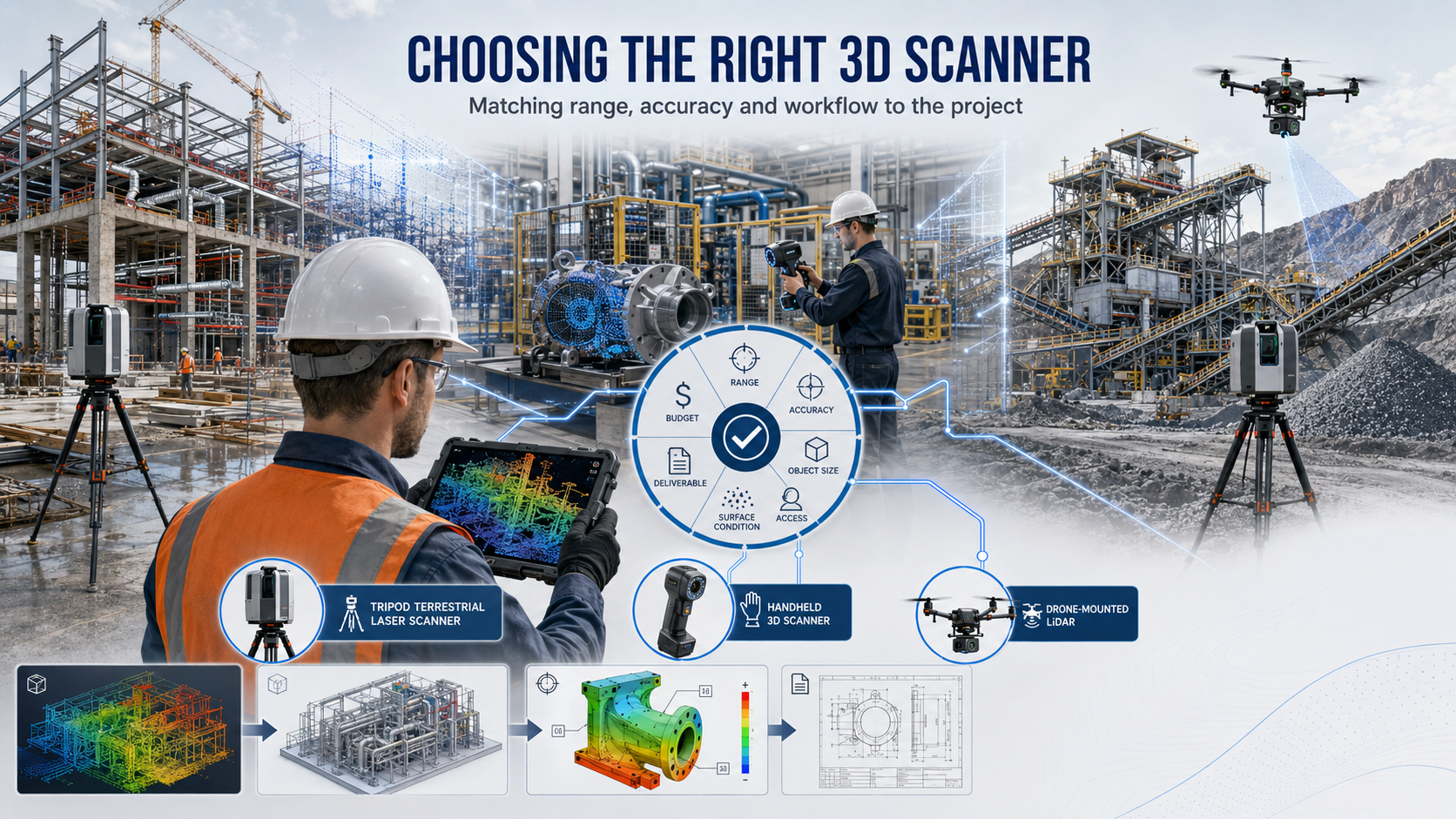
At Hamilton By Design, we know that 3D scanning has become an essential tool for modern engineering — from capturing as-built conditions on construction sites to modeling complex processing plants and validating manufacturing layouts. But not all scanners are created equal, and selecting the right technology is crucial to getting reliable data and avoiding costly surprises later in the project.
3D Scanning for Construction Sites
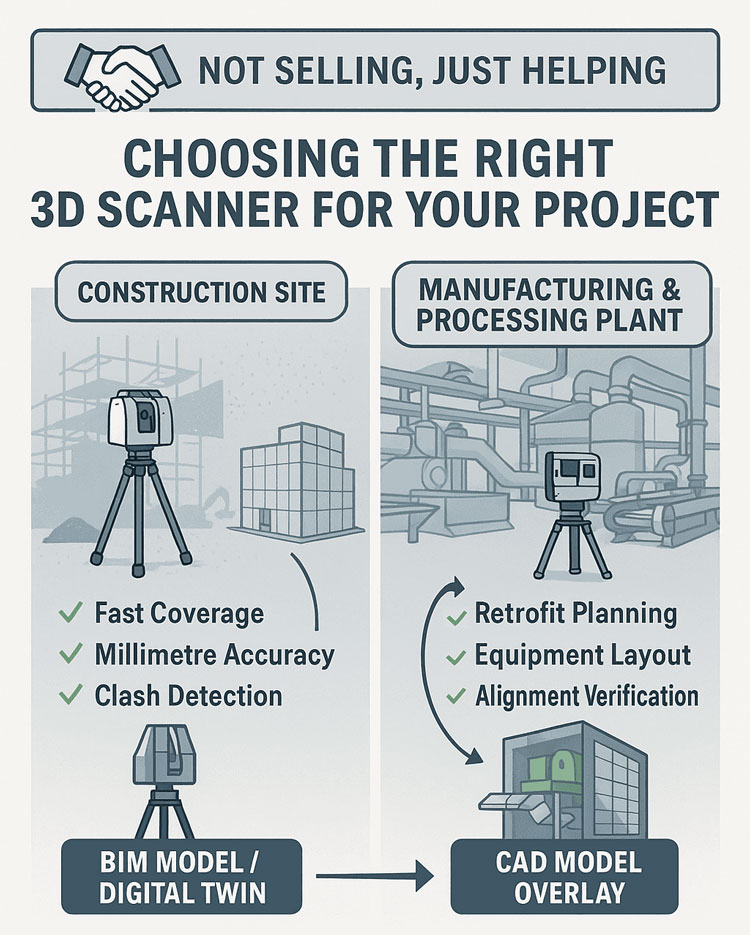
For construction and infrastructure projects, coverage and speed are the top priorities. Terrestrial Laser Scanning (TLS) and LiDAR systems like the FARO Focus S70 are ideal for quickly capturing entire job sites with millimetre-level accuracy. These scanners allow engineers and project managers to:
Verify as-built conditions against design models
Detect clashes early in the process
Support accurate quantity take-offs and progress documentation
TLS works well in tough environments — dust, sunlight, and complex geometry — making it a perfect fit for active building sites.
3D Scanning for Manufacturing & Processing Plants
When it comes to manufacturing facilities and mining processing plants, accuracy and detail matter even more. Scans are often used for:
Retrofit planning and clash detection in tight plant rooms
Structural steel and conveyor alignment checks
Equipment layout for expansion projects
Here, combining TLS with feature-based CAD modeling allows us to deliver data that is usable for engineering design, ensuring that new equipment fits exactly as intended.
We’re Here to Help
Hamilton By Design doesn’t sell scanners — we focus on providing unbiased, engineering-driven advice. If you’re unsure which scanning approach is right for your project, we’re happy to share our experience and guide you toward the best solution.
Feel free to get in touch to discuss your project needs — whether it’s a construction site, manufacturing facility, or processing plant, we can help you turn accurate scan data into actionable engineering insights.
In modern mining, where uptime is money and safety is non-negotiable, understanding the geometry of your process plant is critical. Every conveyor, chute, pipe rack, and piece of equipment must fit together seamlessly and operate reliably — but plants are messy, dusty, and constantly changing. Manual measurement with a tape or total station is slow, risky, and often incomplete.
This is where LiDAR scanning (Light Detection and Ranging) has become a game-changer. By capturing millions of precise 3D points per second, LiDAR gives engineers, maintenance planners, and operators an exact digital replica of the plant — without climbing scaffolds or shutting down equipment. In this post, we’ll explore how mining companies are using LiDAR scanning to solve real problems in processing plants, improve safety, and unlock operational efficiency.
What Is LiDAR Scanning?
LiDAR is a remote sensing technology that measures distance by firing pulses of laser light and recording the time it takes for them to return. Modern terrestrial and mobile LiDAR scanners can:
Capture hundreds of thousands to millions of points per second
Reach tens to hundreds of meters, depending on the instrument
Achieve millimeter-to-centimeter accuracy
Work in GPS-denied environments, such as inside mills, tunnels, or enclosed plants (using SLAM — Simultaneous Localization and Mapping)
The output is a point cloud — a dense 3D dataset representing surfaces, equipment, and structures with stunning accuracy. This point cloud can be used as-is for measurements or converted into CAD models and digital twins.
Why Process Plants Are Perfect for LiDAR
Unlike greenfield mine sites, processing plants are some of the most geometry-rich and access-constrained areas on site. They contain:
Complex networks of pipes, conveyors, tanks, and structural steel
Moving equipment such as crushers, mills, and feeders
Dusty, noisy, and hazardous environments with limited safe access
All these factors make traditional surveying difficult — and sometimes dangerous. LiDAR enables “no-touch” measurement from safe vantage points, even during operation. Multiple scans can be stitched together to create a complete model without shutting down the plant.
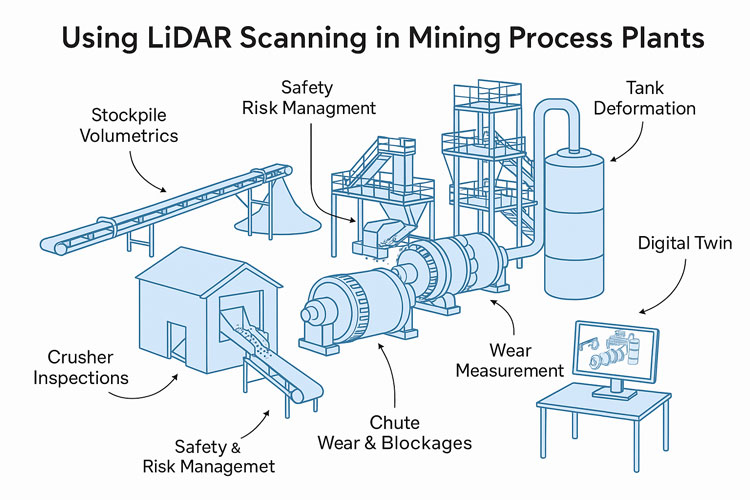
Applications of LiDAR in Process Plants
1. Wear Measurement and Maintenance Planning
LiDAR has revolutionized how mines measure and predict wear on critical process equipment:
SAG and Ball Mill Liners – Portable laser scanners can capture the exact wear profile of liners. Comparing scans over time reveals wear rates, helping maintenance teams schedule relines with confidence and avoid premature failures.
Crusher Chambers – Scanning inside primary and secondary crushers is now faster and safer than manual inspections. The resulting 3D model allows engineers to assess liner life and optimize chamber profiles.
Chutes and Hoppers – Internal scans show where material buildup occurs, enabling targeted cleaning and redesign to prevent blockages.
Result: Reduced downtime, safer inspections, and better forecasting of maintenance budgets.
2. Retrofit and Expansion Projects
When modifying a plant — installing a new pump, rerouting a pipe, or adding an entire circuit — having an accurate “as-built” model is crucial.
As-Built Capture – LiDAR provides an exact snapshot of the existing plant layout, eliminating guesswork.
Clash Detection – Designers can overlay new equipment models onto the point cloud to detect interferences before anything is fabricated.
Shutdown Optimization – With accurate geometry, crews know exactly what to cut, weld, and install — reducing surprise field modifications and shortening shutdown durations.
3. Inventory and Material Flow Monitoring
LiDAR is not just for geometry — it’s also a powerful tool for tracking material:
Stockpile Volumetrics – Mounted scanners on stackers or at fixed points can monitor ore, concentrate, and product stockpiles in real time.
Conveyor Load Measurement – Stationary LiDAR above belts calculates volumetric flow, giving a direct measure of throughput without contact.
Blending Control – Accurate inventory data improves blending plans, ensuring consistent plant feed quality.
4. Safety and Risk Management
Perhaps the most valuable application of LiDAR is keeping people out of harm’s way:
Hazardous Floor Areas – When flooring or gratings fail, robots or drones with LiDAR payloads can enter the area and collect data remotely.
Fall-of-Ground Risk – High walls, bin drawpoints, and ore passes can be scanned for unstable rock or buildup.
Escape Route Validation – Scans verify clearances for egress ladders, walkways, and platforms.
Every scan effectively becomes a permanent digital record — a baseline for monitoring ongoing structural integrity.
5. Digital Twins and Advanced Analytics
A plant-wide LiDAR scan is the foundation of a digital twin — a living, data-rich 3D model connected to operational data:
Combine scans with SCADA, IoT, and maintenance systems
Visualize live process variables in context (flow rates, temperatures, vibrations)
Run “what-if” simulations for debottlenecking or energy optimization
As AI and simulation tools mature, the combination of geometric fidelity and operational data opens new possibilities for predictive maintenance and autonomous plant operations.
Emerging Opportunities
Looking forward, there are several promising areas for LiDAR in mining process plants:
Autonomous Scan Missions – Using quadruped robots (like Spot) or SLAM-enabled drones to perform routine scanning in high-risk zones.
Real-Time Change Detection – Continuous scanning of critical assets with alerts when deformation exceeds thresholds.
AI-Driven Point Cloud Analysis – Automatic object recognition (valves, flanges, motors) to speed up model creation and condition reporting.
Integrated Planning Dashboards – Combining LiDAR scans, work orders, and shutdown schedules in a single interactive 3D environment.
Best Practices for Implementing LiDAR
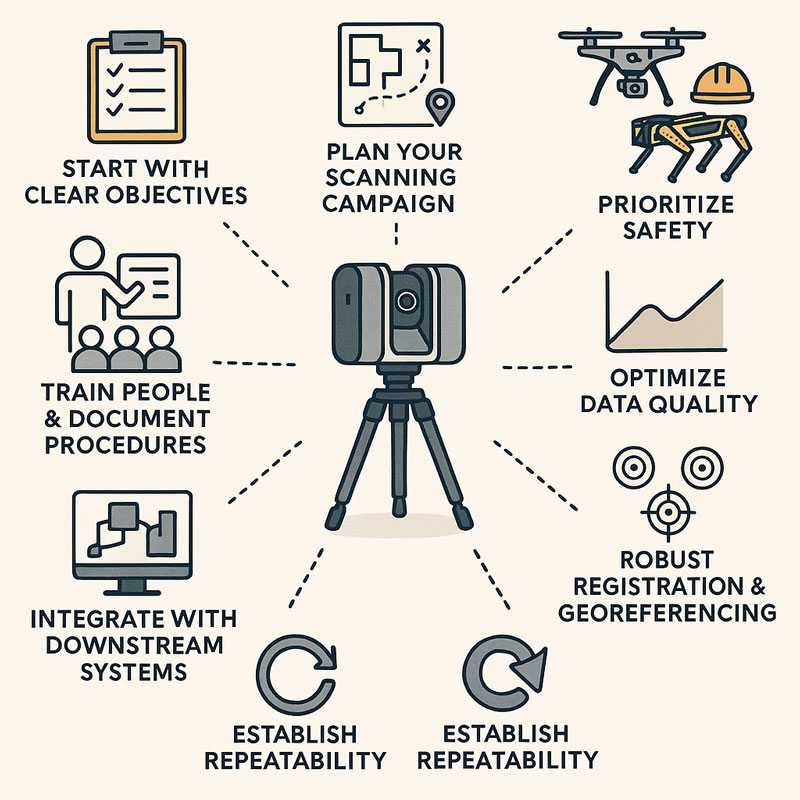
To maximize the value of LiDAR scanning, consider:
Define the Objective – Are you measuring wear, planning a retrofit, or building a digital twin? This affects scanner choice and resolution.
Plan Scan Positions – Minimize occlusions and shadow zones by preplanning vantage points.
Use Proper Registration – Tie scans to a control network for consistent alignment between surveys.
Mind the Environment – Dust, fog, and vibration can degrade data; choose scanners with appropriate filters or protective housings.
Invest in Processing Tools – The raw point cloud is only the start — software for meshing, modeling, and analysis is where value is extracted.
Train Your Team – Build internal capability for scanning, processing, and interpreting the results to avoid vendor bottlenecks.
LiDAR scanning is no longer a niche technology — it is rapidly becoming a standard tool for mining process plants that want to operate safely, efficiently, and with fewer surprises. From mill liners to stockpiles, from shutdown planning to digital twins, LiDAR provides a clear, measurable view of assets that was impossible a decade ago.
For operations teams under pressure to deliver more with less, the case is compelling: better data leads to better decisions. And in a high-stakes environment like mineral processing, better decisions translate directly to improved uptime, reduced costs, and safer workplaces.
The next time you’re planning a shutdown, a retrofit, or even just trying to understand why a chute is plugging, consider pointing a LiDAR scanner at the problem. You may be surprised at how much more you can see — and how much time and money you can save.
Australia’s Federal Government has announced an A$1.2 billion Critical Minerals Strategic Reserve, backed by a $1 billion top-up to its existing Critical Minerals Facility. With implementation set for the second half of 2026, the Reserve aims to secure critical minerals—lithium, cobalt, nickel, rare earths—through government offtake agreements and strategic stockpiling miningmonthly.com
Why It Matters for Mechanical Engineers
This isn’t just political positioning—it’s a major call to action for mechanical engineering consultancies:
Scale and diversification of processing sites – More projects will need robust mechanical systems from crushing and conveying to structural and structural integrity assessments, especially for rare earths and heavy metals.
Advanced processing technologies – Selective stockpiling and refining of critical minerals will require high-precision mechanical design, wear management, and optimization of machinery performance.
Infrastructure and retrofit demand – The Reserve extends the Critical Minerals Facility’s reach to A$5 billion, catalysing greenfield builds and upgrades—areas where Hamilton By Design excels.
Strategic Insights for Hamilton By Design
At Hamilton By Design, our strength lies in supporting projects from feasibility to commissioning, encompassing:
Materials handling systems – conveyors, stockpiles, chutes
Structural and fatigue engineering – ensuring safety and longevity under harsh industrial conditions
Wear and reliability optimisation – extending lifespan and uptime of mechanical assets
Digital tools – such as FEA, 3D scanning, and digital twins to enhance design accuracy and project efficiency
This Government-backed industrial growth is a signal for mining contractors and OEMs to engage expert mechanical consultants early—ensuring streamlined, compliant, and future-proofed system integration.
🛠️ How Hamilton By Design Adds Value
What You Get
How It Helps
Proven materials-handling systems design
Scalable, reliable conveyors and chutes for critical-mineral plants
End-to-end structural assessments
Enables compliance with WHS, AS/NZS and long-term asset management
Wear analysis & maintenance planning
Reduces downtime and extends asset lifespan
Integration of digital engineering
Improves commissioning, reduces risk and cost overruns
With major investments planned and a strong industrial trajectory ahead, now is the time for OEMs and mining clients to tap into specialist mechanical consulting support.
Let’s talk about how Hamilton By Design can partner to deliver cutting‑edge materials handling and structural engineering solutions for your next critical minerals project.
Rigid Body Dynamics vs Transient Structural Analysis – How does it apply to the Mining industry?
In the Australian mining industry — where heavy equipment, high-value production, and harsh conditions are the norm — the ability to simulate, test, and validate mechanical systems before they are fabricated or fail in the field is not just beneficial, it’s essential.
From iron ore operations in the Pilbara, to gold mining east of Perth, across to coal in the Hunter Valley and Bowen Basin, and up to hard rock mines in Mount Isa, mining operations rely heavily on engineered systems that move, load, transfer, and endure extreme forces. These systems are increasingly modelled using computer-aided engineering (CAE) tools to improve design accuracy, increase reliability, and reduce downtime.
Two of the most powerful tools in the mechanical and structural engineering toolbox are Rigid Body Dynamics (RBD) and Transient Structural Analysis (TSA). Both play key roles — but they serve very different purposes.
At Hamilton By Design, we help clients across Australia choose and implement the right type of simulation, whether you’re evaluating motion, stress, fatigue, wear, or all of the above.
What is Transient Structural Analysis (TSA)?
Transient Structural Analysis is a finite element-based simulation used to evaluate how a structure deforms under time-dependent loads. It’s used to calculate:
Displacement and deformation
Internal stresses and strains
Vibrations and dynamic response
Fatigue or structural failure under repeated loading
TSA is essential for components subjected to impact, vibration, or varying loads over time — all of which are common in mining.
Mining Applications of TSA:
Vibrating screens and feeders
High-speed chutes or hoppers handling large volumes
Crusher housings and rotating equipment supports
Structural skids and frames under mobile loads
Transfer stations experiencing dynamic load shifts
What is Rigid Body Dynamics (RBD)?
Rigid Body Dynamics is used to simulate the motion of objects under the influence of forces, assuming the bodies themselves do not deform. RBD calculates:
Positions, velocities, and accelerations of components
Reaction forces at joints and constraints
Behaviour of actuators, linkages, and arms
Impact and collision between rigid parts
It’s particularly useful for modelling complex mechanisms and moving systems, such as hydraulic rams, rotary actuators, diverter gates, and articulated machinery.
Mining Applications of RBD:
Transfer chutes with moving diverter arms
Stacker-reclaimers and shiploaders
Drill mast articulation and boom operations
Hydraulic take-up systems on conveyors
Rockbreaker arms and crusher feed assemblies
Why TSA Isn’t a Substitute for RBD
Although TSA includes the ability to simulate rigid body motion as part of the total deformation field, it is not optimised for modelling systems where motion and kinematic behaviour are the primary focus. TSA solvers are geared towards tracking internal stresses, not joint movement or mechanical control.
If you try to use TSA for systems like diverter gates or mobile stackers:
The solver becomes slow and resource-heavy
You waste time calculating strain in components that are not expected to deform
You risk numerical instability if the system has insufficient structural constraints
RBD, on the other hand, is lean, fast, and perfectly suited for motion analysis. It handles joints, constraints, friction, impacts, and actuators efficiently without the complexity of a full finite element model.
Region-Specific Mining Examples
Let’s explore how these principles apply across key Australian mining regions.
🔶 Pilbara (Iron Ore – North of Perth)
In the Pilbara, high-throughput handling systems like stacker-reclaimers, conveyors, and train loadouts dominate. While TSA is critical for verifying the structural integrity of boom supports or transfer station bases, RBD is essential for simulating the precise motion of long booms, rotating car dumpers, and slewing mechanisms — especially when automated systems are involved.
🟡 Kalgoorlie & Goldfields (Gold – East of Perth)
In this region, we often see compact yet high-capacity systems like ball mills, crushers, and slurry pumps. TSA is ideal for evaluating fatigue life, support frame stresses, and dynamic loading from mill vibration. However, diverter systems in process plants or mobile material handling arms often require RBD to evaluate motion paths and ensure smooth operation under hydraulic or pneumatic control.
⚫ Hunter Valley (Thermal Coal)
Bulk handling is central in this region. TSA is used to assess the wear and fatigue life of chutes, hoppers, and vibrating feeders. For moving equipment like stackers, tripper cars, or sampler mechanisms, RBD provides fast, accurate insight into system dynamics, travel time, and constraint loads.
⚫ Bowen Basin (Metallurgical Coal)
Here, systems like longwall supports, draglines, and hydraulic roof supports dominate. RBD plays a crucial role in simulating the interaction between actuators and supports, ensuring control logic matches physical capability. TSA is then applied to determine structural integrity and fatigue under repetitive stress.
🔵 Mount Isa (Hard Rock Mining)
With aggressive ores and complex underground networks, Mount Isa operations demand robust systems. TSA is vital for verifying vibration resistance and structural life of crushers, vibrating screens, and bin supports. But the motion of equipment like rockbreakers, boom arms, and autonomous loaders must be analysed with RBD to ensure precise control and motion under harsh conditions.
Combining Both for Complete Insight
The real power comes when TSA and RBD are used together. For example:
Use RBD to simulate the motion of a diverter arm and identify peak reaction forces.
Feed those forces into a TSA model to evaluate stress and fatigue in the pivot brackets or mounting plates.
This combination provides full lifecycle analysis — motion, loads, stress, and safety.
Engineering Support from Hamilton By Design
At Hamilton By Design, we understand how to apply these tools to real-world mining problems. We specialise in:
Mechanical system simulation and analysis
Lidar scanning and digital plant modelling
Design for manufacturability and reliability
Integrated RBD + TSA solutions tailored to mining
Whether you’re developing a new materials handling system, upgrading an existing structure, or troubleshooting motion-related issues, our team can provide insight-driven solutions that save time and money.
👉 Learn more at www.hamiltonbydesign.com.au or contact us to request a capability statement or project discussion.
Final Thoughts
Rigid Body Dynamics and Transient Structural Analysis aren’t interchangeable — they are complementary. In the demanding environment of the mining industry, knowing when and how to use each tool can make the difference between a reliable plant and one plagued by maintenance issues and inefficiencies.
If your system moves, RBD gives you clarity. If it bends, vibrates, or wears, TSA gives you answers.
Hamilton By Design – Engineering Australia’s Mining Future.
🔧 Precision Engineering Meets Digital Innovation in the Mining Sector
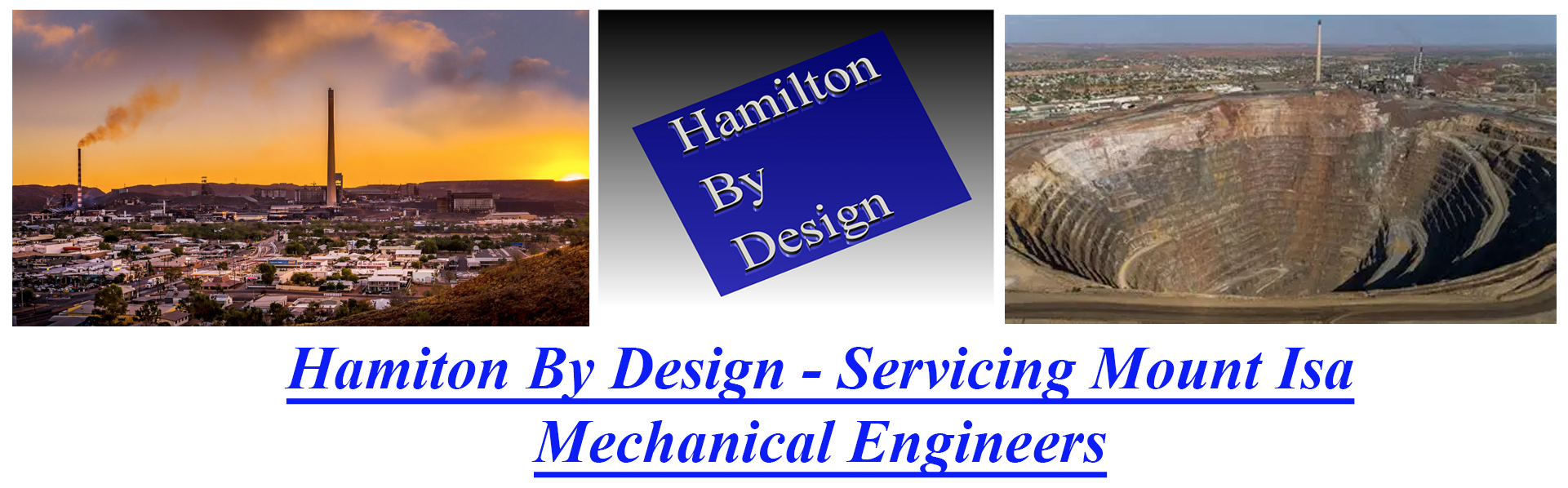
In the heart of Australia’s mining country—Mount Isa—Hamilton By Design is delivering cutting-edge mechanical engineering solutions powered by 3D Lidar scanning and point cloud modelling.
Whether you’re managing underground infrastructure, fixed plant upgrades, or brownfield expansions, our advanced tools and design expertise help you visualise, optimise, and execute projects with clarity and confidence.
How We Support the Mining Industry
As mechanical engineering consultants, we provide services that reduce project risk, increase design accuracy, and streamline construction workflows. Key areas include:
Lidar 3D Scanning of existing plant, pipework, and underground assets
Point Cloud Creation for clash detection and design validation
Mechanical & Structural Drafting using accurate site data
Reverse Engineering of legacy plant or undocumented assets
Detailed Design for Modifications & Upgrades
Compliance, Auditing, and Risk Reduction
By combining field-tested mechanical engineering with cutting-edge digital capture, we help mining teams make better decisions—faster.
Why Mount Isa?
Mount Isa is home to some of Australia’s largest and most complex mining operations. From Glencore’s copper and zinc mines to contracting hubs servicing the broader North West Minerals Province, this region demands precision, speed, and deep mining knowledge.
Hamilton By Design is based locally in Mount Isa, giving us the unique advantage of rapid site access, practical experience in mining environments, and a strong understanding of local challenges.
Why Use Lidar & Point Clouds?
Lidar scanning has transformed how we approach engineering projects in mining:
Capture complex environments in minutes, not days
Generate ultra-accurate point clouds for design, measurement, and planning
Minimise rework by designing to exact, as-built geometry
Visualise site constraints in 3D before committing to fabrication or install
Integrate scan data with CAD models for seamless design workflows
From underground crushers to surface pipe racks, our Lidar system captures the details—so you can design with certainty.
Use Cases in Mining Projects
Some real-world examples of how we apply mechanical engineering + Lidar scanning in mining:
Scanning underground pump stations for upgrade design
Reverse-engineering chutes and hoppers with no existing drawings
Capturing point clouds of processing plants for structural fit-out
Laser-accurate data for mobile plant modifications and safety guarding
Converting scan data into fabrication-ready models and drawings
Want to see a sample point cloud or project output? Just reach out through our website below.
Who We Work With
Mining Operators & Engineers
Shutdown Coordinators
Project Managers & Fabricators
EPCM Contractors
Surveyors & Design Teams
If you’re responsible for delivering accurate, efficient, and safe mechanical solutions on site—Hamilton By Design is your local partner.
1. Setting the Scene: The Central Coast & Its Industrial Backbone
Home to nearly 350,000 people across Gosford, Wyong, Terrigal, and beyond, the Central Coast is well-known for its beaches and bushland—yet it also supports a robust industrial and mining‑services sector (Jora, Wikipedia). With growing infrastructure demands and proximity to resource projects like the Wallarah 2 coal proposal near Wyong (Wikipedia), mechanical engineers play a pivotal role behind the scenes.
2. What Do Mechanical Engineers Do in Mining on the Coast?
Mechanical engineers in mining and related heavy industries are responsible for:
Design & Maintenance: Planning, designing, and overseeing maintenance of critical mineral processing plants, machinery, conveyors, trucks and drilling rigs (Jobsora).
Health & Safety Compliance: Ensuring mechanical systems meet stringent safety regulations and operator protection standards (Jora).
Environmental Efficiency: Optimising equipment to reduce energy use, emissions, and noise—all while supporting mine rehabilitation efforts .
3. Job Opportunities in the Region
Recent job listings highlight robust opportunities for mechanical engineers across the Coast:
Mining Mechanical Engineer roles are regularly advertised in Gosford/Lisarow, appearing in SEEK and Jora job postings (SEEK).
Roles span senior design positions to hands‑on maintenance engineering—offering full-time opportunities with firms like Wabtec, Hyundai Rotem, Boral, and Coffey (SEEK).
Entry-level and graduate engineering roles are also available through pathways like Central Coast Council traineeships and TAFE NSW programs (Central Coast Council).
4. Industry Trends and What You’ll Need
As described by Titan Recruitment, the mining sector is embracing several transformative trends (Titan Recruitment):
Automation & Robotics: Engineers are tasked with integrating autonomous machinery and control systems.
Digital & Data Analytics: Skills in condition monitoring, sensors, and predictive analytics are in demand.
Sustainability Focus: There’s emphasis on clean, efficient systems that reduce environmental footprint.
Complex Machine Design: As equipment sophistication grows, so does the need for mechanical expertise.
Asset Reliability & Safety: Mechanical engineers must ensure zero-fault operation in harsh mining environments.
Site-to-System Integration: Engineers coordinate across disciplines—mechanical, electrical, structural—to optimise operations.
Continuous Upskilling: Ongoing education—through TAFE NSW, professional certifications, and in-house training—is critical.
5. Training & Career Pathways on the Central Coast
🎓 Education & Apprenticeships
TAFE NSW (Hunter & Central Coast) offers mechanical and engineering trade training, forming a strong foundation for local roles (Wikipedia).
Central Coast Council provides apprenticeships and traineeships in mechanical fields—ideal stepping stones into industry .
🏢 Local Industry Experience
Firms like Wabtec, Hyundai Rotem, Boral, Coffey, and Wright Engineering in Somersby/Gosford offer vital on-the-job training and progression (SEEK).
Mining-support businesses across the Central Coast employ engineers to design, maintain, and improve heavy-duty plant and machinery.
6. Why the Central Coast Is a Great Base for Mining Engineers
Proximity to Projects: Infrastructure supporting coal drilling and mineral processing connects easily with local towns via major transport routes in and out of Gosford (Jobsora, Wikipedia).
Balanced Lifestyle: Work-life harmony blends regional industry jobs with coastal living and access to national parks (Indeed).
Clear Career Pathways: Education, apprenticeships, and employers form a supportive ecosystem—from bedrock training to senior site leadership.
Final Takeaway
Mechanical engineers are essential to mining operations on the Central Coast—ensuring machinery runs efficiently, safely, and sustainably. With strong local education pathways, active job markets, and growing tech trends, the region offers rewarding careers tied to both industrial innovation and community lifestyle.
Ready to design, maintain, and optimise the backbone of mining? The Central Coast has the foundation—and the opportunity—awaiting mechanical engineers eager to build the future.
To provide the best experiences, we use technologies like cookies to store and/or access device information. Consenting to these technologies will allow us to process data such as browsing behaviour or unique IDs on this site. Not consenting or withdrawing consent, may adversely affect certain features and functions.
Functional
Always active
The technical storage or access is strictly necessary for the legitimate purpose of enabling the use of a specific service explicitly requested by the subscriber or user, or for the sole purpose of carrying out the transmission of a communication over an electronic communications network.
Preferences
The technical storage or access is necessary for the legitimate purpose of storing preferences that are not requested by the subscriber or user.
Statistics
The technical storage or access that is used exclusively for statistical purposes.The technical storage or access that is used exclusively for anonymous statistical purposes. Without a subpoena, voluntary compliance on the part of your Internet Service Provider, or additional records from a third party, information stored or retrieved for this purpose alone cannot usually be used to identify you.
Marketing
The technical storage or access is required to create user profiles to send advertising, or to track the user on a website or across several websites for similar marketing purposes.