


3D Laser Scanning and Existing-Condition Study for a Hunter Valley CHPP
Project Overview
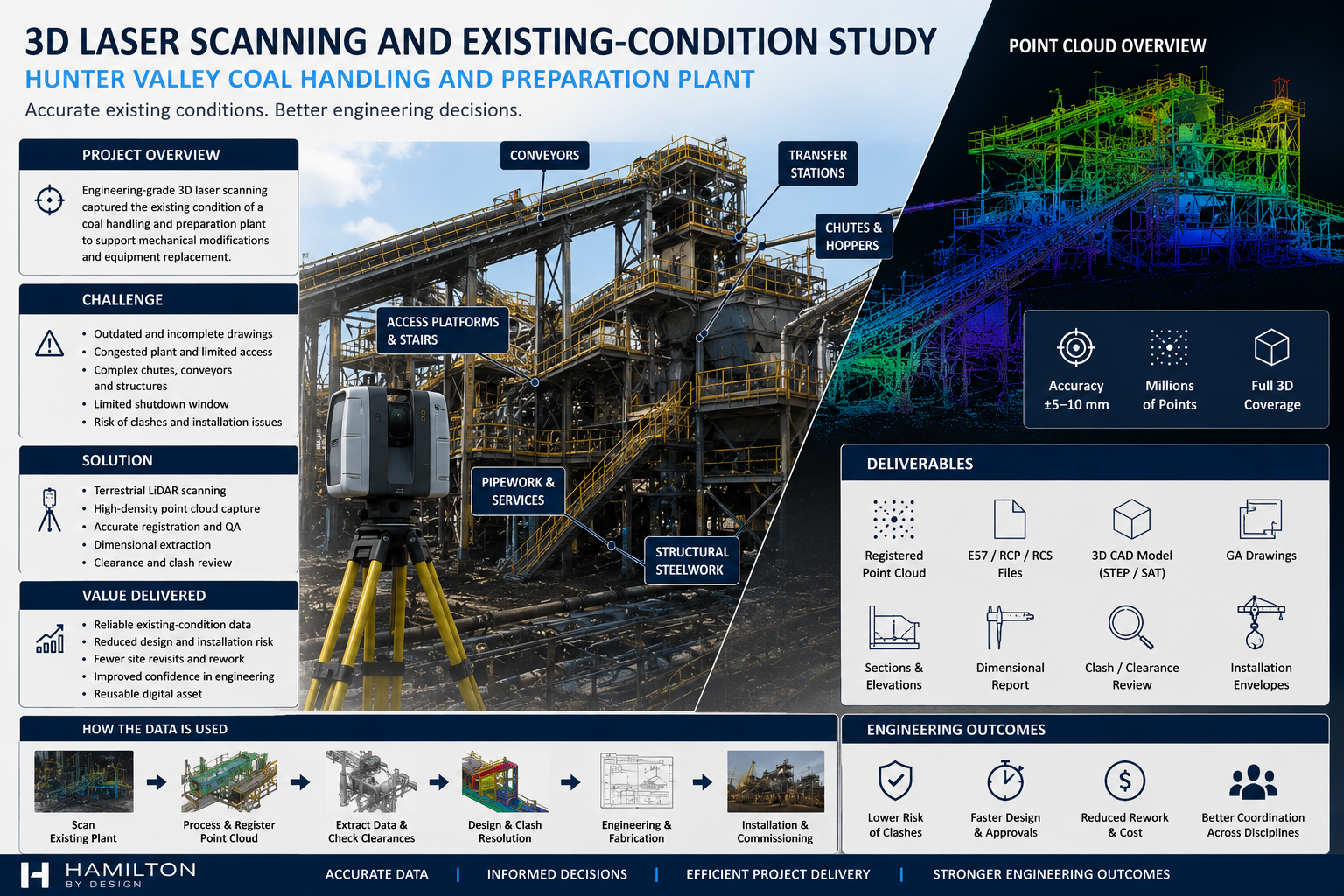
Hamilton By Design completed an engineering-grade 3D laser scanning and existing-condition study for a coal handling and preparation plant in the Hunter Valley, New South Wales.
The study was undertaken to capture the installed condition of the plant before proposed mechanical and structural modifications were developed.
The scanning area included conveyors, transfer stations, chutes, structural steelwork, access platforms, pipework and surrounding equipment.
The plant had undergone changes over time, and the available drawings did not fully represent the current installed condition.
The Engineering Challenge
Coal handling and preparation plants contain complex mechanical, structural and materials-handling systems.
Equipment is often installed within congested areas where conveyors, pipework, platforms, structural supports and electrical services pass through the same working space.
The proposed modifications needed to connect accurately with the existing plant.
The main project risks included:
- incomplete or outdated drawings
- restricted access around operating equipment
- complex chute and conveyor geometry
- elevated plant structures
- limited shutdown periods
- difficult-to-measure equipment interfaces
- uncertainty around existing clearances
- potential clashes with structural steelwork and services
- fabrication errors caused by incorrect dimensions
A conventional site measure would have captured only selected dimensions and could have missed important obstructions or plant interfaces.
Scope of Work
Hamilton By Design completed the following work:
- reviewed the available plant drawings and project information
- defined the required scanning envelope
- planned suitable scanner positions
- completed terrestrial 3D laser scanning throughout the nominated CHPP area
- captured conveyors, chutes, transfer stations and supporting structures
- captured platforms, stairs, handrails, pipework and surrounding services
- registered and quality-checked the scan data
- prepared a coordinated existing-condition point cloud
- extracted critical equipment and structural dimensions
- reviewed clearances and installation constraints
- supported the development of the proposed mechanical modifications
3D Laser Scanning Methodology
The plant area was reviewed before scanning to identify the most important mechanical, structural and installation interfaces.
Multiple scanner positions were used to capture the plant from different directions and reduce hidden areas within the point cloud.
The scan coverage included:
- conveyor head and tail sections
- transfer chutes
- discharge points
- hoppers and bins
- support frames
- platforms and walkways
- stairs and handrails
- pipework and services
- floor and structural levels
- surrounding mechanical equipment
- maintenance-access areas
- proposed installation paths
The individual scans were registered into a single coordinated point cloud.
The completed dataset was checked for alignment, coverage and suitability for engineering use before detailed design work commenced.
Existing-Condition Information Captured

The registered point cloud provided a detailed three-dimensional record of the CHPP area.
The scan data allowed the engineering team to confirm:
- installed conveyor positions
- chute and hopper geometry
- structural support locations
- platform and walkway arrangements
- pipework routes
- equipment connection points
- floor and structural elevations
- maintenance clearances
- removal and installation envelopes
- potential clashes with existing plant
This information provided a reliable basis for developing the proposed modifications.
Engineering Deliverables
The project deliverables included:
- a registered engineering-grade point cloud
- E57 point-cloud files
- Autodesk-compatible point-cloud files
- extracted site dimensions
- existing-condition geometry
- equipment interface locations
- structural interface locations
- clearance and clash-review information
- supporting views for mechanical design and drafting
The point-cloud data could also be used to prepare:
- SolidWorks models
- Autodesk Inventor models
- STEP and SAT files
- general arrangement drawings
- sections and elevations
- fabrication drawings
- installation drawings
- demolition drawings
- shutdown work packs
Engineering Outcome
The completed existing-condition study gave the project team a reliable spatial reference for the proposed CHPP modifications.
Differences between the available drawings and the actual installed plant could be identified before detailed design and fabrication progressed.
The point cloud allowed the mechanical design to be developed around the real plant condition rather than assumed dimensions.
The scan data supported:
- conveyor modification design
- chute replacement and redesign
- transfer-point upgrades
- structural support modifications
- new platform and access design
- pipework rerouting
- equipment replacement planning
- clash detection
- mechanical fit-up verification
- maintenance-access reviews
- fabrication planning
- shutdown installation sequencing
Benefits to the Client
The use of engineering-grade 3D laser scanning provided several practical benefits:
- reduced reliance on outdated drawings
- faster capture of complex CHPP geometry
- fewer manual measurements
- reduced need for return site visits
- improved confidence in the mechanical design
- earlier identification of potential clashes
- lower risk of fabrication errors
- reduced risk of shutdown installation delays
- improved coordination between engineering and site teams
- better planning of equipment removal and installation
- creation of a reusable digital record of the plant
Why 3D Laser Scanning Was Suitable
3D laser scanning was well suited to the project because the engineering work depended on an accurate understanding of the existing plant arrangement.
A CHPP can contain hundreds of interacting mechanical, structural and service components within a relatively small area.
The point cloud allowed a large amount of spatial information to be captured during a controlled site visit.
Engineers and designers could then review the plant remotely, inspect equipment interfaces and take additional measurements without repeatedly returning to site.
This provided a more complete engineering reference than a limited set of manually recorded dimensions.
Conclusion
The project demonstrated the value of 3D laser scanning for brownfield engineering within Hunter Valley coal handling and preparation plants.
By capturing the existing plant before detailed design and fabrication, Hamilton By Design reduced uncertainty and improved the quality of the engineering information available to the project team.
Engineering-grade LiDAR can provide a reliable foundation for:
- conveyor upgrades
- chute and transfer-station modifications
- equipment replacement
- structural modifications
- platform and access upgrades
- pipework modifications
- reverse engineering
- as-built verification
- mechanical fit-up
- shutdown planning
- digital-twin development
Accurate existing-condition data allows CHPP modifications to proceed with greater confidence and a lower risk of site-related design changes.

Contact Us – Talk To Us
Our clients:
























