Why Engineering-Grade Scanning Matters in Reverse Engineering Projects

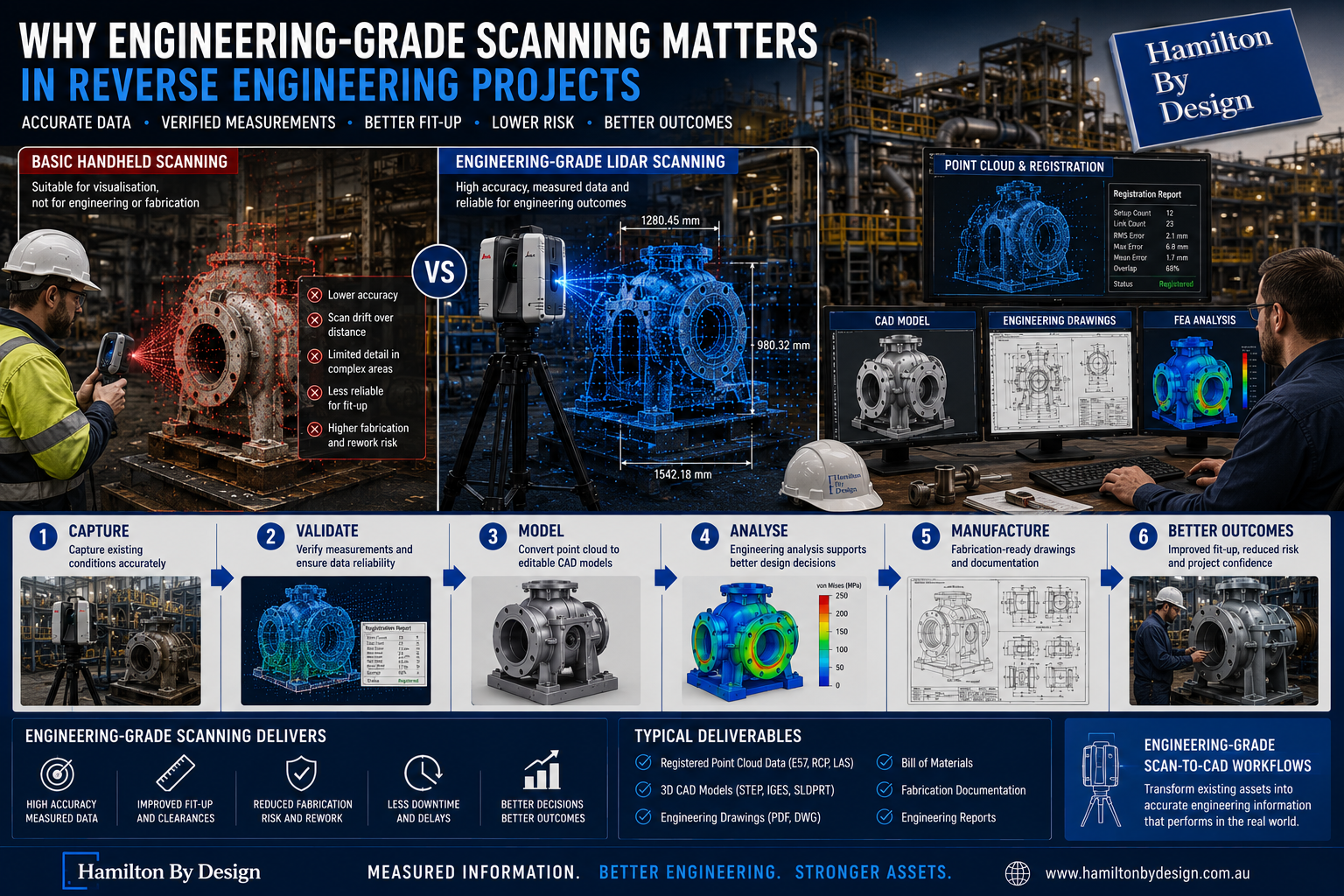
Engineering-grade LiDAR scanning workflow comparing basic scanning and reverse engineering processes for industrial equipment.

Reverse engineering projects often begin with a simple challenge:

“We have the component, but we do not have the engineering information.”

Mining and industrial operations frequently rely on equipment that has been modified, repaired, or operating for many years beyond original installation. Drawings may no longer exist, replacement parts may be difficult to source, and physical components may have changed from their original design.

In these situations, reverse engineering allows existing equipment to be captured and converted into usable engineering information.

However, not all scanning methods deliver the same outcome.

At Hamilton By Design, we use engineering-grade scanning workflows to support reverse engineering projects where accuracy, fit-up, and fabrication outcomes matter.

The objective is not simply creating a visual model.

The objective is creating reliable engineering information.

Why Scanning Accuracy Matters

Reverse engineering projects frequently involve components where small dimensional variations can create significant downstream impacts.

Examples may include:

  • Pump assemblies
  • Conveyor systems
  • Transfer chutes
  • Shafts and couplings
  • Structural components
  • Wear liners
  • Mechanical assemblies

Minor dimensional errors can potentially create:

  • Misalignment
  • Installation difficulties
  • Increased wear
  • Rework
  • Downtime
  • Manufacturing delays

A model that looks correct visually may not necessarily be suitable for fabrication or engineering analysis.

For engineering projects, measured information is critical.

Handheld Scanning vs Terrestrial Scanning

Different scanning technologies are suited to different applications.
3D CAD Modelling Australia service banner for Hamilton By Design

Handheld Scanning Systems

Handheld systems may provide advantages including:

  • Rapid scanning
  • Mobility
  • Convenience
  • Fast visualisation

These systems are commonly used for:

  • Demonstrations
  • General visual models
  • Consumer products
  • Smaller objects
  • Architectural walkthroughs

However, challenges may include:

  • Drift over larger areas
  • Reduced positional control
  • Limited accuracy over extended environments
  • Difficulty in complex industrial sites

Engineering-Grade Terrestrial Scanning

Engineering-grade terrestrial LiDAR systems are typically designed for:

  • Existing condition capture
  • Industrial facilities
  • Brownfield environments
  • Structural information
  • Mechanical equipment
  • Engineering workflows

Potential benefits include:

  • High positional accuracy
  • Measured spatial relationships
  • Existing condition verification
  • Repeatable information capture
  • Better support for engineering decisions

The goal is producing information suitable for engineering use rather than visualisation alone.

Measurement Validation

Engineering workflows often require verification rather than assumptions.

Validation processes may include:

  • Dimensional checks
  • Registration reports
  • Measurement verification
  • Control point assessment
  • Existing condition review

Measurement validation helps ensure information can support:

  • Design development
  • Engineering analysis
  • Manufacturing
  • Construction activities

Confidence in the information improves confidence in the outcome.

Mechanical Fit-Up Requirements

Reverse engineering projects frequently involve equipment that must physically integrate with existing systems.

Examples may include:

  • Conveyor modifications
  • Pump replacements
  • Structural upgrades
  • Access platforms
  • Mechanical assemblies
  • Wear components

Poor fit-up can create:

  • Site rework
  • Delays
  • Fabrication changes
  • Additional labour
  • Installation difficulties

Engineering-grade capture helps reduce uncertainty before fabrication begins.

Brownfield Environments Create Additional Challenges

Brownfield facilities rarely match original documentation.

Industrial sites commonly include:

  • Historical modifications
  • Congested layouts
  • Existing pipework
  • Structural changes
  • Equipment additions
  • Limited access areas

These environments create challenges for reverse engineering because:

  • Drawings may be outdated
  • Components may differ from original designs
  • Existing clearances may be limited

Engineering-grade scanning provides measurable information from the actual operating environment.

Reducing Fabrication Risk

Fabrication errors can become expensive when discovered during installation.

Typical causes of fabrication risk may include:

  • Missing dimensions
  • Incorrect assumptions
  • Clash issues
  • Existing condition inaccuracies
  • Poor fit-up

Engineering-grade scanning can support:

  • Existing condition verification
  • Improved design development
  • Clash detection
  • Better fabrication planning
  • Reduced site modifications

Identifying problems digitally generally costs less than discovering them during installation.

How Hamilton By Design Supports Reverse Engineering Projects

Hamilton By Design combines engineering experience with digital engineering workflows including:

  • Engineering-grade 3D LiDAR scanning
  • Existing condition capture
  • Scan-to-CAD workflows
  • CAD modelling
  • Engineering drawings
  • Engineering analysis and simulation
  • Fabrication documentation
  • Mechanical engineering services

Our workflows naturally support broader engineering services including:

  • 3D CAD Design & Drafting
  • Engineering Analysis & Simulation
  • Mining Mechanical Engineering
  • Engineering Documentation & Digital Engineering
  • Industrial Plant Optimisation
  • LiDAR Scanning Services
3D LiDAR scanning and 3D modelling service button — laser scanner capturing a point cloud for engineering and CAD modelling
Mechanical engineering services

Moving Beyond Visual Models

Reverse engineering projects require more than attractive 3D models.

They require engineering information that supports:

  • Manufacturing
  • Installation
  • Reliability
  • Maintenance
  • Long-term asset management

Engineering-grade scanning helps transform physical assets into measurable engineering information that reduces risk and improves confidence in project outcomes.

Better information supports better engineering decisions.

Hamilton By Design logo displayed on a blue tilted rectangle with a grey gradient background

Our Clients:

Name
Would you like us to arrange a phone consultation for you?
Address

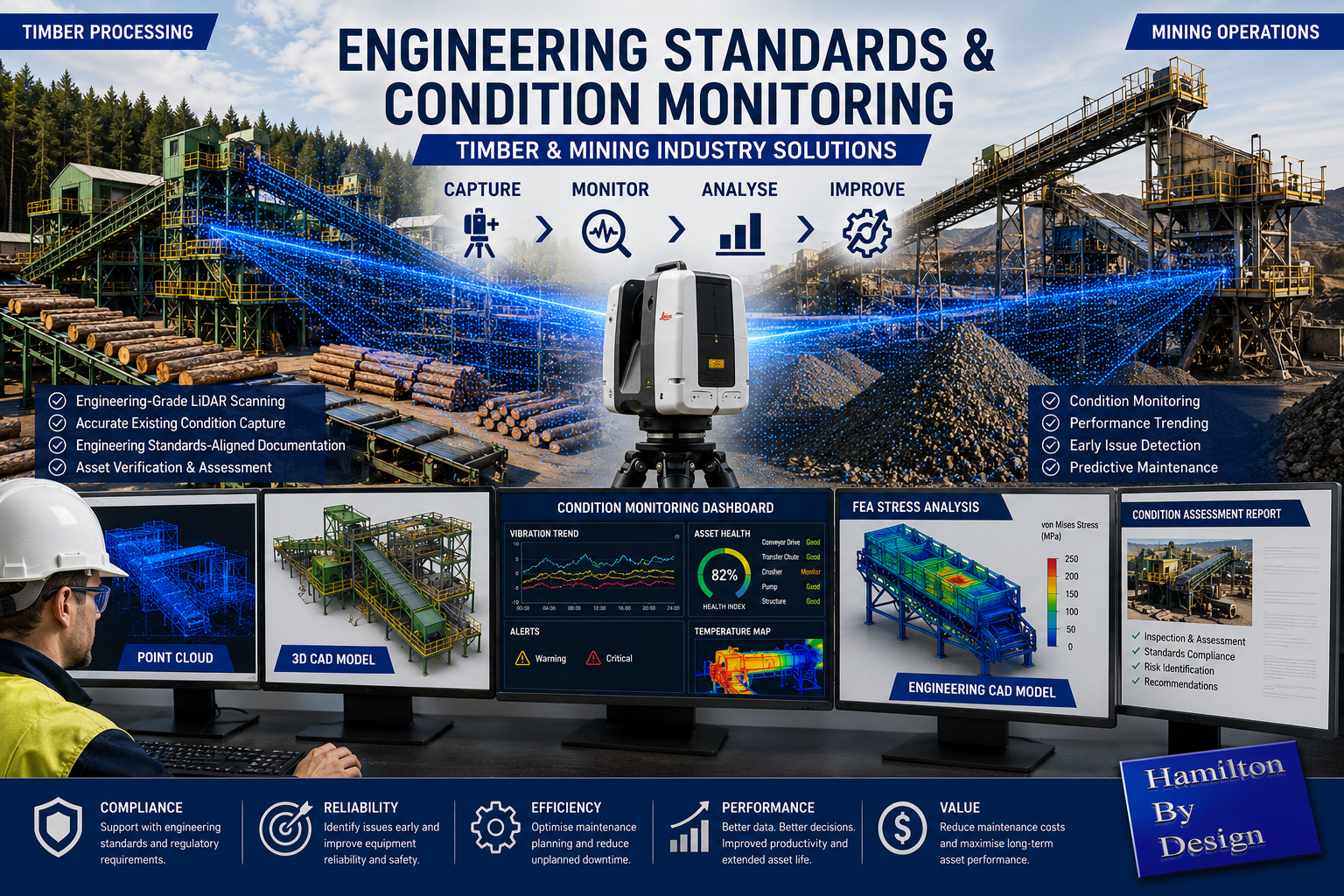
Engineering Standards & Condition Monitoring: Supporting Reliability in Timber and Mining Operations

Engineering-grade LiDAR scanning, condition monitoring, and FEA analysis workflow for timber processing and mining equipment reliability.

Industries such as timber processing and mining operate in demanding environments where equipment reliability directly affects productivity, maintenance costs, and operational performance. Conveyor systems, transfer chutes, rotating equipment, processing machinery, structural assets, and supporting infrastructure are often exposed to continuous loading, wear, vibration, fatigue, and harsh operating conditions.

While machinery failures may appear sudden, many develop gradually through changes in operating conditions, deterioration, or inadequate monitoring and maintenance practices.

Engineering standards and condition monitoring help organisations move from reactive maintenance toward informed engineering decisions and improved asset performance.

At Hamilton By Design, we support mining and timber processing industries through engineering-led approaches that combine engineering standards, digital engineering workflows, reality capture technologies, and practical engineering solutions.

Why Engineering Standards Matter

Engineering standards provide a structured framework for designing, assessing, operating, and maintaining equipment.

Standards help organisations achieve:

  • Improved safety
  • Greater consistency
  • Reduced risk
  • Improved reliability
  • Better maintenance planning
  • Regulatory compliance
  • Improved operational performance

Examples of standards commonly applied within industrial projects may include:

Structural and Mechanical Standards

  • AS 4100 – Steel structures
  • AS 1170 – Structural design actions
  • AS 3996 – Access covers and grates
  • AS 1657 – Fixed platforms, walkways, stairways and ladders
  • AS 1554 – Structural welding

Asset and Equipment Considerations

  • Fatigue assessment
  • Structural integrity
  • Mechanical reliability
  • Equipment life assessment
  • Materials handling performance

Engineering standards support more than design compliance. They help establish long-term operational reliability.

What is Condition Monitoring?

Condition monitoring involves collecting information about equipment performance and asset condition to identify potential issues before failures occur.

Rather than waiting for breakdowns, monitoring allows maintenance and engineering teams to make decisions using measurable data.

Condition monitoring can involve:

  • Equipment inspections
  • Structural assessments
  • Wear monitoring
  • Vibration monitoring
  • Alignment assessment
  • Existing condition capture
  • Thermal assessments
  • Trend analysis
  • Performance assessment

The objective is identifying deterioration before operational impacts occur.

Timber Industry Applications

Timber processing facilities operate continuously with significant material handling demands.

Common assets include:

  • Log conveyors
  • Timber handling systems
  • Chippers
  • Screening systems
  • Structural platforms
  • Transfer systems
  • Processing machinery

Typical challenges may include:

  • Equipment wear
  • Misalignment
  • Build-up
  • Fatigue
  • Structural deterioration
  • Conveyor performance issues

Engineering monitoring and assessment can improve:

  • Throughput
  • Reliability
  • Maintenance planning
  • Downtime reduction
  • Equipment life

Mining Industry Applications

Mining operations often involve harsh operating environments and heavy-duty equipment subjected to high loading conditions.

Applications can include:

  • Conveyor systems
  • Transfer chutes
  • Processing plants
  • Crushers
  • Pump systems
  • Structural assets
  • Materials handling systems

Common challenges may include:

  • Wear
  • Fatigue loading
  • Structural movement
  • Equipment deterioration
  • Production interruptions

Condition monitoring allows operational teams to move toward predictive maintenance approaches rather than emergency repairs.

How Hamilton By Design Supports Engineering Standards and Condition Monitoring

Hamilton By Design supports projects through a combination of engineering tools and practical experience.

Our services can include:

Engineering-Grade 3D LiDAR Scanning

Capture accurate existing conditions and generate point cloud information for:

  • Existing plant geometry
  • Structural assessment
  • Brownfield modifications
  • Asset verification
3D CAD Modelling Australia service banner for Hamilton By Design

Scan-to-CAD Workflows

Convert site information into:

  • Editable engineering models
  • Existing condition documentation
  • Engineering drawings

Engineering Analysis and Simulation

Support asset assessments through:

  • Finite Element Analysis (FEA)
  • Structural assessments
  • Load analysis
  • Design validation

Engineering Documentation

Deliver:

  • Drawings
  • Assessment reports
  • Design documentation
  • Asset information
3D LiDAR scanning and 3D modelling service button — laser scanner capturing a point cloud for engineering and CAD modelling
Mechanical engineering services

Supporting Long-Term Asset Performance

Successful operations are not built around simply repairing equipment after failure.

Long-term value often comes from:

  • Improved reliability
  • Reduced maintenance costs
  • Better planning
  • Increased productivity
  • Reduced downtime
  • Improved asset life
  • Better engineering decisions

By combining engineering standards, condition monitoring, digital engineering workflows, and practical engineering solutions, organisations can move beyond assumptions and improve operational performance.

Hamilton By Design supports timber processing and mining industries by helping transform engineering information into practical decisions and measurable outcomes.

Hamilton By Design logo displayed on a blue tilted rectangle with a grey gradient background
Name
Would you like us to arrange a phone consultation for you?
Address

Our Clients:

Forestry Industry & Timber Processing: Engineering Machinery for Productivity and Long-Term Value

Engineering-grade LiDAR scanning and FEA simulation workflow for forestry and timber processing equipment design.

The forestry and timber processing industries operate in demanding environments where productivity, reliability, and equipment performance directly influence profitability. Whether processing logs, handling timber products, operating sawmills, or managing materials handling systems, machinery downtime and inefficiencies can significantly affect production output and operating costs.

Modern engineering is moving beyond traditional design approaches and increasingly using digital engineering tools to optimise equipment before fabrication and installation begins.

At Hamilton By Design, we combine engineering-grade 3D LiDAR scanning, 3D modelling, and Finite Element Analysis (FEA) to support forestry and timber processing operations by delivering machinery and engineered systems designed for productivity, reliability, and long-term return on investment.

Designing for More Than Initial Cost

The lowest purchase price does not always provide the lowest operating cost.

Machinery and processing systems can incur substantial ongoing costs through:

  • Excessive wear
  • Unplanned maintenance
  • Downtime
  • Energy consumption
  • Material build-up
  • Inefficient layouts
  • Reduced production capacity
  • Premature equipment failure

Engineering decisions made during the design stage can influence the total lifecycle cost of equipment for many years after installation.

The objective is not simply designing machinery that works.

The objective is designing machinery that continues to perform efficiently throughout its operational life.

Engineering-Grade 3D LiDAR Scanning

For existing timber processing plants and brownfield facilities, one of the biggest challenges is understanding current conditions accurately.

Many facilities contain:

  • Existing conveyors
  • Timber processing machinery
  • Structural steel
  • Pipework
  • Platforms and access systems
  • Building constraints
  • Historical modifications

Outdated drawings or manual measurements can introduce risk into engineering projects.

Hamilton By Design uses engineering-grade 3D LiDAR scanning to capture accurate existing conditions and generate high-quality point cloud data.

This provides:
  • Accurate plant geometry
  • Existing condition verification
  • Reduced design assumptions
  • Improved fit-up accuracy
  • Reduced installation risk
  • Faster project development

Rather than designing around assumptions, engineering decisions can be based on actual site information.

3D Modelling for Better Project Outcomes

Once site information has been captured, point cloud data can be converted into editable engineering models.

3D CAD Modelling Australia service banner for Hamilton By Design

3D modelling provides benefits including:
  • Improved visualisation
  • Clash detection
  • Layout optimisation
  • Equipment integration
  • Fabrication planning
  • Improved communication

For forestry and timber processing projects this may include:

  • Log handling systems
  • Conveyors
  • Transfer systems
  • Chutes
  • Processing equipment
  • Access platforms
  • Structural modifications
  • Production upgrades

Digital models help identify issues before they become site problems.

Finite Element Analysis (FEA)

Engineering performance extends beyond appearance and fit-up.

Equipment must withstand:

  • Dynamic loading
  • Material impacts
  • Fatigue
  • Wear
  • Structural loading
  • Operational forces

Hamilton By Design can support projects through Finite Element Analysis (FEA) to evaluate equipment and structural performance before fabrication begins.

FEA can assist with:

  • Stress assessment
  • Deflection analysis
  • Structural performance
  • Design optimisation
  • Weight reduction opportunities
  • Reliability improvements

Rather than overdesigning equipment or relying on assumptions, designs can be refined using measurable engineering information.

Maximising Return on Investment

A successful project should not simply focus on reducing initial capital cost.

The real value often comes from:

  • Increased production rates
  • Reduced maintenance costs
  • Improved reliability
  • Reduced downtime
  • Improved safety
  • Lower lifecycle costs
  • Longer equipment life
  • Improved operational efficiency
3D LiDAR scanning and 3D modelling service button — laser scanner capturing a point cloud for engineering and CAD modelling
Mechanical engineering services

Engineering decisions made early in a project often have long-term financial impacts.

How Hamilton By Design Supports Forestry and Timber Processing

Hamilton By Design combines digital engineering tools with practical engineering experience to support projects from concept through to delivery.

Our services include:

  • Engineering-grade 3D LiDAR scanning
  • Scan-to-CAD workflows
  • 3D modelling
  • Mechanical engineering design
  • Finite Element Analysis (FEA)
  • Engineering drawings
  • Fabrication documentation
  • Existing condition verification
  • Brownfield project support

By integrating reality capture, digital modelling, and engineering analysis, projects can move from assumptions toward measurable engineering outcomes.

The goal is simple:

Design machinery and systems that maximise productivity while delivering stronger long-term returns on investment.