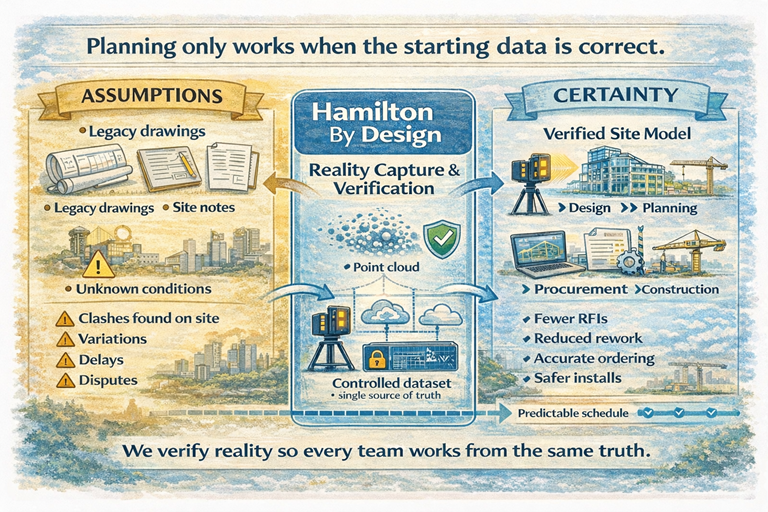
Successful Structural, Mechanical and Piping (SMP) projects are built on one fundamental principle: decisions must be based on accurate knowledge of existing conditions. In brownfields industrial environments, legacy drawings and manual measurements rarely reflect the current state of an asset. Over years of operation, piping is rerouted, structures are strengthened, and equipment is modified to meet changing production demands.
Commencing design on the basis of incomplete or inaccurate information introduces uncertainty that can affect safety, cost, schedule, and quality. Modern 3D laser scanning provides a disciplined method to remove this uncertainty and establish a reliable foundation for project delivery.
Establishing a Reliable Baseline
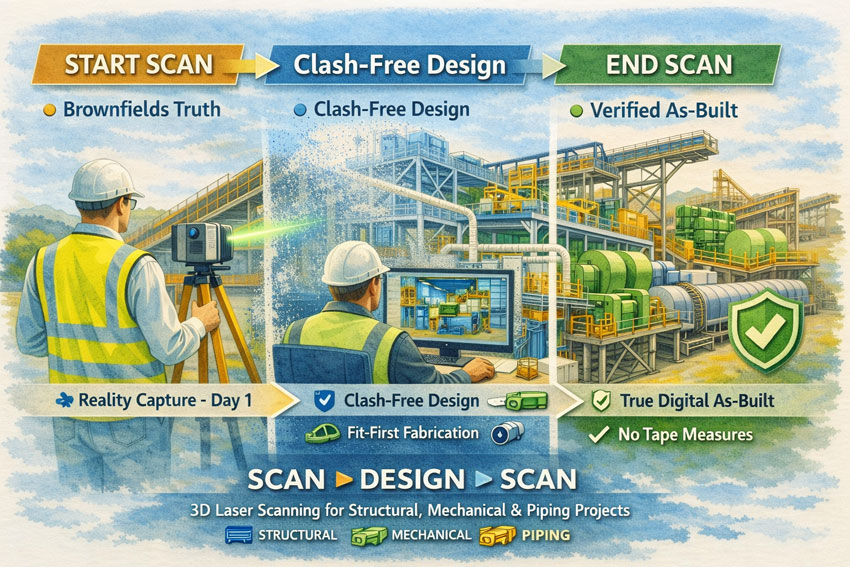
An initial 3D laser scan captures a high-resolution digital representation of the facility, recording structural elements, mechanical equipment, and piping systems exactly as they exist. This dataset becomes the authoritative reference for all subsequent engineering activities.
By beginning with a comprehensive reality capture, project teams can:
Define accurate tie-in locations for new works
Understand spatial constraints and access requirements
Identify potential clashes before detailed design
Reduce reliance on manual surveys and assumptions
Provide designers with objective, measurable data
This approach aligns engineering decisions with actual site conditions, supporting informed planning and reducing the likelihood of downstream rework.
Designing From Truth Rather Than Assumption
When the design phase is grounded in verified scan data, coordination across structural, mechanical, and piping disciplines becomes more effective. Engineers are able to develop models that reflect the real environment rather than an idealised interpretation of it.
The benefits to project success include:
Improved accuracy of fabrication documentation
Reduced design revisions and RFIs
Greater confidence in constructability
More reliable cost and schedule forecasting
Enhanced collaboration between designers, fabricators, and site teams
A scan-based workflow supports the objective of “fit-first” construction, where components are manufactured with confidence that they will integrate with existing assets.
Verifying Outcomes With a Final Scan
Project success is not only measured by installation, but by the quality of information handed to the asset owner. A second 3D scan at project completion provides a verified digital as-built of all SMP works.
This final dataset delivers:
An accurate record of installed structural, mechanical, and piping systems
Validation that construction matches design intent
A foundation for maintenance and asset management
Reliable data for future modifications or expansions
Elimination of manual tape-based as-built surveys
The organisation is left with a living digital asset rather than static drawings that quickly lose relevance.
Supporting Measurable Project Outcomes
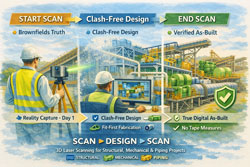
Adopting a Scan → Design → Scan methodology directly contributes to recognised measures of project success:
Safety: Reduced site rework and unplanned interventions
Cost Control: Fewer field modifications and claims
Schedule Reliability: Shorter shutdowns and predictable installation
Quality: Higher confidence in alignment and tolerances
Knowledge Retention: Creation of enduring digital records
These outcomes are particularly critical in SMP environments where interfaces between steel, equipment, and piping are complex and tolerances are unforgiving.
Applications Across Industrial Sectors
This workflow is suited to a wide range of SMP activities, including:
Conveyor and materials handling upgrades
Plant expansions and debottlenecking
Tank, hopper and bin modifications
Piping reroutes and tie-ins
Shutdown and turnaround works
Brownfields engineering studies
In each case, accurate spatial data enables better engineering judgement and more predictable project delivery.
A Framework for Sustainable Project Success
For organisations seeking consistent performance from SMP projects, the integration of 3D laser scanning is not a survey exercise—it is a strategic project control measure. By capturing reality at project commencement and verifying it at completion, stakeholders gain confidence that engineering decisions, construction outcomes, and asset records are aligned.
Start with verified data. Design with confidence. Finish with a true digital as-built.
Hamilton By Design Co. partners with project teams to implement this approach, supporting safer, more reliable, and more successful SMP outcomes.
Why Engineering Design Matters More Than Project Management
Lessons from Tailings Dam Failures in the Global Mining Industry
In engineering-led industries such as mining, construction, and heavy manufacturing, project management is often seen as the key to success — on time, on budget, and on scope.
However, history shows that when failures occur, they are rarely caused by poor project management alone.
Some of the most serious industrial failures in the world — including tailings dam collapses — demonstrate a critical truth:
Project management cannot compensate for poor or marginal engineering design.
At Hamilton By Design, we believe design sets the safety ceiling. Project management operates within it.
Project management is left managing risk it cannot remove
The system becomes fragile
Incidents become a matter of when, not if
Our Approach at Hamilton By Design
At Hamilton By Design, we work from the principle that:
Design must be defensible
Assumptions must be explicit
Failure modes must be understood
Engineering judgement must lead delivery
Whether we’re supporting:
Mining infrastructure
Tailings-adjacent plant systems
Bulk materials handling
Brownfield modifications
Shutdown-critical upgrades
We prioritise engineering-led design decisions that reduce reliance on operational heroics.
Final Thought
Project management is essential — but it should never be asked to solve problems that only engineering design can prevent.
The safest projects are not the best managed ones — they are the best designed ones.
Talk to an Engineer First
If your project involves:
High-risk infrastructure
Brownfield modifications
Water-sensitive systems
Shutdown-critical works
Get engineering involved early. Contact Hamilton By Design to discuss an engineering-led approach that reduces risk before construction begins or Be part of the discussion.
AS 3774 – Loads on Bulk Solids Containers | Safety & Compliance
AS 3774 Loads on Bulk Solids Containers exists for a simple reason: bulk solids do not behave like fluids, and incorrect load assumptions can create serious structural and safety risks.
For asset owners, engineers, and project teams involved in mining, mineral processing, manufacturing, and bulk materials handling, AS 3774 provides the framework for understanding how loads actually develop in silos, bins, hoppers, chutes, transfer stations, and surge bins.
Yet despite its long-standing availability, many new installations are still being delivered without full consideration of AS 3774 load cases.
The risks created by this gap are often not immediately visible — but they are very real.
What AS 3774 Is Designed to Address
AS 3774 recognises that bulk solids behave in complex and sometimes counter-intuitive ways. Unlike liquids, bulk materials:
Develop non-uniform wall pressures
Apply eccentric and asymmetric loads
Change load paths depending on flow behaviour
Generate dynamic and cyclic forces during filling and discharge
The standard provides guidance for determining realistic design loads based on how material actually flows and interacts with container geometry.
This applies across all bulk solids containers, including:
Silos
Bins and surge bins
Hoppers
Chutes and transfer stations
Rail and ship loading structures
Feeders integrated with bins
Why Safety and Compliance Depend on AS 3774
The purpose of AS 3774 is not academic. It exists to prevent outcomes such as:
Progressive wall deformation
Fatigue cracking and bolt failure
Local buckling or plate tearing
Uncontrolled discharge or blockage release
Unexpected load transfer into supporting structures
What makes these issues particularly dangerous is that they often develop over time, not at commissioning.
A structure can appear “fine” on day one — while accumulating damage due to:
Cyclic loading
Eccentric discharge patterns
Inaccurate assumptions about material properties
Mixed construction materials behaving differently over time
Common Design Assumptions That Create Hidden Risk
In practice, many bulk solids containers are still designed using simplified or incorrect assumptions, including:
1. Treating Bulk Solids Like Fluids
Uniform hydrostatic pressure assumptions do not reflect real wall loading patterns and can significantly under-predict peak stresses.
2. Ignoring Eccentric Discharge
Off-centre outlets, partial blockages, or asymmetric flow paths can introduce large bending and torsional effects that are not obvious from geometry alone.
3. Incorrect or Assumed Material Properties
Bulk density, cohesion, moisture content, and flow behaviour are often assumed rather than verified — yet small changes can have large load implications.
4. Mixed Materials Without Long-Term Consideration
It is not uncommon to see hoppers fabricated from a combination of stainless steel and mild steel, without adequate consideration of:
Differential stiffness
Fatigue behaviour
Corrosion mechanisms
Galvanic interaction
These issues may not present as immediate failures, but they can significantly reduce structural life and reliability.
Why the Risk Is Often Not Evident Today
One of the most concerning aspects of non-compliance with AS 3774 is that failure is rarely immediate.
Instead, risk accumulates quietly through:
Repeated filling and discharge cycles
Minor operational changes
Variations in material condition
Small geometric imperfections
By the time visible cracking, deformation, or operational issues appear, the structure may already be compromised.
The Role of Modern Engineering Tools (Briefly)
While AS 3774 is fundamentally about load determination, modern engineering tools can support compliance by helping teams:
Verify as-built geometry against design assumptions
Identify eccentric discharge paths and flow constraints
Review interfaces, wall angles, and structural continuity
Support independent engineering assessment without extended shutdowns
These tools do not replace the standard — but they can help reveal whether its principles have been properly applied.
What Asset Owners and Project Managers Should Ask For
To demonstrate that AS 3774 has been adequately considered, asset owners and project managers should expect to see clear answers to questions such as:
What load cases were considered under AS 3774?
How were discharge conditions defined and assessed?
What assumptions were made about material properties?
How were eccentric and asymmetric loads addressed?
Was fatigue or cyclic loading considered?
How were mixed materials and interfaces assessed?
Has an independent engineering review been undertaken?
If this information cannot be clearly provided, compliance is difficult to demonstrate, regardless of how new the installation is.
Why This Matters for New Installations
AS 3774 compliance is not about legacy assets or historical practices. It is about ensuring that new installations are fit for purpose, safe, and defensible.
Where bulk solids containers are being delivered today without adequate consideration of realistic load behaviour, the risk is being transferred downstream — to operators, maintainers, and asset owners.
Our clients
A Practical Closing Thought
If you are unsure whether AS 3774 has been properly applied to a bulk solids container, an independent engineering review can provide clarity.
The cost of verifying load assumptions and structural adequacy is typically minor compared to the consequences of discovering load-related issues after commissioning.
Hamilton By Design supports asset owners and project teams with engineering review, verification, and redesign of bulk solids containers, helping ensure that safety and compliance are addressed before problems develop.
From Reality to Fabrication: Engineering-Led 3D Modelling, Structural Verification and Build-Ready Documentation
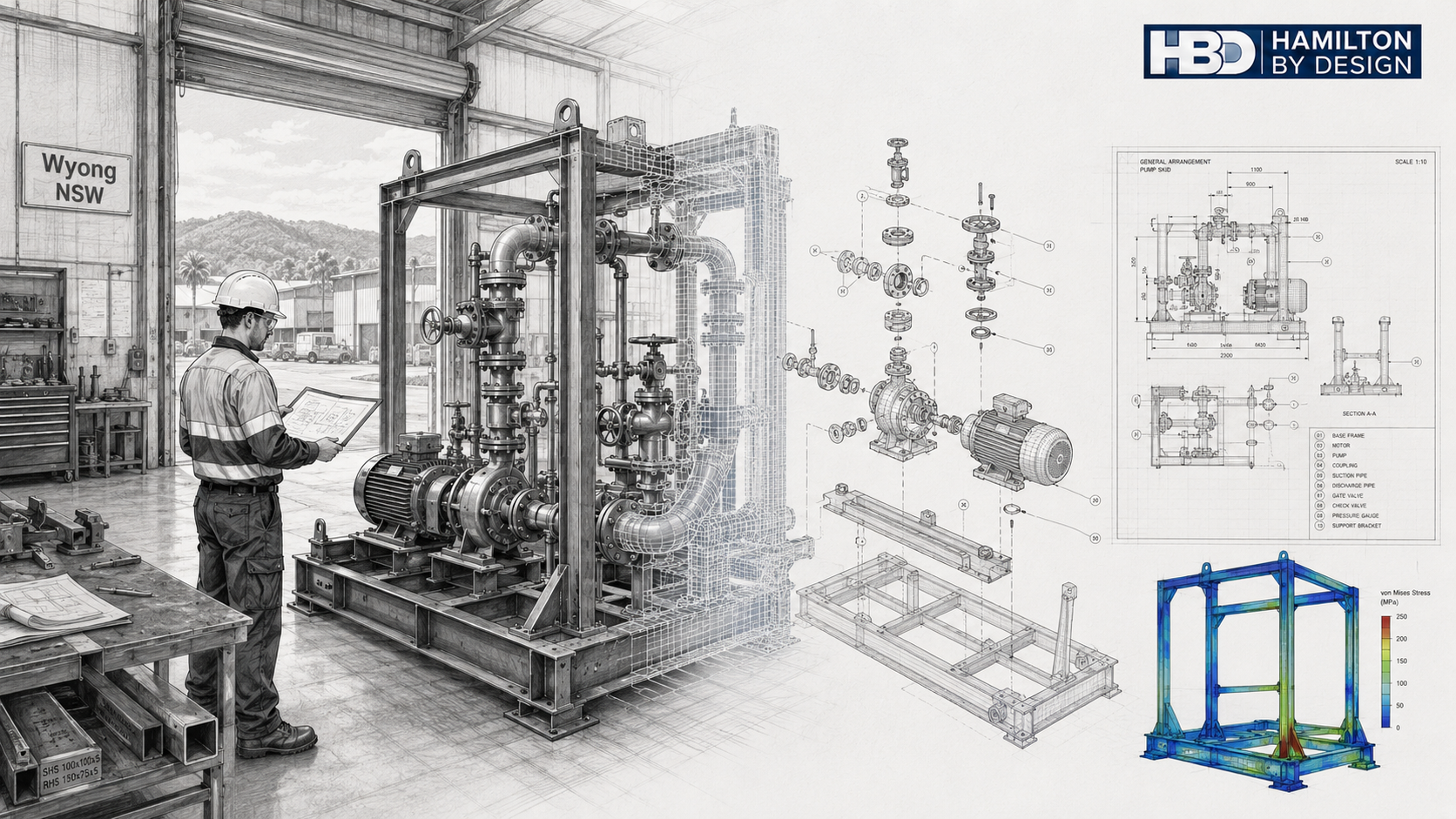
In industrial and infrastructure projects, success is rarely determined by intent alone. It is determined by how accurately existing conditions are understood, how rigorously designs are validated, and how clearly fabrication information is communicated. At Hamilton By Design, we bridge the gap between site reality and fabrication by combining engineering-led 3D modelling, structural engineering, finite element analysis (FEA), and fabrication-ready documentation into a single, accountable workflow.
This integrated approach ensures that what is designed can be built, fits the first time, and performs as intended in service.
3D Modelling for Fabrication: Designing What Can Actually Be Built
3D modelling for fabrication is not simply about producing visually accurate geometry. It is about creating models that reflect real-world constraints, manufacturing tolerances, installation access, and structural behaviour. Hamilton By Design develops fabrication-grade 3D CAD models that are built around how components will be cut, welded, machined, lifted, and installed.
Our models are typically informed by site measurements, laser scanning, and as-built data to ensure alignment with existing structures and equipment. This is particularly critical in brownfield environments such as processing plants, material handling facilities, and industrial upgrades where assumptions based on legacy drawings are unreliable.
Each model is developed with downstream use in mind. Hole sizes, weld preparations, plate thicknesses, member sizes, and connection details are defined so fabricators can confidently transition from model to manufacture without reinterpretation or rework.
Structural Engineering Embedded in the Modelling Process
Structural engineering at Hamilton By Design is not a separate, downstream exercise. It is embedded directly within the 3D modelling process. Structural load paths, support conditions, connection behaviour, and serviceability requirements are considered as the model evolves, not after geometry is frozen.
This integrated method allows structural considerations to inform design decisions early, reducing late-stage redesigns and cost escalation. It also ensures compliance with relevant Australian Standards and industry-specific requirements, whether the project involves steel structures, plant support frames, access platforms, equipment foundations, or retrofit works.
By developing the structural model in parallel with the fabrication model, we maintain alignment between engineering intent and physical deliverables.
Finite Element Analysis: Verifying Performance, Not Guessing
Finite Element Analysis (FEA) plays a critical role in validating that a design will perform safely and efficiently under real operating conditions. Hamilton By Design applies FEA to assess stresses, deflections, load sharing, vibration response, and fatigue risk across a wide range of industrial applications.
FEA is particularly valuable where traditional hand calculations are insufficient or overly conservative. Complex geometries, dynamic loading, eccentric supports, impact forces, and non-uniform load distributions can all be assessed with greater confidence using simulation-based analysis.
Our FEA workflows are directly linked to the 3D CAD models used for fabrication. This ensures consistency between the analysed geometry and the manufactured outcome. Where analysis identifies areas of concern, design modifications are implemented directly in the model, creating a closed-loop engineering process that improves both safety and constructability.
As-Built Documentation: Capturing What Exists, Not What Was Assumed
Accurate as-built documentation is fundamental to effective engineering decision-making. In many facilities, original drawings are outdated, incomplete, or no longer representative of the installed condition. Hamilton By Design produces engineering-grade as-built documentation that reflects the true geometry and configuration of existing assets.
As-built documentation may include 3D models, general arrangement drawings, sectional views, and measured dimensions that form a reliable baseline for future upgrades, maintenance planning, and compliance assessments. This information reduces uncertainty, supports safer design decisions, and enables more efficient project planning.
For clients managing long-life assets, high-quality as-built data becomes a strategic resource rather than a one-off deliverable.
Fabrication Drawings That Reduce Risk on the Workshop Floor
Fabrication drawings are the point where engineering intent meets manufacturing reality. Poorly defined drawings lead to RFIs, delays, rework, and disputes. Hamilton By Design produces clear, unambiguous fabrication drawings that fabricators can trust.
Our drawings typically include detailed part drawings, assembly drawings, weld symbols, material specifications, tolerances, and notes aligned with the approved engineering model. Because these drawings are derived directly from fabrication-ready 3D models that have been structurally verified, inconsistencies between design and manufacture are minimised.
This approach supports faster fabrication turnaround, improved quality control, and smoother installation on site.
A Single, Accountable Engineering Workflow
One of the key advantages of Hamilton By Design’s approach is single-source accountability. By delivering 3D modelling for fabrication, structural engineering, FEA, as-built documentation, and fabrication drawings within a unified workflow, we remove the handover gaps that often exist between consultants, designers, and fabricators.
Clients benefit from clearer communication, reduced coordination risk, and designs that are technically sound, buildable, and aligned with operational requirements. Fabricators benefit from models and drawings that reflect real conditions and engineering intent. Asset owners benefit from safer, more reliable outcomes delivered with fewer surprises.
Engineering That Stands Up in the Real World
At Hamilton By Design, engineering is not about producing documents in isolation. It is about delivering outcomes that work in the real world—on site, in fabrication workshops, and over the life of an asset. By integrating 3D modelling for fabrication with structural engineering, finite element analysis, as-built documentation, and fabrication drawings, we provide a robust foundation for successful industrial projects.
This engineer-led, fabrication-focused approach ensures that designs are not only accurate on screen, but reliable, buildable, and fit for purpose in operation.
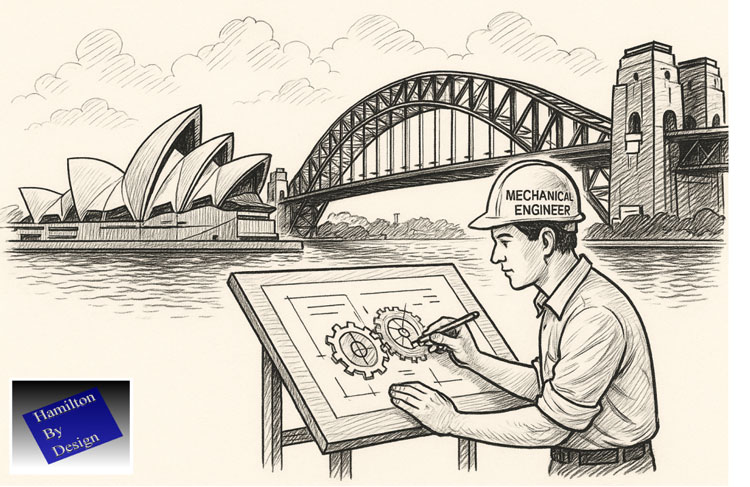
At Hamilton By Design, we are a team of degree-qualified mechanical engineers in Wyong, providing expert design, analysis, and build services for mechanical systems across the Central Coast and Hunter regions. We specialise in engineering design, mechanical systems integration, and prototype development — not car repair or automotive servicing.
Our goal is simple: to design and deliver engineered systems that perform efficiently, safely, and reliably under real operating conditions.
Your Local Mechanical Engineering Specialists
Being locally based in Wyong allows us to deliver responsive, practical engineering solutions that suit regional industries. We understand the Central Coast’s industrial landscape — from manufacturing to infrastructure — and provide mechanical engineering support tailored to each client’s specific operational and compliance needs.
Our services include:
Mechanical design and system modelling
3D CAD drafting, assemblies, and technical documentation
Finite Element Analysis (FEA) and performance simulation
Prototype design, testing, and system optimisation
Fabrication support and workshop documentation
Process improvement and energy efficiency solutions
Structural-mechanical integration for equipment and machinery
Whether it’s a custom mechanical assembly, plant upgrade, or new industrial installation, our engineers combine practical trade awareness with solid analytical expertise to ensure every solution works in the real world.
Why Businesses in Wyong Choose Us
Choosing a local mechanical engineering company in Wyong means partnering with professionals who know local suppliers, fabrication standards, and site conditions. We bring the precision of professional engineering to projects of all sizes while remaining approachable and cost-effective.
Our approach ensures each design is:
Safe: Compliant with Australian Standards and industry codes
Efficient: Engineered for performance and energy conservation
Maintainable: Designed with accessibility and lifecycle costs in mind
Economical: Delivering long-term value for the client
From the first sketch to the final bolt, our work reflects engineering discipline, accuracy, and accountability.
Our Engineering Process
Every project follows a structured, documented workflow that ensures consistency and quality:
Concept and Feasibility – We define project scope, functional requirements, and design objectives through collaboration with clients and stakeholders.
Design and Simulation – Using modern CAD platforms and FEA tools, we model real-world forces, stresses, and flows to optimise performance and safety.
Verification and Prototyping – Our team validates designs with prototypes, testing, or detailed fabrication drawings.
Implementation Support – We assist with workshop drawings, fabrication coordination, and commissioning.
Lifecycle and Maintenance Review – Our post-installation support ensures long-term reliability and efficiency.
This process ensures traceability, compliance, and confidence at every stage of delivery.
Snapshot: Local Industries and Organisations We Support
Our experience extends across a wide range of local companies, manufacturers, and government organisations throughout Wyong and the Central Coast.
Here are some examples of the types of organisations we work with and the engineering value we bring:
Industrial and Manufacturing Clients
Donaldson Australasia (North Wyong) – A leading industrial filtration manufacturer. Our expertise supports the design and integration of mechanical handling, test rigs, and equipment frames for production systems.
Plateau Food Distributors (Wyong) – Food processing and cold storage facilities often rely on mechanical systems for refrigeration, materials handling, and ventilation. We assist with system design, structural support frames, and energy optimisation.
Fabrication and Alloy Manufacturers such as Manufactured Alloy Xtras – We provide structural design, stress analysis, and welding procedure documentation for aluminium and steel assemblies.
General Manufacturers and Industrial Workshops in the Wyong–Tuggerah area – We support local businesses with prototype development, mechanical jigs, and tooling systems designed to Australian Standards.
Government and Public Infrastructure
Central Coast Council (formerly Wyong Shire Council) – Responsible for infrastructure, public buildings, and community assets. Our services include mechanical design for pumping stations, HVAC systems, and public facility upgrades.
NSW Infrastructure Projects (e.g. Pacific Highway Upgrade) – Large-scale transport and civil projects often require custom mechanical and structural integration. We assist contractors and consultants with system modelling and compliance documentation.
TAFE NSW – Wyong Campus – Facilities such as laboratories, animal care centres, and trade workshops require mechanical system design for ventilation, process equipment, and utilities.
Water and Wastewater Services – We provide engineering input on pumping systems, pipework layouts, and mechanical components for water infrastructure projects.
These partnerships reflect our capability to operate across both private and public sectors, supporting projects that range from individual components to fully integrated mechanical systems.
Our Capabilities and Technologies
Our engineers use industry-leading tools and software to ensure precision and compliance:
3D CAD Modelling (SolidWorks, Autodesk Inventor, Fusion 360)
Finite Element Analysis (FEA) for stress and load validation
Computational Fluid Dynamics (CFD) for flow and heat transfer
P&ID and Mechanical Schematics for complex systems
Project Documentation including Bill of Materials (BOMs) and fabrication drawings
By combining digital design with engineering expertise, we can quickly move from concept to prototype, minimising rework and ensuring the design meets its operational goals.
Commitment to Engineering Excellence
Every project we deliver reflects our core principles:
Technical Integrity – Our engineers work to the highest professional standards.
Innovation – We continuously refine designs using simulation, prototyping, and feedback.
Safety and Compliance – We align with AS/NZS codes and WHS regulations in every design.
Sustainability – We promote energy-efficient design and reduced material waste through smart engineering.
Our clients appreciate that we think like engineers and communicate like partners. We bring clarity, technical rigour, and creativity to every project.
Contact Your Local Mechanical Engineers in Wyong
If you’re searching for mechanical engineers in Wyong who can design, analyse, and build high-performance mechanical systems, Hamilton By Design is your trusted local partner.
We are not automotive mechanics — we are qualified mechanical engineers who design and deliver engineered solutions that move industries forward.
To provide the best experiences, we use technologies like cookies to store and/or access device information. Consenting to these technologies will allow us to process data such as browsing behaviour or unique IDs on this site. Not consenting or withdrawing consent, may adversely affect certain features and functions.
Functional
Always active
The technical storage or access is strictly necessary for the legitimate purpose of enabling the use of a specific service explicitly requested by the subscriber or user, or for the sole purpose of carrying out the transmission of a communication over an electronic communications network.
Preferences
The technical storage or access is necessary for the legitimate purpose of storing preferences that are not requested by the subscriber or user.
Statistics
The technical storage or access that is used exclusively for statistical purposes.The technical storage or access that is used exclusively for anonymous statistical purposes. Without a subpoena, voluntary compliance on the part of your Internet Service Provider, or additional records from a third party, information stored or retrieved for this purpose alone cannot usually be used to identify you.
Marketing
The technical storage or access is required to create user profiles to send advertising, or to track the user on a website or across several websites for similar marketing purposes.