Integrating 3D Scanning and Mechanical Design for Safer, Faster Upgrades in Coal Wash Plants

Precision Without the Guesswork

Upgrading or maintaining a coal wash plant has always been a challenge โ€” tight shutdown windows, complex layouts, and the need for perfect fit-ups between new and existing components. Traditional measurement methods, like tape measures and manual sketches, are often impossible in restricted or hazardous areas.

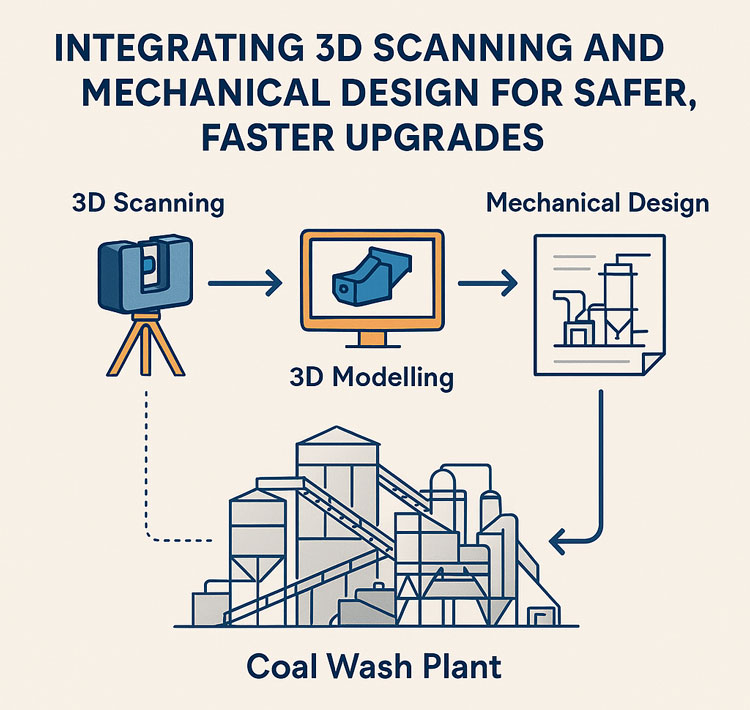
Thatโ€™s where 3D scanning and mechanical engineering come together. At Hamilton By Design, we combine precision laser scanning, intelligent 3D modelling, and practical mechanical design to deliver risk-free upgrades โ€” ensuring every component fits right the first time.

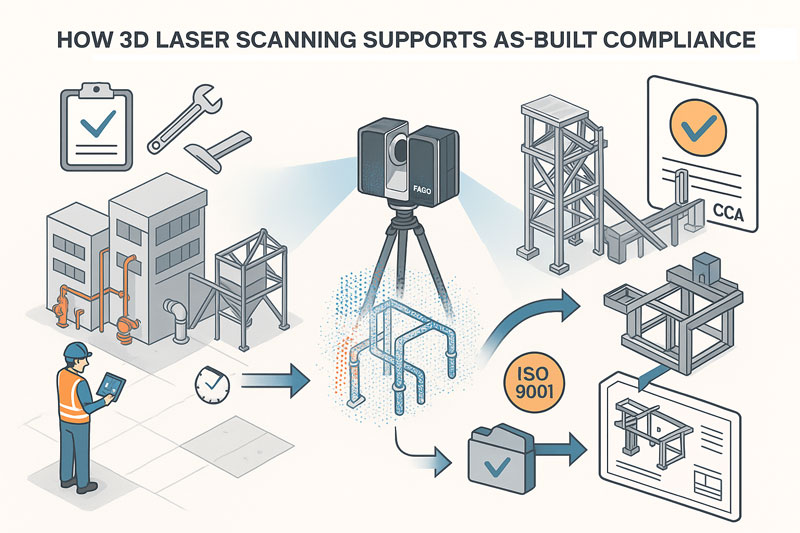
Infographic showing how 3D scanning and 3D modelling feed into mechanical design for safer, faster upgrades at a coal wash plant, with icons representing scanning, modelling, and engineering drawings

When Accuracy Matters Most

Coal wash plants are intricate systems. From cyclones, screens, and diverter chutes to pumps, piping, and structures, every part interacts under tight tolerances. A small misalignment can lead to vibration, spillage, or shutdown delays.

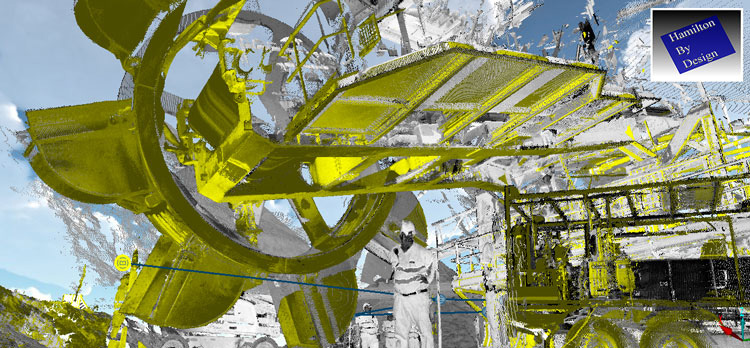
Our 3D scanning process captures millions of spatial data points, creating a detailed digital twin of the existing plant. This allows us to model upgrades, design replacement components, and simulate fit-up โ€” all before fabrication begins.

In many cases, scanning replaces the need to physically measure equipment. For example, in confined or high-risk spaces where a tape measure simply canโ€™t reach, scanning provides complete, line-of-sight geometry with millimetre accuracy.

Recently, our team scanned a diverter chute that had been incorrectly installed. The resulting model revealed that the chute had been fitted in the wrong orientation โ€” explaining why it wasnโ€™t sealing properly. This insight helped our client avoid further downtime and costly rework.


Combining Engineering Experience with Digital Precision

Hamilton By Design provides a full suite of mechanical engineering services tailored to the mining industry, including:

  • 3D Scanning & Point Cloud Capture โ€“ detailed mapping of existing equipment and structures
  • 3D Modelling & Reverse Engineering โ€“ accurate, editable digital models
  • Mechanical Design & Structural Replacement โ€“ like-for-like component upgrades
  • Piping Routes & Spool Fabrication โ€“ optimised pipe design and layout
  • Fabrication & Component Drawings โ€“ compliant with Australian Standards and client templates

Our engineers work across SolidWorks, AutoCAD Plant 3D, Revit, and 3D Experience platforms โ€” integrating point cloud data directly into the design workflow. This means fewer site visits, fewer surprises, and significantly less rework once fabrication begins.


From Drawings to Digital Models

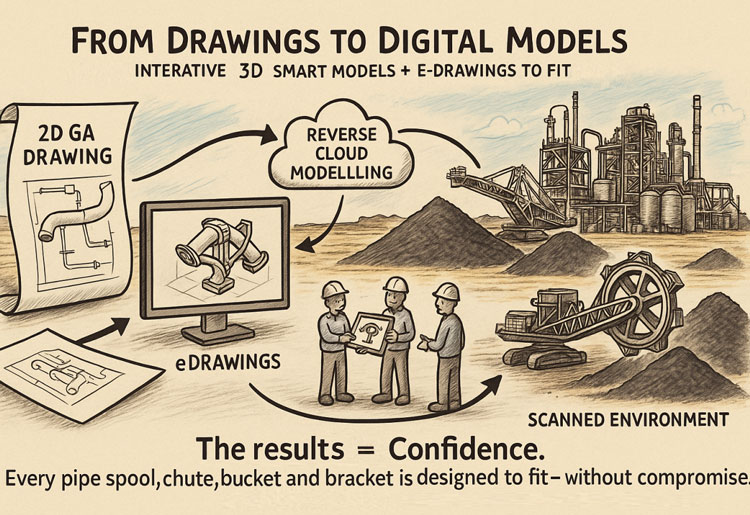
Weโ€™ve evolved beyond traditional 2D general arrangement drawings. Instead, we provide interactive 3D models and e-drawings that allow clients, fabricators, and site teams to visualise how upgrades will fit within the plant.

Our reverse cloud modelling process inserts 3D designs directly into the scanned environment. This enables engineers and site teams to measure potential interferences, check clearances, and validate installation methods โ€” long before shutdowns begin.

Illustrated workflow showing how 2D GA drawings and scanned environments are turned into 3D digital models through reverse cloud modelling and eDrawings, demonstrating confidence in fabrication fit for mining and industrial equipment.

The result = Confidence.
Every pipe spool, chute, and bracket is designed to fit โ€” without compromise.


Supporting Contractors and Plant Operators

We partner with:

  • Mining companies operating coal wash plants
  • Fabricators and contractors supplying mining equipment
  • Maintenance providers planning plant shutdowns

Their biggest challenge is finding people who design for fit and function โ€” not just form. Not all CAD or point cloud software is equal, and not every designer understands the realities of on-site installation. Thatโ€™s where Hamilton By Design stands apart.

We bring hands-on mechanical trade experience, engineering design expertise, and digital technology together โ€” helping your team deliver upgrades that work, first time.


Built to Australian Standards

All design and drawing deliverables are completed in accordance with Australian Standards, ensuring compliance, safety, and interoperability with existing documentation.

We can also supply fabrication drawings on client-specific templates, maintaining intellectual property (IP) requirements and formatting standards.


Servicing Australiaโ€™s Key Mining Regions

Hamilton By Design proudly supports coal wash plant upgrades and mechanical design projects across Australiaโ€™s leading coal regions, including:

  • Bowen Basin
  • Surat Basin
  • Hunter Valley
  • Newcastle
  • Central Coast
  • Western and Central NSW coalfields

Our local experience ensures that we understand the logistical, operational, and environmental challenges unique to each region โ€” helping projects stay compliant, efficient, and on schedule.


Why Choose Hamilton By Design?

  • Reduced Downtime: Accurate pre-shutdown planning through digital models.
  • Improved Safety: Less manual measuring in hazardous or confined areas.
  • Guaranteed Fit-Up: Fabrication drawings verified against real-world geometry.
  • Faster Turnaround: Streamlined scanning-to-design-to-fabrication workflow.
  • Proven Experience: Over two decades in mechanical engineering and plant design.

Our mission is simple โ€” to take the risk out of upgrades by combining engineering insight with digital accuracy.


Quote

โ€œPrecision scanning and mechanical design โ€” taking the risk out of plant upgrades.โ€


Letโ€™s Make Your Next Upgrade Risk-Free

If your next shutdown involves mechanical upgrades, pipework replacement, or structural modifications, talk to Hamilton By Design.

We can help you visualise, plan, and execute upgrades with confidence โ€” reducing downtime, eliminating measurement errors, and delivering safer outcomes for your team.

info@hamiltonbydesign.com.au
www.hamiltonbydesign.com.au

Mechanical Drafting | Structural Drafting

3D CAD Modelling | 3D Scanning

Chute Design

Our clients:

Name
Would you like us to arrange a phone consultation for you?
Address

Building with Precision: 3D Scanning and LiDAR Modelling for Sydney Construction Projects

Accuracy That Builds Sydney Better

From the growing commercial hubs of Parramatta and Chatswood to the complex redevelopments across Sydneyโ€™s Eastern Suburbs, the construction industry is demanding more accuracy, faster turnaround, and fewer on-site surprises.

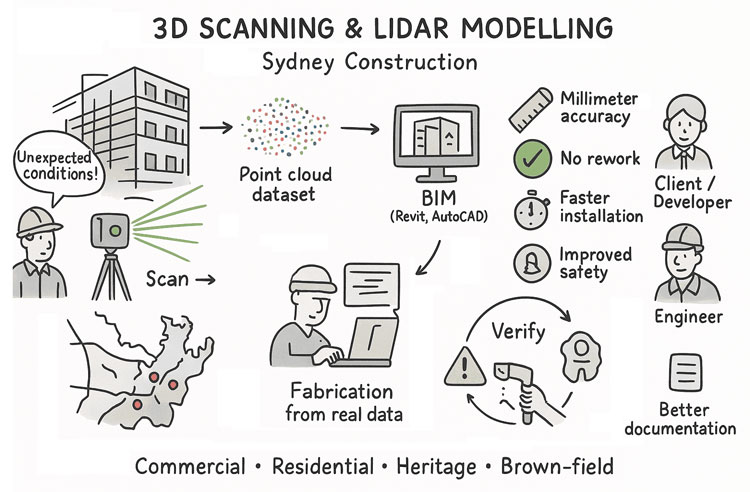
At Hamilton By Design, we use 3D scanning and LiDAR technology to help builders, engineers, and developers capture, model, and verify real site conditions with millimetre accuracy.

Illustrated infographic showing 3D scanning and LiDAR modelling for Sydney construction, from site scanning and point-cloud creation to BIM modelling and fabrication, highlighting millimeter accuracy, no rework, faster installation, improved safety, and better documentation

Our advanced 3D models ensure every structural, mechanical, or architectural component fits perfectly on site โ€” helping Sydneyโ€™s construction professionals deliver projects right the first time.


High-Precision Site Capture with LiDAR Scanning

Using advanced LiDAR (Light Detection and Ranging) technology, our scanners record millions of laser points per second to create a complete 3D โ€œpoint cloudโ€ of your site or structure.

Whether weโ€™re scanning a commercial building in Chatswood, a multi-level development in Parramatta, or a heritage renovation in Sydneyโ€™s Eastern Suburbs, LiDAR scanning allows us to document every detail โ€” without disruption to your workflow.

The result is a digital twin of your project site that forms the foundation for precise design, fabrication, and installation.


From Point Cloud to Construction-Ready Model

Once scanning is complete, our engineers convert the LiDAR data into accurate 3D CAD and BIM models that integrate seamlessly into platforms such as Revit, AutoCAD, Navisworks, and SolidWorks.

This digital workflow allows your team to:

  • Validate as-built conditions before design or fabrication
  • Identify clashes and alignment issues early
  • Plan site installations with confidence
  • Reduce rework and delays during construction

By designing and fabricating to real-world data, Sydney contractors can save valuable time and eliminate unnecessary on-site adjustments.


Why Sydney Contractors Choose 3D Scanning and LiDAR

  • Millimetre Accuracy: Perfect alignment between fabricated and existing structures.
  • Reduced Rework: Detect and fix issues before they reach site.
  • Improved Safety: Non-invasive scanning of hard-to-reach areas.
  • Faster Installation: Minimise downtime and site delays.
  • Better Documentation: Maintain accurate records for QA and future maintenance.

Across Chatswood, Parramatta, and Sydneyโ€™s Eastern Suburbs, our clients use LiDAR scanning to bring greater certainty to every phase of construction.


Supporting Projects Across Sydney

Hamilton By Design supports a wide range of construction and engineering projects across metropolitan Sydney, including:

  • Commercial and retail developments in Chatswood and Parramatta
  • Luxury residential projects and architectural fit-outs in Sydneyโ€™s Eastern Suburbs
  • Industrial and infrastructure upgrades throughout Greater Sydney
  • Brownfield and refurbishment projects requiring accurate as-built data

Whether itโ€™s a new build or a complex retrofit, we make sure every part of your design fits the first time.


Partner with Hamilton By Design

If youโ€™re managing or planning a construction project in Chatswood, Parramatta, or Sydneyโ€™s Eastern Suburbs, Hamilton By Design offers the experience and technology to capture, model, and verify your site with precision.

Our 3D scanning and LiDAR services help Sydney builders, designers, and fabricators deliver more accurate results โ€” reducing risk, rework, and cost.

Mechanical Engineers in Sydney

Mechanical Engineering | Structural Engineering

Hamilton By Design logo displayed on a blue tilted rectangle with a grey gradient background

3D Scanning Sydney

Engineering Services

get in touch

sales@hamiltonbydesign.com.au

Based in Sydney โ€” servicing Chatswood, Parramatta, and the Eastern Suburbs
info@hamiltonbydesign.com.au
www.hamiltonbydesign.com.au

Capture. Model. Verify. Deliver.
Hamilton By Design โ€” ensuring every project across Sydney fits perfectly, down to the last millimetre.

Our clients:

Name
Would you like us to arrange a phone consultation for you?
Address

Building Sydney Smarter: How 3D Scanning and LiDAR Are Transforming Construction Accuracy

A New Era of Construction Accuracy in Sydney

Sydneyโ€™s construction industry is booming โ€” from commercial towers and infrastructure upgrades to industrial developments and complex refurbishments. But as sites become more congested and designs more complex, achieving perfect alignment between fabricated and installed components has never been more challenging.

Thatโ€™s where 3D scanning and LiDAR technology come in. At Hamilton By Design, we provide high-precision digital capture and 3D modelling services that ensure every element of your construction project fits seamlessly together, saving time, cost, and effort onsite.


Capturing the Real Site with LiDAR Scanning

Using LiDAR (Light Detection and Ranging) scanners, we capture millions of laser measurements per second to create an exact 3D digital record โ€” known as a point cloud โ€” of your construction site or structure.

This means we can document existing conditions, monitor progress, and verify installations with millimetre-level precision. For Sydney builders, engineers, and contractors, that data eliminates the guesswork and drastically reduces costly clashes and rework later on.


From Point Cloud to 3D Model

Once the LiDAR data is captured, itโ€™s processed into detailed 3D CAD and BIM models compatible with leading design software such as Revit, AutoCAD, SolidWorks, and Navisworks.

These accurate models allow design teams to:

  • Validate and update as-built conditions before fabrication
  • Detect clashes and misalignments before installation
  • Plan modifications and extensions with confidence
  • Coordinate between mechanical, structural, and architectural disciplines

By working from a true digital twin of your Sydney site, you can be sure every part โ€” from prefabricated frames to pipe runs โ€” will fit exactly where it should.


Why Sydney Construction Projects Are Turning to 3D Scanning

  • Reduced Rework: Identify design and fabrication issues before they reach site.
  • Improved Safety: Capture high or restricted areas without scaffolding or shutdowns.
  • Shorter Installation Times: Minimise downtime and delays during fit-up.
  • Precise Documentation: Maintain accurate records for QA and handover.
  • Better Collaboration: Integrate real-world data into your BIM environment.

From commercial fit-outs to infrastructure projects across Greater Sydney, 3D scanning provides a single source of truth for every stakeholder.


Typical Sydney Projects Using LiDAR and 3D Modelling

Hamilton By Design supports a range of construction and engineering clients, including:

  • Commercial and residential developments in the CBD and inner suburbs
  • Industrial plant upgrades across Western Sydney
  • Transport and infrastructure projects under NSW Government programs
  • Refurbishment and brownfield works requiring detailed as-built verification

Each project benefits from faster delivery, greater precision, and stronger communication between designers, builders, and clients.


Partner with Hamilton By Design

If youโ€™re working on a Sydney construction or infrastructure project and need accurate 3D site data, as-built modelling, or fit-up verification, Hamilton By Design can help.

Our experienced mechanical and design specialists combine field scanning with advanced 3D modelling to deliver practical, reliable results that make construction smoother โ€” and smarter.

Mechanical Engineers in Sydney

Mechanical Engineering | Structural Engineering

Hamilton By Design logo displayed on a blue tilted rectangle with a grey gradient background

3D Scanning Sydney

Engineering Services

get in touch

sales@hamiltonbydesign.com.au

Based in Sydney โ€” working across NSW and Australia
info@hamiltonbydesign.com.au
www.hamiltonbydesign.com.au

Capture. Model. Verify. Deliver โ€” precision that builds Sydney better.

Our Clients:

Name
Would you like us to arrange a phone consultation for you?
Address

Bridging Reality and Design: How 3D Scanning + 3D Modelling Supercharge Mining Process Plants

In mining and mineral processing environments, small mis-fits, outdated drawings, or inaccurate assumptions can translate into shutdowns, costly rework, or worse, safety incidents. For PMs, superintendents, engineering managers and plants operating under heavy uptime and safety constraints, combining 3D scanning and 3D modelling isnโ€™t just โ€œnice to haveโ€ โ€” itโ€™s becoming essential. At Hamilton By Design, weโ€™ve leveraged this combination to deliver greater predictability, lower cost, and improved safety across multiple projects.


What are 3D Scanning and 3D Modelling?

  • 3D Scanning (via LiDAR, laser, terrestrial/mobile scanners): captures the existing geometry of structures, equipment, piping, chutes, supports, tanks, etc., as a dense point cloud. Creates a digital โ€œreality captureโ€ of the plant in its current (often messy) state.
  • 3D Modelling: turning that data (point clouds, mesh) into clean, usable engineering-geometry โ€” CAD models, as-built / retrofit layouts, clash-detection, wear mapping, digital twins, etc.

The power comes when you integrate the two โ€” when the reality captured in scan form feeds directly into your modelling/design workflows rather than being a separate survey activity thatโ€™s then โ€œinterpretedโ€ or โ€œassumed.โ€


Why Combine Scanning + Modelling? Key Benefits

Here are the main advantages you get when you deploy both in an integrated workflow:

BenefitWhat it Means for PMs / Engineering / Plant OpsExamples / Impacts
Accuracy & Reality VerificationVerify whatโ€™s actually in the plant vs what drawings say. Identify deformations, misalignments, wear, obstructions, or changes that werenโ€™t captured in paper drawings.Mill liner wear profiles; chute/hopper buildup; misaligned conveyors or supports discovered post-scan.
Reduced Risk, Safer AccessScanning can be done with limited or no shutdown, and from safer vantage points. Less need for personnel to enter hazardous or confined spaces.Scanning inside crushers, under conveyors, or at height without scaffolding.
Time & Cost SavingsFaster surveying; fewer repeat field trips; less rework; fewer surprises during shutdowns or retrofit work.Scan once, model many; clashes found in model instead of in the field; pre-fabrication of replacement parts.
Better Shutdown / Retrofit PlanningUse accurate as-built models so new equipment fits, interferences are caught, installation time is optimized.New pipelines routed without conflict; steelwork/supports prefabricated; shutdown windows shortened.
Maintenance & Asset Lifecycle ManagementScan history becomes a baseline for monitoring wear or deformation. Enables predictive maintenance rather than reactive.Comparing scans over time to track wear; scheduling relining of chutes; monitoring structural integrity.
Improved Decision Making & VisualisationEngineers, superintendents, planners can visualise the plant as it is โ€” space constraints, access routes, clearances โ€” before making decisions.Clash-detection between new and existing frames; planning maintenance access; safety audits.
Digital Twin / Integration for Future-Ready PlantOnce you have accurate geometric models you can integrate with IoT, process data, simulation tools, condition monitoring etc.Digital twins that simulate flow, energy use, wear; using scan data to feed CFD or FEA; feeding into operational dashboards.

Challenges & How to Overcome Them

Of course, there are pitfalls. Ensuring scanning + modelling delivers value requires attention to:

  • Planning the scanning campaign (scan positions, control points, resolution) to avoid shadow zones or missing data.
  • Choosing hardware and equipment that can operate under plant conditions (dust, vibration, temperature, restricted access).
  • Processing & registration of point clouds, managing the large data sets, and ensuring clean, usable models.
  • Ensuring modelling workflow aligns with engineering design tools (CAD systems, formats, tolerances) so that the scan data is usable without excessive cleanup.
  • Maintaining the model: when plant layouts or equipment change, keeping the scan or model up to date so your decisions are based on recent reality.

At Hamilton By Design we emphasise these aspects; our scan-to-CAD workflows are built to align with plant engineering needs, and we help clients plan and manage the full lifecycle.


Real World Applications in Mining & Process Plants

Hereโ€™s how combined scanning + modelling is applied (and what you might look for in your own facility):

  • Wear & Relining: scanning mill, crusher liners, chutes or hoppers to model wear profiles; predict failures; design replacement parts that fit exactly.
  • Retrofits & Expansions: mapping existing steel, pipe racks, conveyors, etc., creating accurate โ€œas builtโ€ model, checking for clashes, optimizing layouts, prefabricating supports.
  • Stockpile / Volumetric Monitoring: using scans or LiDAR to measure stockpile volumes for planning and reporting; integrating with models to monitor material movement and flow.
  • Safety & Clearance Checking: verifying that walkways, egress paths, platforms have maintained their clearances; assess structural changes; check for deformation or damage.
  • Shutdown Planning: using accurate 3D models to plan the scope, access, scaffold/frame erection, pipe removal etc., so shutdown time is minimised.

Why Choose Hamilton By Design

To get full value from the scan + model combination, you need more than just โ€œweโ€™ll scan itโ€ or โ€œweโ€™ll make a modelโ€ โ€” you need a partner who understands both the field realities and the engineering rigour. Here’s where Hamilton By Design excels:

  • Strong engineering experience in mining & processing plant settings, so we know what level of detail, what tolerances, and what access constraints matter.
  • Proven tools & workflows: from LiDAR / laser scanner work that captures site conditions even under harsh conditions, to solid CAD modelling/reporting that aligns with your fabrication/installation requirements.
  • Scan-to-CAD workflows: not just raw point clouds, but models that feed directly into design, maintenance, procurement and operations.
  • Focus on accuracy, safety, and reduced downtime: ensuring that field work, design, installation etc., are as efficient and risk-averse as possible.
  • Use of modern digital techniques (digital twins, clash detection etc.) so that data isnโ€™t just stored, but actively used to drive improvements.

Practical Steps to Get Started / Best Practice Tips

If youโ€™re managing a plant or engineering project, here are some steps to adopt scanning + modelling optimally:

  1. Define Clear Objectives: What do you want from this scan + model? Wear profiles, retrofit, layout changes, safety audit etc.
  2. Survey Planning: Decide scan positions, control points, resolution (density) based on the objectives and site constraints. Consider access, safety, shutdown windows.
  3. Use Appropriate Hardware: Choose scanners suited to environment (dust, heat), also ensure regulatory and IP protection etc.
  4. Data Processing & Modelling Tools: Have the capacity/software to register, clean, mesh or extract CAD geometry.
  5. Integrate into Existing Engineering Processes: Ensure the outputs are compatible with your CAD standards, procurement, installation etc.
  6. Iterate & Maintain: Frequent scans over time to track changes; update models when plant changes; feed maintenance, design and operations with new data.

Conclusion

In mining process plants, time, safety, and certainty matter. By combining 3D scanning with sound 3D modelling you donโ€™t just get a snapshot of your plant โ€” you gain a powerful toolset to reduce downtime, avoid rework, improve safety, and enhance decision-making.

If youโ€™re responsible for uptime, capital works, maintenance or process improvements, this integration can reshape how you plan, maintain, and operate. At Hamilton By Design, weโ€™re helping clients in Australia harness this power โ€” turning reality into design confidence, and giving stakeholders peace of mind that the layout, equipment, and safety are aligned not to yesterdayโ€™s drawings but to todayโ€™s reality.

Name
Would you like us to arrange a phone consultation for you?
Address

From 3D Scanning to Digital Twins: The Next Step in Mining Data

Mining is evolving faster than ever.
What was once an industry defined by physical muscle โ€” haul trucks, crushers, conveyors โ€” is now being transformed by data intelligence, digital modelling, and real-time insight.

At the heart of this transformation lies a quiet revolution: 3D scanning.
Once used primarily for design verification or plant modification, scanning is now the gateway technology that feeds the emerging world of digital twins โ€” live, data-driven replicas of mine assets that help engineers predict, plan, and optimise before problems occur.

At Hamilton By Design, weโ€™ve spent years scanning and modelling chutes, hoppers, and material-handling systems across Australiaโ€™s mining sector. Each project has shown us one thing clearly:

Scanning isnโ€™t just about geometry โ€” itโ€™s about knowledge.
And digital twins are the next logical step in turning that knowledge into action.


What Exactly Is a Digital Twin?

Think of a digital twin as the digital counterpart of a physical asset โ€” a chute, a conveyor, a processing plant, even an entire mine site.

Itโ€™s not a static 3D model; itโ€™s a dynamic, data-linked environment that mirrors the real system in near real time.
Sensors feed performance data into the twin: wear rates, temperature, vibration, flow speed, throughput. The twin then responds, updating its state and allowing engineers to simulate scenarios, forecast failures, and test design changes before touching the physical equipment.

In essence, a digital twin gives you a real-time window into the life of your assets โ€” one thatโ€™s predictive, not reactive.


How 3D Scanning Powers the Digital Twin

To create a digital twin, you first need an accurate foundation โ€” and thatโ€™s where 3D scanning comes in.
The twin can only be as good as the geometry beneath it.

Laser scanning or LiDAR technology captures millimetre-accurate measurements of chutes, hoppers, crushers, conveyors, and processing structures.
This creates a precise 3D โ€œas-isโ€ model โ€” not what the plant was designed to be, but what it actually is after years of wear, repair, and modification.

That baseline geometry is then aligned with:

  • Operational data from sensors and PLCs (e.g. flow rates, temperatures, vibrations)
  • Material behaviour data from CFD and wear simulations
  • Design intent data from CAD and engineering archives

Once these layers are synchronised, the model becomes a living system โ€” continuously updated, measurable, and comparable to its physical twin.

You can see how we capture and prepare that foundation in our detailed article:
3D Scanning Chutes, Hoppers & Mining


From Reactive Maintenance to Predictive Performance

In most operations today, maintenance still works on a reactive cycle โ€” wait for a fault, shut down, repair, restart.
Itโ€™s expensive, unpredictable, and risky.

With digital twins, that model flips.
Instead of waiting for wear to become a failure, the twin uses real-time and historical data to forecast when parts will reach their limits.
The result is predictive maintenance โ€” planning shutdowns based on evidence, not emergency.

Imagine being able to simulate how a chute will behave under new flow conditions, or when a liner will reach its critical wear thickness, before you commit to a shutdown.
Thatโ€™s not future-speak โ€” itโ€™s what forward-thinking operators are doing right now.

Every hour of avoided downtime can mean tens or even hundreds of thousands of dollars saved.
Even a modest 5 % reduction in unplanned outages can add millions to annual output.


Integrating Scanning, Simulation, and Sensors

A full digital-twin workflow in mining usually includes four steps:

  1. Capture: 3D scanning provides the exact geometry of the asset.
  2. Model: Engineers integrate the geometry with CAD, CFD, and FEA models.
  3. Connect: Real-time data from sensors is linked to the model.
  4. Predict: Algorithms and engineers analyse the twin to predict future performance.

The power lies in connection.
Each new scan or dataset strengthens the model, improving its predictive accuracy. Over time, the digital twin evolves into a decision-support system for engineers, planners, and maintenance teams.


Real-World Applications Across the Mining Value Chain

1. Chute & Hopper Optimisation

Flow issues, blockages, and uneven wear can be modelled digitally before modifications are made.
This reduces trial-and-error shutdowns and improves throughput reliability.

2. Conveyor Alignment

Scanning allows engineers to identify misalignment over kilometres of belting.
A digital twin can then simulate tracking and tension to prevent belt failures.

3. Crusher and Mill Wear

By combining periodic scans with wear sensors, operators can visualise material loss and forecast replacement schedules.

4. Structural Monitoring

3D scanning enables long-term comparison between โ€œas-builtโ€ and โ€œas-maintainedโ€ geometry, detecting distortion or settlement early.

Each of these applications reinforces a core insight:

The line between mechanical engineering and data engineering is disappearing.


Why Digital Twins Matter for Australiaโ€™s Mining Future

Australiaโ€™s competitive advantage has always been resource-based.
But the next advantage will be knowledge-based โ€” how well we understand, model, and optimise those resources.

Digital twins represent that shift from raw extraction to engineering intelligence.
They help miners lower costs, reduce emissions, and improve safety, while extending asset life and reliability.

As Australia pushes toward decarbonisation and productivity targets, technologies like scanning and digital twinning will underpin the next generation of sustainable mining design.


The Hamilton By Design Approach

Our philosophy is simple: technology only matters if it serves engineering integrity.
Thatโ€™s why our process always begins with real-world problems โ€” not software.

  1. Field Capture: We conduct high-resolution 3D scans under live or shutdown conditions.
  2. Engineering Integration: Our designers and mechanical engineers turn that data into usable CAD and FEA models.
  3. Digital Twin Setup: We connect the digital model to operational data, creating a living reference that evolves with the asset.
  4. Continuous Support: We monitor, re-scan, and update as assets change.

This approach ensures every digital twin remains a tool for decision-making, not just a visualisation exercise.


A Connected Knowledge Chain

This article builds on our earlier discussion:


Digital Precision in Mining: How 3D Scanning Transforms Maintenance, Design, and Safety

That piece explored how scanning replaces manual measurement with safe, precise, data-rich modelling.
Digital twins take that same data and carry it forward โ€” connecting it to predictive insights and automated planning.

The flow looks like this:

3D Scan โ†’ Model โ†’ Digital Twin โ†’ Predict โ†’ Improve โ†’ Re-scan

Each loop makes the operation smarter, safer, and more efficient.


Lessons from Global Mining Leaders

  • Rio Tinto and BHP are already trialling digital twins for rail networks, conveyors, and entire processing plants.
  • Anglo American uses twin models to monitor tailings dam integrity, integrating LiDAR scans with geotechnical sensors.
  • Fortescue has explored twin-based predictive maintenance for haulage and fixed plant systems.

Internationally, countries like Finland and Canada have established digital-twin testbeds for mine ventilation, environmental monitoring, and process control โ€” demonstrating that twinning isnโ€™t a luxury, itโ€™s a competitive necessity.


Looking Forward: The Road to Real-Time Mines

The next decade will see digital twins move from project pilots to enterprise-wide ecosystems.
Future systems will integrate:

  • IoT sensors streaming continuous data
  • AI algorithms identifying anomalies in real time
  • Augmented-reality tools allowing operators to โ€œseeโ€ the twin overlaid on the physical plant

Combined, these will make mines safer, cleaner, and more efficient โ€” driven by data instead of downtime.


The Broader Economic Story

The technologyโ€™s value doesnโ€™t stop at the mine gate.
As digital twins become standard across energy, infrastructure, and manufacturing, Australiaโ€™s engineering capability grows alongside GDP.

Every dollar invested in scanning and twin development creates long-term dividends in productivity and sustainability.
By connecting our data and design skills to resource industries, we strengthen both our domestic economy and our global competitiveness.


Building Smarter, Safer, and More Predictable Mines

Mining will always be a physically demanding industry โ€” but its future will be defined by how intelligently we manage that physicality.

From the first laser scan to the fully connected digital twin, every step tightens the link between information and performance.

At Hamilton By Design, weโ€™re proud to stand at that intersection โ€” where mechanical precision meets digital innovation.
We help our clients not just capture data, but understand it โ€” turning measurements into models, and models into insight.

Because when you can see your mine in full digital clarity, you can shape its future with confidence.

Mechanical Engineering | Structural Engineering

Mechanical Drafting | Structural Drafting

3D CAD Modelling | 3D Scanning

Chute Design

SolidWorks Contractors in Australia

Hamilton By Design โ€“ Blog

Custom Designed – Shipping Containers

Coal Chute Design

Mechanical Engineers in Sydney

Digital Precision in Mining: How 3D Scanning Transforms Maintenance, Design, and Safety

Mining is no longer just about moving tonnes โ€” itโ€™s about precision, predictability, and performance.
Across Australiaโ€™s mining sector, the most forward-looking operators are adopting 3D scanning to transform the way they maintain and optimise chutes, hoppers, and material-handling systems.

At Hamilton By Design, weโ€™ve been applying advanced scanning technology to reduce downtime, improve plant design accuracy, and extend asset life.
You can read our detailed technical overview here:
๐Ÿ‘‰ 3D Scanning Chutes, Hoppers & Mining

But hereโ€™s the bigger picture โ€” why this shift matters for the future of mining.


From Manual Inspection to Measured Insight

Traditional inspections rely on tape measures, hand sketches, and assumptions.
3D laser scanning replaces that guesswork with millimetre-accurate data captured safely, often without shutting down production.

  • Reduced risk: Personnel spend less time inside confined spaces.
  • Shorter shutdowns: Entire structures can be captured in minutes.
  • Design-ready models: Engineers receive CAD-compatible data for modification or replacement.

This means decisions are made on facts, not estimates.


Integrating Data into the Design Cycle

The true value of scanning is unlocked when the data feeds directly into design and maintenance workflows.
Once a chute or hopper is scanned, engineers can:

  • Compare actual geometry to design intent.
  • Detect deformation, wear patterns, and misalignment early.
  • Pre-fit replacement liners or components in CAD โ€” reducing on-site rework.

This seamless link between field reality and digital design enables data-driven engineering, saving both time and capital.


A New Standard for Asset Reliability

3D scanning creates a living record of your assets.
Each scan becomes a baseline for future condition monitoring, allowing for proactive maintenance scheduling.

When combined with finite-element analysis (FEA) or wear modelling, site managers can predict failures before they happen.
That means safer plants, lower maintenance costs, and fewer unplanned stoppages.


Part of a Larger Digital Ecosystem

The rise of digital twins and predictive analytics in mining depends on accurate base geometry โ€” and thatโ€™s where scanning fits in.
By capturing exact dimensions, operators can:

  • Link asset data into their digital twin models.
  • Simulate flow behaviour and wear progression.
  • Train AI models using accurate 3D data.

3D scanning isnโ€™t just a tool โ€” itโ€™s the foundation of intelligent mining operations.


Why Hamilton By Design?

Our engineering approach combines field experience with digital precision.
We integrate scanning, modelling, and mechanical design into a single workflow โ€” from problem definition to implementable solutions.

Whether youโ€™re replacing a worn-out chute, upgrading a hopper, or building a new transfer station, our 3D scanning process gives you clarity, accuracy, and confidence.

Learn more about our methodology and recent projects here:
3D Scanning Chutes, Hoppers & Mining

Mechanical Engineering | Structural Engineering

Mechanical Drafting | Structural Drafting

3D CAD Modelling | 3D Scanning

Chute Design

SolidWorks Contractors in Australia

Hamilton By Design โ€“ Blog

Custom Designed – Shipping Containers

Coal Chute Design

Mechanical Engineers in Sydney