


Building the Case for Stronger Project-Management Governance on Thai Infrastructure Projects
Recent infrastructure failures in Thailand have highlighted an issue that extends beyond construction capability, technical standards, or nationality. The common thread running through these events is how large projects are governed, scheduled, and controlled.
This discussion is not about blame.
It is about delivery systems, incentives, and authority — and whether current models are sufficiently robust for complex work undertaken beside live roads, rail, and the public.
The delivery context
Many major infrastructure projects in Thailand are delivered through government-to-government frameworks involving international state-linked partners, including Chinese state-owned enterprises such as China Railway Engineering Corporation and related entities.
Within these arrangements:
- local contractors typically hold construction responsibility
- international partners provide systems, standards, technical authority, or programme input
- project milestones are tightly defined and politically significant
This model brings scale, funding certainty, and delivery speed. It also creates predictable pressure points that deserve closer examination.
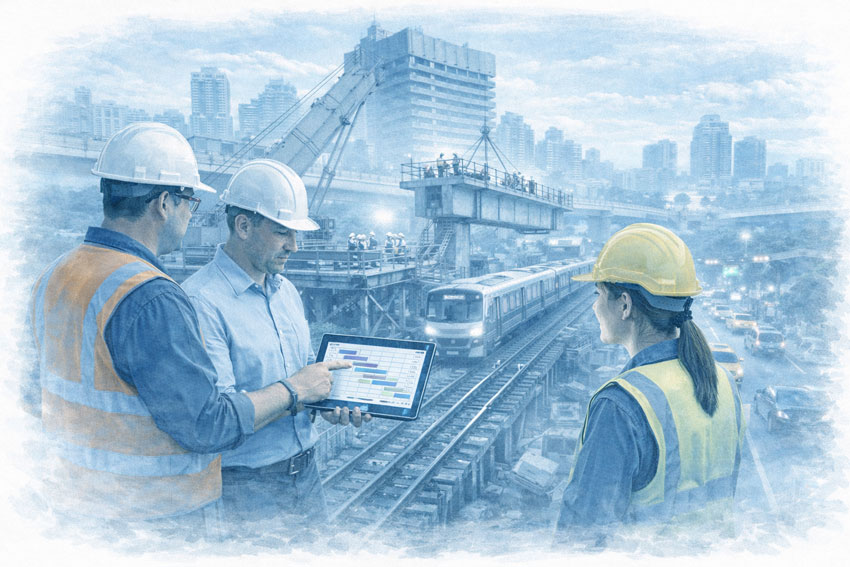
What the recent failures tell us
The incidents that have triggered concern were not failures of rail technology or permanent structural design. They were predominantly:
- temporary works failures
- crane and staging incidents
- work undertaken adjacent to live public corridors
These are execution and sequencing failures, not design failures — and they are heavily influenced by programme structure and schedule control.
This leads to a fundamental governance question:
Who has the authority to change the programme when safe sequencing requires it?
Programme control is not neutral
When schedules are:
- externally fixed
- politically sensitive
- commercially punitive to miss
risk does not disappear. It is transferred downward.
In practice, this often manifests as:
- parallel work instead of sequential isolation
- reduced exclusion zones
- reliance on procedural controls rather than engineered separation
- temporary works treated as “means and methods” instead of engineered systems
None of this requires bad intent. It is a system response to inflexible programmes.
The role of Chinese state-owned enterprises
Chinese SOEs involved in these projects are not typically the principal construction contractors. However, they often exert significant influence over programme structure, milestones, and delivery expectations.
Across multiple countries, state-linked delivery models tend to exhibit consistent characteristics:
- strong emphasis on schedule certainty
- delegation of safety responsibility to downstream contractors
- limited flexibility once programme commitments are set
- incidents framed as execution issues rather than programme-design issues
Whether fair or not, this creates a perception that delivery behaviour is structurally stable and slow to change, even after serious failures.
That perception alone justifies a review of governance arrangements.
Why Australian project-management capability is relevant
Australian companies were not in project-management or programme-control roles on the projects that failed. As a result, Australian safety-governance practices were not embedded in the delivery model.
Australian project-management frameworks are shaped by:
- acceptance that schedules must move to protect safety
- independent temporary-works engineering and sign-off
- explicit treatment of live-interface work as a programme risk
- separation between commercial pressure and safety authority
- deep experience in brownfield, shutdown, and live-asset environments
This does not make Australian firms better builders.
It makes them effective governance counterbalances in high-risk delivery environments.
The case for change
The argument is not to exclude existing partners.
It is to strengthen governance.
A more resilient delivery model could include:
- Australian firms in programme-management or independent PM roles
- independent temporary-works authorities reporting outside the construction chain
- schedule-risk reviews with genuine authority to resequence work
- clearer separation between political milestones and construction logic
These measures do not slow projects — they prevent catastrophic delay caused by failure.
The central point
Safety outcomes are not determined by nationality or intent.
They are determined by who controls the programme, how flexible it is, and whether safety has real authority over time and cost.
Strengthening that authority is a rational, evidence-based step forward.
The power of the people
Real improvement in infrastructure delivery does not start with press releases.
It starts when engineers, supervisors, workers, and communities speak openly about how projects are actually delivered.
Those closest to the work experience programme pressure and safety trade-offs long before failures occur. Giving space to those voices is not about blame — it is about learning, transparency, and better governance.
When people are allowed to speak, systems are forced to listen.

Comments are open
This post is intended to encourage informed, professional discussion about project-management models, programme control, and safety governance.
The focus is on systems and incentives — not nationality or individual blame.
Constructive perspectives from those with professional or on-the-ground experience are welcome.
Our clients:






















Great points about programme control and risk transfer. In my experience, embedding independent temporary works engineering and giving safety authority real control — not just advisory input — dramatically improves outcomes. Look forward to seeing more discussion on integrating strong governance in these environments.”