Mobile 3D Scanning Services – Engineering-Grade Capture Anywhere in Australia

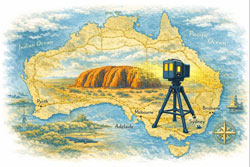
Engineering-led mobile laser scanner digitising Ayers Rock on an Australian road map representing regional onsite 3D scanning.

Mobile 3D Scanning Services | Onsite LiDAR for Regional Australia

When a project is outside the major cities, access to accurate engineering data can be the difference between a smooth upgrade and an expensive mistake. Mobile 3D scanning services bring high-accuracy LiDAR and reality capture directly to your site—whether that’s a regional workshop, a mine in the outback, a water treatment plant, or a small manufacturing facility in a local town.

At Hamilton By Design, our approach is simple:
we come to you, capture the site as it really exists, and convert that data into build-ready CAD and point clouds that engineers, fabricators, and asset owners can rely on.
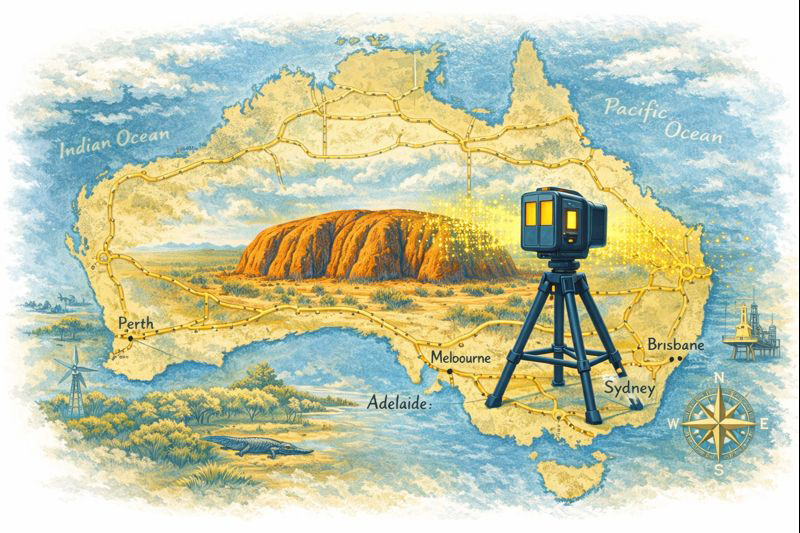


Mobile 3D scanning services illustration showing a LiDAR scanner capturing Uluru on a map of Australia with major highways connecting regional towns.

What Are Mobile 3D Scanning Services?

Mobile 3D scanning means deploying professional laser scanners and engineering workflows on location, not in a lab or office. Instead of measuring with tape, sketches, and guesswork, we capture millions of precise points that represent:

  • Structural steel and concrete
  • Pipework and mechanical equipment
  • Conveyor systems and bulk handling plant
  • Buildings, workshops, and brownfield sites
  • Vehicles, tanks, and custom machinery

The result is a digital twin of your asset that can be used for design, fabrication, clash detection, and maintenance planning—without repeated site visits.


Perfect for Smaller Towns and Regional Projects

Regional businesses often face the same challenges:

  • Limited access to specialist surveyors
  • Old drawings that don’t match reality
  • Upgrades carried out over decades
  • Shutdown windows that are tight and costly

Our mobile service is designed for these exact conditions. We regularly travel to local towns, industrial hubs, and remote facilities to provide the same level of engineering capture normally reserved for major city projects.

Whether you’re in the Central Coast, Mount Isa, Broken Hill, Bathurst, Rockhampton, or anywhere in between, we can mobilise quickly and deliver professional data without the need for you to bring contractors from multiple companies.


How the Process Works

1. One Day Onsite – Minimal Disruption

Most projects can be captured in a single day. We position the scanner, record high-resolution point clouds, and focus extra detail around critical tie-in points.

2. Registered Point Cloud

Back in the office we register and clean the data into a single accurate model referenced to real-world coordinates.

3. Engineering Deliverables

From that scan we can provide:

  • Registered point cloud files
  • PDF site layouts
  • AutoCAD / SOLIDWORKS models
  • Fabrication drawings
  • Clash and tolerance checks

Because we are engineers first—not just surveyors—the outputs are created with practical fabrication and construction in mind.


Why Mobile Scanning Beats Traditional Measuring

  • ✔ No more hand sketches that don’t fit
  • ✔ Reduce rework during shutdowns
  • ✔ Design directly to existing conditions
  • ✔ Accurate tie-ins for conveyors, elevators, pipework
  • ✔ Evidence for compliance and asset records
  • ✔ Faster quoting for fabricators

For small towns where every hour counts and access is limited, this approach removes uncertainty before a single piece of steel is cut.


Industries We Support

Our mobile 3D scanning services are commonly used for:

  • CHPP and mining upgrades
  • Local manufacturing plants
  • Food and beverage facilities
  • Water and wastewater sites
  • Sawmills and timber processing
  • Vehicle and van fit-outs
  • Heritage and retrofit projects
  • Conveyor and bucket elevator installations

No site is too small—if it needs to fit first time, scanning makes sense.


Hamilton By Design logo displayed on a blue tilted rectangle with a grey gradient background

Book Early – Our Calendar Fills Fast

Regional shutdowns and plant upgrades often happen at the same time of year. Booking early ensures:

  • Availability when your site is ready
  • Data delivered before design deadlines
  • Your project stays on track

We typically work on a 50% deposit with purchase order and balance on delivery of the registered point cloud and agreed outputs.


Let’s Capture Your Site – Wherever It Is

If you’re planning an upgrade in a smaller town or regional facility, talk to a team that understands both engineering and scanning.

Call Hamilton By Design
www.hamiltonbydesign.com.au
📍 Servicing Sydney, Central Coast, Bathurst, Broken Hill, Perth, Mount Isa and regional Australia

Mobile 3D scanning services—bringing city-level engineering to every local town.
Name
Would you like us to arrange a phone consultation for you?
Address

Supporting Australian Coal – Engineering-Led 3D Scanning for CHPP & Coal Wash Plants

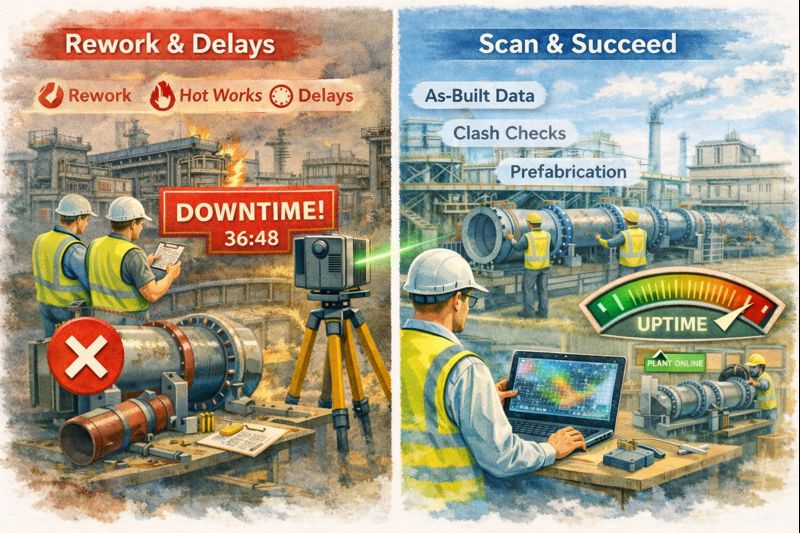
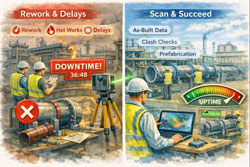
CHPP wash plant illustration comparing shutdown rework with LiDAR scanning and prefabrication success.

3D Scanning Services for CHPP – Reduce Rework, Maximise Uptime

Australian coal operations depend on reliable Coal Handling & Preparation Plants (CHPP), wash facilities, conveyors and mechanical systems. Every shutdown, upgrade and modification must be delivered quickly and safely to protect production. The most effective way to achieve this is through engineering-led 3D scanning services that capture real site conditions before a single component is fabricated.

Hamilton By Design specialises in FARO LiDAR and structured-light 3D scanning for the coal sector, turning complex brownfield sites into accurate digital models that drive practical engineering outcomes. Our focus is simple: maximise plant uptime by reducing rework.


Why Shutdowns Need Better Information

Coal wash plants are dynamic environments. Over decades of modifications:

  • drawings no longer match reality
  • structures move under load
  • pipe routes are altered
  • access becomes restricted

Relying on tape measures and sketches during a shutdown invites risk. A bracket that is 20 mm wrong or a spool that fouls an existing service can cost days of lost production. Accurate 3D scanning before the outage removes those unknowns.


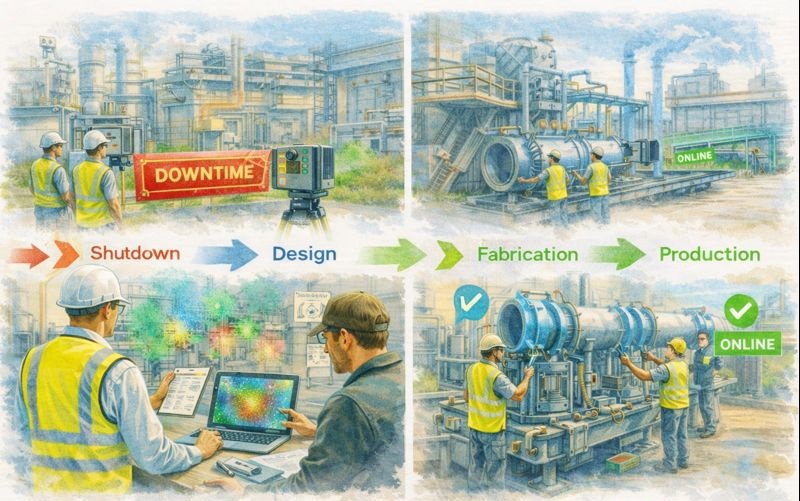
Coal wash plant shutdown workflow from delays to scan-led success using LiDAR.

Hamilton By Design 3D Scanning Services

Our scanning services are built specifically for industrial and mining applications:

FARO LiDAR As-Built Capture

  • full plant and conveyor surveys
  • transfer stations, bins and pump boxes
  • structural steel and foundations
  • tie-in points for new pipework
  • clearance verification for maintenance

Structured-Light Scanning (EinScan)

  • motors, gearboxes and legacy parts
  • guards, covers and small assemblies
  • reverse engineering for obsolete components
  • detailed capture for first-time-fit design

Point Cloud to CAD Workflows

  • modelling in SolidWorks & Fusion
  • fabrication drawings for local workshops
  • clash detection and installation planning
  • digital twins for ongoing maintenance

These services ensure that design decisions are based on measured reality, not assumptions.


Engineering-led LiDAR scanning sequence from downtime to online restart.

FARO LiDAR for CHPP As-Builts

Terrestrial LiDAR creates a high-density point cloud of the entire coal wash facility. Engineers can:

  • design new chutes and spools directly over site geometry
  • confirm conveyor alignments
  • plan access platforms and walkways
  • test installation sequences digitally

By linking scanning to engineering, components arrive on site ready to install — protecting uptime and reducing rework during critical shutdown windows.


Practical Outcomes for Coal Plants

Conveyor & Transfer Upgrades

  • accurate chute replacements
  • skirt and belt line verification
  • drive and pulley modifications
  • minimal site adjustments

Pump Boxes & Pipework

  • prefabricated spools that fit first time
  • reverse engineering of worn equipment
  • safe tie-ins without surprises

Structural & Access Works

  • platform and handrail retrofits
  • screen support modifications
  • crane and lifting planning

Every task is driven by 3D scan data so workshops fabricate with confidence.


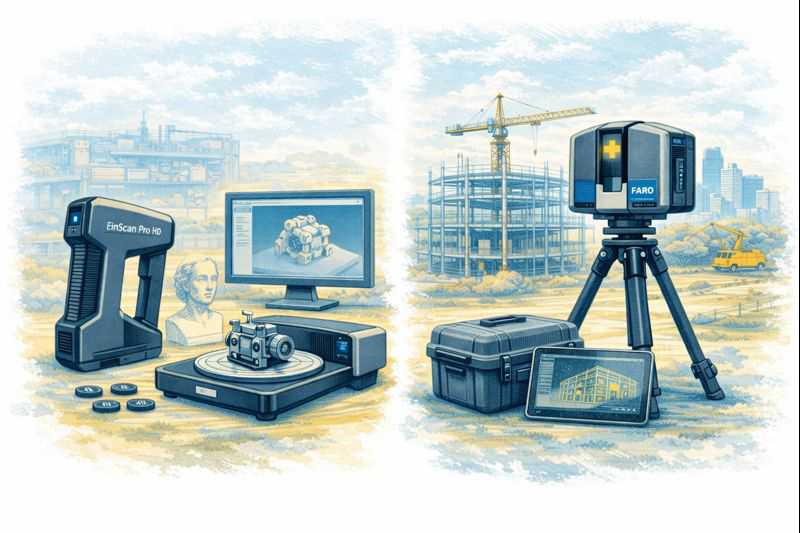
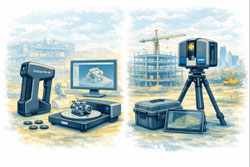
Visual comparison of EinScan object scanner and LiDAR terrestrial laser scanner in matching sketch style.

Engineering-Led, Not Just Surveying

Hamilton By Design treats scanning as part of the engineering process:

  1. 3D capture of the live plant
  2. engineering review of critical datums
  3. point cloud modelling in parametric CAD
  4. fabrication drawings for Australian workshops
  5. shutdown planning to ensure first-time fit

This approach directly supports the goal of maximum plant uptime.


Supporting Australian Capability

Scan-driven design keeps work local. Regional fabricators receive accurate models and drawings that reflect the real CHPP environment, enabling:

  • faster workshop production
  • fewer site variations
  • safer installations
  • reduced dependence on imported components

Committed to the Coal Sector

Hamilton By Design supports coal operations across NSW, the Central Coast, Sydney and regional Queensland including Mount Isa. Our 3D scanning services enhance every stage of shutdown planning and brownfield upgrades by eliminating guesswork and cutting rework.


Hamilton By Design logo displayed on a blue tilted rectangle with a grey gradient background

Our Services

  • FARO LiDAR scanning for CHPP as-builts
  • EinScan component capture
  • Point cloud to CAD modelling
  • Fabrication drawings & DXF outputs
  • Clash detection and digital twin support

Maximise your plant uptime by reducing rework — talk to us before your next shutdown.

Name
Would you like us to arrange a phone consultation for you?
Address

Every Shutdown Matters – Engineering-Led Scanning with FARO LiDAR for As-Builts

Illustration showing LiDAR scanning workflow for industrial shutdown from capture to installation.

Every Shutdown Matters – FARO LiDAR for As-Built Scanning

In heavy industry, a shutdown is not just another project milestone — it is the most expensive window on the calendar. Production stops, contractors mobilise, and every hour has a dollar value attached. When something does not fit, the cost is immediate and visible. This is why every shutdown matters, and why the approach to measurement and design before the outage has become critical.

Traditional site measurement relies on tape measures, sketches, and assumptions about existing conditions. In brownfield environments those assumptions are often wrong. Steel moves, plant is modified without drawings, and tolerances stack up over decades. Engineering-led 3D scanning, particularly using FARO terrestrial LiDAR for as-built capture, has changed the way shutdowns are planned and delivered.


Engineering-led LiDAR scanning sequence from downtime to online restart.

From Guesswork to Measured Reality

A terrestrial LiDAR scanner captures millions of accurate points across an entire facility. Instead of a handful of manual dimensions, designers receive a complete digital replica of the plant — every beam, pipe, handrail and obstruction recorded in context. The result is a point cloud that becomes the single source of truth for engineering decisions.

The difference between scanning and traditional measurement is not just accuracy; it is completeness. A fitter with a tape can only measure what they think is relevant. A LiDAR scan measures everything, including the issues no one knew to look for: misaligned bases, out-of-square structures, undocumented modifications and clearance problems that would otherwise appear during the shutdown itself.

When this data is managed by engineers rather than survey technicians alone, it becomes more than a pretty model — it becomes a design tool.

Engineering-Led Scanning

Scanning by itself does not deliver value. The benefit comes when point clouds are interpreted through an engineering lens:

  • What tolerances actually matter?
  • Which surfaces are datums and which are cosmetic?
  • Where will fabrication interfaces occur?
  • How will the new design be installed within the shutdown sequence?

At Hamilton By Design we approach LiDAR capture as part of the engineering workflow, not a separate service. FARO scans are registered, cleaned and aligned to suit the specific design task — whether that is a conveyor upgrade, pump replacement, structural modification or access platform.

The aim is simple: design once, fit first time.

FARO LiDAR for As-Built Confidence

FARO terrestrial scanners are built for industrial environments. They capture long-range, high-density point clouds that allow designers to work with real conditions rather than idealised drawings. Typical applications include:

  • As-built capture of processing plants and mine infrastructure
  • Pipework routing and clash detection
  • Structural modifications and tie-ins
  • Equipment change-outs and baseplate verification
  • Access and safety improvements

By modelling new work directly over the point cloud, engineers can test installation paths, crane clearances and maintenance access long before the shutdown begins. Fabrication drawings are generated from a model that already “fits” the site.

The Cost of Getting It Wrong

During outages the smallest oversight becomes expensive:

  • A pipe spool 20 mm too long
  • A bracket that fouls an existing conduit
  • A motor base drilled to the wrong PCD
  • A platform clash discovered after hot works have started

Each of these problems triggers rework, additional labour, hot work permits and schedule delays. The true cost is rarely the part itself — it is the lost hours in the critical path.

Engineering-led LiDAR scanning attacks these risks at the source. By understanding existing geometry before fabrication begins, contractors arrive on site with components that have already been proven digitally.

Complementing LiDAR with Object Scanning

Large-scale LiDAR captures the plant; structured-light scanners such as EinScan capture the individual components within it. Motors, guards, cast housings and legacy parts can be digitised on the bench and integrated back into the LiDAR model. This two-tool approach supports:

  • Reverse engineering of obsolete components
  • Design of adapters and mounting brackets
  • Verification of replacement equipment
  • Creation of accurate fabrication models

The result is a seamless path from reality capture to parametric CAD in Fusion 360 or SolidWorks — guided by engineering intent rather than raw mesh data.

Planning the Shutdown Backwards

Successful outages are designed backwards from the installation day. FARO as-built scanning supports this process:

  1. Pre-shutdown capture – full LiDAR survey of affected areas
  2. Engineering modelling – new design built over the point cloud
  3. Workshop fabrication – components manufactured to verified geometry
  4. Dry fit digitally – clash and access checks completed
  5. On-site installation – minimal adjustment required

By the time the shutdown begins, the unknowns have been removed. Crews are executing a plan rather than solving problems in real time.

More Than Measurement

LiDAR point clouds are also powerful communication tools. Maintenance teams, project managers and contractors can visualise the work in context, improving safety and coordination. Decisions that once required multiple site visits can be made from the office with confidence.

For organisations moving toward digital twin strategies, as-built scans provide the foundation layer — an accurate spatial framework that future projects can reference.

Why Every Shutdown Matters

In mining, manufacturing and energy sectors the shutdown window defines the success of the year. Budgets are tight, schedules are fixed, and tolerance for rework is zero. Engineering-led scanning recognises that reality capture is not an optional extra; it is risk management.

FARO LiDAR for as-builts delivers:

  • Reduced site hours
  • Fewer fabrication errors
  • Safer installation planning
  • Better collaboration between design and maintenance
  • Confidence that new work will integrate with old

Most importantly, it respects the fact that every shutdown matters.


Talk to Us

Hamilton By Design provides engineering-led LiDAR scanning across Sydney, the Central Coast and regional Australia, supporting brownfield upgrades, shutdown planning and reverse engineering.

If you’re preparing for an outage or plant modification, speak with our team about capturing accurate as-builts before the clock starts ticking.

www.hamiltonbydesign.com.au


Terrestrial LiDAR Scanner Price – Buy or Hire?

Comparison illustration showing EinScan structured-light scanner on left and FARO LiDAR terrestrial laser scanner on right.

Terrestrial LiDAR Scanner Price – Buy or Hire Options

When organisations first explore terrestrial LiDAR scanning, the biggest question is usually not technical — it’s commercial: should we buy a scanner or hire one for the project?

Terrestrial LiDAR scanners such as FARO and Leica systems are powerful tools for capturing accurate point clouds of buildings, industrial facilities, infrastructure and construction sites. They support as-built documentation, clash detection, shutdown planning and digital twin workflows. However, the right decision between purchase and hire depends on how often the equipment will be used and the level of in-house expertise available.


Visual comparison of EinScan object scanner and LiDAR terrestrial laser scanner in matching sketch style.

Buying a LiDAR Scanner

Purchasing a scanner can make sense for businesses that:

  • undertake regular surveying or as-built capture
  • need immediate access on multiple sites
  • want to build internal reality-capture capability
  • plan to integrate point clouds into ongoing design workflows

Ownership provides flexibility and control, but also involves training, software, calibration and maintenance considerations.

Hiring a LiDAR Scanner

Hiring is often the smarter option when:

  • the requirement is project-specific
  • workloads are seasonal or occasional
  • specialist software and support are needed
  • you want to trial the technology before committing

Hire packages can include advice on setup, data management and export formats so the results integrate smoothly with CAD and BIM platforms.

We Support Both Options

Hamilton By Design offers terrestrial LiDAR scanners for both hire and sale, backed by engineering support to ensure the data delivers real value on your project. Whether you need equipment for a short shutdown, a construction survey, or you are considering building your own scanning capability, our team can guide you through the most practical pathway.

Rather than publishing generic prices, we prefer to understand:

  • the type of site you need to capture
  • required accuracy and deliverables
  • software and CAD integration
  • duration and level of support

This allows us to recommend the right scanner package and commercial model for your specific needs.

Please contact our team for a price and availability.
We’ll help you decide whether buy or hire is the best approach for your project.

www.hamiltonbydesign.com.au
info@hamiltonbydesign.com.au

Name
Would you like us to arrange a phone consultation for you?
Address

EinScan vs LiDAR Terrestrial Laser Scanners – Choosing the Right Tool for Reality Capture

Comparison illustration showing EinScan structured-light scanner on left and FARO LiDAR terrestrial laser scanner on right.

EinScan vs LiDAR Terrestrial Laser Scanners – Choosing the Right Tool for Reality Capture


The rapid growth of 3D scanning has given engineers, fabricators and designers access to tools that were once limited to large survey companies. Today you can buy a compact EinScan structured-light scanner for a few thousand dollars or hire a FARO or Leica terrestrial LiDAR scanner capable of mapping an entire processing plant in an afternoon. Both are called “3D scanners,” yet they serve very different purposes. Understanding the difference between EinScan-style scanners and terrestrial LiDAR systems is essential before investing time or money into reality capture.

Two Technologies, Two Different Jobs

EinScan scanners, produced by SHINING 3D, are primarily structured-light or short-range laser scanners. They project patterns of light onto an object and use cameras to interpret how that light deforms across the surface. The result is a dense mesh model of the object—typically exported as STL, OBJ or PLY files. EinScan units are designed for objects you can walk around, such as mechanical parts, castings, plastic housings and small assemblies.

Terrestrial LiDAR scanners such as the FARO Focus, Leica RTC360 or Trimble X-series operate on a completely different principle. These instruments sit on a tripod and fire millions of laser pulses across a 360-degree field, measuring the time it takes for each pulse to return. The output is a georeferenced point cloud containing precise XYZ coordinates for everything the laser can see—buildings, structures, conveyors, tanks, pipework and terrain.

Calling both devices “3D scanners” is like calling a vernier caliper and a total station the same tool. They both measure, but at entirely different scales.


Visual comparison of EinScan object scanner and LiDAR terrestrial laser scanner in matching sketch style.

Scale and Range

The first and most obvious difference is working range.
An EinScan handheld unit is comfortable scanning parts from a few centimetres up to perhaps three or four metres. It is ideal for a gearbox housing on a bench or the plastic bumper of a vehicle. Once the object grows larger than a small room, the scanner begins to lose tracking and accuracy.

A terrestrial LiDAR scanner is built for the opposite end of the spectrum. A FARO Focus S-series can capture data from 0.6 metres out to 70 metres or more, mapping entire buildings or industrial sites from a single setup. Multiple scans are then registered together to create a complete digital twin of a facility.

For workshops and machine shops the question becomes simple:
Are you scanning an object, or are you scanning a place?
Objects suit EinScan; places suit LiDAR.

Accuracy and Tolerance Expectations

Manufacturers often quote impressive numbers, but real-world accuracy must be considered.

  • EinScan desktop and handheld systems typically achieve 0.05–0.2 mm accuracy on small parts when conditions are ideal.
  • Terrestrial LiDAR scanners deliver around ±1 mm to ±3 mm accuracy over distance.

At first glance EinScan appears “more accurate,” but this is only true at short range. A LiDAR scanner maintains consistent accuracy across tens of metres, something structured-light devices simply cannot do.

For precision mechanical components—bearing fits, machined bores, threaded holes—neither technology replaces traditional metrology tools. Scanning excels at capturing shape and context, while micrometers and CMMs remain the authority for tolerance verification.

Type of Data Produced

EinScan produces mesh files made from millions of tiny triangles. These are excellent for visualisation and 3D printing but contain no intelligence about holes, planes or cylinders. CAD systems like SolidWorks or Fusion 360 cannot directly convert these meshes into editable parametric models without additional reverse-engineering work.

LiDAR scanners generate point clouds—individual points with coordinates and often colour values. Point clouds are perfect for surveying, clash detection, volume calculations and as-built documentation. They are not intended to be edited like CAD models; instead, engineers build new geometry over the top using the cloud as reference.

Understanding this distinction avoids disappointment. Neither scanner delivers a “one-click CAD model.” Human engineering judgement is always required.

Surface and Environmental Limitations

EinScan technology relies on optical cameras and projected light, which introduces several practical limitations:

  • Shiny or black surfaces are difficult to capture
  • Transparent plastics confuse the cameras
  • Deep holes and narrow slots are often missed
  • Sunlight can overpower the projected pattern
  • Tracking can be lost on large flat surfaces

LiDAR systems are more tolerant of environment. They can operate outdoors, in dusty workshops and over long distances. However, they also struggle with highly reflective materials such as polished stainless steel or glass, and they require careful setup to avoid shadows and occlusions.

Workflow Considerations

A typical EinScan workflow looks like this:

  1. Prepare the part—often with scanning spray
  2. Capture multiple passes
  3. Clean and align the mesh
  4. Export STL/OBJ
  5. Rebuild geometry in CAD using the mesh as reference

This process suits reverse engineering of brackets, castings, vehicle parts and consumer products.

A LiDAR workflow is different:

  1. Set up the scanner at multiple locations
  2. Register scans together in software such as FARO Scene or Leica Cyclone
  3. Classify and clean the point cloud
  4. Use the cloud for measurements, modelling or BIM integration

This approach is ideal for as-built surveys, plant upgrades, brownfield design and digital twins.

Cost and Ownership

EinScan systems range from a few thousand to around twenty thousand dollars. They are accessible to small businesses and even serious hobbyists. Software is generally included, and the learning curve is manageable.

Terrestrial LiDAR scanners are capital equipment. Purchase prices often exceed $60,000–$100,000 before software, training and maintenance. For many companies it makes more sense to engage a specialist scanning provider when required.


Hamilton By Design logo displayed on a blue tilted rectangle with a grey gradient background

Choosing the Right Tool

The decision should be driven by the problem you are solving:

Choose EinScan when you need to:

  • Create a bracket to fit an existing motor
  • Reverse engineer a plastic enclosure
  • Modify a vehicle component
  • Capture complex organic shapes
  • Produce meshes for 3D printing

Choose LiDAR when you need to:

  • Document an industrial facility
  • Design around existing plant and pipework
  • Perform clash detection for upgrades
  • Measure volumes and clearances
  • Create a site-wide digital twin

Many organisations ultimately use both. A LiDAR scan provides the big picture, while an EinScan captures detailed components within that environment.

Integration with CAD

Engineers often ask which scanner works best with SolidWorks or Fusion 360. The honest answer is that neither integrates directly into parametric CAD without intermediate steps. EinScan meshes require reverse-engineering tools or manual modelling. LiDAR point clouds usually pass through Autodesk Recap, FARO Scene or similar before being referenced in CAD.

Scanning is a method of collecting truth, not generating finished design. The value lies in reducing site visits, avoiding clashes and giving designers confidence about existing conditions.

Final Thoughts

EinScan scanners and terrestrial LiDAR systems are not competitors; they are complementary tools on the reality-capture spectrum. One excels at objects on a bench, the other at assets spread across hectares. Selecting the wrong tool leads to frustration, while choosing correctly can transform the way projects are delivered.

For Australian fabricators and engineers, the key question is simple:
Are you capturing a part, or are you capturing a place?
Answer that, and the choice between EinScan and LiDAR becomes clear.

Name
Would you like us to arrange a phone consultation for you?
Address

Why You Should 3D Scan Your White Van Before a Tradie Fit Out?

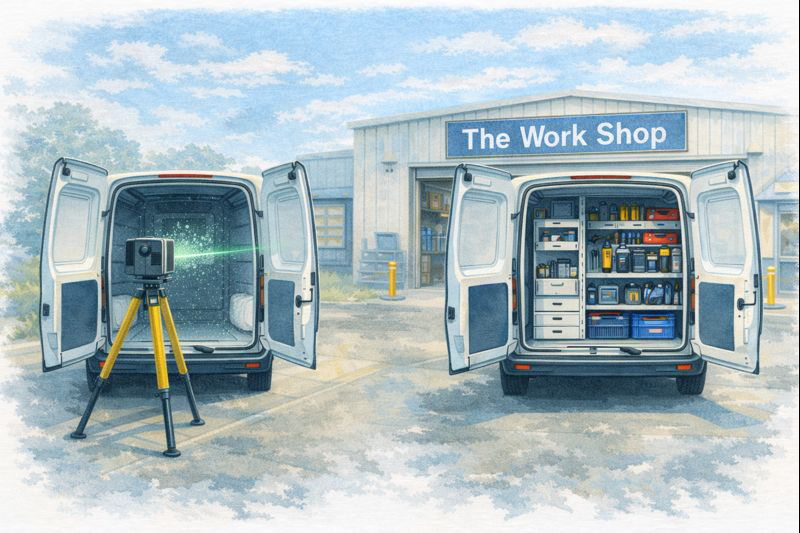
LiDAR scanning the interior of a white van beside a fully fitted tradie van outside a workshop

Why 3D Scan Your White Van Before a Tradie Fit-Out?

Customising your van is no different to customising your toolbox.

You wouldn’t buy a toolbox full of drawers and shelves that don’t suit your tools — so why accept a van fit-out that doesn’t suit the way you work?

If you’re paying good money for a van fit-out, 3D scanning your van first ensures you actually get what you want, not a generic solution.


3D scanning a white van before a custom tradie fit-out compared to a completed organised van interior

Your Van Is Your Toolbox

For most tradies, the van is:

  • a mobile workshop
  • a storage system
  • an office
  • and a productivity tool

Every trade works differently, and every van gets used differently.

A 3D scan captures the exact internal geometry of your van, so the fit-out is designed around your vehicle, not assumptions.


Why Guessing Costs You Money

Traditional van fit-outs often rely on:

  • standard templates
  • rough measurements
  • generic layouts

That can lead to:

  • wasted space
  • awkward access
  • tools that don’t fit properly
  • shelves and drawers you don’t actually use

Once it’s built, changing it is expensive.

3D scanning removes the guesswork before anything is built.


What 3D Scanning Does for a Van Fit-Out

A 3D scan creates an accurate digital model of your van interior.

This allows the design team to:

  • optimise every millimetre of space
  • design shelving, drawers, racks, and storage to fit properly
  • check clearances before anything is installed
  • tailor the layout to how you work day-to-day

You’re paying for a fit-out — this ensures you get value from every dollar.


Trades That Benefit from 3D-Scanned Van Fit-Outs

We regularly assist (but are not limited to):

  • Plumbing vans – pipe storage, fittings, pumps, and access
  • Electrical vans – cable drums, test equipment, safe storage
  • Carpenters’ vans – tool cases, saw storage, materials
  • Fitters’ vans – precision tools, parts, and fast access
  • Boilermakers’ vans – heavy tools, welding gear, safe load distribution
  • Delivery vans – optimised load space and restraint systems
  • HVAC / air conditioning vans – gas bottles, units, tools
  • Painters / decorators – organised storage for finishes and equipment
  • Locksmiths / security installers – fast access, clean layout
  • Handymen / general maintenance – flexibility and adaptability
  • Camper vans – beds, storage, kitchens, and utilities that actually fit

Different trades. Same problem.
One-size-fits-all doesn’t work.


Design It Right — Before It’s Built

With a 3D scan, the design team can:

  • trial different layouts digitally
  • adjust storage heights and access
  • confirm everything fits before fabrication

Traditionally, we assist with fit-out design — but scanning takes it further by giving everyone accurate data to work from.

This reduces:

  • rework
  • compromises
  • frustration

You’re Paying for a Fit-Out — Get What You Want

A van fit-out is an investment.

So ask yourself:

  • Why accept a generic layout?
  • Why compromise on access or storage?
  • Why redesign later when you can get it right first time?

Scan the van. Design it properly. Build it once.


The Bottom Line

Customising your van is just like customising your toolbox.

The better it suits you, the faster you work, the easier your days are, and the more value you get from it.

If you’re already spending money on a fit-out, 3D scanning your van is the smartest way to make sure you get exactly what you want — not what happens to fit.

Name
Would you like us to arrange a phone consultation for you?
Address