


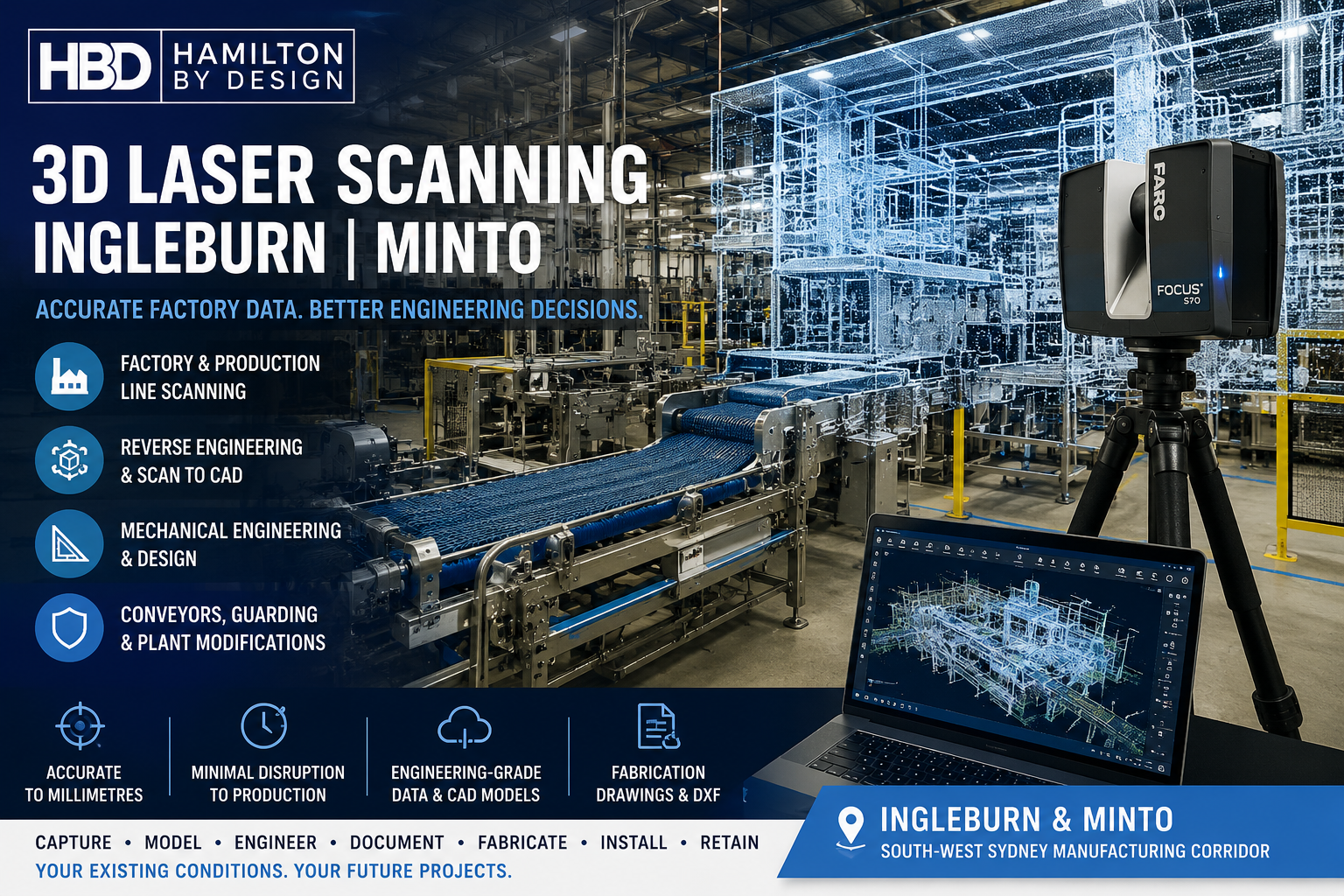

Ingleburn and Minto form one of South-West Sydney’s major manufacturing and industrial corridors, supporting food production, machinery manufacturing, metal fabrication, processing equipment, warehousing and established industrial plant.
For many of these facilities, the engineering challenge is not necessarily designing a new machine, conveyor or guard. The greater difficulty is accurately understanding the factory and equipment that the new design must connect to.
Production lines evolve over time. Machines are moved, conveyors are extended, guarding is replaced, structural supports are altered and services are rerouted. After years of incremental modification, the physical factory may differ substantially from the original engineering drawings.
Hamilton By Design provides 3D laser scanning in Ingleburn and Minto to capture these existing conditions and convert them into useful engineering information for production-line modifications, machinery upgrades, reverse engineering and fabrication.
Unlike conventional site measuring, 3D scanning can capture the machinery together with the surrounding factory environment, creating a detailed digital reference that engineers can continue using after leaving site.
For broader industrial applications across Sydney, see our Industrial 3D Scanning Sydney services.
The Biggest Engineering Problem in an Established Factory
A recurring problem within established manufacturing facilities is that the equipment exists physically, but accurate engineering information describing it may not.
A production line may incorporate equipment installed by several manufacturers over many years. Some components may have been locally fabricated, others modified during maintenance shutdowns, and some may no longer be supported by their original manufacturer.
Existing drawings may therefore be:
- incomplete;
- obsolete;
- unavailable;
- based on superseded machinery arrangements;
- missing previous plant modifications; or
- unsuitable for the engineering work now required.
This creates risk when planning a new machine, conveyor, platform, guard or processing system.
Traditional tape measurements can determine individual dimensions, but interconnected production equipment often contains hundreds of spatial relationships. The position of one support frame may affect a conveyor. The conveyor may affect guarding. The guarding may influence maintenance access, while nearby pipework or electrical services may restrict the available installation envelope.
The fundamental question becomes:
How can a plant modification be accurately engineered without repeatedly stopping production to measure the factory?
Engineering-led 3D laser scanning provides one answer.
3D Laser Scanning for Ingleburn and Minto Factories
A terrestrial laser scanner captures millions of measured points from visible surfaces throughout an industrial environment.
These measurements form a 3D point cloud, representing machinery, structures, conveyors, floors, platforms and other surrounding infrastructure in their actual installed positions.
For an Ingleburn manufacturing project, the scan might capture:
- production machinery;
- conveyor systems;
- processing equipment;
- structural columns and frames;
- platforms and stairs;
- machine guarding;
- pipework;
- walls and floors;
- equipment foundations;
- access areas;
- neighbouring machinery; and
- interfaces between old and proposed equipment.
Rather than attempting to manually document every dimension during a short site visit, the project team has a measurable digital reference that can subsequently be reviewed from the office.
Hamilton By Design’s broader 3D Reality Capture Services explain how reality-capture data can support engineering, design and verification workflows.
Production-Line Scanning Before Factory Modifications
Production-line modifications can be particularly difficult because the machinery rarely operates independently.
A relatively small change to a conveyor may affect several adjacent systems.
For example, installing a replacement conveyor could involve:
- determining existing conveyor centre lines;
- identifying discharge and receiving equipment;
- checking pulley and drive locations;
- measuring available headroom;
- reviewing structural supports;
- checking guarding clearances;
- confirming maintenance access;
- determining available installation space; and
- identifying potential clashes with existing equipment.
Scanning the production area creates a common geometric reference against which the proposed modification can be developed.
The objective is not necessarily to model the entire factory in CAD. Instead, Hamilton By Design can identify and model the geometry relevant to the engineering task.
This targeted approach can reduce unnecessary modelling while retaining sufficient site information to understand the surrounding plant.
From Point Cloud to Engineering CAD
A point cloud is extremely useful for understanding existing conditions, but mechanical engineering normally requires structured CAD geometry.
Hamilton By Design can convert selected parts of the scan into usable CAD models and drawings.
Our Point Cloud to AutoCAD workflow can support the development of:
- equipment layouts;
- factory plans;
- structural reference geometry;
- machine positions;
- conveyor layouts;
- equipment interfaces;
- existing-condition drawings; and
- plant modification documentation.
Depending on the project, deliverables may also include SolidWorks, Inventor, STEP, SAT, Parasolid, DWG or DXF information.
The important difference is that CAD modelling can be developed directly against measured factory geometry rather than reconstructed primarily from assumptions.
Reverse Engineering Machinery in Ingleburn
Manufacturing facilities often contain machinery that remains mechanically sound but is no longer well documented.
Original drawings may have disappeared, OEM support may have ended or the machine may have been substantially modified since installation.
This is where reverse engineering in Ingleburn can complement factory scanning.
Hamilton By Design can use scan data, direct measurement and engineering assessment to reconstruct components or assemblies for:
- replacement;
- modification;
- refurbishment;
- duplication;
- maintenance planning; or
- integration with new machinery.
The process can progress from the existing physical asset through to CAD models and, where required, fabrication drawings.
For more specialised applications, see our Reverse Engineering 3D Scanning Sydney capability.
This approach can be particularly valuable for older production equipment where a relatively inexpensive fabricated replacement component may keep a productive machine operating without requiring complete equipment replacement.
Conveyor and Material-Handling Modifications
Conveyors are common throughout food manufacturing, processing, packaging, fabrication and industrial production facilities.
They also frequently become modified over time.
A conveyor may need to be:
- extended;
- shortened;
- relocated;
- raised or lowered;
- redirected;
- integrated with replacement machinery;
- fitted with new guarding; or
- redesigned around changed production requirements.
Accurate existing-condition information is particularly useful when modifying conveyors because a small positional error can influence downstream equipment.
Scanning can capture conveyor frames, supports, drives, pulleys, transfer points, surrounding structures and adjacent machinery as one coordinated dataset.
The resulting CAD information can then support new fabrication and installation planning.
Machine Guarding and Access
Factory modifications often create a secondary requirement for new guarding.
Changing a conveyor, moving a machine or altering an access platform may affect existing protective systems even when the machinery itself remains unchanged.
Laser scanning can capture existing guarding geometry together with the machine and surrounding access areas.
This information can assist with:
- replacement fixed guards;
- conveyor guarding;
- machine perimeter guarding;
- maintenance access;
- removable panels;
- support brackets;
- access platforms; and
- retrofit guarding arrangements.
Hamilton By Design also provides Machine Guarding Certification and Engineering services where engineering review and guarding documentation form part of the broader plant modification.
Mechanical Engineering After the Scan
The greatest value of 3D scanning is realised when the captured information becomes part of the engineering process.
Hamilton By Design can continue from scanning into mechanical design, CAD modelling and fabrication documentation.
A proposed piece of equipment can be positioned digitally within the scanned factory environment before fabrication begins.
This allows the engineering team to investigate questions such as:
- Will the proposed machine fit?
- Does the new conveyor align with the existing transfer point?
- Is sufficient maintenance clearance available?
- Will new guarding obstruct an access route?
- Does the fabrication clash with existing structural steel?
- Can the assembly physically be installed through the available access?
- Are existing platforms or supports suitable for the proposed arrangement?
The objective is to identify these issues digitally before they become expensive site problems.
Our broader Engineering Services Sydney capability allows scanning to connect directly with mechanical design and plant-modification work.
Fabrication Documentation from Existing Factory Geometry
Once a design has been developed and checked against the scanned environment, engineering information can be prepared for manufacture.
Depending on the project, this may include:
- general arrangement drawings;
- assembly drawings;
- detail drawings;
- fabrication drawings;
- bills of materials;
- DXF cutting profiles;
- CAD assemblies; and
- neutral-format STEP or SAT files.
Hamilton By Design’s CAD Services Sydney can support this transition from measured site conditions to workshop documentation.
The overall process can therefore become:
Scan → Model → Engineer → Check → Document → Fabricate → Install
Rather than several disconnected contractors working from separate interpretations of site conditions, the same measured geometry can remain available throughout the engineering workflow.
Retaining a Digital Engineering Record of the Factory
For established manufacturing facilities, one of the less obvious benefits of 3D laser scanning is the ability to retain the data for future engineering work.
Hamilton By Design can retain project information such as:
- registered production-line point clouds;
- equipment layouts;
- CAD assemblies;
- conveyor models;
- guarding geometry;
- machine interfaces;
- fabrication drawings; and
- plant modification records.
This means a scan undertaken for one project may continue providing value during future modifications.
For example, a production line initially scanned for a conveyor replacement may later require:
- new guarding;
- another machine;
- an access platform;
- structural modifications; or
- relocation of existing equipment.
Provided the relevant area has not materially changed, the retained dataset gives engineers a reference from which to begin evaluating the next project.
This creates a longer-term engineering cycle:
Capture once → retain the data → update where necessary → reuse for future plant modifications.
3D Laser Scanning Across the Ingleburn–Minto Industrial Corridor
Hamilton By Design can support manufacturing and industrial facilities throughout the Ingleburn and Minto area, including nearby industrial locations across South-West Sydney.
Typical projects may involve:
- food and beverage production;
- industrial machinery;
- fabrication facilities;
- packaging equipment;
- manufacturing plants;
- processing equipment;
- conveyors;
- warehouses containing production equipment; and
- brownfield industrial upgrades.
For projects where structured CAD models are required after scanning, our Scan to CAD services provide the link between captured site geometry and engineering design.
Frequently Asked Questions
What is 3D laser scanning used for in an Ingleburn factory?
3D laser scanning can capture machinery, conveyors, structural steel, production equipment, factory layouts and surrounding infrastructure. The resulting point cloud can support plant modifications, equipment integration, reverse engineering and fabrication.
Can you scan a production line while the factory is operating?
In many circumstances, yes. The practical scanning strategy depends on site access, machinery movement, safety requirements and the surfaces that need to be captured. Some areas may require controlled access or short production pauses.
Can the scan be converted into SolidWorks or AutoCAD?
Yes. Relevant areas of a point cloud can be converted into structured CAD geometry using platforms such as SolidWorks, AutoCAD or Inventor. Neutral formats such as STEP and SAT can also be supplied where appropriate.
Do you need to model the entire factory?
No. For most engineering projects, only the geometry relevant to the modification needs to become CAD. The wider point cloud can remain available as contextual information.
Can 3D scanning help with reverse engineering obsolete equipment?
Yes. Scanning, conventional measurement and mechanical engineering can be combined to reconstruct poorly documented or obsolete equipment. CAD models and fabrication documentation can then be developed where required.
Can you design conveyors from the scan data?
Yes. Existing conveyors and surrounding factory geometry can be captured and used as the basis for conveyor modifications, extensions, replacements or integration with new production machinery.
Can you also design machine guarding?
Yes. Hamilton By Design can use scanned machinery and conveyor geometry to develop retrofit guarding arrangements, subject to the required engineering and safety assessment.
Can the point cloud be kept for future projects?
Yes. Production-line point clouds, equipment layouts, CAD assemblies, conveyor models and associated engineering documentation can be retained as a digital record for future modifications, provided changes to the physical plant are considered.
What file formats can be supplied?
Depending on project requirements, deliverables may include point-cloud formats such as E57, RCP, RCS or LAS together with CAD formats such as DWG, DXF, STEP, SAT and native engineering models.
Who normally uses 3D laser scanning in manufacturing facilities?
Typical clients include maintenance managers, plant engineers, project engineers, reliability engineers, production managers, machinery suppliers, OEMs and fabricators undertaking upgrades to existing industrial facilities.
Discuss a 3D Laser Scanning Project in Ingleburn or Minto
If you are planning a production-line modification, replacing obsolete machinery, adding conveyors, upgrading guarding or integrating new equipment into an established factory, accurate existing-condition information can significantly reduce uncertainty before fabrication begins.
Hamilton By Design combines 3D laser scanning, reverse engineering, mechanical design, CAD modelling and fabrication documentation within one engineering workflow.
By capturing the actual factory environment and retaining that information as reusable engineering data, future modifications can be developed from measured site conditions rather than outdated drawings or assumptions.
For 3D laser scanning in Ingleburn, reverse engineering in Ingleburn, mechanical engineering in Minto or production-line scanning across South-West Sydney, contact Hamilton By Design to discuss the existing plant, the proposed modification and the engineering information required.

Contact Us – Talk To Us
Our clients:
























