


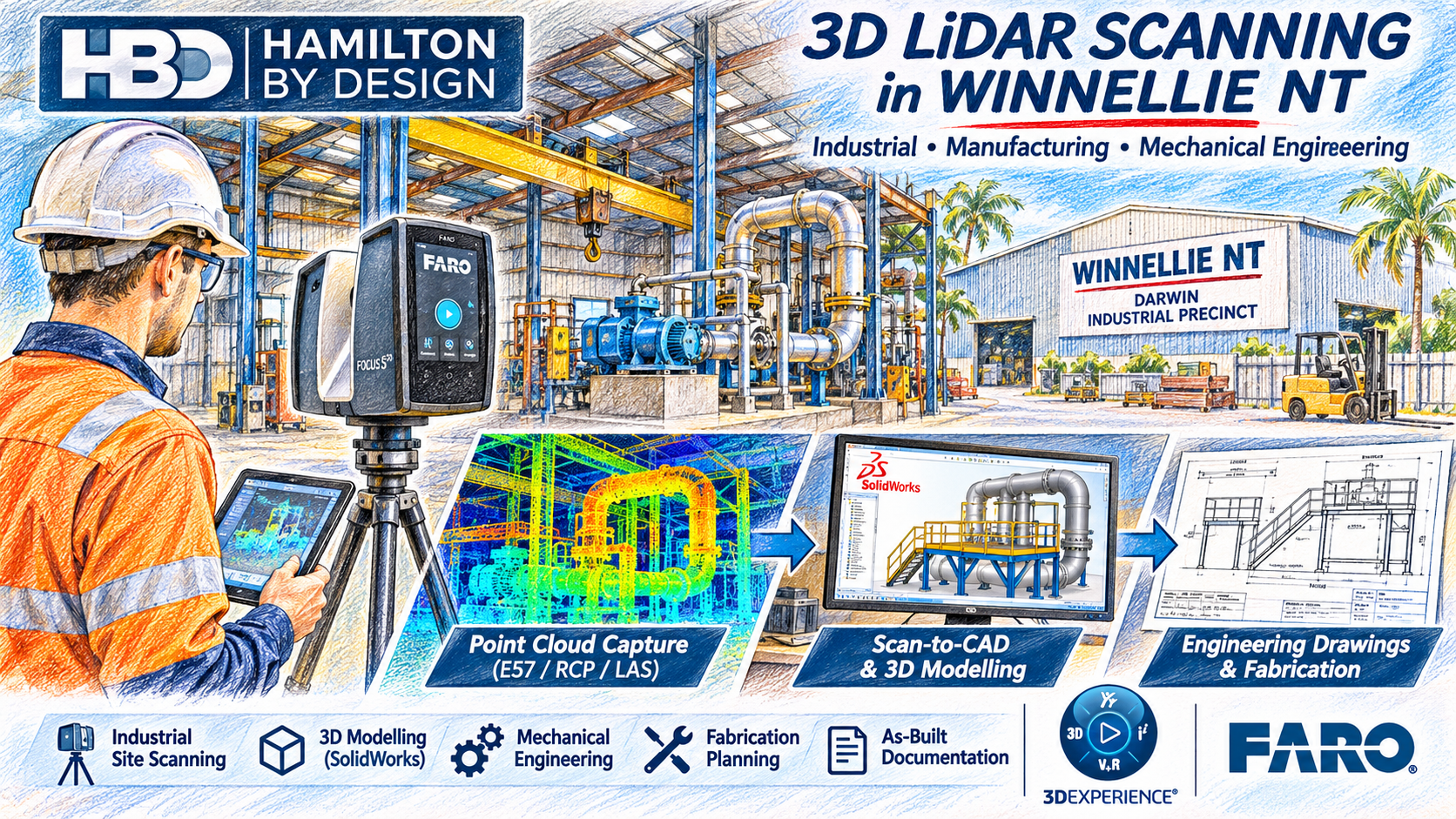
Precision 3D LiDAR Scanning for Winnellie’s Industrial and Manufacturing Sector
Winnellie is one of Darwin’s most established industrial and manufacturing precincts, supporting businesses involved in mechanical fabrication, engineering, transport, equipment maintenance, construction and industrial services.

For businesses operating in Winnellie, accurate dimensional information is essential when modifying existing equipment, installing new machinery, designing replacement components or planning changes to industrial facilities.
Hamilton By Design provides engineering-grade 3D LiDAR scanning, mechanical engineering design, 3D modelling and scan-to-CAD services for industrial and manufacturing projects in Winnellie, Darwin and across the Northern Territory.
Our services help engineering contractors, fabricators, maintenance teams and project managers capture existing site conditions and convert physical assets into accurate digital information suitable for engineering design, fabrication planning and installation.
Rather than relying solely on traditional tape measurements, photographs or outdated drawings, 3D LiDAR scanning allows engineers to capture extensive geometric information from existing industrial environments.
This information can then be used to develop point clouds, 3D CAD models, general arrangement drawings and fabrication documentation.
Why 3D LiDAR Scanning Is Valuable in Winnellie
Winnellie’s industrial character makes it particularly suited to 3D scanning applications.
Many established industrial buildings and workshops have undergone modifications over time. Equipment may have been relocated, structural supports added, services rerouted and production layouts changed without corresponding updates to the original drawings.
This creates challenges when new equipment must be designed or installed within existing facilities.
3D LiDAR scanning helps address these challenges by providing a digital record of the existing geometry.
Typical applications include:
- Industrial workshop and factory layout scanning.
- Mechanical equipment and machinery installations.
- Steel fabrication and structural modifications.
- Pipework and process service modifications.
- Vehicle and equipment fit-outs.
- Conveyor systems, platforms and access structures.
- Reverse engineering of existing mechanical components.
- As-built documentation for maintenance and future projects.
The resulting point cloud can be used as a geometric reference when developing new engineering designs.
Industrial 3D Laser Scanning and Point Cloud Capture
Hamilton By Design uses terrestrial 3D LiDAR scanning technology to capture detailed geometric information from industrial sites.
Our FARO Focus S70 laser scanner is suited to capturing workshops, buildings, structural steelwork, plant equipment, mechanical installations and industrial infrastructure.
Depending on site conditions, scanning can capture:
- Structural steelwork: Columns, beams, bracing and connection locations.
- Mechanical equipment: Equipment envelopes, mounting locations and clearances.
- Pipework: Pipe routes, flanges, fittings and surrounding obstructions.
- Manufacturing workshops: Existing machinery positions and production layouts.
- Industrial buildings: Floors, walls, roof structures and service penetrations.
- Vehicle fit-outs: Internal geometry, equipment locations and available space.
Multiple scan positions can be registered together to develop a coordinated point cloud of the relevant work area.
Where a project requires known elevations or survey coordinates, suitable control points or a nominated datum can be incorporated into the scanning workflow.
Point Cloud Deliverables
Depending on project requirements, deliverables may include:
- Registered E57 point cloud files.
- Autodesk ReCap RCP/RCS files.
- LAS point cloud files.
- FARO SCENE project or viewer-compatible data.
- SolidWorks or Inventor 3D CAD models.
- STEP or Parasolid geometry.
- PDF and DWG general arrangement drawings.
These deliverables allow the captured information to be used across engineering, drafting, design review and fabrication workflows.
Scan-to-CAD Services for Mechanical Engineering
One of the principal advantages of 3D LiDAR scanning is the ability to convert existing physical geometry into usable engineering models.
Hamilton By Design combines 3D scanning with mechanical engineering and CAD modelling to support projects that extend beyond simply collecting site measurements.
Our scan-to-CAD workflow can involve capturing the existing equipment, registering the point cloud, developing the required CAD geometry and preparing drawings for engineering review or fabrication.
For example, an engineering contractor replacing pipework in a Winnellie manufacturing facility may need to establish the exact locations of existing flanges, structural supports, equipment and obstructions.
A registered point cloud can be used to develop a proposed pipe route within the existing environment, allowing potential clashes and installation constraints to be identified during design.
This approach can reduce reliance on assumptions and help limit costly rework during fabrication and installation.
3D Scanning for Fabrication and Structural Steelwork
Winnellie’s established engineering and fabrication businesses frequently work with existing structures and equipment.
Fabricating components for an existing industrial installation requires more than simply knowing the overall dimensions.
Connection locations, clearances, mounting interfaces, surrounding services and access constraints can all affect whether a fabricated assembly fits correctly.
Hamilton By Design provides 3D scanning to support:
- Structural steel additions and modifications.
- Equipment support frames and mounting structures.
- Access platforms, stairs and industrial ladders.
- Conveyor modifications and transfer arrangements.
- Pipe supports, brackets and fabricated assemblies.
- Replacement mechanical components.
- Installation planning and spatial coordination.
Where required, the point cloud can be incorporated into SolidWorks or Autodesk Inventor to develop new components around the existing site geometry.
Scanning provides a geometric reference for design; critical fabrication dimensions and tolerances are verified according to the requirements of the individual project.
Vehicle and Equipment Fit-Out Scanning in Darwin
Darwin’s industrial sector supports transport operators, service vehicle providers, emergency services, utilities and specialist equipment suppliers.
Vehicle and equipment fit-outs can involve installing fabricated components within limited available space.
3D scanning can assist with capturing vehicle interiors, mounting surfaces, structural features and equipment envelopes.
Hamilton By Design can use terrestrial LiDAR scanning for larger vehicle and workshop environments, together with handheld metrology-grade scanning where finer component geometry is required.
Applications include specialist vehicle modifications, equipment mounting brackets, service body arrangements, storage systems and mechanical component integration.
Captured geometry can be used to develop CAD models and installation arrangements before components are manufactured.
Reverse Engineering and Mechanical Component Scanning
Not every engineering project involves an entire building or industrial facility.
In some cases, the requirement is to reproduce or modify an individual mechanical component for which original drawings are unavailable.
Hamilton By Design also provides handheld 3D scanning using the Revopoint MetroY Ultra for suitable smaller mechanical components.
Applications may include:
- Replacement machinery components.
- Pump and equipment components.
- Castings and fabricated parts.
- Mounting brackets and housings.
- Component comparison and reverse engineering.
The resulting scan data can be used as a reference for developing CAD geometry, subject to the component’s material, surface condition, accessibility and required tolerances.
Supporting Brownfield Industrial Modifications
Brownfield engineering projects involve modifying or upgrading existing facilities while working around installed equipment, structural steelwork and operational constraints.
These projects are particularly relevant to established industrial areas such as Winnellie.
A proposed installation may need to fit between existing columns, pass beneath structural beams or connect to equipment that has been modified over several years.
Without reliable as-built information, engineers may be required to make assumptions about existing dimensions.
3D LiDAR scanning provides a practical method of recording the available geometry before detailed design begins.
For maintenance shutdowns and equipment upgrades, this information can support earlier planning, better coordination and identification of potential installation conflicts.
Our 3D LiDAR Scanning Process
1. Project Scope and Site Requirements
Identify the assets to be scanned, required accuracy, access restrictions, nominated datums and intended engineering deliverables.
2. Site Scanning and Data Capture
Capture the required geometry using appropriate scanner positions to manage line-of-sight restrictions and reduce areas of missing information.
3. Point Cloud Registration and Quality Review
Register individual scans into a coordinated dataset and review registration quality and coverage.
4. Engineering Modelling and Drafting
Develop the required CAD models, layouts or drawings using the registered point cloud as a geometric reference.
5. Digital Deliverables
Supply the agreed point cloud, CAD models and engineering documentation in formats suited to the client’s software and project requirements.
Servicing Winnellie and Greater Darwin
Hamilton By Design supports industrial 3D scanning and mechanical engineering projects throughout Darwin and the surrounding industrial areas.
Relevant service locations include Winnellie, Berrimah, East Arm, Hidden Valley, Pinelands, Yarrawonga, Palmerston and the wider Darwin region.
Our services are suitable for manufacturing workshops, transport depots, industrial warehouses, fabrication businesses, maintenance facilities and engineering contractors.
We also support regional and remote Northern Territory projects where engineering-grade site measurement and mechanical design services are required.
Frequently Asked Questions
What is 3D LiDAR scanning used for in industrial facilities?
3D LiDAR scanning captures the existing geometry of buildings, machinery, pipework and structural installations. The resulting point cloud can be used for as-built documentation, equipment modifications, CAD modelling and fabrication planning.
Can you scan an operating manufacturing workshop?
Yes, subject to site safety requirements and access arrangements. Scanning can be undertaken in operational facilities, although moving machinery, vehicles and personnel may affect data quality. Scanning during quieter periods or planned shutdowns may improve results.
Can point cloud data be converted into SolidWorks models?
Yes. Hamilton By Design can use registered point clouds to develop SolidWorks models of selected equipment, structures and mechanical components. The level of modelling detail depends on the intended engineering application.
How accurate is industrial 3D LiDAR scanning?
Accuracy depends on the scanner, scanning distance, registration quality, surface characteristics and site conditions. The FARO Focus S70 is capable of millimetre-level measurement under suitable conditions. Overall project tolerances should be agreed according to the required deliverables.
Can you provide drawings for fabrication?
Yes. Hamilton By Design can develop general arrangement drawings, mechanical component models and fabrication-related documentation. The required level of detail and dimensional verification is established during project scoping.
Do you provide 3D scanning services outside Winnellie?
Yes. Hamilton By Design supports projects throughout Darwin, Palmerston and the Northern Territory, as well as industrial engineering projects across Australia.
Why Choose Hamilton By Design?
Hamilton By Design combines mechanical engineering experience with 3D LiDAR scanning and CAD modelling capabilities.
Unlike services focused solely on point cloud capture, our work can extend into mechanical design, reverse engineering, equipment layout development and preparation of engineering drawings.
This integrated approach is particularly useful where the final objective is to manufacture, modify or install equipment within an existing industrial environment.
Our capabilities include terrestrial LiDAR scanning, handheld component scanning, SolidWorks modelling, Autodesk Inventor drafting, mechanical engineering and engineering documentation.
Discuss Your Winnellie 3D Scanning Project
Whether you are planning a workshop modification, designing new equipment, replacing mechanical components or preparing a fabrication project, Hamilton By Design can assist with capturing the existing geometry and developing practical engineering deliverables.
Contact Hamilton By Design to discuss 3D LiDAR scanning in Winnellie, Darwin and the Northern Territory.
Hamilton By Design

Contact Us – Talk To Us
Our clients:

























3D LiDAR Scanning | Mechanical Engineering | Scan-to-CAD