

Aluminium smelting facilities contain complex arrangements of mechanical equipment, structural steelwork, pipework, ventilation systems, conveyors and production infrastructure. When existing equipment requires modification or replacement, accurate dimensional information is essential to reducing installation risks and avoiding costly delays.
Hamilton By Design provides 3D LiDAR scanning, point cloud processing, scan-to-CAD modelling and mechanical engineering services for industrial facilities in Tomago, Newcastle and the Hunter Region.
Our services support maintenance teams, project engineers, shutdown planners and engineering contractors undertaking plant upgrades, equipment replacements and mechanical modifications.
By combining 3D laser scanning with practical mechanical engineering experience, we help project teams understand existing plant conditions before commencing detailed design, fabrication or installation.
Supporting Aluminium Smelter Upgrades at Tomago
Tomago Aluminium is a major aluminium smelting operation located near Newcastle in New South Wales. Its industrial environment contains extensive production equipment, mechanical infrastructure, structural steelwork and supporting services.
Aluminium smelters require ongoing maintenance, equipment replacement and engineering modifications to support plant reliability, operational efficiency and workplace safety.
Hamilton By Design offers engineering and dimensional measurement services relevant to these activities, including:
- 3D LiDAR scanning of existing industrial equipment and structures.
- Mechanical equipment replacement and retrofit design.
- Fume extraction ductwork and ventilation modifications.
- Conveyor and material handling system upgrades.
- Structural steelwork and mechanical support arrangements.
- Industrial pipework and service routing.
- Equipment access platforms and machine guarding.
- Point cloud modelling for plant modification projects.
- General arrangement and fabrication drawing development.
- Dimensional verification before planned shutdowns.
Our objective is to provide accurate existing-condition information that supports practical engineering decisions and reduces uncertainty during plant modifications.
Why 3D LiDAR Scanning Is Important for Aluminium Smelters
Industrial facilities frequently undergo modifications throughout their operating life. Equipment may be replaced, structural supports altered, pipework rerouted and access arrangements changed.
Over time, existing drawings may no longer accurately represent the installed plant.
Traditional measurement methods can also become difficult where equipment is congested, access is restricted or multiple mechanical systems occupy the same area.
3D LiDAR scanning provides a practical method of capturing existing plant geometry and developing a digital reference for engineering design.
The resulting point cloud can be used to identify existing equipment positions, structural interfaces, pipework routes and available installation clearances.
This information can help engineers develop modifications around actual site conditions rather than relying solely on historical drawings or assumed dimensions.
Fume Extraction and Ventilation System Modifications
Fume extraction and ventilation systems are important components of aluminium smelting operations.
These systems can include extensive ductwork, extraction hoods, support frames, transitions, fans and associated mechanical equipment.
Replacing or modifying existing ductwork can present dimensional challenges, particularly where new components must connect to equipment installed many years earlier.
Hamilton By Design can provide 3D LiDAR scanning to capture accessible existing ductwork arrangements and surrounding structures.
Point cloud information can then support:
- Existing ductwork geometry assessment.
- Replacement duct and transition design.
- Flange and connection location assessment.
- Structural support modifications.
- Available clearance verification.
- 3D modelling of proposed ductwork arrangements.
- Fabrication and installation drawing development.
Critical connections and fabrication interfaces may require supplementary dimensional verification to achieve the required tolerances.
Mechanical Equipment and Potline Infrastructure
Aluminium smelting facilities contain closely integrated mechanical equipment, process infrastructure and associated services.
Modifying one component can affect surrounding structures, maintenance access, equipment clearances and service connections.
3D scanning can help establish the relationship between existing equipment and proposed modifications.
Hamilton By Design can assist with mechanical equipment support frames, access arrangements, guarding, service installations and other mechanical engineering modifications.
Where scanning is proposed near operating smelting equipment, site-specific conditions such as heat, electromagnetic interference, access restrictions and operational safety requirements must be assessed before work commences.
Conveyor and Material Handling System Upgrades
Material handling equipment is essential to industrial production facilities.
Conveyors, transfer points, support frames and associated equipment may require modifications to improve reliability, accommodate replacement components or support changing operational requirements.
Hamilton By Design provides mechanical engineering and 3D scanning services relevant to:
- Conveyor modifications and equipment replacement.
- Transfer chute design and replacement.
- Material discharge arrangements.
- Mechanical equipment support structures.
- Conveyor guarding and maintenance access.
- Existing equipment interface assessment.
- Fabrication drawing development.
By scanning the surrounding equipment and structural arrangements, proposed modifications can be assessed against the available installation space before fabrication.
Industrial Pipework and Service Modifications
Aluminium smelting facilities rely on various industrial services, including cooling water, compressed air and other process utilities.
Pipework modifications can become difficult where existing systems are congested or where installation space is limited.
3D LiDAR scanning can capture the surrounding plant geometry and provide a reference for developing proposed pipe routes.
The point cloud can assist engineers in identifying potential clashes, assessing maintenance access and developing installation arrangements.
For precision-critical connections, flange positions, bolt patterns and other interfaces should be verified using measurement methods appropriate to the required fabrication accuracy.
Reducing Shutdown Fit-Up Risk with 3D Scanning
One of the greatest challenges in industrial maintenance and shutdown projects is ensuring that replacement equipment fits correctly when delivered to site.
A replacement duct, conveyor component, pipe spool or mechanical support may appear suitable during design but encounter unexpected interference during installation.
These conflicts can lead to site modifications, additional fabrication, rework and delays.
3D LiDAR scanning helps move dimensional uncertainty from the shutdown installation period into the engineering design stage.
By developing proposed equipment models against existing-condition point clouds, engineering teams can assess potential clashes and installation constraints before fabrication begins.
This approach can support:
- Improved understanding of existing plant geometry.
- Earlier identification of equipment clashes.
- Better coordination between engineering and fabrication teams.
- Reduced reliance on assumed site dimensions.
- More informed shutdown planning.
- Reduced risk of unexpected installation rework.
Although scanning cannot eliminate every installation risk, it provides valuable information for improving project preparation.
From 3D LiDAR Scanning to Engineering Drawings
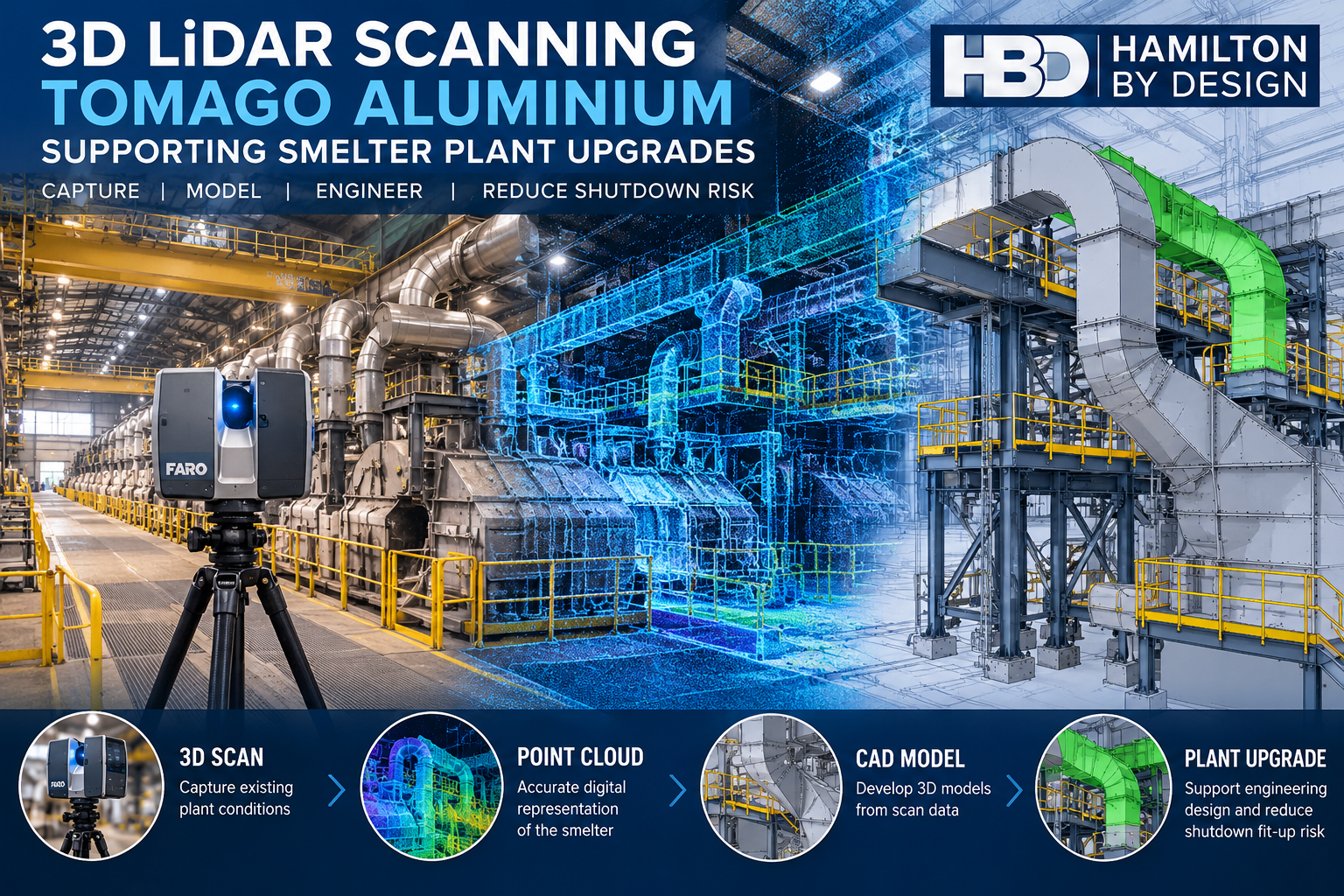
Hamilton By Design offers an integrated workflow that combines site measurement, point cloud processing, mechanical engineering and drawing development.
Stage 1 – Site Assessment
Establish the scanning scope, project objectives, required deliverables, site access and dimensional accuracy requirements.
Stage 2 – 3D LiDAR Scanning
Capture accessible existing equipment, pipework, structures and surrounding infrastructure using terrestrial laser scanning equipment.
Stage 3 – Point Cloud Registration
Process and register the scan data to develop a coordinated digital reference of the scanned plant areas.
Stage 4 – Scan-to-CAD Modelling
Convert relevant point cloud information into 3D CAD models using engineering software such as SolidWorks and AutoCAD.
Stage 5 – Mechanical Engineering Design
Develop proposed equipment modifications, assess available clearances and review the arrangement against the existing plant geometry.
Stage 6 – Engineering Drawing Development
Prepare agreed general arrangement drawings, fabrication drawings and other project documentation.
This coordinated approach helps reduce repeated site measurement and provides continuity between dimensional capture and engineering design.
3D Scanning and Mechanical Engineering Deliverables
Depending on project requirements, Hamilton By Design can provide:
- Registered 3D point cloud files in E57 and RCP formats.
- 3D CAD models of existing mechanical equipment and structures.
- STEP and Parasolid models for engineering coordination.
- AutoCAD general arrangement drawings.
- Mechanical equipment modification drawings.
- Fabrication drawings for defined components.
- Navisworks-compatible models for design coordination.
- PDF drawing packages for project review and controlled issue.
The required level of detail, modelling scope and dimensional tolerances are established during project planning.
Engineering Experience Beyond 3D Scanning
Hamilton By Design combines dimensional measurement technology with practical mechanical engineering experience.
Our capabilities extend beyond collecting point cloud information to include mechanical design, reverse engineering, equipment modifications, engineering modelling and fabrication documentation.
We understand that successful plant modifications require more than a visually accurate 3D model.
Engineering teams also need to consider installation access, equipment interfaces, fabrication methods, structural support arrangements, maintenance requirements and operational constraints.
By combining scanning and mechanical engineering services, Hamilton By Design can support projects from existing-condition capture through to design and drawing development.
3D LiDAR Scanning Across Tomago, Newcastle and the Hunter Region
Hamilton By Design supports industrial engineering projects throughout Tomago and the surrounding Hunter Region.
Our services are relevant to facilities and contractors operating in:
- Tomago
- Newcastle
- Hexham
- Beresfield
- Mayfield
- Kooragang Island
- Williamtown
- Raymond Terrace
- Port Stephens
- The broader Hunter Region
We support projects involving aluminium production, industrial manufacturing, mining, mineral processing, material handling and heavy industrial maintenance.
Frequently Asked Questions
Can 3D LiDAR scanning be completed in an operating aluminium smelter?
Scanning may be possible during normal operations, depending on site access, safety requirements and environmental conditions. Heat, electromagnetic interference, moving equipment and restricted access areas must be assessed before mobilisation.
Can 3D scanning help with replacement ductwork?
Yes. Scanning can capture accessible existing ductwork and surrounding infrastructure to support replacement duct design, transition development and installation planning. Critical fabrication interfaces may require additional verification.
Can point cloud data be used to develop fabrication drawings?
Yes. Point cloud information can provide the basis for 3D CAD modelling and fabrication drawing development. Required dimensions and connection details must be verified to the tolerances appropriate for manufacturing.
What accuracy can be expected from industrial 3D LiDAR scanning?
Accuracy depends on equipment, scan distance, environmental conditions, registration quality and the geometry being measured. For larger registered industrial datasets, approximately ±5–10 mm may be a preliminary planning allowance, but the achievable project accuracy must be assessed and verified. Precision-critical connections may require supplementary measurement.
Can Hamilton By Design provide mechanical engineering as well as scanning?
Yes. Hamilton By Design provides 3D LiDAR scanning, scan-to-CAD modelling, mechanical equipment design, reverse engineering, general arrangement drawings and fabrication documentation.
Can 3D scanning reduce shutdown delays?
3D scanning can help identify dimensional conflicts before installation, reducing the risk of avoidable site rework. Actual time savings depend on the project scope, engineering verification and shutdown execution.
Discuss Your Tomago Aluminium Smelter Upgrade
Whether your project involves replacement ductwork, conveyor modifications, pipework changes, mechanical equipment replacement or structural support arrangements, accurate existing-condition information is an important starting point.
Hamilton By Design provides 3D LiDAR scanning and mechanical engineering services to support industrial plant upgrades in Tomago, Newcastle and the Hunter Region.
We can assist with capturing existing plant geometry, developing 3D CAD models, reviewing proposed equipment arrangements and preparing engineering drawings.
Contact Hamilton By Design to discuss your next industrial scanning or mechanical engineering project.
Website: https://www.hamiltonbydesign.com.au/
Hamilton By Design is an independent engineering service provider. This article describes services applicable to aluminium smelting facilities and does not imply an existing commercial relationship with Tomago Aluminium.
Contact Us – Talk To Us
Our clients: