Wastewater Treatment Plant LiDAR Scanning in Sydney NSW โ€“ Engineering Accuracy for Complex Brownfield Upgrades

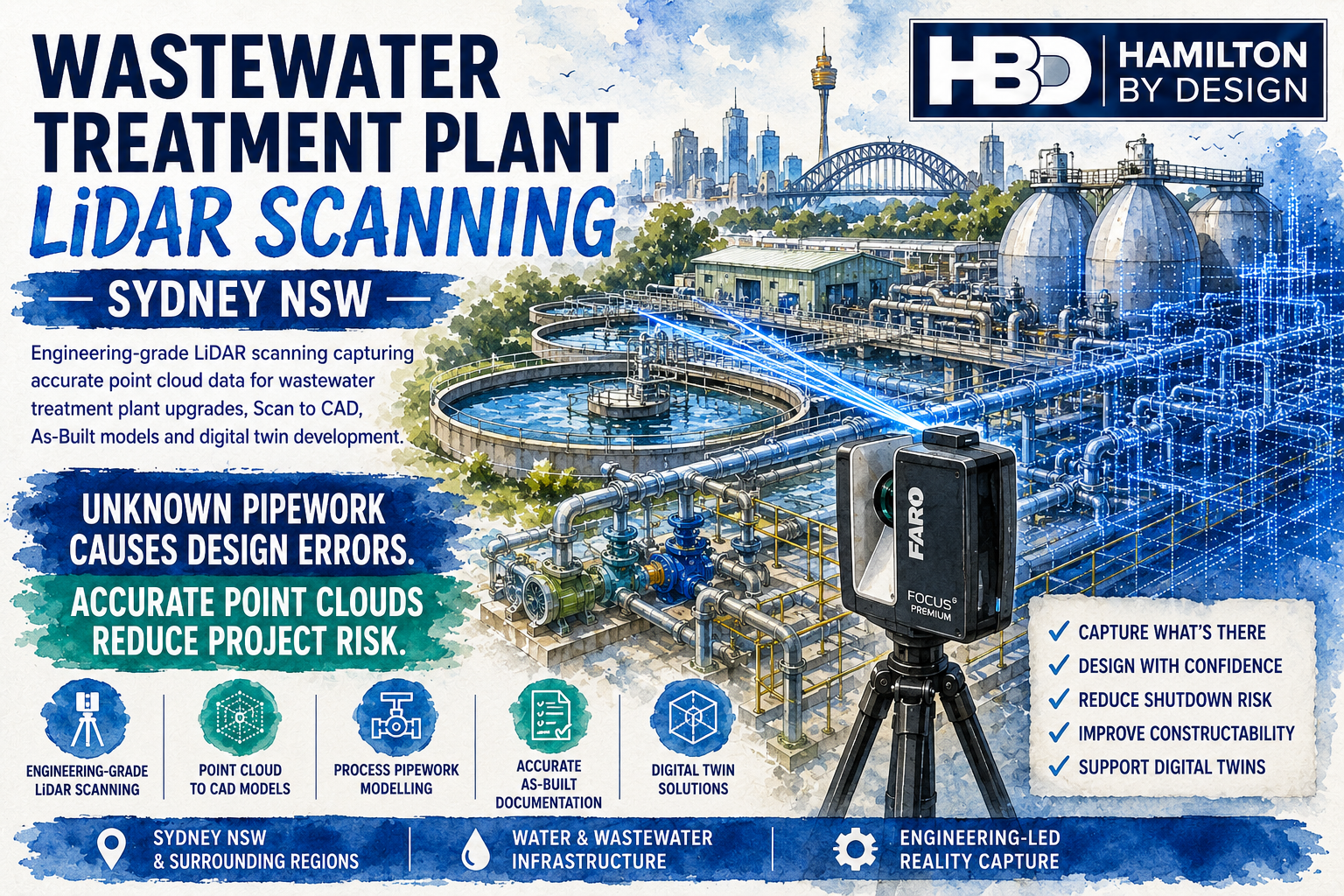
Engineering-grade LiDAR scanning at a Sydney wastewater treatment plant, capturing process pipework, tanks, pumps and equipment to create accurate point cloud data for As-Built models, Scan to CAD and digital twin development.

Wastewater treatment plants are among the most complex industrial facilities in Australia. They contain thousands of interconnected assets, including pumps, tanks, pipework, valves, digesters, blowers, electrical equipment, structural steel and process instrumentation. Many of Sydney’s wastewater treatment plants have evolved over decades, with continual upgrades, maintenance activities and emergency repairs altering the original plant layout.

Unfortunately, the engineering documentation often fails to keep pace with these changes.

One of the most common challenges facing engineers working on wastewater treatment plants is not knowing the exact location of existing pipework and equipment. Drawings may be outdated, undocumented modifications may have occurred during previous shutdowns, and temporary installations may have become permanent. When engineering teams rely on inaccurate information, the result is design errors, construction delays, costly rework and extended shutdowns.

Hamilton By Design provides engineering-grade Wastewater Treatment Plant LiDAR Scanning Services throughout Sydney NSW, delivering accurate point cloud data and reality capture that forms the foundation for reliable engineering design, Scan to CAD workflows, digital twins and future plant upgrades.


The Challenge of Existing Wastewater Infrastructure

Unlike greenfield projects where everything is designed from a clean slate, wastewater treatment plants present a true brownfield engineering environment.

Facilities are continually modified to improve capacity, meet environmental regulations and replace ageing assets. These modifications may include:

  • Replacement pumps
  • New process pipework
  • Chemical dosing systems
  • Additional valves
  • Electrical upgrades
  • Instrumentation changes
  • Structural steel modifications
  • Access platforms
  • Pipe bridges
  • Temporary bypass systems
  • Maintenance repairs

While these improvements keep the plant operating efficiently, they also create a significant challenge.

The original drawings rarely represent the current plant configuration.

Engineers designing future upgrades often discover that equipment is not where the drawings indicate, pipework has been rerouted and structural elements have changed considerably since construction.


Why Unknown Pipework Creates Expensive Problems

Pipework is the backbone of every wastewater treatment plant.

Unknown pipe locations can create serious engineering issues including:

  • Pipe clashes during installation
  • Incorrect spool fabrication
  • Valve interference
  • Equipment access restrictions
  • Foundation conflicts
  • Structural clashes
  • Maintenance clearance problems
  • Shutdown delays
  • Additional site welding
  • Emergency redesign

Even a small discrepancy in pipe alignment can require extensive fabrication changes during installation.

These problems become significantly more expensive once contractors are mobilised and the plant is offline.


Engineering LiDAR Scanning Removes Uncertainty

Hamilton By Design uses high-resolution terrestrial LiDAR scanners to accurately capture the entire wastewater treatment facility.

Rather than collecting isolated survey points, LiDAR scanning records millions of highly accurate measurements across every visible surface.

This includes:

  • Process pipework
  • Pumps
  • Blowers
  • Clarifiers
  • Digesters
  • Tanks
  • Screens
  • Conveyors
  • Valves
  • Structural steel
  • Pipe supports
  • Access platforms
  • Handrails
  • Stairways
  • Electrical switchrooms
  • Cable trays
  • Instrumentation
  • Concrete structures

The result is a highly detailed point cloud representing the facility exactly as it exists today.


Engineering Applications

Plant Upgrades

As treatment capacity increases, plants require continual expansion.

LiDAR scanning provides engineers with accurate existing-condition data before detailed design begins.


Pump Replacements

Pump replacement projects benefit from accurate verification of:

  • Baseplate locations
  • Pipe flange alignment
  • Maintenance clearances
  • Motor access
  • Lifting paths

Replacement equipment can be designed around actual site conditions rather than outdated drawings.


Pipework Modifications

New process improvements frequently require:

  • Additional pipelines
  • Larger pipe diameters
  • Bypass systems
  • New isolation valves
  • Flow measurement equipment
  • Chemical dosing lines

Point cloud data ensures new pipework integrates correctly with existing infrastructure.


Structural Modifications

Engineering upgrades often require:

  • New maintenance platforms
  • Pipe supports
  • Equipment frames
  • Walkways
  • Ladders
  • Access stairs

LiDAR scanning accurately captures existing structural steel for seamless integration.


Electrical and Instrumentation

Reality capture also supports:

  • Cable tray routing
  • MCC upgrades
  • Instrument relocation
  • Electrical design
  • Control system upgrades

Designers can verify available space before construction begins.


Accurate Point Cloud Data for Engineering Design

The value of LiDAR scanning extends well beyond visualisation.

Accurate point cloud data enables engineers to:

  • Measure existing equipment
  • Verify pipe routing
  • Confirm elevations
  • Check structural geometry
  • Review maintenance access
  • Identify clashes
  • Plan installations
  • Validate design assumptions

Because measurements can be taken directly from the point cloud, engineers spend less time returning to site and more time designing solutions.


Scan to CAD Services

Hamilton By Design transforms point cloud data into engineering-ready deliverables.

Typical outputs include:

  • Intelligent 3D CAD models
  • General Arrangement drawings
  • Equipment layouts
  • Pipework models
  • Structural steel models
  • Plant sections
  • Elevations
  • Fabrication drawings
  • Asset registers
  • As-built documentation

These deliverables integrate with modern engineering software including SOLIDWORKS, Autodesk Inventor, AutoCAD, Navisworks and ReCap.


Supporting Digital Twin Development

Water utilities across Australia are increasingly adopting digital twin technology.

LiDAR scanning provides the accurate geometric foundation for these digital assets.

Digital twins support:

  • Asset management
  • Maintenance planning
  • Capital works
  • Lifecycle management
  • Operator training
  • Shutdown planning
  • Future engineering design
  • Regulatory compliance

Instead of relying on historical drawings, digital twins represent the facility exactly as it exists.


Reducing Shutdown Risk

Wastewater treatment plants typically operate continuously, making shutdown windows extremely valuable.

Every hour of delay increases project costs.

Engineering-grade LiDAR scanning reduces shutdown risk by allowing designers to:

  • Verify equipment locations
  • Perform clash detection
  • Optimise installation sequences
  • Confirm maintenance access
  • Validate fabrication before delivery

Many construction issues can therefore be resolved during design rather than during installation.


Supporting Brownfield Engineering Projects

Brownfield engineering demands accurate information.

Hamilton By Design supports projects including:

  • Plant expansions
  • Process upgrades
  • Mechanical replacements
  • Structural modifications
  • Pipework redesign
  • Electrical upgrades
  • Asset verification
  • Condition assessments

Accurate reality capture significantly improves engineering confidence throughout the project lifecycle.


Typical Workflow

Our wastewater treatment plant scanning workflow includes:

1. Project Planning

Review project objectives, operational constraints and shutdown requirements.

2. Site LiDAR Scanning

Capture all required plant areas using engineering-grade terrestrial laser scanning.

3. Point Cloud Registration

Register individual scans into one accurate coordinate system.

4. Quality Assurance

Verify scan accuracy, completeness and registration quality.

5. Engineering Modelling

Develop CAD models, layouts and engineering documentation from the point cloud.

6. Design Integration

Use verified existing conditions for mechanical, structural and process design.

7. Construction Verification

Review proposed modifications against existing infrastructure before fabrication.


Why Choose Hamilton By Design?

Hamilton By Design combines engineering expertise with advanced reality capture technology.

Our capabilities include:

  • Engineering-grade terrestrial LiDAR scanning
  • Wastewater infrastructure surveying
  • Scan to CAD
  • Reverse engineering
  • Mechanical engineering
  • Structural engineering support
  • Engineering drafting
  • As-built documentation
  • Digital twin development
  • Brownfield engineering
  • Shutdown planning support

Because our team understands industrial engineering, we capture the information designers actually requireโ€”not simply visual data.


Supporting Sydney’s Wastewater Infrastructure

Sydney’s wastewater treatment plants are critical to protecting public health, supporting population growth and maintaining environmental compliance. As these facilities continue to modernise, reliable engineering information becomes essential for successful upgrades.

Unknown pipework and undocumented equipment locations should never compromise engineering design.

Engineering-grade LiDAR scanning provides accurate point cloud data that replaces uncertainty with confidence. By capturing every visible asset in its true position, Hamilton By Design helps engineers reduce design errors, improve constructability and minimise costly site modifications.

Whether your project involves replacing pumps, upgrading treatment processes, modifying pipework or developing a digital twin, our engineering-led LiDAR scanning services deliver the accurate existing-condition data required for successful project outcomes.

If you’re planning a wastewater treatment plant upgrade in Sydney NSW, Hamilton By Design can provide the engineering-grade reality capture, Scan to CAD modelling and As-Built documentation needed to ensure your design is based on the facility as it exists todayโ€”not as it was drawn years ago.

Talk to Us – Contact Us

Name
Would you like us to arrange a phone consultation for you?
Address

Our clients:


Talk to Us – Contact Us

Name
Would you like us to arrange a phone consultation for you?
Address

Our clients:


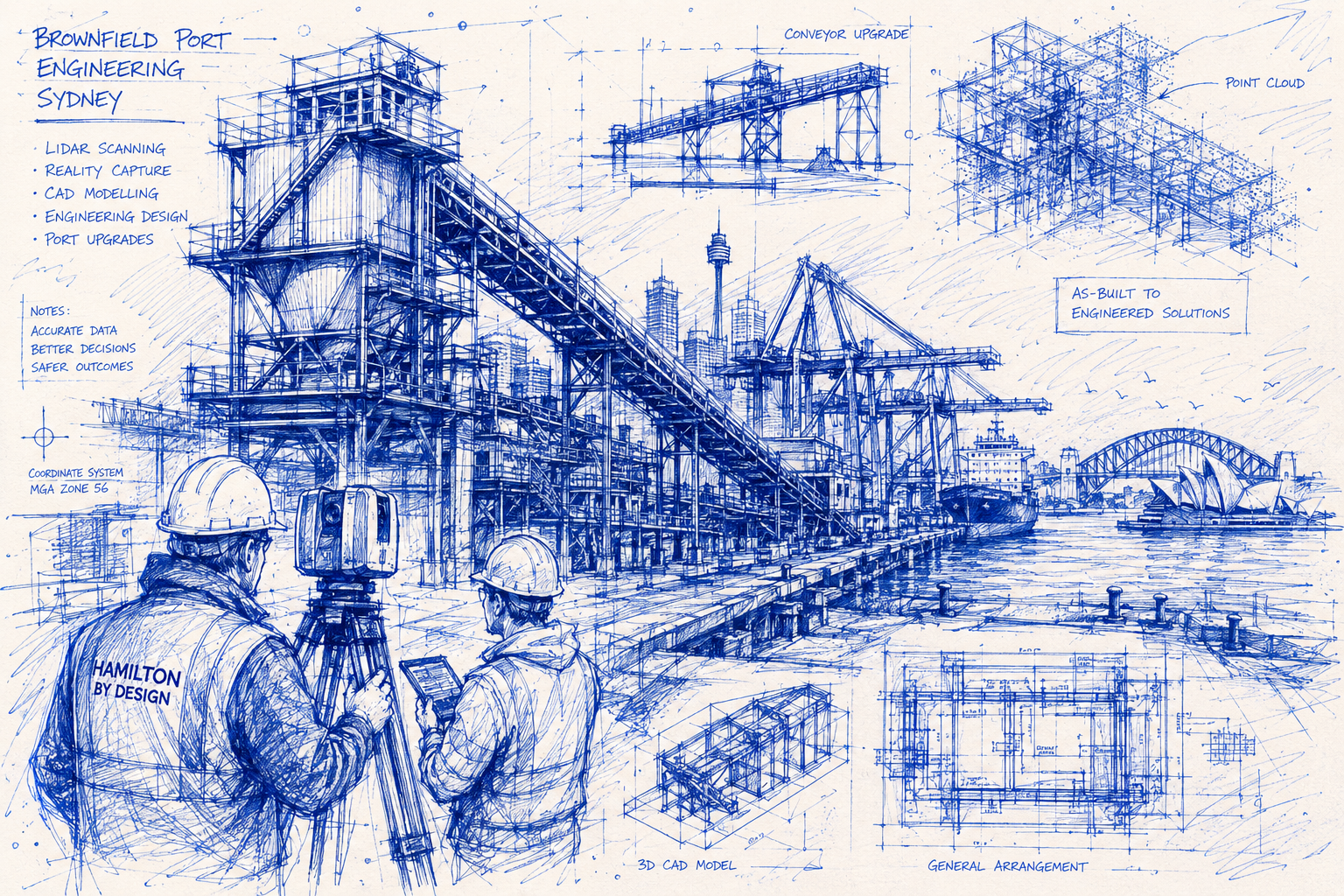
Brownfield Port Engineering Services in Sydney

Blue pen and ink illustration of a Sydney brownfield port engineering project showing LiDAR scanning, point cloud modelling, CAD design and port infrastructure upgrades with conveyors, cranes, wharves and engineering drawings.

Hamilton By Design provides engineering solutions for brownfield port upgrades throughout Sydney using engineering-grade LiDAR scanning, reality capture, CAD modelling, reverse engineering and mechanical design services. We help port operators, engineering consultants, infrastructure owners and contractors accurately capture existing conditions and develop practical engineering solutions for modifications, upgrades and asset management projects.

Brownfield engineering projects differ significantly from greenfield developments because they involve working within existing operational facilities. Existing infrastructure often contains undocumented modifications, outdated drawings, restricted access areas and complex interfaces between new and existing assets. Our engineering-led approach combines 3D laser scanning, CAD modelling and engineering design to reduce project risk and improve project outcomes.

Whether upgrading a conveyor system, replacing mechanical equipment, modifying a ship loader, installing new pipework or documenting existing infrastructure, Hamilton By Design delivers accurate information that supports successful project execution.


Engineering Solutions for Sydney Port Infrastructure

Sydney is home to a wide range of port and maritime infrastructure including:

  • Container terminals
  • Bulk material handling facilities
  • Fuel terminals
  • Storage and logistics facilities
  • Wharf structures
  • Berths and jetties
  • Ship loading facilities
  • Conveyor systems
  • Pump stations
  • Utility infrastructure
  • Mechanical handling equipment

Many of these facilities have evolved over decades and contain multiple generations of modifications. Original engineering drawings are often incomplete, inaccurate or unavailable. This creates significant challenges when planning upgrades, shutdown works and asset replacement projects.

Our brownfield port engineering services provide accurate site information and engineering documentation that enables confident design decisions.


Why Brownfield Port Projects Require Accurate Site Data

One of the biggest risks in any brownfield engineering project is relying on outdated information.

Existing drawings frequently fail to reflect:

  • Structural modifications
  • Equipment replacements
  • Pipework rerouting
  • Utility relocations
  • Maintenance alterations
  • Temporary works that became permanent

When engineering decisions are based on inaccurate information, projects can experience:

  • Design clashes
  • Construction delays
  • Increased costs
  • Installation difficulties
  • Additional shutdown requirements

Hamilton By Design uses terrestrial LiDAR scanning to create highly accurate digital representations of existing facilities, allowing engineering teams to work from verified site conditions rather than assumptions.


LiDAR Scanning for Brownfield Port Engineering Sydney

LiDAR scanning is typically the first stage of a brownfield port engineering project.

Using advanced terrestrial laser scanners, millions of measurements are captured across an operating facility to generate a detailed 3D point cloud.

Typical Sydney port scanning applications include:

  • Conveyor systems
  • Ship loaders and unloaders
  • Transfer stations
  • Structural steelwork
  • Wharf infrastructure
  • Pipework systems
  • Storage facilities
  • Marine mechanical equipment
  • Maintenance access structures
  • Utility corridors

The resulting point cloud becomes a digital twin of the facility that can be used throughout the engineering lifecycle.

Typical LiDAR Deliverables

Clients can receive:

  • E57 point cloud files
  • RCP and RCS files
  • LAS point clouds
  • Registered scan datasets
  • Site measurements
  • Asset verification reports
  • As-built documentation
  • Clash detection models

These deliverables can be integrated directly into engineering workflows.


Scan to CAD Modelling for Existing Port Assets

Once scanning is complete, the point cloud can be converted into engineering-ready CAD models.

This process creates accurate representations of:

  • Mechanical equipment
  • Structural steelwork
  • Pipework systems
  • Conveyors
  • Platforms
  • Access systems
  • Buildings
  • Utility infrastructure

Our engineering team develops models using industry-standard software including:

  • SolidWorks
  • Autodesk Inventor
  • AutoCAD
  • Autodesk ReCap
  • Navisworks

The resulting models provide an accurate foundation for engineering design and project planning.


Engineering Design for Brownfield Port Upgrades

Hamilton By Design supports a wide range of brownfield engineering projects throughout Sydney’s port and maritime sectors.

Mechanical Engineering Design

Mechanical engineering services may include:

  • Conveyor upgrades
  • Chute redesigns
  • Transfer station modifications
  • Equipment replacements
  • Maintenance access improvements
  • Materials handling improvements
  • Mechanical plant modifications
  • Pumping systems

Every design is developed using verified site conditions to minimise risk during installation.

Structural Engineering Support

Structural engineering support may include:

  • Platform design
  • Walkway modifications
  • Handrail systems
  • Equipment support structures
  • Maintenance access systems
  • Structural steel modifications
  • Wharf equipment support frames

Existing structures can be assessed and modelled to support future upgrade works.


Brownfield Port Upgrade Workflow

Hamilton By Design follows a structured workflow that ensures engineering decisions are based on accurate information.

1. Project Review

We review:

  • Existing drawings
  • Asset information
  • Site requirements
  • Operational constraints
  • Project objectives

This ensures the capture scope aligns with project requirements.

2. Site Capture

Engineering-grade LiDAR scanning is completed on site.

Data collection may occur during:

  • Normal operations
  • Maintenance shutdowns
  • Restricted access periods
  • Staged upgrade projects

3. Point Cloud Processing

Captured scan data is registered and processed to create a unified digital representation of the facility.

Quality checks are performed to verify registration accuracy.

4. Existing Conditions Modelling

The point cloud is converted into:

  • As-built CAD models
  • General arrangement drawings
  • Existing condition layouts
  • Structural models
  • Mechanical models

5. Engineering Design

Design concepts are developed directly within the verified digital environment.

This allows engineers to identify potential issues before fabrication begins.

6. Clash Detection and Verification

New equipment and structures are checked against existing infrastructure.

This process helps avoid:

  • Installation clashes
  • Structural conflicts
  • Pipework interference
  • Access restrictions

7. Final Documentation

Project deliverables are prepared for procurement, fabrication and construction activities.


Deliverables for Brownfield Port Engineering Projects

Depending on project requirements, clients may receive:

Reality Capture Deliverables

  • E57 files
  • RCP files
  • RCS files
  • LAS files
  • Registered point clouds

CAD Deliverables

  • DWG drawings
  • DXF drawings
  • 3D CAD models
  • STEP files
  • Parasolid files
  • SAT files

Engineering Documentation

  • General arrangement drawings
  • Fabrication drawings
  • Installation drawings
  • Structural details
  • Mechanical details
  • Engineering reports

These deliverables support engineering, construction and asset management activities.


Industries We Support

Hamilton By Design provides brownfield engineering services to a wide range of industries including:

  • Ports and marine infrastructure
  • Container terminals
  • Bulk materials handling facilities
  • Logistics operations
  • Manufacturing facilities
  • Mining export terminals
  • Fuel handling facilities
  • Water and utility infrastructure
  • Government infrastructure assets

Our experience working within operational industrial environments allows us to deliver practical engineering outcomes with minimal disruption to operations.


Hamilton By Design logo displayed on a blue tilted rectangle with a grey gradient background

Why Choose Hamilton By Design for Brownfield Port Engineering Sydney

Brownfield engineering projects require more than traditional design capabilities. They require accurate site information, a strong understanding of existing infrastructure and practical engineering experience.

Hamilton By Design combines:

  • Engineering-led LiDAR scanning
  • Scan-to-CAD modelling
  • Mechanical engineering expertise
  • Structural drafting support
  • Reverse engineering capabilities
  • Reality capture workflows
  • Industrial project experience

By integrating site capture and engineering design into a single workflow, we help Sydney port operators and infrastructure owners reduce project risk, improve design accuracy and achieve successful upgrade outcomes.

If you are planning a brownfield port upgrade in Sydney and require accurate site capture, CAD modelling or engineering support, Hamilton By Design can provide the engineering-grade information needed to move your project forward with confidence.


Talk to Us – Contact Us

Name
Would you like us to arrange a phone consultation for you?
Address

Our clients:


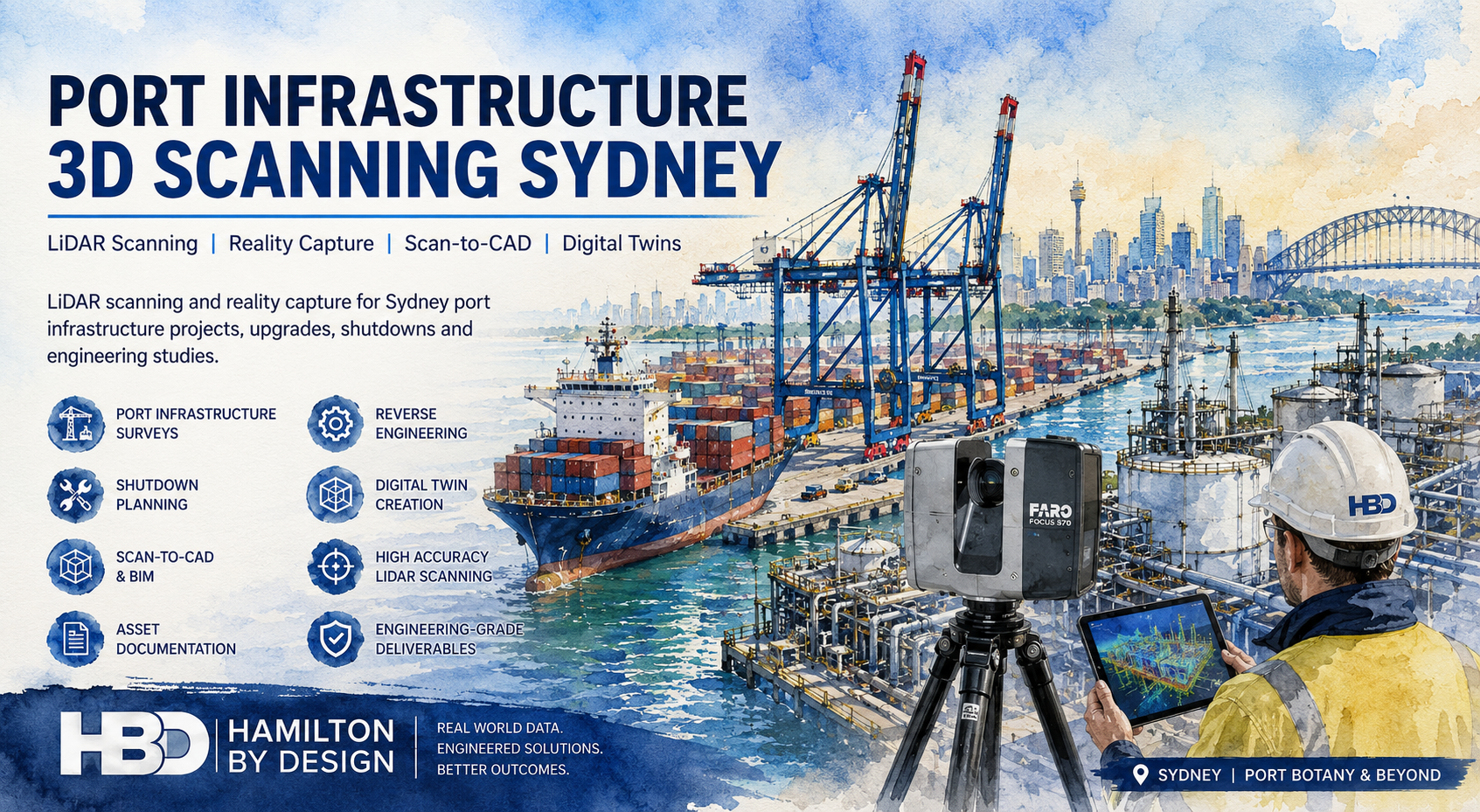
Port Infrastructure 3D Scanning Sydney

Watercolour illustration of Sydney port infrastructure showing container cranes, cargo vessels, tank farms, pipelines and a FARO Focus S70 laser scanner capturing reality capture data for port infrastructure engineering projects. Hamilton By Design Port Infrastructure 3D Scanning Sydney services.

Hamilton By Design provides professional Port Infrastructure 3D Scanning Sydney services for port operators, engineering consultants, contractors, infrastructure owners and industrial facilities throughout Sydney and New South Wales. Using engineering-grade terrestrial LiDAR scanning and reality capture technology, we accurately document existing conditions and create reliable digital datasets that support maintenance, shutdowns, upgrades, asset management and future development projects.

Our scanning services capture highly accurate measurements of wharves, container terminals, bulk handling facilities, rail infrastructure, tank farms, marine structures, conveyors, pipework and industrial assets. The resulting point cloud data can be converted into CAD drawings, BIM models, digital twins, engineering documentation and asset management systems.

Whether your project involves a major terminal upgrade, a brownfield expansion, shutdown planning or reverse engineering of existing assets, Hamilton By Design delivers accurate reality capture data to reduce project risk and improve engineering outcomes.


Engineering-Grade Reality Capture for Sydney Port Infrastructure

Sydney is home to some of Australia’s most critical maritime and logistics infrastructure. Facilities such as Port Botany, intermodal terminals, rail infrastructure, fuel terminals and marine assets are continuously upgraded to meet increasing operational demands.

Many of these facilities have evolved over decades, resulting in incomplete documentation and modifications that differ significantly from original drawings. Engineering projects often require accurate existing-condition information before design work can commence.

3D LiDAR scanning solves this problem by capturing millions of measurement points and creating an accurate digital representation of the facility.

This information becomes the foundation for:

  • Engineering design
  • Asset management
  • Maintenance planning
  • Shutdown preparation
  • Structural modifications
  • Equipment upgrades
  • Construction verification
  • Digital twin development

Port Infrastructure Assets We Scan

Hamilton By Design performs reality capture of a wide range of port and marine infrastructure assets throughout Sydney.

Container Terminals

Container terminals contain complex infrastructure requiring accurate documentation for future upgrades and maintenance projects.

Assets commonly scanned include:

  • Container cranes
  • Rail-mounted gantries
  • Container stacking yards
  • Maintenance facilities
  • Service corridors
  • Electrical infrastructure
  • Stormwater systems

Wharf and Berth Infrastructure

Marine infrastructure often requires detailed surveys to support inspections, maintenance and expansion projects.

Examples include:

  • Wharves
  • Berths
  • Jetties
  • Dolphins
  • Fender systems
  • Mooring structures
  • Access walkways

Bulk Materials Handling Facilities

Bulk handling infrastructure is ideally suited to 3D scanning due to its complexity and ongoing modification requirements.

Typical assets include:

  • Conveyors
  • Transfer towers
  • Chutes
  • Hoppers
  • Ship loaders
  • Stackers
  • Reclaimers

Tank Farms and Fuel Terminals

Storage and fuel facilities require accurate engineering information for maintenance and compliance projects.

Common assets include:

  • Storage tanks
  • Pipe racks
  • Pump stations
  • Loading facilities
  • Valve stations
  • Fire systems
  • Structural steel platforms

Rail and Intermodal Infrastructure

Port-related rail infrastructure often requires accurate as-built documentation for upgrades and future expansion.

Assets may include:

  • Rail sidings
  • Intermodal terminals
  • Service facilities
  • Signalling structures
  • Maintenance depots

Why Use 3D LiDAR Scanning for Port Infrastructure?

Accurate Existing Conditions

Many engineering projects fail because the actual site differs from available drawings.

LiDAR scanning captures the true condition of the facility, allowing engineers to design using real-world information.

Reduced Project Risk

Accurate site data reduces:

  • Design clashes
  • Site rework
  • Installation delays
  • Construction variations
  • Fabrication errors

Improved Safety

Field measurements in operational ports can expose personnel to moving equipment, vehicle traffic, elevated structures and restricted areas.

Laser scanning significantly reduces the amount of time required on-site.

Faster Engineering Delivery

Once captured, point cloud data can be accessed repeatedly without returning to site, allowing engineers and designers to obtain measurements directly from the digital model.

Long-Term Asset Records

The scan becomes a permanent digital record of the facility at the time of capture and can support future maintenance and upgrade projects.


Supporting Port Shutdowns and Maintenance Projects

Shutdowns are among the most time-critical activities undertaken within port infrastructure environments.

Every hour of downtime can result in significant operational costs.

LiDAR scanning supports shutdown planning by providing:

  • Accurate existing-condition models
  • Installation planning
  • Equipment replacement studies
  • Structural verification
  • Prefabrication support
  • Clash detection
  • Construction sequencing

Engineering teams can review and plan modifications before arriving on site, reducing shutdown durations and improving project certainty.


Scan to CAD Services for Port Infrastructure

Point cloud data can be converted into detailed engineering documentation suitable for maintenance, upgrades and future design projects.

Typical deliverables include:

  • Site plans
  • General arrangement drawings
  • Structural layouts
  • Equipment layouts
  • Pipework documentation
  • Existing-condition drawings
  • Sections and elevations

Output formats include:

  • DWG
  • DXF
  • PDF
  • AutoCAD models

Scan-to-CAD services provide engineering teams with accurate documentation for facilities where drawings may be outdated or unavailable.


Scan to BIM and Digital Twin Development

Many infrastructure owners are adopting BIM and digital twin strategies to improve asset management and long-term planning.

Hamilton By Design can convert point cloud data into:

  • BIM models
  • Revit models
  • Asset information models
  • Digital twins
  • Facilities management datasets

These models assist with:

  • Asset lifecycle management
  • Maintenance planning
  • Future upgrades
  • Risk management
  • Operational decision making

Reverse Engineering and Engineering Support

One of the major advantages of working with Hamilton By Design is the ability to combine reality capture with engineering expertise.

In addition to scanning, we can assist with:

  • Mechanical engineering
  • Reverse engineering
  • Structural design support
  • CAD modelling
  • Fabrication drawings
  • Equipment redesign
  • Asset verification

Where original drawings no longer exist, scanned data can be used to recreate components and assemblies for manufacture.

Typical reverse engineering projects include:

  • Pump components
  • Conveyor equipment
  • Structural steel assemblies
  • Marine infrastructure
  • Mechanical systems

Our Port Infrastructure Scanning Process

1. Project Planning

We review project requirements, access constraints, safety requirements and deliverables.

2. Site Capture

Engineering-grade LiDAR scanners are used to capture the required infrastructure with complete coverage.

3. Registration and Processing

Individual scans are registered into a unified point cloud and processed for engineering use.

4. Modelling and Documentation

The point cloud is converted into CAD drawings, BIM models or engineering deliverables as required.

5. Delivery

Final deliverables are supplied in formats suitable for engineering, construction and asset management teams.


Deliverables

Hamilton By Design can provide:

  • E57 point clouds
  • RCP files
  • RCS files
  • LAS files
  • AutoCAD DWG files
  • DXF files
  • PDF drawings
  • Navisworks models
  • Revit models
  • SolidWorks models
  • STEP files
  • Parasolid files
  • General arrangement drawings
  • Asset verification reports

Hamilton By Design logo displayed on a blue tilted rectangle with a grey gradient background

Sydney Port Infrastructure 3D Scanning Services

Hamilton By Design provides professional Port Infrastructure 3D Scanning Sydney services for container terminals, marine infrastructure, logistics facilities, fuel terminals, rail assets and industrial facilities throughout Sydney and New South Wales.

Our engineering-led approach combines LiDAR scanning, Scan-to-CAD, Scan-to-BIM, reverse engineering and mechanical engineering expertise to deliver practical outcomes for infrastructure owners, operators and contractors.

Whether you are planning a shutdown, upgrading existing facilities, developing a digital twin or undertaking a major engineering project, Hamilton By Design can provide the accurate reality capture data required to support informed decision-making and successful project delivery.

Talk to Us – Contact Us

Name
Would you like us to arrange a phone consultation for you?
Address

Our clients:


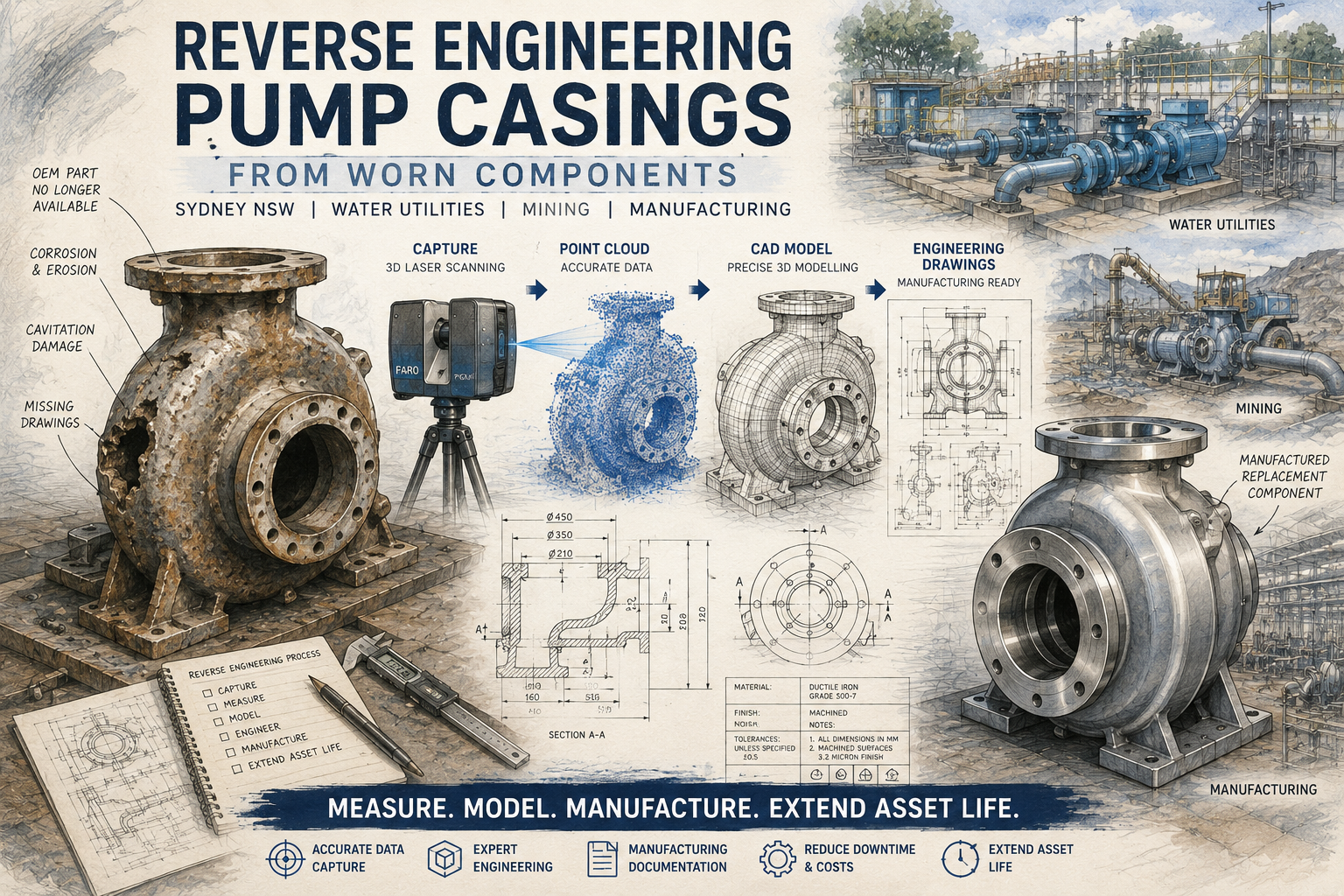
Reverse Engineering Pump Casings from Worn Components Sydney NSW

Reverse engineering worn pump casings from existing components using 3D laser scanning, CAD modelling and engineering drawings in Sydney NSW

Reverse Engineering Worn Pump Casings and Housings to Reduce Downtime and Avoid Costly Replacements

Pump and Motor Assembly Icon for Reverse Engineering and Water Infrastructure Engineering Services

Hamilton By Design provides reverse engineering services for worn pump casings, pump housings and obsolete pump components throughout Sydney NSW. Using engineering-grade 3D laser scanning, precision measurement, CAD modelling and engineering analysis, we recreate pump casings and associated components from existing assets when original drawings are unavailable, OEM support has ceased or replacement components are no longer manufactured.

Many water utilities, mining operations, industrial facilities and manufacturing plants rely on pumps that have been operating for decades. While pumps may remain structurally serviceable, pump casings often experience wear, corrosion, erosion, cavitation damage and mechanical deterioration. In many cases, replacement casings are unavailable or have excessive lead times, creating operational risks and unplanned downtime.

Hamilton By Design helps asset owners extend equipment life by reverse engineering worn components and producing manufacturing-ready documentation for replacement parts.


Why Reverse Engineer Pump Casings?

Pump casings are critical components that contain and direct fluid flow through centrifugal pumps and other pumping systems. Over time, exposure to abrasive materials, corrosive environments and continuous operation can result in significant wear and damage.

Common reasons for reverse engineering pump casings include:

  • OEM support no longer available
  • Replacement components obsolete
  • Original manufacturer no longer exists
  • Long lead times for imported parts
  • Missing engineering drawings
  • Emergency breakdown situations
  • Asset replacement costs are excessive
  • Critical infrastructure requires ongoing operation

Rather than replacing an entire pumping system, reverse engineering enables replacement casings to be manufactured while retaining existing infrastructure.


Industries We Support

Water Utilities

Water treatment plants, wastewater treatment facilities and sewer pump stations often contain legacy pumping equipment that remains operational but suffers from casing wear and corrosion.

Reverse engineering allows water utilities to maintain service reliability while avoiding premature asset replacement.

Mining Operations

Mining pumps operate in some of the harshest environments, handling abrasive slurries, process water and aggressive materials.

Pump casings frequently experience wear caused by:

  • Abrasive solids
  • High flow velocities
  • Corrosion
  • Cavitation
  • Impact damage

Reverse engineering supports ongoing maintenance and asset life extension within mining operations.

Manufacturing Facilities

Industrial processing plants rely on pumps for water transfer, chemical processing, cooling systems and manufacturing operations.

When replacement casings are unavailable, reverse engineering provides a practical solution to minimise downtime and maintain production.


Reverse Engineering from Worn Components

A common misconception is that reverse engineering requires a perfect original component.

In reality, Hamilton By Design can develop accurate replacement designs from worn, damaged or partially deteriorated components.

Our engineers assess:

  • Existing geometry
  • Wear patterns
  • Remaining wall thickness
  • Original design intent
  • Functional requirements
  • Manufacturing constraints

By combining engineering judgement with modern measurement technology, we reconstruct the original component geometry while incorporating improvements where appropriate.


Reverse Engineering


3D Laser Scanning of Pump Casings

Accurate measurement is the foundation of successful reverse engineering.

Hamilton By Design uses FARO 3D laser scanning technology to capture detailed geometry from existing pump casings and surrounding equipment.

Benefits include:

  • Rapid data capture
  • High accuracy measurements
  • Complex geometry capture
  • Reduced manual measurement errors
  • Accurate digital records
  • Improved engineering outcomes

Laser scanning is particularly valuable when dealing with large pump casings, complex shapes or equipment that remains installed within an operating facility.


Precision Measurement and Verification

In addition to laser scanning, conventional engineering measurement techniques are used where required.

Measurements may include:

  • Bearing locations
  • Shaft centre lines
  • Flange dimensions
  • Mounting interfaces
  • Bolt patterns
  • Wear surfaces
  • Internal geometries

This process ensures all critical dimensions are accurately captured before modelling begins.


CAD Modelling and Reconstruction

Following data capture, pump casings are recreated using advanced engineering software.

Hamilton By Design develops:

  • SolidWorks Models
  • AutoCAD Models
  • STEP Files
  • Parasolid Files
  • Manufacturing Models
  • Assembly Models

During the modelling process, engineers identify and compensate for wear, erosion and distortion to recreate the original design geometry.

Where beneficial, design improvements can also be incorporated to enhance performance and service life.


Engineering Analysis and Material Selection

Pump casing replacement projects often provide an opportunity to improve asset reliability.

Hamilton By Design can assess:

  • Material suitability
  • Corrosion resistance
  • Wear resistance
  • Manufacturing methods
  • Structural performance
  • Operational requirements

Where required, Finite Element Analysis (FEA) can be performed to evaluate stress distribution and verify component performance.

Potential material options may include:

  • Cast Iron
  • Ductile Iron
  • Stainless Steel
  • Duplex Stainless Steel
  • High Chrome Alloys
  • Specialty Wear Resistant Materials

Material selection is based on the operating environment and client requirements.


Manufacturing Documentation

Once the reverse engineering process is complete, Hamilton By Design develops manufacturing-ready documentation suitable for fabrication, machining and casting.

Typical deliverables include:

Engineering Drawings

  • General Arrangement Drawings
  • Manufacturing Drawings
  • Fabrication Drawings
  • Assembly Drawings

Digital Models

  • SolidWorks Files
  • STEP Files
  • Parasolid Files
  • DWG Files
  • DXF Files

Engineering Information

  • Material Specifications
  • Inspection Requirements
  • Critical Dimensions
  • Tolerance Information
  • Engineering Reports

These deliverables enable local or international manufacturers to produce replacement casings accurately and efficiently.


Supporting Asset Life Extension Programs

Many asset owners are under increasing pressure to maximise the value of existing infrastructure while reducing capital expenditure.

Reverse engineering worn pump casings supports:

  • Asset life extension
  • Reduced maintenance costs
  • Reduced downtime
  • Improved reliability
  • Replacement component availability
  • Reduced operational risk

By replacing only the worn components rather than entire pump systems, organisations can achieve significant cost savings while maintaining operational performance.


Typical Reverse Engineering Workflow

1. Component Inspection

Assess the condition of the existing pump casing and identify project objectives.

2. Data Capture

Undertake 3D laser scanning and detailed engineering measurements.

3. Engineering Analysis

Review wear patterns, material performance and operational requirements.

4. CAD Reconstruction

Develop accurate 3D models of the original component.

5. Design Verification

Validate dimensions, fitment and engineering requirements.

6. Manufacturing Documentation

Prepare detailed drawings and manufacturing deliverables.

7. Manufacturing Support

Provide engineering support throughout manufacturing and installation if required.


Why Choose Hamilton By Design?

Hamilton By Design combines practical engineering experience with advanced reverse engineering technology.

Our capabilities include:

  • Reverse Engineering
  • 3D Laser Scanning
  • Scan-to-CAD
  • Mechanical Engineering
  • SolidWorks Modelling
  • AutoCAD Drafting
  • FEA Analysis
  • Manufacturing Documentation
  • Asset Life Extension Engineering

Unlike companies that simply provide measurement services, Hamilton By Design delivers complete engineering solutions from site capture through to manufacturing-ready documentation.


Hamilton By Design logo displayed on a blue tilted rectangle with a grey gradient background

Reverse Engineering Pump Casings Across Sydney NSW

Hamilton By Design supports water utilities, mining operations, manufacturing facilities, engineering consultancies and maintenance contractors throughout Sydney NSW.

Whether you need to replace a worn pump casing, recreate obsolete components, develop manufacturing drawings or extend the life of critical infrastructure assets, our engineering-led reverse engineering services provide practical solutions that reduce downtime and avoid unnecessary asset replacement.

Contact Hamilton By Design to discuss your pump casing reverse engineering project.

Talk to Us – Contact Us

Name
Would you like us to arrange a phone consultation for you?
Address

Our clients:


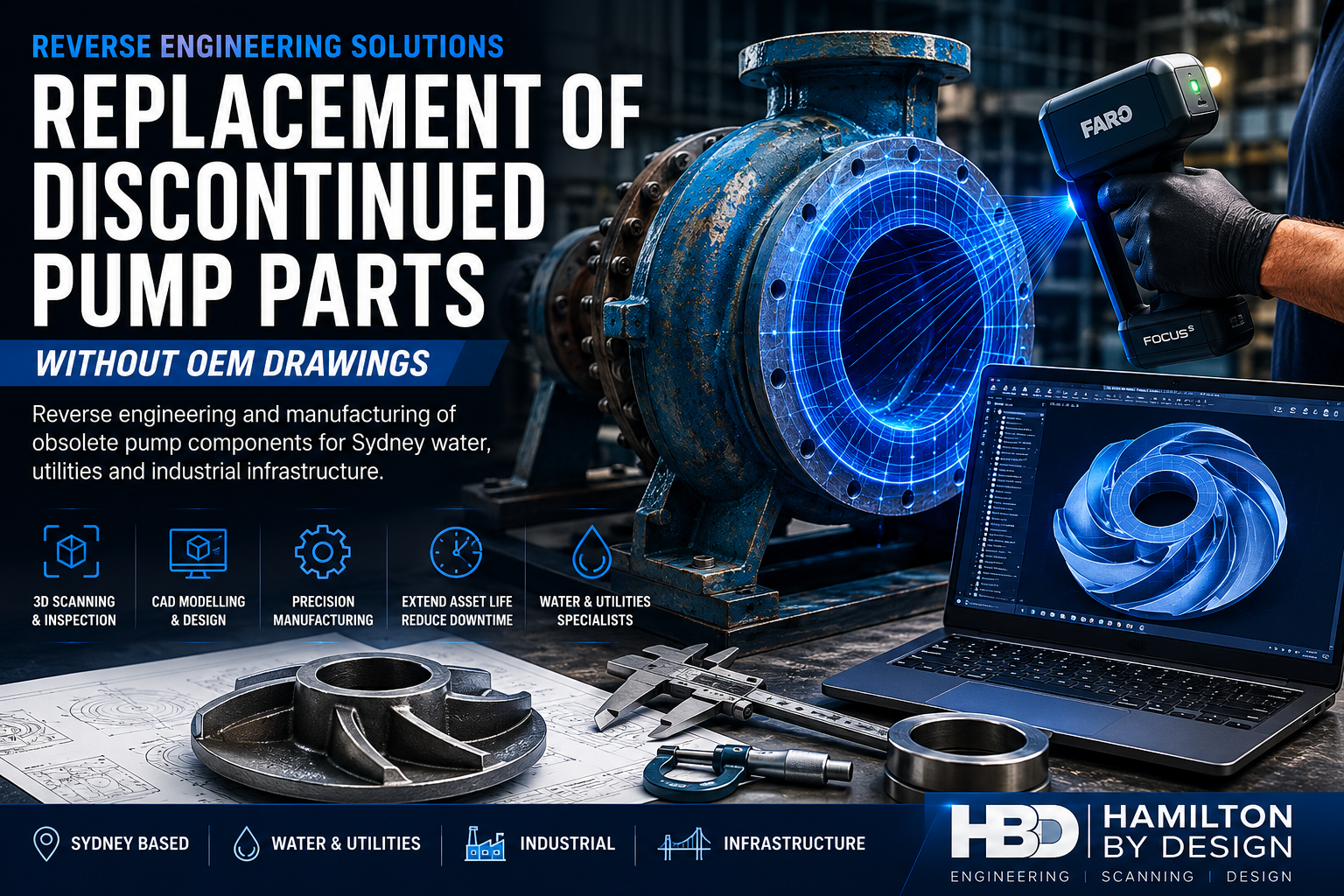
Replacement of Discontinued Pump Parts Without OEM Drawings Sydney

Replacement of discontinued pump parts without OEM drawings in Sydney using 3D scanning, reverse engineering, CAD modelling and precision manufacturing for water and utility infrastructure.

When critical pump components fail and original OEM drawings are unavailable, organisations are often faced with costly downtime, long lead times, or complete equipment replacement. Hamilton By Design provides professional reverse engineering services in Sydney to manufacture replacement pump parts without OEM drawings, allowing water utilities, councils, industrial facilities and infrastructure operators to extend the life of valuable assets.

Using advanced 3D LiDAR scanning, precision measurement, CAD modelling and engineering analysis, we recreate discontinued pump components and assemblies from existing physical parts. Our process enables the manufacture of replacement components that fit and function correctly, even when original drawings, CAD files and technical documentation no longer exist.

Reverse Engineering Pump Parts Without OEM Documentation

Many pumping systems operating throughout Sydney’s water, wastewater and industrial infrastructure were installed decades ago. In many cases:

  • Original manufacturers no longer exist
  • OEM drawings have been lost
  • Spare parts are no longer supported
  • Equipment has become obsolete
  • Lead times exceed operational requirements
  • Replacement pumps require expensive plant modifications

Rather than replacing entire pump systems, reverse engineering allows existing assets to remain operational by recreating critical components from physical samples.

Hamilton By Design specialises in reverse engineering pump parts where no OEM information is available.

Sydney Reverse Engineering Services for Obsolete Pump Components

Our Sydney-based engineering team can recreate:

  • Pump impellers
  • Wear rings
  • Shaft sleeves
  • Bearing housings
  • Casings
  • Volutes
  • Mechanical seal housings
  • Couplings
  • Drive shafts
  • Universal joints
  • Diffusers
  • Back plates
  • Suction covers
  • Bearing carriers
  • Custom castings
  • Fabricated replacement assemblies

Whether only a damaged component exists or a complete pump assembly requires documentation, we can generate accurate engineering models suitable for manufacturing.

Industries We Support

Our reverse engineering services are regularly used by:

Water Utilities

Water treatment facilities, pump stations, reservoirs and distribution networks frequently operate legacy pumping equipment where replacement parts are difficult to source.

Wastewater Infrastructure

Sewage treatment plants and wastewater transfer systems often contain specialised pumps that have exceeded their original service life.

Local Government

Councils throughout Sydney require cost-effective solutions to maintain pumping infrastructure without complete asset replacement.

Manufacturing Facilities

Industrial plants rely on critical pumps for production processes and cannot afford extended shutdowns while waiting for overseas OEM parts.

Mining and Resources

Mining operations frequently require rapid replacement of worn or damaged pumping components to minimise downtime.

Ports and Marine Facilities

Marine pumps, cooling systems and bulk handling infrastructure often contain obsolete equipment requiring reverse engineering support.

Advanced Reverse Engineering Technology

Hamilton By Design combines modern reality capture technology with engineering expertise to reproduce discontinued components accurately.

3D LiDAR Scanning

We utilise high-accuracy laser scanning systems to capture complex geometries and large assemblies.

Typical deliverables include:

  • E57 point clouds
  • RCP files
  • RCS files
  • Registered scan data
  • Mesh models

Precision Measurement

Critical dimensions are verified using:

  • Digital metrology equipment
  • Precision callipers
  • Micrometers
  • Bore measurement tools
  • Surface inspection techniques

CAD Modelling

Components are recreated using industry-standard software including:

  • SolidWorks
  • Autodesk Inventor
  • AutoCAD
  • Autodesk ReCap
  • FARO SCENE

The resulting CAD models are suitable for manufacture, maintenance and future asset management.

Our Reverse Engineering Process

1. Initial Assessment

We review the existing component or assembly and determine:

  • Component function
  • Wear condition
  • Missing features
  • Manufacturing requirements
  • Material considerations

2. Site Inspection and Scanning

Where required, our engineers visit Sydney sites to:

  • Inspect operating equipment
  • Capture 3D scan data
  • Measure interfaces
  • Verify installation requirements

3. Geometry Reconstruction

The scanned component is converted into a detailed CAD model.

This stage includes:

  • Feature recognition
  • Surface reconstruction
  • Parametric modelling
  • Dimensional verification

4. Engineering Review

The design is assessed for:

  • Manufacturability
  • Material suitability
  • Service conditions
  • Installation requirements
  • Potential design improvements

5. Manufacturing Documentation

Detailed engineering drawings are produced for fabrication or machining.

6. Manufacturing Support

We can work directly with:

  • Machine shops
  • Foundries
  • Fabricators
  • Maintenance contractors
  • Asset owners

to ensure successful component production.

Common Challenges with Discontinued Pump Parts

Many organisations encounter the following issues:

No Drawings Exist

Original documentation may have been lost during ownership changes, plant upgrades or company closures.

Damaged Components

Wear, corrosion and erosion often make dimensional measurement difficult.

Unknown Materials

Legacy equipment may contain materials no longer commonly used.

Complex Castings

Impellers, casings and volutes often contain complicated geometries that are difficult to measure manually.

Overseas Lead Times

OEM replacement parts can require months of waiting and significant freight costs.

Reverse engineering provides a practical solution to each of these challenges.

Benefits of Reverse Engineering Pump Components

Reduce Downtime

Avoid waiting for discontinued or overseas spare parts.

Extend Asset Life

Continue operating valuable infrastructure without complete replacement.

Lower Maintenance Costs

Manufacture replacement parts locally when required.

Improve Asset Documentation

Create digital records for future maintenance activities.

Support Future Manufacturing

Once a CAD model exists, future replacement parts can be manufactured quickly.

Eliminate Obsolescence Risks

Maintain operational control of critical assets regardless of OEM support status.

Deliverables

Depending on project requirements, clients may receive:

  • 3D CAD models
  • SolidWorks files
  • STEP files
  • Parasolid files
  • IGES files
  • AutoCAD DWG files
  • Manufacturing drawings
  • General arrangement drawings
  • Assembly drawings
  • BOM documentation
  • E57 point clouds
  • RCP files
  • RCS files
  • Engineering reports
  • Material recommendations
Hamilton By Design logo displayed on a blue tilted rectangle with a grey gradient background

Why Choose Hamilton By Design?

Hamilton By Design combines practical engineering experience with advanced digital capture technology to deliver reliable reverse engineering solutions across Sydney.

Our team understands the challenges faced by water authorities, utilities, manufacturers and infrastructure operators when critical equipment becomes obsolete. We focus on producing accurate engineering data that allows replacement parts to be manufactured quickly and confidently.

Whether you require a single impeller, a complete pump assembly modelled from an existing installation, or engineering support for critical infrastructure assets, we can help extend equipment life and reduce operational risk.

Replacement Pump Parts Without OEM Drawings Sydney

If you have obsolete pump equipment, discontinued OEM components or critical infrastructure requiring replacement parts without original drawings, contact Hamilton By Design.

We provide reverse engineering services throughout Sydney and across Australia, helping organisations maintain water, wastewater, industrial and infrastructure assets through accurate engineering documentation and replacement component design.

Need replacement pump parts without OEM drawings in Sydney? Contact Hamilton By Design to discuss your reverse engineering requirements and obtain a quotation.

Talk to Us – Contact Us

Name
Would you like us to arrange a phone consultation for you?
Address

Our clients:


Engineering Drafting Sydney Ports

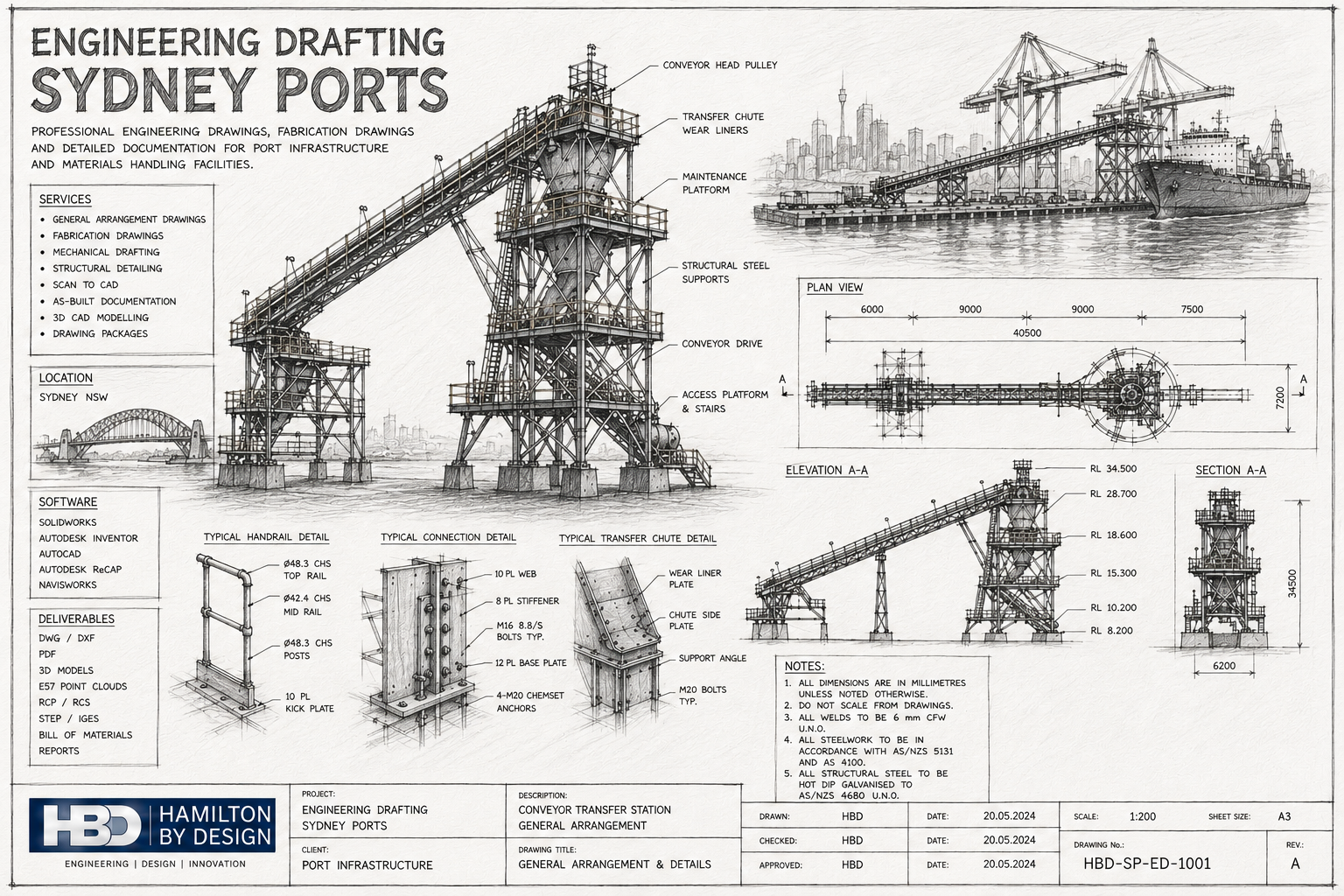
Engineering Drafting Sydney Ports technical drawing showing conveyor systems, fabrication drawings, general arrangement layouts, structural steel details and materials handling infrastructure.

Engineering Drafting Sydney Ports

Structural engineering drafting icon showing a seated engineer working at a drafting table in blue vector style.

Hamilton By Design provides engineering drafting services for Sydney ports, marine terminals, wharves, bulk handling facilities, container terminals and industrial port infrastructure. We prepare accurate general arrangement drawings, fabrication drawings, mechanical layouts, structural details, as-built documentation and CAD models for port operators, contractors, fabricators, manufacturers and maintenance teams across Sydney NSW.

Our drafting services support mechanical engineering projects, materials handling upgrades, conveyor modifications, structural steel works, access platforms, equipment layouts, pipework changes and brownfield plant upgrades. By combining practical trade knowledge, mechanical engineering experience, 3D LiDAR scanning and CAD design, we help clients produce clear, buildable and reliable engineering documentation.

Engineering Drafting Services for Sydney Ports

Sydney port facilities require accurate drawings to support safe installation, fabrication, maintenance and future asset management. Many existing facilities have been modified over time, which means old drawings may be incomplete, outdated or missing.

Hamilton By Design supports port infrastructure projects by producing technical drawings that reflect both the design intent and the real site conditions.

Our engineering drafting services include:

  • General arrangement drawings
  • Fabrication drawings
  • Mechanical layouts
  • Structural steel details
  • Conveyor arrangement drawings
  • Transfer chute drawings
  • Access platform drawings
  • Walkway, stair and handrail drawings
  • Equipment layout drawings
  • Pipework drafting
  • As-built drawings
  • Site measure drawings
  • Scan to CAD drawings
  • 3D CAD modelling
  • Drawing markups and revisions
  • Drawing package preparation

Drafting for Port Infrastructure and Materials Handling

Port environments often include conveyors, transfer stations, ship loaders, hoppers, chutes, platforms, pipework and support structures. These systems need clear documentation so that designers, fabricators, installers and maintenance teams can work from the same information.

We provide engineering drafting for:

  • Conveyor systems
  • Conveyor galleries
  • Transfer stations
  • Transfer chutes
  • Ship loading equipment
  • Maintenance platforms
  • Access stairs and walkways
  • Structural steel supports
  • Equipment bases and frames
  • Guarding and safety access
  • Pipework and mechanical services
  • Brownfield plant modifications
  • Industrial buildings and workshops

This makes the service suitable for Sydney ports, bulk material handling sites, infrastructure projects, manufacturing facilities, utilities, mining support operations and industrial plants.

Sydney NSW and Australia-Wide Support

Hamilton By Design supports engineering drafting projects throughout Sydney NSW, including port and industrial areas around Botany, Port Botany, Glebe Island, White Bay, Sydney Harbour, Kurnell, Parramatta River industrial areas and surrounding logistics hubs.

We also support clients across Newcastle, the Hunter Valley, Central Coast, Brisbane, Melbourne, Adelaide, Perth, Darwin, Mount Isa and regional Australia.

For clients outside Sydney, we can provide drafting support remotely using supplied drawings, site photos, point clouds, 3D scan data, markups and engineering sketches.

General Arrangement Drawings

General arrangement drawings show how equipment, structures and systems fit together. They are commonly used for design review, client approval, construction planning and installation coordination.

A GA drawing may include:

  • Plan views
  • Elevation views
  • Section views
  • Main dimensions
  • Equipment locations
  • Structural interfaces
  • Access clearances
  • Connection points
  • Drawing notes
  • Reference drawings
  • Revision history

For Sydney port projects, GA drawings are often required before fabrication drawings are produced. This helps confirm the design layout and reduce the risk of clashes during installation.

Fabrication Drawings

Fabrication drawings provide the detail required to manufacture steelwork, mechanical components and assemblies.

Depending on the project, fabrication drawings may include:

  • Plate details
  • Weld details
  • Material callouts
  • Hole sizes and locations
  • Cut lengths
  • Fold details
  • Machining details
  • Assembly information
  • Bill of materials
  • Finish requirements
  • Drawing notes

Fabrication drawings are especially important for conveyor supports, platforms, stairs, handrails, guarding, brackets, frames, hoppers, chutes and mechanical assemblies.

3D LiDAR Scanning and Scan to CAD

Many port projects are completed in brownfield environments where accurate site information is essential. When existing drawings are not reliable, Hamilton By Design can use 3D LiDAR scanning to capture the real site conditions before drafting begins.

3D scanning can capture:

  • Structural steel
  • Conveyors
  • Chutes
  • Platforms
  • Pipework
  • Equipment
  • Building layouts
  • Access areas
  • Obstructions
  • Existing services

The scan data can then be converted into CAD drawings, 3D models and as-built documentation.

Typical scan and CAD deliverables may include:

  • E57 point clouds
  • RCP files
  • RCS files
  • DWG drawings
  • DXF drawings
  • SolidWorks models
  • Autodesk Inventor models
  • STEP files
  • PDF drawing packages
  • As-built documentation

This workflow helps reduce site rework and improves confidence before fabrication or installation begins.

CAD Software and Technical Capability

Hamilton By Design works with commonly used engineering and drafting platforms to support practical project delivery.

Software and file formats may include:

  • SolidWorks
  • Autodesk Inventor
  • AutoCAD
  • Autodesk ReCap
  • Navisworks
  • STEP
  • Parasolid
  • DWG
  • DXF
  • PDF
  • E57
  • RCP
  • RCS

We can work from supplied sketches, old drawings, site markups, redline drawings, photographs, point cloud data or 3D models.

Relevant Standards and Drawing Considerations

Engineering drafting for port and industrial environments should be clear, consistent and suitable for the intended use.

Depending on the project, drawings may consider:

  • AS 1657 for fixed platforms, walkways, stairways and ladders
  • AS/NZS 4024 for machine safety and guarding considerations
  • AS 3990 for mechanical equipment and steelwork design considerations
  • AS 4100 for steel structures where applicable
  • Site-specific safety requirements
  • Client drawing standards
  • Fabricator requirements
  • Maintenance access requirements
  • Installation constraints

Drawings should be practical, readable and suitable for review by engineers, fabricators, project managers and site teams.

Step-by-Step Drafting Process

1. Project Review

We review the project scope, available drawings, sketches, photos, site information and client requirements.

2. Site Measure or 3D Scan

Where required, we attend site to measure or complete 3D LiDAR scanning to capture the existing conditions.

3. CAD Setup

Existing drawings, scan data or design sketches are brought into the CAD environment.

4. 3D Modelling or 2D Drafting

We prepare 3D models or 2D drawings depending on the project requirements.

5. Engineering Review

Drawings are reviewed for layout, access, interfaces, buildability and design intent.

6. Drawing Issue

The drawing package is issued for review, approval, fabrication, installation or as-built records.

7. Revisions and Final Documentation

Client comments, engineer markups and site changes are incorporated before final issue.

What the Client Receives

Depending on the project scope, clients may receive:

  • General arrangement drawings
  • Fabrication drawings
  • Mechanical detail drawings
  • Structural detail drawings
  • Conveyor layout drawings
  • Access platform drawings
  • As-built drawings
  • 3D CAD models
  • SolidWorks models
  • Inventor models
  • STEP files
  • DWG files
  • DXF files
  • PDF drawing sets
  • Bill of materials
  • Drawing registers
  • E57 point clouds
  • RCP and RCS files
  • Engineering notes and reports

The final deliverables are tailored to suit the project, whether the requirement is design review, fabrication, installation, asset management or maintenance planning.

Why Choose Hamilton By Design?

Hamilton By Design combines engineering drafting with practical mechanical engineering and site experience. This is important for port projects where drawings must be more than visually correct. They must also be practical, buildable and suitable for real site conditions.

Our strengths include:

  • Mechanical engineering experience
  • Trade and fabrication background
  • 3D CAD modelling capability
  • 3D LiDAR scanning capability
  • Brownfield industrial project experience
  • Materials handling knowledge
  • Conveyor and chute drafting experience
  • Port and infrastructure drafting support
  • Practical drawing documentation
  • Australia-wide project support

We understand the importance of clear drawings for shutdowns, fabrication, maintenance works and plant upgrade projects.

Hamilton By Design also provides related engineering and digital design services, including:

  • Mechanical Engineering Services
  • 3D LiDAR Scanning Sydney Ports
  • Scan to CAD Sydney Ports
  • Scan to BIM Sydney
  • Reverse Engineering Services
  • Structural Drafting Services
  • Industrial Plant 3D Scanning
  • Conveyor Design and Drafting
  • Fabrication Drawing Services

These related services allow clients to combine site capture, drafting, modelling and engineering support within one practical workflow.

Frequently Asked Questions

Do you provide engineering drafting for Sydney ports?

Yes. Hamilton By Design provides engineering drafting services for Sydney ports, port infrastructure, marine terminals, conveyors, transfer stations and industrial facilities.

What types of drawings can you produce?

We can produce general arrangement drawings, fabrication drawings, mechanical layouts, structural details, as-built drawings, conveyor drawings and CAD models.

Can you work from old or incomplete drawings?

Yes. We can work from existing drawings, site sketches, photos, redline markups and 3D scan data. Where drawings are unreliable, a site measure or 3D LiDAR scan may be recommended.

Can you provide fabrication drawings?

Yes. We prepare fabrication drawings for steelwork, platforms, brackets, frames, chutes, hoppers, conveyor supports and mechanical assemblies.

Do you provide Scan to CAD services?

Yes. We can convert 3D LiDAR scan data into DWG drawings, 3D CAD models, SolidWorks files and as-built documentation.

What software do you use?

We commonly use SolidWorks, Autodesk Inventor, AutoCAD, Autodesk ReCap and Navisworks.

Can you help with brownfield port upgrades?

Yes. We support brownfield upgrade projects where existing equipment, structures and services must be captured and documented before modification.

Do you provide drawing updates from site markups?

Yes. We can update drawings from redline markups, site measurements, scanned information and engineering comments.

Do you work outside Sydney?

Yes. We support clients across NSW and Australia, including Newcastle, Hunter Valley, Central Coast, Brisbane, Melbourne, Adelaide, Perth, Darwin and regional industrial sites.

What information do you need to prepare a quote?

Useful information includes the project scope, existing drawings, photos, site location, required drawing types, preferred file formats, deadlines and whether a site measure or 3D scan is required.

Hamilton By Design logo displayed on a blue tilted rectangle with a grey gradient background

Contact Hamilton By Design

If you require Engineering Drafting Sydney Ports services, Hamilton By Design can assist with general arrangement drawings, fabrication drawings, CAD modelling, Scan to CAD, as-built documentation and detailed engineering drawing packages for port and industrial infrastructure.

Contact Hamilton By Design to discuss your Sydney port drafting project and prepare a practical drawing solution for your site, workshop or engineering team.

Talk to Us – Contact Us

Name
Would you like us to arrange a phone consultation for you?
Address

Our clients: