Mechanical Engineering | 3D Scanning | 3D Modelling
Tag: SolidWorks
SolidWorks covers the use of SolidWorks CAD software for mechanical design, 3D modelling, engineering analysis, and fabrication-ready documentation. This tag brings together content showing how SolidWorks is used in real engineering workflows, including scan-to-CAD modelling, point-cloud interpretation, parametric design, and integration with FEA for industrial, mining, infrastructure, and construction projects.
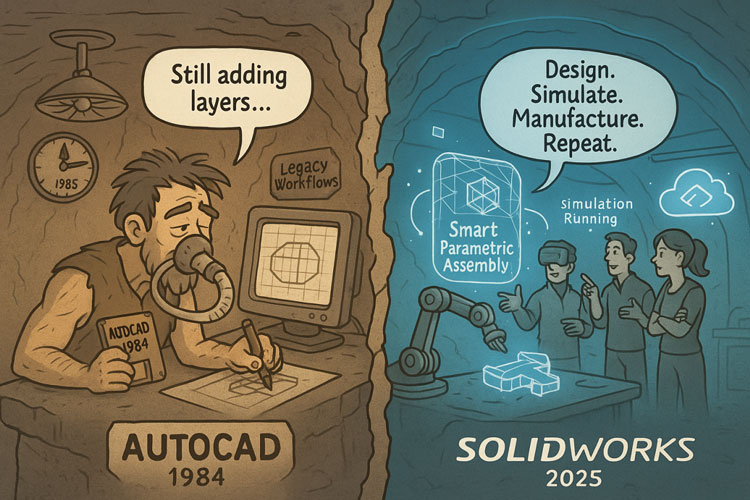
In the 1980s, AutoCAD was revolutionary. It replaced drafting boards and sharpened pencils with a digital drawing tool. Architects, engineers, and designers suddenly had a new way to bring ideas to life — faster, cleaner, and more accurate than ever before.
But here’s the problem: it’s 2025 now, and AutoCAD is still trying to breathe the same thin air it did back then.
Stuck in 2D While the World Moved On
Today’s engineering isn’t about drawing — it’s about designing. It’s about simulating real-world forces, visualizing assemblies, testing tolerances, and producing manufacturable parts before a single prototype is built.
AutoCAD, at its core, is still a 2D drafting platform trying to wear a 3D mask. The workflows are fragmented, the feature set feels patched together, and it lacks the intelligence modern teams demand.
By contrast, SOLIDWORKS was built for this century — fully parametric, model-driven, and collaborative. When you make a change to a design in SOLIDWORKS, every part, drawing, and assembly updates instantly. That’s not an upgrade; that’s evolution.
Design Needs Intelligence, Not Layers
AutoCAD still asks you to think in layers and lines — the language of draftsmen. SOLIDWORKS speaks the language of relationships, assemblies, and constraints — the language of engineers and innovators.
Modern design tools must integrate simulation, visualization, and manufacturability. They must predict behavior, test fit, and optimize before production. AutoCAD just can’t breathe in that environment anymore — it’s stuck flipping between tabs while SOLIDWORKS users are already printing parts.
Collaboration and Data: The New Oxygen
The world doesn’t design in isolation anymore. Teams are global, deadlines are tighter, and innovation cycles are shorter. AutoCAD’s file-based approach is like passing blueprints across a fax machine.
SOLIDWORKS integrates cloud data management, real-time collaboration, and digital twin technology — letting design teams iterate and innovate in real time, anywhere in the world.
The Future Is 3D — and It’s Already Here
You wouldn’t build an electric vehicle using a typewriter. So why design modern products with 1980s software?
SOLIDWORKS represents the present and the future — intelligent modeling, simulation-driven design, and integrated manufacturing tools that push boundaries instead of tracing them.
Final Thoughts
AutoCAD made history — no one can deny that. But history belongs in the museum, not the manufacturing floor.
If your software is still gasping for air in a 2D world, maybe it’s time to give it a well-earned retirement. SOLIDWORKS doesn’t imitate innovation — it defines it.
3D Laser Scanning & Mechanical Engineering Solutions
In today’s fast-paced engineering and construction industries, precision and efficiency are everything. Whether you’re managing a large-scale infrastructure project in Brisbane, creating a mechanical prototype in Perth, or needing accurate as-built data for a site in the Hunter Valley, 3D laser scanning and expert mechanical design services are game changers.
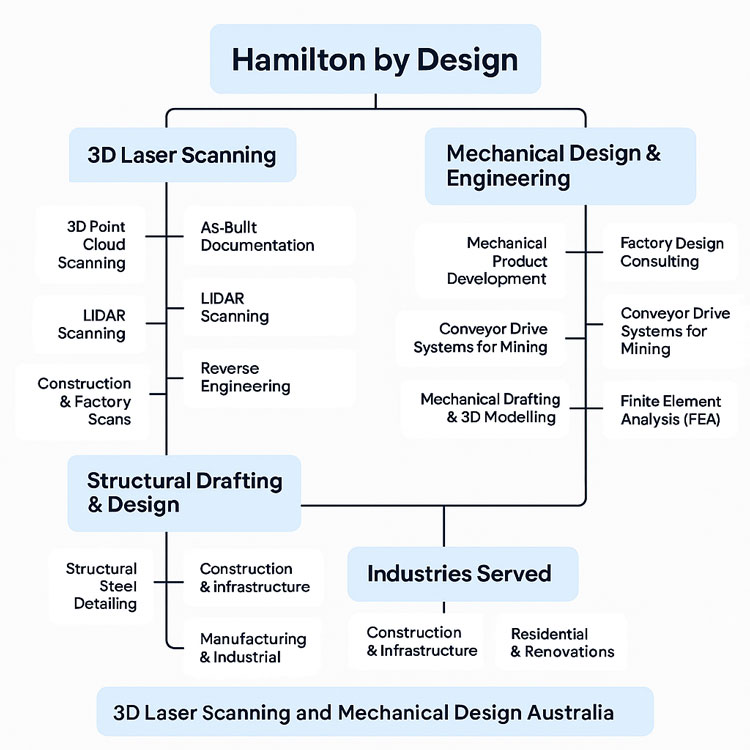
At Hamilton By Design, we specialise in connecting cutting-edge scanning technology with skilled mechanical designers and structural drafting services to deliver seamless, accurate solutions for every stage of your project.
The Power of 3D Laser Scanning
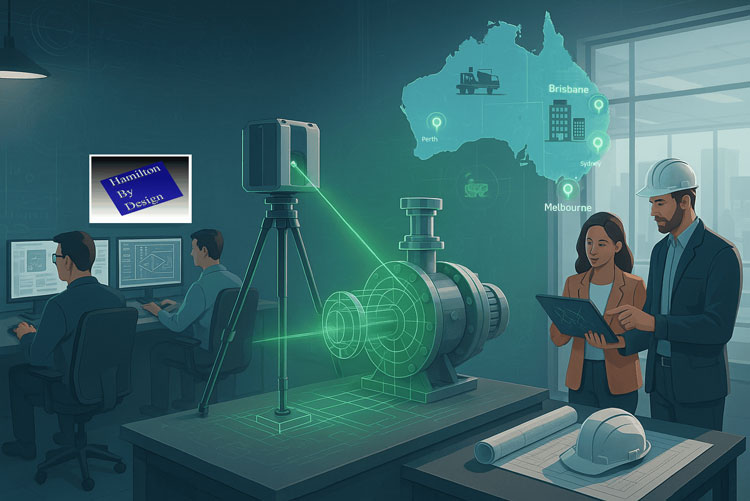
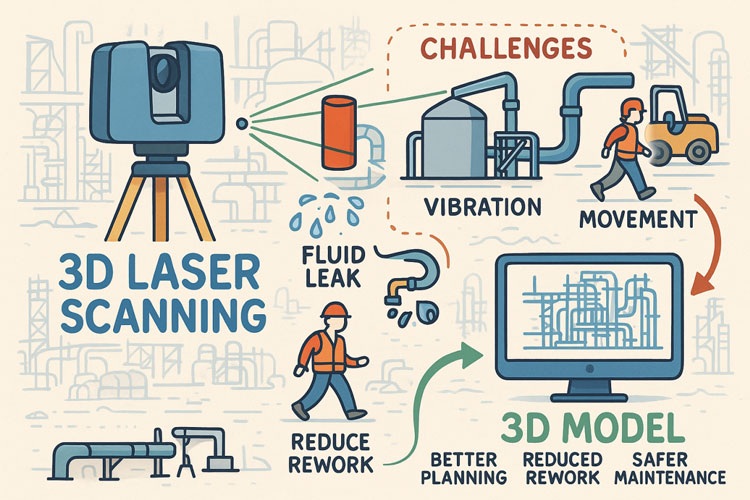
3D laser scanning is transforming the way engineers, architects, and manufacturers work. By capturing millions of data points with millimetre accuracy, laser scanning creates a highly detailed 3D representation of your asset, site, or structure.
Our team provides 3D laser scanning services in Perth, Brisbane, and Melbourne, as well as laser scanning in the Hunter Valley, helping clients save time and avoid costly rework. This technology is ideal for:
Capturing as-built conditions before design or construction.
Supporting plant upgrades and facility expansions.
Documenting heritage structures and complex geometries.
Reducing site visits with accurate digital models.
Reverse Engineering & Mechanical Design
In addition to scanning, we offer reverse engineering services in Perth and beyond. By combining point cloud data with CAD modelling, we can recreate components, optimise designs, and prepare manufacturing-ready files.
Our mechanical engineers and mechanical designers bring years of experience in 3D mechanical engineering, design and manufacturing mechanical engineering, and problem-solving for a wide range of industries. From bespoke machinery to process equipment, we deliver solutions that work.
Structural Drafting & Project Support
No project is complete without clear, accurate documentation. Our skilled drafters at Hamilton By Design provide high-quality structural drafting services that integrate seamlessly with your workflows.
Whether you need shop drawings, fabrication details, or BIM-ready models, our team ensures every line and dimension is correct — saving you time and cost on-site.
Why Choose Hamilton By Design?
Nationwide Reach: Serving clients with 3D scanning services in Perth, Brisbane, and Melbourne, and supporting projects in the Hunter Valley.
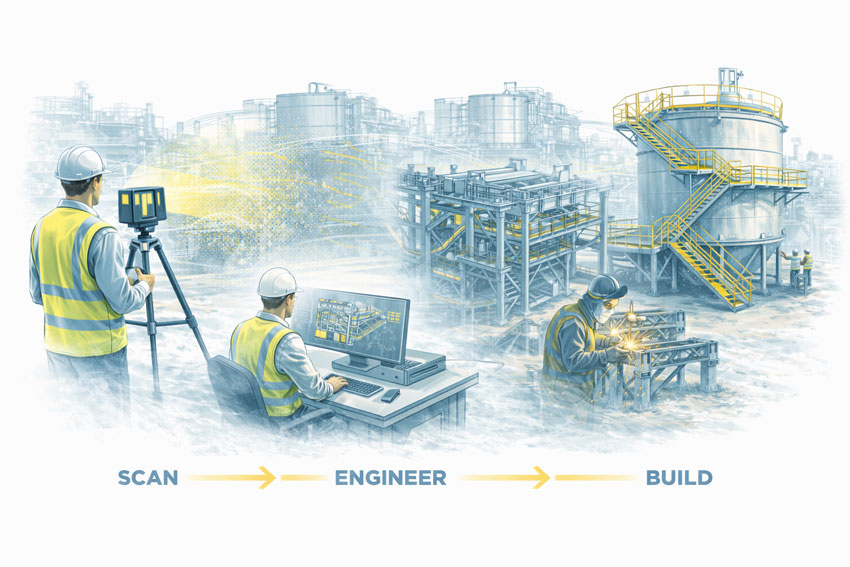
Complete Solutions: From scanning to modelling to mechanical engineering design.
Accuracy & Efficiency: Reduce project risk and improve decision-making with reliable data.
Experienced Team: Skilled mechanical engineers and drafters who understand your industry.
Ready to Get Started?
If you’re looking for mechanical engineering companies that deliver precision, innovation, and reliability, Hamilton By Design is ready to help. Whether you need laser scanning in Perth or Brisbane, structural drafting, or full mechanical design services, our team can support your next project from concept to completion.
Contact us today to discuss your project requirements and find out how our 3D laser scanning and mechanical engineering design solutions can save you time and money.
When it comes to precision engineering, structural drafting, and mechanical design services, Hamilton by Design leads the way. We provide advanced 3D laser scanning solutions across Perth, Sydney, Brisbane, Melbourne, and the Hunter Valley — giving clients accurate data for smarter decisions and efficient project delivery.
3D Laser Scanning Across Australia
Our 3D laser scanning services capture exact measurements of your site, plant, or equipment to create detailed 3D point clouds and as-built documentation. This reduces rework, saves time, and improves project planning.
We offer:
3D Laser Scanning Perth & Fremantle – Industrial plant surveys, mining site scanning, and reverse engineering.
3D Laser Scanning Sydney & Melbourne – Building surveys, renovation planning, and structural inspections.
3D Laser Scanning Brisbane & Hunter Valley – Factory layouts, conveyor drive design, and structural scanning.
3D Laser Scanning for Engineering & Mining – Point cloud scanning, clash detection, and 3D modelling.
Our team uses the latest 3D scanning and LiDAR technology to produce millimetre-accurate results that engineers, architects, and builders can trust.
Structural Drafting & Design Services
Hamilton by Design provides structural drafting services across Australia, including:
Structural Design and Drafting – For residential, commercial, and industrial projects.
Steel Detailing & Shop Drawings – Produced to Australian drafting standards.
Structural Scanning Services Brisbane & Sydney – Helping engineers assess existing structures for upgrades or repairs.
Our experienced structural design engineers work closely with builders, architects, and civil engineers in Hamilton and beyond to deliver reliable, build-ready plans.
In the mining industry, system uptime isn’t just a goal—it’s a necessity. Transfer points such as chutes, hoppers, and conveyors are often the most failure-prone components in processing plants, especially in high-wear environments like HPGR (High Pressure Grinding Rolls) circuits. Abrasive ores, heavy impact, fines accumulation, and moisture can all combine to reduce flow efficiency, damage components, and drive up maintenance costs.
At Hamilton By Design, we help mining clients minimise downtime and extend the life of their material handling systems by applying advanced 3D scanning, DEM simulation, smart material selection, and modular design strategies. This ensures that transfer points operate at peak efficiency—day in, day out.
Here’s how we do it:
Optimised Flow with DEM-Based Chute & Hopper Design
Flow blockages and misaligned velocities are among the biggest contributors to transfer point failure in the mining industry. That’s why we use Discrete Element Method (DEM) simulations to model bulk material flow through chutes, hoppers, and transfer transitions.
Through DEM, we can simulate how different ores—ranging from dry coarse rock to sticky fines—move, compact, and impact structures. This allows us to tailor chute geometry, outlet angles, and flow paths in advance, helping:
Prevent material buildup or arching inside hoppers and chutes
Align material velocity with the conveyor belt speed using hood & spoon or trumpet-shaped designs
Reduce wear by managing trajectory and impact points
Not all wear is the same—and neither are the materials we use to combat it. By studying the abrasion and impact zones in your chute and hopper systems, we strategically apply wear liners suited to each application.
Our engineering team selects from:
AR (Abrasion-Resistant) steels for high-wear areas
Ceramic liners in fines-rich or ultra-abrasive streams
Rubber liners to absorb shock and reduce noise
This approach reduces liner replacement frequency, improves operational safety, and lowers the risk of unplanned shutdowns at key transfer points.
3. Dust and Spillage Control: Cleaner, Safer Operation
Dust and spillage around conveyors and transfer chutes can lead to extensive cleanup time, increased maintenance, and health hazards. At Hamilton By Design, we treat this as a core design challenge.
We design chutes and hoppers with:
Tight flange seals at interface points
Enclosed transitions that contain dust at the source
Controlled discharge points to reduce turbulent material drops
This reduces environmental risk and contributes to more consistent plant performance—especially in confined or enclosed processing facilities in the mining industry.
4. Modular & Accessible Designs for Faster Maintenance
When liners or components need replacement, every minute counts. That’s why our chute and hopper systems are built with modular sections—each engineered for fast removal and reinstallation.
Key maintenance-driven design features include:
Bolt-on panels or slide-in liner segments
Accessible inspection doors for safe visual checks
Lightweight modular components for easy handling
These details reduce labour time, enhance safety, and keep your plant online longer—especially critical in HPGR zones where throughput is non-stop.
5. Precision 3D Scanning & 3D Modelling for Retrofit Accuracy
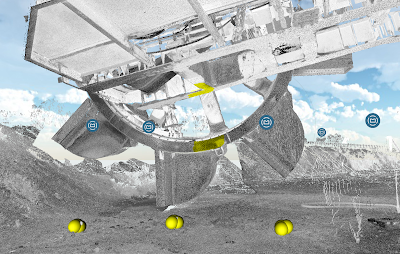
One of the most powerful tools we use is 3D scanning. In retrofit or brownfield projects, physical measurements can be inaccurate or outdated. We solve this by conducting detailed laser scans that generate accurate point cloud data—a precise digital twin of your plant environment.
That data is then transformed into clean 3D CAD models, which we use to:
Design retrofits that precisely match existing structure
Identify interferences or fit-up clashes before fabrication
Reduce install time by ensuring right-first-time fits
This scan-to-CAD workflow dramatically reduces rework and error margins during installation, saving time and cost during shutdown windows.
Real-World Application: HPGR & Minerals Transfer Systems
In HPGR-based circuits, transfer points between crushers, screens, and conveyors experience high rates of wear, dust generation, and blockages—particularly where moisture-rich fines are present.
Here’s how Hamilton By Design’s methodology addresses these pain points:
DEM-based flow modelling ensures the HPGR discharge flows cleanly into chutes and onto conveyors without buildup.
Hood/spoon geometries help track material to belt velocity—minimising belt wear and reducing misalignment.
Strategic liner selection extends life in critical wear zones under extreme abrasion.
Modular chute designs allow for fast liner swap-outs without major disassembly.
3D scanning & CAD design ensures new chute sections fit seamlessly into existing HPGR and conveyor frameworks.
By designing smarter transfer systems with these technologies, we enable operators to reduce downtime, increase liner life, and protect critical assets in high-throughput mining applications.
Faster maintenance turnarounds during scheduled shutdowns
3D scanning & CAD integration
Precise fit, reduced installation time, fewer errors during retrofit
Final Word: Engineering That Keeps the Mining Industry Moving
At Hamilton By Design, we combine mechanical engineering expertise with 3D modelling, material flow simulation, and smart fabrication practices to deliver high-performance chute, hopper, and transfer point systems tailored for the mining industry.
Whether you’re dealing with a problematic HPGR discharge, spillage issues, or planning a brownfield upgrade, our integrated design process delivers results that improve reliability, extend service life, and protect uptime where it matters most.
Looking to retrofit or upgrade transfer systems at your site? Let’s talk. We bring together 3D scanning, DEM modelling, practical engineering, and proven reliability to deliver systems that work—from concept through to install.
Discover how mechanical engineering, government funding, and digital innovation are driving the future of mining in Australia. Learn how Hamilton By Design leads the change.
Australia’s mining industry is undergoing one of its most significant transformations in decades. At the heart of this change lies the convergence of mechanical engineering innovation, government-backed funding, and cutting-edge technology.
With over $750 million in federal support for metals manufacturing and state-based funding for METS innovation, mechanical engineers are now in a position to redefine how mining operations are designed, maintained, and optimised.
At Hamilton By Design, we are helping clients across the country harness these changes—offering smart mechanical solutions that are efficient, resilient, and future-ready.
Key Opportunities: How Technology is Reshaping Mechanical Engineering in Mining
1. Government Funding is Fueling Innovation
In March 2025, the Australian Government announced a $750 million investment to boost advanced manufacturing and metals production in Australia.
Local manufacturing partnerships to reduce supply chain risk
At Hamilton By Design, we are already supporting mining clients to align their capital projects with these funding pathways.
2. Digital Tools Enhance Mechanical Performance
According to the CSIRO METS Roadmap, digitalisation and automation are critical for the next phase of mining growth.
We implement:
LiDAR scanning for as-built plant modelling
Finite Element Analysis (FEA) for structural design optimisation
Predictive maintenance planning using real-time sensor data
These tools not only extend the life of critical components but also enhance safety, reduce downtime, and support remote operations.
3. WA and NSW Governments Are Supporting METS Innovation
The Western Australian government continues to support Mining Equipment, Technology and Services (METS) innovation and commercialisation through its METS Innovation Grants.
This creates opportunities for mechanical engineering firms to:
Collaborate with OEMs and fabricators
Introduce novel materials and designs for harsh mining environments
Lead the push toward zero-emissions equipment and sustainable design
Hamilton By Design’s agile project delivery and deep mechanical experience allow us to integrate seamlessly with these innovation pipelines.
The Challenges: Bridging the Gap Between Legacy and Future
Despite the exciting momentum, the sector also faces critical challenges:
Skills Gaps: Many engineers are not yet equipped with digital or automation skills.
System Complexity: Mechanical systems are increasingly integrated with electrical and digital subsystems, requiring multidisciplinary design thinking.
Capital Risk: Large investments in automation must deliver measurable value, which requires robust mechanical frameworks.
Hamilton By Design addresses these risks by offering not only high-quality design services, but also strategy, planning, and training support to ensure seamless project delivery.
Why Hamilton By Design is Your Engineering Partner of the Future
We work with clients across NSW, WA, QLD, and SA, offering nationwide support for design, development, and delivery.
Let’s Engineer the Future Together
Mechanical engineering is no longer just about function—it’s about intelligence, adaptability, and sustainability.
At Hamilton By Design, we help mining companies, fabricators, and OEMs thrive in this new landscape. Whether you’re applying for funding, upgrading equipment, or redesigning your processing infrastructure, we have the tools, experience, and innovation to lead you forward.
In the 1980s through to the early 2000s, AutoCAD ruled supreme. It revolutionised the way engineers and designers approached 2D drafting, enabling technical drawings to be created and shared with speed and precision across industries. For two decades, it set the benchmark for visual communication in engineering and construction. But that era has passed.
Today, we live and work in a three-dimensional world — not only in reality, but in design.
From 2D Drafting to Solid Modelling: The New Standard
At Hamilton By Design, we see 3D modelling not just as a tool, but as an essential evolution in how we think, design, and manufacture. The transition from 2D lines to solid geometry has reshaped the possibilities for every engineer, machinist, and fabricator.
With the widespread adoption of platforms like SolidWorks, design engineers now routinely conduct simulations, tolerance analysis, motion studies, and stress testing — all in a virtual space before a single part is made. Companies like Tesla, Ford, Eaton, Medtronic, and Johnson & Johnson have integrated 3D CAD tools into their product development cycles with great success, dramatically reducing rework, increasing precision, and accelerating innovation.
Where 2D design was once enough, now solid models drive machining, laser cutting, 3D printing, automated manufacturing, and finite element analysis (FEA) — all from a single digital source.
At Hamilton By Design, we work with and alongside these firms — and others — to deliver scalable, intelligent 3D modelling solutions to the Australian industrial sector. From laser scanning and site capture to custom steel fabrication, we translate concepts into actionable, manufacturable designs. Our clients benefit not only from our hands-on trade knowledge but also from our investment in cutting-edge tools and engineering platforms.
So What’s Next? The Future Feels More Fluid Than Solid
With all these tools now at our fingertips — FEA simulation, LiDAR scanning, parametric modelling, cloud collaboration — the question becomes: what comes after 3D?
We’ve moved from pencil to pixel, from 2D lines to intelligent digital twins. But now the line between design and experience is beginning to blur. Augmented reality (AR), generative AI design, and real-time simulation environments suggest that the next wave may feel more fluid than solid — more organic than mechanical.
We’re already seeing early glimpses of this future:
Generative design tools that evolve geometry based on performance goals
Real-time digital twins updating with sensor data from operating plants
AI-driven automation that simplifies design iterations in minutes, not days
In short: the future of 3D design might not be “3D” at all in the traditional sense — it could be interactive, immersive, adaptive.
At Hamilton By Design — We’re With You Now and Into the Future
Whether you’re looking to upgrade legacy 2D drawings, implement laser-accurate reverse engineering, or develop a full-scale 3D model for simulation or manufacturing — Hamilton By Design is here to help.
We bring hands-on trade experience as fitters, machinists, and designers, and combine it with the modern toolset of a full-service mechanical engineering consultancy. We’re not just imagining the future of design — we’re building it.
Let’s design smarter. Let’s think in 3D — and beyond.
To provide the best experiences, we use technologies like cookies to store and/or access device information. Consenting to these technologies will allow us to process data such as browsing behaviour or unique IDs on this site. Not consenting or withdrawing consent, may adversely affect certain features and functions.
Functional
Always active
The technical storage or access is strictly necessary for the legitimate purpose of enabling the use of a specific service explicitly requested by the subscriber or user, or for the sole purpose of carrying out the transmission of a communication over an electronic communications network.
Preferences
The technical storage or access is necessary for the legitimate purpose of storing preferences that are not requested by the subscriber or user.
Statistics
The technical storage or access that is used exclusively for statistical purposes.The technical storage or access that is used exclusively for anonymous statistical purposes. Without a subpoena, voluntary compliance on the part of your Internet Service Provider, or additional records from a third party, information stored or retrieved for this purpose alone cannot usually be used to identify you.
Marketing
The technical storage or access is required to create user profiles to send advertising, or to track the user on a website or across several websites for similar marketing purposes.