Mechanical Engineering | 3D Scanning | 3D Modelling
Tag: shutdown-planning
Hamilton By Design provides engineering, 3D LiDAR scanning and CAD support for planned industrial and mining shutdowns.
Effective shutdown planning requires the scope, site conditions, equipment interfaces, access requirements and work sequence to be understood before the plant is taken offline. Missing information or unidentified clashes can lead to fabrication changes, installation delays and extended downtime.
Our services can include existing-condition scanning, point-cloud registration, dimensional verification, 3D CAD modelling, mechanical design, clash detection and fabrication documentation. LiDAR scanning can capture equipment, supporting structures, connection points and available removal or installation paths while the plant remains accessible.
Proposed equipment and modifications can be reviewed against the point cloud before fabrication. This can help verify fit, identify restricted clearances and coordinate lifting, transport, access and installation requirements.
Shutdown planning support can apply to conveyors, chutes, pumps, pipework, tanks, guards, platforms and other fixed plant assets. Deliverables may include registered point clouds, 3D CAD models, general arrangement drawings, fabrication drawings, installation layouts and marked-up work sequences.
Detailed safety plans, isolations, lifting studies and contractor work methods must be prepared and approved by the appropriately responsible parties.
At Hamilton By Design, we use secure digital tools to collaborate with our clients on engineering projects.
To access the Hamilton By Design client portal on the 3DEXPERIENCE platform, you will need an authorised login.
If you already have a 3DEXPERIENCE account, the form below will allow us to grant you access to our specific project portal.
If you do not yet have access, please complete the form below. Once approved, we will set up the correct access level for you and your team.
Please complete the form so we can verify your details and configure your permissions. We’ll review your request, confirm any required information, and then email your login instructions.
Already have access.
If you already have your username and password, you can log in here:
3. Responsible Person (Content & Business Operations)
Owner / Director: Anthony Hamilton
Anthony Hamilton is responsible for the content published on this website, except where otherwise stated.
4. Business Activity
Hamilton By Design provides mechanical engineering and related services, including but not limited to:
3D LiDAR laser scanning
Point cloud processing and 3D modelling
Mechanical design and drafting
Structural and mechanical detailing for fabrication
Engineering support for coal handling, processing plants, mining, and industrial facilities
All services are provided in accordance with relevant Australian standards, client contracts, and project scopes.
5. Professional Standards & Insurance
Where applicable, Hamilton By Design operates under:
Relevant Australian engineering and design standards
Project-specific safety, quality, and compliance requirements
6. Liability for Website Content
The content on this website is provided for general information only and does not constitute engineering advice, legal advice, or a formal design certification.
While we take care to keep information accurate and up to date, we:
Make no warranties as to completeness, accuracy, or suitability for a particular purpose
Reserve the right to change, update, or remove content at any time without notice
You should not rely solely on website information to make project, safety, or engineering decisions. Always seek a formal proposal, design, or report specific to your situation.
7. Liability for External Links
This website may contain links to third-party websites. We have no control over the content of external sites and accept no responsibility for:
The accuracy or legality of external content
Any loss or damage arising from the use of third-party websites
Use of external links is at your own risk.
8. Intellectual Property & Copyright
Unless otherwise stated:
All text, images, graphics, diagrams, and downloadable content on this website are the intellectual property of Hamilton By Design.
Unauthorised copying, distribution, or modification of website content is prohibited without prior written permission.
You may view, download, or print content for personal, non-commercial use related to evaluating or engaging Hamilton By Design’s services.
This page was last changed on 9 September 2026, last checked on 9 September 2026 and applies to citizens of Australia.
1. Introduction
Our website, https://www.hamiltonbydesign.com.au (hereinafter: "the website") uses cookies and other related technologies (for convenience all technologies are referred to as "cookies"). Cookies are also placed by third parties we have engaged. In the document below we inform you about the use of cookies on our website.
2. What are cookies?
A cookie is a small simple file that is sent along with pages of this website and stored by your browser on the hard drive of your computer or another device. The information stored therein may be returned to our servers or to the servers of the relevant third parties during a subsequent visit.
3. What are scripts?
A script is a piece of program code that is used to make our website function properly and interactively. This code is executed on our server or on your device.
4. What is a web beacon?
A web beacon (or a pixel tag) is a small, invisible piece of text or image on a website that is used to monitor traffic on a website. In order to do this, various data about you is stored using web beacons.
5. Consent
When you visit our website for the first time, we will show you a pop-up with an explanation about cookies. You do have the right to opt-out and to object against the further use of non-functional cookies.
5.1 Manage your consent settings
You have loaded the Cookie Policy without javascript support. On AMP, you can use the manage consent button on the bottom of the page.
You can also disable the use of cookies via your browser, but please note that our website may no longer work properly.
6. Cookies
6.1 Technical or functional cookies
Some cookies ensure that certain parts of the website work properly and that your user preferences remain known. By placing functional cookies, we make it easier for you to visit our website. This way, you do not need to repeatedly enter the same information when visiting our website and, for example, the items remain in your shopping cart until you have paid. We may place these cookies without your consent.
6.2 Analytical cookies
We use analytical cookies to optimize the website experience for our users. With these analytical cookies we get insights in the usage of our website.
6.3 Marketing/Tracking cookies
Marketing/Tracking cookies are cookies or any other form of local storage, used to create user profiles to display advertising or to track the user on this website or across several websites for similar marketing purposes.
6.4 Social media
On our website, we have included content from Instagram, X (Formerly Twitter) and LinkedIn to promote web pages (e.g. “like”, “pin”) or share (e.g. “tweet”) on social networks like Instagram, X (Formerly Twitter) and LinkedIn. This content is embedded with code derived from Instagram, X (Formerly Twitter) and LinkedIn and places cookies. This content might store and process certain information for personalized advertising.
Please read the privacy statement of these social networks (which can change regularly) to read what they do with your (personal) data which they process using these cookies. The data that is retrieved is anonymized as much as possible. Instagram, X (Formerly Twitter) and LinkedIn are located in the United States.
You can use your internet browser to automatically or manually delete cookies. You can also specify that certain cookies may not be placed. Another option is to change the settings of your internet browser so that you receive a message each time a cookie is placed. For more information about these options, please refer to the instructions in the Help section of your browser.
Please note that our website may not work properly if all cookies are disabled. If you do delete the cookies in your browser, they will be placed again after your consent when you visit our website again.
9. Your rights with respect to personal data
You have the following rights with respect to your personal data:
you may submit a request for access to the data we process about you;
you may request an overview, in a commonly used format, of the data we process about you;
you may request correction or deletion of the data if it is incorrect or not or no longer relevant for any purpose under the Privacy Act.
To exercise these rights, please contact us. Please refer to the contact details at the bottom of this cookie statement. If you have a complaint about how we handle your data, we would like to hear from you.
10. Contact details
For questions and/or comments about our Cookie Policy and this statement, please contact us by using the following contact details:
Hamilton By Design 10/11 Donaldson St,
Wyong NSW Australia 2259 Australia Website: https://www.hamiltonbydesign.com.au Email: anthony@ex.comhamiltonbydesign.com.au Phone number: 0477002249
This Cookie Policy was synchronised with cookiedatabase.org on 19 June 2026.
It’s Time to Level Up: Why Mechanical Engineering Consultants Are Key to Unlocking the Power of Point Cloud to 3D Modeling
In today’s competitive manufacturing and fabrication landscape, the difference between success and frustration often comes down to one thing: how well you capture and use data. Traditional methods of measurement, drafting, and design simply can’t keep up with the complexity and pace of modern projects.
Enter point cloud scanning and 3D modeling — a transformative approach that is reshaping how manufacturers, fabricators, and engineers work together. But as powerful as this technology is, getting the most from it takes more than just buying a scanner. It takes expertise, insight, and a partner who can integrate this digital transformation seamlessly into your workflows.
So, is it time to level up and engage mechanical engineering consultants who can make this happen?
We think so — and here’s why.
From Point Cloud to 3D Model: A Game-Changer
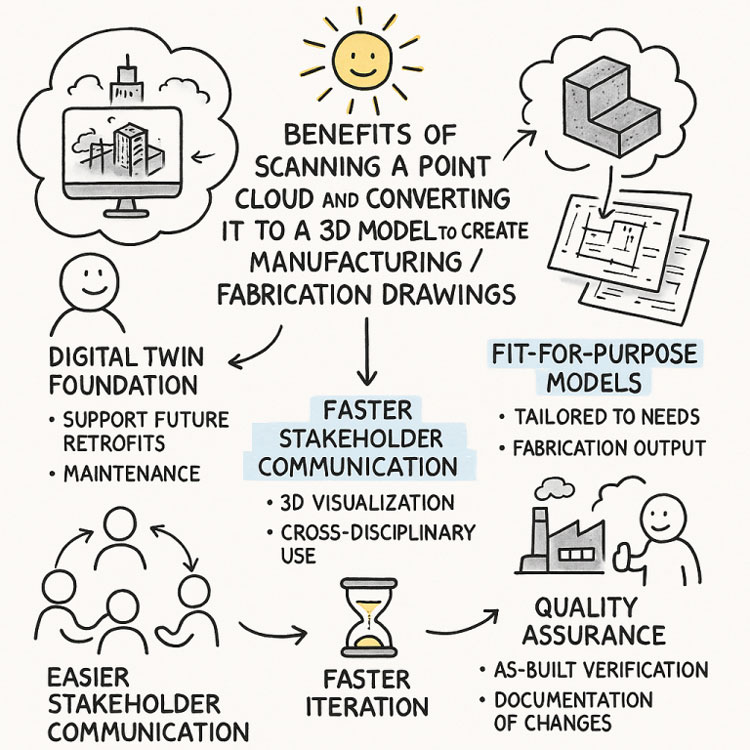
When you scan a physical space, component, or assembly using modern laser scanning or photogrammetry, you capture millions of data points — a digital twin of reality. Converting that data into a precise 3D model opens the door to benefits like:
Pinpoint Accuracy: Say goodbye to guesswork and human measurement errors.
Faster Iteration: Generate manufacturing and fabrication drawings quickly, test design variations digitally, and accelerate your project timelines.
Improved Collaboration: Give engineers, fabricators, and stakeholders a single source of truth that everyone can see and work from.
Risk Reduction: Spot interferences, clashes, and potential problems before they become costly rework in the shop or on-site.
Future-Proofing: Create a digital foundation for maintenance, upgrades, and retrofits years down the line.
This isn’t just better engineering — it’s smarter business.
The Missing Piece: Expertise
Technology alone doesn’t guarantee success. A high-resolution point cloud is just data — and without the right people turning that data into insight, it won’t deliver its full value.
That’s where mechanical engineering consultants come in. By partnering with experts who understand both the technology and the application, you gain:
Tailored Workflows: A consultant knows how to align the process with your unique needs, whether it’s structural steel, piping systems, or custom machinery.
Best-Practice Modeling: Avoid bloated, unusable models or drawings that don’t reflect fabrication realities.
Integrated Solutions: Consultants ensure your 3D models, fabrication drawings, and QA processes work seamlessly with your existing systems.
Strategic Insight: Move beyond simply “drawing what’s there” to rethinking processes, improving efficiency, and reducing total cost of ownership.
Why Now Is the Perfect Time
Market pressures are increasing. Labor costs are rising. Margins are under strain. Mistakes are expensive — but digital solutions are more accessible than ever.
Your competitors are already exploring Industry 4.0 technologies like point cloud scanning, 3D modeling, and digital twins. The companies that succeed are the ones that move early, learn fast, and embed these practices into their operations.
Bringing in mechanical engineering consultants allows you to leapfrog the painful trial-and-error phase and start reaping the benefits from day one.
Level Up Your Engineering Today
If you’re still relying on outdated measurement methods, 2D drawings, and siloed workflows, now is the time to level up. Scanning, modeling, and digital collaboration aren’t “nice-to-haves” anymore — they’re the foundation of modern manufacturing and fabrication.
Engage a trusted mechanical engineering consultant who can:
Capture your as-built environment accurately
Convert point clouds into actionable 3D models
Deliver fabrication-ready drawings
Help you reduce risk, save time, and improve quality
The future of engineering is here. Don’t just keep up — get ahead.
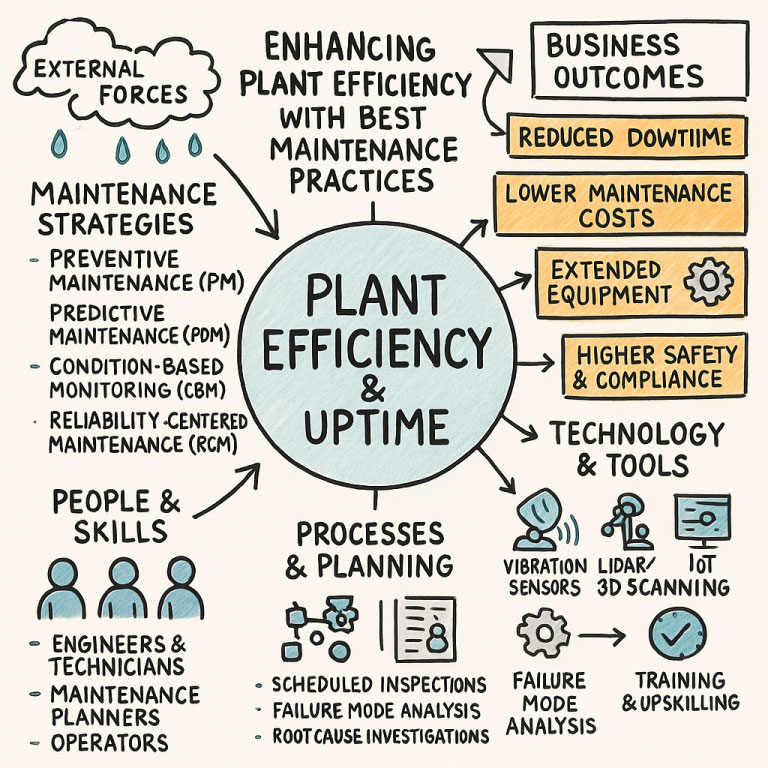
In today’s competitive industrial landscape, maintaining high levels of Overall Equipment Effectiveness (OEE) is a cornerstone of operational success. Achieving this requires adopting advanced maintenance practices that minimize downtime, reduce operational costs, and extend the lifecycle of critical assets.
This white paper outlines best maintenance practices aligned with the ISO 18436.2 standard and highlights how Hamilton By Design’s team of mechanical engineers can partner with your organization to enhance your plant’s OEE. By leveraging our expertise in condition-based and predictive maintenance, we can optimize equipment performance and drive measurable improvements in productivity and reliability.
The Role of Maintenance in Maximizing OEE
OEE is a comprehensive measure of manufacturing productivity, defined by three critical components:
Availability: Minimizing downtime to maximize operational hours.
Performance: Ensuring equipment runs at optimal speeds.
Quality: Reducing defects and waste during production.
Maintenance strategies are key to influencing these factors. Moving beyond reactive approaches to predictive and condition-based maintenance can significantly enhance equipment reliability and efficiency, ensuring better alignment with OEE goals.
Adopting Best Maintenance Practices
Condition-Based Maintenance (CBM)
CBM involves monitoring the real-time condition of equipment to predict and prevent failures. At Hamilton By Design, we integrate cutting-edge technologies like vibration analysis, thermography, and ultrasonic testing to enable proactive interventions before problems escalate.
How CBM Enhances OEE:
Reduces unplanned downtime (Availability).
Maintains consistent performance by addressing issues early (Performance).
Prevents production disruptions that cause defects (Quality).
Predictive Maintenance (PdM)
Predictive maintenance leverages data analytics to anticipate potential failures. By applying ISO 18436.2-certified practices, we implement advanced diagnostic tools and algorithms to forecast maintenance needs with precision.
Our Approach:
Deploy vibration analysis tools managed by certified Level II and III analysts.
Use infrared thermography to detect heat anomalies in electrical and mechanical systems.
Employ ultrasonic testing to identify leaks and structural weaknesses.
Benefits for OEE:
Prolonged equipment lifespan by addressing issues at their inception.
Higher productivity with fewer interruptions.
Reduced maintenance costs through targeted interventions.
Reliability-Centered Maintenance (RCM)
RCM focuses on optimizing maintenance strategies for each asset, emphasizing a deep understanding of failure modes and effects. Our engineers employ RCM to prioritize maintenance tasks that align with your plant’s specific OEE goals.
Steps We Implement:
Asset Function Analysis: Understanding the purpose and criticality of each asset.
Failure Mode and Effects Analysis (FMEA): Identifying risks and developing mitigation strategies.
Data-Driven Decision Making: Using condition monitoring data to guide maintenance schedules.
Impact on OEE:
Ensures maintenance is aligned with production priorities.
Reduces waste and rework caused by unexpected equipment malfunctions.
Leveraging ISO 18436.2 Standards
ISO 18436.2 defines the competencies required for condition monitoring personnel, ensuring a standardized approach to predictive maintenance. Hamilton By Design’s mechanical engineers are certified under this standard, offering expertise in:
Vibration analysis for detecting unbalance, misalignment, and bearing faults.
Developing and managing comprehensive condition monitoring programs.
Interpreting and analyzing complex diagnostic data for actionable insights.
How Hamilton By Design Can Assist
Customized Maintenance Solutions
We recognize that every plant has unique operational challenges. Hamilton By Design tailors maintenance strategies to your specific needs, focusing on:
Asset Criticality Assessment: Identifying and prioritizing key equipment for monitoring and intervention.
Technology Integration: Implementing IoT-enabled sensors, data platforms, and diagnostic tools.
Program Development: Designing maintenance schedules aligned with production cycles and OEE targets.
Expert Training and Certification
Our team provides in-depth training for your personnel, ensuring they gain ISO 18436.2 certification and the skills to sustain advanced maintenance programs.
Ongoing Support and Continuous Improvement
Maintenance isn’t static. Hamilton By Design offers ongoing support to refine your maintenance practices, ensuring your plant stays ahead of evolving operational demands.
Case Study: Improving OEE with Hamilton By Design
Challenge: A manufacturing plant experienced frequent equipment failures, leading to a 15% drop in OEE.
Solution: Hamilton By Design implemented a tailored predictive maintenance program:
Installed vibration sensors on critical rotating machinery.
Trained plant engineers to monitor and analyze data using ISO 18436.2 standards.
Provided ongoing diagnostics and recommendations.
Outcome:
Downtime was reduced by 40%, significantly improving availability.
Defects decreased by 25%, improving product quality.
Maximizing OEE requires a strategic approach to maintenance that integrates advanced tools, skilled personnel, and data-driven insights. Hamilton By Design’s mechanical engineers, certified under ISO 18436.2, are uniquely equipped to help your plant achieve these goals.
By partnering with us, you can transform your maintenance practices, boost operational efficiency, and secure a competitive edge in your industry. Let Hamilton By Design help you take the first step toward a more reliable and productive future.
Petrochem Expert – Best Practices for Plant Maintenance Explores how proper maintenance planning ensures efficiency, reliability, and safety in plant operations. https://petrochemexpert.com/best-practices-for-plant-maintenance-ensuring-operational-efficiency-and-safety/
Keeping machinery running isn’t just about fixing things when they break — it’s about preventing problems before they stop production, cause delays, or create safety risks. In today’s competitive industrial world, companies are using smarter strategies, better data, and more skilled people to make maintenance a strategic advantage rather than just an expense.
This shift is supported by new research, industry reports, and technology innovations that are changing the way maintenance is done. Let’s explore these best practices, the trends driving them, and how businesses are putting them into action.
Why Smarter Maintenance Matters
Every time a machine unexpectedly breaks down, it costs money — sometimes thousands of dollars per hour — not to mention the lost production and safety risks. This is why businesses are turning to condition monitoring — the practice of keeping an eye on equipment health through vibration data, temperature readings, and other signals.
According to SNS Insider, the market for vibration sensors alone is set to exceed USD 8.19 billion by 2032, driven by demand for predictive maintenance and automation. In other words, smart maintenance is no longer a nice-to-have — it’s becoming the industry standard.
Building a Proactive Maintenance Approach
Continuous Equipment Monitoring
Rather than waiting for something to fail, companies now collect data from equipment in real time. This data reveals whether something is running smoothly or starting to show early signs of trouble — like excessive vibration, heat, or noise.
Recent Cerexio research shows that condition-based maintenance is now a top trend in manufacturing, reducing unnecessary downtime and maintenance costs by focusing resources where they are actually needed.
Smarter Decision-Making
Not every machine needs the same treatment. Reliability-focused strategies look at each asset individually:
What is its purpose?
How likely is it to fail?
What would it cost if it did fail?
This allows businesses to focus on the machines that matter most to production, safety, and quality, instead of spreading resources too thinly across every piece of equipment.
Predicting Failures Before They Happen
Predictive maintenance is the next evolution — using tools like vibration analysis, thermal imaging, and ultrasonic testing to spot problems weeks or months in advance.
Cutting-edge research is making this even more powerful. A 2025 arXiv study proposed robust methods for fault detection and severity estimation, allowing teams to find issues earlier and with greater accuracy. Another study showed how advanced neural networks can run these diagnostics on low-power edge devices, making predictive monitoring cheaper, faster, and more energy-efficient.
People at the Center of Maintenance Success
Even with advanced sensors, AI, and cloud software, the human factor is crucial. Skilled technicians and analysts know how to interpret data, identify root causes, and make the right call on whether to intervene now or keep watching.
The industry faces a global skills gap, with a shortage of qualified maintenance professionals. As WorkTrek’s 2025 trends report points out, investing in training is now one of the most important things companies can do. Well-trained teams ensure that technology investments deliver real-world results.
Common Hurdles and How to Overcome Them
Skill Shortage: Close the gap by training your workforce, hiring certified professionals, and encouraging knowledge sharing inside the organization.
High Upfront Costs: Sensors, training, and software can be expensive, but companies often recover the cost quickly through fewer breakdowns and lower downtime.
Data Overload: More data isn’t always better — use good analytics tools and qualified staff to filter out noise and focus on what matters most.
Where Maintenance Is Headed
The future of maintenance is smarter, faster, and more connected than ever before. MaintWorld forecasts that AI-powered predictive maintenance will grow into a $1.69 billion global market by 2030, and f7i.ai notes that wireless sensors and cloud platforms are rapidly becoming the standard way of doing vibration monitoring.
This means we’ll see:
Always-on monitoring: Equipment continuously “talking” to maintenance teams
Fewer surprises: Early warnings will prevent expensive emergency shutdowns
Energy-efficient solutions: Low-power devices will make monitoring cheaper and greener
Smarter plants: Integrated systems will combine vibration data with temperature, pressure, and production data to make better decisions automatically
Final Thoughts
The way we maintain equipment is evolving fast. Instead of waiting for machines to break, businesses are using technology, data, and skilled people to stay ahead of problems. The result? Safer operations, fewer unexpected stoppages, and a stronger bottom line.
Maintenance is no longer just a cost — it’s a competitive advantage. Companies that invest in smarter practices today are setting themselves up for a more reliable, efficient future.
To provide the best experiences, we use technologies like cookies to store and/or access device information. Consenting to these technologies will allow us to process data such as browsing behaviour or unique IDs on this site. Not consenting or withdrawing consent, may adversely affect certain features and functions.
Functional
Always active
The technical storage or access is strictly necessary for the legitimate purpose of enabling the use of a specific service explicitly requested by the subscriber or user, or for the sole purpose of carrying out the transmission of a communication over an electronic communications network.
Preferences
The technical storage or access is necessary for the legitimate purpose of storing preferences that are not requested by the subscriber or user.
Statistics
The technical storage or access that is used exclusively for statistical purposes.The technical storage or access that is used exclusively for anonymous statistical purposes. Without a subpoena, voluntary compliance on the part of your Internet Service Provider, or additional records from a third party, information stored or retrieved for this purpose alone cannot usually be used to identify you.
Marketing
The technical storage or access is required to create user profiles to send advertising, or to track the user on a website or across several websites for similar marketing purposes.