Mechanical Engineering | 3D Scanning | 3D Modelling
Tag: reverse-engineering
Hamilton By Design provides reverse engineering services for mechanical components, machinery and industrial equipment where original drawings or reliable CAD models are unavailable.
We use 3D laser scanning, metrology-grade scanning and conventional measurement techniques to capture the geometry of existing components and assemblies. The captured data can then be converted into practical 3D CAD models, manufacturing information and technical drawings.
Our reverse engineering services can support worn or obsolete component replacement, equipment modifications, spare-parts development, dimensional verification and the reproduction of legacy parts. Deliverables may include point clouds, polygon meshes, SolidWorks models, STEP or Parasolid files, DXF profiles and fabrication drawings.
Combining mechanical engineering, fitting and machining experience with modern 3D scanning allows us to consider how a component functions, interfaces and may be manufactured—not just its external shape.
Services are available throughout Sydney, Newcastle, the Hunter Valley, regional NSW and across Australia.
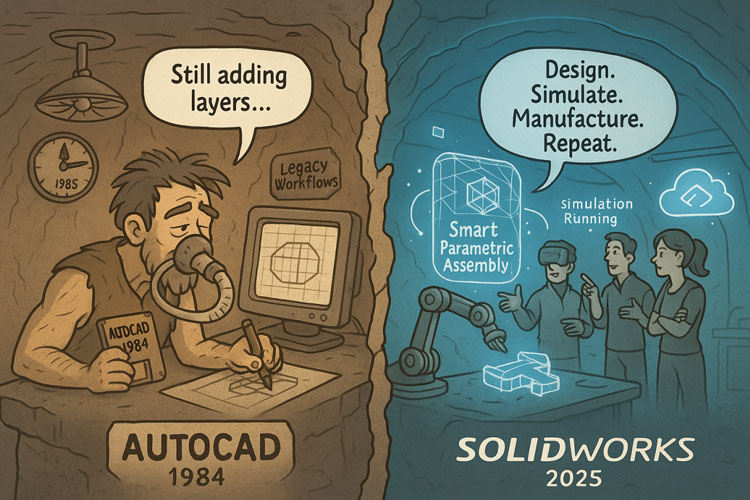
In the 1980s, AutoCAD was revolutionary. It replaced drafting boards and sharpened pencils with a digital drawing tool. Architects, engineers, and designers suddenly had a new way to bring ideas to life — faster, cleaner, and more accurate than ever before.
But here’s the problem: it’s 2025 now, and AutoCAD is still trying to breathe the same thin air it did back then.
Stuck in 2D While the World Moved On
Today’s engineering isn’t about drawing — it’s about designing. It’s about simulating real-world forces, visualizing assemblies, testing tolerances, and producing manufacturable parts before a single prototype is built.
AutoCAD, at its core, is still a 2D drafting platform trying to wear a 3D mask. The workflows are fragmented, the feature set feels patched together, and it lacks the intelligence modern teams demand.
By contrast, SOLIDWORKS was built for this century — fully parametric, model-driven, and collaborative. When you make a change to a design in SOLIDWORKS, every part, drawing, and assembly updates instantly. That’s not an upgrade; that’s evolution.
Design Needs Intelligence, Not Layers
AutoCAD still asks you to think in layers and lines — the language of draftsmen. SOLIDWORKS speaks the language of relationships, assemblies, and constraints — the language of engineers and innovators.
Modern design tools must integrate simulation, visualization, and manufacturability. They must predict behavior, test fit, and optimize before production. AutoCAD just can’t breathe in that environment anymore — it’s stuck flipping between tabs while SOLIDWORKS users are already printing parts.
Collaboration and Data: The New Oxygen
The world doesn’t design in isolation anymore. Teams are global, deadlines are tighter, and innovation cycles are shorter. AutoCAD’s file-based approach is like passing blueprints across a fax machine.
SOLIDWORKS integrates cloud data management, real-time collaboration, and digital twin technology — letting design teams iterate and innovate in real time, anywhere in the world.
The Future Is 3D — and It’s Already Here
You wouldn’t build an electric vehicle using a typewriter. So why design modern products with 1980s software?
SOLIDWORKS represents the present and the future — intelligent modeling, simulation-driven design, and integrated manufacturing tools that push boundaries instead of tracing them.
Final Thoughts
AutoCAD made history — no one can deny that. But history belongs in the museum, not the manufacturing floor.
If your software is still gasping for air in a 2D world, maybe it’s time to give it a well-earned retirement. SOLIDWORKS doesn’t imitate innovation — it defines it.
At Hamilton By Design, we specialise in delivering practical and innovative solutions for industrial, commercial, and infrastructure projects. As experienced mechanical engineers in Sydney, we provide expert services in mechanical design, structural engineering, drafting, and 3D scanning. Our team is committed to helping clients across Sydney achieve safe, cost-effective, and fully compliant project outcomes.
Our Services in Sydney
Mechanical Engineering & Design
Custom design of process equipment such as chutes, hoppers, and conveyors
Pump and piping system layouts for reliable fluid and material transfer
Plant layout optimisation, retrofits, and system upgrades
Failure diagnosis, problem-solving, and performance improvement
Structural Engineering
Steel structures, platforms, and support framework design
Structural modifications and like-for-like replacements
Load assessments, foundation design, and audits for compliance
Integration of mechanical systems with structural solutions
Drafting & CAD Services
Accurate shop drawings, assemblies, and fabrication details
P&IDs, BOMs, and detailed documentation for construction and manufacturing
Mechanical and structural drafting compliant with Australian Standards
CAD drafting that integrates seamlessly with site data
3D Laser & LiDAR Scanning
High-precision scans of facilities, plants, and infrastructure in Sydney
As-built data capture to reduce costly site visits
Point cloud conversion into detailed CAD models
Digital twins, clash detection, and retrofit planning
SolidWorks & CAD Contracting
Expert SolidWorks design, modelling, and validation
Reverse engineering and interference detection
Flexible CAD resource support for Sydney businesses and projects
Project Support & Compliance
End-to-end project support from concept through to fabrication drawings
On-site validation, quality assurance, and safety compliance
Independent inspections and reporting for reliable project delivery
Collaboration with multidisciplinary teams across Sydney
Why Choose Hamilton By Design?
Trusted mechanical engineers in Sydney with national project experience
Flexible services tailored to projects of all sizes
Advanced tools including SolidWorks, CAD, and LiDAR scanning
Proven track record supporting manufacturing, industrial, and infrastructure clients
Industries We Support
Hamilton By Design provides mechanical engineering services throughout Sydney for manufacturing facilities, materials handling systems, water treatment plants, food processing facilities, mining infrastructure, industrial plants and commercial developments.
Hamilton By Design supports projects throughout Sydney CBD, Parramatta, Liverpool, Penrith, Chatswood, Alexandria, Mascot, Newcastle and the Central Coast with practical mechanical engineering services. Our experience includes materials handling systems, plant upgrades, shutdown engineering, equipment design and brownfield project support.
Our clients:
Looking for reliable mechanical engineers in Sydney to support your next project? Hamilton By Design offers the expertise and tools to get the job done right.
Hamilton By Design supports projects throughout Sydney CBD, Parramatta, Liverpool, Penrith, Blacktown, Chatswood, Alexandria, Mascot, Newcastle and the Central Coast.
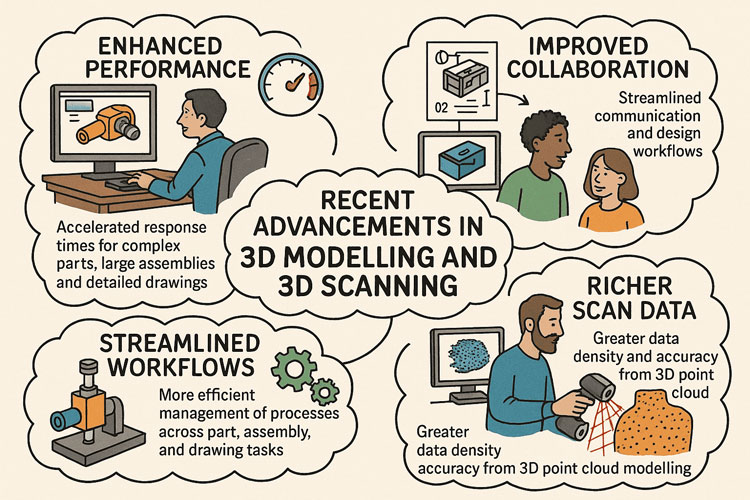
Collaboration is increasingly centred around 3D data. Modern platforms now let teams review, comment on, and markup native 3D models directly inside the design environment. Instead of relying solely on screenshots or static drawings, stakeholders can spin, section, and measure live models for better context. Real-time update notifications and cloud-connected revision control ensure that scanned 3D data and parametric CAD models stay synchronized — critical when working with reality capture data that represents the as-built environment. Hybrid data management options combine local PDM systems with cloud platforms, supporting distributed teams handling massive point clouds or mesh data. This tight integration means that model changes — whether from new design iterations or updated scans — propagate instantly across the project team. Decision-making becomes more visual and informed, keeping everyone aligned around a single, authoritative 3D dataset. Collaboration is no longer a separate process but embedded into daily 3D workflows.
2. Smarter Part Modelling
3D modelling tools are now more intelligent and better suited for working with scan-derived geometry. Designers can quickly apply chamfers, fillets, and shells across complex surfaces, even those imported from meshes or point cloud extractions. Automated bend notch creation and sheet metal tools are optimized to work with geometry derived from scanning existing parts, making reverse-engineering and fabrication preparation much faster. Reference geometry patterning allows engineers to build parametric frameworks over point cloud regions, speeding up master model creation. Cleanup utilities now support selectively removing unnecessary features or smoothing noisy scan data without rebuilding the entire model history. These advances turn what used to be a labour-intensive process into a streamlined workflow that transforms raw reality capture data into production-ready models. The focus is on reducing friction between physical and digital — allowing engineers to move quickly from scan to design, then to manufacturing.
3. Large Assembly Performance
Point cloud and mesh datasets are often extremely large, so performance improvements are critical. Modern CAD platforms now handle assemblies containing both traditional parametric models and massive scan data without bringing systems to a crawl. Engineers can duplicate components while maintaining mates, overlay scans onto assemblies to check fit, and perform interference detection even in lightweight modes. Visualization performance has been tuned for high-density point clouds, allowing smooth pan, zoom, and rotate interactions even with billions of points. Simplification and decimation tools let users strip out unneeded scan detail for faster load times while retaining critical geometry. Seamless transitions between lightweight review and full edit mode make it possible to work interactively with scanned environments. This capability is especially valuable for plant layout, construction validation, and retrofitting projects, where the ability to handle large, mixed-format 3D datasets directly within assemblies is a competitive advantage.
4. Enhanced Drawings and Documentation
Although 3D is the primary medium, 2D documentation remains essential — especially for suppliers and manufacturing partners. Modern CAD environments generate drawings directly from parametric models or scan-based reconstructions, ensuring that documentation matches the latest as-built conditions. Multi-approval stamps, BOM quantity overrides, and standards compliance tools make it easy to document parts created from reverse engineering or field measurement data. Automatic view generation and model-based definition (MBD) help reduce the reliance on fully manual drawings, embedding dimensions and tolerances directly into the 3D model where possible. For projects using scans, section views can be cut through the point cloud or mesh to produce accurate reference drawings without redrawing geometry. These improvements ensure that documentation is both faster to produce and more accurate — giving fabrication teams confidence that the deliverables reflect real-world conditions rather than idealized design intent.
5. Seamless ECAD/MCAD Integration
The convergence of 3D scanning and electronics integration is enabling more precise mechatronic design. Point cloud models of housings, enclosures, and factory floors can be combined with PCB outlines and component data for fit validation. Modern tools allow importing copper traces, vias, and keep-out regions into the mechanical model to run thermal or clearance checks directly against scanned geometry. This prevents collisions and ensures proper heat management early in the design cycle. Real-time synchronization between ECAD and MCAD domains means that if a scanned housing reveals unexpected tolerances, electrical designers can adjust their board layout accordingly. The result is a more accurate digital twin that accounts for both the designed and as-built states. This tighter integration avoids costly late-stage changes, shortens time-to-market, and ensures that mechanical and electrical systems are developed with a shared, reliable 3D reference that reflects physical reality.
6. Performance and Visualization
Visualization is where 3D scanning truly shines. GPU-accelerated engines now render massive point clouds, meshes, and parametric geometry in real time, allowing teams to virtually “walk through” captured environments or inspect reverse-engineered parts at full fidelity. Silhouette-based defeature tools can strip away irrelevant details while maintaining enough geometry for accurate reviews and clash detection. Cached mass property calculations extend to mesh and hybrid models, giving accurate weight and center of gravity data even from scan-derived parts. Photorealistic rendering using real-time ray tracing allows stakeholders to experience designs exactly as they will look, bridging the gap between scanned reality and proposed modifications. This level of visual fidelity improves collaboration, reduces the need for physical mock-ups, and accelerates stakeholder buy-in. High-quality 3D visualization is no longer a luxury — it is a daily tool for engineers, designers, and decision-makers alike.
7. Future Outlook
The future of 3D modelling is increasingly driven by AI and reality capture. Expect CAD platforms to automatically recognize features within point clouds — holes, slots, threads — and generate parametric features with minimal user input. Cloud-native workflows will make it easier to process extremely large scan datasets without local performance bottlenecks. Automated drawing generation and model-based definition will continue to reduce documentation overhead, while digital twin technology will tie live sensor data to scanned geometry for ongoing validation. Generative design powered by AI will be able to work directly with scanned environments, proposing optimized solutions that account for real-world constraints. This convergence of scanning, modelling, and simulation promises a future where physical and digital coexist seamlessly — enabling engineers to capture, design, simulate, and validate with unprecedented speed and accuracy, ultimately transforming how products, factories, and infrastructure are created and maintained.
Why Engineers, Designers & Project Managers Are Turning to 3D Scanning & CAD Modelling
Why Engineers, Designers & Project Managers Are Turning to 3D Scanning and CAD Modelling
In engineering and fabrication, the margin for error is razor-thin. A few millimetres off can mean costly rework, delays, or worse — safety issues. At Hamilton By Design, we believe the future of precision engineering lies in combining smart data capture with expert design workflows. That’s why more businesses are moving away from guesswork and toward 3D laser scanning and CAD modelling as standard practice.
We’ve put together a detailed overview of our services and methods in a recent blog post that explains how we help industry clients across Australia deliver with confidence.
Traditional site measurements and hand-drawn markups are time-consuming, error-prone, and hard to communicate between disciplines. With 3D laser scanning, we can capture complex geometry quickly and accurately — from plant layouts and piping to structural steel and mobile machinery.
Using FARO laser scanning technology, we generate high-resolution point clouds that form the foundation for everything that follows — whether that’s clash detection, fabrication detailing, or a full digital twin.
It’s fast, accurate, and incredibly efficient — especially on live sites where access is limited and downtime is costly.
🧩 CAD Modelling That Fits — Literally and Logically
Once the scan is complete, our team of experienced mechanical designers converts that data into solid CAD models, tailored to your workflow.
Whether you need:
Accurate as-built documentation
Reverse-engineered mechanical components
Custom fabrication-ready drawings
Plant modification layouts
We deliver models that integrate seamlessly with your existing systems — whether you use SolidWorks, Inventor, Revit, or MicroStation.
Our CAD modelling isn’t just visual. It’s functional. It’s engineered for fit, fabrication, and future upgrades.
👷♂️ Real-World Applications Across Industry
Our clients range from mining operations and water utilities to fabrication shops and site-based engineering firms. In all cases, the common problem is the same: they need to understand what’s really there before they design what comes next.
Some recent use cases include:
Replacing worn mechanical components with no existing drawings
Planning plant upgrades where outdated PDFs weren’t reliable
Creating fabrication models from legacy assets
Capturing geometry for safety reviews and clearances
If your team still relies on measurements taken with a tape measure or outdated hand sketches, there’s a better way.
Don’t Guess. Scan. Model. Deliver.
At Hamilton By Design, we’ve been providing CAD modelling since 2001, and offering 3D scanning since 2017. We’ve built our reputation on doing it right the first time — with engineering logic, practical experience, and technology that works.
If you want to understand how 3D laser scanning and CAD modelling can reduce risk and deliver better results, we invite you to read our full blog post:
In the 1980s through to the early 2000s, AutoCAD ruled supreme. It revolutionised the way engineers and designers approached 2D drafting, enabling technical drawings to be created and shared with speed and precision across industries. For two decades, it set the benchmark for visual communication in engineering and construction. But that era has passed.
Today, we live and work in a three-dimensional world — not only in reality, but in design.
From 2D Drafting to Solid Modelling: The New Standard
At Hamilton By Design, we see 3D modelling not just as a tool, but as an essential evolution in how we think, design, and manufacture. The transition from 2D lines to solid geometry has reshaped the possibilities for every engineer, machinist, and fabricator.
With the widespread adoption of platforms like SolidWorks, design engineers now routinely conduct simulations, tolerance analysis, motion studies, and stress testing — all in a virtual space before a single part is made. Companies like Tesla, Ford, Eaton, Medtronic, and Johnson & Johnson have integrated 3D CAD tools into their product development cycles with great success, dramatically reducing rework, increasing precision, and accelerating innovation.
Where 2D design was once enough, now solid models drive machining, laser cutting, 3D printing, automated manufacturing, and finite element analysis (FEA) — all from a single digital source.
At Hamilton By Design, we work with and alongside these firms — and others — to deliver scalable, intelligent 3D modelling solutions to the Australian industrial sector. From laser scanning and site capture to custom steel fabrication, we translate concepts into actionable, manufacturable designs. Our clients benefit not only from our hands-on trade knowledge but also from our investment in cutting-edge tools and engineering platforms.
So What’s Next? The Future Feels More Fluid Than Solid
With all these tools now at our fingertips — FEA simulation, LiDAR scanning, parametric modelling, cloud collaboration — the question becomes: what comes after 3D?
We’ve moved from pencil to pixel, from 2D lines to intelligent digital twins. But now the line between design and experience is beginning to blur. Augmented reality (AR), generative AI design, and real-time simulation environments suggest that the next wave may feel more fluid than solid — more organic than mechanical.
We’re already seeing early glimpses of this future:
Generative design tools that evolve geometry based on performance goals
Real-time digital twins updating with sensor data from operating plants
AI-driven automation that simplifies design iterations in minutes, not days
In short: the future of 3D design might not be “3D” at all in the traditional sense — it could be interactive, immersive, adaptive.
At Hamilton By Design — We’re With You Now and Into the Future
Whether you’re looking to upgrade legacy 2D drawings, implement laser-accurate reverse engineering, or develop a full-scale 3D model for simulation or manufacturing — Hamilton By Design is here to help.
We bring hands-on trade experience as fitters, machinists, and designers, and combine it with the modern toolset of a full-service mechanical engineering consultancy. We’re not just imagining the future of design — we’re building it.
Let’s design smarter. Let’s think in 3D — and beyond.
Elevating Engineering Precision: 3D CAD Design, Laser Scanning, and Simulation for Custom Steel Fabrication
In modern engineering, accuracy, efficiency, and adaptability are not just desired—they are essential. At Hamilton By Design, we combine cutting-edge tools like 3D CAD design, 3D laser scanning, and SolidWorks FEA Simulation with practical expertise in custom steel fabrication to deliver intelligent, end-to-end solutions for complex engineering projects.
From detailed CAD Modelling to field-accurate Faro Scanning, our consultancy supports Australian industries with precise, timely, and cost-effective design solutions.
The Role of 3D CAD Design in Modern Engineering
3D CAD design (Computer-Aided Design) forms the foundation of most modern engineering workflows. It transforms initial concepts into detailed digital models, enabling design validation, collaboration, and modification long before anything is physically built.
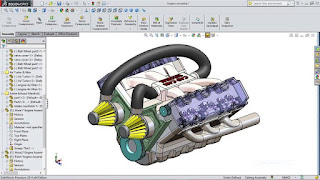
Using tools like SolidWorks, our experienced 3D CAD designers create accurate representations of components, assemblies, and entire systems. This not only reduces costly errors during fabrication but also allows clients to visualise and interact with their product in a virtual environment.
With 3D CAD design at the core, we help clients navigate engineering challenges—from product development to mechanical infrastructure—faster and with greater confidence.
3D Modelling: Bridging Concept and Construction
Closely integrated with CAD design is 3D modelling, which allows designers to create digital prototypes of physical objects. At Hamilton By Design, 3D modelling is used not just for form but also for function. Our models include precise dimensions, material properties, tolerances, and interaction points.
Whether it’s reverse engineering an existing plant structure or designing custom brackets for a conveyor system, our 3D modelling ensures high fidelity and interoperability across platforms.
The Power of 3D Laser Scanning for Engineering Accuracy
To capture as-built environments with unmatched accuracy, we use 3D laser scan for engineering projects of all sizes. Leveraging Faro scanning technology, we generate detailed point clouds that map real-world environments down to millimetre accuracy.
This Faro scan data is then converted into actionable geometry for further CAD modelling or simulation. It’s particularly valuable in retrofit, maintenance, or upgrade projects, where existing site data is often incomplete or outdated.
Whether you’re updating mechanical systems in a processing plant or ensuring compliance in a structural audit, 3D laser scanning delivers the reliable data you need for precise engineering decisions.
From Scan to Simulation: Enhancing Designs with SolidWorks FEA
After creating a digital model, it’s crucial to understand how it will perform under real-world conditions. That’s where SolidWorks FEA simulation comes in.
SolidWorks Simulation allows our team to perform finite element analysis (FEA) on assemblies, evaluating factors such as stress, strain, fatigue, and thermal distribution. By integrating FEA into the design process, we validate designs before they are fabricated—saving both time and material costs.
This proactive approach is particularly useful in custom steel fabrication, where load-bearing components must meet stringent safety and performance criteria.
CAD Modelling in Custom Steel Fabrication
Custom steel fabrication is both an art and a science. It requires a deep understanding of materials, tolerances, and manufacturing techniques. At Hamilton By Design, we combine advanced CAD modelling with practical fabrication experience to create components that meet your exact requirements.
Whether you need custom brackets, enclosures, chutes, or full-scale structural assemblies, our models are production-ready and tailored to your fabrication process. We provide DXFs, laser-cutting files, and BOMs that integrate seamlessly with your shop floor operations.
Why Choose a 3D CAD Designer?
A skilled 3D CAD designer does more than just draw. They anticipate fitment issues, consider manufacturing constraints, and collaborate across disciplines to create practical, buildable designs.
At Hamilton By Design, our team brings over a decade of experience across heavy industry, defence, mining, and manufacturing. We understand the nuances of real-world engineering and tailor our CAD services to each project’s unique needs.
Integrating Faro Scanning with SolidWorks
One of our key differentiators is the seamless integration of Faro scan data into SolidWorks. This workflow allows us to:
Overlay scanned data onto CAD designs
Identify deviations between as-built and as-designed models
Rapidly develop retrofit solutions with accurate field measurements
Conduct clash detection and ensure proper clearances
This end-to-end capability reduces rework, shortens project timelines, and increases overall design quality.
Applications Across Industry
Our services benefit a broad range of industries, including:
Manufacturing – Tooling, jigs, and production line modifications
Defence – CAD design and simulation for retrofit and upgrade works
Construction – Structural steel design and site validation
Whether you’re fabricating a single part or overseeing a multi-million-dollar infrastructure upgrade, our tools and experience help you deliver with confidence.
The Difference
At Hamilton By Design, we don’t just deliver drawings—we provide engineering certainty. By combining the precision of 3D CAD, the power of SolidWorks simulation, and the real-world accuracy of Faro scanning, we help clients design, assess, and fabricate with confidence.
If you’re looking for an Australian mechanical engineering consultancy that delivers intelligent design, detailed modelling, and practical support for custom steel fabrication projects, we’re ready to help.
Let’s Work Together
Visit www.hamiltonbydesign.com.au to learn more or contact us to discuss how we can support your next engineering challenge.
To provide the best experiences, we use technologies like cookies to store and/or access device information. Consenting to these technologies will allow us to process data such as browsing behaviour or unique IDs on this site. Not consenting or withdrawing consent, may adversely affect certain features and functions.
Functional
Always active
The technical storage or access is strictly necessary for the legitimate purpose of enabling the use of a specific service explicitly requested by the subscriber or user, or for the sole purpose of carrying out the transmission of a communication over an electronic communications network.
Preferences
The technical storage or access is necessary for the legitimate purpose of storing preferences that are not requested by the subscriber or user.
Statistics
The technical storage or access that is used exclusively for statistical purposes.The technical storage or access that is used exclusively for anonymous statistical purposes. Without a subpoena, voluntary compliance on the part of your Internet Service Provider, or additional records from a third party, information stored or retrieved for this purpose alone cannot usually be used to identify you.
Marketing
The technical storage or access is required to create user profiles to send advertising, or to track the user on a website or across several websites for similar marketing purposes.