Mechanical Engineering | 3D Scanning | 3D Modelling
Tag: engineering risk management
Engineering Risk Management involves identifying, assessing, and mitigating hazards across the design, fabrication, and operational lifecycle of industrial and structural assets. This tag includes topics such as risk analysis, failure-mode assessment, WHS obligations, design verification practices, and strategies for preventing incidents through data-driven engineering controls.
Hamilton By Design is committed to providing a safe and healthy work environment for all employees, contractors, clients, and visitors. We recognise that effective work health and safety management is fundamental to professional engineering practice and the successful delivery of our services.
This policy outlines our commitment to preventing injury and illness, managing workplace risks, and complying with all applicable work health and safety legislation.
Scope
This policy applies to all Hamilton By Design activities, including:
Mechanical and structural engineering services
3D LiDAR scanning and site data capture
CAD modelling, drafting, and engineering analysis
Office-based work, workshops, and client sites
Interaction with clients, suppliers, and contractors
Our Commitment
Hamilton By Design is committed to:
Complying with all applicable Work Health and Safety (WHS) legislation, regulations, and codes of practice
Providing and maintaining a safe working environment and safe systems of work
Identifying hazards and implementing effective risk control measures
Preventing work-related injury, illness, and incidents
Consulting with workers on health and safety matters that affect them
Continually improving our WHS performance
Hazard Identification and Risk Management
Hamilton By Design applies a risk-based approach to health and safety by:
Identifying hazards associated with office-based and site-based activities
Assessing risks and implementing controls using the hierarchy of controls
Preparing and following Safe Work Method Statements (SWMS) and risk assessments where required
Reviewing risk controls to ensure they remain effective
Roles and Responsibilities
Management
Management is responsible for:
Implementing this policy and providing adequate resources to support WHS objectives
Ensuring risks are identified and controlled
Providing appropriate training, supervision, and instruction
Employees and Contractors
All employees and contractors are responsible for:
Taking reasonable care for their own health and safety
Ensuring their actions do not adversely affect others
Following WHS procedures, site rules, and client requirements
Reporting hazards, incidents, and near misses
Training and Competency
Hamilton By Design ensures that:
Personnel are appropriately trained and competent for the tasks they perform
Site-specific inductions are completed where required
WHS awareness is maintained through ongoing communication and engagement
Incident Reporting and Investigation
All incidents, injuries, and near misses must be reported promptly. Incidents are investigated to identify root causes and to implement corrective actions to prevent recurrence.
Site and Client Safety
When working on client or construction sites, Hamilton By Design will:
Comply with site-specific WHS requirements and permit systems
Use appropriate personal protective equipment (PPE)
Coordinate with clients and contractors to manage shared risks
Consultation and Communication
Hamilton By Design is committed to consulting with employees and contractors on WHS matters and encourages active participation in identifying hazards and improving safety outcomes.
Review and Continuous Improvement
This Work Health & Safety Policy is reviewed periodically to ensure it remains current, effective, and aligned with legislative requirements and industry best practice.
This paper examines the mechanical degradation, failure mechanisms, and system-level reliability implications of Australia’s ageing coal-fired power generation assets, focusing on Callide Power Station (Queensland) and Yallourn Power Station (Victoria). Both stations have experienced significant mechanical failures in the past five years, exposing vulnerabilities in maintenance, asset management, and risk governance under conditions of declining reinvestment. From a mechanical engineering standpoint, these failures illustrate the predictable end-of-life behaviour of large rotating and pressure-bound systems when maintenance expenditure, material renewal, and operational monitoring decline. The paper argues that sustained industrial reliability—and thus national energy and employment security—requires engineering-informed policy that balances decarbonisation with technical integrity management.
Coal-fired power stations are among the most complex mechanical systems ever built in Australia. They integrate high-temperature, high-pressure thermodynamic processes with massive rotating equipment, lubrication systems, and precision alignment tolerances.
From a mechanical engineer’s perspective, their reliability depends on three interlinked pillars:
Structural and material integrity,
Lubrication and vibration control, and
Predictive maintenance and monitoring.
However, as the nation accelerates toward renewable transition targets, investment in these legacy systems has declined. Mechanical failures at Callide and Yallourn are therefore not random accidents but the mechanical manifestation of economic and policy choices.
This analysis seeks to understand those failures in engineering terms, predict future risks, and outline how a re-commitment to industrial infrastructure and jobs requires a concurrent commitment to mechanical reliability.
Technical Overview of Recent Failures
Callide Power Station
Callide’s units span several generations of design and material technology. The C4 explosion (2021) was catastrophic: the failure originated within the turbine hall, leading to structural collapse and large-scale ejection of debris. Subsequent analysis by CS Energy and external investigators identified battery charger replacement errors, inadequate isolation protocols, and loss of process safety discipline as initiators.
From an engineering integrity perspective, the incident represents a compound failure:
Mechanical systems operated under degraded conditions;
Electrical and process-control systems failed to detect early anomalies;
Organisational maintenance controls were insufficient to interrupt escalation.
Later failures — including the C3 boiler pressure event (2025) and cooling tower collapse (2022) — further confirm that structural materials, corrosion protection, and load-carrying assemblies had entered the fatigue–creep interaction phase of their service life.
Yallourn Power Station
At Yallourn, the August 2025 low-pressure turbine dislodgement occurred after decades of vibration monitoring alarms and bearing wear signals. Earlier (2024) shutdowns for “high vibration alarms” indicated growing rotor dynamic instability. When the Unit 2 turbine dislodged, the damage pattern suggested bearing wear, misalignment, or bolt relaxation leading to component displacement.
In mechanical engineering terms, this is a classic late-life failure sequence:
Fatigue crack initiation in critical load-carrying components (rotor or coupling bolts),
Progressive loosening and unbalance,
Dynamic amplification under operating RPM,
Catastrophic structural displacement.
The turbine’s dislodgement was therefore an expected end-of-life event, accelerated by reduced overhaul investment and ageing metallurgical properties.
Comparative Engineering Analysis
Engineering Dimension
Callide
Yallourn
Comparison / Insight
Failure Type
Explosion / Pressure Containment Breach
Turbine Mechanical Dislodgement
Callide shows energy-release failure; Yallourn a structural integrity loss.
Root Mechanical Cause
Overpressure / process safety
Fatigue, unbalance, bearing or bolt failure
Both reflect cumulative degradation.
Indicative Material State
Creep-fatigued pressure shells; corroded supports
Thermal-fatigued steel, worn journals
Metallurgical ageing dominates both.
Maintenance Culture
Process-safety erosion
Reactive, “run-to-retirement”
Organisational degradation common factor.
System Outcome
Explosion and total destruction
Severe mechanical damage, unit outage
Both reduce grid reliability and reveal systemic neglect.
These failures share a unifying pattern recognised in mechanical reliability theory:
Late-life degradation compounded by maintenance deferral and organisational fatigue produces cascading mechanical failure modes that were once preventable.
Predicting Future Failure Behaviour
Mechanical engineers use reliability-centred maintenance (RCM) models to quantify end-of-life risk. For rotating equipment, mean time to failure (MTTF) typically decreases exponentially once fatigue propagation exceeds ~70 % of material endurance life.
Data from the National Electricity Market (NEM) indicates:
Forced outage frequency has doubled since 2012.
Vibration and lubrication alarms are rising in frequency.
Unit unavailability correlates strongly (R² > 0.8) with turbine age and last major overhaul date.
Projected forward, these indicators imply that without major overhauls or component replacements, most Australian coal units will face critical mechanical reliability decline by 2032–2035.
Engineering Economics and Policy Interaction
From an engineering management perspective, the problem is not purely technical — it is thermo-economic.
A major turbine retrofit (~A$25–40 million per unit) is uneconomic for plants scheduled for closure in under a decade.
The probability of catastrophic failure increases sharply as the cost of prevention declines below the cost of repair.
This is the engineering expression of policy-induced obsolescence: political commitments to retire coal reduce the incentive to sustain its mechanical integrity, even while industries still depend on its output.
Industrial Reliability and the Employment Interface
Reliable baseload power is the foundation for industrial continuity. From the standpoint of a mechanical engineer, industrial productivity is a function of mechanical uptime: Productivity=f(Power Reliability,Maintenance Efficiency)\text{Productivity} = f(\text{Power Reliability}, \text{Maintenance Efficiency})Productivity=f(Power Reliability,Maintenance Efficiency)
When power generation becomes intermittent—whether from renewable intermittency or coal unreliability—industrial operations must compensate with redundancy, backup generation, or load-shedding. These add capital and operational costs that ultimately affect employment.
Regional Implications
Queensland retains a stronger firm power horizon (coal + gas + hydro until ~2035), giving industry more operational certainty.
Victoria, by contrast, will face a reliability inflection point after Yallourn (2028) and Loy Yang A (2035) closures.
Without firm generation or large-scale storage online, manufacturing regions risk power volatility—directly translating to production downtime and job insecurity.
Engineering the Transition: Commitment to Jobs and Infrastructure
From a mechanical engineering ethics and systems standpoint, a commitment to industry must be synonymous with a commitment to mechanical reliability. That requires three converging actions:
Asset Integrity Management: Continuous structural health monitoring, vibration analysis, and overhaul planning for remaining thermal units. Even in decline, they must be safely and predictably retired.
Design and Commissioning of Replacement Systems: Engineers must ensure that renewable generation, storage, and transmission assets meet equivalent reliability and maintainability standards. This includes redundancy design, grid inertia replacement, and mechanical resilience of large rotating machinery (e.g., pumped hydro, turbines, bearings).
Workforce Transition as Engineering Continuity: The skills used to maintain turbines, bearings, and boilers are transferable to wind, hydro, and hydrogen equipment. Protecting those jobs preserves both mechanical capability and national energy security.
Engineering Conclusions
From a mechanical engineer’s viewpoint, the failures at Callide and Yallourn are textbook case studies of end-of-life degradation under policy-driven neglect. They illustrate that:
Mechanical degradation is predictable — vibration, lubrication, and thermal-stress indicators were present years before failure.
Organisational and policy decisions override engineering recommendations — maintenance deferral was economic, not technical.
Systemic reliability cannot be sustained without mechanical investment — whether in turbines, batteries, or hydro equipment, engineering integrity remains central.
A national commitment to industry equals a commitment to engineering.
If Australia seeks to safeguard its industrial base and employment, it must invest not only in new energy technologies but in the mechanical soundness of the systems that bridge the transition. Neglecting this will reproduce the same failure patterns—just in new forms of infrastructure.
References (Indicative)
CS Energy (2024). Callide C4 Incident Investigation Summary.
WattClarity (2025). Analysis of Yallourn Unit 2 Trip and Frequency Response.
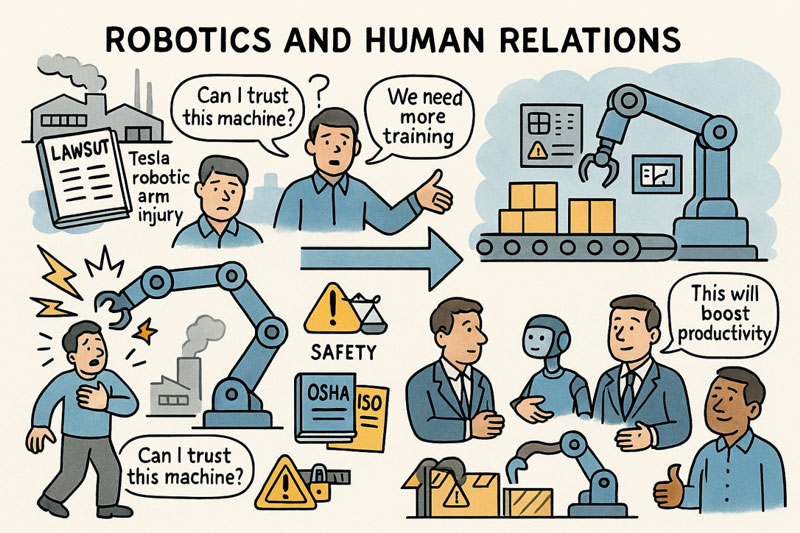
Robots are no longer the stuff of science fiction—they are embedded in our factories, warehouses, and even food-processing plants. They promise efficiency, speed, and the ability to take on dangerous jobs humans shouldn’t have to do. Yet, as recent headlines show, this promise comes with serious risks. From the lawsuit against Tesla over a robotic arm that allegedly injured a worker to the tragic death of a Wisconsin pizza factory employee crushed by a machine, the conversation about human–robot relations has never been more urgent.
This blog post explores the promise and peril of robotics in the workplace, drawing lessons from recent incidents and asking: how do we ensure humans and robots can coexist safely?
The Rise of Robotics in Everyday Work
Robotics is spreading quickly across industries. Automotive giants like Tesla rely on robotic arms for precision assembly, while food plants use automated systems to handle packaging and processing. According to the International Federation of Robotics, robot installations worldwide continue to grow year after year. For businesses, it’s a clear win: fewer errors, lower costs, and reduced human exposure to dangerous tasks.
But with robots entering smaller facilities—where safety infrastructure may be weaker—the risks grow. A mis calibrated robot, a missed safety step, or a poorly trained operator can turn a productivity tool into a deadly hazard.
When Robots Go Wrong: Lessons from Recent Cases
Tesla’s Robotic Arm Lawsuit A former technician at Tesla claims he was struck and knocked unconscious by a robotic arm while performing maintenance. The lawsuit highlights a crucial point: safety procedures like lockout/tagout aren’t optional—they are lifesaving. When machines are energized during servicing, even a momentary slip can have devastating consequences.
Wisconsin Pizza Factory Fatality In a smaller manufacturing plant, a worker lost his life after being crushed by a robotic machine. Unlike Tesla, this wasn’t a high-tech car factory but a food facility—showing that robotics risks extend far beyond Silicon Valley. Smaller plants may lack robust safety training, yet they are increasingly embracing automation.
Both cases are tragic reminders that technology alone can’t guarantee safety. Human oversight, training, and organizational commitment to safety matter just as much.
The Human Side of Robotics
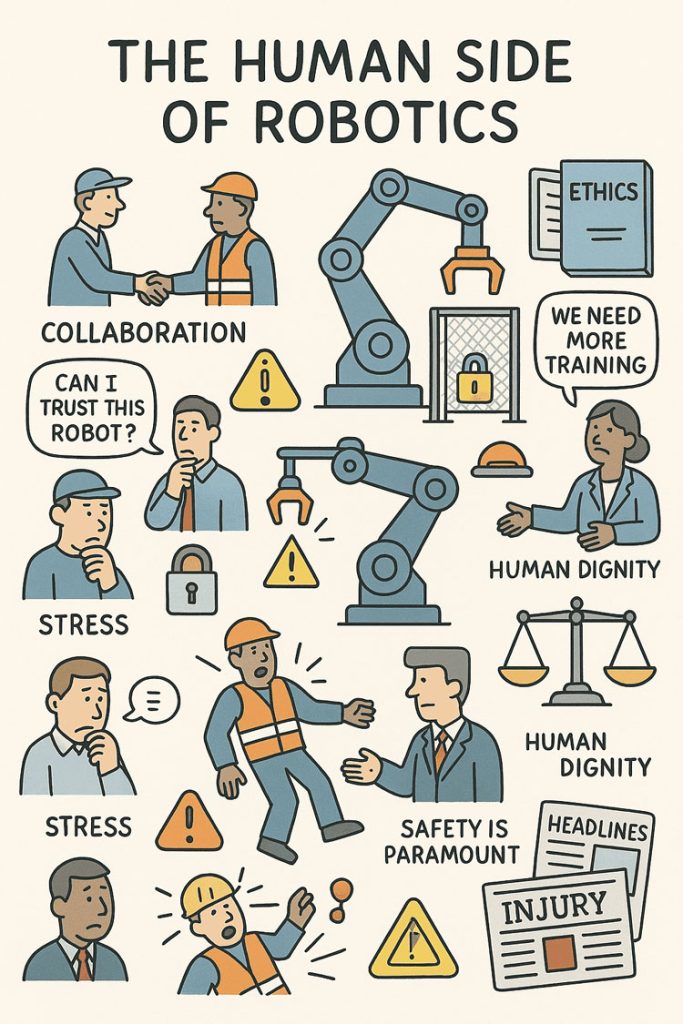
When people think about robots at work, they often picture job displacement. But for many workers, the immediate concern is safety. Studies show that trust plays a huge role: workers who believe robots are reliable tend to perform better. However, misplaced trust—assuming a machine will always stop when needed—can be just as dangerous as fear or mistrust.
Beyond physical risks, robots can also affect morale and mental health. Workers may feel devalued or expendable when machines take over critical tasks. The challenge isn’t just engineering safer robots—it’s creating workplaces where humans feel respected and protected.
Building a Safer Future Together
So how do we strike the right balance between robotics innovation and human well-being? A few key steps stand out:
Design Safety Into the Machine: Emergency stops, advanced sensors, and fail-safes should be standard features—not optional add-ons.
Enforce Safety Protocols: OSHA’s lockout/tagout rules exist for a reason. Employers must ensure that servicing robots without proper shutdowns is never allowed.
Invest in Training: Robots are only as safe as the people who interact with them. Ongoing, practical training helps prevent accidents.
Foster a Safety Culture: Workers should feel empowered to report unsafe practices without fear of retaliation.
Update Regulations: As robots spread into more industries, regulators must adapt. International safety standards like ISO 10218 need to be more widely enforced, especially in smaller facilities.
Conclusion
Robotics is here to stay. It has the potential to make our workplaces more efficient, less physically demanding, and even safer. But incidents like those at Tesla and the Wisconsin pizza plant remind us that without proper safeguards, the cost of automation can be measured in human lives.
The future of human–robot relations doesn’t have to be one of fear or tragedy. With the right mix of engineering, regulation, and workplace culture, robots and humans can work side by side—not as rivals, but as partners. The question isn’t whether we should embrace robotics, but whether we’ll do so responsibly, putting people’s safety and dignity first.
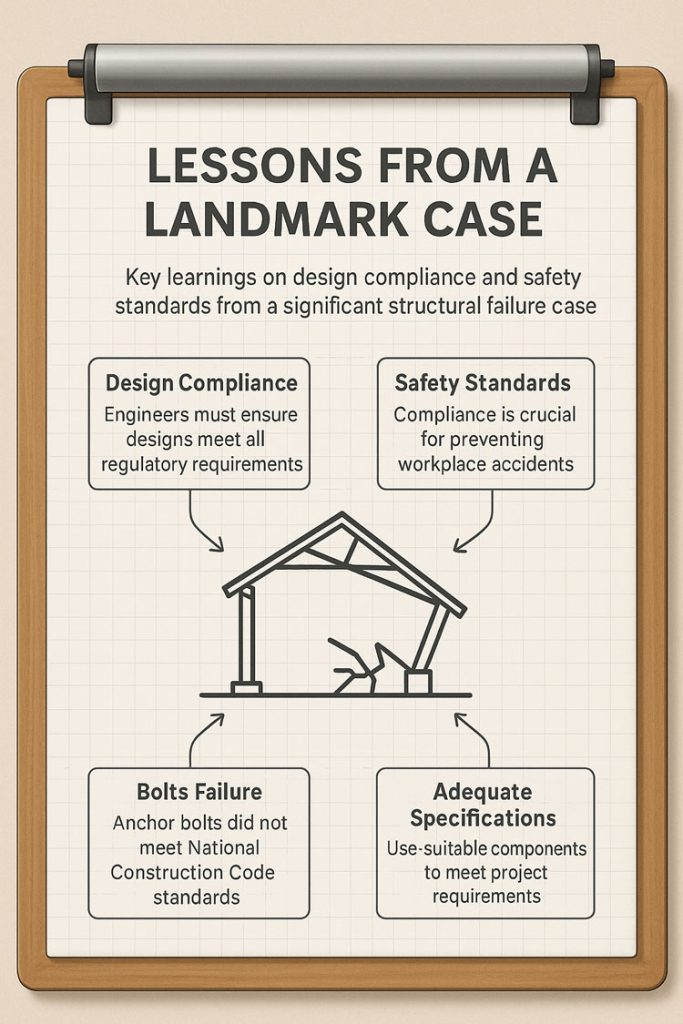
In 2024, SafeWork SA concluded a landmark case involving a spectator-roof collapse during a football club redevelopment project in South Australia. While no life-threatening injuries occurred, the incident highlighted how critical it is for design, review, and certification processes to work together to ensure safety on site.
This was the first successful design-related prosecution under South Australia’s Work Health and Safety Act, sending a clear signal to the engineering and construction sector: design decisions carry legal and safety obligations, not just technical ones.
What Happened (Briefly)
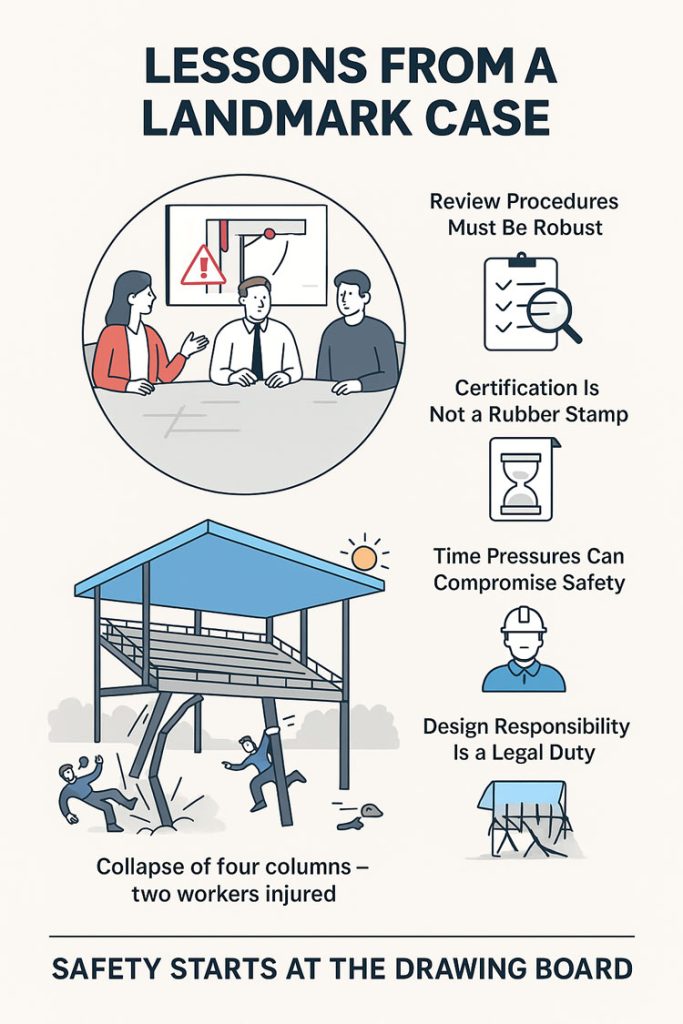
During roof sheeting works in late 2021, four of seven supporting columns of a cantilevered spectator roof failed, causing two apprentices to slide down the roof sheets. SafeWork SA’s investigation found that the anchor bolts specified for the column base plates were inadequate and did not meet the requirements of the National Construction Code (NCC).
An independent compliance review also failed to detect this issue, allowing the error to pass unchecked into construction. The result was a collapse that could have had far more severe consequences had the roof been fully loaded or occupied.
Key Learnings for the Industry
This case underscores several important lessons for engineers, designers, project managers, and certifiers:
1. Design Responsibility Is a WHS Duty
Under the WHS Act, designers have a duty to ensure their work is safe not just in its intended use, but during construction. This means bolts, connections, and base plates must be designed for real-world loads — including wind uplift, combined shear and tension, and concrete breakout limits per NCC and relevant Australian Standards.
2. Review Procedures Must Be Robust — and Followed
Having a documented review procedure is not enough if it isn’t rigorously applied. Independent verification and internal peer review are critical to catching design errors before they reach site.
3. Certification Is Not a Rubber Stamp
Independent certifiers play a key role in safeguarding public safety. They must actively verify that designs meet compliance, rather than simply sign off on documentation.
4. Time Pressures Can Compromise Safety
Compressed project timelines were noted as a factor in missed opportunities to catch the error. Project teams must resist the temptation to shortcut review steps when schedules are tight — safety must remain non-negotiable.
5. Documentation & Traceability Protect Everyone
Maintaining calculation records, checklists, and review signoffs creates a clear audit trail. This helps demonstrate due diligence if something goes wrong.
Why This Matters
The collapse at Angaston Football Club was a relatively small incident with minor injuries — but it could easily have been catastrophic. By learning from cases like this, the industry can improve its processes and prevent future failures.
As professionals, our role is to design for safety, verify rigorously, and document clearly. Doing so protects workers, end-users, and our own organisations.
Legal & Ethical Considerations
This post is intended as a learning resource, not as an allocation of blame. The case referenced is a matter of public record through SafeWork SA and SAET decisions, and all commentary here focuses on general principles of safe design and compliance.
We recommend that other practitioners review their own QA and certification procedures in light of this case to ensure compliance with the National Construction Code and WHS obligations.
To provide the best experiences, we use technologies like cookies to store and/or access device information. Consenting to these technologies will allow us to process data such as browsing behaviour or unique IDs on this site. Not consenting or withdrawing consent, may adversely affect certain features and functions.
Functional
Always active
The technical storage or access is strictly necessary for the legitimate purpose of enabling the use of a specific service explicitly requested by the subscriber or user, or for the sole purpose of carrying out the transmission of a communication over an electronic communications network.
Preferences
The technical storage or access is necessary for the legitimate purpose of storing preferences that are not requested by the subscriber or user.
Statistics
The technical storage or access that is used exclusively for statistical purposes.The technical storage or access that is used exclusively for anonymous statistical purposes. Without a subpoena, voluntary compliance on the part of your Internet Service Provider, or additional records from a third party, information stored or retrieved for this purpose alone cannot usually be used to identify you.
Marketing
The technical storage or access is required to create user profiles to send advertising, or to track the user on a website or across several websites for similar marketing purposes.