Mechanical Engineering | 3D Scanning | 3D Modelling
Tag: engineering certification
Hamilton By Design provides engineering documentation, design verification and technical support for projects requiring engineering review or certification.
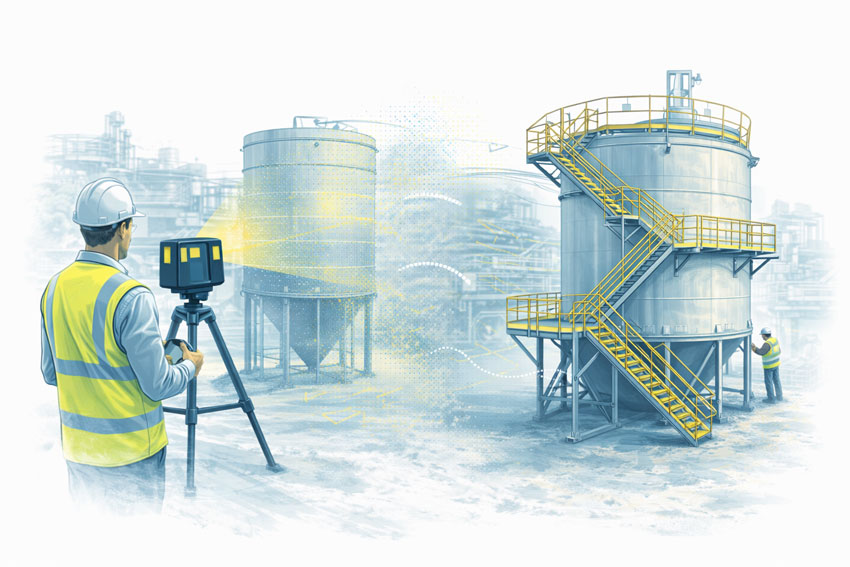
Certification requires reliable information about the design, materials, loads, existing conditions, fabrication and completed installation. Our services can help establish and document this information through site inspection, 3D LiDAR scanning, CAD modelling, mechanical calculations, finite element analysis and controlled engineering drawings.
Depending on the project, our support may include:
Existing-condition and as-built verification
Mechanical design calculations
Finite element analysis reports
General arrangement and fabrication drawings
Design assumptions and load information
Revision-controlled technical documentation
Coordination with specialist engineers
Installation and dimensional verification
Hamilton By Design provides mechanical engineering services within the competence and registration requirements applicable to each project. We do not provide structural engineering certification.
Where structural, civil, electrical, hydraulic or other specialist certification is required, the work must be reviewed and certified by an appropriately qualified and registered engineer. We can provide the scan data, CAD models, drawings and supporting information required to assist that review.
Certification can only be considered after the relevant design, fabrication, installation and supporting evidence have been appropriately reviewed.
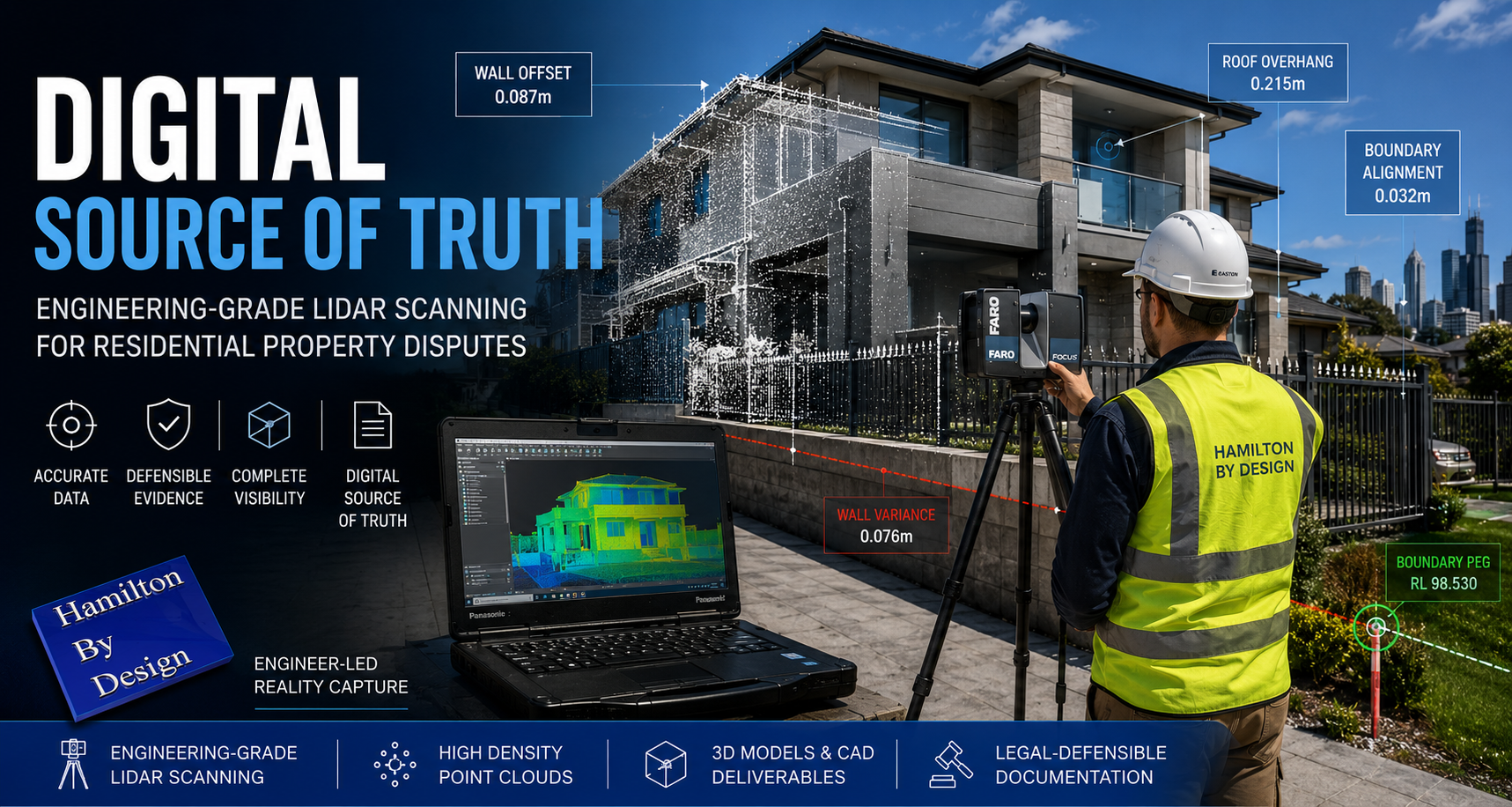
In residential property, a few centimeters can be the difference between a successful renovation and a decade-long legal battle. Whether it’s a dispute over a boundary fence, a claim regarding a construction defect, or an insurance argument over structural movement, the “he-said, she-said” of manual measurements is no longer enough.
At Hamilton By Design, we provide homeowners and legal teams with a “Digital Source of Truth” through high-precision LiDAR (Light Detection and Ranging) scanning.
Why “Near Enough” Isn’t Enough in Residential Law
Traditional property documentation often relies on old paper titles or handheld tape measurements. These methods are prone to human error and fail to capture the complex, three-dimensional reality of a home.
In a legal setting, ambiguity is the enemy. If you are heading to mediation or court, you need data that is objective, repeatable, and millimeter-accurate. LiDAR offers a simple, non-invasive solution for documenting every corner of a property’s geometry.
4 Ways LiDAR Point Clouds Settle Legal Cases
1. Encroachment & Boundary Disputes
The most common residential dispute often involves a fence, retaining wall, or overhanging structure. A LiDAR scan creates a “Point Cloud”—a 3D map of millions of data points—that can be overlaid with official cadastral surveys. This proves exactly where a structure sits in relation to the legal boundary, leaving no room for argument.
2. Construction Defect & Variation Claims
If a builder has installed a wall that isn’t plumb, or a slab that is out of level, manual checks can be disputed. A LiDAR scan captures the entire surface geometry of the building. We can produce “heat maps” that visually demonstrate deviations from the design plans, providing undeniable evidence of whether or not a project meets Australian Standards.
3. Dilapidation Surveys (The “Before & After”)
Before a neighbor begins a major excavation or a council starts roadworks, a LiDAR scan acts as a “digital time capsule.” It documents the exact current state of your home—including existing cracks or structural leans. If damage occurs during the nearby construction, you have a 3D record to prove the change, making insurance claims significantly smoother.
4. Forensic Investigation & Evidence
In more serious cases, such as structural failures or fire damage, LiDAR allows for a “virtual walkthrough” of the scene. Judges and juries can navigate a digital twin of the property, understanding spatial relationships and damage patterns that 2D photos simply cannot convey.
The Value of Geometry
Geometry is the mathematical language of your property. By capturing the precise angles, elevations, and volumes of a home, we help owners:
Identify structural movement over time.
Calculate exact volumes for material disputes.
Verify solar access or view loss in planning disputes.
Bringing Certainty to Your Case
A point cloud is more than just a scan; it is a permanent, digital record that can be revisited years later if new issues arise. At Hamilton By Design, we bridge the gap between complex laser data and practical legal evidence.
Protect your most valuable asset with data that stands up in court. —
Would you like me to create a “Checklist for Homeowners” section to add to this post, detailing when they should consider a scan?
Learning From Mining Industry Incidents | Engineering Insight
Why Engineers Study Failures Without Assigning Blame
In engineering, learning does not come only from success.
Some of the most valuable improvements in safety, reliability, and design practice come from studying incidents after they occur — not to assign blame, but to better understand how systems behave under real-world conditions.
At Hamilton By Design, our interest in industry incidents is purely educational. We do not provide legal opinions, and we do not involve ourselves in litigation. Our focus is engineering learning and risk reduction.
Why Engineers Study Incidents
Engineering is a discipline built on:
Understanding failure modes
Learning from unintended outcomes
Improving designs so similar events are less likely to occur again
Courts determine liability. Engineers determine how systems can be made safer.
These are very different roles.
An Example From the Mining Fabrication Sector
A recent court-reported incident in the Australian mining fabrication sector involved a serious worker injury during the handling of a large steel plate.
This event has been widely reported in industry safety communications and regulator summaries. The matter has been dealt with by the courts.
Our interest is not who was responsible — but what can be learned from an engineering and design perspective.
Separating Legal Outcomes From Engineering Lessons
When incidents are discussed publicly, it is easy for conversations to drift toward:
Fault
Error
Individual actions
Compliance outcomes
From an engineering standpoint, a more useful question is:
“Why was this failure mode possible in the first place?”
This shifts the focus from people to systems.
The Engineering Perspective: Systems, Not Individuals
In fabrication, mining, and heavy industry environments, engineers routinely work with:
Large masses
Stored energy
Gravity-driven hazards
Tight workspaces
Time pressure
In these environments, safe outcomes should not rely on:
Perfect timing
Continuous vigilance
People always being in the right place
Good engineering design assumes:
Humans make mistakes
Conditions change
Equipment can fail
Distractions occur
And it designs accordingly.
Learning Through the Hierarchy of Controls
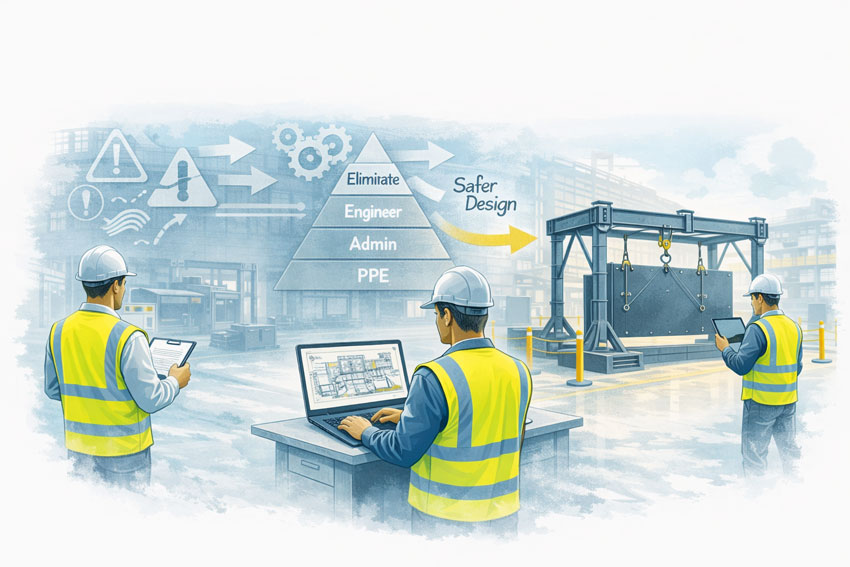
One of the most useful tools engineers have for learning from incidents is the hierarchy of controls.
From a learning perspective, incidents often highlight opportunities to move risk higher up the hierarchy:
Can the hazard be eliminated?
Can the task be re-designed so people are not exposed?
Can engineering controls prevent a single failure from becoming an injury?
Are procedures being used where physical controls could exist instead?
These are design questions, not legal ones.
Why This Matters for Engineering Practice
Studying incidents like this helps engineers:
Identify hidden assumptions in workshop layouts
Improve material handling design
Reduce reliance on administrative controls
Design processes that are more tolerant of variation
Prevent “normalised” risk from becoming invisible
Importantly, these lessons apply well beyond a single incident or company.
The Link to Broader Engineering Failures
The same learning approach is used when engineers study:
Structural failures
Mining incidents
Equipment damage
Tailings dam collapses
Process plant upsets
In each case, the goal is the same:
Understand how design decisions influence risk over time.
Not to judge — but to improve.
Our Position at Hamilton By Design
To be clear:
We do not comment on legal responsibility
We do not provide expert opinions on prosecutions
We do not participate in legal proceedings
Our interest is strictly:
Engineering learning
Design improvement
Risk reduction
Better outcomes for industry
We believe that open, professional learning from incidents strengthens engineering practice and improves safety across the sector.
Final Thought
Engineering advances when professionals are willing to say:
“What can we learn from this?”
Without blame. Without legal positioning. Without hindsight judgement.
Just better design, informed by real-world experience.
📩 Engineering-Led Design Matters
If you’re working in mining, fabrication, or heavy industry and want to reduce risk through better design decisions, Hamilton By Design supports engineering-led thinking that prioritises:
Hamilton By Design is committed to delivering high-quality engineering services that meet client requirements, applicable standards, and regulatory obligations.
Our Quality Policy ensures that all work is performed with technical integrity, accuracy, accountability, and consistency, supporting safe, reliable, and fit-for-purpose outcomes across all projects.
2. Our Commitment to Quality
Hamilton By Design is committed to:
Delivering engineering solutions that are accurate, defensible, and fit for purpose
Applying sound engineering judgement, not blind replication
Meeting or exceeding client, regulatory, and contractual requirements
Continually improving our systems, processes, and services
Maintaining professional integrity and accountability in all work undertaken
3. Scope
This policy applies to all activities undertaken by Hamilton By Design, including:
Mechanical engineering and design
Engineering-grade LiDAR and 3D laser scanning
3D CAD modelling and drafting
Structural and mechanical analysis
Fabrication-ready documentation
Engineering support for construction, mining, manufacturing, and industrial assets
The policy applies to employees, directors, contractors, and consultants working on behalf of Hamilton By Design.
4. Quality Objectives
Hamilton By Design achieves quality outcomes by:
Understanding client requirements and project objectives before commencing work
Defining scope, assumptions, and limitations clearly
Applying appropriate standards, codes, and best-practice engineering methods
Ensuring drawings, models, and deliverables are checked and reviewed
Delivering documentation suitable for construction, fabrication, and site use
Maintaining traceability of design decisions and changes
5. Engineering-Led Quality Approach
Quality at Hamilton By Design is underpinned by an engineering-led workflow, including:
Engineering-grade data capture suitable for downstream design and fabrication
Design intent based on function, safety, and service life—not just geometry
Integration of scanning, modelling, analysis, and documentation under single-source accountability
Professional judgement informed by experience, standards, and site conditions
6. Continuous Improvement
Hamilton By Design is committed to continuous improvement through:
Regular review of processes and project outcomes
Learning from lessons identified during project delivery
Incorporating client feedback
Updating systems to reflect industry best practice and technological advancements
Opportunities for improvement are actively encouraged and supported.
7. Compliance and Standards
Hamilton By Design will:
Comply with applicable Australian Standards, codes, and legislation
Align quality processes with ISO 9001 quality management principles
Meet client-specific quality and documentation requirements
Ensure records are maintained to demonstrate compliance and traceability
8. Roles and Responsibilities
Management
Management is responsible for:
Establishing and maintaining this Quality Policy
Providing resources to support quality outcomes
Promoting a culture of accountability and continuous improvement
Workers and Contractors
All workers are responsible for:
Performing work in accordance with agreed procedures and standards
Identifying and reporting quality issues or risks
Taking ownership of the quality of their work
9. Review of Policy
This Quality Policy will be reviewed periodically to ensure it remains current, effective, and aligned with:
Business objectives
Client expectations
Legislative and industry requirements
10. Quality Commitment Statement
Hamilton By Design is committed to delivering engineering services you can rely on—accurate, accountable, and fit for purpose—every time.
AS ISO 10816 & 20816 – Mechanical Vibration | Hamilton By Design
Mechanical vibration is one of the earliest indicators that rotating equipment is developing a fault. Standards such as AS ISO 10816 and AS ISO 20816 provide a consistent framework for measuring, evaluating, and managing vibration in industrial machinery.
At Hamilton By Design, we help clients apply these standards in a practical, engineering-led way by connecting vibration data with mechanical design, asset condition, and real-world site conditions.
What Are AS ISO 10816 and AS ISO 20816?
The AS ISO 10816 / 20816 standards define:
How mechanical vibration should be measured on machines
How vibration severity should be evaluated
What vibration levels are considered acceptable, marginal, or unacceptable
These standards are commonly applied to motors, pumps, gearboxes, compressors, fans, conveyors, and other rotating equipment where vibration provides an early warning of mechanical or structural issues.
Why Mechanical Vibration Standards Matter
Using vibration data without a recognised standard often leads to inconsistent interpretation and delayed action. Applying AS ISO 10816 / 20816 helps organisations to:
Identify mechanical problems early
Reduce unplanned downtime and breakdowns
Prevent secondary damage to bearings, shafts, and foundations
Improve overall equipment reliability
Support condition-based and predictive maintenance strategies
When vibration is assessed against an accepted standard, maintenance decisions become clearer and more defensible.
The Common Gap: Vibration Data Without Engineering Context
Many sites collect vibration data but struggle to connect it to:
As-installed geometry and alignment
Structural stiffness and support conditions
Design intent versus site reality
Maintenance and modification history
Vibration issues are often symptoms of broader mechanical or structural problems. Without engineering context, vibration data alone can be misleading.
This is where vibration assessment benefits from being connected to engineering-grade site information.
Hamilton By Design connects vibration standards with practical engineering outcomes through a coordinated service offering.
Engineering-Led Vibration Interpretation
We assess vibration results against AS ISO 10816 / 20816 using engineering judgement rather than relying solely on alarm limits. Machine type, operating duty, and site conditions are all considered.
Understanding the Physical Asset
By linking vibration data with mechanical layouts, drawings, and 3D models, we help identify whether vibration is driven by alignment issues, inadequate stiffness, foundation behaviour, or design constraints.
Where vibration levels indicate potential resonance, flexibility, or dynamic response issues, we support deeper investigation using structural and mechanical analysis tools.
AS ISO 10816 and AS ISO 20816 provide the benchmark for assessing mechanical vibration. Hamilton By Design provides the engineering connection that turns those benchmarks into practical action.
By linking vibration data with 3D scanning, mechanical design, and engineering analysis, vibration assessments become clearer, more accurate, and far more useful across the asset lifecycle.
Walkways, Conveyor Structures, Platforms and Gantries
Mechanical equipment steelwork is everywhere in industrial sites — conveyor structures, access walkways, maintenance platforms, gantries and support frames. Over time, these structures are modified, loaded differently, repaired, and upgraded. That’s where AS 3990 – Mechanical equipment – Steelwork becomes critical: it provides a framework for designing and verifying steelwork that supports mechanical equipment and associated access systems.
At Hamilton By Design, we help asset owners and project teams reduce risk by converting real as-built steelwork into engineering-grade digital models that can be checked, upgraded, and documented with confidence.
When AS 3990 Steelwork Becomes a Problem in the Real World
Steelwork rarely fails because it was “obviously wrong” on day one. The most common issues develop gradually due to changes in loading, upgrades, corrosion, or incomplete documentation.
Common triggers we see on site
New conveyor drives, chutes, skirts, guards, or pull-wire systems added after commissioning
Extra services added: cable trays, hose reels, water lines, pipework, and supports
Walkway changes for access, maintenance, or guarding upgrades
Localised damage from impact, vibration, or operational fatigue
Corrosion or section loss in wash-down areas, coastal environments, or chemical exposure zones
Legacy steelwork with missing drawings or unknown load assumptions
If you can’t prove what exists (accurately), it becomes difficult to prove compliance, fitness-for-purpose, or due diligence.
Key Engineering Risks with Walkways, Platforms, Gantries and Conveyor Structures
1) Design intent vs as-built reality
Many sites have steelwork that differs from drawings due to shutdown modifications or brownfield constraints. Small deviations in member size, connection detailing, or geometry can materially change structural performance.
2) Loads have changed — but the steelwork didn’t
A “simple” modification can add significant load: added services, heavier equipment, changed maintenance practices, or multiple personnel working in the same bay. These changes can push members or connections beyond the original assumptions.
3) Conveyor vibration and dynamic effects
Conveyor structures experience cyclic loading, start/stop effects, and vibration. Even if the structure looks acceptable, fatigue and resonance can become a long-term reliability problem — particularly around drive stations, transfer points, and cantilevered platforms.
4) Connection adequacy often governs
Field-welded brackets, modified gussets, bolt slip, corroded fasteners, and non-standard connection geometry can become the weak link. Connection performance is frequently the true limiting factor in older or heavily modified steelwork.
5) Access and safety interfaces
Walkways and platforms often sit at the intersection of multiple requirements: safe access geometry, handrails, toe-boards, gates, and guarding. If access steelwork was modified without a proper verification step, the risk becomes both structural and safety-related.
What “Verification” Looks Like in Practice
AS 3990 steelwork compliance is not just a box-tick. In a practical project environment, it means you can answer:
What steelwork exists right now (as-built)?
What loads and operational conditions apply today (not ten years ago)?
Are members and connections adequate under realistic scenarios?
What upgrades are required, and can they be fabricated to fit first time?
Can the asset owner document compliance and risk controls for governance?
Hamilton By Design supports this process by bringing LiDAR scanning + mechanical engineering + fabrication-ready outputs together under one roof.
How Hamilton By Design Helps (Our Typical Deliverables)
1) Engineering-grade 3D LiDAR scanning of steelwork
We capture accurate geometry of:
Walkways and access platforms
Conveyor stringers, trestles, and transfer towers
Gantries, monorails, and maintenance frames
Supports, bracing, ladders, stairs, and access interfaces
Standards and Compliance Context (How AS 3990 Fits In)
AS 3990 typically sits alongside a broader compliance context depending on the asset and scope. In many industrial environments, it may interact with standards and guidance such as:
AS 1657 (fixed platforms, walkways, stairways and ladders)
AS 4100 (steel structures)
AS/NZS 1170 (structural actions / loading)
AS 1755 (conveyor safety and associated interfaces)
(Note: Always confirm the current revision and applicability of standards for your site, scope, and jurisdiction.)
Why Digital As-Built Matters for AS 3990 Steelwork
A verified as-built model reduces:
Upgrade risk and fabrication rework
Shutdown time lost to unexpected clashes
Safety risks from undocumented modifications
Compliance gaps during audits and governance reviews
It also supports “fit-first-time” fabrication because designers, engineers, and fabricators are working from the same geometry — not assumptions.
Talk to an Engineer About Your AS 3990 Steelwork
If you’re planning an upgrade, responding to an audit, or unsure whether existing walkways, platforms, gantries or conveyor structures still meet their intended duty, we can help you quickly establish a reliable baseline.
Start with scanning, modelling, and engineering verification — and build from facts.
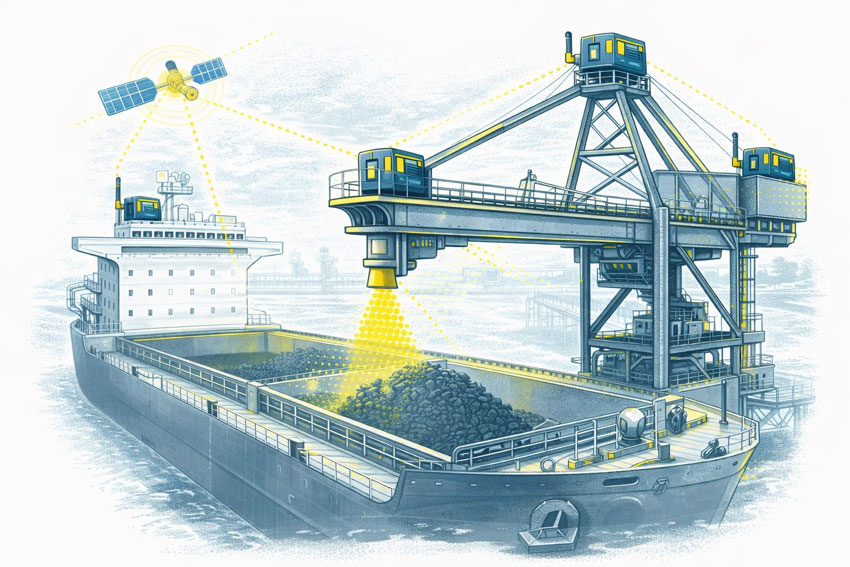
Mobile equipment for the continuous handling of bulk materials—such as stackers, reclaimers, and ship loaders—forms the backbone of Australia’s mining and export infrastructure. Many of these assets operate continuously in demanding environments, often well beyond their original design life.
Australian Standard AS 4324.1 provides essential guidance for the design and safe operation of this class of equipment. However, on many Australian mine sites, the practical application of the standard is misunderstood or only partially implemented, particularly when dealing with legacy machines and brownfield upgrades.
For asset owners and engineering managers, the challenge is rarely about greenfield compliance. It is about managing risk, extending asset life, and implementing upgrades without unplanned downtime.
Understanding AS 4324.1 in a Brownfield Context
AS 4324.1 addresses mobile equipment used for continuous bulk handling, including:
Yard stackers and reclaimers
Bucket wheel reclaimers
Slewing and travelling machines
Ship loaders at export terminals
While the standard establishes a strong baseline for design and safety, many operating machines:
Pre-date the current revision of the standard
Have undergone multiple undocumented modifications
Operate under loading conditions that differ from original assumptions
In these situations, engineering judgement is required. Compliance becomes less about box-ticking and more about demonstrating that risks are understood, controlled, and managed over the asset lifecycle.
Common Challenges on Operating Mine Sites
Across coal handling plants, iron ore operations, and port facilities, several recurring issues emerge:
1. Incomplete or Outdated As-Built Information
Accurate geometry, slew limits, clearances, and structural interfaces are often unknown. This creates risk during upgrades and maintenance planning.
2. Fatigue and Structural Degradation
Large mobile machines experience cyclic loading across slewing, luffing, and travel motions. Fatigue cracking and unexpected failures require ongoing monitoring, not one-off assessments.
3. Access, Guarding, and Maintenance Compliance
Requirements evolve over time. Older machines may not meet current expectations for access systems, guarding, or safe maintenance practices.
4. Downtime Sensitivity
Stackers, reclaimers, and ship loaders are often production-critical assets. Upgrade windows are limited, and poor fit-up or rework can have significant commercial consequences.
Technology Supporting Modern Risk Management
While AS 4324.1 remains the foundation, modern technology allows asset owners to manage risk more effectively—particularly on brownfield equipment.
GPS Positioning and Controlled Operating Zones
Where GPS positioning is enabled, defined operating zones can be established to:
Prevent interaction with stockpiles during rapid translation
Automatically reduce slew or travel speed in high-risk zones
Limit impact loads on critical components such as slew rings and fluffing gears
These systems are primarily productivity-driven, but they also reduce the likelihood of high-energy impacts that contribute to mechanical damage.
LiDAR Scanning as an Emerging Risk Layer
LiDAR scanning is not a replacement for traditional controls, and it is still evolving in this application. However, it can provide:
Accurate spatial awareness of surrounding structures
Verification of clearances and exclusion envelopes
A secondary risk-management layer supporting operator decision-making
When combined with engineering-led interpretation, LiDAR contributes to a layered risk approach rather than acting as a standalone safety system.
Condition Monitoring and Real Load Understanding
Accelerometers installed across a range of frequencies can deliver valuable insight into:
Actual operating loads
Dynamic response during slewing, reclaiming, and travel
Early indicators of fatigue-related issues
This data supports more informed maintenance decisions and provides evidence of how a machine is truly being used—often revealing load cases not considered in original designs.
Engineering-Led Compliance and Asset Life Extension
For brownfield assets, compliance with AS 4324.1 is best approached as a continuous engineering process, not a single milestone. This includes:
Accurate reality capture and digital models
Verification of clearances, interfaces, and structural geometry
Informed upgrade design that fits the first time
Risk-based decision-making supported by real operating data
This approach helps asset owners extend the life of critical machines while managing risk, performance, and availability.
How Hamilton By Design Supports Bulk Handling Assets
Hamilton By Design works with asset owners and engineering teams to support:
Brownfield upgrades of stackers, reclaimers, and ship loaders
Engineering-grade LiDAR scanning and as-built documentation
Fit-for-purpose mechanical design for modifications and life-extension
Independent engineering insight across OEM and site interfaces
Our focus is on engineering clarity, practical risk reduction, and minimising disruption to operations.
Talk to an Engineer About Your Asset
If you are planning a brownfield upgrade, life-extension, or risk review of mobile bulk-handling equipment, talk to an engineer at Hamilton By Design about how accurate data and practical engineering can support your next decision.
To provide the best experiences, we use technologies like cookies to store and/or access device information. Consenting to these technologies will allow us to process data such as browsing behaviour or unique IDs on this site. Not consenting or withdrawing consent, may adversely affect certain features and functions.
Functional
Always active
The technical storage or access is strictly necessary for the legitimate purpose of enabling the use of a specific service explicitly requested by the subscriber or user, or for the sole purpose of carrying out the transmission of a communication over an electronic communications network.
Preferences
The technical storage or access is necessary for the legitimate purpose of storing preferences that are not requested by the subscriber or user.
Statistics
The technical storage or access that is used exclusively for statistical purposes.The technical storage or access that is used exclusively for anonymous statistical purposes. Without a subpoena, voluntary compliance on the part of your Internet Service Provider, or additional records from a third party, information stored or retrieved for this purpose alone cannot usually be used to identify you.
Marketing
The technical storage or access is required to create user profiles to send advertising, or to track the user on a website or across several websites for similar marketing purposes.