3D Scanning Engineering in Orange

3D Scanning Engineering in Orange

Orange is one of Australiaโ€™s most distinctive regional cities. Set high on the Central Tablelands, it combines a cool-climate environment with major health, education, agriculture, infrastructure, and mining-services activity. Engineering in Orange is shaped by altitude, frost, diverse industries, and a mix of modern and legacy assetsโ€”making accuracy, coordination, and practical design essential.

Hamilton By Design supports projects in and around Orange by combining 3D LiDAR laser scanning, mechanical and structural engineering, 3D CAD modelling, FEA, and fabrication-ready drafting. Our approach focuses on capturing real site conditions and turning them into buildable, engineering-approved outcomes.

Engineering challenges in a high-altitude regional city

Unlike many inland centres, Orangeโ€™s elevation brings colder temperatures, frost, and greater thermal movement. At the same time, the city supports critical assets such as hospitals, utilities, agricultural processing facilities, and infrastructure that must remain operational.

Engineering teams commonly deal with:

  • Brownfield sites with assets added over decades
  • Incomplete or outdated drawings
  • Tight staging requirements around live facilities
  • A need for conservative, reliable design

In this environment, assumptions introduce risk. Accurate as-built data is the foundation of successful projects.

3D Laser Scanning for Orange projects

Hamilton By Design uses high-accuracy 3D Laser Scanning to capture the true as-built condition of sites across Orange and the Central Tablelands. Laser scanning records millions of precise measurements, creating a detailed digital record of buildings, plant, structures, and surrounding interfaces.

3D laser scanning is particularly valuable in Orange for:

  • Health, education, and public infrastructure upgrades
  • Industrial and agricultural processing facilities
  • Mining-support and utilities assets
  • Sites where drawings no longer reflect reality

Scanning is typically completed during short, controlled site visits, minimising disruption while delivering data that can be relied on throughout the project.

Turning scan data into accurate 3D models

Once scanning is complete, the data is processed and converted into detailed 3D CAD Modelling. These models represent what actually exists on siteโ€”not what historic documentation suggests.

For Orange projects, scan-based 3D modelling supports:

  • Mechanical upgrades and equipment replacements
  • Structural additions such as platforms, supports, and access ways
  • Integration of new assets into existing facilities
  • Long-term digital records for future maintenance and expansion

Accurate models reduce uncertainty and allow design decisions to be made early and with confidence.

Mechanical and structural engineering built on real conditions

Engineering in Orange often involves coordinating multiple disciplines across constrained or operational sites. Working from scan-derived models allows engineers to:

  • Understand existing load paths and constraints
  • Check clearances and access early in the design
  • Coordinate mechanical and structural elements in a single environment

This leads to designs that are practical, buildable, and aligned with how assets are actually usedโ€”particularly important in a climate-affected region.

FEA to support performance and compliance

Where performance, safety, or compliance is critical, Hamilton By Design applies FEA Capabilities to support engineering decisions.

Finite Element Analysis is commonly used to:

  • Check structural capacity under operational and environmental loads
  • Assess modifications to existing steel and concrete
  • Review fatigue, vibration, and deflection
  • Support engineering approval and sign-off

Using FEA on scan-based geometry provides confidence that designs will perform as intended in real operating conditions.

Easy-to-build fabrication drawings with engineering approval

Clear documentation is essential for efficient constructionโ€”particularly in regional locations where rework can be costly. Hamilton By Design produces fabrication-ready Drafting directly from coordinated 3D models.

Typical deliverables include:

  • General arrangement and detail drawings
  • Fabrication and installation drawings
  • Engineering-reviewed and approval-ready documentation

This focus on clarity and constructability helps fabricators and contractors build accurately the first time.

Reducing risk through digital engineering

By capturing site conditions once and completing the majority of engineering off site, projects in Orange benefit from:

  • Reduced site visits and travel costs
  • Improved safety outcomes
  • Better coordination before fabrication
  • Fewer surprises during installation

This approach aligns well with Orangeโ€™s role as a regional hub supporting diverse industries across central NSW.

Hamilton By Design logo displayed on a blue tilted rectangle with a grey gradient background

Supporting Orange with practical, buildable engineering

Orangeโ€™s strength lies in its balanceโ€”health, agriculture, infrastructure, mining services, and community all intersect here. Hamilton By Designโ€™s integrated scanning and engineering workflow supports this complexity by delivering accurate data, sound engineering judgement, and clear documentation.

3D Scanning Engineering in Orange is about turning real-world site conditions into clear, buildable engineering outcomes that support growth, reliability, and long-term performance across the region.


Our clients:

Name
Would you like us to arrange a phone consultation for you?
Address

3D Scanning Engineering in Traralgon

Engineer using 3D LiDAR laser scanning to capture a power plant in the Latrobe Valley for engineering and as-built documentation.

3D Scanning Engineering in Traralgon

Traralgon sits at the centre of the Latrobe Valley โ€” one of Australiaโ€™s most significant energy and industrial regions. For decades, the area supported large-scale power generation and heavy infrastructure. Today, Traralgon is at the frontline of energy transition, where legacy assets, decommissioning works, rehabilitation, and new infrastructure all coexist.

Engineering in this environment is rarely simple. Projects often involve ageing plant, undocumented modifications, strict safety requirements, and high public scrutiny. Getting the data right up front is critical.

Hamilton By Design supports Traralgon projects with engineering-led 3D LiDAR laser scanning, mechanical and structural engineering, 3D modelling, FEA, and easy-to-build fabrication drawings with engineering approval, helping asset owners and contractors reduce risk and move confidently from concept to construction.


Engineering in Traralgon: Legacy Assets and Future Infrastructure

Most engineering work in Traralgon is brownfield by default. Typical projects include:

  • Power station and energy-related infrastructure
  • Decommissioning and staged demolition works
  • Industrial plant upgrades and repurposing
  • Transmission, substations, and supporting structures

Many assets were designed to older standards and modified repeatedly over decades. Accurate as-built information, conservative engineering judgement, and clear documentation are essential to safely manage change.


Engineer performing 3D laser scanning of an industrial power plant in the Latrobe Valley.

3D Laser Scanning for Traralgon Sites

High-accuracy 3D LiDAR laser scanning provides the foundation for safe and efficient engineering in Traralgon.

Hamilton By Design captures precise as-built data for:

  • Large industrial plant and energy infrastructure
  • Structural steel, conveyors, platforms, and access ways
  • Decommissioning and rehabilitation sites
  • Assets with limited, outdated, or unreliable drawings

3D scanning records the true as-built condition โ€” including deformation, misalignment, corrosion loss, and undocumented changes โ€” without disrupting live operations.

This enables:

  • Reduced assumptions in high-risk environments
  • Better planning for shutdowns and staged works
  • Safer decommissioning and modification strategies
  • Lower fabrication and installation risk

Learn more about our scanning services here:
3D Laser Scanning


3D Modelling from Real As-Built Data

From the point cloud, Hamilton By Design develops accurate 3D CAD models that reflect what actually exists on site โ€” not what legacy drawings suggest.

Our 3D modelling services support:

  • Brownfield upgrades and plant modifications
  • Decommissioning and dismantling planning
  • Clash detection between new and existing systems
  • Modular design and construction sequencing
  • Digital asset records for future redevelopment

In Traralgonโ€™s complex industrial environment, modelling from real data significantly reduces safety, cost, and schedule risk.

Explore our modelling capability:
3D CAD Modelling


FEA for Verification of Existing and Modified Assets

Traralgon engineering frequently involves verifying old assets under new conditions. Finite Element Analysis (FEA) plays a critical role in understanding real structural behaviour.

Hamilton By Design applies FEA to:

  • Assess structural capacity and load paths
  • Check deflection, fatigue, and buckling
  • Verify temporary and permanent works
  • Support strengthening, reuse, or staged demolition decisions

By analysing as-built geometry, FEA provides more reliable insight โ€” essential when working with large, safety-critical infrastructure.

Learn more about our analysis services:
FEA Capabilities


Easy-to-Build Fabrication Drawings with Engineering Approval

Clear, practical documentation is vital for Traralgon projects, where fabrication, installation, and demolition often occur in high-risk environments.

Hamilton By Design delivers easy-to-build fabrication and installation drawings, including:

  • General arrangement drawings
  • Fabrication and workshop details
  • Installation, lifting, and staging layouts
  • As-built documentation

Drawings are produced directly from scanned data and validated 3D models and can be issued with engineering approval, giving contractors confidence that what is built or modified will fit, function, and comply.

View our drafting services here:
Drafting Services


Hamilton By Design logo displayed on a blue tilted rectangle with a grey gradient background

Why Hamilton By Design in Traralgon?

Hamilton By Design provides a single, engineering-led digital workflow โ€” from site capture through to modelling, analysis, and construction documentation.

For Traralgon clients, this means:

  • Reduced risk on complex brownfield and transition sites
  • Better decision-making before shutdowns or demolition works
  • Designs grounded in real site conditions
  • Fabrication-ready drawings backed by engineering sign-off

Whether youโ€™re modifying legacy energy infrastructure, planning decommissioning works, or developing the next generation of industrial assets, Hamilton By Design delivers accurate, practical, and build-ready engineering solutions tailored to Traralgonโ€™s unique challenges.

Our clients


Name
Would you like us to arrange a phone consultation for you?
Address

3D Scanning Engineering Simplified in Kalgoorlieโ€“Boulder

3D Scanning Engineering Simplified in Kalgoorlieโ€“Boulder

Kalgoorlieโ€“Boulder is unlike any other city in Australia. Built on one of the richest goldfields on Earth, it remains a powerhouse of heavy industry, large-scale mining, metallurgical processing, mechanical maintenance and fabrication. With vast open-cut mines, underground networks, processing plants, workshops, rail infrastructure and expanding industrial precincts, the region demands precision, resilience and engineering that can stand up to harsh environmental conditions.

Hamilton By Design supports these exact needs with 3D LiDAR laser scanning, advanced engineering services, accurate 3D CAD modelling, and fabrication-ready drafting. For brownfield upgrades, shutdown planning, structural assessment or new installations, we simplify engineering by delivering millimetre-accurate digital data and industry-grade design documentation.


Why Kalgoorlieโ€“Boulder Is Unique for Engineering Projects

Kalgoorlieโ€“Boulder is shaped by extreme conditions and complex industrial systems. Its uniqueness comes from:

1. One of the world’s largest open-cut mines

The Super Pit and surrounding operations involve large-scale mechanical systems, crushers, conveyors, structural platforms, heavy mobile equipment and intricate processing facilities. These environments change frequently as operations evolve, making as-built accuracy critical.

2. Harsh, abrasive and high-wear environments

Dust, vibration, heat and heavy loading accelerate wear on structural steel, machinery and plant systems. Engineering assessments and redesigns must factor in high fatigue cycles and abrasive service.

3. A dense concentration of fabrication & maintenance workshops

Kalgoorlieโ€“Boulder supports workshops specialising in mill relining, crusher repairs, structural fabrication, heavy-haul equipment maintenance and mining components. These businesses rely on accurate geometry for reverse-engineering and fit-out of parts.

4. Constant brownfield upgrades

Processing plants, conveyors, crushers, pump stations and underground infrastructure undergo frequent modificationsโ€”making 3D scanning and digital twins essential for reducing shutdown time and project risk.

5. Remote-region reliability demands

Any mistake in fabrication or installation results in delays, lost production and major cost impacts. Thatโ€™s why engineering certainty is paramount.


How Hamilton By Design Supports Kalgoorlieโ€“Boulder Industries

We bring an engineer-led, accuracy-driven approach to projects across gold processing plants, mining workshops, underground facilities, industrial yards and remote infrastructure.


High-Accuracy 3D LiDAR Laser Scanning

Our first step is capturing your site or equipment with millimetre-level precision using 3D laser scanning. This allows your team to design, fabricate and install with full confidence. Laser scanning is perfect for crushers, platforms, conveyor systems, tanks, mechanical rooms, structural steel and plant upgrades.

Learn more here:
3D Laser Scanning

Benefits for Kalgoorlieโ€“Boulder include:

  • Reduced downtime during shutdowns
  • No need for repeat site visits
  • Accurate tie-in points for brownfield modifications
  • Clear visibility of alignment issues, deflections and wear
  • Safe data capture in challenging environments

Intelligent 3D CAD Modelling for Mining & Industrial Assets

Once scanned, we convert the point cloud into accurate 3D CAD models suitable for engineering analysis, fabrication and layout planning.

Learn more here:
3D CAD Modelling

This enables:

  • Clash detection before fabrication
  • Reverse-engineering of components
  • Visualisation of complex plant areas
  • Better coordination between engineers, fabricators & installers

Perfect for rebuilds, relocations, shutdown works and equipment optimisation.


Engineering & FEA for Mining-Grade Demands

Kalgoorlieโ€“Boulderโ€™s high-load and high-fatigue environments require engineering that goes beyond standard design. Hamilton By Design provides mechanical and structural assessment, optimisation, and FEA-based verification.

Learn more here:
FEA Capabilities

Our analysis supports:

  • Structural steelwork validation
  • Chute, tank and vessel assessments
  • Conveyor and machinery load cases
  • Fatigue and vibration studies
  • Repair strategy development

This ensures your equipment remains safe, compliant and production-ready.


Fabrication-Ready Drafting for Workshops & Site Installations

From detailed drawings to GA layouts and isometrics, we deliver drafting packages suited for mining workshops, fabrication yards and onsite installation teams.

Learn more here:
Drafting Services

We provide:

  • Workshop drawings
  • Structural detailing
  • Mechanical layouts
  • Piping/isometric drawings
  • As-built drawing updates

Clear documentation means fewer fabrication errors, less rework and a smoother installation process.


Real-World Use Cases in Kalgoorlieโ€“Boulder

Hamilton By Design supports projects such as:

  • Plant expansion and shutdown upgrades
  • Crusher and conveyor rebuilds
  • Structural assessments and remediations
  • Mill, tank and chute upgrades
  • Workshop fit-outs and equipment design
  • Remote infrastructure and facility upgrades

With accurate scanning, engineering certainty and integrated modelling, your team can make confident decisions at every stage.


Hamilton By Design logo displayed on a blue tilted rectangle with a grey gradient background

Why Hamilton By Design Is a Strong Fit for Kalgoorlieโ€“Boulder

  • Engineer-led scanning ensures precision and technical oversight
  • Mining-grade modelling and engineering
  • Reduced rework, faster fabrication and safer installations
  • End-to-end workflow from scan โ†’ model โ†’ engineer โ†’ draft
  • Ideal for remote or high-complexity environments

Kalgoorlieโ€“Boulder projects demand reliability, clarity and accuracy โ€” and thatโ€™s exactly what we deliver.

Our Clients

Name
Would you like us to arrange a phone consultation for you?
Address

Mechanical Plant Optimisation

Mechanical Plant Optimisation: Boosting Throughput, Reliability and Safety Across Australia

Industrial plants are under more pressure than ever to deliver higher output, reduce downtime and operate safely. Ageing equipment, inconsistent maintenance, and brownfield constraints often limit performance โ€” but with the right engineering approach, even long-running plants can achieve major efficiency gains.

At Hamilton By Design, we specialise in mechanical plant optimisation using a powerful combination of engineering expertise, high-accuracy LiDAR scanning, precise 3D modelling, and practical redesign strategies that deliver measurable improvements.

If your goal is higher throughput, fewer breakdowns and safer shutdowns, this guide explains how mechanical optimisation transforms plant performance.


Why Mechanical Plant Optimisation Is Essential

Most processing plants โ€” from CHPPs and quarries to manufacturing and power stations โ€” suffer from the same long-term issues:

  • Reduced throughput
  • Conveyor misalignment
  • Flow bottlenecks in chutes and transfer points
  • Vibration, cracking and structural fatigue
  • Outdated drawings and unknown modifications
  • Premature wear and high maintenance costs
  • Shutdown overruns due to poor fit-up

Optimisation tackles these issues using real engineering data, not assumptions.


Step 1: LiDAR Scanning to Capture True As-Built Conditions

As equipment ages, it moves, twists and wears in ways that drawings rarely capture. Our FARO laser scanners map a complete digital twin of your plant with ยฑ1โ€“2 mm accuracy, giving engineers:

  • Full geometry of structural frames
  • Wear patterns inside chutes
  • Deflection in platforms, conveyor trusses and supports
  • Misalignment in pipes, pulleys and mechanical drives
  • Clash risks for future upgrades

This becomes the foundation of all optimisation work โ€” ensuring upgrades fit first time.


Step 2: 3D Modelling & Engineering Redesign

Hamilton By Design converts point-cloud data into SolidWorks models to identify optimisation opportunities such as:

  • Reprofiling chutes for smoother flow
  • Strengthening or realigning structural members
  • Repositioning pumps or motors
  • Correcting conveyor and drive alignment
  • Redesigning access platforms for maintenance
  • Improving liner selection and service life

Every model is fabrication-ready, eliminating costly rework during shutdowns.


Step 3: Material Flow & Conveyor Performance Improvement

Flow constraints are one of the biggest sources of lost production. Through engineering review, modelling and experience, we address:

  • Impact zones causing excessive wear
  • Restrictive chute geometry
  • Poorly performing transfer points
  • Belt-tracking issues
  • Flow blockages
  • Inefficient material transitions

These improvements often deliver immediate gains in throughput and reliability.


Step 4: Mechanical Integrity & Reliability Assessments

We also perform condition assessments to understand the root causes of downtime:

  • Vibration analysis
  • Cracking and corrosion detection
  • Bearing, gearbox and pulley assessment
  • Thermal/overload risks
  • Misalignment and load distribution issues

This supports predictive maintenance and informed upgrade planning.


Step 5: Shutdown Planning & Upgrade Execution

By combining scanning, modelling and mechanical design, we ensure that every upgrade:

  • Fits perfectly into existing brownfield spaces
  • Reduces time on tools
  • Eliminates site modifications
  • Improves safety during installation
  • Delivers predictable shutdown timelines

Clients commonly see ROI within the first shutdown cycle.


Benefits of Mechanical Plant Optimisation

When optimisation is done properly, plants experience:

โœ” Measurable throughput increases

โœ” Longer equipment life

โœ” Reduced wear and maintenance costs

โœ” Safer operation and shutdown execution

โœ” Accurate documentation for future projects

โœ” Extended reliability of mechanical systems

With the right engineering support, even ageing plants can operate like new.


Serving Clients Across Australia

Hamilton By Design supports mechanical plant optimisation projects across:
Sydney, Newcastle, Hunter Valley, Central Coast, Bowen Basin, Surat Basin, Pilbara, Perth, Adelaide, Melbourne and regional Australia.

We work across mining, CHPPs, quarries, ports, power stations, manufacturing and heavy industrial sites.


Hamilton By Design logo displayed on a blue tilted rectangle with a grey gradient background

Ready to Optimise Your Plant?

If you want higher throughput, better reliability and safer operation, mechanical plant optimisation is the smartest investment you can make.

Or reach out directly for a project discussion.

Hamilton By Design โ€” Engineering Certainty for Complex Plants.


Name
Address
You would like to:

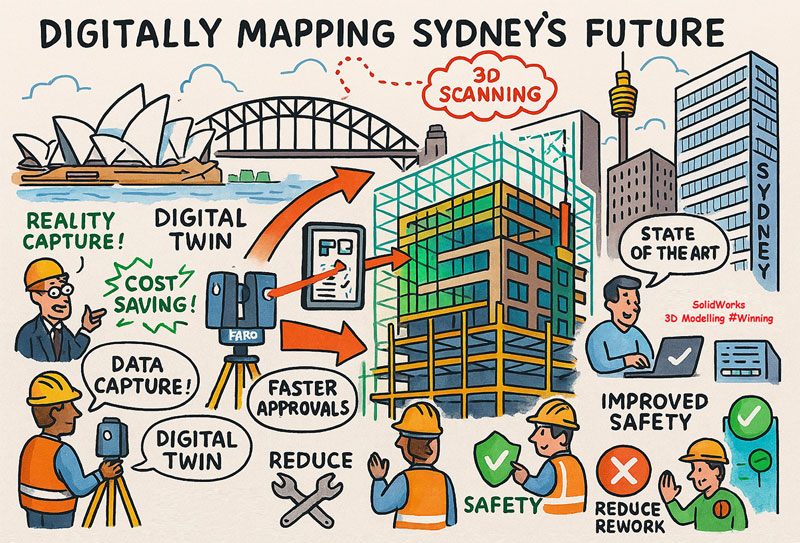
Building Sydney Smarter: How 3D Scanning and LiDAR Are Transforming Construction Accuracy

A New Era of Construction Accuracy in Sydney

Sydneyโ€™s construction industry is booming โ€” from commercial towers and infrastructure upgrades to industrial developments and complex refurbishments. But as sites become more congested and designs more complex, achieving perfect alignment between fabricated and installed components has never been more challenging.

Thatโ€™s where 3D scanning and LiDAR technology come in. At Hamilton By Design, we provide high-precision digital capture and 3D modelling services that ensure every element of your construction project fits seamlessly together, saving time, cost, and effort onsite.


Capturing the Real Site with LiDAR Scanning

Using LiDAR (Light Detection and Ranging) scanners, we capture millions of laser measurements per second to create an exact 3D digital record โ€” known as a point cloud โ€” of your construction site or structure.

This means we can document existing conditions, monitor progress, and verify installations with millimetre-level precision. For Sydney builders, engineers, and contractors, that data eliminates the guesswork and drastically reduces costly clashes and rework later on.


From Point Cloud to 3D Model

Once the LiDAR data is captured, itโ€™s processed into detailed 3D CAD and BIM models compatible with leading design software such as Revit, AutoCAD, SolidWorks, and Navisworks.

These accurate models allow design teams to:

  • Validate and update as-built conditions before fabrication
  • Detect clashes and misalignments before installation
  • Plan modifications and extensions with confidence
  • Coordinate between mechanical, structural, and architectural disciplines

By working from a true digital twin of your Sydney site, you can be sure every part โ€” from prefabricated frames to pipe runs โ€” will fit exactly where it should.


Why Sydney Construction Projects Are Turning to 3D Scanning

  • Reduced Rework: Identify design and fabrication issues before they reach site.
  • Improved Safety: Capture high or restricted areas without scaffolding or shutdowns.
  • Shorter Installation Times: Minimise downtime and delays during fit-up.
  • Precise Documentation: Maintain accurate records for QA and handover.
  • Better Collaboration: Integrate real-world data into your BIM environment.

From commercial fit-outs to infrastructure projects across Greater Sydney, 3D scanning provides a single source of truth for every stakeholder.


Typical Sydney Projects Using LiDAR and 3D Modelling

Hamilton By Design supports a range of construction and engineering clients, including:

  • Commercial and residential developments in the CBD and inner suburbs
  • Industrial plant upgrades across Western Sydney
  • Transport and infrastructure projects under NSW Government programs
  • Refurbishment and brownfield works requiring detailed as-built verification

Each project benefits from faster delivery, greater precision, and stronger communication between designers, builders, and clients.


Partner with Hamilton By Design

If youโ€™re working on a Sydney construction or infrastructure project and need accurate 3D site data, as-built modelling, or fit-up verification, Hamilton By Design can help.

Our experienced mechanical and design specialists combine field scanning with advanced 3D modelling to deliver practical, reliable results that make construction smoother โ€” and smarter.

Mechanical Engineers in Sydney

Mechanical Engineering | Structural Engineering

Hamilton By Design logo displayed on a blue tilted rectangle with a grey gradient background

3D Scanning Sydney

Engineering Services

get in touch

sales@hamiltonbydesign.com.au

Based in Sydney โ€” working across NSW and Australia
info@hamiltonbydesign.com.au
www.hamiltonbydesign.com.au

Capture. Model. Verify. Deliver โ€” precision that builds Sydney better.

Our Clients:

Name
Would you like us to arrange a phone consultation for you?
Address

Bridging Reality and Design: How 3D Scanning + 3D Modelling Supercharge Mining Process Plants

In mining and mineral processing environments, small mis-fits, outdated drawings, or inaccurate assumptions can translate into shutdowns, costly rework, or worse, safety incidents. For PMs, superintendents, engineering managers and plants operating under heavy uptime and safety constraints, combining 3D scanning and 3D modelling isnโ€™t just โ€œnice to haveโ€ โ€” itโ€™s becoming essential. At Hamilton By Design, weโ€™ve leveraged this combination to deliver greater predictability, lower cost, and improved safety across multiple projects.


What are 3D Scanning and 3D Modelling?

  • 3D Scanning (via LiDAR, laser, terrestrial/mobile scanners): captures the existing geometry of structures, equipment, piping, chutes, supports, tanks, etc., as a dense point cloud. Creates a digital โ€œreality captureโ€ of the plant in its current (often messy) state.
  • 3D Modelling: turning that data (point clouds, mesh) into clean, usable engineering-geometry โ€” CAD models, as-built / retrofit layouts, clash-detection, wear mapping, digital twins, etc.

The power comes when you integrate the two โ€” when the reality captured in scan form feeds directly into your modelling/design workflows rather than being a separate survey activity thatโ€™s then โ€œinterpretedโ€ or โ€œassumed.โ€


Why Combine Scanning + Modelling? Key Benefits

Here are the main advantages you get when you deploy both in an integrated workflow:

BenefitWhat it Means for PMs / Engineering / Plant OpsExamples / Impacts
Accuracy & Reality VerificationVerify whatโ€™s actually in the plant vs what drawings say. Identify deformations, misalignments, wear, obstructions, or changes that werenโ€™t captured in paper drawings.Mill liner wear profiles; chute/hopper buildup; misaligned conveyors or supports discovered post-scan.
Reduced Risk, Safer AccessScanning can be done with limited or no shutdown, and from safer vantage points. Less need for personnel to enter hazardous or confined spaces.Scanning inside crushers, under conveyors, or at height without scaffolding.
Time & Cost SavingsFaster surveying; fewer repeat field trips; less rework; fewer surprises during shutdowns or retrofit work.Scan once, model many; clashes found in model instead of in the field; pre-fabrication of replacement parts.
Better Shutdown / Retrofit PlanningUse accurate as-built models so new equipment fits, interferences are caught, installation time is optimized.New pipelines routed without conflict; steelwork/supports prefabricated; shutdown windows shortened.
Maintenance & Asset Lifecycle ManagementScan history becomes a baseline for monitoring wear or deformation. Enables predictive maintenance rather than reactive.Comparing scans over time to track wear; scheduling relining of chutes; monitoring structural integrity.
Improved Decision Making & VisualisationEngineers, superintendents, planners can visualise the plant as it is โ€” space constraints, access routes, clearances โ€” before making decisions.Clash-detection between new and existing frames; planning maintenance access; safety audits.
Digital Twin / Integration for Future-Ready PlantOnce you have accurate geometric models you can integrate with IoT, process data, simulation tools, condition monitoring etc.Digital twins that simulate flow, energy use, wear; using scan data to feed CFD or FEA; feeding into operational dashboards.

Challenges & How to Overcome Them

Of course, there are pitfalls. Ensuring scanning + modelling delivers value requires attention to:

  • Planning the scanning campaign (scan positions, control points, resolution) to avoid shadow zones or missing data.
  • Choosing hardware and equipment that can operate under plant conditions (dust, vibration, temperature, restricted access).
  • Processing & registration of point clouds, managing the large data sets, and ensuring clean, usable models.
  • Ensuring modelling workflow aligns with engineering design tools (CAD systems, formats, tolerances) so that the scan data is usable without excessive cleanup.
  • Maintaining the model: when plant layouts or equipment change, keeping the scan or model up to date so your decisions are based on recent reality.

At Hamilton By Design we emphasise these aspects; our scan-to-CAD workflows are built to align with plant engineering needs, and we help clients plan and manage the full lifecycle.


Real World Applications in Mining & Process Plants

Hereโ€™s how combined scanning + modelling is applied (and what you might look for in your own facility):

  • Wear & Relining: scanning mill, crusher liners, chutes or hoppers to model wear profiles; predict failures; design replacement parts that fit exactly.
  • Retrofits & Expansions: mapping existing steel, pipe racks, conveyors, etc., creating accurate โ€œas builtโ€ model, checking for clashes, optimizing layouts, prefabricating supports.
  • Stockpile / Volumetric Monitoring: using scans or LiDAR to measure stockpile volumes for planning and reporting; integrating with models to monitor material movement and flow.
  • Safety & Clearance Checking: verifying that walkways, egress paths, platforms have maintained their clearances; assess structural changes; check for deformation or damage.
  • Shutdown Planning: using accurate 3D models to plan the scope, access, scaffold/frame erection, pipe removal etc., so shutdown time is minimised.

Why Choose Hamilton By Design

To get full value from the scan + model combination, you need more than just โ€œweโ€™ll scan itโ€ or โ€œweโ€™ll make a modelโ€ โ€” you need a partner who understands both the field realities and the engineering rigour. Here’s where Hamilton By Design excels:

  • Strong engineering experience in mining & processing plant settings, so we know what level of detail, what tolerances, and what access constraints matter.
  • Proven tools & workflows: from LiDAR / laser scanner work that captures site conditions even under harsh conditions, to solid CAD modelling/reporting that aligns with your fabrication/installation requirements.
  • Scan-to-CAD workflows: not just raw point clouds, but models that feed directly into design, maintenance, procurement and operations.
  • Focus on accuracy, safety, and reduced downtime: ensuring that field work, design, installation etc., are as efficient and risk-averse as possible.
  • Use of modern digital techniques (digital twins, clash detection etc.) so that data isnโ€™t just stored, but actively used to drive improvements.

Practical Steps to Get Started / Best Practice Tips

If youโ€™re managing a plant or engineering project, here are some steps to adopt scanning + modelling optimally:

  1. Define Clear Objectives: What do you want from this scan + model? Wear profiles, retrofit, layout changes, safety audit etc.
  2. Survey Planning: Decide scan positions, control points, resolution (density) based on the objectives and site constraints. Consider access, safety, shutdown windows.
  3. Use Appropriate Hardware: Choose scanners suited to environment (dust, heat), also ensure regulatory and IP protection etc.
  4. Data Processing & Modelling Tools: Have the capacity/software to register, clean, mesh or extract CAD geometry.
  5. Integrate into Existing Engineering Processes: Ensure the outputs are compatible with your CAD standards, procurement, installation etc.
  6. Iterate & Maintain: Frequent scans over time to track changes; update models when plant changes; feed maintenance, design and operations with new data.

Conclusion

In mining process plants, time, safety, and certainty matter. By combining 3D scanning with sound 3D modelling you donโ€™t just get a snapshot of your plant โ€” you gain a powerful toolset to reduce downtime, avoid rework, improve safety, and enhance decision-making.

If youโ€™re responsible for uptime, capital works, maintenance or process improvements, this integration can reshape how you plan, maintain, and operate. At Hamilton By Design, weโ€™re helping clients in Australia harness this power โ€” turning reality into design confidence, and giving stakeholders peace of mind that the layout, equipment, and safety are aligned not to yesterdayโ€™s drawings but to todayโ€™s reality.

Name
Would you like us to arrange a phone consultation for you?
Address